Results by title
17 books match the query 'Authors, Russian'

A Time to Gather Stones
Vladimir Soloukhin, Translated from the Russian and with an Introduction by Valerie Z. Nollan
Northwestern University Press, 1993
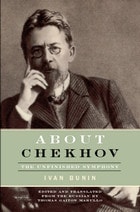
About Chekhov
The Unfinished SymphonyIvan Bunin
Northwestern University Press, 2007
In About Chekhov Ivan Bunin sought to free the writer from limiting political, social, and aesthetic assessments of his life and work, and to present both in a more genuine, insightful, and personal way. Editor and translator Thomas Gaiton Marullo subtitles About Chekhov "The Unfinished Symphony," because although Bunin did not complete the work before his death in 1953, he nonetheless fashioned his memoir as a moving orchestral work on the writers' existence and art. . . . "Even in its unfinished state, About Chekhov stands not only as a stirring testament of one writer's respect and affection for another, but also as a living memorial to two highly creative artists." Bunin draws on his intimate knowledge of Chekhov to depict the writer at work, in love, and in relation with such writers as Tolstoy and Gorky. Through anecdotes and observations, spirited exchanges and reflections, this memoir draws a unique portrait that plumbs the depths and complexities of two of Russia's greatest writers.
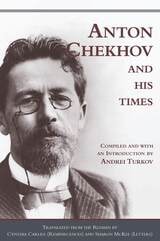
Anton Chekhov and his Times
Andrei Turkov
University of Arkansas Press, 1995
This anthology comprises reminiscences by a number of Anton Pavlovich Chekhov’s contemporaries, including the artist Konstantin Korovin, the writer Maxim Gorky, and Chekhov’s wife, Olga Knipper-Chekhova, and numerous letters written by Chekhov to his fellow writers and artists, family, publishers, and others.
Now available for the first time in English in America, these sixty-eight letters and ten essay-length reminiscences trace the development of Chekhov’s personality and talent, opening a window into the life and times of one of the world’s greatest short-story writers and playwrights. These perspectives on his family life and marriage, his early works, the stage productions of his plays, his literary successes, and the philosophies behind his writing create a rich biography of Chekhov that will reward writers, scholars, and all lovers of literature.
Anton Chekhov's Life and Thought
Selected Letters and CommentariesAnton Chekhov
Northwestern University Press, 1996
Conversations in Exile
Russian Writers AbroadJohn Glad, ed.
Duke University Press, 1993
Glad's introduction situates the three distinct waves of westward emigration in their historical and political framework. Organized by genre, the book begins with discussions with the older generation of writers and then moves on to more recent arrivals: the makers of fantasy and humor, the aesthetes, the moralists, and the realists. Each voice is compelling for its invaluable testimony--some reveal startling insights into the persecution of dissidents under Soviet rule while others address the relationship between creativity, writing, and conditions of exile. Taken together these interviews reveal the range of modern Russian writing and document the personalities and positions that have made Russian writers in emigration so diverse, experimental, and controversial.
The Writers: Vasily Aksyonov, Joseph Brodsky, Igor Chinnov, Natalya Goranevskaya, Frifrikh Gorensetin, Roman Goul, Yury Ivask, Boris Khazanov, Edward Liminov, Vladimir Makisimov, Andrei Siniavsky and Maria Rozanova, Sasha Sokolov, Vladimir Voinovich, Aleksandr Zinoviev
Excerpt
John Glad: You're a Russian poet but an American essayist. Does that bring on any measure of split personality? Do you think you are becoming less and less Russian?
Joseph Brodsky (recipient of 1987 Nobel Prize for Literature): That's not for me to say. As far as I'm concerned, in my inner self, inside, it feels quite natural. I think being a Russian poet and an American essayist is an ideal situation. It's all a matter of whether you have (a) the heart and (b) the brains to be able to do both. Sometimes I think I do. Sometimes I think I don't. Sometimes I think that one interferes with the other.
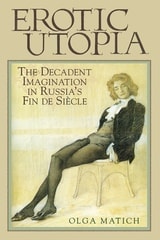
Erotic Utopia
The Decadent Imagination in Russia's Fin de SiecleOlga Matich
University of Wisconsin Press, 2007
The first generation of Russian modernists experienced a profound sense of anxiety resulting from the belief that they were living in an age of decline. What made them unique was their utopian prescription for overcoming the inevitability of decline and death both by metaphysical and physical means. They intertwined their mystical erotic discourse with European degeneration theory and its obsession with the destabilization of gender. In Erotic Utopia, Olga Matich suggests that same-sex desire underlay their most radical utopian proposal of abolishing the traditional procreative family in favor of erotically induced abstinence.
“Offers a fresh perspective and a wealth of new information on early Russian modernism. . . . It is required reading for anyone interested in fin-de-siècle Russia and in the history of sexuality in general.”—Bernice Glatzer Rosenthal, Slavic and East European Journal
“Thoroughly entertaining.”—Avril Pyman, Slavic Review

Gogol
V. V. Gippius
Duke University Press, 1989
How Russia Learned to Write
Literature and the Imperial Table of RanksIrina Reyfman
University of Wisconsin Press, 2021
Irina Reyfman illuminates the surprisingly diverse effects of the Table of Ranks on writers, their work, and literary culture in Russia. From Sumarokov and Derzhavin in the eighteenth century through Pushkin, Gogol, Dostoevsky, and poets serving in the military in the nineteenth, state service affected the self-images of writers and the themes of their creative output. Reyfman also notes its effects on Russia’s atypical course in the professionalization and social status of literary work.
No Day without a Line
From Notebooks by Yury OleshaYury Olesha
Northwestern University Press, 1998
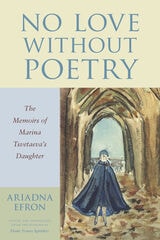
No Love Without Poetry
The Memoirs of Marina Tsvetaeva's DaughterAriadna Efron
Northwestern University Press, 2009
The memoirs of Ariadna Efron provide an intimate and indispensable perspective on the poet Marina Tsvetaeva’s life and work, told from the point of view of her daughter. This wrenching story about the difficulty of living with genius charts Efron’s relationship with her parents as they navigate art and exile.
Efron’s rapport with her mother, already intense, became strained under the hardships imposed by early twentieth century Russian political upheaval. Efron recounts the family’s travels from Moscow to Germany, to Czechoslovakia, and finally to France, where, against her mother’s advice, Efron decided to return to Russia. Diane Nemec Ignashev draws on Efron’s short stories and her mother’s notebooks to supplement the original memoirs. Haunting and poignant, No Love without Poetry completes extant historical records on Tsvetaeva—and showcases Efron as a literary force in her own right.
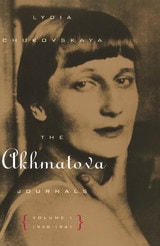
The Akhmatova Journals
Volume 1: 1938-1941Lydia Chukovskaya
Northwestern University Press, 2002
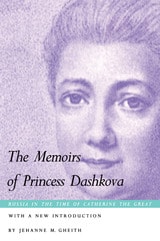
The Memoirs of Princess Dashkova
Ekaterina Romanovna Dashkova
Duke University Press, 1995
Originally written in French, first published in English, and long out of print, Dashkova’s Memoirs tell the story of a woman who at age eighteen played an important role in the coup that brought Catherine the Great to the throne. The relationship between these two women, often tense, is a central theme throughout this story. Dashkova, occupying the highly unusual position of both stateswoman and mother, also reveals her own path between the demands and limitations of the "private" and "public" spheres of her society. She provides a view of the expectations of Russian aristocratic women, the possibilities available to them, and the ways in which gender roles were conceived in the eighteenth century.
With a new introduction by Jehanne M Gheith, The Memoirs of Princess Dashkova will renew interest in the life of a fascinating woman for students of Russian history, women’s studies, and eighteenth-century studies. It will be a significant text for those engaged in the cross-cultural study of the traditions of women’s autobiographical writing.
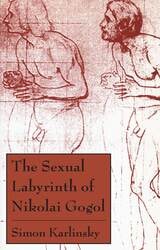
The Sexual Labyrinth of Nikolai Gogol
Simon Karlinsky
University of Chicago Press, 1992
"A brilliant new biography that will long be prized for its illuminating psychological insights into Gogol's actions, its informative readings of his fiction and drama, and its own stylistic grace and vivacity."—Edmund White, Washington Post Book World
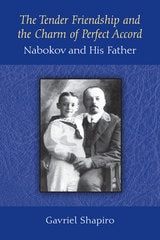
The Tender Friendship and the Charm of Perfect Accord
Nabokov and His FatherGavriel Shapiro
University of Michigan Press, 2014
Vladimir Nabokov (1899–1977), a writer of world renown, grew up in a culturally refined family with diverse interests. Nabokov’s father, Vladimir Dmitrievich (1870–1922), was a distinguished jurist and statesman at the turn of the twentieth century. He was also a great connoisseur and aficionado of literature, painting, theater, and music as well as a passionate butterfly collector, keen chess player, and avid athlete. This book, the first of its kind, examines Vladimir Nabokov’s life and works as impacted by his distinguished father. It demonstrates that V. D. Nabokov exerted the most fundamental influence on his son, making this examination pivotal to understanding the writer’s personality and his world perception, as well as his literary, scholarly, and athletic accomplishments. The book contains never heretofore published archival materials. It is appended with rare articles by Nabokov and his father and is accompanied by old photographs. In addition, the book constitutes a survey of sorts of Russian civilization at the turn of the twentieth century by providing a partial view of the multifaceted picture of Imperial Russia in its twilight hours. The book illumines the historical background, political struggle, juridical battles, and literary and artistic life as well as athletic activities during the epoch, rich in cultural events and fraught with sociopolitical upheavals.
Cover illustration: Vladimir Nabokov and his father, 1906. The Nabokov family photographs. Copyright © The Estate of Vladimir Nabokov, used by permission of The Wylie Agency, LLC; and of The Henry W. and Albert A. Berg Collection of English and American Literature, The New York Public Library, Astor, Lenox and Tilden Foundations.
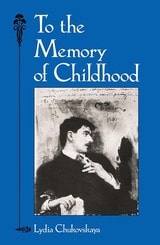
To the Memory of Childhood
Lydia Chukovskaya
Northwestern University Press, 1988
Her father is a household name in Russia because of his tales in verse for children. But his literary accomplishments ranged far beyond bedtime stories. As a critic he wrote controversial articles and lively profiles of cultural figures; as a translator he introduced Whitman, Twain, Kipling, and Wilde to Russian readers. When his children's literature was attacked in the 1920s and 1930s, he turned to editing, scholarship, and articles on translation. A man of boundless energy, he played a vital role in his country's cultural life until his death in 1969. "I am not writing Kornei Ivanovich's biography," Chukovskaya says, "but he was the author of my childhood."
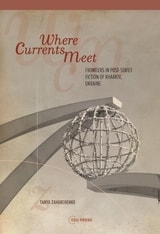
Where Currents Meet
Frontiers of Memory in Post-Soviet Fiction of Kharkiv, UkraineTanya Zaharchenko
Central European University Press, 2016
Where Currents Meet, Tanya Zaharchenko’s path-breaking study of literature and cultural memory, moves decisively beyond the simplistic view of a post-Soviet Ukraine divided between east and west. It positions the Ukrainian and Russian components of cultural experience in the country’s east as elements of a complex continuum. Combining insights from memory studies and border studies, Zaharchenko analyzes a generation of younger riters in the city of Kharkiv—a “doubletake generation” that came of age at the time of the Soviet Union’s collapse and now revisits this experience through fiction. In the works of Serhiy Zhadan, Andreĭ Krasniashchikh, Yuri Tsaplin, Oleh Kotsarev, and others the author reveals how borderlands and frontiers, both geographical and conceptual, acquire zonal qualities of their own as these writers navigate the historical legacy they have inherited.
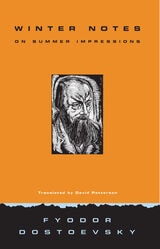
Winter Notes on Summer Impressions
Fyodor Dostoevsky
Northwestern University Press, 1997
In June 1862, Dostoevsky left Petersburg on his first excursion to Western Europe. Ostensibly making the trip to consult Western specialists about his epilepsy, he also wished to see firsthand the source of the Western ideas he believed were corrupting Russia. Over the course of his journey he visited a number of major cities, including Berlin, Paris, London, Florence, Milan, and Vienna. He recorded his impressions in Winter Notes on Summer Impressions, which were first published in the February 1863 issue of Vremya (Time), the periodical of which he was the editor.
Among other themes, Dostoevsky reveals his Pan-Slavism, rejecting European culture as corrupt and exhorting Russians to resist the temptation to emulate or adopt European ways of life.