Results by title

47 books match the query 'Christian ethics'
cover of A Catechism For Business

A Catechism For Business

Andrew V. Abela

Catholic University of America Press, 2014
A Catechism for Business presents the teachings of the Catholic Church as they relate to more than one hundred specific and challenging moral questions that have been asked by business leaders. Andrew V. Abela and Joseph E. Capizzi have assembled the relevant quotations from recent Catholic social teaching as responses to these questions. Questions and answers are grouped under major topics such as marketing, finance, and investment. Business ethics questions can be too subtle for definitive yes / no answers, so the book offers no more and no less than church teaching on each particular question. Where the church has offered definitive answers, the book provides them. When the church has not, the book offers guidelines for reflection and insights into what one should consider in given situations.
[more]
cover of A Catechism for Business

A Catechism for Business

Andrew V. Abela

Catholic University of America Press, 2016
This second edition streamlines some of the editing from the first addition, and more importantly, includes material from Pope Francis's encyclical, Laudato Si’, and his apostolic exhortation, Evangelii Gaudium. A Catechism for Business presents the teachings of the Catholic Church as they relate to more than one hundred specific and challenging moral questions as they have been asked by business leaders. Andrew V. Abela and Joseph E. Capizzi have assembled the relevant quotations from recent Catholic social teaching as responses to these questions. Questions and answers are grouped together under major topics such as marketing, finance and investment. The book's easy-to-use question and answer approach invites quick reference for tough questions and serves as a basis for reflection and deeper study in the rich Catholic tradition of social doctrine.
[more]
cover of A Catechism for Health Care: Insights from Catholic Teaching on Human Life, Medical Ethics, and Love of Neighbor

A Catechism for Health Care

Insights from Catholic Teaching on Human Life, Medical Ethics, and Love of Neighbor

Stephen Napier

Catholic University of America Press, 2024
The Catholic Church’s teachings on ethical issues arising in healthcare delivery and biomedical science are distributed across a plethora of different places ranging from papal allocutions, encyclicals, instructions by the Congregation for the Doctrine of the Faith, and guidance documents authored by various congregations of bishops. Furthermore, they are distributed throughout time ranging from, for example, the Didache (or teaching of the 12 apostles, circa 1st Century), to Pope Pius XII’s address in 1954 addressing ethical issues in transplantation, and onto the 2009 instruction entitled Dignitas personae. It is difficult for a wider audience to make sense of these sources on the various issues arising in healthcare delivery and scientific research, but the editors of A Catechism for Health Care have collated them in a way that makes them easier to understand The purpose of this book is to present the teachings of the Catholic Church as they pertain to ethical issues arising in the healthcare and biomedical sciences. The premise of the project is that the Catholic Church’s teaching speaks in an accessible way to a wide range of people concerned about healthcare ethics. It is important to present these teachings concisely. The book is ordered around numerous questions concerning the most common practices in health care that have ethical dimensions. It then provides concise answers to these questions as are found in various magisterial Church documents. These answers are refreshingly clear and to the point.
[more]
cover of After Pandemic, After Modernity: The Relational Revolution

After Pandemic, After Modernity

The Relational Revolution

Giulio Maspero

St. Augustine's Press, 2022

The global pandemic has levied a heavy toll on humanity, but in its wake appears a great opportunity. Amidst what he calls a crisis of modernity, Giulio Maspero points to a phenomenon that can be seen in plain sight. "The absence of personal relationships highlighted by the health crisis exposes the consequences of the modern matrix, which, having lost its Christian element, now risks transforming itself into a digital matrix, substantially configuring itself as a technognosis."   

Without Trinitarian framework ancient and new idols emerge, as the Covid-19 tragedies have shown. Yet post-pandemic must be a moment of clarity and realism, as we can see how necessary it is that humanity place itself in relation to something beyond. The post-modern journey, however, must be in the spirit of Christian humanism or else any so-called progress will no longer be unable to speak authentically of our humanity. That is to say, the relational dimension of human life will be erased right along with the other ills that plague our earth. 
[more]
cover of By knowledge & by love: charity and knowledge in the moral theology of St. Thomas Aquinas

By knowledge & by love

charity and knowledge in the moral theology of St. Thomas Aquinas

Michael S. Sherwin

Catholic University of America Press, 2005
By Knowledge and By Love represents a major contribution to Thomistic moral theology and philosophy by providing a thoughtful examination of Aquinas' psychology of action and his theology of charity.
[more]
cover of Can Ethics Be Christian?

Can Ethics Be Christian?

James M. Gustafson

University of Chicago Press, 1977

Is there a special relation between religious beliefs and moral behavior? In particular, is there a distinctive Christian moral character and how is this manifested in moral actions? The influential theologian James M. Gustafson probes these questions and offers an analysis of the distinctively religious reasons of the "heart and mind" which constitute the basis for a Christian ethics.

Professor Gustafson grounds his discussion in a concrete example of moral conduct which deeply impressed him. The incident—narrated in detail at the start and referred to throughout—concerns a nonreligious colleague who came to the aid of an intoxicated soldier. Although seemingly trivial, this incident, in the author's view, approximates the normal sorts of experiences in which individuals have to make moral decisions every day; it becomes a touchstone to investigate the logical, social, and religious elements in moral decision making.
[more]
cover of Counsels of Imperfection: Thinking Through Catholic Social Teaching

Counsels of Imperfection

Thinking Through Catholic Social Teaching

Edward Hadas

Catholic University of America Press, 2021
For more than a century, the teaching authority of the Catholic Church has attempted to walk along with the modern world, criticizing what is bad and praising what is good. Counsels of Imperfection described the current state of that fairly bumpy journey. The book is divided into 11 chapters. First comes an introduction to ever-changing modernity and the unchanging Christian understanding of human nature and society. Then come two chapters on economics, including a careful delineation of the Catholic response, past and present, to socialism and capitalism. The next topic is government, with one chapter on Church and State, another on War, and a third that runs quickly through democracy, human rights, the welfare state, crimes and punishments (including the death penalty), anti-Semitism, and migration. Counsels of Imperfection then dedicates two chapters on ecology, including an enthusiastic analysis of Francis’s “technocratic paradigm”. The last topic is the family teaching, which presents the social aspects of the Church’s sexual teaching. A brief concluding chapter looks at the teaching’s changing response to the modern world, and at the ambiguous Catholic appreciation of the modern idea of progress. For each topic, Counsels of Imperfection provides biblical, historical and a broad philosophical background. Thomas Aquinas appears often, but so does G. W. F Hegel. The goal is not only to explain what the Church really says, but also how it got to its current position and who it is arguing with. In the spirit of a doctrine that is always in development, Counsels of Imperfection points out both strong-points and imperfections in the teaching. The book should be of interest to specialists in Catholic Social Teaching, but its main audience is curious newcomers, especially people who do not want to be told that there are simple Catholic answers to the complicated problems of the modern world.
[more]
cover of Dialogic Confession: Bonhoeffer's Rhetoric of Responsibility

Dialogic Confession

Bonhoeffer's Rhetoric of Responsibility

Ronald C. Arnett. Foreword by Clifford Christians

Southern Illinois University Press, 2005

In this landmark volume of contemporary communication theory, Ronald C. Arnett applies the metaphor of dialogic confession—which enables historical moments to be addressed from a confessed standpoint and through a communicative lens—to the works of German theologian Dietrich Bonhoeffer, who pointed to an era of postmodern difference with his notion of "a world come of age." Arnett’s interpretations of Bonhoeffer’s life and scholarship in contention with Nazi dominance offer implications for a dialogic confession that engages the complexity of postmodern narrative contention.

Rooted in classical theory, the field of communication ethics is abstract and arguably outmoded. In Dialogic Confession: Bonhoeffer’s Rhetoric of Responsibility, Arnett locates cross-cultural and comparative anchors that not only bring legitimacy and relevance to the field but also develop a conceptual framework that will advance and inspire future scholarship.
[more]
cover of Didymus the Blind and His Circle in Late-Antique Alexandria: Virtue and Narrative in Biblical Scholarship

Didymus the Blind and His Circle in Late-Antique Alexandria

Virtue and Narrative in Biblical Scholarship

Richard A. Layton

University of Illinois Press, 2004

This is the first comprehensive study in the English language of the commentaries of Didymus the Blind, who was revered as the foremost Christian scholar of the fourth century and an influential spiritual director of ascetics.
 
The writings of Didymus were censored and destroyed due to his posthumous condemnation for heresy. This study recovers the uncensored voice of Didymus through the commentaries among the Tura papyri, a massive set of documents discovered in an Egyptian quarry in 1941.
 
This neglected corpus offers an unprecedented glimpse into the internal workings of a Christian philosophical academy in the most vibrant and tumultuous cultural center of late antiquity. By exploring the social context of Christian instruction in the competitive environment of fourth-century Alexandria, Richard A. Layton elucidates the political implications of biblical interpretation.
 
Through detailed analysis of the commentaries on Psalms, Job, and Genesis, the author charts a profound tectonic shift in moral imagination as classical ethical vocabulary becomes indissolubly bound to biblical narrative. Attending to the complex interactions of political competition and intellectual inquiry, this study makes a unique contribution to the cultural history of late antiquity.
 
[more]
cover of Dwelling in the Splendor of Truth: Catholic Moral Theology in Light of <i>Veritatis splendor</i>

Dwelling in the Splendor of Truth

Catholic Moral Theology in Light of <i>Veritatis splendor</i>

James W. Stroud

Catholic University of America Press, 2026
On August 6, 1993, Pope John Paul II promulgated the long-awaited encyclical on moral theology entitled Veritatis splendor. In this landmark encyclical, directed principally toward bishops, Pope John Paul II sought a reset of the discipline of Catholic moral theology after the Second Vatican Council in response to the theological dissent that had called into question the foundations of Catholic morality. More than thirty years after the promulgation of Veritatis splendor, the essays in this edited volume consider the major themes and topics of this encyclical as it seeks to contribute to the revitalization of moral theology today. These themes and topics include: the rich young man and the renewal of moral theology, freedom, nature, and law, conscience, intrinsically evil acts, the state of revisionism, the moral object, martyrdom and morality, evangelization, the role of the moral theologian, and the role of scripture in moral theology. Contributors include: William C. Mattison, III, Irene Alexander, Matthew Levering, Matthew Dugandzic, James W. Stroud, Stephen L. Brock, Patrick Clark, Timothy P. O’Malley, Jana Marguerite Bennet, John Grabowski, with a foreword by Archbishop of Sydney Anthony Fisher, OP.
[more]
cover of Ethica Thomistica: The Moral Philosophy of Thomas Aquinas

Ethica Thomistica

The Moral Philosophy of Thomas Aquinas

Ralph McInerny

Catholic University of America Press, 1997

First published fifteen years ago, Ethica Thomistica is widely recognized as one of the finest introductions to St. Thomas's moral philosophy. Though the book has been out of print for several years, scholars and students still refer to it as the standard resource on Thomistic ethics. In this much-anticipated, revised edition, Ralph McInerny revisits the basics of Thomas's teachings and offers a brief, intelligible, and persuasive summary.


Chapters: Morality and Human Life; The Good for Man; Ultimate End and Moral Principles; The Structure of the Human Act; Good and Evil Action; Character and Decision; Prudence and Conscience; Religion and Morality ABOUT THE AUTHOR:


Ralph McInerny is Michael P. Grace Professor of Medieval Studies and director of the Jacques Maritain Center at the University of Notre Dame, where he has taught since 1955. He is founder and publisher of Catholic Dossier magazine; cofounder of Crisis magazine; and author of several books published by CUA Press, including Aquinas on Human Action (1992), The Question of Christian Ethics (1993), and Aquinas and Analogy (1996).


PRAISE FOR THE BOOK:


"Remarkable for its moderation and common sense. . . . [McInerny] rapidly sketches selected themes from Thomistic moral thinking: what distinguishes the moral activities of man, what is distinctive of moral goodness (in Aristotle and in Aquinas), an analysis of practical reason in relation to natural law, the bases for judging good and evil moral actions, the roles of intellect and will in voluntary activity, the work of virtues as components of moral character, the functions of prudence and conscience, and finally the relation of ethics to religious belief. . . . For the person who desires a quick and understandable introduction to this subject, this little book can be recommended as readable and reliable."—Vernon J. Bourke, Speculum "An important contribution both to moral philosophy and to its teaching. . . . [McInerny] has put us all in his debt by writing it."—Alasdair MacIntyre, Teaching Philosophy "A clear, thorough and readable introduction to the thought of one of the intellectual giants of the Catholic moral tradition."—National Catholic Register
[more]
cover of Ethics from a Theocentric Perspective, Volume 1: Theology and Ethics

Ethics from a Theocentric Perspective, Volume 1

Theology and Ethics

James M. Gustafson

University of Chicago Press, 1983
"Ethics from a Theocentric Perspective will surprise some, shock others, and unleash a flood of speculation about what has happened to James Gustafson. The answer quite simply is nothing has happened to Gustafson except that he has now turned his attention to developing his constructive theological position, and we should all be very glad. . . . In this, the first of two volumes, Gustafson displays his colors as a constructive theologian, and they are indeed brilliant and splendid. . . . Though Gustafson is a theologian who works in the Christian tradition, he reminds us that the God Christians worship is not merely the Christian God. For Gustafson the kind of God who is the object of the theologians's reflection eludes or surpasses the inevitably confessional activity of Christian theological reflection. Thus Gustafson, the constructive theologian, is also Gustafson the revisionist theologian who takes as his task nothing less than challenging the anthropocentrism that he alleges characterizes mainstream Western Christian theology."—Stanley Hauerwas, Journal of Religion
[more]
cover of Ethics from a Theocentric Perspective, Volume 2: Ethics and Theology

Ethics from a Theocentric Perspective, Volume 2

Ethics and Theology

James M. Gustafson

University of Chicago Press, 1984

Gustafson's two-volume work has been hailed as a major contribution to Christian ethics. In this second volume, Gustafson considers marriage, suicide, and the allocation of resources in famine and in biomedical research to develop an ethical outlook in which divine purpose is the basis of moral activity.

"Breadth and subtlety, wisdom and insight . . . Gustafson is a first-rate theologian."—Commonweal

"The two-volume work, now complete, will be a benchmark for discussions of Christian ethics for years to come. With it Gustafson becomes one of the thinkers by whom others can, by agreement or divergence, define their own ethics."—Roger L. Shinn, Christianity and Crisis

"Gustafson's theocentrism is an original and creative contribution to modern ethical discussion."—Douglas Sturm, Ethics
[more]
cover of Ethics of Liberation: In the Age of Globalization and Exclusion

Ethics of Liberation

In the Age of Globalization and Exclusion

Enrique Dussel

Duke University Press, 2012

Available in English for the first time, this much-anticipated translation of Enrique Dussel's Ethics of Liberation marks a milestone in ethical discourse. Dussel is one of the world's foremost philosophers. This treatise, originally published in 1998, is his masterwork and a cornerstone of the philosophy of liberation, which he helped to found and develop.

Throughout his career, Dussel has sought to open a space for articulating new possibilities for humanity out of, and in light of, the suffering, dignity, and creative drive of those who have been excluded from Western Modernity and neoliberal rationalism. Grounded in engagement with the oppressed, his thinking has figured prominently in philosophy, political theory, and liberation movements around the world.

In Ethics of Liberation, Dussel provides a comprehensive world history of ethics, demonstrating that our most fundamental moral and ethical traditions did not emerge in ancient Greece and develop through modern European and North American thought. The obscured and ignored origins of Modernity lie outside the Western tradition. Ethics of Liberation is a monumental rethinking of the history, origins, and aims of ethics. It is a critical reorientation of ethical theory.
[more]
cover of God, Science, Sex, Gender: An Interdisciplinary Approach to Christian Ethics

God, Science, Sex, Gender

An Interdisciplinary Approach to Christian Ethics

Edited by Patricia Beattie Jung and Aana Marie Vigen with John Anderson

University of Illinois Press, 2010

God, Sex, Science, Gender: An Interdisciplinary Approach to Christian Ethics is a timely, wide-ranging attempt to rescue dialogues on human sexuality, sexual diversity, and gender from insular exchanges based primarily on biblical scholarship and denominational ideology. Too often, dialogues on sexuality and gender devolve into the repetition of party lines and defensive postures, without considering the interdisciplinary body of scholarly research on this complex subject. This volume expands beyond the usual parameters, opening the discussion to scholars in the humanities, social sciences, and natural sciences to foster the development of Christian sexual ethics for contemporary times.

Essays by prominent and emerging scholars in the fields of anthropology, sociology, psychology, philosophy, literary studies, theology, and ethics reveal how faith and reason can illuminate our understanding of human sexual and gender diversity. Focusing on the intersection of theology and science and incorporating feminist theory, God, Science, Sex, Gender is a much-needed call for Christian ethicists to map the origins and full range of human sexual experience and gender identity. Essays delve into why human sexuality and gender can be so controversial in Christian contexts, investigate the complexity of sexuality in humans and other species, and reveal the implications of diversity for Christian moral theology.

Contributors are Joel Brown, James Calcagno, Francis J. Catania, Pamela L. Caughie, Robin Colburn, Robert Di Vito, Terry Grande, Frank Fennell, Anne E. Figert, Patricia Beattie Jung, Fred Kniss, John McCarthy, Jon Nilson, Stephen J. Pope, Susan A. Ross, Joan Roughgarden, and Aana Marie Vigen.
[more]
cover of Habits and Holiness: Ethics, Theology, and Biopsychology

Habits and Holiness

Ethics, Theology, and Biopsychology

Ezra, OP Sullivan

Catholic University of America Press, 2021
The topic of habitus is one of Thomas Aquinas’s greatest contributions to moral theology, but it has been generally neglected in theological scholarship until now. Habits and Holiness is the first work in English to explore Aquinas’s rich theology of habit in all of its grandeur and depth. Habits and Holiness shows that most facets of human life and behavior are greatly influenced by habits, which Thomas appraises as an analogous concept that is much broader than previous scholarship has recognized. Habits and Holiness accomplishes three tasks. First, it gives a complete and coherent account of Aquinas’s account of habitus. Most accounts of Aquinas’s view of habitus focus almost exclusively on “Treatise on Habits” in the Summa Theologiae I-II, qq. 49-54, and speak of habitus in reference to the virtues. However, Aquinas speaks of habitus in many other places, especially his commentaries on Aristotle’s works and his commentaries on Sacred Scripture. Aquinas employs the concept of habitus to explain a wide variety of human inclinations, such as instincts, personal and societal custom, acquired skills and virtues, original sin, grace, infused virtues, and Gifts of the Holy Spirit. Second, this book indicates how biological psychology illuminates and enriches Aquinas’s account of habit, and vice versa. Finally, Habits and Holiness provides readers with a framework for interpreting and utilizing the vast amount of practical habit literature that exists: it offers a practical analysis of habit development found in Aquinas’s works and those of empirical studies. The topic of habits is a golden thread that helps readers find their way through Aquinas’s extensive writings on morals. By describing the many kinds of habits we possess, and their widespread but often hidden effects in our lives, this book offers a new and unique reevaluation of many issues central to the moral life. It addresses childhood development, pagan virtue, akrasia, circumstances that limit free choice, how heroic virtue operates, and more. By seeing habits in general as a prism for understanding human action and its influences, Habits and Holiness provides a unique and appealing synthesis of Thomistic virtue theory, the contemporary science of habits, and best practices for eliminating bad habits and living good habits.
[more]
cover of Introduction to Moral Theology (Catholic Moral Thought, Volume 1)

Introduction to Moral Theology (Catholic Moral Thought, Volume 1)

Romanus Cessario, O.P.

Catholic University of America Press, 2001
The present volume, the first in the new Catholic Moral Thought series, responds to the need for a new introduction to the basic and central elements of Catholic moral theology written in the light of Veritatis splendor.
[more]
cover of Introduction to Moral Theology, revised edition

Introduction to Moral Theology, revised edition

Romanus Cessario

Catholic University of America Press, 2013
Originally published in 2001, Introduction to Moral Theology responded to the need for a new introduction to the basic and central elements of Catholic moral theology written in the light of Veritatis splendor. Since then, it has become a standard text for students and a reputable resource on such topics as moral theology and the good of the human person created in God's image; natural law; principles of human action; determination of the moral good through objects, ends, and circumstances; and the virtues, gifts of the Holy Spirit, and the Beatitudes.
[more]
cover of Knowing the Natural Law

Knowing the Natural Law

Steven Jensen

Catholic University of America Press, 2015
Knowing the Natural Law traces the thought of Aquinas from an understanding of human nature to a knowledge of the human good, from there to an account of ought-statements, and finally to choice, which issues in human actions. The much discussed article on the precepts of the natural law (I-II, 94, 2) provides the framework for a natural law rooted in human nature and in speculative knowledge. Practical knowledge is itself threefold: potentially practical knowledge, virtually practical knowledge, and fully practical knowledge.
[more]
cover of Living the Good Life

Living the Good Life

Steven J. Jensen

Catholic University of America Press, 2013

Living the Good Life presents a brief introduction to virtue and vice, self-control and weakness, misery and happiness.
[more]
cover of Medicine, Health Care, & Ethics: Catholic Voices

Medicine, Health Care, & Ethics

Catholic Voices

John F. Morris

Catholic University of America Press, 2007
Medicine, Health Care, and Ethics adds to this rich tradition with a collection of contemporary essays that represent the very best efforts of current Catholic scholarship in the field of health care and medical ethics.
[more]
cover of Moral Absolutes: Tradition, Revision, and Truth (Michael J. McGivney Lectures of the John Paul II Institute)

Moral Absolutes

Tradition, Revision, and Truth (Michael J. McGivney Lectures of the John Paul II Institute)

John Finnis

Catholic University of America Press, 1991
Moral Absolutes sets forth a vigorous but careful critique of much recent work in moral theology. It is illustrated with examples from the most controversial aspects of Christian moral doctrine, and a frank account is given of the roots of the upheaval in Roman Catholic moral theology in and after the 1960s.
[more]
cover of Moral Visions: Ethics and the Book of Mormon

Moral Visions

Ethics and the Book of Mormon

Edited by Courtney S. Campbell and Kelly Sorensen

University of Illinois Press, 2025

Though used by millions as a guide for how to live one’s life, the Book of Mormon’s links with contemporary ethics remain largely unexamined. Courtney S. Campbell and Kelly Sorensen edit essays that spotlight and encourage further thought on these connections.

Contributors in the first section discuss foundational issues such as the Book of Mormon’s moral psychology, its minimalist and covenantal moralities, the nature of the good and how the good is known, the question of whether value depends on a certain kind of future, the Book of Mormon's strategy for moral persuasion, and God’s participation in human choices. In the second section, the essayists turn to everyday ethical questions concerning resistance to forced cultural assimilation, clothing and dress, authority, and memory. The final chapter further explores practical moral visions.

A rich and thought-provoking analysis, Moral Visions examines the Book of Mormon through a variety of methods while aiming to deepen understanding of both the text’s messages and its potential place in future discussions of ethics. Contributors: Daniel Becerra, Courtney S. Campbell, Ryan Davis, Michael D. K. Ing, Ariel Bybee Laughton, Kimberly Matheson, Rachel Esplin Odell, Kelly Sorensen, Joseph M. Spencer
[more]
cover of Natural Moral Law in Contemporary Society

Natural Moral Law in Contemporary Society

Holger Zaborowski

Catholic University of America Press, 2010
The essays of this volume examine natural moral law, different natural law theories, and the role that natural law can and should play in our contemporary society
[more]
cover of Nature as Guide: Wittgenstein and the Renewal of Moral Theology

Nature as Guide

Wittgenstein and the Renewal of Moral Theology

David Goodill, OP

Catholic University of America Press, 2022
Wittgenstein influenced a generation of philosophers and theologians, with works such as Fergus Kerr’s Theology After Wittgenstein showing the relevance of Wittgenstein’s philosophy for contemporary questions in theology. Nature as Guide follows many of the insights of this earlier generation of Wittgenstein influenced scholars, to bring Wittgenstein into conversation with contemporary Catholic moral theology. The first four chapters of the book provides a reading of key themes in Wittgenstein’s philosophy, and draw among others on G.E.M. Anscombe to situate Wittgenstein in relation to the Platonic tradition. Understanding the relationship between grammar, metaphysics and nature is central to this tradition and these themes are examined through an account of Wittgenstein’s philosophical development. These four chapters also provides a critical perspective on Wittgenstein’s thought, engaging with the criticisms of Wittgenstein offered by philosophers such as Rhees Rush and William Charlton. Chapter five lays the groundwork for a dialogue between Wittgenstein and moral theology. Firstly, by examining how open Wittgenstein’s philosophy is to dialogue with theology, and secondly through proposing the use of Servais Pinckaers’ definition of moral theology to structure the conversation developed in subsequent chapters. Pinckaers’ definition is based upon St Thomas Aquinas’ presentation of the principles of human acts in the Prima Secundae of the Summa Theologiae and the final three chapters focus on the question of human acts and their basis in human nature. The reading of Wittgenstein developed in the first part of the book is brought into dialogue with the tradition of Catholic moral theology represented by Pinckaers and other students of St Thomas, such as Anscombe, Josef Pieper, Herbert McCabe, Jean Porter and Alasdair MacIntyre. The book finishes with McCabe’s account of the transformation of human nature through God’s Word, showing how Wittgenstein’s understanding of human practices can shed light on the life of grace.
[more]
cover of Passions and Virtue

Passions and Virtue

Servais Pinckaers

Catholic University of America Press, 2015
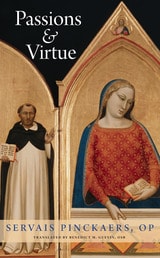
This book, the last that noted moral theologian Servais Pinckaers, OP, wrote before his death, was conceived as a follow-up to his previous work Plaidoyer pour la vertu (An Appeal for Virtue) (2007) Pinckaers' aim in Passions and Virtue was to show the positive and essential role that our emotions play in the life of virtue. His purpose is part of a larger project of renewing moral theology, a theology too often experienced as an ethics of obligation rather than as a practical guide to living virtuously. To this end, Pinckaers sketches a positive psychology of the passions as found in the biblical tradition, in the writings of the Fathers of the Church, in pagan authors and, especially, in the writings of Saint Thomas Aquinas.
[more]
cover of Perfecting Human Actions: St. Thomas Aquinas on Human Participation in Eternal Law

Perfecting Human Actions

St. Thomas Aquinas on Human Participation in Eternal Law

John Rziha

Catholic University of America Press, 2009
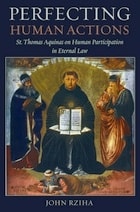
During the last few centuries, a practical dichotomy between God and humans has developed within moral theory. As a result, moral theory tends to focus only on humans where human autonomy is foundational or only on God where divine commands capriciously rule. However, the moral theology of Thomas Aquinas overcomes this dichotomy. For Thomas, humans reach their perfection by participating in God's wisdom and love. Perfecting Human Actions explores the ways humans participate in eternal law--God's wisdom that guides and moves all things to their proper action. The book begins with a thoughtful examination of the philosophic recovery of the notion of participation in Thomistic metaphysics. It then explains Thomas's theological understanding of the notion of participation to show how humans are related to God. It is discovered that when performing human actions, humans participate in the eternal law in two ways: as moved and governed by it, and cognitively. In reference to participation as moved and governed, humans are directed by God to their proper end of eternal happiness. This mode of participation can be increased by perfecting the natural inclinations through virtue, grace, and the gifts of the Holy Spirit. In reference to cognitive participation, humans as rational creatures can know their proper end and how to attain it. Through this knowledge of moral truths, the intellect participates in the eternal law. Cognitive participation is perfected by the intellectual virtues (especially faith) and the gifts of the Holy Spirit (especially wisdom). The book concludes by showing how the notion of human participation in the eternal law is a much better foundation for moral theory than the contemporary notion of autonomy.
[more]
cover of Proportionalism and the Natural Law Tradition

Proportionalism and the Natural Law Tradition

Christopher Kaczor

Catholic University of America Press, 2002

Consequentialism and Catholic ethics seem to be natural enemies. The Catholic prohibition against intentionally killing the innocent, lying, committing adultery, and so on contradicts the very essence of consequentialism that no act may be assessed as good or evil independently of its consequences. However in the 1960s within the Catholic tradition itself, there arose a method in ethics called proportionalism which practically, if not theoretically, affirmed that which consequentialists have long affirmed and Catholic ethicists had so long denied, namely one may do evil that good may come. According to proportionalists, so long as the good effects are proportioned to the bad effects of the act, the act is licit even if evil is used as a means to achieve the good.


In this book, Christopher Kaczor argues against the plausibility of proportionalism and its first proponents, namely Peter Knauer, Joseph Fuchs, Bruno Schüller, Louis Janssens, and Richard McCormick. Examining the genealogy of the movement, he disputes a received history that depicts proportionalism as a recovery of Thomas Aquinas. Instead, contends Kaczor, proportionalism is best seen as the organic successor to the moral manuals of the pre-Vatican II era. Proportionalism arises not from Thomas but rather extends many of the tendencies and presuppositions of the manuals. In particular, it retains their marginalizing of the account of human action as a knowing-willing involving a number of stages not always consciously recognized yet carefully described by Thomas in Summa theologiae, Prima Secundae, 6-17. Kaczor shows that a great deal of the plausibility of proportionalism rests on a fragile foundation that is rapidly eroding, an education in the moral manuals.
[more]
cover of Protestant and Roman Catholic Ethics: Prospects for Rapprochement

Protestant and Roman Catholic Ethics

Prospects for Rapprochement

James M. Gustafson

University of Chicago Press, 1978
"If Catholic and Protestant ethicians were asked to name a single theologian who was qualified to write a comprehensive overview of the historical divergences of Catholic and Protestant positions on ethical questions, the bases for those divergences in fundamentally different philosophical and theological perspectives, and the possibilities for future convergences of the traditions, my guess is that James Gustafson would be the one. . . . This brilliant and tightly argued book . . . will be the most important book on moral theology to appear this year."—John Coleman, National Catholic Reporter
[more]
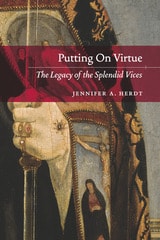
cover of Putting On Virtue: The Legacy of the Splendid Vices

Putting On Virtue

The Legacy of the Splendid Vices

Jennifer A. Herdt

University of Chicago Press, 2008
Augustine famously claimed that the virtues of pagan Rome were nothing more than splendid vices. This critique reinvented itself as a suspicion of acquired virtue as such, and true Christian virtue has, ever since, been set against a false, hypocritical virtue alleged merely to conceal pride. Putting On Virtue reveals how a distrust of learned and habituated virtue shaped both early modern Christian moral reflection and secular forms of ethical thought. 
Jennifer Herdt develops her claims through an argument of broad historical sweep, which brings together the Aristotelian tradition as taken up by Thomas Aquinas with the early modern thinkers who shaped modern liberalism. In chapters on Luther, Bunyan, the Jansenists, Mandeville, Hume, Rousseau, and Kant, she argues that efforts to make a radical distinction between true Christian virtue and its tainted imitations actually created an autonomous natural ethics separate from Christianity. This secular value system valorized pride and authenticity, while rendering graced human agency less meaningful. Ultimately, Putting On Virtue traces a path from suspicion of virtue to its secular inversion, from confession of dependence to assertion of independence.
[more]
cover of Religion, Order, and Law

Religion, Order, and Law

David Little

University of Chicago Press, 1984
"The issue of the Protestant ethic and the spirit of capitalism has been debated endlessly, but few scholars have seriously continued Weber's own research into the Reformation sources of seventeenth-century England. David Little's study was one of the first to do so, and remains an important contribution."—Guenther Roth, University of Washington
[more]
cover of Templeton Plan: 21 Steps to Personal Success and Real Happiness

Templeton Plan

21 Steps to Personal Success and Real Happiness

Sir John Templeton

Templeton Press, 2013
Sir John Templeton (1912–2008), the Wall Street legend who has been described as “arguably the greatest global stock picker of the twentieth century,” clearly knew what it took to be successful. The most important thing, he observed, was to have strong convictions that guided your life—this was the common denominator he saw in all successful people and enterprises. Fortunately for us, he was eager to share his own blueprint for personal success and happiness with the rest of the world. In The Templeton Plan, he laid out the twenty-one guiding principles by which he governed both his professional and personal life.
 
These principles were grounded in virtues that he considered important enough to be considered the “laws of life”—they include honesty, perseverance, thrift, enthusiasm, humility, and altruism. From this moral foundation, Templeton formulated a step-by-step plan to help improve anyone’s personal and professional life. Among the steps he enumerates, readers will find:
·       Four exercises that will help anyone find the positive in every negative
·       How to be the one person in ten that will productively use more time than they waste
·       The secret trait that separates great workers from good workers
·       How to control your thoughts for effective action
·       The practical applications of a sense of humility
·       How successful people approach risks differently from most people
Taken as a whole, the lessons contained within his twenty-one steps will help readers make lasting friendships, reap significant financial rewards, and find personal satisfaction.
 
Ever a believer in the future’s vast potential, Templeton hoped that sharing his principles would inspire others to seek their own laws of life, formulate their own plans, and find success and happiness on a scale exponentially greater than his own. He freely admitted that he didn’t know everything and that there was yet much to be discovered about prosperity and joy. The Templeton Plan not only offers his recipe for success, but also shows us the way to formulate our own plans.

[more]
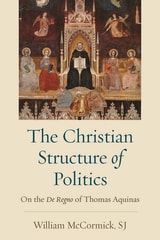
cover of The Christian Structure of Politics: The De Regno of Thomas Aquinas

The Christian Structure of Politics

The De Regno of Thomas Aquinas

William McCormick, SJ

Catholic University of America Press, 2022
The Christian Structure of Politics, the first full-length monograph on Thomas Aquinas's De Regno in decades, offers an authoritative interpretation of De Regno as a contribution to our understanding of Aquinas's politics, particularly on the relationship between Church and State. William McCormick argues that Aquinas takes up a via media between Augustine and Aristotle in De Regno, invoking human nature to ground politics as rational, but also Christian principles to limit politics because of both sin and the supernatural end of man beyond politics. Where others have seen disjoined sections on the best regime, tyranny, and the reward of the king, McCormick identifies a dialogical structure to the text - one not unlike the disputed question format - whereby Aquinas both tempers expectations for the best government and offers a spiritual diagnosis of tyranny, culminating in a sharp critique of civil religion and political theology. McCormick draws upon historical research on Aquinas' context, especially that of Anthony Black, Cary Nederman and Francis Oakley, from which he develops three themes: the medieval preponderance of kingship and royal ideology; the relationship between Church and State; and the intersection of Latin Christianity and Greco-Roman antiquity. While age-old concerns, recent research in these areas has allowed us to move beyond simplistic platitudes. For scholars of political theory and the history of political thought, De Regno will prove fascinating for the interplay of Aristotelian and Augustinian elements, undercutting the conventional wisdom that Aquinas was simply an Aristotelian. De Regno also includes an extended treatment of civil religion, one of Aquinas’ most historically-oriented discussions of politics.
[more]
cover of The Didache: A Missing Piece of the Puzzle in Early Christianity

The Didache

A Missing Piece of the Puzzle in Early Christianity

Jonathan A. Draper

SBL Press, 2015

An intriguing dilemma for those who study ancient Christian contexts and literature

This edited volume includes essays and responses from specialists in the Didache and in early church history in general.

Features:

  • Strategies for understanding liturgical constructions and ritual worship found in the text
  • Studies that apply generally to the overall content and background of the Didache
  • Essays on the relationship between the Didache and scripture—particularly with respect to the Gospel of Matthew
[more]
cover of The Good Is Love: The Body and Human Acts in Humanae Vitae and John Paul II

The Good Is Love

The Body and Human Acts in Humanae Vitae and John Paul II

Adrian Reimers

St. Augustine's Press, 2020

John Paul II in his personalist approach to moral questions reaffirmed that as sin offends that which is good, if we truly know what human love is––and that it is good––we would thereby see how certain acts can never be acceptable insofar as they in all cases wound this love. Yet in moral debates surrounding love, sex and contraception Adrian Reimers observes that we are not using this approach and these debates are not advancing the cause of real love. 

Reimers draws upon the encyclical Humanae Vitae and John Paul II’s catechesis known as the theology of the body to respond to the stalled development of moral theology on the issues most crucial to human love and intimacy. “It is time, we are told, for a ‘paradigm shift’ in the Catholic Church’s moral teaching, such shift representing a more pastoral and less dogmatic approach to moral issues,” writes Reimers. His claim that “a paradigm shift in moral theology and philosophy may be valuable––perhaps vital––to scholars who think and write about these sciences and to teachers who communicate moral truth” is not an exhortation to redefine moral truths. Rather, he argues that an approach to contraception, for example, that relies exclusively on natural law is a hackneyed one and often “tedious.”

John Paul II’s series of catechetical addresses known as the theology of the body was originally composed in the 1970s after Paul VI’s encyclical Humanae Vitae. Albeit derived from the writing of an archbishop and not yet pope, Reimers identifies John Paul II’s perspectives on love, sex and contraception as an essential force behind this so-called paradigm shift in continuity with the profound and unchanging truths set forth in Humanae Vitae. As Reimers states, “Moral truths do not change, even if our ways to understand them improve.”

How, then, is our sense of the goodness or badness of contraception meant to be helped by such a development of thought? Ethics grounded philosophically tends to lean toward legalism in the context of moral actions, says Reimers, as it emphasizes conformity to God’s law and largely overlooks “the relationship between moral behavior and the human person’s ultimate end of beatitude with God.” The important principle of the necessarily two-fold description that natural law gives to sex––namely, as unitive and procreative––must not be the authoritative end of the discussion regarding the moral nature of contraception. In an age where technology has given human beings new power it seems there must be new rules as well, and the conquest of procreative acts changes the human perception of the limitations once associated with harmful acts. Herein lies the importance of John Paul II’s catechesis––the goodness or badness of acts is not just concerned with end of a particular act. As Reimers writes, “If we are to understand the complex relationships among love, marriage, and their sexual expression, we must situate these within the context of the end of the human being.”

A position on contraception and human sexuality cannot be comprehensive without a concept of love properly understood. Human acts must bring us closer to sanctity, not to comfort or possession. Holiness is the perfection of love, and its pursuit aims at ultimate beatitude. This end, the truest love human can know, is the end which ultimately condemns contraception once and for all, as “contracepted sex is contrary to holiness.” Reimers unpacks this sometimes difficult truth in eight chapters, which begin with love and conclude with faithfulness to moral norms and a spirituality of marriage.  

The arguments surrounding contraception and “good sex” seem to have set the grounds for coherently choosing a side rather than to have succeeded in presenting certain human acts as definitively immoral. As Reimers notes, a natural law position on contraception often fails to employ its greatest ally: the reality of authentic human love and “victory” of the individual in one’s sanctity as achieved through that love. This work will reorient the objectives and claims of the moral debate, as well as influence the popular notion of what love is and what it cannot be. It is an aid to scholars, students and study groups, humanists, and those who seek to deepen the sense of love’s highest physical expression. 
[more]
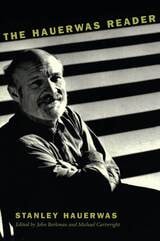
cover of The Hauerwas Reader

The Hauerwas Reader

Stanley Hauerwas

Duke University Press, 2001

Stanley Hauerwas is one of the most widely read and oft-cited theologians writing today. A prolific lecturer and author, he has been at the forefront of key developments in contemporary theology, ranging from narrative theology to the “recovery of virtue.” Yet despite his prominence and the esteem reserved for his thought, his work has never before been collected in a single volume that provides a sense of the totality of his vision.
The editors of The Hauerwas Reader, therefore, have compiled and edited a volume that represents all the different periods and phases of Hauerwas’s work. Highlighting both his constructive goals and penchant for polemic, the collection reflects the enormous variety of subjects he has engaged, the different genres in which he has written, and the diverse audiences he has addressed. It offers Hauerwas on ethics, virtue, medicine, and suffering; on euthanasia, abortion, and sexuality; and on war in relation to Catholic and Protestant thought. His essays on the role of religion in liberal democracies, the place of the family in capitalist societies, the inseparability of Christianity and Judaism, and on many other topics are included as well.
Perhaps more than any other author writing on religious topics today, Hauerwas speaks across lines of religious traditions, appealing to Methodists, Jews, Anabaptists or Mennonites, Catholics, Episcopalians, and others.
[more]
cover of The Law of Love: From Autonomy to Communion

The Law of Love

From Autonomy to Communion

Stephen F. Brett, SSJ

University of Scranton Press, 2010

With an interdisciplinary combination of philosophy, theology, and family law, The Law of Love explores the impact of secular conceptions of autonomy on sexuality and family. Drawing from the thought of Aristotle, Cicero, Augustine, Aquinas, and the modern theologian Servais Pinckaers, Stephen F. Brett argues that the divorce of freedom from virtue has caused cultural relativism, and that a potent and healthy mix of temperance, chastity, and modesty is the antidote. Styled accessibly and quite cleverly with a broader audience in mind, The Law of Love will appeal to intellectuals of all faiths who are interested in facing the ambiguities and problems of contemporary life in a secularized society.
[more]
cover of The Moral Philosophy of Dietrich von Hildebrand

The Moral Philosophy of Dietrich von Hildebrand

Martin Cajthaml

Catholic University of America Press, 2020
The Moral Philosophy of Dietrich von Hildebrand is the first full-fledged monograph on von Hildebrand’s moral philosophy available to date. Despite this pioneering effort, its aim is not to treat all the themes belonging to this area with equal depth and breadth. Rather, it focuses on the themes indicated by the aforementioned questions and relates them according to their inner systematic links rather than according to how and when they appear in von Hildebrand’s works. It also engages von Hildebrand in a critical dialogue, particularly with the ethics of Plato and Aristotle. This book will serve as a very good introduction not just to von Hildebrand´s moral philosophy but to his thought in general.
[more]
cover of The Pinckaers Reader: Renewing Thomistic Moral Theology

The Pinckaers Reader

Renewing Thomistic Moral Theology

Servais Pinckaers O.P.

Catholic University of America Press, 2005
The first collection of its kind available in any language, this volume features the twenty most significant essays written by Pinckaers since his highly praised Sources.
[more]
cover of The Sources of Christian Ethics

The Sources of Christian Ethics

Servais Pinckaers

Catholic University of America Press, 2013
First published in 1985 as Les sources de la morale chrétienne by University Press Fribourg, this work has been recognized by scholars worldwide as one of the most important books in the field of moral theology
[more]
cover of The Templeton Plan: 21 Steps to Personal Success and Real Happiness

The Templeton Plan

21 Steps to Personal Success and Real Happiness

John Marks Templeton

Templeton Press, 2011
John Templeton believes that his financial accomplishments are directly related to his strong convictions. Now he shares the secrets of his phenomenal success in twenty-one principles that provide readers with solid guidelines for prosperity and happiness.
Templeton maintains that the common denominator connecting successful people with successful enterprises is a devotion to ethical and spiritual principles. He emphasizes the “laws of life”—truthfulness, perseverance, thrift, enthusiasm, humility, and altruism—that can help everyone discover and develop their individual abilities.
A Giniger Book formerly published by Harper & Row in 1987
[more]
cover of The Trinity; The Spectacle; Jewish Foods; In Praise of Purity; Letters

The Trinity; The Spectacle; Jewish Foods; In Praise of Purity; Letters

Catholic University of America Press, 1974
No description available
[more]
cover of The person and the polis: faith and values within the secular state

The person and the polis

faith and values within the secular state

Craig Steven Titus

Catholic University of America Press, 2006

[more]
cover of Transformed in Christ

Transformed in Christ

John S. Grabowski

Catholic University of America Press, 2017
[more]
cover of Un Catecismo para los Negocios

Un Catecismo para los Negocios

Andrew V. Abela

Catholic University of America Press, 2016
This second edition, translated into Spanish, streamlines some of the editing from the first addition, and more importantly, includes material from Pope Francis's encyclical, Laudato Si’, and his apostolic exhortation, Evangelii Gaudium. A Catechism for Business presents the teachings of the Catholic Church as they relate to more than one hundred specific and challenging moral questions as they have been asked by business leaders. Andrew V. Abela and Joseph E. Capizzi have assembled the relevant quotations from recent Catholic social teaching as responses to these questions. Questions and answers are grouped together under major topics such as marketing, finance and investment. The book's easy-to-use question and answer approach invites quick reference for tough questions and serves as a basis for reflection and deeper study in the rich Catholic tradition of social doctrine.
[more]
cover of Visions of Sodom: Religion, Homoerotic Desire, and the End of the World in England, c. 1550-1850

Visions of Sodom

Religion, Homoerotic Desire, and the End of the World in England, c. 1550-1850

H. G. Cocks

University of Chicago Press, 2017

The book of Genesis records the fiery fate of Sodom and Gomorrah—a storm of fire and brimstone was sent from heaven and, for the wickedness of the people, God destroyed the cities “and all the plains, and all the inhabitants of the cities, and that which grew upon the ground.” According to many Protestant theologians and commentators, one of the Sodomites’ many crimes was homoerotic excess.

In Visions of Sodom, H. G. Cocks examines the many different ways in which the story of Sodom’s destruction provided a template for understanding homoerotic desire and behaviour in Britain between the Reformation and the nineteenth century. Sodom was not only a marker of sexual sins, but also the epitome of false—usually Catholic—religion, an exemplar of the iniquitous city, a foreshadowing of the world’s fiery end, an epitome of divine and earthly punishment, and an actual place that could be searched for and discovered. Visions of Sodom investigates each of these ways of reading Sodom’s annihilation in the three hundred years after the Reformation. The centrality of scripture to Protestant faith meant that Sodom’s demise provided a powerful origin myth of homoerotic desire and sexual excess, one that persisted across centuries, and retains an apocalyptic echo in the religious fundamentalism of our own time.
[more]
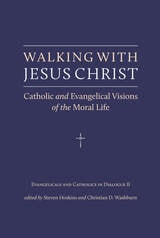
cover of Walking with Jesus Christ: Catholic and Evangelical Visions of the Moral Life

Walking with Jesus Christ

Catholic and Evangelical Visions of the Moral Life

Steven Hoskins

Saint Paul Seminary Press, 2023

Walking with Jesus Christ: Catholic and Evangelical Visions of the Moral Life is the collected essays and consensus statements of the second round of the National Evangelical-Catholic Dialogue. In 2021 the National Evangelical-Catholic Dialogue completed its four-year round of discussion on the moral life, at the University of St. Thomas in St. Paul, MN. Sessions were held each year on the following topics. In 2017, the dialogue discussed the norms governing the moral life. In 2018, the dialogue discussed sexual ethics. In 2019, the dialogue discussed social ethics. Finally, in 2021 the dialogue discussed the relationship of the moral life to eschatology. At each of the annual meetings, members presented background papers that formed the basis of that meeting’s discussion and became starting points for constructing a common statement. These common statements and background papers make up this book. The members of the dialogue hope this book will provide a fruitful starting point for future conversations between evangelicals and Catholics. The Catholic essays begin with the contributions of Catholic theologians Daniel Keating, William Stevenson and Christian Washburn, who examine the various norms for Catholic moral theology including the role of Scripture, tradition, magisterium, and natural law (2017). David Fleischacker, Daniel Keating, and Christian Washburn examine the morality of marriage, contraception, abortion, and homosexual acts (2018). Daniel Keating and William Stevenson discuss social ethics, including Catholic social teaching and socialism (2019). David Fleischacker and Christian Washburn discuss the relationship of the moral life to our final beatific end (2020). The Evangelical essays begin with the contribution of Evangelical theologians Bruce Cromwell and Dennis Jowers who explore the norms of Protestant Ethics (2017). David Van Drunen and Luke Geraty discuss sexual ethics from different ends of the Evangelical perspective (2018). Glen Menzies and Steve Hoskins evaluate approaches to evangelical social ethics from Pentecostal and Wesleyan points of view (2019). Bruce Cromwell and Steve Hoskins discuss the notions of eschatology and ethics from a Wesleyan viewpoint (2020).
[more]