Results by title
43 books match the query 'Cultural Heritage'
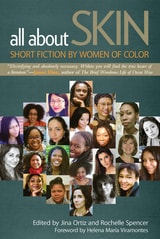
All about Skin
Short Fiction by Women of ColorEdited by Jina Ortiz and Rochelle Spencer, Foreword by Helena María Viramontes
University of Wisconsin Press, 2014
The stories are by American writers Aracelis González Asendorf, Jacqueline Bishop, Glendaliz Camacho, Learkana Chong, Jennine Capó Crucet, Ramola D., Patricia Engel, Amina Gautier, Manjula Menon, ZZ Packer, Princess Joy L. Perry, Toni Margarita Plummer, Emily Raboteau, Ivelisse Rodriguez, Metta Sáma, Joshunda Sanders, Renee Simms, Mecca Jamilah Sullivan, Hope Wabuke, and Ashley Young; Nigerian writers Unoma Azuah and Chinelo Okparanta; and Chinese writer Xu Xi.
Best Books for General Audiences, selected by the American Association of School Librarians
Best Books for General Audiences, selected by the Public Library Reviewers
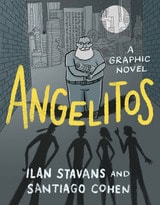
Angelitos
A Graphic NovelIlan Stavans and Santiago Cohen
The Ohio State University Press, 2018
Though Angelitos: A Graphic Novel is a fictional retelling of a desperate time, it draws on autobiographical elements to tell the real-life story of Alejandro García Durán de Lara, popularly known as Padre Chinchachoma, a complicated figure revered by some and reviled by others.
As She Was Discovering Tigony
Olympe Bhêly-Quenum
Michigan State University Press, 2016

Balkan Beauty, Balkan Blood
Modern Albanian Short StoriesRobert Elsie
Northwestern University Press, 2006
Albania's more established writers (including Dritëro Agolli, Ismail Kadare, Teodor Laço, and Eqrem Basha) appear here alongside newer talents (such as Ylljet Aliçka, Mimoza Ahmeti, Elivra Dones, Lindita Arapi, and Kim Mehmeti), providing English-speaking readers with an elucidating and entertaining overview of the recent history, and the future, of the nation's literature.

Beirut '75
Ghadah Samman
University of Arkansas Press, 1995
Ghada Samman’s first full-length novel, originally published in Arabic in 1974, is a creative and daring work prophetically depicting the social and political causes of the Lebanese civil war in 1975. The story opens in a taxi in which we meet the five central characters, each seeking something to give life meaning: security, fame, wealth, dignity, recognition, freedom from fear and from tradition-sanctioned, dehumanizing practices. Once they reach the capital city of Beirut, on which they’ve pinned their hopes, they all discover, man and woman alike, that they are victims of forces either partially or completely beyond their control, such as political corruption, class discrimination, economic and sexual exploitation, destruction of the natural environment, and blind allegiance to tradition.
Beirut ’75 addresses struggles of Arab society, particularly the Lebanese, but the message is one of the universal human condition. Thus, in addition to this superb English-language presentation, Samman’s novel has already appeared in German (two editions), French, and Italian versions.
Winner of The University of Arkansas Press Award for Arabic Literature in Translation.

Benefit Street
A NovelAdria Bernardi
University of Alabama Press, 2022
WINNER OF FC2's CATHERINE DOCTOROW INNOVATIVE FICTION PRIZE
A universal story of exile, of the refugee and emigrant, and of all those displaced who can reconstruct a sense of home only by weaving a new fabric of the imagination
For nearly two decades, Şiva has met after work on Tuesdays with four friends at a teahouse called the Kafiye. In interrupted conversations, the women explore what it is to live engaged lives inside and outside the home. Amidst joking and complaints, while drinking too much tea and eating too many sweets, they tell of their days: a son’s ninth birthday, the bruise on the arm of an aging parent, soldiers stationed outside the school, the funeral of an opposition political leader killed in a mysterious car accident.
Set in an unnamed provincial capital of an unnamed country, Benefit Street tells of a wide circle of friends—teachers, lawyers, missionaries, doctors, artisans—in a time of gathering and dispersal. It tells the story of mothers, daughters, sisters, wives, colleagues, and neighbors, as war to the East threatens and constitutional rights are daily eroded by an increasingly authoritarian regime.
The ideals of youth, freedom, and coexistence are severely tested with the shocking revelation that the charismatic leader of their group has sexually abused the women under his care. The limits of reconciliation are tested as Şiva makes an arduous journey into the mountains to meet an estranged mother with a genius for weaving complex rugs.

Black Diamond
Zakes Mda
Seagull Books, 2014
Kristin receives menacing phone calls and her home is invaded and vandalized—even her cat isn’t spared the threats—and the chief magistrate has no choice but to assign a bodyguard to protect her. To Kristin’s consternation, security guard Don Mateza moves into her home and trails her everywhere. This new arrangement doesn’t suit Don’s longtime girlfriend Tumi, a former model and successful businesswoman, who is intent on turning Don into a Black Diamond—a member of the wealthy new black South African middle class. And Don soon finds that his new assignment has unexpected complications that Tumi simply does not understand.
In Black Diamond, Mda tackles every conceivable South African stereotype, skillfully turning them upside down and exposing their ironies—often hilariously. This is a clever, quirky novel, in which Mda captures the essence of contemporary life in a fast-changing urban world.
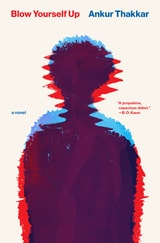
Blow Yourself Up
A NovelAnkur Thakkar
Northwestern University Press, 2026
A story of first love across cities spanning the decade that transformed the internet
In the halls of an elite East Coast high school, Arjun and Payal fall in love as the world begins to tilt toward the digital. Over the next eight years, their trajectories diverge as sharply as the fractured internet itself. Payal ascends to the dizzying, dopamine-fueled heights of New York’s influencer economy, finding fame on Boost, a looping video app that is as rewarding as it is demanding. Meanwhile, in a cavernous office in Chicago, Arjun, a musician whose dreams have quieted, now cleans up the same platform’s debris, moderating the internet’s darkest videos. When a brutal act of political violence against a beloved musician goes viral, this rip in reality forces the pair to confront the motivations of the platforms they inhabit. A sharp exploration of creative ambition and the multifarious nature of identity, this is a story of love in the time of infinite scroll and a look at what we sacrifice to be seen.
Brown Girls, Grown Up
StoriesSima Qadeer
Northwestern University Press, 2026
A poignant and graceful story collection about the clash and harmony of finding one’s place in an adult world that feels “other”
Brown Girls, Grown Up shines a light on the nuances of modern womanhood with grace, honesty, and charm. The stories in Qadeer’s debut collection delve into the subtleties and blatant struggles of navigating shifting identities as one matures, into the joys and challenges of intimacy and aging, and into the changing tides of motherhood. Middle-aged Amira takes radical action after meeting a new friend who lulls her into feeling safe and accepted; Hanna enrolls her biracial children in a local Sunday school after worrying they have no real connection to her Muslim heritage; betrayals and secrets come to light when a group of college friends reunite to take stock and compare achievements. Filled with humor and heartache, this collection offers a fresh and profoundly relatable perspective on the lifelong search for belonging in a world shaped by tradition, modernity, and individual ambition.
Camp Nine
A NovelVivienne Schiffer
University of Arkansas Press, 2011
Clearing Out
A NovelHelene Uri
University of Minnesota Press, 2024
Winner of the Nadia Christensen Prize for translation from the American-Scandinavian Foundation
In a masterful blend of fiction and autobiography, a Norwegian novelist sends her character to the far north to learn what she can about their Sami ancestry
Inspired by Helene Uri’s own journey into her family’s ancestry, Clearing Out, an emotionally resonant novel by one of Norway’s most celebrated authors, tells two intertwining stories. A novelist, named Helene, is living in Oslo with her husband and children and contemplating her new protagonist, Ellinor Smidt—a language researcher, divorced and in her late thirties, with a doctorate but no steady job.
An unexpected call from a distant relative reveals that Helene’s grandfather, Nicolai Nilsen, was the son of a coastal (sjø) Sami fisherman—something no one in her family ever talked about. Uncertain how to weave this new knowledge into who she believes she is, Helene continues to write her novel, in which her heroine Ellinor travels to Finnmark in the far north to study the dying languages of the Sami families there. What Ellinor finds among the Sami people she meets is a culture little known in her own world; she discovers history richer and more alluring than rumor and a connection charged with mystery and promise. Through her persistence in approaching an elderly Sami activist, and her relationship with a local Sami man, Ellinor confronts a rift that has existed between two families for generations.
Intricate and beautifully constructed, Clearing Out offers a solemn reflection on how identities, like families, are formed and fractured and recovered as stories are told. In its depiction of the forgotten and the fiercely held memories among the Sea (sjø) Sami of northern Norway, the novel is a powerful statement on what is lost, and what remains in reach, in the character and composition of contemporary life.
Conflict and Cultural Heritage
A Moral Analysis of the Challenges of Heritage ProtectionHelen Frowe
J. Paul Getty Trust, The, 2019
A number of writers and thinkers working on the problem of preserving the world’s most treasured monuments, sites, and objects today cite what Frowe and Matravers call extrinsic and intrinsic justifications for the protection of cultural heritage. These are arguments that maintain that protecting heritage will be a key means to achieve other important goals, like the prevention of genocide, or arguments that heritage deserves to be forcefully protected for its own sake. Frowe and Matravers deconstruct both types of justifications, demonstrating a lack of clear evidence for a causal relationship between the destruction of cultural heritage and atrocities like genocide and arguing that the defense of heritage must not be treated with the same weight or urgency, or according to the same international policies, as the defense of human lives.
By calling for expanded theory and empirical data and the consideration of morality in the crafting of international policy vis-à-vis cultural heritage protection, Frowe and Matravers present a thoughtful critique that enriches this important series and adds to the ongoing dialogue in the field.
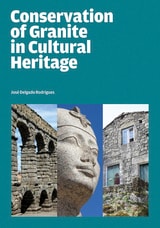
Conservation of Granite in Cultural Heritage
José Delgado Rodrigues
J. Paul Getty Trust, The, 2025
The field of stone conservation has long needed a holistic perspective that embraces the needs of conservation professionals and provides scientific support to enable them to better analyze preservation issues and implement efficient, long-lasting treatments. Conservation of Granite in Cultural Heritage offers such a perspective by bridging scholarly research on the available literature related to granite decay and best practices from conservators working in the field and laboratory.
First offering an overview of granitic rocks and their natural weathering, this volume then outlines the issues that arise when removing granite from quarries and incorporating it into what eventually becomes built heritage. Case studies are presented alongside guidelines for assessing conservation problems. This book will serve as a fundamental manual for students, conservation scientists, conservators, and restorers alike.
Conservation of Natural and Cultural Heritage in Kenya
Edited by Anne-Marie Deisser and Mugwima Njuguna
University College London, 2016
Cosella Wayne
Or, Will and DestinyCora Wilburn, edited and introduced by Jonathan D. Sarna
University of Alabama Press, 2019
Published serially in the spiritualist journal Banner of Light in 1860, Cosella Wayne: Or, Will and Destiny is the first coming-of-age novel, written and published in English by an American Jewish woman, to depict Jews in the United States and transforms what we know about the history of early American Jewish literature. The novel never appeared in book form, went unmentioned in Jewish newspapers of the day, and studies of nineteenth-century American Jewish literature ignore it completely. Yet the novel anticipates many central themes of American Jewish writing: intermarriage, generational tension, family dysfunction, Jewish-Christian relations, immigration, poverty, the place of women in Jewish life, the nature of romantic love, and the tension between destiny and free will.
The narrative recounts a relationship between an abusive Jewish father and the rebellious daughter he molested as well as that daughter’s struggle to find a place in the complex social fabric of nineteenth-century America. It is also unique in portraying such themes as an unmarried Jewish woman’s descent into poverty, her forlorn years as a starving orphaned seamstress, her apostasy and return to Judaism, and her quest to be both Jewish and a spiritualist at one and the same time.
Jonathan Sarna, who introduces the volume, discovered Cosella Wayne while pursuing research at the Israel Institute for Advanced Studies in Jerusalem. This edition is supplemented with selections from Cora Wilburn’s recently rediscovered diary, which are reprinted in the appendix. Together, these materials help to situate Cosella Wayne within the life and times of one of nineteenth-century American Jewry’s least known and yet most prolific female authors.
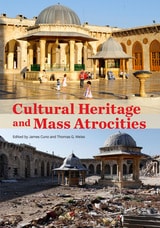
Cultural Heritage and Mass Atrocities
James Cuno
J. Paul Getty Trust, The, 2022
Intentional destruction of cultural heritage has a long history. Contemporary examples include the Bamiyan Buddhas in Afghanistan, mosques in Xinjiang, mausoleums in Timbuktu, and Greco-Roman remains in Syria. Cultural heritage destruction invariably accompanies assaults on civilians, making heritage attacks impossible to disentangle from the mass atrocities of genocide, war crimes, crimes against humanity, and ethnic cleansing. Both seek to eliminate people and the heritage with which they identify.
Cultural Heritage and Mass Atrocities assembles essays by thirty-eight experts from the heritage, social science, humanitarian, legal, and military communities. Focusing on immovable cultural heritage vulnerable to attack, the volume's guiding framework is the Responsibility to Protect (R2P), a United Nations resolution adopted unanimously in 2005 to permit international intervention against crimes of war or genocide. Based on the three pillars of prevent, react, and rebuild, R2P offers today's policymakers a set of existing laws and international norms that can and—as this book argues—must be extended to the protection of cultural heritage. Contributions consider the global value of cultural heritage and document recent attacks on people and sites in China, Guatemala, Iraq, Mali, Sri Lanka and Afghanistan, Syria, and Yemen. Comprehensive sections on vulnerable populations as well as the role of international law and the military offer readers critical insights and point toward research, policy, and action agendas to protect both people and cultural heritage. A concise abstract of each chapter is offered online in Arabic, Chinese, French, Russian, and Spanish to facilitate robust, global dissemination of the strategies and tactics offered in this pathbreaking call to action.
The free online edition of this publication is available at getty.edu/publications/cultural-heritage-mass-atrocities. Also available are free PDF, EPUB, and Kindle/MOBI downloads of the book.
Cultural Heritage and the Campus Community
Academic Libraries and Museums in CollaborationAlexia Hudson-Ward
Assoc of College & Research Libraries, 2022
Cultural Heritage and the Campus Community collects examples of successful academic library-museum collaborations and serves as critical knowledge for the cultural heritage sector. Authors from libraries and museums across the United States demonstrate how to develop and execute partnerships and bring forth new dimensions of transdisciplinary objects-based pedagogy, research, and learning centered on inclusive educational practices. Chapters explore visual thinking strategies and the Framework for Information Literacy in Higher Education in the undergraduate classroom; restoring Indigenous heritage through tribal partnerships; using object-based teaching to motivate student research; and much more.
The collaborative approaches highlighted here demonstrate the power of possibility when two collections-centric entities unite to enrich our collective understanding of materiality, instructional approaches, and the importance of provenance. Cultural Heritage and the Campus Community also illustrates why interrogating past practices and value assignments within academic library and museum collections is essential to advancing culturally relevant approaches to knowledge sharing in physical and digital spaces.
Cultural Heritage in Mali in the Neoliberal Era
Rosa De Jorio
University of Illinois Press, 2016
Double Toil and Trouble
A New Novel and Short Stories by Donald HaringtonDonald Harington
University of Arkansas Press, 2020
Edited by longtime Harington scholar Brian Walter, Double Toil and Trouble also includes an appendix featuring the author’s spirited correspondence with the editor who originally inspired the title novel, providing an insider’s look at the American literary scene and Harington’s own early assessment of his work. Spanning several decades of the author’s career, this volume gives readers a Harington who is at once familiar and fresh as he experiments with new formal possibilities, only to once again endear the vagaries of love, life, and folk language to us.
Faith and Fat Chances
A NovelCarla Trujillo
Northwestern University Press, 2015
Finalist, 2012 PEN/Bellwether Prize for Socially Engaged Fiction
Carla Trujillo brings to life another side of the fabled city of Santa Fe in this rollicking novel set in Dogtown, a dilapidated neighborhood on the outskirts of town. Home to a hardscrabble community of working people struggling to make a living on meager means, Dogtown is worlds apart from the tourists, artists, and upscale eateries just a stone’s throw away. The close-knit neighborhood thrives in its own way, until an entrepreneur arrives with a plan to cast out its occupants and construct a winery in its place.
Led by Dogtown’s unofficial mayor, Pepa Romero—an irreverent healer with old-world wisdom and new-age knowledge—the citizens of Dogtown revolt. Using everything at their disposal, including spying, supernatural powers, the law, and individual cunning, they set in motion a thrilling and at times hilarious chain of events that culminates in a storm of epic proportions. With an unforgettable cast of characters, Faith and Fat Chances illuminates the ingenuity and resilience of people fighting to preserve their way of life.
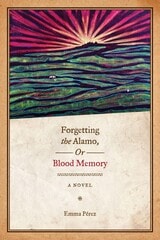
Forgetting the Alamo, Or, Blood Memory
A NovelBy Emma Pérez
University of Texas Press, 2009
Runner-up, Best Historical Fiction in English, Latino Book Awards Competition, 2010
This literary adventure takes place in nineteenth-century Texas and follows the story of a Tejana lesbian cowgirl after the fall of the Alamo. Micaela Campos, the central character, witnesses the violence against Mexicans, African Americans, and indigenous peoples after the infamous battles of the Alamo and of San Jacinto, both in 1836. Resisting an easy opposition between good versus evil and brown versus white characters, the novel also features Micaela's Mexican-Anglo cousin who assists and hinders her progress. Micaela's travels give us a new portrayal of the American West, populated by people of mixed races who are vexed by the collision of cultures and politics. Ultimately, Micaela's journey and her romance with a black/American Indian woman teach her that there are no easy solutions to the injustices that birthed the Texas Republic.
This novel is an intervention in queer history and fiction with its love story between two women of color in mid-nineteenth-century Texas. Pérez also shows how a colonial past still haunts our nation's imagination. The battles of the Alamo and San Jacinto offered freedom and liberty to Texans, but what is often erased from the story is that common people who were Mexican, Indian, and Black did not necessarily benefit from the influx of so many Anglo immigrants to Texas. The social themes and identity issues that Pérez explores—political climate, debates over immigration, and historical revision of the American West—are current today.
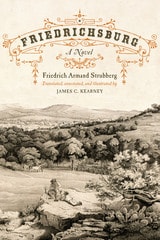
Friedrichsburg
A NovelBy Friedrich Armand Strubberg
University of Texas Press, 2012
Summerfield G. Roberts Award for a Work of Creative Writing, Sons of the Texas Republic, 2013
First published in Germany in 1867, this fascinating autobiographical novel of German immigrants on the antebellum Texas frontier provides a trove of revelations about the myriad communities that once called the Hill Country home.
Founded in 1846, Fredericksburg, Texas, was established by German noblemen who enticed thousands of their compatriots to flee their overcrowded homeland with the prospect of free land in a place that was portrayed as a new Garden of Eden. Few of the settlers, however, were prepared for the harsh realities of the Texas frontier or for confrontation with the Comanche. In his 1867 novel Friedrichsburg, Friedrich Armand Strubberg, a.k.a. Dr. Schubbert, interwove his personal story with a fictional romance to capture the flavor of Fredericksburg, Texas, during its founding years when he served as the first colonial director.
Now available in a contemporary translation, Friedrichsburg brings to life the little-known aspects of life among these determined but often ill-equipped settlers who sought to make the transition to a new home and community on the Texas frontier. Opening just as a peace treaty is being negotiated between the German newcomers and the Comanches, the novel describes the unlikely survival of these fledgling homesteads and provides evidence that support from the Delaware Indians, as well as the nearby Mormon community of Zodiac, was key to the Germans’ success. Along the way, Strubberg also depicts the laying of the cornerstone to the Vereinskirche, the blazing of an important new road to Austin, exciting hunting scenes, and an admirable spirit of cultural cohesion and determined resilience. In so doing, he resurrects a fascinating lost world.
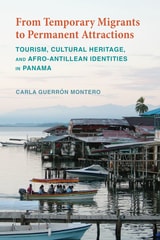
From Temporary Migrants to Permanent Attractions
Tourism, Cultural Heritage, and Afro-Antillean Identities in PanamaCarla Guerrón Montero
University of Alabama Press, 2020
A new reading of Panama’s nation-building process, interpreted through a lens of transnational tourism
Based on long-term ethnographic and archival research, From Temporary Migrants to Permanent Attractions: Tourism, Cultural Heritage, and Afro-Antillean Identities in Panama considers the intersection of tourism, multiculturalism, and nation building. Carla Guerrón Montero analyzes the ways in which tourism becomes a vehicle for the development of specific kinds of institutional multiculturalism and nation-building projects in a country that prides itself on being multiethnic and racially democratic.
The narrative centers on Panamanian Afro-Antilleans who arrived in Panama in the nineteenth century from the Greater and Leeward Antilles as a labor force for infrastructural projects and settled in Panama City, Colón, and the Bocas del Toro Archipelago. The volume discusses how Afro-Antilleans, particularly in Bocas del Toro, have struggled since their arrival to become part of Panama’s narrative of nationhood and traces their evolution from plantation workers for the United Fruit Company to tourism workers. Guerrón Montero notes that in the current climate of official tolerance, they have seized the moment to improve their status within Panamanian society, while also continuing to identify with their Caribbean heritage in ways that conflict with their national identity.
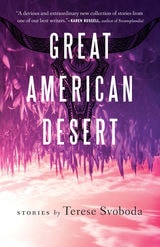
Great American Desert
StoriesTerese Svoboda
The Ohio State University Press, 2019
In her arresting and inimitable style, Svoboda’s delicate handling of the complex dynamics of family and self seeps into every sentence of these first-rate short stories about what we do to the world around us—and what it can do to us.
Historical and Philosophical Issues in the Conservation of Cultural Heritage
Nicholas Price
J. Paul Getty Trust, The, 1996
The thirty major art historians and scholars represented raise questions such as when to restore, what to preserve, and how to maintain aesthetic character. Excerpts have been selected from the following books and essays: John Ruskin, The Seven Lamps of Architecture; Bernard Berenson, Aesthetics and History in the Visual Arts; Clive Bell, The Aesthetic Hypothesis; Cesare Brandi, Theory of Restoration; Kenneth Clark, Looking at Pictures; Erwin Panofsky, The History of Art as a Humanistic Discipline; E. H. Gombrich, Art and Illusion; Marie Cl. Berducou, The Conservation of Archaeology; and Paul Philippot, Restoration from the Perspective of the Social Sciences. The fully illustrated book also contains an annotated bibliography and an index.
Hobomok and Other Writings on Indians
Karcher, Carolyn L
Rutgers University Press, 1986
Hope Leslie
Or, Early Times in the MassachusettsSedgwick, Catherine M
Rutgers University Press, 1987
Hope Leslie (1827), set in the seventeenth-century New England, is a novel that forced readers to confront the consequences of the Puritans’ subjugation and displacement of the indigenous Indian population at a time when contemporaries were demanding still more land from the Cherokees, the Chickasaws, and the Choctaws.
"This handsome reprint ... makes available after many decades the New Englander's tale of seventeeth-century Puritans, and their relations with the indigenous Indian population." -- Nineteeth-Century Literature
" A splendidly conceived edition of Sedwick's historical romance. Highly recommended." --Choice
"Develop(s) the connections between patriarchal authority within the Puritan state and its policy of dispossessing and exterminating Indians. The different heritage it envisions explicitly link white women and Indians and elaborates a communal concept of liberty at odds with the individualistic concept which predominated in American culture." -- Legacy
Sacred Wilderness
Susan Power
Michigan State University Press, 2014

Seventeen Syllables and Other Stories
Yamamoto, Hisaye
Rutgers University Press, 2001
In addition to the contents of the original volume, this edition brings back into print the following works:
- Death Rides the Rails to Poston
- Eucalyptus
- A Fire in Fontana
- Florentine Gardens
Smiling in the Darkness
Adelaide Freitas, Translated by Katharine F. Baker, with Bobby J. Chamberlain, Reinaldo F. Silva, and Emanuel Melo
Tagus Press, 2020
Many people of Portuguese descent take pride in claiming that the word “saudade” is untranslatable. In reality, we come close with a melding of bittersweet nostalgia, bone-deep longing, and an endless yearning for what one can never have again—or indeed may never have had. Adelaide Freitas dipped her pen in saudade to tell of family separation and bonds that never loosen. In her authentic Azorean voice, she recounts the immigrant experience and centrifugal impulses that force people apart in spite of their desperation to cling to one another. In their sensitive rendering, the translators have captured the nuances of Freitas's novel Smiling in the Darkness, with special care for those who have her native language in their heritage and heartfelt saudade for its loss.
Spirit Wind
Jon L. Gibson
University of Alabama Press, 2009
A coming-of-age story set in the isolated, murky swamps of Louisiana.
When the mighty wind blows through the swamps of southern Louisiana, it changes not only the land, but the inhabitants as well. Just such a wind brought a lone infant into the care of the Chitimacha Indians deep in the Atchafalaya swamp. Raised by the tribal holy man, Storm Rider grows to adolescence as a respected tribal member, steeped in the wisdom and traditions of his adopted people. Their clan competitions, life-cycle rituals, social interactions, and subsistence labors are well explained in this historical novel.
When captured by an enemy raiding party, Storm Rider and his nemesis, the village bully, forge a bond that delivers them from danger and charts their futures. Love, hate, friendship, and loyalty ride the dark bayou waters and converge at the sacred Rain Tree. Swamps, hurricanes, cannibals, and unforgettable characters are interwoven as tightly as one of old Cane Basket's watertight baskets in this anthropologically accurate story of American Indian cultures in conflict.
Stories for a Lost Child
Carter Meland
Michigan State University Press, 2017
Tales from la Vida
A Latinx Comics AnthologyEdited by Frederick Luis Aldama
The Ohio State University Press, 2018
In the Latinx comics community, there is much to celebrate today, with more Latinx comic book artists than ever before. The resplendent visual-verbal storyworlds of these artists reach into and radically transform so many visual and storytelling genres. Tales from la Vida celebrates this space by bringing together more than eighty contributions by extraordinary Latinx creators. Their short visual-verbal narratives spring from autobiographical experience as situated within the language, culture, and history that inform Latinx identity and life. Tales from la Vida showcases the huge variety of styles and worldviews of today’s Latinx comic book and visual creators.
Whether it’s detailing the complexities of growing up—mono- or multilingual, bicultural, straight, queer, or feminist Latinx—or focusing on aspects of pop culture, these graphic vignettes demonstrate the expansive complexity of Latinx identities. Taken individually and together, these creators—including such legendary artists as Jaime and Gilbert Hernandez, Roberta Gregory, and Kat Fajardo, to name a few—and their works show the world that when it comes to Latinx comics, there are no limits to matters of content and form. As we travel from one story to the next and experience the unique ways that each creator chooses to craft his or her story, our hearts and minds wake to the complex ways that Latinxs live within and actively transform the world.
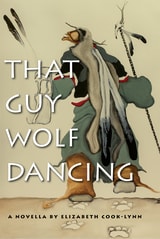
That Guy Wolf Dancing
Elizabeth Cook-Lynn
Michigan State University Press, 2014
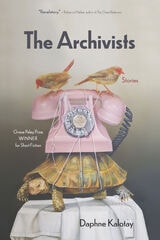
The Archivists
StoriesDaphne Kalotay
Northwestern University Press, 2023
Longlisted for the 2024 Joyce Carol Oates Prize
Longlisted for the 2024 Massachusetts Book Award
The characters in The Archivists are everyday people, but when private losses or the shocks of history set their worlds reeling, they find connection and liberation in surprising, buoyant ways. This vibrant collection brings transcendence, wry humor, and a touch of the uncanny to life’s absurdities and catastrophes—whether the 2008 economic crash, fallout after the 2016 presidential election, gentrification, pandemic lockdown, illness, or the intergenerational impacts of the Holocaust and Communist occupation of Eastern Europe.
A hardheaded realist is confronted by both her mortality and a would-be wizard. A thirteen-year-old girl in 1950s Toronto infiltrates the ranks of Bell Canada. A ninety-nine-year-old woman appears to be invincible. A group hikes in Germany, and a solitary woman is pursued on a walk in New Mexico. These deeply moving stories ingeniously consider issues of identity, history, and memory and our shared search for meaning in an off-kilter world.
The Golden Land
Elizabeth Shick
New Issues Poetry and Prose, 2022
When Etta's grandmother dies, she is compelled to travel to Myanmar to explore complicated adolescent memories of her grandmother's family and the violence she witnessed there. Full of rich detail and complex relationships, The Golden Land explores those personal narratives that might lie beneath the surface of historical accounts.
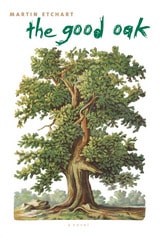
The Good Oak
Martin Etchart
University of Nevada Press, 2005
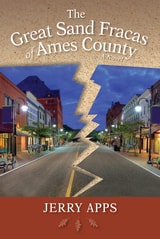
The Great Sand Fracas of Ames County
A NovelJerry Apps
University of Wisconsin Press, 2014
Soon the fracas over frac sand attracts some national attention, including that of Stony Field, the pen name of a nationally syndicated columnist. Will the village board vote to solve their budget problems with a cut of the mining profits? Will the mine create real jobs for local folks? Will Stony Field come to the village to lead protests against the mine? And will defenders of the Trail Marker Oak literally draw a battle line in the sand?
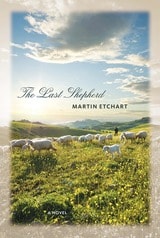
The Last Shepherd
Martin Etchart
University of Nevada Press, 2012
Matt’s journey to manhood takes place in a vividly depicted landscape populated by lively, memorable characters. This is the powerful story of a young man’s search for an identity that encompasses two cultures and one complex, scattered family.
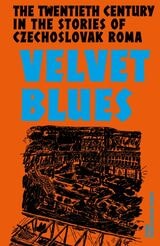
Velvet Blues
Twentieth Century in the Stories of Czechoslovak RomaEdited by Karolína Ryvolová
Karolinum Press, 2026
Romani writers from former Czechoslovakia offer their history and perspective in this important collection that fills a gap in world literature.
As representatives of an oral culture, the Romani people have throughout history been the subject of stories written by outsiders. Sometimes idealized, often defamed, and even condemned, they have seldom been accurately portrayed by the majority of writers. It has only been in the last century that the Roma have finally started writing for themselves.
The fifteen Romani writers from former Czechoslovakia featured in this anthology speak of the people, times, and places they particularly hold dear. Although the roads of the Roma have always been paved with disrespect, discrimination, and vicious racial persecution by mainstream societies, these stories frequently talk about the good things in life. Be it the writers’ homes in the traditional settlements of rural Eastern Slovakia, the Czech industrial towns where the families moved after WWII in search of a better life, or the bustling cities of the post-transition period, they demonstrate immense pride in their Romani identity, love of their Romani language, and heartfelt respect for their elders. Velvet Blues provides a very different picture from the stock character of “the Gypsy” so common in world literature.
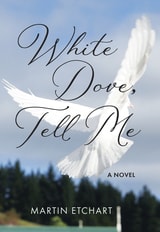
White Dove, Tell Me
A NovelMartin Etchart
University of Nevada Press, 2024
In the wake of this tragedy, Xabier learns that not only is the family ranch in jeopardy of foreclosure but his father’s death may not have been the accident it first appeared to be. Now, he must find a way to save his family’s ranch while unraveling the mysteries leading to his father’s death. Along the way, Xabier strives to adhere to his father’s memory and words—the invitation to stay true to who he is without losing his arima (soul).
In lyrical language that evokes the mythologies that have shaped the Etxeas’s worldview, White Dove, Tell Me speaks to the divided self that seeks to honor the family’s Basque heritage, while they strive for understanding in a new land.
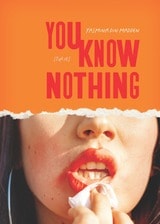
You Know Nothing
StoriesYasmina Din Madden
Northwestern University Press, 2026
Following women and girls as they navigate everyday life in contemporary America, You Know Nothing explores the experiences of mothers, daughters, sisters, wives, and lovers whose inner worlds are animated by a tangle of emotion—from desire to rage and everything in between. Yasmina Din Madden’s characters inhabit the margins of their cultures, their diverse backgrounds united by their profound unease and the female bodies in which each resides. Madden takes us into the lives of a ravenous mother who devours her own son, a woman who sands away parts of her body, a Vietnamese mother facing her too-American children, and a fiercely protective dog owner who wanders a dog park with Satan’s master. In this debut collection, Madden brings these characters to life in bite-size stories of surreal revelation and inquisitive long-form explorations alike, leaving newfound clarity and hypnotizing carnage in her wake.
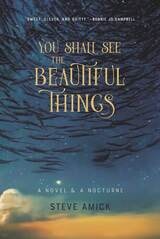
You Shall See the Beautiful Things
A Novel & A NocturneSteve Amick
Acre Books, 2023
In the fishing village of Scheveningen in 1889, three men build and secretly launch an unorthodox fishing vessel, departing from the long tradition of netting herring using massive boats and large crews. Collaborating in this venture are Wyn van Winkel, a cavalier joker and opium addict currently AWOL from the Aceh War in Sumatra; Ned Nodder, a seasoned fisherman trying to support his family while plagued by narcolepsy and prophetic dreams; and Luuk Blenkin, a scattered young troubadour failing at love and searching for his place in the world.
As formally innovative as the “picarooner” this mismatched trio construct, the narrative lifts off into the fantastical, flitting between reality and irreality. Sparked by lines of the “Dutch lullaby,” the inexplicable adventure unfolds—and along the way, we learn of Wyn’s romantic recklessness, his broken relationship with his father, and the tragedies of war that scarred and changed him. We witness Ned’s unconventional path toward matrimony, as well as the painful loss that made his marriage a true union. We follow Luuk’s fumblings for purpose and fulfillment beyond the disgrace that befell his family and marred both his outlook and his prospects.
In the spirit of a nocturne, Steve Amick envelops his characters in the world of night and dreams. Lyrical, historical, surprising, magical, heartwarming, and heartbreaking, You Shall See the Beautiful Things will make readers look at the stars—and herring—in a new light.