Results by title
21 books match the query 'Curriculum'
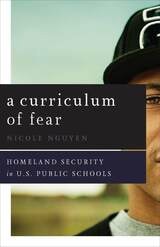
A Curriculum of Fear
Homeland Security in U.S. Public SchoolsNicole Nguyen
University of Minnesota Press, 2016
Welcome to Milton High School, where fear is a teacher’s best tool and every student is a soldier in the war on terror. A struggling public school outside the nation’s capital, Milton sat squarely at the center of two trends: growing fear of resurgent terrorism and mounting pressure to run schools as job training sites. In response, the school established a specialized Homeland Security program.
A Curriculum of Fear takes us into Milton for a day-to-day look at how such a program works, what it means to students and staff, and what it says about the militarization of U.S. public schools and, more broadly, the state of public education in this country. Nicole Nguyen guides us through a curriculum of national security–themed classes, electives, and internships designed through public-private partnerships with major defense contractors like Northrop Grumman and federal agencies like the NSA. She introduces us to students in the process of becoming a corps of “diverse workers” for the national security industry, learning to be “vigilant” citizens; and she shows us the everyday realities of a program intended to improve the school, revitalize the community, and eliminate the achievement gap.
With reference to critical work on school militarization, neoliberal school reform, the impact of the global war on terror on everyday life, and the political uses of fear, A Curriculum of Fear maps the contexts that gave rise to Milton’s Homeland Security program and its popularity. Ultimately, as the first ethnography of such a program, the book provides a disturbing close encounter with the new normal imposed by the global war on terror—a school at once under siege and actively preparing for the siege itself.
Assignments across the Curriculum
A National Study of College WritingDan Melzer
Utah State University Press, 2014
In Assignments across the Curriculum, Dan Melzer analyzes the rhetorical features and genres of writing assignments through the writing-to-learn and writing-in-the-disciplines perspectives. Presenting the results of his study of 2,101 writing assignments from undergraduate courses in the natural sciences, social sciences, business, and humanities in 100 postsecondary institutions in the United States, Assignments across the Curriculum is unique in its cross-institutional breadth and its focus on writing assignments.
The results provide a panoramic view of college writing in the United States. Melzer's framework begins with the rhetorical situations of the assignments—the purposes and audiences—and broadens to include the assignments' genres and discourse community contexts. Among his conclusions is that courses connected to a writing-across-the-curriculum (WAC) initiative ask students to write more often, in a greater variety of genres, and for a greater variety of purposes and audiences than non-WAC courses do, making a compelling case for the influence of the WAC movement.
Melzer's work also reveals patterns in the rhetorical situations, genres, and discourse communities of college writing in the United States. These larger patterns are of interest to WAC practitioners working with faculty across disciplines, to writing center coordinators and tutors working with students who bring assignments from a variety of fields, to composition program administrators, to first-year writing instructors interested in preparing students for college writing, and to high school teachers attempting to bridge the gap between high school and college writing.
Basic Principles of Curriculum and Instruction
Ralph W. Tyler
University of Chicago Press, 1969
The four sections of the book deal with ways of formulating, organizing, and evaluating the educational objectives that have been chosen for the curriculum. Tyler emphasizes the fact that curriculum planning is a continuous cyclical process, involving constand replanning, redevelopment, and reappraisal. Substitution of such an integrated view of an instructional program for hit-or-miss judgment as the basis for curriculum development cannot but result in an increasingly effective curriculum.
Basic Principles of Curriculum and Instruction
Ralph W. Tyler
University of Chicago Press, 2013
Basic Principles of Curriculum and Instruction has been the standard in the field for decades, and it continues to be the leading guide to curriculum development today. Ralph W. Tyler presents here the concept that curriculum should be dynamic, a program under constant evaluation and revision. Before the publication of this book, curriculum had generally been thought of as a static, set program, and in an era preoccupied with student testing, he offered the innovative idea that teachers and administrators should spend as much time evaluating their plans as they do assessing their students.
Although not a strict how-to guide, the book shows how educators can critically approach curriculum planning, studying progress and retooling when needed. Its four sections focus on setting objectives, selecting learning experiences, organizing instruction, and evaluating progress. Readers will come away with a firm understanding of how to formulate educational objectives and how to analyze and adjust their plans so that students meet the objectives. Tyler also explains that curriculum planning is a continuous, cyclical process, an instrument of education that needs to be fine-tuned.
This emphasis on thoughtful evaluation has kept Basic Principles of Curriculum and Instruction a relevant, trusted companion for decades. Even as the educational landscape changes and teachers and administrators have to adjust to new developments in testing, student engagement, regulation, and more, the core principles animating this book remain as valid and effective as ever. And with school districts across the nation working to align their curriculum with Common Core standards, Tyler's straightforward recommendations are sound and effective tools for educators working to create a curriculum that integrates national objectives with their students' needs.
Basic Principles of Curriculum and Instruction
Ralph W. Tyler
University of Chicago Press, 2013
In 1949, a small book had a big impact on education. In just over one hundred pages, Ralph W. Tyler presented the concept that curriculum should be dynamic, a program under constant evaluation and revision. Curriculum had always been thought of as a static, set program, and in an era preoccupied with student testing, he offered the innovative idea that teachers and administrators should spend as much time evaluating their plans as they do assessing their students.
Since then, Basic Principles of Curriculum and Instruction has been a standard reference for anyone working with curriculum development. Although not a strict how-to guide, the book shows how educators can critically approach curriculum planning, studying progress and retooling when needed. Its four sections focus on setting objectives, selecting learning experiences, organizing instruction, and evaluating progress. Readers will come away with a firm understanding of how to formulate educational objectives and how to analyze and adjust their plans so that students meet the objectives. Tyler also explains that curriculum planning is a continuous, cyclical process, an instrument of education that needs to be fine-tuned.
This emphasis on thoughtful evaluation has kept Basic Principles of Curriculum and Instruction a relevant, trusted companion for over sixty years. And with school districts across the nation working feverishly to align their curriculum with Common Core standards, Tyler's straightforward recommendations are sound and effective tools for educators working to create a curriculum that integrates national objectives with their students' needs.
Curriculum as Conversation
Transforming Traditions of Teaching and LearningArthur N. Applebee
University of Chicago Press, 1996
“Applebee's central point, the need to teach 'knowledge in context,' is absolutely crucial for the hopes of any reformed curriculum. His experience and knowledge give his voice an authority that makes many of the current proposals on both the left and right seem shallow by comparison.”—Gerald Graff, University of Chicago
Curriculum of the Mind
Stevie “Dr. View” Johnson and The Space Program
University of Michigan Press, 2026
Curriculum of the Mind is a groundbreaking hip-hop album that transforms the boundaries of scholarship, sound, and storytelling. A deeply personal and political intervention into the structures of higher education, the project speaks directly to the soul of education, identity, and cultural resilience. Part collective memoir, part mixtape, and part political manifesto, Curriculum of the Mind invites readers and listeners alike into a world where turntables become textbooks, beats carry the weight of history, and samples act as archives of Black life.
Produced by Stevie “Dr. View” Johnson, this album features the work of Black students, parents, creatives, and prospective college-goers who rarely see themselves reflected in academia. At the same time, it challenges educators, librarians, and institutions to rethink what learning looks and sounds like in the 21st century. The album draws from and contributes to interdisciplinary fields including Black studies, critical race theory, performance studies, and hip-hop pedagogy. Through powerful mashups and lyrical reflections, Dr. View and The Space Program explore themes of educational trauma, invisibility, intergenerational resilience, and the radical potential of sound as a vehicle for theorizing lived experience. Paired with a written preface, the project challenges the primacy of text-based knowledge, asserting that sound, emotion, and memory are equally valid forms of intellectual inquiry—and that scholarship can, and should, be a collective effort. As a model for the future of performance-based scholarship, Curriculum of the Mind proves that hip-hop is not only music—it’s a method, a memory, and a movement.
Curriculum or Craftsmanship
Elementary School Teachers in a Bureaucratic SystemHarry L. Gracey
University of Chicago Press, 1972
The majority of teachers are "production" oriented. They believe that their job is to see that the children in their charge complete as much of the standardized grade level curriculum as possible during the school year. They do achieve some success in preparing children for life in a society where bureaucracy is the dominant form of social organization.
The other significant type of teaching orientation is that of the "craftsmen." These instructors see their goal as the development of each individual's learning potential, with the curriculum built upon the specific needs and interests of each child. Bureaucratic school structures do nothing to promote this kind of teaching.
Any ideas that are at variance with the school's organizational structure will fail. The craftsman teachers do not have the time to communicate the standardized programs desired by the school board and also to make use of their own individualistic techniques. Further, the continued use of the former cancels the effects of the craftsman approach.
In delineating his conclusions, Professor Gracey includes his observations on the community and educational setting of the study, the two types of teachers, the administration, the parents, and the children's response to educational organization.
This study is unique in approaching its educational subject matter from a sociological point of view; Professor Gracey intended it as a study of behavior in organizations. It should also serve educational goals, however, and will therefore interest educators and concerned citizens as well as sociologists.
Deaf Learners
Developments in Curriculum and InstructionDonald F. Moores
Gallaudet University Press, 2006
Diverse Approaches to Teaching, Learning, and Writing Across the Curriculum
IWAC at 25Lesley Erin Bartlett
University Press of Colorado, 2020

Drama-based Pedagogy
Activating Learning Across the CurriculumKathryn Dawson and Bridget Kiger Lee
Intellect Books, 1995
Kathryn Dawson and Bridget Kiger Lee provide an extensive range of tried and tested strategies, planning processes, and learning experiences, in order to create a uniquely accessible manual for those who work, think, train, and learn in educational and/or artistic settings. It is the perfect companion for professional development and university courses, as well as for already established educators who wish to increase student engagement and ownership of learning.
English across the Curriculum
Voices from around the WorldBruce Morrison
University Press of Colorado, 2021
Genre Across The Curriculum
edited by Anne Herrington and Charles Moran
Utah State University Press, 2005
Genre across the Curriculum will function as a "good" textbook, one not for the student, but for the teacher, and one with an eye on the context of writing. Here you will find models of practice, descriptions written by teachers who have integrated the teaching of genre into their pedagogy in ways that both support and empower the student writer.
While authors here look at courses across disciplines and across a range of genres, they are similar in presenting genre as situated within specific classrooms, disciplines, and institutions. Their assignments embody the pedagogy of a particular teacher, and student responses here embody students' prior experiences with writing. In each chapter, the authors define a particular genre, define the learning goals implicit in assigning that genre, explain how they help their students work through the assignment, and, finally, discuss how they evaluate the writing their students do in response to their teaching.

Issues in Curriculum
Selected Essays from Past NSSE YearbooksEdited by Margaret Early and Kenneth J. Rehage
University of Chicago Press, 1999
New Work of Writing Across the Curriculum
Diversity and Inclusion, Collaborative Partnerships, and Faculty DevelopmentStaci M. Perryman-Clark
Utah State University Press, 2023
Many of these initiatives are created in isolation, reinforcing institutional silos that are not used strategically to gain the attention of senior administrators, particularly those working at state-supported public institutions who must manage shrinking institutional budgets. Yet teaching and learning centers and WAC programs gain tremendously from one another by building explicit partnerships on campus-wide diversity initiatives that emphasize cultural competence. In addition, both cultural competence and written proficiency enhance the transferable skills necessary for completing undergraduate education requirements, and this work can be leveraged to draw the attention of senior administrative leadership.
Faculty development and WAC need to make diversity and inclusion initiatives a priority for professional development. The New Work of Writing Across the Curriculum reviews initiatives that point to increased understanding of diversity and inclusion that will be of significance to administrators, WAC specialists, faculty developers, and diversity officers across the spectrum of institutions of higher learning.
Reconstructing Response to Student Writing
A National Study from across the CurriculumDan Melzer
Utah State University Press, 2023
Presenting the results of a national study of teacher and peer response and student self-assessment at institutions of higher education across the United States, Melzer analyzes teacher and peer response to over 1,000 pieces of student writing as well as 128 student portfolio reflection essays. He draws on his analysis and on a comprehensive review of the literature on response to introduce a constructivist heuristic for response aimed at both composition instructors and instructors across disciplines. Melzer argues that teachers and researchers should focus less on teacher response to individual pieces of student writing and more on engaging in dialogue with student self-assessment and peer response, focusing on growth and transfer rather than products and grades.
Reconstructing Response to Student Writing, especially when taken together with Melzer’s previous book Assignments across the Curriculum, provides a comprehensive and large-scale view of college writing and responding across the curriculum in the United States.
Science, Curriculum, and Liberal Education
Selected EssaysJoseph J. Schwab
University of Chicago Press, 1982
Schwab participated in what Daniel Bell has described as the "most thoroughgoing experiment in general education in any college in the United States," the College of the University of Chicago during the thirties, forties, and fifties. He played a central role in the curriculum reform movement of the sixties, and his extraordinary command of science, the philosophy of science, and traditional and modern views of liberal education found expression in these exceptionally thoughtful essays.
Teaching as Story Telling
An Alternative Approach to Teaching and Curriculum in the Elementary SchoolKieran Egan
University of Chicago Press, 1989
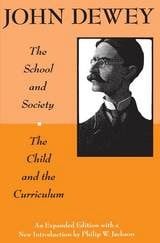
The School and Society and The Child and the Curriculum
John Dewey
University of Chicago Press, 1990
The School and Society and The Child and the Curriculum
John Dewey
University of Chicago Press, 1990
This edition brings Dewey's educational theory into sharp focus, framing his two classic works by frank assessments, past and present, of the practical applications of Dewey's ideas. In addition to a substantial introduction in which Philip W. Jackson explains why more of Dewey's ideas haven't been put into practice, this edition restores a "lost" chapter, dropped from the book by Dewey in 1915.
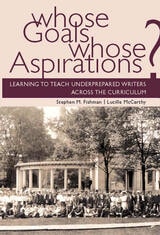
Whose Goals Whose Aspirations
Learning to Teach Underprepared Writers across the CurriculumStephen M. Fishman and Lucille McCarthy
Utah State University Press, 2002
Ever since Horace Mann promoted state supported schooling in the 1850s, the aims of U.S. public education have been the subject of heated national debate. Whose Goals? Whose Aspirations? joins this debate by exploring clashing educational aims in a discipline-based university classroom and the consequences of these clashes for "underprepared" writers.
In this close-up look at a White middle-class teacher and his ethnically diverse students, Fishman and McCarthy examine not only the role of Standard English in college writing instruction but also the underlying and highly charged issues of multiculturalism, race cognizance, and social class.