Results by title
20 books match the query 'Evaluation & Assessment'
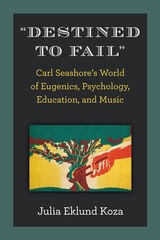
"Destined to Fail"
Carl Seashore’s World of Eugenics, Psychology, Education, and MusicJulia Eklund Koza
University of Michigan Press, 2021
A little-known fact about the prominent US psychologist and educator Carl E. Seashore (1866–1949) is that he was deeply involved in the American eugenics movement. He was among the US academics to support eugenics long before German Nazis embraced it. A titan in a host of disciplines and a proponent of radical education reform, Seashore used his positional power to promote a constellation of education reforms consistent with central precepts of eugenics. Many of these reforms, including tracking, gifted and talented programs, and high-stakes standardized testing, were adopted and remain standard practice in the United States today. He promulgated the idea that musical talent is biologically inheritable, and he developed the first standardized tests of musical talent; these tests were used by early-twentieth-century researchers in their attempts to determine whether there are race differences in musical talent. Seashore’s ideas and work profoundly shaped music education’s research trajectory, as well as enduring “commonsense” beliefs about musical ability. An intersectional analysis, “Destined to Fail” focuses on the relationship between eugenics and Seashore’s views on ability, race, and gender. Koza concludes that Seashore promoted eugenics and its companion, euthenics, because he was a true believer. She also discusses the longstanding silences surrounding Seashore’s participation in eugenics. As a diagnosis and critique of the present, “Destined to Fail” identifies resemblances and connections between past and present that illustrate the continuing influence of eugenics—and the systems of reasoning that made early-twentieth-century eugenics imaginable and seem reasonable—on education discourse and practice today. It maps out discursive, citational, and funding connections between eugenicists of the early twentieth-century and contemporary White supremacists; this mapping leads to some of Donald Trump’s supporters and appointees.
American Indian Educators in Reservation Schools
Terry Huffman
University of Nevada Press, 2014
An Age of Accountability
How Standardized Testing Came to Dominate American Schools and Compromise EducationJohn L. Rury
Rutgers University Press, 2024
An Alternate Pragmatism for Going Public
Jim Webber
Utah State University Press, 2017
An Alternate Pragmatism for Going Public interrogates composition’s most prominent responses to contemporary K–16 education reform. By “going public,” teachers, scholars, and administrators rightfully reassert their expertise against corporate-political standards and assessments like the Common Core, Complete College America, and the Collegiate Learning Assessment. However, author Jim Webber shows that composition’s professional imperative for self-defense only partly fulfils the broader aims of “going public,” which include fostering public participation that can assess and potentially affirm the public good of professional judgment.
Drawing on the pragmatic/democratic tradition, Webber envisions an alternate rhetoric of professionalism, one that not only reasserts compositionists’ expertise but also expands opportunities for publics to authorize this expertise. While this public inquiry and engagement may not safeguard professional standing against neoliberal reform, it reorients composition toward an equally important goal, enabling publics to gauge the adequacy of the educational standardization so often advocated by contemporary reform.
An Alternate Pragmatism for Going Public shows how public engagement can serve composition’s efforts related to “going public.”
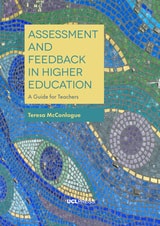
Assessment and Feedback in Higher Education
A Guide for TeachersTeresa McConlogue
University College London, 2020
Teachers spend much of their time on assessment, yet many higher education teachers have received minimal guidance on assessment design and marking. This means assessment can often be a source of stress and frustration. Offering a concise overview of assessment theory and practice, this guide provides teachers with the help they need. In education, theory and practice are often poorly linked. In this guide, Teresa McConlogue presents theoretical ideas and research findings and links them to practice. She considers recent theoretical work on feedback and suggests ways of developing evaluative judgment. Throughout the book, teachers are encouraged to examine their practice critically, and there are ideas for small-scale educational investigations, involving teachers, their colleagues, and students, such as using the Assessment Review Questionnaire to adapt assessments. This guide explores the concept of academic standards and proposes methods of co-constructing shared standards within a teaching team and with students through calibration activities.
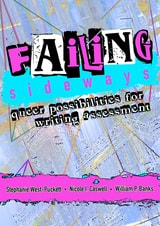
Failing Sideways
Queer Possibilities for Writing AssessmentStephanie West-Puckett
Utah State University Press, 2023
A failure-oriented assessment model unsettles some of the most common practices, like rubrics and portfolios, and challenges many deeply held assumptions about validity and reliability in order to ask what could happen if assessment was oriented toward possibility and potential. Working to engage a more capacious writing construct, the authors propose queer validity inquiry (QVI) as a model for assessment that values failure, affect, identity, and materiality. These overlapping lenses help teachers honor parts of writing and learning that writing studies faculty have struggled to hold onto in a world overly focused on quickness and efficiency in schools.
Through programmatic and classroom examples, Failing Sideways privileges what is valued in the classroom but traditionally ignored in assessments. Reimagining what matters in the teaching and learning of writing and using assessment data differently, this book demonstrates what writing can be and could do in a more diverse and just world.
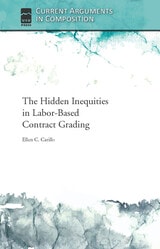
Hidden Inequities in Labor-Based Contract Grading
Ellen C. Carillo
Utah State University Press, 2021
Current Arguments in Composition Series
The Hidden Inequities in Labor-Based Contract Grading intervenes in the increasingly popular practice of labor-based grading by expanding the scope of this assessment practice to include students who are disabled and multiply marginalized. Through the lens of disability studies, the book critiques the assumption that labor is a neutral measure by which to assess students and explores how labor-based grading contracts put certain groups of students at a disadvantage. Ellen C. Carillo offers engagement-based grading contracts as an alternative that would provide a more equitable assessment model for students of color, those with disabilities, and students who are multiply marginalized.
This short book explores the history of labor-based grading contracts, reviews the scholarship on this assessment tool, highlights the ways in which it normalizes labor as an unbiased tool, and demonstrates how to extend the conversation in new and generative ways both in research and in classrooms. Carillo encourages instructors to reflect on their assessment practices by demonstrating how even assessment methods that are designed through a social-justice lens may unintentionally privilege some students over others.
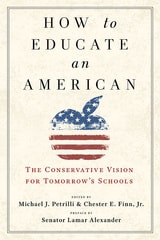
How to Educate an American
The Conservative Vision for Tomorrow's SchoolsMichael J. Petrilli
Templeton Press, 2020
Today, these gains are in retreat, ceding ground to progressive nostrums that do little to boost the skills and knowledge of young people. Far from being discouraged, however, conservatives should seize the moment to refresh their vision of quality K–12 education for today’s America. These essays by 20 leading conservative thinkers do just that.
Students, according to this vision, should complete high school with a thorough understanding of the country’s history, including gratitude for its sacrifices, respect for its achievements, and awareness of its shortcomings. They should also learn to be trustworthy stewards of a democratic republic, capable of exercising virtue and civic responsibility.
Beyond helping to form their character, schools ought to ready their pupils for careers that are productive, rewarding, and dignified. Excellent technical-training opportunities will await those not headed to a traditional college. Regardless of the paths and schools that they select, all students must come to understand that they can succeed in America if they are industrious, creative, and responsible.
Anchored in tradition yet looking towards tomorrow, How to Educate an American should be read by anyone concerned with teaching future generations to preserve the country’s heritage, embody its universal ethic, and pursue its founding ideals.
Inside Jewish Day Schools
Leadership, Learning, and CommunityAlex Pomson and Jack Wertheimer
Brandeis University Press, 2021
This book takes readers inside Jewish day schools to observe what happens day to day, as well as what the schools mean to their students, families, and communities. Many different types of Jewish day schools exist, and the variations are not well understood, nor is much information available about how day schools function. Inside Jewish Day Schools proves a vital guide to understanding both these distinctions and the everyday operations of these contemporary schools.

Let's Talk About Critique
Reimagining Art and Design EducationElissa Armstrong and Mariah Doren
Intellect Books, 2023
Let’s Talk about Critique examines how critique in art education has evolved, how it falls short, and what else it could be. Elissa Armstrong and Mariah Doren contextualize current practices by discussing the history of critique, the field of education, and the characteristics of today’s students. Then they offer suggestions for ways to have more open, inclusive, and dynamic classroom conversations about art and design. The core of the book consists of critique format descriptions, written by experienced educators, that provide a wide variety of thoughtful approaches that can be readily adapted and used.
Outcomes Book
Debate and Consensus after the WPA Outcomes Statementedited by Susanmarie Harrington, Keith Rhodes, Ruth Fischer, & Rita Malenczyk
Utah State University Press, 2005
The WPA Outcomes Statement is important because it represents a working consensus among composition scholars about what college students should learn and do in a composition program. But as a single-page document, the statement cannot convey the kind of reflective process that a writing program must undertake to address the learning outcomes described.
The Outcomes Book relates the fuller process by exploring the matrix of concerns that surrounded the developing Statement itself, and by presenting the experience of many who have since employed it in their own settings.
Psychological and Psychoeducational Assessment of Deaf and Hard of Hearing Children and Adolescents
Margery S. Miller
Gallaudet University Press, 2015
Authors Margery S. Miller, Tania Thomas-Presswood, Kurt Metz, and Jennifer Lukomski bring a wealth of knowledge and experience to this in-depth treatment of topics essential to educators and school psychologists. They cover such critical areas as test construction and measurement; the diversity in American Deaf culture; the role of parents in the assessment process; neuropsychological assessments; nonverbal methods for assessing intelligence; and the need for sign language competency when testing cognitive and language skills.
The text concludes with recommendations for the development of valid and reliable tests for all students who are deaf and hard of hearing.
Reconstructing Response to Student Writing
A National Study from across the CurriculumDan Melzer
Utah State University Press, 2023
Presenting the results of a national study of teacher and peer response and student self-assessment at institutions of higher education across the United States, Melzer analyzes teacher and peer response to over 1,000 pieces of student writing as well as 128 student portfolio reflection essays. He draws on his analysis and on a comprehensive review of the literature on response to introduce a constructivist heuristic for response aimed at both composition instructors and instructors across disciplines. Melzer argues that teachers and researchers should focus less on teacher response to individual pieces of student writing and more on engaging in dialogue with student self-assessment and peer response, focusing on growth and transfer rather than products and grades.
Reconstructing Response to Student Writing, especially when taken together with Melzer’s previous book Assignments across the Curriculum, provides a comprehensive and large-scale view of college writing and responding across the curriculum in the United States.
Reframing Writing Assessment to Improve Teaching and Learning
Linda Adler-Kassner
Utah State University Press, 2010
Adler-Kassner and O'Neill show writing faculty and administrators how to frame discussions of writing assessment so that they accurately represent research-based practices, and promote assessments that are valid, reliable, and discipline-appropriate.
Public discourse about writing instruction is currently driven by ideas of what instructors and programs “need to do,” “should do,” or “are not doing,” and is based on poorly informed concepts of correctness and unfounded claims about a broad decline in educational quality. This discussion needs to be reframed, say Adler-Kassner and O'Neill, to help policymakers understand that the purpose of writing instruction is to help students develop critical thinking, reading, and writing strategies that will form the foundation for their future educations, professional careers, and civic engagement.
Reframing Writing Assessment to Improve Teaching and Learning is grounded in the best of writing assessment research, and focuses on how to communicate it effectively to publics beyond academe.

Requirements for Certification of Teachers, Counselors, Librarians, and Administrators for Elementary and Secondary Schools, 2001-2002
Edited by Elizabeth A. Kaye
University of Chicago Press, 2001
Schooled and Sorted
How Educational Categories Create InequalityThurston Domina
Russell Sage Foundation, 2023
Some educational categories have broadly egalitarian consequences. Indeed, Domina, Penner, and Penner argue that when societies enroll young people in school, making them students, they mark them as individuals who are worthy of rights. But other educational categories reinforce powerful social categories—including race, gender, and class—and ultimately reproduce social and economic inequality in society. Elite colleges, tracked high schools, and elementary school gifted programs provide not only different educational experiences, but also create merit and inequality by sorting students into categories that are defined by the students who are excluded.
Schooled & Sorted highlights that many of the decisions that define educational categories occur in school-based committee meetings and other relatively local settings. The local nature of these decisions provides many opportunities to define educational categories differently, and for school communities to bring about change.
Schooled & Sorted is an illuminating investigation into the ways sorting within schools translates into inequality in the larger world. While some educational categorization may be unavoidable, the authors suggest ways to build a more equitable system—and thus a more equitable society.
The Education of Historians for Twenty-first Century
Thomas Bender, Philip M. Katz, Colin Palmer, and the Committee on Graduate Education (AHA)
University of Illinois Press, 2004
An examination and analysis of history education in American colleges and universities
In 1958, the American Historical Association began a study to determine the status and condition of history education in U.S. colleges and universities. Published in 1962 and addressing such issues as the supply and demand for teachers, student recruitment, and training for advanced degrees, that report set a lasting benchmark against which to judge the study of history thereafter. Now, more than forty years later, the AHA has commissioned a new report. The Education of Historians for the Twenty-first Century documents this important new study's remarkable conclusions.
Both the American academy and the study of history have been dramatically transformed since the original study, but doctoral programs in history have barely changed. This report from the AHA explains why and offers concrete, practical recommendations for improving the state of graduate education. The Education of Historians for the
Twenty-first Century stands as the first investigation of graduate training for historians in more than four decades and the best available study of doctoral education in any major academic discipline.
Prepared for the AHA by the Committee on Graduate Education, the report represents the combined efforts of a cross-section of the entire historical profession. It draws upon a detailed review of the existing studies and data on graduate education and builds upon this foundation with an exhaustive survey of history doctoral programs. This included actual visits to history departments across the country and consultations with scores of individual historians, graduate students, deans, academic and non-academic employers of historians, as well as other stakeholders in graduate education.
As the ethnic and gender composition of both graduate students and faculty has changed, methodologies have been refined and the domains of historical inquiry expanded. By addressing these revolutionary intellectual and demographic changes in the historical profession, The Education of Historians for the Twenty-first Century breaks important new ground. Combining a detailed historical snapshot of the profession with a rigorous analysis of these intellectual changes, this volume is ideally positioned as the definitive guide to strategic planning for history departments. It includes practical recommendations for handling institutional challenges as well as advice for everyone involved in the advanced training of historians, from department chairs to their students, and from university administrators to the AHA itself.
Although focused on history, there are lessons here for any department. The Education of Historians for the Twenty-first Century is a model for in-depth analysis of doctoral education, with recommendations and analyses that have implications for the entire academy. This volume is required reading for historians, graduate students, university administrators, or anyone interested in the future of higher education.
The Impracticality of Practical Research
A History of Contemporary Sciences of Change That ConserveThomas S. Popkewitz
University of Michigan Press, 2020
There is an alluring desire that research should lead us to find the practical knowledge that enables people to live a good life in a just and equitable society. This desire haunted the 19th century emergence of the social sciences as a discipline, then became more pronounced in the postwar mobilizations of research. Today that desire lives on in the international assessments of national schools and in the structure of professional education, both of which influence government modernization of schools and also provide for people’s well-being. American policy thus reflects research in which reforms are verified by “scientific, empirical evidences” about “what works” in experiments, and “will work” therefore in society.
The book explores the idea that practical and useful knowledge changes over time, and shows how this knowledge has been (re)visioned in contemporary research on educational reform, instructional improvement, and professionalization. The study of science draws on a range of social and cultural theories and historical studies to understand the politics of science, as well as scientific knowledge that is concerned with social and educational change. Research hopes to change social conditions to create a better life, and to shape people whose conduct embodies these valued characteristics—the good citizen, parent, or worker. Yet this hope continually articulates the dangers that threaten this future. Thomas Popkewitz explores how the research to correct social wrongs is paradoxically entangled with the inscription of differences that ultimately hamper the efforts to include.
The Problem of Assessment in Art and Design
Edited by Trevor Rayment
Intellect Books, 2007
Towards Coherence Between Classroom Assessment and Accountability
Edited by Mark Wilson
University of Chicago Press, 2004
The authors of this volume emphasize that assessment, as it exists in schools today, consists mainly of the measurements that teachers themselves design, evaluate, and act upon every day. Improving the usefulness of assessment in schools primarily requires assisting and harnessing this flood of assessment information, both as a means of learning within the classroom and as the source of crucial information flowing out of classrooms.
This volume aims to encourage debate and reflection among educational researchers, professionals, and policymakers. Five source chapters describe successful classroom assessment models developed in partnership with teachers, while additional commentaries give a range of perspectives on the issues of classroom assessment, standardized testing, and accountability.