Results by title
22 books match the query 'French fiction'
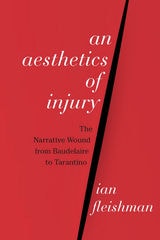
An Aesthetics of Injury
The Narrative Wound from Baudelaire to TarantinoIan Fleishman
Northwestern University Press, 2018
Violence in the modernist mode, an ostensible intrusion of raw bodily harm into the artwork, aspires to transcend its own textuality, and yet, as An Aesthetics of Injury establishes, the wound paradoxically remains the essence of inscription. Fleishman thus shows how the wound, once the modernist emblem par excellence of an immediate aesthetic experience, comes to be implicated in a postmodern understanding of reality reduced to ceaseless mediation. In so doing, he demonstrates how what we think of as the most real object, the human body, becomes indistinguishable from its “nonreal” function as text. At stake in this tautological textual model is the heritage of narrative thought: both the narratological workings of these texts (how they tell stories) and the underlying epistemology exposed (whether these narrativists still believe in narrative at all).
With fresh and revealing readings of canonical authors and filmmakers seldom treated alongside one another, An Aesthetics of Injury is important reading for scholars working on literary or cinematic modernism and the postmodern, philosophy, narratology, body culture studies, queer and gender studies, trauma studies, and cultural theory.

Behold an Animal
Four Exorbitant ReadingsThangam Ravindranathan
Northwestern University Press, 2019
As animals recede from our world, what tale is being told by literature’s creatures? Behold an Animal: Four Exorbitant Readings examines incongruous animals in the works of four major contemporary French writers: an airborne horse in a novel by Jean-Philippe Toussaint, extinct orangutans in Éric Chevillard, stray dogs in Marie NDiaye, vanishing (bits of) hedgehogs in Marie Darrieussecq. Resisting naturalist assumptions that an animal in a story is simply—literally or metaphorically—an animal, Thangam Ravindranathan understands it rather as the location of something missing. The animal is a lure: an unfinished figure fleeing the frame, crossing bounds of period, genre, even medium and language. Its flight traces an exorbitant (self-)portrait in which thinking admits to its commerce with life and flesh. It is in its animals, at the same time unbearably real and exquisitely unreal, that literature may today be closest to philosophy.
This book’s primary focus is the contemporary French novel and continental philosophy. In addition to Toussaint, Chevillard, NDiaye, and Darrieussecq, it engages the work of Jean de La Fontaine, Eadweard Muybridge, Edgar Allan Poe, Lewis Carroll, Samuel Beckett, and Francis Ponge.
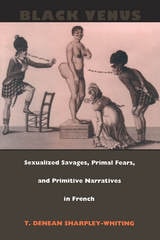
Black Venus
Sexualized Savages, Primal Fears, and Primitive Narratives in FrenchT. Denean Sharpley-Whiting
Duke University Press, 1999
The book opens with an exploration of scientific discourse on black females, using Sarah Bartmann, the so-called Hottentot Venus, and natural scientist Georges Cuvier as points of departure. To further show how the image of a savage was projected onto the bodies of black women, Sharpley-Whiting moves into popular culture with an analysis of an 1814 vaudeville caricature of Bartmann, then shifts onto the terrain of canonical French literature and colonial cinema, exploring the representation of black women by Baudelaire, Balzac, Zola, Maupassant, and Loti. After venturing into twentieth-century film with an analysis of Josephine Baker’s popular Princesse Tam Tam, the study concludes with a discussion of how black Francophone women writers and activists countered stereotypical representations of black female bodies during this period. A first-time translation of the vaudeville show The Hottentot Venus, or Hatred of Frenchwomen supplements this critique of the French male gaze of the nineteenth and early twentieth centuries.
Both intellectually rigorous and culturally intriguing, this study will appeal to students and scholars in the fields of nineteenth- and twentieth-century French literature, feminist and gender studies, black studies, and cultural studies.
Cacaphonies
The Excremental Canon of French LiteratureAnnabel L. Kim
University of Minnesota Press, 2022
Exploring why there is so much fecal matter in literary works that matter
Cacaphonies takes fecal matter and its place in literature seriously. Readers and critics have too long overlooked excrement’s vital role in the twentieth- and twenty-first-century French canon. In a stark challenge to the tendency to view this literature through sanitizing abstractions, Annabel L. Kim undertakes close readings of key authors to argue for feces as a figure of radical equality, both a literary object and a reflection on literature itself, without which literary studies is impoverished and sterile.
Following the fecal through line in works by Céline, Beckett, Genet, Sartre, Duras, and Gary and the contemporary authors Anne Garréta and Daniel Pennac, Kim shows that shit, far from vanishing from the canon after the early modern period, remains present in the modern and contemporary French literature that follows. She argues that all the shit in the canon expresses a call to democratize literature, making literature for all, just as shit is for (or of) all. She attends to its presence in this prized element of French identity, treating it as a continually uttered desire to manifest the universality France aspires to—as encapsulated by the slogan Liberté, égalité, fraternité—but fails to realize. In shit there is a concrete universalism that traverses bodies with disregard for embodied differences.
Cacaphonies reminds us that literature, and the ideas to be found therein, cannot be separated from the corporeal envelopes that create and receive them. In so doing, it reveals the aesthetic, political, and ethical potential of shit and its capacity to transform literature and life.
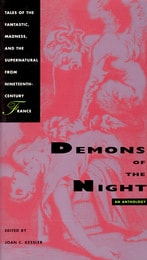
Demons of the Night
Tales of the Fantastic, Madness, and the Supernatural from Nineteenth-Century FranceEdited by Joan C. Kessler
University of Chicago Press, 1995
The anthology opens with "Smarra, or the Demons of the Night," Nodier's 1821 tale of nightmare, vampirism, and compulsion, acclaimed as the first work in French literature to explore in depth the realm of dream and the unconscious. Other stories include Balzac's "The Red Inn," in which a crime is committed by one person in thought and another in deed, and Mérimée's superbly crafted mystery, "The Venus of Ille," which dramatizes the demonic power of a vengeful goddess of love emerging out of the pagan past. Gautier's protagonist in "The Dead in Love" develops an obsessive passion for a woman who has returned from beyond the grave, while the narrator of Maupassant's "The Horla" imagines himself a victim of psychic vampirism.
Joan Kessler has prepared new translations of nine of the thirteen tales in the volume, including Gérard de Nerval's odyssey of madness, "Aurélia," as well as two tales that have never before appeared in English. Kessler's introduction sets the background of these tales—the impact of the French Revolution and the Terror, the Romantics' fascination with the subconscious, and the influence of contemporary psychological and spiritual currents. Her essay illuminates how each of the authors in this collection used the fantastic to articulate his own haunting obsessions as well as his broader vision of human experience.
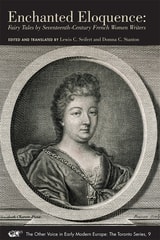
Enchanted Eloquence
Fairy Tales by Seventeenth–Century French Women WritersEdited and Translated by Lewis C. Seifert and Domna C. Stanton
Iter Press, 2010
—Jack Zipes
Professor of German, Emeritus, University of Minnesota

Enemy Within
Culture Wars and Political Identity in Novels of the French Third RepublicGilbert D. Chaitin
The Ohio State University Press, 2008
Experiments with Empire
Anthropology and Fiction in the French AtlanticJustin Izzo
Duke University Press, 2019
Fiction Rivals Science
The French Novel from Balzac to ProustAllen Thiher
University of Missouri Press, 2001
In Fiction Rivals Science, Allen Thiher describes the epistemic rivalry that the major nineteenth-century French novelists felt in dealing with science. After brief considerations of Stendhal, Thiher focuses on the four most important "realist" novelists in France: Balzac, Flaubert, Zola, and, going into the twentieth century, Proust. According to Thiher, each of these novelists considered himself to be in competition with science to make the novel an instrument for knowledge.
The first chapter sets forth the understanding of science that dominated the early nineteenth century in order to make it plausible that literary minds, throughout the nineteenth century, thought that they could not only rival science, but even make positive contributions to knowledge. The Newtonian paradigm that had dominated the Enlightenment was slowly being challenged by new developments both in physics and in nonphysical sciences such as biology. Especially in biology the development of a scientific discourse using narrative temporality favored the idea that novelists could also use fiction to construct discourses that advanced knowledge.
Balzac wanted to construct a natural history of society and correct the chemical theory of his time. Flaubert drew upon medicine and physiology for the rhetoric of his realist fiction. Zola used unsuccessful medical paradigms for his doctrine of heredity, and models drawn from thermodynamics to describe the relation of the individual to societal forces. Finally, Proust drew upon thinkers such as Poincar‚ to elaborate an epistemology that put an end to the rivalry novelists might feel with scientists. Proust located certain knowledge within the realm of human subjectivity while granting the power of laws to rule over the contingent realm of physical reality, in which, after Poincar‚, neither mathematics nor Newton was any longer a source of absolute certainty. Proust's novel is thus the last great realist work of the nineteenth century and the first modernist work of consciousness taking itself as the object of knowledge.
By demonstrating that the great French realist novelists dealt with many of the same problems as did the scientists of the nineteenth century, Fiction Rivals Science attempts to show how culture unites literary and scientific inquiry into knowledge. Providing a new interpretation of the development of literary realism, this important new work will be welcomed not only by literary scholars, but by historians of science and culture as well.
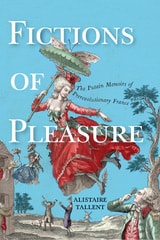
Fictions of Pleasure
The Putain Memoirs of Prerevolutionary FranceAlistaire Tallent
University of Delaware Press, 2024

Maternal Fictions
Stendahl, Sand, Rachilde, and BatailleMaryline Lukacher
Duke University Press, 1994
Through readings of Armance, Le Rouge et le noir, La Vie de Henry Brulard, and Les Cenci, Lukacher exposes Stendhal's preoccupation with his dead mother, who is obsessively retrieved throughout his work. George Sand's identity is, in effect, divided between two mothers, her biological mother and her grandmother, and in Histoire de ma vie, Indiana, and Mauprat, we see the writer's efforts to break the impasse created by this divided identity. In the extraordinary but too little known work of Rachilde (Marguerite Eymery), Lukacher finds the maternal figure identified as the secret inner force of patriarchal oppression. This resistance to feminism continues in the pseudonymous work of Georges Bataille. In Ma mère, Le coupable, and L’Expérience intérieure Lukacher traces Bataille’s representation of the mother as a menacing, ever subversive figure who threatens basic social configurations.
Maternal Fictions establishes a new pseudonymous genealogy in modern French writing that will inform and advance our understanding of the act of self-creation that occurs in fiction.
Novel Gazing
Queer Readings in FictionEve Kosofsky Sedgwick, ed.
Duke University Press, 1997
Through discussions of a diverse array of British, French, and American novels—including major canonical novels, best-sellers, children’s fiction, and science fiction—these essays explore queer worlds of taste, texture, joy, and ennui, focusing on such subjects as flogging, wizardry, exorcism, dance, Zionist desire, and Internet sexuality. Interpreting the works of authors as diverse as Benjamin Constant, Toni Morrison, T. H. White, and William Gibson, along with canonical queer modernists such as James, Proust, Woolf, and Cather, contributors reveal the wealth of ways in which selves and communities succeed in extracting sustenance from the objects of a culture whose avowed desire has often been not to sustain them. The dramatic reframing that these essays perform will make the significance of Novel Gazing extend beyond the scope of queer studies to literary criticism in general.
Contributors. Stephen Barber, Renu Bora, Anne Chandler, James Creech, Tyler Curtain, Jonathan Goldberg, Joseph Litvak, Michael Lucey, Jeff Nunokawa, Cindy Patton, Jacob Press, Robert F. Reid-Pharr, Eve Kosofsky Sedgwick, Melissa Solomon, Kathryn Bond Stockton, John Vincent, Maurice Wallace, Barry Weller
On Both Sides of the Tracks
Social Mobility in Contemporary French LiteratureMorgane Cadieu
University of Chicago Press, 2024
Social climbers have often been the core characters of novels. Their position between traditional tiers in society makes them touchstones for any political and literary moment, including our own. Morgane Cadieu’s study looks at a certain kind of social climber in contemporary French literature whom she calls the parvenant. Taken from the French term parvenu, which refers to one who is newly arrived, a parvenant is a character who shuttles between social groups. A parvenant may become part of a new social class but devises literary ways to come back, constantly undoing any fixed idea of social affiliation.
Focusing on recent French novels and autobiographies, On Both Sides of the Tracks speaks powerfully to issues of emancipation and class. Cadieu offers a fresh critical look at tales of social mobility in the work of Annie Ernaux, Kaoutar Harchi, Michel Houellebecq, Édouard Louis, and Marie NDiaye, among others, shedding fascinating light on upward mobility today as a formal, literary problem.

Politicizing Gender
Narrative Strategies in the Aftermath of the French RevolutionKadish, Doris Y
Rutgers University Press, 1991

Provinces of the Mind
The Modern Novel on Provincial TimeVictoria Baena
University of Chicago Press, 2027
How the provinces, rather than cities or capitals, became the key setting dramatized in—but also transformed by—modern novels in English and French.
To be provincial is to mistake one’s narrow milieu for the world: it is to fall prey to an error of scale. But it is also to feel behind, belated, and excluded from the possibilities of the modern world. In this elegant study of the novel “on provincial time,” Victoria Baena argues that the literary geography of “the provinces” played a key role in forging European narratives of modernity.
In the wake of French revolutionaries’ suppression of older provincial identities and as Britain expanded its imperial reach, the provinces were reinvented on various scales: from countryside to small town, from domestic region to faraway colony. Baena brings together Marxist and feminist spatial theory with a close attention to the politics of narrative form in order to show how the remarkably mobile concept of the provinces developed across social and cultural frameworks from 1800 to 1933. Offering new interpretations of novels of the realist tradition—by Honoré de Balzac, George Eliot, Emily Brontë, George Sand, Thomas Hardy, Marcel Proust, Alain-Fournier, James Joyce, and Claude McKay—she shows how the question of representing the provinces transformed the modern novel.
Provinces of the Mind illuminates some of the more pernicious fictions of provincialism. But it also describes, often movingly, the desire no longer to be provincial, along with the ambivalence and alienation that can entail. Ultimately, the book shows how literary critics can use the provinces to translate questions of literary geography across borders. By interrogating the provincialisms of our own time and place, Baena suggests, critics might make a better case for those worth retaining, as well as a better grasp of those to be left behind.

Real Time
Accelerating Narrative from Balzac to ZolaDavid F. Bell
University of Illinois Press, 2003
Nineteenth-century technological advances radically altered the infrastructure of France, changing the ways ordinary citizens–-and literary characters--viewed time, space, distance, and speed. The most influential of these advances included the improvement of the stagecoach, the growth of road and canal networks leading to the advent of the railway, and the increasing use of mail, and of the optical telegraph. Citing examples from a wide range of novels and stories, Bell demonstrates the numerous ways in which these trends of acceleration became not just literary devices and themes but also structuring principles of the novels themselves.
Beginning with both the provincial and the Parisian communications networks of Balzac, Bell proceeds to discuss the roles of horses and optical telegraphs in Stendhal and the importance of domination of communication channels to the characters of Dumas, whose Count of Monte-Cristo might be seen as the ultimate fictional master of this accelerated culture. Finally, Bell analyzes the cinematic vision created by the arrival of the railroad, as depicted by Zola in La Bète Humaine.
Sex Work, Text Work
Mapping Prostitution in the Nineteenth-Century French NovelJessica Tanner
Northwestern University Press, 2027
While prostitutes in nineteenth-century Paris were subject to municipal laws that policed their bodies and movements, writers of the era enlisted them to stake their own claims on both the city and the novel as literary territory. Sex Work, Text Work: Mapping Prostitution in the Nineteenth-Century French Novel explores how prostitutes depicted by Émile Zola, Joris-Karl Huysmans, Edmond de Goncourt, Adolphe Tabarant, and Charles-Louis Philippe “write back,” confounding civil and literary efforts to contain them in space and in narrative.
In city-regulated brothels, brasseries à femmes, Haussmannian boulevards, and the novel itself, working-class prostitutes served to reinforce the boundaries of social inclusion and exclusion. And yet, Jessica Tanner contends, even the novels that most explicitly aligned with the disciplinary logic of regulated prostitution make space for a distinctly literary form of resistance: these women elude or disrupt the mapping that would claim them as literary territory, revealing their authors’ failure to secure their narratives as property. Tanner pushes back against the critical tendency to attribute agency only to courtesans who became published authors and forwards a new framework for understanding the political work novels engage in as they circulate. Observing that debates about the regulation of prostitution surfaced in tandem with racialized anxieties about the boundaries of the French nation, Tanner ultimately expands that framework to the history of French colonialism and the politics of immigration in the current day. This book shows that while sex workers have been recruited to mark the borders of civic and moral life, prostitution can also make space for more inclusive forms of community, both in the novel and in the world beyond its bounds.
The Novel Map
Space and Subjectivity in Nineteenth-Century French FictionPatrick M. Bray
Northwestern University Press, 2013
Focusing on Stendhal, Gérard de Nerval, George Sand, Émile Zola, and Marcel Proust, The Novel Map: Mapping the Self in Nineteenth-Century French Fiction explores the ways that these writers represent and negotiate the relationship between the self and the world as a function of space in a novel turned map.
With the rise of the novel and of autobiography, the literary and cultural contexts of nineteenth-century France reconfigured both the ways literature could represent subjects and the ways subjects related to space. In the first-person works of these authors, maps situate the narrator within the imaginary space of the novel. Yet the time inherent in the text’s narrative unsettles the spatial self drawn by the maps and so creates a novel self, one which is both new and literary. The novel self transcends the rigid confines of a map. In this significant study, Patrick M. Bray charts a new direction in critical theory.
The Price of Literature
The French Novel's Theoretical TurnPatrick M. Bray
Northwestern University Press, 2019
Literary thought, or the theory produced by the text, can only function by exploring what escapes dominant representations. The Price of Literature analyzes how certain iconic texts from the nineteenth century (by Mme de Staël, Hugo, Balzac, Flaubert, and Proust) perform a theoretical turn to claim the freedom to represent anything in the world, but also literature’s ability to transform the world it represents. The conclusion advances a new way of thinking about literary scholarship—one based on how literature redistributes ways of writing by lending form to thought.
The Surprising Effects of Sympathy
Marivaux, Diderot, Rousseau, and Mary ShelleyDavid Marshall
University of Chicago Press, 1988
Placing novels in the context of eighteenth-century writing about theater, fiction, and painting, Marshall argues that an unusual variety of authors and texts were concerned with the possibility of entering into someone else's thoughts and feelings. He shows how key eighteenth-century works reflect on the problem of how to move, touch, and secure the sympathy of readers and beholders in the realm of both "art" and "life." Marshall discusses the demands placed upon novels to achieve certain effects, the ambivalence of writers and readers about those effects, and the ways in which these texts can be read as philosophical meditations on the differences and analogies between the experiences of reading a novel, watching a play, beholding a painting, and witnessing the spectacle of someone suffering. The Surprising Effects of Sympathy traces the interaction of sympathy and theater and the artistic and philosophical problems that these terms represent in dialogues about aesthetics, moral philosophy, epistemology, psychology, autobiography, the novel, and society.
Unbecoming Language
Anti-Identitarian French Feminist FictionsAnnabel L. Kim
The Ohio State University Press, 2018
Kim’s close readings ultimately enliven the current conversation in French studies by serving as a provocation to return to reading literary texts deeply and closely, without subordinating literature to a pre-existing ideological framework—to let literature speak, to let it theorize. Tracking the influence of these writers on each other, Kim provides a new, original French feminist poetics and demonstrates that Sarraute, Wittig, and Garréta’s work allows for a hollowing out of difference from within, allowing writers and readers to unbecome—to break free of identity and exist as subjectivities without subjecthood. In looking at these writers together, Kim provides a defense of literature as liberatory— capable of effecting personal and political change—and gives readers an experience of literature’s revolutionary possibilities.
Writing Japonisme
Aesthetic Translation in Nineteenth-Century French ProsePamela A. Genova
Northwestern University Press, 2016