Results by title

11 books match the query 'Gogolʹ, Nikolaĭ Vasilʹevich'
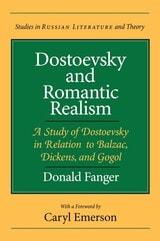
cover of Dostoevsky and Romantic Realism: A Study of Dostoevsky in Relation to Balzac, Dickens, and Gogol

Dostoevsky and Romantic Realism

A Study of Dostoevsky in Relation to Balzac, Dickens, and Gogol

Donald Fanger

Northwestern University Press, 1998
Dostoevsky and Romantic Realism is Donald Fanger's groundbreaking study of the art of Dostoevsky and the literary and historical context in which it was created. Through detailed analyses of the work of Balzac, Dickens, and Gogol, Fanger identifies romantic realism, the transformative fusion of two generic categories, as a powerful imaginary response to the great modern city. This fusion reaches its aesthetic and metaphysical climax in Dostoevsky, whose vision culminating in Crime and Punishment is seen by Fanger as the final synthesis of romantic realism.
[more]
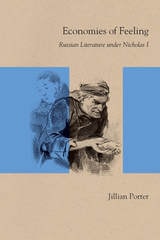
cover of Economies of Feeling: Russian Literature under Nicholas I

Economies of Feeling

Russian Literature under Nicholas I

Jillian Porter

Northwestern University Press, 2017

Economies of Feeling offers new explanations for the fantastical plots of mad or blocked ambition that set the nineteenth-century Russian prose tradition in motion. Jillian Porter compares the conceptual history of social ambition in post-Napoleonic France and post-Decembrist Russia and argues that the dissonance between foreign and domestic understandings of this economic passion shaped the literature of Nicholas I’s reign (1825 —1855).
 
Porter shows how, for Pushkin, Gogol, Dostoevsky, and Faddei Bulgarin, ambition became a staging ground for experiments with transnational literary exchange. In its encounters with the celebrated Russian cultural value of hospitality and the age-old vice of miserliness, ambition appears both timely and anachronistic, suspiciously foreign and disturbingly Russian—it challenges readers to question the equivalence of local and imported words, feelings, and forms.
 
Economies of Feeling examines founding texts of nineteenth-century Russian prose alongside nonliterary materials from which they drew energy—from French clinical diagnoses of “ambitious monomania” to the various types of currency that proliferated under Nicholas I. It thus contributes fresh and fascinating insights into Russian characters’ impulses to attain rank and to squander, counterfeit, and hoard. Porter’s interdisciplinary approach will appeal to scholars of comparative as well as Russian literature.
 
[more]
cover of Essays on Gogol: Logos and the Russian Word

Essays on Gogol

Logos and the Russian Word

Susanne Fusso and Priscilla Meyer

Northwestern University Press, 1994

These fourteen essays reflect the increasingly interdisciplinary character of Russian literature research in general and of the study of Gogol in particular, focusing on specific works, Gogol's own character, and the various approaches to aesthetic, religious, and philosophical issues raised by his writing.
[more]
cover of Gogol

Gogol

V. V. Gippius

Duke University Press, 1989
[more]
cover of Gogol's Afterlife: The Evolution of a Classic in Imperial and Soviet Russia

Gogol's Afterlife

The Evolution of a Classic in Imperial and Soviet Russia

Caryl Emerson

Northwestern University Press, 2002

Gogol's claim to the title of national literary classic is incontestable. An exemplar of popular audiences no less than for the intelligentsia, Gogol was pressed into service under the tsarist and Soviet regimes for causes both aesthetic and political, official and unofficial. In Gogol's Afterlife, Stephen Moeller-Sally explores how he achieved this peculiar brand of cultural authority and later maintained it, despite dramatic shifts in the organization of Russian literature and society.

Part I charts the historical and cultural currents that shaped Gogol's reputation, devoting particular attention to the models of authorship Gogol himself devised in response to his changing audience and developing authorial mission. Part II takes a panoramic view of the social milieu in which Gogol's status evolved. Finally, Part III examines the place of the classics in Soviet culture, with a focus on Gogol's role in the cultural revolution and his peculiar relationship with state power under Stalinism.
[more]
cover of Gogol's Artistry

Gogol's Artistry

Andrei Bely, translated by Christopher Colbath

Northwestern University Press, 2009

When one great author engages another, as Andrei Bely so brilliantly does in Gogol’s Artistry, the result is inevitably a telling portrait of both writers. So it is in Gogol’s Artistry. Translated into English for the first time, this idiosyncratic, exhaustive critical study is as interesting for what it tells us about Bely’s thought and method as it is for its insights into the oeuvre of his literary predecessor. Bely’s argument in this book is that Gogol’s earlier writing should be given more consideration than most critics have granted. Employing what might be called a scientific perspective, Bely considers how often certain colors appear; he diagrams sentences and discusses Gogol’s prose in terms of mathematical equations. The result, as strange and engaging as Bely’s best fiction, is also an innovative, thorough, and remarkably revealing work of criticism.
[more]
cover of Gogol: Plays and Selected Writings

Gogol

Plays and Selected Writings

Nikolai Gogol

Northwestern University Press, 1994
The theatrical genius of Gogol has gone largely unappreciated by English-speaking audiences because literal translations have left his plays virtually impossible to perform. These fresh translations restore the vitality of Gogol's language and humor, allowing his dramatic art to speak to readers, directors, actors, and theater-goers.
[more]
cover of The Complete Tales of Nikolai Gogol, Volume 1

The Complete Tales of Nikolai Gogol, Volume 1

Nikolai Gogol

University of Chicago Press, 1985
The complete tales of one of the most creative, incisive, and entertaining of the Russian masters
 
Nikolai Gogol was an artist who, like Rabelais, Cervantes, Swift, and Sterne, "knew how to walk upside down in our valley of sorrows so as to make it to a merry place." The list of writers who credit his absurd, bitingly satirical, wildly funny work as an influence includes Dostoevsky, Kafka, Mikhail Bulgakov, Nabokov, Flannery O'Connor, and many more. 
 
This two-volume edition at last brings all of Gogol's fiction (except his novel Dead Souls) together in paperback. Volume 1 includes Evenings on a Farm near Dikanka, the early Ukrainian folktales that first brought Gogol fame, as well as "Nevsky Prospekt" and "Diary of a Madman." 
 
[more]
cover of The Complete Tales of Nikolai Gogol, Volume 2

The Complete Tales of Nikolai Gogol, Volume 2

Nikolai Gogol

University of Chicago Press, 1983
The complete tales of one of the most creative, incisive, and entertaining of the Russian masters
 
Nikolai Gogol was an artist who, like Rabelais, Cervantes, Swift, and Sterne, "knew how to walk upside down in our valley of sorrows so as to make it to a merry place." The list of writers who credit his absurd, bitingly satirical, wildly funny work as an influence includes Dostoevsky, Kafka, Mikhail Bulgakov, Nabokov, Flannery O'Connor, and many more. 
 
This two-volume edition at last brings all of Gogol's fiction (except his novel Dead Souls) together in paperback. Volume 2 of The Complete Tales includes Gogol's Mirgorod stories—among them that masterpiece of grotesque comedy, "The Tale of How Ivan Ivanovich Quarreled with Ivan Nikiforovich," the wonderfully satiric "Old World Landowners," and the Cossak epic "Taras Bulba." Here also is "The Nose," Gogol's final effort in the realm of the fantastic, as well as "The Coach," "The Portrait" (in its final version), and the most influential of his Petersburg stories, "The Overcoat."
[more]
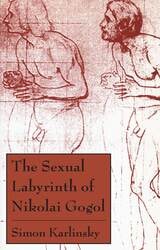
cover of The Sexual Labyrinth of Nikolai Gogol

The Sexual Labyrinth of Nikolai Gogol

Simon Karlinsky

University of Chicago Press, 1992

Through careful textual readings of Gogol's most famous works, Karlinsky argues that Gogol's homosexual orientation—which Gogol himself could not accept or forgive in himself—may provide the missing key to the riddle of Gogol's personality.

"A brilliant new biography that will long be prized for its illuminating psychological insights into Gogol's actions, its informative readings of his fiction and drama, and its own stylistic grace and vivacity."—Edmund White, Washington Post Book World
[more]
cover of Writing as Exorcism: The Personal Codes of Pushkin, Lermontov, and Gogol

Writing as Exorcism

The Personal Codes of Pushkin, Lermontov, and Gogol

Ilya Kutik

Northwestern University Press, 2005

"Sometimes it takes a poet to read a poet. In this inspired, idiosyncratic study, Ilya Kutik offers exemplary interpretations of three Russian writers, of the lessons of fatalism, and of the complexities of reading." —from the Introduction

A remarkable literary performance in its own right, this interpretive essay brings a highly original poetic sensibility to bear on the lives and works of three major Russian writers. It is Ilya Kutik's contention that many writers are tormented by secret fears and desires that only writing—in particular, the use of certain words and images—can exorcise. Making this biographical approach peculiarly his own—and susceptible to the nuances of comedy, tragedy, and critical equanimity—Kutik reads works of Alexander Pushkin, Mikhail Lermontov, and Nikolai Gogol, three Russian writers who were demonstrably subject to the whims, superstitions, and talismans that Kutik identifies. Exposing the conjunction of literary effort and private act in writings such as "The Queen of Spades," Dead Souls, and A Hero of Our Time, Kutik's work gives us a new way of understanding these masterpieces of Russian literature and their authors, and a new way of reading the mysteries of life and literature as mutually enriching.
[more]