Results by title
25 books match the query 'Greek literature'
A Short History of Greek Literature
Jacqueline de Romilly
University of Chicago Press, 1985
Ancient Obscenities
Their Nature and Use in the Ancient Greek and Roman WorldsDorota Dutsch and Ann Suter, editors
University of Michigan Press, 2015
Catalogus Translationum et Commentariorum, Volume 8
Virginia Brown
Catholic University of America Press, 1960
Catalogus Translationum et Commentariorum, Volume 9
Virginia Brown
Catholic University of America Press, 1960
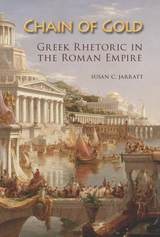
Chain of Gold
Greek Rhetoric in the Roman EmpireSusan C. Jarratt
Southern Illinois University Press, 2019
Through allusions to classical Greek literature, sophists such as Dio Chrysostom, Aelius Aristides, and Philostratus slipped oblique challenges to empire into otherwise innocuous works. Such figures protected their creators from the danger of direct confrontation but nonetheless would have been recognized by elite audiences, Roman and Greek alike, by virtue of their common education. Focusing on such moments, Jarratt presents close readings of city encomia, biography, and texts in hybrid genres from key second sophistic figures, setting each in its geographical context. Although all the authors considered are male, the analyses here bring to light reflections on gender, ethnicity, skin color, language differences, and sexuality, revealing an underrecognized diversity in the rhetorical activity of this period.
While US scholars of ancient rhetoric have focused largely on the pedagogical, Jarratt brings a geopolitical lens to her study of the subject. Her inclusion of fourth-century texts—the Greek novel Ethiopian Story, by Heliodorus, and the political orations of Libanius of Antioch—extends the temporal boundary of the period. She concludes with speculations about the pressures brought to bear on sophistic political subjectivity by the rise of Christianity and with ruminations on a third sophistic in ancient and contemporary eras of empire.
Classics in Translation, Volume I
Greek LiteratureEdited by Paul L. MacKendrick and Herbert M. Howe
University of Wisconsin Press, 1959
Here, translated into modern English, are the works of literature, history, science, oratory, and philosophy that constitute the mainstream of classical Greek thought and continue to influence world civilizations. This volume includes:
· Complete translations of Aeschylus’ Agamemnon, Sophocles’ Antigone, Euripides’ Medea, Aristophanes’ Frogs, and The Constitution of Athens by the “Old Oligarch.”
· Abridged translations of Homer’s Iliad and Odyssey, The Homeric Hymn to Hermes, and Plutarch’s Life of Tiberius Gracchus.
· Selections from Hesiod and Lucian; from twenty-eight lyric poets including Sappho, Pindar, and Meleagar; from the histories of Herodotus and Thucydides; and from eight Attic orators, including Isocrates and Demosthenes.
· Selections from the scientific writings of Hippocrates, Archimedes, and Galen.
· Selections from the pre-Socratic philosophers and from Plato, Aristotle, Epicurus, and Epictetus.
Clio's Other Sons
Berossus and ManethoJohn Dillery
University of Michigan Press, 2015
Contemporary Athletics and Ancient Greek Ideals
Daniel A. Dombrowski
University of Chicago Press, 2009
Despite their influence in our culture, sports inspire dramatically less philosophical consideration than such ostensibly weightier topics as religion, politics, or science. Arguing that athletic playfulness coexists with serious underpinnings, and that both demand more substantive attention, Daniel Dombrowski harnesses the insights of ancient Greek thinkers to illuminate contemporary athletics.
Dombrowski contends that the ideas of Plato, Aristotle, and Plotinus shed important light on issues—such as the pursuit of excellence, the concept of play, and the power of accepting physical limitations while also improving one’s body—that remain just as relevant in our sports-obsessed age as they were in ancient Greece. Bringing these concepts to bear on contemporary concerns, Dombrowski considers such questions as whether athletic competition can be a moral substitute for war, whether it necessarily constitutes war by other means, and whether it encourages fascist tendencies or ethical virtue. The first volume to philosophically explore twenty-first-century sport in the context of its ancient predecessor, Contemporary Athletics and Ancient Greek Ideals reveals that their relationship has great and previously untapped potential to inform our understanding of human nature.
Corrupting Luxury in Ancient Greek Literature
Robert J. Gorman and Vanessa B. Gorman
University of Michigan Press, 2014
Exiling the Poets
The Production of Censorship in Plato's RepublicRamona A. Naddaff
University of Chicago Press, 2002
Censorship, Nadaff argues, is not merely a mechanism of silencing but also provokes new ways of speaking about controversial and crucial cultural and artistic events. It functions philosophically in the Republic to subvert Plato's most crucial arguments about politics, epistemology, metaphysics, and ethics. Naddaff develops this stunning argument through an extraordinary reading of Plato's work. In books 2 and 3, the first censorship of poetry, she finds that Plato constitutes the poet as a rival with whom the philosopher must vie agonistically. In other words, philosophy does not replace poetry, as most commentators have suggested; rather, the philosopher becomes a worthy and ultimately victorious poetic competitor. In book 10's second censorship, Plato exiles the poets as a mode of self-subversion, rethinking and revising his theory of mimesis, of the immortality of the soul, and, most important, the first censorship of poetry. Finally, in a subtle and sophisticated analysis of the myth of Er, Naddaff explains how Plato himself censors his own censorships of poetry, thus producing the unexpected result of a poetically animated and open-ended dialectical philosophy.

God of Many Names
Play, Poetry and Power in Hellenic Thought, From Homer to AristotleMihai I. Spariosu
Duke University Press, 1991
Building upon the scholarship of an earlier volume, Dionysus Reborn, Spariosu her continues to draw on Dionysus—the “God of many names,” of both poetic play and sacred power—as a mythical embodiment of the two sides of the classical Greek mentality. Combining philosophical reflection with close textual analysis, the author examines the divided nature of the Hellenic mentality in such primary canonic texts as the Iliad, the Odyssey, the Theogony, Works and Days, the most well-known of the Presocratic fragments, Euripides’ Bacchae, Aristophanes’ The Frogs, Plato’s Republic and Laws, and Aristotle’s Poetics and Politics.
Spariosu’s model illuminates the many of the most enduring questions in contemporary humanistic study and addresses modern questions about the nature of the interrelation of poetry, ethics, and politics.
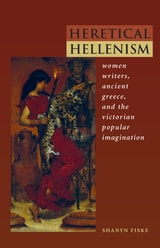
Heretical Hellenism
Women Writers, Ancient Greece, and the Victorian Popular ImaginationShanyn Fiske
Ohio University Press, 2008
The prevailing assumption regarding the Victorians’ relationship to ancient Greece is that Greek knowledge constituted an exclusive discourse within elite male domains. Heretical Hellenism: Women Writers, Ancient Greece, and the Victorian Popular Imagination challenges that theory and argues that while the information women received from popular sources was fragmentary and often fostered intellectual insecurities, it was precisely the ineffability of the Greek world refracted through popular sources and reconceived through new fields of study that appealed to women writers’ imaginations.
Examining underconsidered sources such as theater history and popular journals, Shanyn Fiske uncovers the many ways that women acquired knowledge of Greek literature, history, and philosophy without formal classical training. Through discussions of women writers such as Charlotte Brontë, George Eliot, and Jane Harrison, Heretical Hellenism demonstrates that women established the foundations of a heretical challenge to traditional humanist assumptions about the uniformity of classical knowledge and about women’s place in literary history.
Heretical Hellenism provides a historical rationale for a more expansive definition of classical knowledge and offers an interdisciplinary method for understanding the place of classics both in the nineteenth century and in our own time.
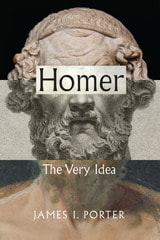
Homer
The Very IdeaJames I. Porter
University of Chicago Press, 2021
Homer, the great poet of the Iliad and the Odyssey, is revered as a cultural icon of antiquity and a figure of lasting influence. But his identity is shrouded in questions about who he was, when he lived, and whether he was an actual person, a myth, or merely a shared idea. Rather than attempting to solve the mystery of this character, James I. Porter explores the sources of Homer’s mystique and their impact since the first recorded mentions of Homer in ancient Greece.
Homer: The Very Idea considers Homer not as a man, but as a cultural invention nearly as distinctive and important as the poems attributed to him, following the cultural history of an idea and of the obsession that is reborn every time Homer is imagined. Offering novel readings of texts and objects, the book follows the very idea of Homer from his earliest mentions to his most recent imaginings in literature, criticism, philosophy, visual art, and classical archaeology.
Kallimachos
The Alexandrian Library and the Origins of BibliographyRudolf Blum
University of Wisconsin Press, 1991
The famous library of Alexandria, founded around 295 BCE by Ptolemaios I, housed the greatest collection of texts in the ancient world and was a fertile site of Hellenistic scholarship. Rudolf Blum’s landmark study, originally published in German in 1977, argues that Kallimachos of Kyrene was not only the second director of the Alexandrian library but also the inventor of two essential scholarly tools still in use to this day: the library catalog and the “biobibliographical” reference work. Kallimachos expanded the library’s inventory lists into volumes called the Pinakes, which extensively described and categorized each work and became in effect a Greek national bibliography and the source and paradigm for most later bibliographic lists of Greek literature. Though the Pinakes have not survived, Blum attempts a detailed reconstruction of Kallimachos’s inventories and catalogs based on a careful analysis of surviving sources, which are presented here in full translation.
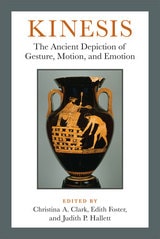
Kinesis
The Ancient Depiction of Gesture, Motion, and EmotionChristina A. Clark, Edith Foster, and Judith P. Hallett, editors
University of Michigan Press, 2015
Playing the Other
Gender and Society in Classical Greek LiteratureFroma I. Zeitlin
University of Chicago Press, 1995
Zeitlin demonstrates the indispensable workings of gender as a major factor in Greek social, religious, and cultural practices and in more abstract ideas about nature and culture, public and private, citizen and outsider, self and other, and mortal and immortal. Focusing on the prominence of female figures in these male authored texts, she enlarges our perspective on critical components of political order and civic identity by including issues of sexuality, the body, modes of male and female maturation, and speculations about parentage, kinship, and reproductive strategies. Along with considerations of genre, poetics, and theatrical mimesis, she points to the powerful mythmaking capacities of Greek culture for creating memorable paradigms and dramatic scenarios that far exceed simple notions of male and female opposition and predictable enforcement of social norms. Consisting of both new and revised essays, Playing the Other is a wide-ranging account of a central category of Greek literature by a scholar who pioneered an approach to classics through the perspective of gender.
Present Shock in Late Fifth-Century Greece
Francis M. Dunn
University of Michigan Press, 2010
Francis M. Dunn's Present Shock in Late Fifth-Century Greece examines the widespread social and cultural disorientation experienced by Athenians in a period that witnessed the revolution of 411 B.C.E. and the military misadventures in 413 and 404---a disturbance as powerful as that described in Alvin Toffler's Future Shock. The late fifth century was a time of vast cultural and intellectual change, ultimately leading to a shift away from Athenians' traditional tendency to seek authority in the past toward a greater reliance on the authority of the present. At the same time, Dunn argues, writers and thinkers not only registered the shock but explored ways to adjust to living with this new sense of uncertainty. Using literary case studies from this period, Dunn shows how narrative techniques changed to focus on depicting a world in which events were no longer wholly predetermined by the past, impressing upon readers the rewards and challenges of struggling to find their own way forward.
Although Present Shock in Late Fifth-Century Greece concentrates upon the late fifth century, this book's interdisciplinary approach will be of broad interest to scholars and students of ancient Greece, as well as anyone fascinated by the remarkably flexible human understanding of time.
Francis M. Dunn is Professor of Classics at the University of California, Santa Barbara. He is author of Tragedy's End: Closure and Innovation in Euripidean Drama (Oxford, 1996), and coeditor of Beginnings in Classical Literature (Cambridge, 1992) and Classical Closure: Reading the End in Greek and Latin Literature (Princeton, 1997).
"In this fascinating study, Francis Dunn argues that in late fifth-century Athens, life became focused on the present---that moving instant between past and future. Time itself changed: new clocks and calendars were developed, and narratives were full of suspense, accident, and uncertainty about things to come. Suddenly, future shock was now."
---David Konstan, John Rowe Workman Distinguished Professor of Classics and the Humanistic Tradition and Professor of Comparative Literature, Brown University
"In this fascinating work, Dunn examines the ways in which the Greeks constructed time and then shows how these can shed new light on various philosophical, dramatic, historical, scientific and rhetorical texts of the late fifth century. An original and most interesting study."
---Michael Gagarin, James R. Dougherty, Jr., Centennial Professor of Classics, the University of Texas at Austin
"Interesting, clear, and compelling, Present Shock in Late Fifth-Century Greece analyzes attitudes toward time in ancient Greece, focusing in particular on what Dunn terms 'present shock,' in which rapid cultural change undermined the authority of the past and submerged individuals in a disorienting present in late fifth-century Athens. Dunn offers smart and lucid analyses of a variety of complex texts, including pre-Socratic and sophistic philosophy, Euripidean tragedy, Thucydides, and medical texts, making an important contribution to discussions about classical Athenian thought that will be widely read and cited by scholars working on Greek cultural history and historiography."
---Victoria Wohl, Associate Professor, Department of Classics, University of Toronto
Setting Plato Straight
Translating Ancient Sexuality in the RenaissanceTodd W. Reeser
University of Chicago Press, 2015
In Setting Plato Straight, Todd W. Reeser undertakes the first sustained and comprehensive study of Renaissance textual responses to Platonic same-sex sexuality. Reeser mines an expansive collection of translations, commentaries, and literary sources to study how Renaissance translators transformed ancient eros into non-erotic, non-homosexual relations. He analyzes the interpretive lenses translators employed and the ways in which they read and reread Plato’s texts. In spite of this cleansing, Reeser finds surviving traces of Platonic same-sex sexuality that imply a complicated, recurring process of course-correction—of setting Plato straight.
The Argument of the Action
Essays on Greek Poetry and PhilosophySeth Benardete
University of Chicago Press, 2000
This volume brings together Seth Benardete’s studies of Hesiod, Homer, and Greek tragedy, eleven Platonic dialogues, and Aristotle’s Metaphysics.
The Argument of the Action spans four decades of Seth Benardete’s work, documenting its impressive range. Benardete’s philosophic reading of the poets and his poetic reading of the philosophers share a common ground, guided by the key he found in the Platonic dialogue: probing the meaning of speeches embedded in deeds, he uncovers the unifying intention of the work by tracing the way it unfolds through a movement of its own. Benardete’s original interpretations of the classics are the fruit of this discovery of the “argument of the action.”
The Cast of Character
Style in Greek LiteratureBy Nancy Worman
University of Texas Press, 2003
Well before Aristotle's Rhetoric elucidated the elements of verbal style that give writing its persuasive power, Greek poets and prose authors understood the importance of style in creating compelling characters to engage an audience. And because their works were composed in predominantly oral settings, their sense of style included not only the characters' manner of speaking, but also their appearance and deportment. From Homeric epic to classical tragedy and oratory, verbal and visual cues work hand-in-hand to create distinctive styles for literary characters.
In this book, Nancy Worman investigates the development and evolution of ideas about style in archaic and classical literature through a study of representations of Odysseus and Helen. She demonstrates that, as liars and imitators, pleasing storytellers, and adept users of costume, these two figures are especially skillful manipulators of style. In tracing the way literary representations of them changed through time—from Homer's positive portrayal of their subtle self-presentations to the sharply polarized portrayals of these same subtleties in classical tragedy and oratory—Worman also uncovers a nascent awareness among the Greek writers that style may be used not only to persuade but also to distract and deceive.
The Greeks and Us
Essays in Honor of Arthur W. H. AdkinsEdited by Robert B. Louden and Paul Schollmeier
University of Chicago Press, 1996
The timely subjects addressed by the contributors include the relation between literature and moral understanding, moral and nonmoral values, and the contemporary meaning of ancient Greek ethics. The volume also includes an essay from the late Adkins himself illustrating his methodology in an analysis of the "Speech of Lysias" in Plato's Phaedrus.
The Greeks and Us will interest all those concerned with how ancient moral values do or do not differ from our own.
Contributors include Arthur W. H. Adkins, Stephanie Nelson, Martha C. Nussbaum, Paul Schollmeier, James Boyd White, Bernard Williams, and Lee Yearley.
Commentaries by Wendy Doniger, Charles M. Gray, David Grene, Robert B. Louden, Richard Posner, and Candace Vogler.
The Soul of the Greeks
An InquiryMichael Davis
University of Chicago Press, 2011
The understanding of the soul in the West has been profoundly shaped by Christianity, and its influence can be seen in certain assumptions often made about the soul: that, for example, if it does exist, it is separable from the body, free, immortal, and potentially pure. The ancient Greeks, however, conceived of the soul quite differently. In this ambitious new work, Michael Davis analyzes works by Homer, Herodotus, Euripides, Plato, and Aristotle to reveal how the ancient Greeks portrayed and understood what he calls “the fully human soul.”
Beginning with Homer’s Iliad, Davis lays out the tension within the soul of Achilles between immortality and life. He then turns to Aristotle’s De Anima and Nicomachean Ethics to explore the consequences of the problem of Achilles across the whole range of the soul’s activity. Moving to Herodotus and Euripides, Davis considers the former’s portrayal of the two extremes of culture—one rooted in stability and tradition, the other in freedom and motion—and explores how they mark the limits of character. Davis then shows how Helen and Iphigeneia among the Taurians serve to provide dramatic examples of Herodotus’s extreme cultures and their consequences for the soul. The book returns to philosophy in the final part, plumbing several Platonic dialogues—the Republic, Cleitophon, Hipparchus, Phaedrus, Euthyphro, and Symposium—to understand the soul’s imperfection in relation to law, justice, tyranny, eros, the gods, and philosophy itself. Davis concludes with Plato’s presentation of the soul of Socrates as self-aware and nontragic, even if it is necessarily alienated and divided against itself.
The Soul of the Greeks thus begins with the imperfect soul as it is manifested in Achilles’ heroic, but tragic, longing and concludes with its nontragic and fuller philosophic expression in the soul of Socrates. But, far from being a historical survey, it is instead a brilliant meditation on what lies at the heart of being human.

The Thinker As Artist
From Homer To Plato and AristotleGeorge Anastaplo
Ohio University Press, 1997
Traces of the Past
Classics between History and ArchaeologyKaren Bassi
University of Michigan Press, 2016
Aimed at classicists, literary scholars, ancient historians, cultural historians, and archaeological theorists, the book combines three areas of research: time as a feature of narrative structure in literary theory; the concept of “the past itself” in the philosophy of history; and the ontological status of material objects in archaeological theory. Each of five central chapters explores how specific protoarchaeological narratives—from the fate of Zeus’ stone in Hesiod’s Theogony to the contest between words and objects in Aristophanes’ Frogs—both expose and attempt to bridge this gap. Throughout, the book serves as a response to Herodotus’ task in writing the Histories, namely, to ensure that “the past deeds of men do not fade with time.”
Wandering in Ancient Greek Culture
Silvia Montiglio
University of Chicago Press, 2005
Attitudes toward wandering have evolved in accordance with cultural perspectives, causing some characterizations to persist while others have faded. For instance, the status of wanderers in Greek societies varied from outcasts and madmen to sages, who were recognized as mystical, even divine. Examining the act of wandering through many lenses, Wandering in Ancient Greek Culture shows how the transformation of the wanderer coincided with new perceptions of the world and of travel and invites us to consider its definition and import today.