Results by title
944 books match the query 'Indians of North America' and 113 start with a
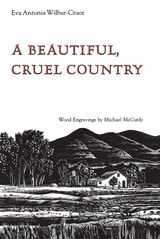
A Beautiful, Cruel Country
Eva Antonia Wilbur-Cruce
University of Arizona Press, 1987
Eva Antonia Wilbur inherited a unique affinity for the land. Granddaughter of a Harvard-educated physician who came to the Territory in the 1860s, she was the firstborn child of a Mexican mother and Anglo father who instilled in her an appreciation for both cultures. Little Toña learned firsthand the responsibilities of ranching—an education usually reserved for boys—and also experienced the racial hostility that occurred during those final years before the Tohono O'odham were confined to a reservation.
Begun as a reminiscence to tell younger family members about their "rawhide tough and lonely" life at the turn of the century, Mrs. Wilbur-Cruce's book is rich with imagery and dialogue that brings the Arivaca area to life. Her story is built around the annual cycle of ranch life—its spring and fall round-ups, planting and harvesting—and features a cavalcade of border characters, anecdotes about folk medicine, and recollections of events that were most meaningful in a young girl's life. Her account constitutes a valuable primary source from a region about which nothing similar has been previously published, while the richness of her story creates a work of literature that will appeal to readers of all ages.

A Bibliography of Northern Manitoba
Richard A. Enns
University of Manitoba Press, 1991
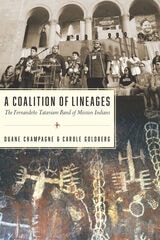
A Coalition of Lineages
The Fernandeño Tataviam Band of Mission IndiansDuane Champagne and Carole Goldberg
University of Arizona Press, 2021
The history of Southern California’s Indigenous communities is mapped through the story of family and their descendants, or lineages. The authors explain how politically and culturally independent lineages merged and strengthened via marriage, creating complex and enduring coalitions among Indigenous communities. The Indigenous people of Southern California faced waves of colonizers—the Spanish, then the Mexicans, followed by Americans—and their coalitions allowed them to endure to today.
Champagne and Goldberg are leading experts in Native sovereignty policies and histories. They worked in collaboration with members of the Fernandeño Tataviam Band of Mission Indians to illustrate how the community formed and persisted. A Coalition of Lineages is not only the story of a Native Southern California community, it is also a model for multicultural tribal development for recognized and nonrecognized Indian nations in the United States and elsewhere.
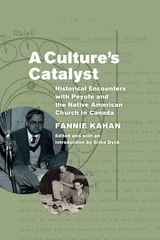
A Culture's Catalyst
Historical Encounters with Peyote and the Native American Church in CanadaFannie Kahan
University of Manitoba Press, 2016
A Fateful Time
The Background And Legislative History Of The Indian Reorganization ActElmer R. Rusco
University of Nevada Press, 2026
The Indian Reorganization Act (IRA) of 1934 has been generally acknowledged as the most important statute affecting Native Americans after the General Allotment Act of 1887, and it is probably the most important single statute affecting Native Americans during the two-thirds of a century since its passage. Over half the Native governments in the contemporary U.S. are organized under its provisions or under separate statutes that parallel the IRA in major ways. Although the impact of the IRA has been widely studied and debated, no scholar until now has looked closely at the forces that shaped its creation and passage. Author Elmer Rusco spent over a decade of research in national and regional archives and other repositories to examine the legislative intent of the IRA, including the role of issues like the nature and significance of judge-made Indian law; the allotment policy and its relation to Indian self-government; the nature of Native American governments before the IRA; the views and actions of John Collier, commissioner of Indian Affairs and leader in the campaign to reform the nation’s Indian policy; and the influence of relations between the president and Congress during the second year of the New Deal. Rusco also discusses the role of conflicting ideologies and interests in this effort to expand the rights of Native Americans; the general ignorance of Native American concerns and policy on the part of legislators engaged in the writing and passage of the law; and the limited but crucial impact of Indian involvement in the struggle over the IRA.
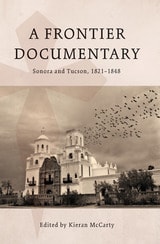
A Frontier Documentary
Sonora and Tucson, 1821–1848Edited by Kieran McCarty
University of Arizona Press, 1997
These documents give a sense of immediacy to the military operations, Indian activities, and missionary work going on in Tucson and the surrounding areas. They also demonstrate that Hispanic families maintained continuity in military and political control on the frontier, and clearly show that the frontier was not beset by anarchy in spite of the change in national government. In the forty chapters of translated documents in this collection, the voices of those who lived in what is now the Arizona-Sonora border region provide firsthand accounts of the people and events that shaped their era. These documents record such events as the arrival of the first Americans, the reconstruction of Tucson’s presidio wall, and conflict between Tohono O’odham villagers and Mexicans. All are set against the backdrop of an unrelenting Apache offensive that heightened after the departure of the Spanish military but that was held in check by civilian militias. Each chapter begins with a brief introduction in which historian Kieran McCarty provides background on the documents’ context and authorship. Taken together, they offer a fascinating look at this little-known period and provide a unique panorama of southwestern history.
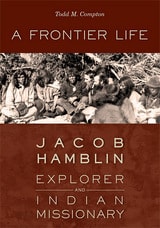
A Frontier Life
Jacob Hamblin, Explorer and Indian MissionaryTodd M. Compton
University of Utah Press, 2013
Winner of the Evans Biography Award, the John Whitmer Historical Society Best Biography Award, and the Francis Armstrong Madsen Best Book Award
Frontiersman, colonizer, missionary to the Indians, and explorer of the American West, Jacob Hamblin has long been one of the most enigmatic figures in Mormon history. In this defining biography, Todd Compton examines and disentangles many of the myths and controversies surrounding Hamblin. His Grand Canyon adventures and explorations as a guide alongside John Wesley Powell are well documented, as are his roles as a missionary, cultural liaison, and negotiator to the Indian tribes of southern Utah and Arizona. Hamblin struggled in this latter role, sometimes unable to bridge the gulf between Mormonism and Indian culture. He disavowed violent conflict and ceaselessly sought peaceful resolutions where others resorted to punitive action. He strove above all for mutual understanding in the absence of conversion.
A Frontier Life provides a rich narrative that fleshes out a picture of a sometimes vilified figure, particularly in regard to his connection to the infamous Mountain Meadows Massacre, where Compton provides nuanced discussion clarifying Hamblin’s post-massacre role—he was not present at the massacre, but reported on it to both Brigham Young and military investigators. Compton’s engagement with Mormon historiography and previous Hamblin portrayals will make this work of particular interest to both scholars and students. The casual reader will take pleasure in learning of a true pioneer who lived life at the geographical, cultural, and spiritual boundaries of his era. This dramatic, entertaining biography is a truly significant contribution to Mormon history.
A History in Indigenous Voices
Menominee, Ho-Chunk, Oneida, Stockbridge, and Brothertown Interactions in the Removal EraCarol Cornelius
Wisconsin Historical Society Press, 2023
Treaties made in the 1800s between the United States and the Indigenous nations of what is now Wisconsin have had profound influence on the region’s cultural and political landscape. Yet few people realize that in the early part of that century, the Menominee and Ho-Chunk Nations of Wisconsin signed land treaties with several Indigenous nations from New York State. At the onset of the removal era, these eastern nations, including the Oneida Nation and the Six Nations Confederacy, were under constant pressure from the federal government and land speculators to move to lands around Green Bay and Lake Winnebago.
In this groundbreaking book, Carol A. Cornelius has compiled a careful account of these nation-to-nation treaties, in large part in the words of those Indigenous leaders who served as the voices and representatives of their nations. Drawing on a rich collection of primary sources, Cornelius walks readers through how, why, and for whom these treaties were made and how the federal government’s failure and unwillingness to acknowledge their legitimacy led to the further loss of Indigenous lands. The living documents transcribed here testify to the complexity and sovereignty of Indigenous governance then and now, making this volume a vital resource for historians and an accessible introduction to Indigenous treatymaking in Wisconsin.
Winner of the 2024 Wisconsin Historical Society’s Book of Merit Award
Finalist for the 2023 Foreword INDIES Book of the Year Award for Adult Nonfiction History
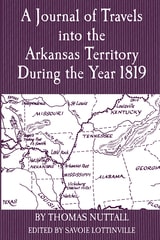
A Journal of Travels into the Arkansas Territory During the Year 1819
Thomas Nuttall
University of Arkansas Press, 1999
This is the famous naturalist Thomas Nuttall's only surviving complete journal of his American scientific explorations. Covering his travels in Arkansas and what is now Oklahoma, it is pivotal to an understanding of the Old Southwest in the early nineteenth century, when the United States was taking inventory of its acquisitions from the Louisiana Purchase.
The account follows Nuttall's route from Philadelphia to Pittsburg, down the Ohio River to its mouth, then down the Mississippi River to the Arkansas Post, and up the Arkansas River with a side trip to the Red River. It is filled with valuable details on the plants, animals, and geology of the region, as well as penetrating observations of the resident native tribes, the military establishment at Fort Smith, the arrival of the first governor of Arkansas Territory, and the beginnings of white settlement.
Originally published in 1980 by the University of Oklahoma Press, this fine edited version of Nuttall's work boasts a valuable introduction, notes, maps, and bibliography by Savoie Lottinville. The editor provided common names for those given in scientific classification and substituted modern genus and species names for the ones used originally by Nuttall. The resulting journal is a delight to read for anyone—historian, researcher, visitor, resident, or enthusiast.
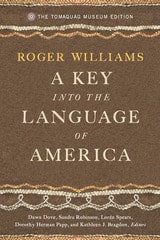
A Key into the Language of America
The Tomaquag Museum EditionRoger Williams
Westholme Publishing, 2019
Roger Williams’s Key into the Language of America, first published in 1643, is one of the most important artifacts of early Indigenous American culture. In it, Williams recorded the day-to-day experience of the Narragansett people of Rhode Island in their own words, the first documentation of an American Indian language in English. Williams’s Key can be read at many levels because of its historical, literary, political, and religious significance. Its greatest value, though, is its intimate portrait of the Narragansett and their linguistic neighbors in the early years of European colonial settlement, before disease, dislocation, warfare—in particular, King Philip’s War—and colonial interference had diminished their population and power in the region. An extraordinary achievement, Williams’s Key gives us a contemporary account of Narragansett family life, of their sociability and skill in business, their dress, foodways, and the farming, fishing, and hunting that formed the basis of their sustenance practices.
This new Tomaquag Museum edition includes for the first time cultural commentary provided by the Narragansett Tribe as well as modern linguistic information provided by a leading authority in the study of American Indian languages.
The Tomaquag Museum, located in Exeter, Rhode Island, is an Indigenous nonprofit organization dedicated to sharing the culture, arts, and history of the Narragansett and other tribal communities of southern New England.

A Knock on the Door
The Essential History of Residential Schools from the Truth and Reconciliation Commission of CanadaUniversity of Manitoba Press, 2015
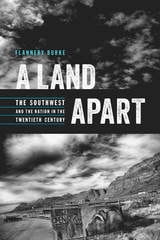
A Land Apart
The Southwest and the Nation in the Twentieth CenturyFlannery Burke
University of Arizona Press, 2017
Winner, Spur Award for Best Contemporary Nonfiction (Western Writers of America)
A Land Apart is not just a cultural history of the modern Southwest—it is a complete rethinking and recentering of the key players and primary events marking the Southwest in the twentieth century. Historian Flannery Burke emphasizes how indigenous, Hispanic, and other non-white people negotiated their rightful place in the Southwest. Readers visit the region’s top tourist attractions and find out how they got there, listen to the debates of Native people as they sought to establish independence for themselves in the modern United States, and ponder the significance of the U.S.-Mexico border in a place that used to be Mexico. Burke emphasizes policy over politicians, communities over individuals, and stories over simple narratives.
Burke argues that the Southwest’s reputation as a region on the margins of the nation has caused many of its problems in the twentieth century. She proposes that, as they consider the future, Americans should view New Mexico and Arizona as close neighbors rather than distant siblings, pay attention to the region’s history as Mexican and indigenous space, bear witness to the area’s inequalities, and listen to the Southwest’s stories. Burke explains that two core parts of southwestern history are the development of the nuclear bomb and subsequent uranium mining, and she maintains that these are not merely a critical facet in the history of World War II and the militarization of the American West but central to an understanding of the region’s energy future, its environmental health, and southwesterners’ conception of home.
Burke masterfully crafts an engaging and accessible history that will interest historians and lay readers alike. It is for anyone interested in using the past to understand the present and the future of not only the region but the nation as a whole.
A Land Not Forgotten
Indigenous Food Security and Land-Based Practices in Northern OntarioMichael A. Robidoux
University of Manitoba Press, 2017
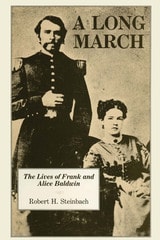
A Long March
The Lives of Frank and Alice BaldwinBy Robert H. Steinbach
University of Texas Press, 1990
During a distinguished military career, in which he rose to the rank of brigadier general and twice won the Medal of Honor, Frank Baldwin saw service in the Civil War, the Indian wars on the Great Plains, and the Spanish-American War. His wife, Alice Blackwood Baldwin, shared the "long march" with him, from his Plains service onward. In this first biography of the Baldwins, Robert Steinbach combines military and personal history to vividly portray a marriage that survived both the harshness of frontier army life and the restrictive Victorian concept of "separate spheres" for husband and wife.
Drawing on a wealth of diaries, letters, and other family papers, Steinbach re-creates the Baldwins' life on the Plains. Moving from post to post in Kansas, New Mexico, Montana, North Dakota, and Texas, they faced danger, excitement, separations, poverty, and many other hardships. Frequently they clashed over Alice's desire to be something more than "an ornament to society"—a wish eventually granted as Frank's long absences and chronic ill health required Allie to take responsibility for herself and their daughter.
With insights into military campaigns on the Great Plains in the years 1865–1890 and a revealing look at the human side of those campaigns, A Long March will appeal to a wide audience.
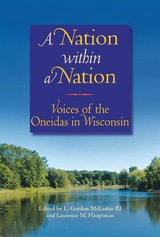
A Nation within a Nation
Voices of the Oneidas in WisconsinL. Gordon McLester III
Wisconsin Historical Society Press, 2010
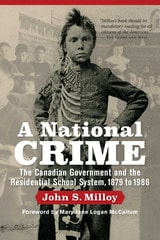
A National Crime
The Canadian Government and the Residential School System 2nd editionJohn S. Milloy
University of Manitoba Press, 2017
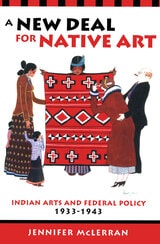
A New Deal for Native Art
Indian Arts and Federal Policy, 1933-1943Jennifer McLerran
University of Arizona Press, 2009
In A New Deal for Native Art, Jennifer McLerran reveals how positioning the native artist as a pre-modern Other served the goals of New Deal programs—and how this sometimes worked at cross-purposes with promoting native self-sufficiency. She describes federal policies of the 1930s and early 1940s that sought to generate an upscale market for Native American arts and crafts. And by unraveling the complex ways in which commodification was negotiated and the roles that producers, consumers, and New Deal administrators played in that process, she sheds new light on native art’s commodity status and the artist’s position as colonial subject.
In this first book to address the ways in which New Deal Indian policy specifically advanced commodification and colonization, McLerran reviews its multi-pronged effort to improve the market for Indian art through the Indian Arts and Crafts Board, arts and crafts cooperatives, murals, museum exhibits, and Civilian Conservation Corps projects. Presenting nationwide case studies that demonstrate transcultural dynamics of production and reception, she argues for viewing Indian art as a commodity, as part of the national economy, and as part of national political trends and reform efforts.
McLerran marks the contributions of key individuals, from John Collier and Rene d’Harnoncourt to Navajo artist Gerald Nailor, whose mural in the Navajo Nation Council House conveyed distinctly different messages to outsiders and tribal members. Featuring dozens of illustrations, A New Deal for Native Art offers a new look at the complexities of folk art “revivals” as it opens a new window on the Indian New Deal.
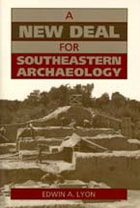
A New Deal for Southeastern Archaeology
Edwin A. Lyon
University of Alabama Press, 1996
Recipient of the 1994 Anne B. and James B. McMillan Prize
This comprehensive study provides a history of New Deal archaeology in the Southeast in the 1930s and early 1940s and focuses on the projects of the Federal Emergency Relief Administration, the Civil Works Administration, the Works Progress Administration, the Tennessee Valley Authority, the National Park Service, and the Smithsonian Institution.
Utilizing primary sources including correspondence and unpublished reports, Lyon demonstrates the great importance of the New Deal projects in the history of southeastern and North American archaeology. New Deal archaeology transformed the practice of archaeology in the Southeast and created the basis for the discipline that exists today. With the current emphasis on curation and repatriation, archaeologists and historians will find this volume invaluable in reconstructing the history of the projects that generated the many collections that now fill our museums.
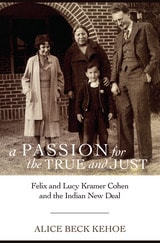
A Passion for the True and Just
Felix and Lucy Kramer Cohen and the Indian New DealAlice Beck Kehoe
University of Arizona Press, 2014
Kehoe argues that, due to anti-Semitism in 1930s America, Cohen could not speak for his legislation before Congress, and that Collier, an upper-class WASP, became the spokesman as well as the administrator. According to the author, historians of the Indian New Deal have not given due weight to Cohen’s work, nor have they recognized its foundation in his liberal secular Jewish culture. Both Felix and Lucy Cohen shared a belief in the moral duty of mitzvah, creating a commitment to the “true and the just” that was rooted in their Jewish intellectual and moral heritage, and their Social Democrat principles.
A Passion for the True and Just takes a fresh look at the Indian New Deal and the radical reversal of US Indian policies it caused, moving from ethnocide to retention of Indian homelands. Shifting attention to the Jewish tradition of moral obligation that served as a foundation for Felix and Lucy Kramer Cohen (and her professor Franz Boas), the book discusses Cohen’s landmark contributions to the principle of sovereignty that so significantly influenced American legal philosophy.
A Place in Common
Rethinking the History of Early DetroitKaren L. Marrero
Michigan State University Press, 2025
A Projectile Point Guide for the Upper Mississippi River Valley
Robert F. Boszhardt
University of Iowa Press, 2003
The most common relics of the 12,000-year occupancy of the Upper Mississippi River Valley may be the chipped stone projectile points that Native Americans fastened to the ends of their spears, darts, and arrow shafts. This useful guide provides a key to identifying the various styles of points found along the Upper Mississippi River in the Driftless region stretching roughly from Dubuque, Iowa, to Red Wing, Minnesota, but framed within a somewhat larger area extending from the Rock Island Rapids at the modern Moline-Rock Island area to the Falls of St. Anthony at Minneapolis-St. Paul.
Logging tens of thousands of miles and visiting private collectors from all walks of life since 1982, Robert Boszhardt has documented thousands of projectile points found in this region. In addition to drawings of each style, he provides other accepted names as well as names of related points, age, distribution, a description (including length and width), material, and references for each type. The guide is meant for the many avocational archaeologists who collect projectile points in the Upper Midwest and will be a useful reference tool for professional field archaeologists as well.
Emphasizing the preservation of sites as well as a mutual exchange of information between professional and avocational archaeologists, this guide will reveal projectile points as clues to the past, time markers which embody crucial information about the cultures of the Mississippi River Valley's early inhabitants.
A Race at Bay
New York Times Editorials on "the Indian Problem," 1860 - 1900Robert G. Hays. Foreword by Paul Simon
Southern Illinois University Press, 1997
Robert G. Hays chronicles the "Indian problem" precisely as it was explained to Americans through the editorial columns of the New York Times between 1860 and 1900, the years when battles between white settlers and Native Americans split a nation and its spirit apart.
Covering the final forty-one years of the nineteenth century, Hays’s collection of Times editorials gives readers what current accounts cannot: perspectives by contemporary writers with unique insights into the public images of Native Americans and their place in a nation bent on expansion. The authentic voices of a national newspaper’s daily record speak with an urgency both immediate and real.
These editorials express the unbridled bitterness and raw ambition of a nation immersed in an agenda of conquest. They also resonate with the struggle to find a common ground. Some editorials are patronizing and ironic: "Yet it seems pitiful to cage so fine a savage among a herd of vulgar criminals in a penitentiary." Others include a willingness to poke fun: "Many persons on the platform were astonished to find that an ‘illiterate barbarian’ could handle the weapon of sarcasm. The truth is that the Indians spoke far better than ninety-nine out of a hundred members of congress." And yet others evince an attitude of respect, which set the tone for reconciling national ambition with natural rights.
In some instances, the Times allowed Native Americans to tell their own stories, as in this eloquent, moving account of the testimony of Satanta, the warrior chief of the Kiowas: "A certain dim foreboding of the Indians’ fate swept across his mind, and in its passage lit his eyes up with a fierce light, and his voice rose to a pitch of frenzy as he exclaimed: ‘We don’t want to settle—I love to roam over the prairie; there I am free and happy."
History demonstrates that the costs of owning one’s soil and one’s destiny remain without measure. Many of the problems blocking the progress of Native Americans continue unsolved: unemployment, infant mortality, suicide, crime, alcoholism, and poverty. Following such works as Helen Hunt Jackson’s A Century of Dishonor and Dee Brown’s Bury My Heart at Wounded Knee, Hays looks back on the records of national history for the roots of our challenges today.
A Short History of Indians in Canada
StoriesThomas King
University of Minnesota Press, 2013

A Tale of Three Villages
Indigenous-Colonial Interactions in Southwestern Alaska, 1740–1950Liam Frink
University of Arizona Press, 2016
Liam Frink focuses on three indigenous-colonial events along the southwestern Alaskan coast: the late precolonial end of warfare and raiding, the commodification of subsistence that followed, and, finally, the engagement with institutional religion. Frink’s innovative interdisciplinary methodology respectfully and creatively investigates the spatial and material past, using archaeological, ethnoecological, and archival sources.
The author’s narrative journey tracks the histories of three villages ancestrally linked to Chevak, a contemporary Alaskan Native community: Qavinaq, a prehistoric village at the precipice of colonial interactions and devastated by regional warfare; Kashunak, where people lived during the infancy and growth of the commercial market and colonial religion; and Old Chevak, a briefly occupied “stepping-stone” village inhabited just prior to modern Chevak. The archaeological spatial data from the sites are blended with ethnohistoric documents, local oral histories, eyewitness accounts of people who lived at two of the villages, and Frink’s nearly two decades of participant-observation in the region.
Frink provides a model for work that examines interfaces among indigenous women and men, old and young, demonstrating that it is as important as understanding their interactions with colonizers. He demonstrates that in order to understand colonial history, we must actively incorporate indigenous people as actors, not merely as reactors.
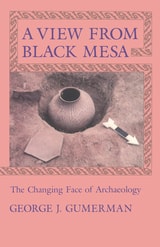
A View From Black Mesa
The Changing Face of ArchaeologyGeorge J. Gumerman
University of Arizona Press, 1984
"In clear and nontechnical language it provides readers with a synopsis of Anasazi prehistory and cultural ecology. ...Gumerman's work is especially useful for anyone seeking an `on-site' introduction to some of the basic techniques and research orientations of modern American archaeology. Highly recommended for students and general readers." —Choice
"It should be read with thoughtful care by the `professional' archaeologist and ethnographer. And it will even more effectively serve the informed general reader, unconcerned with academic minutiae, through its fresh and direct exposition of the procedures, frustrations, and rewards of the calling." —The Kiva
"An outstanding success....a readable book that is suitable for professional archaeologists and the general public as well." —North American Archaeologist
"A readable book that is suitable for professional archaeologists and the general public." —North American Archaeologist
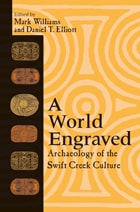
A World Engraved
Archaeology of the Swift Creek CultureEdited by Mark Williams and Daniel T. Elliott
University of Alabama Press, 1998
This major summary of the current state of archaeological research on the Swift Creek culture is the first comprehensive collection ever published concerning the Swift Creek people.
The Swift Creek people, centered in Georgia and surrounding states from A.D. 100 to 700, are best known from their pottery, which was decorated before firing with beautiful paddle-stamped designs--some of the most intricate and fascinating in the world.
Comprehensive in scope, this volume details the discovery of this culture, summarizes what is known about it at the present time, and shows how continued improvements in the collection and analysis of archaeological data are advancing our knowledge of this extinct society.
Although they know nothing of Swift Creek language and little about its society, archaeologists have collected valuable information about the
economic strategies of Swift Creek inhabitants. What archaeologists know best, however, is that the Swift Creek people were some of the best wood carvers the world has seen, and their pottery will stand as their lasting legacy for all time. This book presents and preserves their legacy.

A World You Do Not Know
Settler Societies, Indigenous Peoples and the Attack on Cultural DiversityColin Samson
University of London Press, 2014
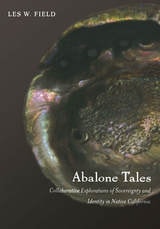
Abalone Tales
Collaborative Explorations of Sovereignty and Identity in Native CaliforniaLes W. Field
Duke University Press, 2008
Tales about abalone and their historical and contemporary meanings are related by Field and his coauthors, who include the chair and other members of the Muwekma Ohlone Tribe; a Point Arena Pomo elder; the chair of the Wiyot tribe and her sister; several Hupa Indians; and a Karuk scholar, artist, and performer. Reflecting the divergent perspectives of various Native groups and people, the stories and analyses belie any presumption of a single, unified indigenous understanding of abalone. At the same time, they shed light on abalone’s role in cultural revitalization, struggles over territory, tribal appeals for federal recognition, and connections among California’s Native groups. While California’s abalone are in danger of extinction, their symbolic power appears to surpass even the environmental crises affecting the state’s vulnerable coastline.
Aboriginal Resource Use in Canada
Historical and Legal AspectsKerry Abel
University of Manitoba Press, 1991
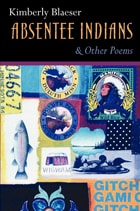
Absentee Indians and Other Poems
Kimberly Blaeser
Michigan State University Press, 2002
Absentee Indians and Other Poems evokes personal yet universal experiences of the places that Native Americans call home, their family and national histories, and the emotional forces that help forge Native American identities. These are poems of exile, loss, and the celebration of that which remains. Anchored in the physical landscape, Blaeser’s poetry finds the sacred in those ordinary actions that bind a community together. As Blaeser turns to the mysterious passage from sleeping to wakefulness, or from nature to spirit, she reveals not merely the movement from one age or place to another, but the movement from experience to vision.
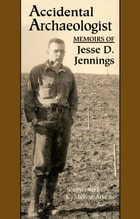
Accidental archaeologist
memoirs of Jesse D. JenningsJesse David Jennings
University of Utah Press, 1994
Accomplishing NAGPRA
Perspectives on the Intent, Impact, and Future of the Native American Graves Protection and Repatriation ActSangita Chari and Jaime M. N. Lavallee
Oregon State University Press, 2013
NAGPRA requires museums and federal agencies to return requested Native American cultural items to lineal descendants, culturally affiliated Indian tribes, and Native Hawai’ian organizations. Since the 1990 passage of the act, museums and federal agencies have made more than one million cultural items—and the remains of nearly forty thousand Native Americans—available for repatriation.
Drawing on case studies, personal reflections, historical documents, and statistics, the volume examines NAGPRA and its grassroots, practical application throughout the United States.? Accomplishing NAGPRA will appeal to professionals and academics with an interest in cultural resource management, Indian and human rights law, Indigenous studies, social justice movements, and public policy.
Across a Great Divide
Continuity and Change in Native North American Societies, 1400–1900Edited by Laura L. Scheiber and Mark D. Mitchell
University of Arizona Press, 2010
The contributors address a series of interlocking themes. Several consider the role of indigenous agency in the processes of colonial interaction, paying particular attention to gender and status. Others examine the ways long-standing native political economies affected, and were in turn affected by, colonial interaction. A third group explores colonial-period ethnogenesis, emphasizing the emergence of new native social identities and relations after 1500. The book also highlights tensions between the detailed study of local cases and the search for global processes, a recurrent theme in postcolonial research.
If archaeologists are to bridge the artificial divide separating history from prehistory, they must overturn a whole range of colonial ideas about American Indians and their history. This book shows that empirical archaeological research can help replace long-standing models of indigenous culture change rooted in colonialist narratives with more nuanced, multilinear models of change—and play a major role in decolonizing knowledge about native peoples.
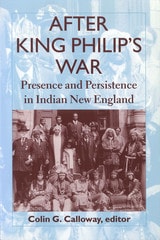
After King Philip’s War
Presence and Persistence in Indian New EnglandEdited by Colin G. Calloway
Dartmouth College Press, 1997

After the Bloodbath
Is Healing Possible in the Wake of Rampage Shootings?James D. Diamond
Michigan State University Press, 2019
Afterlives of Indigenous Archives
Edited by Ivy Schweitzer and Gordon Henry
Dartmouth College Press, 2019
Aggression and Sufferings
Settler Violence, Native Resistance, and the Coalescence of the Old SouthF. Evan Nooe
University of Alabama Press, 2024
WINNER OF THE FRANCIS B. SIMKINS AWARD, SOUTHERN HISTORICAL ASSOCIATION
WINNER OF THE 2024 BEST FIRST BOOK AWARD FROM PHI ALPHA THETA, THE NATIONAL HISTORY HONOR SOCIETY
A bold reconceptualization of how settler expansion and narratives of victimhood, honor, and revenge drove the conquest and erasure of the Native South and fed the emergence of a distinct white southern identity.
In 1823, Tennessee historian John Haywood encapsulated a foundational sentiment among the white citizenry of Tennessee when he wrote of a “long continued course of aggression and sufferings” between whites and Native Americans. According to F. Evan Nooe, “aggression” and “sufferings” are broad categories that can be used to represent the framework of factors contributing to the coalescence of the white South.
Traditionally, the concept of coalescence is an anthropological model used to examine the transformation of Indigenous communities in the Eastern Woodlands from chieftaincies to Native tribes, confederacies, and nations in response to colonialism. Applying this concept to white southerners, Nooe argues that through the experiences and selective memory of settlers in the antebellum South, white southerners incorporated their aggression against and suffering at the hands of the Indigenous peoples of the Southeast in the coalescence of a regional identity built upon the violent dispossession of the Native South. This, in turn, formed a precursor to Confederate identity and its later iterations in the long nineteenth century.
Geographically, Aggression and Sufferings prioritizes events in South Carolina, Florida, Tennessee, Georgia, and Alabama. Nooe considers how divergent systems of violence and justice between Native Americans and white settlers (such as blood revenge and concepts of honor) functioned in the region and examines the involved societies’ conflicting standards on how to equitably resolve interpersonal violence. Finally, Nooe explores how white southerners constructed, propagated, and perpetuated harrowing tales of colonizers as both victims and heroes in the violent expulsion of the region’s Native peoples from their homelands. This constructed sense of regional history and identity continued to flower into the antebellum period, during western expansion, and well through the twentieth century.
Alabama and the Borderlands
From Prehistory To StatehoodEdited by R. Reid Badger and Lawrence A. Clayton
University of Alabama Press, 1985
Brings together the nation's leading scholars on the prehistory and early history of Alabama and the southeastern US
This fascinating collection was born of a concern with Alabama's past and the need to explore and explain that legacy, so often hidden by the veils of time, ignorance, or misunderstanding. In 1981 The University of Alabama celebrated its 150th anniversary, and each College contributed to the celebration by sponsoring a special symposium. The College of Arts and Sciences brought together the nation's leading scholars on the prehistory and early history of Alabama and the Southeastern United States, and for two memorable days in September 1981 several hundred interested listeners heard those scholars present their interpretations of Alabama's remarkable past.
The organizers of the symposium deliberately chose to focus on Alabama's history before statehood. Alabama as a constituent state of the Old South is well known. Alabama as a home of Indian cultures and civilizations of a high order, as an object of desire, exploration, and conquest in the sixteenth century, and as a borderland disputed by rival European nationalities for almost 300 years is less well known. The resulting essays in this collection prove as interesting, enlightening, and provocative to the casual reader as to the professional scholar, for they are intended to bring to the general reader artifacts and documents that reveal the realities and romance of that older Alabama.
Topics in the collection range from the Mississippian Period in archaeology and the de Soto expedition (and other early European explorations and settlements of Alabama) to the 1780 Siege of Mobile.
Alaska Native Cultures and Issues
Responses to Frequently Asked QuestionsEdited by Libby Roderick
University of Alaska Press, 2010
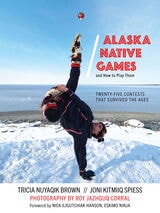
Alaska Native Games and How to Play Them
Tricia Nuyaqik Brown and Joni Kitmiiq Spiess
University of Alaska Press, 2020
As Tricia Nuyaqik Brown shows, even though today’s competitions are a big media event in Alaska, the games themselves are really no different from those of long ago. Ancestral communities once pitted their strongest, their most agile, their fastest men and women against those from neighboring villages or tribal groups. Those games never died, but rather than gathering in a sod meeting place, competitions are now held in gyms and arenas. Each game today can be linked to some aspect of surviving in a harsh environment, of drawing sustenance from the land and sea. From the Seal Hop to the Bench Reach to the Four-Man Carry, these ancient games still require athletes to be in top physical condition and possess sharp mental focus. They hold dear the traditional Native values of honoring the elders, responsibility to tribe, sportsmanship, humor, patience, and hunter success. This book offers an engaging introduction to these games and their history, inviting people to jump in and try them for themselves!
Alliance and Landscape on Perry Mesa in the Fourteenth Century
David R. Abbott
University of Utah Press, 2014
Contributors to this volume examine the migration process under two explanatory frameworks: alliance and landscape. These frameworks are used to explore competing hypotheses, positing either a rapid colonization associated with an alliance organized for warfare at a regional scale, or a more protracted migration as this landscape became comparatively more attractive for migrating farmers in the late thirteenth century.
As the first major publication on the archaeology of Perry Mesa, this volume contributes to theoretical perspectives on migration and ethnogenesis, the study of warfare in the prehistoric Southwest, the study of intensive agricultural practices in a marginal environment, and the cultural history of a little studied and largely unknown portion of the ancient Southwest. It not only documents the migration but also the ensuing birth of a new ethnic identity that arose from the coalescence of diverse groups atop Perry Mesa.
Allotment Stories
Indigenous Land Relations under Settler SiegeDaniel Heath Justice
University of Minnesota Press, 2021
More than two dozen stories of Indigenous resistance to the privatization and allotment of Indigenous lands
Land privatization has been a longstanding and ongoing settler colonial process separating Indigenous peoples from their traditional homelands, with devastating consequences. Allotment Stories delves into this conflict, creating a complex conversation out of narratives of Indigenous communities resisting allotment and other dispossessive land schemes.
From the use of homesteading by nineteenth-century Anishinaabe women to maintain their independence to the role that roads have played in expropriating Guam’s Indigenous heritage to the links between land loss and genocide in California, Allotment Stories collects more than two dozen chronicles of white imperialism and Indigenous resistance. Ranging from the historical to the contemporary and grappling with Indigenous land struggles around the globe, these narratives showcase both scholarly and creative forms of expression, constructing a multifaceted book of diverse disciplinary perspectives. Allotment Stories highlights how Indigenous peoples have consistently used creativity to sustain collective ties, kinship relations, and cultural commitments in the face of privatization. At once informing readers while provoking them toward further research into Indigenous resilience, this collection pieces back together some of what the forces of allotment have tried to tear apart.
Contributors: Jennifer Adese, U of Toronto Mississauga; Megan Baker, U of California, Los Angeles; William Bauer Jr., U of Nevada, Las Vegas; Christine Taitano DeLisle, U of Minnesota–Twin Cities; Vicente M. Diaz, U of Minnesota–Twin Cities; Sarah Biscarra Dilley, U of California, Davis; Marilyn Dumont, U of Alberta; Munir Fakher Eldin, Birzeit U, Palestine; Nick Estes, U of New Mexico; Pauliina Feodoroff; Susan E. Gray, Arizona State U; J. Kēhaulani Kauanui, Wesleyan U; Rauna Kuokkanen, U of Lapland and U of Toronto; Sheryl R. Lightfoot, U of British Columbia; Kelly McDonough, U of Texas at Austin; Ruby Hansen Murray; Tero Mustonen, U of Eastern Finland; Darren O’Toole, U of Ottawa; Shiri Pasternak, Ryerson U; Dione Payne, Te Whare Wānaka o Aoraki–Lincoln U; Joseph M. Pierce, Stony Brook U; Khal Schneider, California State U, Sacramento; Argelia Segovia Liga, Colegio de Michoacán; Leanne Betasamosake Simpson; Jameson R. Sweet, Rutgers U; Michael P. Taylor, Brigham Young U; Candessa Tehee, Northeastern State U; Benjamin Hugh Velaise, Google American Indian Network.
Alternative Leadership Strategies in the Prehispanic Southwest
Edited by Barbara J. Mills
University of Arizona Press, 2000
In considerations of societal change, the application of classic evolutionary schemes to prehistoric southwestern peoples has always been problematic for scholars. Because recent theoretical developments point toward more variation in the scale, hierarchy, and degree of centralization of complex societies, this book takes a fresh look at southwestern prehistory with these new ideas in mind.
This is the first book-length work to apply new theories of social organization and leadership strategies to the prehispanic Southwest. It examines leadership strategies in a number of archaeological contexts—from Chaco Canyon to Casas Grandes, from Hohokam to Zuni—to show striking differences in the way that leadership was constructed across the region.
These case studies provide ample evidence for alternative models of leadership in middle-range societies. By illustrating complementary approaches in the study of political organization, they offer new insight into power and inequality. They also provide important models of how today's archaeologists are linking data to theory, providing a basis for comparative analysis with other regions.
CONTENTSAlternative Models, Alternative Strategies: Leadership in the Prehispanic Southwest / Barbara J. Mills
Political Leadership and the Construction of Chacoan Great Houses, A.D. 1020-1140 / W. H. Wills
Leadership, Long-Distance Exchange, and Feasting in the Protohistoric Rio Grande / William M. Graves and Katherine A. Spielmann
Ritual as a Power Resource in the American Southwest / James M. Potter and Elizabeth M. Perry
Ceramic Decoration as Power: Late Prehistoric Design Change in East-Central Arizona / Scott Van Keuren
Leadership Strategies in Protohistoric Zuni Towns / Keith W. Kintigh
Organizational Variability in Platform Mound-Building Groups of the American Southwest / Mark D. Elson and David R. Abbott
Leadership Strategies among the Classic Period Hohokam: A Case Study / Karen G. Harry and James M. Bayman
The Institutional Contexts of Hohokam Complexity and Inequality / Suzanne K. Fish and Paul R. Fish
Leadership at Casas Grandes, Chihuahua, Mexico / Michael E. Whalen and Paul E. Minnis
Reciprocity and Its Limits: Considerations for a Study of the Prehispanic Pueblo World / Timothy A. Kohler, Matthew W. Van Pelt, and Lorene Y. L. Yap
Dual-Processual Theory and Social Formations in the Southwest / Gary M. Feinman
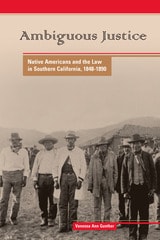
Ambiguous Justice
Native Americans and the Law in Southern California, 1848-1890Vanessa Ann Gunther
Michigan State University Press, 2006
In 1769, Spain took action to solidify control over its northern New World territories by establishing a series of missions and presidios in what is now modern California. To populate these remote establishments, the Spanish crown relied on Franciscan priests, whose role it was to convince the Native Californian population to abandon their traditional religious practices and adopt Catholicism. During their tutelage, the Indians of California would be indoctrinated into Spanish society, where they would learn obedience to the church and crown.
The legal system of Southern California has been used by Anglo populations as a social and demographic tool to control Native Americans. Following the Mexican-American War and the 1849 Gold Rush, as California property values increased and transportation corridors were established, Native Americans remained a sharply declining presence in many communities, and were likely to be charged with crimes. The sentences they received were lighter than those given to Anglo offenders, indicating that the legal system was used as a means of harassment. Additionally, courts chronicled the decline of the once flourishing native populations with each case of drunkenness, assault, or rape that appeared before the bench. Nineteenth-century American society had little sympathy for the plight of Indians or for the destruction of their culture. Many believed that the Indians of Southern California would fade from history because of their inability to adapt to a changing world. While many aspects of their traditional culture have been irreparably lost, the people of southern California are, nevertheless, attempting to recreate the cultures that were challenged by the influx of Europeans and later Americans to their lands.
Amer Indian Law Deskbook 3ed
Hardy Conference of Western Attorneys General
University Press of Colorado, 2004

American Indian Activism
ALCATRAZ TO THE LONGEST WALKEdited by Troy Johnson; Joane Nagel; and Duane Champagne
University of Illinois Press, 1997
In this volume, some of the dominant scholars in the field chronicle and analyze Native American activism of the 1960s and 1970s. Much of what is included here began as a special issue of the American Indian Culture and Research Journal; the introduction has been extensively modified and one chapter deleted. Importantly, the new first chapter provides extended background and historical analysis of the Alcatraz takeover and discusses its place in contemporary Indian activism.
Contributors include: Karren Baird-Olson, LaNada Boyer, Edward D. Castillo, Duane Champagne, Ward Churchill, Vine Deloria, Jr., Tim Findley, Jack D. Forbes, Adam (Nordwall) Fortunate Eagle, Lenny Foster, John Garvey, George P. Horse Capture, Troy Johnson, Luis S. Kemnitzer, Woody Kipp, Joane Nagel, Robert A. Rundstrom, Steve Talbot
American Indian Constitutional Reform and the Rebuilding of Native Nations
Edited by Eric D. Lemont
University of Texas Press, 2006
Since 1975, when the U.S. government adopted a policy of self-determination for American Indian nations, a large number of the 562 federally recognized nations have seized the opportunity to govern themselves and determine their own economic, political, and cultural futures. As a first and crucial step in this process, many nations are revising constitutions originally developed by the U.S. government to create governmental structures more attuned to native people's unique cultural and political values. These new constitutions and the governing institutions they create are fostering greater governmental stability and accountability, increasing citizen support of government, and providing a firmer foundation for economic and political development.
This book brings together for the first time the writings of tribal reform leaders, academics, and legal practitioners to offer a comprehensive overview of American Indian nations' constitutional reform processes and the rebuilding of native nations. The book is organized in three sections. The first part investigates the historical, cultural, economic, and political motivations behind American Indian nations' recent reform efforts. The second part examines the most significant areas of reform, including criteria for tribal membership/citizenship and the reform of governmental institutions. The book concludes with a discussion of how American Indian nations are navigating the process of reform, including overcoming the politics of reform, maximizing citizen participation, and developing short-term and long-term programs of civic education.
American Indian Educators in Reservation Schools
Terry Huffman
University of Nevada Press, 2014
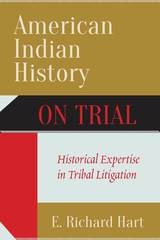
American Indian History on Trial
Historical Expertise in Tribal LitigationE. Richard Hart
University of Utah Press, 2017
Hart, a historian who has testified in cases that have resulted in roughly a billion dollars in judgments, uses specific cases to explain at length what kind of historical research and documentation is necessary for tribes seeking to protect and claim their rights under United States law. He demonstrates the legal questions that Native Americans face by exploring the cultural history and legal struggles of six Indian nations. He recounts how these were addressed by expert testimony grounded in thorough historical understanding, research, and argumentation. The case studies focus on the Wenatchi, Coeur d’Alene, Hualapai, Amah Mutsun, Klamath, and Zuni peoples but address issues relevant to many American tribes.
American Indian Law Deskbook, Fourth Edition
Conference of Western Attorneys General Conference of Western Attorneys General
University Press of Colorado, 2008
Included are:
-The evolution of federal statutory Indian law and the judicial foundations of federal Indian policy.
-An extensive compilation and analysis of federal and state court decisions.
- Reservation and Indian lands ownership and property interests.
-The parameters of criminal jurisdiction in Indian country.
-Concepts of tribal sovereignty and jurisdiction relating to a number of specific areas, including tribal courts, hunting and fishing, environmental regulation, water rights, gaming, and child welfare.
-Cooperative approaches used by the states and tribes for resolving jurisdictional disputes and promoting better relations.
Thorough, scholarly, and balanced, the American Indian Law Deskbook, Fourth Edition is an invaluable reference for a wide range of people working with Indian tribes, including attorneys, legal scholars, government officials, social workers, state and tribal jurists, and historians. This revised edition includes information from more recent court decisions, federal statutes, administrative regulations, and law reviews.