Results by title
19 books match the query 'Indigenous Law & Legal Systems'
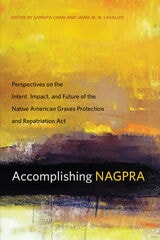
Accomplishing NAGPRA
Perspectives on the Intent, Impact, and Future of the Native American Graves Protection and Repatriation ActSangita Chari and Jaime M. N. Lavallee
Oregon State University Press, 2013
NAGPRA requires museums and federal agencies to return requested Native American cultural items to lineal descendants, culturally affiliated Indian tribes, and Native Hawai’ian organizations. Since the 1990 passage of the act, museums and federal agencies have made more than one million cultural items—and the remains of nearly forty thousand Native Americans—available for repatriation.
Drawing on case studies, personal reflections, historical documents, and statistics, the volume examines NAGPRA and its grassroots, practical application throughout the United States.? Accomplishing NAGPRA will appeal to professionals and academics with an interest in cultural resource management, Indian and human rights law, Indigenous studies, social justice movements, and public policy.

Biopolitics of the More-Than-Human
Forensic Ecologies of ViolenceJoseph Pugliese
Duke University Press, 2020
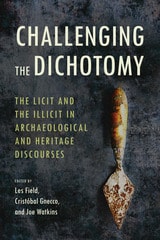
Challenging the Dichotomy
The Licit and the Illicit in Archaeological and Heritage DiscoursesEdited by Les Field, Cristóbal Gnecco, and Joe Watkins
University of Arizona Press, 2016
Utilizing both ethnographic and archaeological examples, contributors ask big questions vital to anyone working in cultural heritage. What are the issues surrounding private versus museum collections? What is considered looting? Is archaeology still a form of colonialization? The contributors discuss this vis-à-vis a global variety of contexts and cultures from the United States, South Africa, Argentina, New Zealand, Honduras, Colombia, Palestine, Greece, Canada, and from the Nasa, Choctaw, and Maori nations.
Challenging the Dichotomy underscores how dichotomies—such as licit/illicit, state/nonstate, public/private, scientific/nonscientific—have been constructed and how they are now being challenged by multiple forces. Throughout the eleven chapters, contributors provide examples of hegemonic relationships of power between nations and institutions. Scholars also reflect on exchanges between Western and non-Western epistemologies and ontologies.
The book’s contributions are significant, timely, and inclusive. Challenging the Dichotomy examines the scale and scope of “illicit” forms of excavation, as well as the demands from minority and indigenous subaltern peoples to decolonize anthropological and archaeological research.
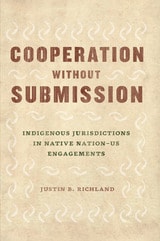
Cooperation without Submission
Indigenous Jurisdictions in Native Nation–US EngagementsJustin B. Richland
University of Chicago Press, 2021
It is well-known that there is a complicated relationship between Native American Tribes and the US government. Relations between Tribes and the federal government are dominated by the principle that the government is supposed to engage in meaningful consultations with the tribes about issues that affect them.
In Cooperation without Submission, Justin B. Richland, an associate justice of the Hopi Appellate Court and ethnographer, closely examines the language employed by both Tribes and government agencies in over eighty hours of meetings between the two. Richland shows how Tribes conduct these meetings using language that demonstrates their commitment to nation-to-nation interdependency, while federal agents appear to approach these consultations with the assumption that federal law is supreme and ultimately authoritative. In other words, Native American Tribes see themselves as nations with some degree of independence, entitled to recognition of their sovereignty over Tribal lands, while the federal government acts to limit that authority. In this vital book, Richland sheds light on the ways the Tribes use their language to engage in “cooperation without submission.”
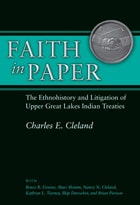
Faith in Paper
The Ethnohistory and Litigation of Upper Great Lakes Indian TreatiesCharles E. Cleland
University of Michigan Press, 2011
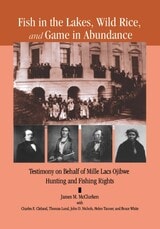
Fish in the Lakes, Wild Rice, and Game in Abundance
Testimony on Behalf of Mille Lacs Ojibwe Hunting and Fishing RightsEdited by James M. McClurken
Michigan State University Press, 2000
On 13 August 1990 members of the Mille Lacs Band of Ojibwe filed a lawsuit against the State of Minnesota for interfering with the hunting, fishing, and gathering rights that had been guaranteed to them in an 1837 treaty with the United States. In order to interpret the treaty the courts had to consider historical circumstances, the intentions of the parties, and the treaty's implementation. The Mille Lacs Band faced a mammoth challenge. How does one argue the Native side of the case when all historical documentation was written by non- Natives? The Mille Lacs selected six scholars to testify for them. Published here for the first time, Charles Cleland, James McClurken, Helen Tanner, John Nichols, Thomas Lund, and Bruce White discuss the circumstances under which the treaty was written, the personalities involved in the negotiations and the legal rhetoric of the times, as well as analyze related legal conflicts between Natives and non- Natives. Justice Sandra Day O'Connor delivered the 1999 Opinion of the [United States Supreme] Court.
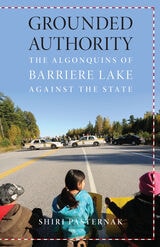
Grounded Authority
The Algonquins of Barriere Lake against the StateShiri Pasternak
University of Minnesota Press, 2017
Western Political Science Association's Clay Morgan Award for Best Book in Environmental Political Theory
Canadian Studies Network Prize for the Best Book in Canadian Studies
Nominated for Best First Book Award at NAISA
Honorable Mention: Association for Political and Legal Anthropology Book Prize
Since Justin Trudeau’s election in 2015, Canada has been hailed internationally as embarking on a truly progressive, post-postcolonial era—including an improved relationship between the state and its Indigenous peoples. Shiri Pasternak corrects this misconception, showing that colonialism is very much alive in Canada. From the perspective of Indigenous law and jurisdiction, she tells the story of the Algonquins of Barriere Lake, in western Quebec, and their tireless resistance to federal land claims policy.
Grounded Authority chronicles the band’s ongoing attempts to restore full governance over its lands and natural resources through an agreement signed by settler governments almost three decades ago—an agreement the state refuses to fully implement. Pasternak argues that the state’s aversion to recognizing Algonquin jurisdiction stems from its goal of perfecting its sovereignty by replacing the inherent jurisdiction of Indigenous peoples with its own, delegated authority. From police brutality and fabricated sexual abuse cases to an intervention into and overthrow of a customary government, Pasternak provides a compelling, richly detailed account of rarely documented coercive mechanisms employed to force Indigenous communities into compliance with federal policy.
A rigorous account of the incredible struggle fought by the Algonquins to maintain responsibility over their territory, Grounded Authority provides a powerful alternative model to one nation’s land claims policy and a vital contribution to current debates in the study of colonialism and Indigenous peoples in North America and globally.
Imprints
The Pokagon Band of Potawatomi Indians and the City of ChicagoJohn N. Low
Michigan State University Press, 2016
Imprints: The Pokagon Band of Potawatomi Indians and the City of Chicago examines the ways some Pokagon Potawatomi tribal members have maintained a distinct Native identity, their rejection of assimilation into the mainstream, and their desire for inclusion in the larger contemporary society without forfeiting their “Indianness.” Mindful that contact is never a one-way street, Low also examines the ways in which experiences in Chicago have influenced the Pokagon Potawatomi. Imprints continues the recent scholarship on the urban Indian experience before as well as after World War II.
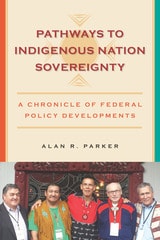
Pathways to Indigenous Nation Sovereignty
A Chronicle of Federal Policy DevelopmentsAlan R Parker
Michigan State University Press, 2018
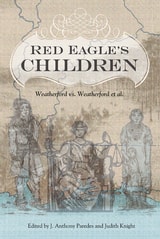
Red Eagle's Children
Weatherford vs. Weatherford et al.Edited by J. Anthony Paredes and Judith Knight
University of Alabama Press, 2012
Tracing identity, law, and legacy in an inheritance dispute that reveals the intersection of two cultural and legal systems: Creek Indian and Euro-American.
In 1846, in the Chancery Court of Mobile, Alabama, William “Red Eagle” Weatherford’s son, by the Indian woman Supalamy, sued his half siblings fathered by Weatherford with two other Creek women, Polly Moniac and Mary Stiggins, for a greater share of Weatherford’s estate. While the court recognized William Jr. as the son of William Sr., he nevertheless lost his petition for inheritance due to the lack of legal evidence concerning the marriage of his biological mother to William Sr. The case, which went to the Alabama Supreme Court in 1851, provides a record of an attempt to interrelate and, perhaps, manipulate differences in cultures as they played out within the ritualized, arcane world of antebellum Alabama jurisprudence.
Although the case has value in the classic mold of salvage ethnography of Creek Indian culture, Red Eagle’s Children, edited by J. Anthony Paredes and Judith Knight, shows that its more enduring value lies in being a source for historical ethnography—that is, for anthropological analyses of cultural dynamics of the past events that complement the narratives of professional historians.
CONTRIBUTORS: David I. Durham / Robbie Ethridge / Judith Knight / J. Anthony Paredes / Paul M. Pruitt Jr. / Nina Gail Thrower / Robert Thrower / Gregory A. Waselkov
Seeds of Tomorrow
Nurturing Roots of Oneida GovernanceEdited by Rebecca M. Webster and Lois Stevens
University of Wisconsin Press, 2026
This indispensable and unique volume is at once a history of and a pathfinder for the future of the Great Law, the governing principles behind the long-standing Haudenosaunee Confederacy. Focused on the Duck Creek Oneida people of Wisconsin, Seeds of Tomorrow draws together a wide range of tribal voices, from elders and community members to young people and academic experts. This collection chronicles the history of the Haudenosaunee Confederacy’s revolutionary governing principles, outlines the current state of tribal government, and proposes a vision for a political future that draws on traditional Indigenous practices and knowledge. This guide toward stronger sovereignty, revitalized community ties, and a healthier and more self-determined future based on traditional structures of governance is indigenization in practice: a model not just for Duck Creek Oneida but for Indigenous nations everywhere.
Contributors: Kenzie Allen, Marley Atkinson, Marena Bridges, Robert “Bob” Brown, Breann Clark, Julie Clark, Carol Cornelius, Margaret Cornelius, Randy Cornelius, Michele Doxtater, Richard “Lotni” Elm-Hill, Jennifer “Jen” Falck, William Gollnick, Joie Guiterrez, Gerald L. Hill, Jo Anne House, Toni M. House, Nicholas Metoxen, Paul Ninham, Saniya Ninham, John III Powless, Mark Powless, Nina Powless, Artley Skenandore, Lois Stevens, Vernon Stevens, Amelia “Mia” Webster, Grace Webster, Hunter D. Webster, Rebecca M. Webster, Arthur Wilbur, Jameson Wilson
Sovereign Selves
American Indian Autobiography and the LawDavid J. Carlson
University of Illinois Press, 2005
Carlson argues that by drawing on the conventions of early colonial treaty-making, nineteenth- and early twentieth-century Indian autobiographers sought to adapt and redefine the terms of Indian law as a way to assert specific property-based and civil rights. Focusing primarily on the autobiographical careers of two major writers (William Apess and Charles Eastman), Sovereign Selves traces the way that their sustained engagement with colonial legal institutions gradually enabled them to produce a new rhetoric of "Indianness."

Sovereignty, Indigeneity, and the Law, Volume 110
Eric Cheyfitz
Duke University Press, 0
This wide-ranging collection addresses the political possibilities of Western law and the international meanings of sovereignty and Indigeneity. One essay analyzes the autonomous government through which local citizens in Indigenous Zapatista communities in Mexico hope to dissolve systems of top-down sovereignty altogether. Another explores narratives of Native American law and the treatment of sovereignty in contemporary Mohawk visual culture. Several essays discuss the legal and political implications of the field’s pivotal public documents, including the 2007 U.N. Declaration on the Rights of Indigenous Peoples.
Eric Cheyfitz is the Ernest I. White Professor of American Studies and Humane Letters in the Department of English at Cornell University. N. Bruce Duthu is the Samson Occom Professor of Native American Studies and Chair of the Native American Studies Program at Dartmouth College. Shari M. Huhndorf is Associate Professor of English at the University of Oregon.
Contributors: Christine Black, Eric Cheyfitz, Gordon Christie, Chris Cunneen, Jonathan Goldberg-Hiller, Lorie M. Graham, Roy M. Huhndorf, Shari M. Huhndorf, Forrest Hylton, Mara Kaufman, Alvaro Reyes, Jolene Rickard, Carlos Salinas, Noenoe K. Silva, Cheryl Suzack, Siegfried Wiessner
The Colonial Construction of Indian Country
Native American Literatures and Federal Indian LawEric Cheyfitz
University of Minnesota Press, 2024
A guide to the colonization and projected decolonization of Native America
In The Colonial Construction of Indian Country, Eric Cheyfitz mounts a pointed historical critique of colonialism through careful analysis of the dialogue between Native American literatures and federal Indian law. Illuminating how these literatures indict colonial practices, he argues that if the decolonization of Indian country is to be achieved, then federal Indian law must be erased and replaced with independent Native nation sovereignty—because subordinate sovereignty, the historical regime, is not sovereignty at all.
At the same time, Cheyfitz argues that Native American literatures, specifically U.S. American Indian literatures, cannot be fully understood without a knowledge of U.S. federal Indian law: the matrix of colonialism in Indian country. Providing intersectional readings of a range of literary and legal texts, he discusses such authors as Louise Erdrich, Frances Washburn, James Welch, Gerald Vizenor, Simon Ortiz, Leslie Marmon Silko, and others. Cheyfitz examines how American Indian writers and critics have responded to the impact of law on Native life, revealing recent trends in Native writing that build upon traditional modes of storytelling and governance.
With a focus on resistance to the colonial regime of federal Indian law, The Colonial Construction of Indian Country not only elucidates how Native American literatures and federal Indian law are each crucial to any reading of the other, it also guides readers to better understand the genocidal assault on Indigenous peoples by Western structures of literacy, politics, and law.
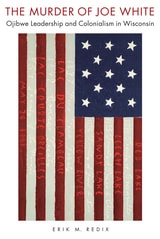
The Murder of Joe White
Ojibwe Leadership and Colonialism in WisconsinErik M. Redix
Michigan State University Press, 2014
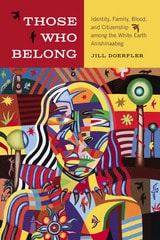
Those Who Belong
Identity, Family, Blood, and Citizenship among the White Earth AnishinaabegJill Doerfler
Michigan State University Press, 2015
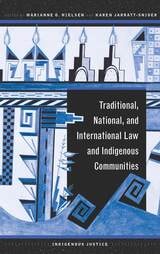
Traditional, National, and International Law and Indigenous Communities
Edited by Marianne O. Nielsen and Karen Jarratt-Snider
University of Arizona Press, 2020
While all of these issues are rooted in colonization, Indigenous peoples are using their own solutions to demonstrate the resilience, persistence, and innovation of their communities. With chapters focusing on the use and misuse of law as it pertains to Indigenous peoples in North America, Latin America, Canada, Australia, and New Zealand, this book offers a wide scope of global injustice. Despite proof of oppressive legal practices concerning Indigenous peoples worldwide, this book also provides hope for amelioration of colonial consequences.
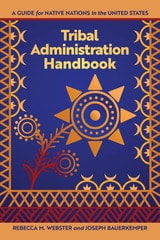
Tribal Administration Handbook
A Guide for Native Nations in the United StatesRebecca M. Webster
Michigan State University Press, 2022
Understanding Tribal Sovereignty
Federal Indian Law and Self-GovernanceDonald L. Fixico
University of Arizona Press, 2026
What does tribal sovereignty really mean—and why does it matter today?
Accessibly written for the nonspecialist, acclaimed historian Donald L. Fixico unpacks the complex history and legal foundations of tribal sovereignty in the United States. From traditional Native governance to landmark treaties, federal laws, and court cases, Fixico guides readers through the evolution of tribal self-rule and its modern expressions—from tribal constitutions to license plates and casinos. Designed for students, educators, tribal members, and professionals alike, this book offers a clear, compelling introduction to one of the most important—and often misunderstood—concepts in American Indian affairs.
This book is a go-to source for understanding the federal Indian laws, treaties, and court cases simplified to explain tribal sovereignty.