Results by title
358 books match the query 'Labor & Industrial Relations' and 33 start with a
A Blueprint for Worker Solidarity
Class Politics and Community in WisconsinNaomi R Williams
University of Illinois Press, 2025
Naomi R Williams traces the journeys of two local activists to highlight how people can support democracy and economic freedom in the twenty-first century. In Racine, ideas of class and race shifted but remained strong. The broad-based class politics that emerged drew on racial analysis, vigilant organizing, and agile labor leadership that organized more people. Unionized workers in turn won political power while uniting to resist conservative and corporate attacks. Charting Racine’s transition, Williams breaks down how worker solidarity persevered and presents lessons that can provide valuable guidance for today’s generation of activists.
A Collective Pursuit
Teachers' Unions and Education ReformLesley Lavery
Temple University Press, 2020
Teachers’ unions are the organizations responsible for safeguarding the conditions of teachers’ employment. Union supporters claim strong synergies between teachers’ interests and students’ interests, but critics of unions insist that the stance of teachers in collective bargaining may disadvantage students as unions reduce the power of administrators to manage, remove, reward or retain excellent teachers.
In A Collective Pursuit, Lesley Laveryunpacks how teachers’ unions today are fighting for contracts that allow them to earn a decent living and build “schools all students deserve.” She explains the form and function of the nation’s largest teachers’ unions. Lavery then explores unionization campaigns in the Twin Cities charter schools. A Collective Pursuit also examines teacher strikes and contract negotiations, school finance and finance reform, and district and union attempts to address racial achievement gaps, to provide a context for understanding the economic, political, and demographic forces that inspire teachers to improve conditions for students.
A Collective Pursuit emphasizes that while teachers’ unions serve a traditional, economic role, they also provide a vast array of valuable services to students, educators, parents, and community members.
A Contest of Ideas
Capital, Politics and LaborNelson Lictenstein
University of Illinois Press, 2013
These incisive writings link the fate of the labor movement to the transformations in the shape of world capitalism, to the rise of the civil rights movement, and to the activists and intellectuals who have played such important roles. Tracing broad patterns of political thought, Lichtenstein offers important perspectives on the relationship of labor and the state, the tensions that sometimes exist between a culture of rights and the idea of solidarity, and the rise of conservatism in politics, law, and intellectual life. The volume closes with portraits of five activist intellectuals whose work has been vital to the conflicts that engage the labor movement, public policy, and political culture.
A David Montgomery Reader
Essays on Capitalism and Worker ResistanceDavid Montgomery. Edited by Shelton Stromquist and James R. Barrett
University of Illinois Press, 2024
A foundational figure in modern labor history, David Montgomery both redefined and reoriented the field. This collection of Montgomery’s most important published and unpublished articles and essays draws from the historian’s entire five-decade career.
Taken together, the writings trace the development of Montgomery’s distinct voice and approach while providing a crucial window into an era that changed the ways scholars and the public understood working people’s place in American history. Three overarching themes and methods emerge from these essays: that class provided a rich reservoir of ideas and strategies for workers to build movements aimed at claiming their democratic rights; that capital endured with the power to manage the contours of economic life and the capacities of the state but that workers repeatedly and creatively mounted challenges to the terms of life and work dictated by capital; and that Montgomery’s method grounded his gritty empiricism and the conceptual richness of his analysis in the intimate social relations of production and of community, neighborhood, and family life.
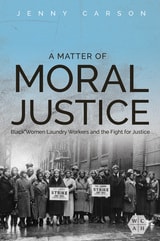
A Matter of Moral Justice
Black Women Laundry Workers and the Fight for JusticeJenny Carson
University of Illinois Press, 2021
Like thousands of African American women, Charlotte Adelmond and Dollie Robinson worked in New York’s power laundry industry in the 1930s. Jenny Carson tells the story of how substandard working conditions, racial and gender discrimination, and poor pay drove them to help unionize the city’s laundry workers. Laundry work opened a door for African American women to enter industry, and their numbers allowed women like Adelmond and Robinson to join the vanguard of a successful unionization effort. But an affiliation with the powerful Congress of Industrial Organizations (CIO) transformed the union from a radical, community-based institution into a bureaucratic organization led by men. It also launched a difficult battle to secure economic and social justice for the mostly women and people of color in the plants. As Carson shows, this local struggle highlighted how race and gender shaped worker conditions, labor organizing, and union politics across the country in the twentieth century.
Meticulous and engaging, A Matter of Moral Justice examines the role of African American and radical women activists and their collisions with labor organizing and union politics.
A Most Promising Weed
A History of Tobacco Farming and Labor in Colonial Zimbabwe, 1890–1945Steven C. Rubert
Ohio University Press, 1998
A Nation at Work
The Heldrich Guide to the American WorkforceVan Horn, Carl E
Rutgers University Press, 2003
A Nation at Work addresses the fundamental economic, demographic, policy, and business facts about how the workforce and workplace are changing in the early twenty-first century. Illustrated with over thirty-five graphs, Part I covers essential topics about the American workforce and workers. Part II gathers essays and speeches from the nation's outstanding journalists and workplace analysts. The book incorporates facts and data, including invaluable tables and listings for useful Internet sites, books, and organizations.
Comprehensive in scope, A Nation at Work will help readers reach a better understanding about their own work and the world of work around them.
A Prelude to the Welfare State
The Origins of Workers' CompensationPrice V. Fishback and Shawn Everett Kantor
University of Chicago Press, 2000
In this highly original and persuasive work, Price V. Fishback and Shawn Everett Kantor challenge widespread historical perceptions, arguing that, rather than being an early progressive victory, workers' compensation succeeded because all relevant parties—labor and management, insurance companies, lawyers, and legislators—benefited from the legislation. Thorough, rigorous, and convincing, A Prelude to the Welfare State: The Origins of Workers' Compensation is a major reappraisal of the causes and consequences of a movement that ultimately transformed the nature of social insurance and the American workplace.
A Renegade Union
Interracial Organizing and Labor RadicalismLisa Phillips
University of Illinois Press, 2013

A Time for Tea
Women, Labor, and Post/Colonial Politics on an Indian PlantationPiya Chatterjee
Duke University Press, 2001
Allowing personal, scholarly, and artistic voices to speak in turn and in tandem, Chatterjee discusses the fetishization of women who labor under colonial, postcolonial, and now neofeudal conditions. In telling the overarching story of commodity and empire, A Time for Tea demonstrates that at the heart of these narratives of travel, conquest, and settlement are compelling stories of women workers. While exploring the global and political dimensions of local practices of gendered labor, Chatterjee also reflects on the privileges and paradoxes of her own “decolonization” as a Third World feminist anthropologist. The book concludes with an extended reflection on the cultures of hierarchy, power, and difference in the plantation’s villages. It explores the overlapping processes by which gender, caste, and ethnicity constitute the interlocked patronage system of villages and their fields of labor. The tropes of coercion, consent, and resistance are threaded through the discussion.
A Time for Tea will appeal to anthropologists and historians, South Asianists, and those interested in colonialism, postcolonialism, labor studies, and comparative or international feminism.
Designated a John Hope Franklin Center book by the John Hope Franklin Seminar Group on Race, Religion, and Globalization.
A Union for Appalachian Healthcare Workers
The Radical Roots and Hard Fights of Local 1199John Hennen
West Virginia University Press, 2021
The union of hospital workers usually referred to as the 1199 sits at the intersection of three of the most important topics in US history: organized labor, health care, and civil rights. John Hennen’s book explores the union’s history in Appalachia, a region that is generally associated with extractive industries but has seen health care grow as a share of the overall economy.
With a multiracial, largely female, and notably militant membership, 1199 was at labor’s vanguard in the 1970s, and Hennen traces its efforts in hospitals, nursing homes, and healthcare centers in West Virginia, eastern Kentucky, and Appalachian Ohio. He places these stories of mainly low-wage women workers within the framework of shake-ups in the late industrial and early postindustrial United States, relying in part on the words of Local 1199 workers and organizers themselves. Both a sophisticated account of an overlooked aspect of Appalachia’s labor history and a key piece of context for Americans’ current concern with the status of “essential workers,” Hennen’s book is a timely contribution to the fields of history and Appalachian studies and to the study of social movements.
A. Philip Randolph and the Struggle for Civil Rights
Cornelius L. Bynum
University of Illinois Press, 2010
AFSCME's Philadelphia Story
Municipal Workers and Urban Power in the Twentieth CenturyFrancis Ryan
Temple University Press, 2011
AFSCME's Philadelphia Story provides the most comprehensive account of the early years of the American Federation of State, County and Municipal Employees, which is one of the nation’s largest and most politically powerful unions in the AFL-CIO. Author Francis Ryan details the emergence of the Quaker City's interracial union, charting its beginnings in the political patronage system of one of the nation's most notorious political machines to the first decade of the twenty-first century. Ryan provides new insight into the working class origins of African American political power in the late twentieth century as well as a thorough overview of the role the municipal state played in the urban economy of one of the nation's largest cities.
Ryan describes the work processes and how they changed, and uses workers' testimonies to ground the detailed accounts of issues and negotiations. Beginning in the 1920s and ending in the 2000s, Ryan's study offers a long-term analysis of the growth of a single union in a major American city.
Activist Media
Documenting Movements and Networked SolidarityGino Canella
Rutgers University Press, 2022
Now more than ever, activists are using media to document injustice and promote social and political change. Yet with so many media platforms available, activists sometimes fail to have a coherent media and communication strategy.
Drawing from his experiences as a documentary filmmaker with Black Lives Matter 5280 and Service Employees International Union (SEIU) Local 105 in Denver, Colorado, Gino Canella argues that activist media create opportunities for activists to navigate conflict and embrace their political and ideological differences. Canella details how activist media practices—interviewing organizers, script writing, video editing, posting on social media, and hosting community screenings—foster solidarity among grassroots organizers.
Informed by media theory, this book explores how activists are using media to mobilize supporters, communicate their values, and reject anti-union rhetoric. Furthermore, it demonstrates how collaborative media projects can help activists build broad-based coalitions and amplify their vision for a more equitable and just society.
African American Workers and the Appalachian Coal Industry
Joe William Trotter
West Virginia University Press, 2024
This collection brings together nearly three decades of research on the African American experience, class, and race relations in the Appalachian coal industry. It shows how, with deep roots in the antebellum era of chattel slavery, West Virginia’s Black working class gradually picked up steam during the emancipation years following the Civil War and dramatically expanded during the late nineteenth and early twentieth centuries.
From there, African American Workers and the Appalachian Coal Industry highlights the decline of the region’s Black industrial proletariat under the impact of rapid technological, social, and political changes following World War II. It underscores how all miners suffered unemployment and outmigration from the region as global transformations took their toll on the coal industry, but emphasizes the disproportionately painful impact of declining bituminous coal production on African American workers, their families, and their communities. Joe Trotter not only reiterates the contributions of proletarianization to our knowledge of US labor and working-class history but also draws attention to the gender limits of studies of Black life that focus on class formation, while calling for new transnational perspectives on the subject. Equally important, this volume illuminates the intellectual journey of a noted labor historian with deep family roots in the southern Appalachian coalfields.
After Coal
Stories of Survival in Appalachia and WalesTom Hansell
West Virginia University Press, 2018
What happens when fossil fuels run out? How do communities and cultures survive?
Central Appalachia and south Wales were built to extract coal, and faced with coal’s decline, both regions have experienced economic depression, labor unrest, and out-migration. After Coal focuses on coalfield residents who chose not to leave, but instead remained in their communities and worked to build a diverse and sustainable economy. It tells the story of four decades of exchange between two mining communities on opposite sides of the Atlantic, and profiles individuals and organizations that are undertaking the critical work of regeneration.
The stories in this book are told through interviews and photographs collected during the making of After Coal, a documentary film produced by the Center for Appalachian Studies at Appalachian State University and directed by Tom Hansell. Considering resonances between Appalachia and Wales in the realms of labor, environment, and movements for social justice, the book approaches the transition from coal as an opportunity for marginalized people around the world to work toward safer and more egalitarian futures.
Against Labor
How U.S. Employers Organized to Defeat Union ActivismEdited by Rosemary Feurer and Chad Pearson
University of Illinois Press, 2017
Against the Law
Paul F. Campos, Pierre Schlag, and Steven D. Smith
Duke University Press, 1996
Linked by a persistent inquiry into the nature and identity of “the law,” these essays are informed by the conviction that the conventional representations of law, both in law schools and the courts, cannot be taken at face value—that the law, as commonly conceived, makes no sense. The authors argue that the relentlessly normative prescriptions of American legal thinkers are frequently futile and, indeed, often pernicious. They also argue that the failure to recognize the role that authorship must play in the production of legal thought plagues both the teaching and the practice of American law. Ranging from the institutional to the psychological and metaphysical deficiencies of the American legal system, the depth of criticism offered by Against the Law is unprecedented.
In a departure from the nearly universal legitimating and reformist tendencies of American legal thought, this book will be of interest not only to the legal academics under attack in the book, but also to sociologists, historians, and social theorists. More particularly, it will engage all the American lawyers who suspect that there is something very wrong with the nature and direction of their profession, law students who anticipate becoming part of that profession, and those readers concerned with the status of the American legal system.
Age Discrimination in the American Workplace
Old at a Young AgeGregory, Raymond F
Rutgers University Press, 2001
Nearly every middle-aged and older worker, at some time during his or her career, will suffer age discrimination in the workplace. Employers too often use early-retirement plans, restructurings, and downsizings to dismiss older workers. Many of these individuals are unwillingly ushered into earlier-than-planned retirements, are denied promotions, or are terminated. The baby-boomer generation now accounts for just under 50 percent of the entire workforce. A vast army of workers now stands ready to contest employer acts of age discrimination.
Attorney Raymond Gregory addresses himself to the millions of workers who think they might be facing age discrimination and traces the history of the federal measures enacted to assist workers in contesting unlawful employer conduct. He explains how the law works and presents actual court cases to demonstrate the ways that workers have challenged their employers. The cases help to illustrate legal principles in real-life experiences and many of the cases relate compelling stories of workers caught up in a web of employer discriminatory conduct. Gregory has eliminated all legal jargon, ensuring that all concepts are clear to his readers. Individuals will turn to this book again and again to obtain authoritative background on this important topic.
Air Transport Labor Relations
Robert W. Kaps
Southern Illinois University Press, 1997
Robert W. Kaps examines air transport labor law in the United States as well as the underlying legislative and policy directives established by the federal government. The body of legislation governing labor relations in the private sector of the U.S. economy consists of two separate and distinct acts: the Railway Labor Act (RLA), which governs labor relations in the railroad and airline industries, and the National Labor Relations Act (NLRA), which governs labor relations in all other industrial sectors.
Although the NLRA closely follows the pattern established by the RLA, Kaps notes that the two laws are distinguishable in several important areas. Labor contracts negotiated under the RLA continue in perpetuity, for example, whereas all other labor contracts expire at a specified date. Other important areas of difference relate to the collective bargaining process itself, the procedures for the arbitration of disputes and grievances, and the spheres of authority and jurisdiction to consider such matters as unfair labor practices.
Congress established a special labor law for railroad and airline workers for several reasons. Because of transportation’s critical importance to the economy, an essential goal of public policy has been to ensure that both passenger and freight transportation services continue without interruption. Production can cease—at least temporarily—in most other industries without causing significant harm to the economy. When transportation stops, however, production stops. Thus Congress saw fit to enact a statute that contained provisions to ensure that labor strife would not halt rail services. Primarily because of the importance of air mail transportation, the Railway Labor Act of 1926 was extended to the airline industry in 1936.
The first section of this book introduces labor policy and presents a history of the labor movement in the United States. Discussing early labor legislation, Kaps focuses on unfair labor practices and subsequent major labor statutes.
The second section provides readers with a comparison of labor provisions that apply to the railroad and airline industries as well as to the remainder of the economy.
The final section centers on the evolution of labor in the airline industry. The author pays particular attention to recent events affecting labor in commercial aviation, particularly the effect of airline deregulation on airline labor.
Alt-Labor and the New Politics of Workers' Rights
Daniel J. Galvin
Russell Sage Foundation, 2024
Alt-labor groups have long offered their members services and organizing opportunities to contest their unfair treatment on the job. But many groups have grown frustrated by the limited impact of these traditional strategies and have turned to public policy to scale up their work. They have successfully led campaigns to combat wage theft, raise the minimum wage, improve working conditions, strengthen immigrants’ rights, and more. These successes present something of a puzzle: relative to their larger, wealthier, and better-connected opponents, alt-labor groups are small, poor, and weak. Their members are primarily low-wage immigrant workers and workers of color who are often socially, economically, and politically marginalized. With few exceptions, the groups lack large dues-paying memberships and are dependent on philanthropic foundations and other unpredictable sources of funding. How, given their myriad challenges, have alt-labor groups managed to make gains for their members?
Galvin reveals that alt-labor groups are leveraging their deep roots in local communities, their unique position in the labor movement, and the flexibility of their organizational forms to build their collective power and extend their reach. A growing number of groups have also become more politically engaged and have set out to alter their political environments by cultivating more engaged citizens, influencing candidate selection processes, and expanding government capacities. These efforts seek to enhance alt-labor groups’ probabilities of success in the near term while incrementally shifting the balance of power over the long term.
Alt-Labor and the New Politics of Workers’ Rights comprehensively details alt-labor’s turn to policy and politics, provides compelling insights into the dilemmas the groups now face, and illuminates how their efforts have both invigorated and complicated the American labor movement.
Ambassadors of the Working Class
Argentina's International Labor Activists and Cold War Democracy in the AmericasErnesto Semán
Duke University Press, 2017
American City
A Rank and File History of MinneapolisCharles Rumford Walker
University of Minnesota Press, 2005
American Labor and the Cold War
Grassroots Politics and Postwar Political CultureCherny, Robert
Rutgers University Press, 2004
The American labor movement seemed poised on the threshold of unparalleled success at the beginning of the post-World War II era. Fourteen million strong in 1946, unions represented thirty five percent of non-agricultural workers. Why then did the gains made between the 1930s and the end of the war produce so few results by the 1960s?
This collection addresses the history of labor in the postwar years by exploring the impact of the global contest between the United States and the Soviet Union on American workers and labor unions. The essays focus on the actual behavior of Americans in their diverse workplaces and communities during the Cold War. Where previous scholarship on labor and the Cold War has overemphasized the importance of the Communist Party, the automobile industry, and Hollywood, this book focuses on politically moderate, conservative workers and union leaders, the medium-sized cities that housed the majority of the population, and the Roman Catholic Church. These are all original essays that draw upon extensive archival research and some upon oral history sources.
American Labor in the Southwest
The First One Hundred YearsEdited by James C. Foster
University of Arizona Press, 1982
The Western Federation of Miners
James C. Foster, D. H. Dinwoodie
The Industrial Workers of the World
Earl Bruce White, James Byrkit
The Rise of Unionized Farm Workers
H. L. Mitchell, Edward D. Beechert, Art Carstens
Mexican Labor, North and South of the Border
John M. Hart, Rodney Anderson, David Maciel
Labor and Politics
Paul Mandel, George N. Green, Charles O. Rice
American Unemployment
Past, Present, and FutureFrank Stricker
University of Illinois Press, 2020
- Workers do not normally choose to be unemployed.
- In our current system, persistent unemployment is not an aberration. It is much more common than full employment, and the outcome of elite policy choices.
- Labor surpluses propped up by flawed unemployment numbers have helped to keep real wages stagnant for more than forty years.
- Prior to the New Deal and the era of big government, laissez-faire policies repeatedly led to depressions with heavy, even catastrophic, job losses.
- Undercounting the unemployed sabotages the creation of government job programs that can lead to more high-paying jobs and full employment.

An American in Hitler's Berlin
Abraham Plotkin's Diary, 1932-33Abraham Plotkin; Edited & with an introduction by Catherine Collomp & Bruno Grop
University of Illinois Press, 2007
Compared to the writings of other American observers of the Third Reich, Plotkin's diary is unique in style, scope, themes, and time span. Most accounts of Hitler's rise to power emphasize political institutions by focusing on the Nazi party's clashes with other political forces. In contrast, Plotkin is especially attentive to socioeconomic factors, providing an alternative view from the left that stems from his access to key German labor and socialist leaders. Chronologically, the diary reports on the moment when Hitler's seizure of power was not yet inevitable and when leaders on the left still believed in a different outcome of the crisis, but it also includes Plotkin's account of the complete destruction of German labor in May 1933.

Archie Green
The Making of a Working-Class HeroSean Burns
University of Illinois Press, 2011
Are Worker Rights Human Rights?
Richard P. McIntyre
University of Michigan Press, 2008
"In a much-needed intervention, Ric McIntyre recasts the debate about globalization and labor rights and speeds us to the heart of the matter: the battle between transnational corporations who distance themselves from responsibility for the fate of workers, and labor activists who seek to reestablish bonds of accountability and moral obligation. The stakes in this struggle are enormous, and Dr. McIntyre provides crucial insight into the economic and political dynamics that define it."
---Scott Nova, Executive Director, Worker Rights Consortium, Washington, DC
"This book presents an insightful, powerful corrective to the contemporary debate over worker rights. McIntyre identifies the limitations of thinking of worker rights as individualized human rights and challenges us instead to examine how rights are defined through conventional thinking and class interest. The product is rich and compelling: McIntyre's investigation demands of us that we be far more attentive to the contradictory effects of ‘rights talk.' I recommend this book enthusiastically to all those who advocate for a just economic order the world over."
---George DeMartino, Associate Professor of Political Economy, the Josef Korbel School of International Studies, University of Denver
"An important contribution to the interdisciplinary study of labor. McIntyre's book will challenge the debate over labor rights on all fronts."
---Michael Hillard, Professor of Economics, University of Southern Maine
"A timely examination of our modern 'sweating system' . . . essential reading for all workers who hope for greater dignity in the workplace and greater fairness in society."
---Janet Knoedler, Associate Professor of Economics, Bucknell University
"Ric McIntyre convincingly shows how local actions, regulations changes, and international norms can combine to establish collective rights for workers."
---Gilles Raveaud, Assistant Professor in Economics, University of Saint-Denis, France, and cofounder of the "post-autistic economics movement"
"An important, timely, and needed contribution to our understanding of worker rights."
---Patrick McHugh, Associate Professor of Management, George Washington University
"Workers of the world, unite!" Karl Marx's famous call to action still promises an effective means of winning human rights in the modern global economy, according to economist Richard P. McIntyre. Currently, the human rights movement insists upon a person's right to life, freedom, and material necessities. In democratic, industrial nations such as the United States, the movement focuses more specifically on a person's civil rights and equal opportunity.
The movement's victories since WWII have come at a cost, however. The emphasis on individual rights erodes collective rights---the rights that disadvantaged peoples need to assert their most basic human rights. This is particularly true for workers, McIntyre argues. By reintroducing Marxian and Institutional analysis, he reveals the class relations and power structures that determine the position of workers in the global economy. The best hope for achieving workers' rights, he concludes, lies in grassroots labor organizations that claim the right of association and collective bargaining.
At last, an economist offers a vision for human rights that takes both moral questions and class relations seriously.
Richard P. McIntyre is Director of the University Honors Program and Professor of Economics at the University of Rhode Island.
Arizona’s Quest for Reform
Socialists, Unionists, and Progressives, 1900–1920David R. Berman
University of Arizona Press, 2026
In Arizona’s Quest for Reform, David R. Berman traces the rise and fall of a dynamic coalition of socialists, labor activists, and progressive Democrats led by the influential Governor George Hunt as they pursued sweeping reforms in a rapidly changing state. From the fight for workers’ rights and women’s suffrage to the use of the initiative process and the role of radical newspapers, Berman brings to life the people and movements that shaped Arizona’s early political identity.
Drawing on extensive primary sources and organized in a clear chronological structure, Berman’s study reveals the tensions, alliances, and dramatic events that defined Arizona’s reform efforts between 1900 and 1920. The book explores the impact of powerful mining interests, railroad companies, and labor unions, while also examining the racialization of Mexican miners and their evolving role in the labor movement. Through vivid storytelling and rigorous scholarship, Berman uncovers the complexities of political change in a state straddling the transition from territory to statehood.
This landmark work will appeal to scholars of western history, labor studies, and political science, as well as general readers interested in Arizona’s unique place in the national Progressive movement. Arizona’s Quest for Reform not only deepens our understanding of the past but also offers timely insights into the enduring challenges of coalition building, grassroots activism, and political reform. It is a vital contribution to the study of Arizona and the American West.
Arms, Country, and Class
The Philadelphia Militia and the Lower Sort during the American RevolutionSteve Rosswurm
Rutgers University Press, 1989
In 1949 and 1950, the Congress of Industrial Organizations (CIO) expelled many left-wing unions, representing 750,000 workers, because they were supposedly Communist-dominated. This collection of previously unpublished essays explores the history of those eleven left-led unions. Some essays consider specific aspects of several unions--the Longshoremen, the United Electricians (UE), the Fur Workers, and the Food and Tobacco Workers--while others take up the impact of the federal government's and the Catholic church's anticommunism upon the unions as a whole.
This collection also addresses central domestic issues of twentieth-century America: race and government policy in the shaping of trade unionism; the impact of anticommunism and the cold war on race relations and working conditions; and the short- and long-range impact of the expulsions upon the labor movement. With groundbreaking essays that also concern the post-World War II period, Southern workers and workers in non-basic industries, this book will appeal to students of radicalism, race relations, anticommunism, and labor history.
At the Altar of the Bottom Line
The Degradation of Work in the 21st CenturyThomas Juravich
University of Massachusetts Press, 2009
Tom Juravich combines oral history with social and economic analysis to provide a vivid account of the multiple challenges presented in today's workplaces.
Based on extensive interviews with workers in four different industries, this book takes us behind the statistics of the economic collapse and into the lives of Americans who are struggling to make ends meet and support their families.
At a Verizon call center in Andover, Massachusetts, customer service reps find themselves overwhelmed by the pace of work and the constant monitoring. They describe a daily routine marked by regimentation, intense pressure to sell, and unrelenting stress. In New Bedford, undocumented Guatemalans in the fish-processing industry are fired if they don't work fast enough, cheated out of wages, and mistreated by supervisors. Juravich describes a brutal immigration raid by U.S. Immigration and Customs Enforcement that divided families and forced workers further underground.
Juravich then takes us inside the operating rooms at the Boston Medical Center, where hospital consolidation has brought a new “bottom line” philosophy that has fundamentally altered the way patient care is delivered. Surgery takes place almost non-stop, driving some nurses from their chosen profession and leaving those who remain exhausted.
The final case study looks at the shuttering of the Jones Beloit plant, an internationally known manufacturer of machinery for the paper industry. Despite the best efforts of highly skilled and productive workers to save their plant, it was abruptly closed and they were abandoned after their CEO recklessly became involved in a shaky foreign investment.
Juravich argues that workers face a series of paradoxes in the contemporary American workplace. They can no longer assume that large established firms create good jobs. The new working conditions often resemble what was traditionally associated with marginal and low-wage employers. He concludes that we must bring a discussion about the quality of jobs back into the public discourse and that a “good jobs” strategy is a fundamental building block to economic recovery.
Workers' voices are front and center in this highly readable book. It includes striking photographs by Paul Shoul and a CD that presents a series of audio documentaries with excerpts from the interviews, as well as four original songs written and performed by Juravich.
Austerities and Aspirations
A Comparative History of Growth, Consumption, and Quality of Life in East Central Europe since 1945Béla Tomka
Central European University Press, 2020
This monograph provides an analysis of the economic performance and living standard in Czechoslovakia and its successor states, Hungary, and Poland since 1945. The novelty of the book lies in its broad comparative perspective: it places East Central Europe in a wider European framework that underlines the themes of regional disparities and European commonalities. Going beyond the traditional growth paradigm, the author systematically studies the historical patterns of consumption, leisure, and quality of life—aspects that Tomka argues can best be considered in relation to one other. By adopting this “triple approach,” he undertakes a truly interdisciplinary research drawing from history, economics, sociology, and demography.
As a result of Tomka’s three-pillar comparative analysis, the book makes a major contribution to the debates on the dynamics of economic growth in communist and postcommunist East Central Europe, on the socialist consumer culture along with its transformation after 1990, and on how the accounts on East Central Europe can be integrated into the emerging field of historical quality of life research.