Results by title

16 books match the query 'Motion pictures and the war'
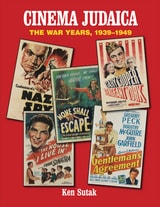
cover of Cinema Judaica

Cinema Judaica

Ken Sutak

Central Conference of American Rabbis, 2012
A unique look at how these Jewish-themed movies prepared Americans for war with Nazi Germany, rallied the Allies to victory, fought anti-Semitism, portrayed the Holocaust in Europe, and captured the refugee exodus to Israel. Featuring 200 rare movie posters, publicity stills, and other images in full-color. An ebook companion volume to the acclaimed exhibit.
[more]
cover of Destructive Sublime: World War II in American Film and Media

Destructive Sublime

World War II in American Film and Media

Allison, Tanine

Rutgers University Press, 2018

The American popular imagination has long portrayed World War II as the “good war,” fought by the “greatest generation” for the sake of freedom and democracy. Yet, combat films and other war media complicate this conventional view by indulging in explosive displays of spectacular violence. Combat sequences, Tanine Allison argues, construct a counter-narrative of World War II by reminding viewers of the war’s harsh brutality.

Destructive Sublime traces a new aesthetic history of the World War II combat genre by looking back at it through the lens of contemporary video games like Call of Duty. Allison locates some of video games’ glorification of violence, disruptive audiovisual style, and bodily sensation in even the most canonical and seemingly conservative films of the genre. In a series of case studies spanning more than seventy years—from wartime documentaries like The Battle of San Pietro to fictional reenactments like The Longest Day and Saving Private Ryan to combat video games like Medal of Honor—this book reveals how the genre’s aesthetic forms reflect (and influence) how American culture conceives of war, nation, and representation itself.  
[more]
cover of Entertaining History: The Civil War in Literature, Film, and Song

Entertaining History

The Civil War in Literature, Film, and Song

Edited by Chris Mackowski

Southern Illinois University Press, 2020

Popular media can spark the national consciousness in a way that captures people’s attention, interests them in history, and inspires them to visit battlefields, museums, and historic sites. This lively collection of essays and feature stories celebrates the novels, popular histories, magazines, movies, television shows, photography, and songs that have enticed Americans to learn more about our most dramatic historical era.

From Ulysses S. Grant’s Memoirs to Abraham Lincoln: Vampire Hunter, from Roots to Ken Burns’s The Civil War, from “Dixie” to “Ashokan Farewell,” and from Civil War photography to the Gettysburg Cyclorama, trendy and well-loved depictions of the Civil War are the subjects of twenty contributors who tell how they and the general public have been influenced by them. Sarah Kay Bierle examines the eternal appeal of Gone with the Wind and asks how it is that a protagonist who so opposed the war has become such a figurehead for it. H. R. Gordon talks with New York Times–bestselling novelist Jeff Shaara to discuss the power of storytelling. Paul Ashdown explores ColdMountain’s value as a portrait of the war as national upheaval, and Kevin Pawlak traces a shift in cinema’s depiction of slavery epitomized by 12 Years a Slave. Tony Horwitz revisits his iconic Confederates in the Attic twenty years later.

The contributors’ fresh analysis articulates a shared passion for history’s representation in the popular media. The variety of voices and topics in this collection coalesces into a fascinating discussion of some of the most popular texts in the genres. In keeping with the innovative nature of this series, web-exclusive material extends the conversation beyond the book.
 
[more]
cover of From Hanoi to Hollywood: The Vietnam War in American Film

From Hanoi to Hollywood

The Vietnam War in American Film

Dittmar, Linda

Rutgers University Press, 1990

This volume is about power. It is about the power to make war and to destroy lives. It is also about another kind of power-the power to make images that may distort, displace, and destroy knowledge of the times in which those lives were lived. Many of the nineteen essays gathered in this volume are about the interrelationships between these two types of power. They demonstrate, as well, yet another type of power, the power of critical thinking to challenge dangerous myths and to confront prevailing ideologies.

The title of this anthology calls attention to the process whereby aspects of the Vietnam War have been appropriated by the American cultural industry. Probing the large body of emotion-laden, controversial films, From Hanoi to Hollywood is concerned with the retelling of history and the retrospection that such a process involves. In this anthology, an awareness of film as a cultural artifact that molds beliefs and guides action is emphasized, an awareness that the contributors bring to a variety of films. Their essays span over one hundred documentary and fiction films, and include in-depth analyses of major commercial films, ranging from Apocalypse Now to Platoon, Rambo: First Blood Part II, and Full Metal Jacket, and documentaries from In the Year of the Pig to Dear America: Letters Home from Vietnam.

The essays in this volume deal with representations of the Vietnam war in documentary film and television reporting, examining the ways the power of film is used to deliver political messages. There are surprises here, new readings, and important insights on the ways we as a society have attempted to come to terms with the experiences of the Vietnam era. The book also contains two appendixes-a detailed chronology charting the relationship between major historical events and the release of American war films from 1954 through 1988, and a filmography listing information on over four hundred American and foreign films about the Vietnam War.
[more]
cover of Han Heroes and Yamato Warriors: Competing Masculinities in Chinese and Japanese War Cinema

Han Heroes and Yamato Warriors

Competing Masculinities in Chinese and Japanese War Cinema

Amanda Weiss

Hong Kong University Press, 2023

An exploration of collective memory through the lens of East Asian film during World War II.

Taking the “tidal wave” of memory in the late twentieth and early twenty-first century as its starting point, this monograph explores the collective memory of World War II in East Asia (1937–1945) through film. Weiss argues that Chinese, Japanese, and American remembrance of World War II is intertwined in what she terms a “memory loop,” the transnational mediation and remediation of war narratives. Gender is central to this process, as the changing representation of male soldiers, political leaders, and patriarchal father figures within these narratives reveals Japanese and Chinese challenges to each other and to the perceived “foundational” American narrative of the war. This process continues to intensify due to the globally visible nature of the memory loop, which drives this cycle of transmission, translation, and reassessment.

This volume is the first to bring together a collection of Chinese and Japanese war films that have received little attention in English-language literature. It also produces new readings of popular war memory in East Asia by revealing the gendered dimensions of collective remembrance in these films.
[more]
cover of Hollywood's Unofficial Film Corps: American Jewish Moviemakers and the War Effort

Hollywood's Unofficial Film Corps

American Jewish Moviemakers and the War Effort

Michael Berkowitz

University of Wisconsin Press, 2025

It has long been known that Hollywood was actively involved in shaping US public opinion during World War II. Less well-documented are the ways in which Washington sought to work behind the scenes, subtly obliterating the boundaries between “studio” and “government” films. Michael Berkowitz studies the contributions of humorist and best-selling author Leo Rosten (The Joys of Yiddish, The Education of H*Y*M*A*N* K*A*P*L*A*N) and writer, producer, and screenwriter Budd Schulberg (On the Waterfront, A Face in the Crowd) in order to examine the elusive story of Jewish Hollywood’s role in World War II. 

Hollywood’s Unofficial Film Corps shows that Rosten, Schulberg, and others—including Garson Kanin, George Cukor, Stanley Kramer, and Jules Buck—created movies that were both entertaining and politically expeditious for US war aims. At the same time, in an effort to unify the American public, they avoided focusing on the fate of European Jews, even while addressing racism and antisemitism in the United States. Jewish themes were often downplayed, and Jewish directors, writers, and other contributors frequently went uncredited. As Berkowitz writes, “Rosten’s cohort changed feature films forever.” Thanks to his research, we now have a better understanding of how and why.
[more]
cover of Imperial Screen: Japanese Film Culture In The Fifteen Years War,

Imperial Screen

Japanese Film Culture In The Fifteen Years War,

Peter B. High

University of Wisconsin Press, 2003
From the late 1920s through World War II, film became a crucial tool in the state of Japan. Detailing the way Japanese directors, scriptwriters, company officials, and bureaucrats colluded to produce films that supported the war effort, The Imperial Screen is a highly-readable account of the realities of cultural life in wartime Japan. Widely hailed as "epoch-making" by the Japanese press, it presents the most comprehensive survey yet published of "national policy" films, relating their montage and dramatic structures to the cultural currents, government policies, and propaganda goals of the era. Peter B. High’s treatment of the Japanese film world as a microcosm of the entire sphere of Japanese wartime culture demonstrates what happens when conscientious artists and intellectuals become enmeshed in a totalitarian regime.
[more]
cover of Inventing Vietnam: The War in Film and Television

Inventing Vietnam

The War in Film and Television

edited by Michael Anderegg

Temple University Press, 1991
The Vietnam War has been depicted by every available medium, each presenting a message, an agenda, of what the filmmakers and producers choose to project about America's involvement in Southeast Asia. This collection of essays, most of which are previously unpublished, analyzes the themes, modes, and stylistic strategies seen in a broad range of films and television programs. From diverse perspectives, the contributors comprehensively examine early documentary and fiction films, postwar films of the 1970s such as The Deer Hunter and Apocalypse Now, and the reformulated postwar films of the 1980s--Platoon, Full Metal Jacket, and Born on the Fourth of July. They also address made-for-television movies and serial dramas like China Beach and Tour of Duty. The authors show how the earliest film responses to America's involvement in Vietnam employ myth and metaphor and are at times unable to escape glamorized Hollywood. Later films strive to portray a more realistic Vietnam experience, often creating images that are an attempt to memorialize or to manufacture different kinds of myths. As they consider direct and indirect representations of the war, the contributors also examine the power or powerlessness of individual soldiers, the racial views presented, and inscriptions of gender roles. Also included in this volume is a chapter that discusses teaching Vietnam films and helping students discern and understand film rhetoric, what the movies say, and who they chose to communicate those messages. Excerpt Read an excerpt from Chapter 1 (pdf). Contents Acknowledgments Introduction - Michael Anderegg 1. Hollywood and Vietnam: John Wayne and Jane Fonda as Discourse - Michael Anderegg 2. "All the Animals Come Out at Night": Vietnam Meets Noir in Taxi Driver - Cynthia J. Fuchs 3. Vietnam and the Hollywood Genre Film: Inversions of American Mythology in The Deer Hunter and Apocalypse Now - John Hellmann 4. "Charlie Don't Surf": Race and Culture in the Vietnam War Films - David Desser 5. Finding a Language for Vietnam in the Action-Adventure Genre - Ellen Draper 6. Narrative Patterns and Mythic Trajectories in Mid-1980s Vietnam Movies - Tony Williams 7. Rambo's Vietnam and Kennedy's New Frontier - John Hellmann 8. Gardens of Stone, Platoon, and Hamburger Hill: Ritual and Remembrance - Judy Lee Kinney 9. Primetime Television's Tour of Duty - Daniel Miller 10. Women Next Door to War: China Beach - Carolyn Reed Vartanian 11. Male Bonding, Hollywood Orientalism, and the Repression of the Feminine in Kubrick's Full Metal Jacket - Susan White 12. Vietnam, Chaos, and the Dark Art of Improvisation - Owen W. Gilman, Jr. 13. Witness to War: Oliver Stone, Ron Kovic, and Born on the Fourth of July - Thomas Doherty 14. Teaching Vietnam: The Politics of Documentary - Thomas J. Slater Selected Bibliography Selected Filmography and Videography The Contributors Index About the Author(s) Michael Anderegg is Professor of English at the University of North Dakota, and author of two other books: William Wyler and David Lean. Contributors: Cynthia J. Fuchs, John Hellman, David Desser, Ellen Draper, Tony Williams, Judy Lee Kinney, Daniel Miller, Carolyn Reed Vartanian, Susan White, Owen W. Gilman, Jr., Thomas Doherty, Thomas J. Slater, and the editor.
[more]
cover of Long Shadows: The Second World War in British Fiction and Film

Long Shadows

The Second World War in British Fiction and Film

Edited by Petra Rau

Northwestern University Press, 2016
Few countries attribute as much importance to the Second World War and its memory as Britain; arguably nowhere else has this conflict developed such longevity in cultural memory and retained such presence in contemporary culture. Long Shadows is about how literature and film have helped shape this process in Britain. More precisely, the essays collected here suggest that this is a continuous work in progress, subject to transgenerational revisions, political expediencies, commercial considerations, and the vicissitudes of popular taste. It would indeed be more accurate to speak of the meanings (plural) that the war has been given at various moments in British cultural life. These semantic variations and fluctuations in cultural import are rooted in the specificity of the British war experience, in the political aftermath of the war in Europe, and in its significance for Britain’s postwar position on the global stage. In other words, the books and films discussed in these essays respond to how the war has been interpreted and remembered; what is at stake is the way in which the war has been emplotted as a hegemonic cultural narrative about Britain.
[more]
cover of Reel Patriotism: The Movies and World War I

Reel Patriotism

The Movies and World War I

Leslie Midkiff DeBauche

University of Wisconsin Press, 1997

     Mixing film history with social history, Reel Patriotism examines the role played by the American film industry during World War I and the effects of the industry’s pragmatic patriotism in the decade following the war. Looking at such films as Joan the Woman and Wings and at the war-time activities of Mary Pickford and Charlie Chaplin, film distributors, including George Kleine, and the National Association of the Motion Picture Industry, this book shows how heavily publicized gestures of patriotism benefited the reputation and profits of the movie business.
     Leslie Midkiff DeBauche shows how the United States government’s need to garner public support for the war, conserve food, raise money, and enlist soldiers was met by the film industry. Throughout the nineteen months of American involvement in World War I, film studios supported the war effort through the production of short instructional films, public speaking activities of movie stars, the civic forum provided by movie theaters, and the National Association of the Motion Picture Industry’s provision of administrative personnel to work directly with government agencies. While feature films about the war itself never dominated the release schedules of film distributors, they did become a staple film industry offering throughout the late 1910s and 1920s.
     The film industry had much to gain, DeBauche demonstrates, from working closely with the U.S. government. Though the war posed a direct challenge to the conduct of business as usual, the industry successfully weathered the war years. After the war, film producers, distributors, and exhibitors were able to capitalize on the good will of the movie-goer and the government that the industry’s war work created. It provided a buffer against national censorship when movie stars became embroiled in scandal, and it served as a selling point in the 1920s when major film companies began to trade their stock on Wall Street.
[more]
cover of Scarlett's Women: Gone With the Wind and Its Female Fans

Scarlett's Women

Gone With the Wind and Its Female Fans

Taylor, Helen

Rutgers University Press, 1989
One of the most successful books ever published and the basis of one of the most popular and highly praised Hollywood films, Gone with the Wind has entered world culture in a way that few other stories have. The book was published in June 1936; the film premiered on December 15, 1939. The book has sold 25 million copies, has been translated into twenty-seven languages, and won the 1936 Pulitzer Prize. The film received eight Oscars and has been called the greatest movie ever made. Everyone has heard of GWTW. Most of us have seen the movie or read the novel. In this entertaining and informative book, Helen Taylor is the first to seek reasons for the film/novel's success among viewers/readers. The author asked GWTW fans to relate their experiences with the works, to explain their fascination with the story, to describe the impact GWTW has had on their lives. The results are astonishing and illuminating. In the United States and England, where the author conducted her research, women have to a remarkable degree claimed the story Margaret Mitchell wrote as their own. They name their children Rhett and Scarlett. They see in the lives of the men and women of GWTW their own lives, their own restlessness, their own aspirations for something better than marriage and motherhood. Helen Taylor not only explains the enduring appeal of the work, but also identifies different kinds of response at particular historical moments (especially World War II) and through the past five decades by women of different classes, races, and generations. The author also looks at the contemporary implications of the work's political conservatism, racism, and--paradoxically--feminism. The result is a book that is sophisticated, accessible, and revealing. Scarlett's Women is a book for eery fan, and for all students of film and popular culture.
[more]
cover of Scarlett's Women: Gone With the Wind and Its Female Fans

Scarlett's Women

Gone With the Wind and Its Female Fans

Taylor, Helen

Rutgers University Press, 1969

One of the most successful books ever published and the basis of one of the most popular and highly praised Hollywood films, Gone with the Wind has entered world culture in a way that few other stories have. The book was published in June 1936; the film premiered on December 15, 1939. The book has sold 25 million copies, has been translated into twenty-seven languages, and won the 1936 Pulitzer Prize. The film received eight Oscars and has been called the greatest movie ever made. Everyone has heard of GWTW. Most of us have seen the movie or read the novel. In this entertaining and informative book, Helen Taylor is the first to seek reasons for the film/novel's success among viewers/readers. The author asked GWTW fans to relate their experiences with the works, to explain their fascination with the story, to describe the impact GWTW has had on their lives. The results are astonishing and illuminating. In the United States and England, where the author conducted her research, women have to a remarkable degree claimed the story Margaret Mitchell wrote as their own. They name their children Rhett and Scarlett. They see in the lives of the men and women of GWTW their own lives, their own restlessness, their own aspirations for something better than marriage and motherhood. Helen Taylor not only explains the enduring appeal of the work, but also identifies different kinds of response at particular historical moments (especially World War II) and through the past five decades by women of different classes, races, and generations. The author also looks at the contemporary implications of the work's political conservatism, racism, and--paradoxically--feminism. The result is a book that is sophisticated, accessible, and revealing. Scarlett's Women is a book for eery fan, and for all students of film and popular culture.
[more]
cover of Search and Clear: Critical Responses to Selected Literature and Films of the Vietnam War

Search and Clear

Critical Responses to Selected Literature and Films of the Vietnam War

William J. Searle

University of Wisconsin Press, 1988
Search and Clear demonstrates that the seeds of war were implicit in American culture,  distinguishes between literature spawned by Vietnam and that of other conflicts, reviews the literary merits of works both well and little known, and explores the assumptions behind and the persistence of stereotypes associated with the consequences of the Vietnam War. It examines the role of women in fiction, the importance of gender in Vietnam representation, and the mythic patterns in Oliver Stone’s Platoon. Essayists sharply scrutinize American values, conduct, and conscience as they are revealed in the craft of Tim O’Brien, Philip Caputo, Michael Herr, Stephen Wright, David Rabe, Bruce Weigl, and others.
[more]
cover of Soldiers of the Pen: The Writers' War Board in World War II

Soldiers of the Pen

The Writers' War Board in World War II

Thomas Howell

University of Massachusetts Press, 2019

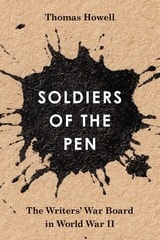
From 1942 to 1945, a small, influential group of media figures willingly volunteered their services to form the Writers' War Board (WWB), accepting requests from government agencies to create propaganda. Members included mystery writer Rex Stout, Pulitzer and Nobel Prize winner Pearl S. Buck, novelist and sports writer Paul Gallico, Book-of-the-Month Club editor and popular radio host Clifton Fadiman, and Broadway lyricist Oscar Hammerstein II. The WWB mobilized thousands of other writers across the country to spread its campaigns through articles, public appearances, radio broadcasts, and more.

The WWB received federal money while retaining its status as a private organization that could mount campaigns without government oversight. Historian Thomas Howell argues that this unique position has caused its history to fall between the cracks, since it was not recognized as an official part of the government's war effort. Yet the WWB's work had a huge impact on the nation's wartime culture, and this fascinating history will inform contemporary thinking on propaganda, the media, and American society.
[more]
cover of The First World War and Popular Cinema: 1914 to the Present

The First World War and Popular Cinema

1914 to the Present

Paris, Michael

Rutgers University Press, 2000

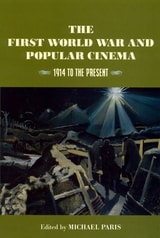
The Great War played an instrumental role in the development of cinema, so necessary was it to the mobilization efforts of the combatant nations. In turn, after the war, as memory began to fade, cinema continued to shape the war's legacy and eventually to determine the ways in which all warfare is imagined.

The First World War and Popular Cinema provides fresh insight into the role of film as an historical and cultural tool. Through a comparative approach, essays by contributors from Europe, Australia, Canada, and the United States enrich our understanding of cinematic depictions of the Great War in particular and combat in general. New historical research on both the uses of propaganda and the development of national cinemas make this collection one of the first to show the ways in which film history can contribute to our study of national histories. The contributors to the volume monitor popular perceptions of the war, the reshaping of the war's legacy, and the evolution of cinematic clichés that are perpetuated in filmmaking through the century. Some of the films they discuss are All Quiet on the Western Front, Gallipoli, The Grand Illusion, The Big Parade, Battle of the Somme, J'Accuse, Regeneration, and many more. The First World War and Popular Cinema is a vital addition to film studies and history, two fields only recently united in a productive way.
[more]
cover of The Oriental Obscene: Violence and Racial Fantasies in the Vietnam Era

The Oriental Obscene

Violence and Racial Fantasies in the Vietnam Era

Sylvia Shin Huey Chong

Duke University Press, 2011

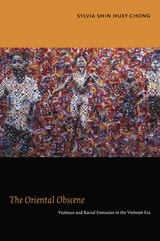
The Oriental Obscene is a sophisticated analysis of Americans’ reactions to visual representations of the Vietnam War, such as the photograph of the “napalm girl,” news footage of the Tet Offensive, and feature films from The Deer Hunter to Rambo: First Blood Part II. Sylvia Shin Huey Chong combines psychoanalytic and film theories with U.S. cultural history to explain what she terms the oriental obscene: racialized fantasies that Americans derived largely from images of Asians as the perpetrators or victims of extreme violence. Chong contends that these fantasies helped Americans to process the trauma of the Vietnam War, as well as the growth of the Asian American population after the Immigration and Nationality Act of 1965 and the postwar immigration of Southeast Asian refugees. The oriental obscene animated a wide range of political narratives, not only the movements for and against the war, but causes as diverse as the Black Power movement, law-and-order conservatism, second-wave feminism, and the nascent Asian American movement. During the Vietnam era, pictures of Asian bodies were used to make sense of race, violence, and America’s identity at home and abroad.
[more]