Results by title
28 books match the query 'National Identity'

"I Hear America Singing"
Folk Music and National IdentityRachel Clare Donaldson
Temple University Press, 2014
In "I Hear America Singing," Rachel Donaldson traces the vibrant history of the twentieth-century folk music revival from its origins in the 1930s through its end in the late 1960s. She investigates the relationship between the revival and concepts of nationalism, showing how key figures in the revival--including Pete Seeger , Alan Lomax, Moses Asch, and Ralph Rinzler--used songs to influence the ways in which Americans understood the values, the culture, and the people of their own nation.
As Donaldson chronicles how cultural norms were shaped over the course of the mid-twentieth century, she underscores how various groups within the revival and their views shifted over time. "I Hear America Singing" provides a stirring account of how and why the revivalists sustained their culturally pluralist and politically democratic Americanism over this tumultuous period in American history.

A Home for All Jews
Citizenship, Rights, and National Identity in the New Israeli StateOrit Rozin
Brandeis University Press, 2016
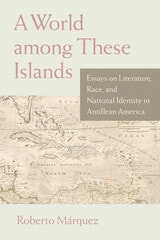
A World among These Islands
Essays on Literature, Race, and National Identity in Antillean AmericaRoberto Marquez
University of Massachusetts Press, 2010
Caribbean literature and culture have all too often been viewed in fragmented terms, without attention to the broader commonalities of the region. In this collection of essays written over many years, Roberto Márquez offers a more encompassing vision, one that respects the individual traditions of particular locales, languages, and cultures but also sees the larger themes that bind the area's literary heritage and history. Márquez begins by making the case for a genuinely Caribbean literary criticism, one that moves beyond the colonial history of fragmentation and isolation and the critical insularity of more conventional approaches. His pan-Caribbean perspective provides a point of departure for the scrutiny of the evolving dramas of race, nationality, nation-building, and cultural articulation in the region. Márquez then focuses specifically on Puerto Rico—its literary and socio—historical experience, the particularities of its “New Creole” incarnations, and the effects of waves of migration to the United States. In the final section of the book, he discusses writers and cultural figures from the other Spanish, Anglophone, and Francophone territories and the ways in which they engage or reflect the defining themes of literature, race, and national identity in Antillean America.

Blacks, Coloureds and National Identity in Nineteenth-century Latin America
Edited by Nancy Priscilla Naro
University of London Press, 2003

CERTAIN OTHER COUNTRIES
Homicide, Gender, and National Identity in Late Nineteenth-Century England, Ireland, Scotland, and WalesCarolyn A. Conley
The Ohio State University Press, 2007
By combining quantitative techniques in the analysis of over seven thousand cases, as well as careful and detailed readings of individual cases, the book exposes trends and patterns that might not have been evident in works using only one method. For instance, by examining all homicide trials rather than concentrating exclusively on a few highly celebrated ones, it becomes clear that most female killers were not viewed with particular horror, but were treated much like their male counterparts.
The conclusions offer challenges and correctives to existing scholarship on gender, ethnicity, class, and violence. The book also demonstrates that the Welsh, Scots, and English remained quite distinct long after their melding as Britons was announced and celebrated. By blending a study of trends in violent behavior with ideas about national identity, Conley brings together rich and hotly debated fields of modern history. This book will be valuable both for scholars of crime and violence as well as for those studying British history.

Cold War Femme
Lesbianism, National Identity, and Hollywood CinemaRobert J. Corber
Duke University Press, 2011
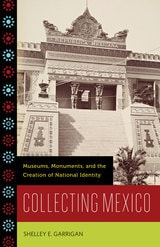
Collecting Mexico
Museums, Monuments, and the Creation of National IdentityShelley E. Garrigan
University of Minnesota Press, 2012
Collecting Mexico centers on the ways in which aesthetics and commercialism intersected in officially sanctioned public collections and displays in late nineteenth-century Mexico. Shelley E. Garrigan approaches questions of origin, citizenry, membership, and difference by reconstructing the lineage of institutionally collected objects around which a modern Mexican identity was negotiated. In doing so, she arrives at a deeper understanding of the ways in which displayed objects become linked with nationalistic meaning and why they exert such persuasive force.
Spanning the Porfiriato period from 1867 to 1910, Collecting Mexico illuminates the creation and institutionalization of a Mexican cultural inheritance. Employing a wide range of examples—including the erection of public monuments, the culture of fine arts, and the representation of Mexico at the Paris World’s Fair of 1889—Garrigan pursues two strands of thought that weave together in surprising ways: national heritage as a transcendental value and patrimony as potential commercial interest.
Collecting Mexico shows that the patterns of institutional collecting reveal how Mexican public collections engendered social meaning. Using extensive archival materials, Garrigan’s close readings of the processes of collection building offer a new vantage point for viewing larger issues of identity, social position, and cultural/capital exchange.

Creating Germans Abroad
Cultural Policies and National Identity in NamibiaDaniel Joseph Walther
Ohio University Press, 2002
When World War I brought an end to German colonial rule in Namibia, much of the German population stayed on. The German community, which had managed to deal with colonial administration, faced new challenges when the region became a South African mandate under the League of Nations in 1919. One of these was the issue of Germanness, which ultimately resulted in public conversations and expressions of identity.
In Creating Germans Abroad, Daniel Walther examines this discourse and provides striking new insights into the character of the German populace in both Germany and its former colony, Southwest Africa, known today as Namibia. In addition to German colonialism, Walther considers issues of race, class, and gender and the activities of minority groups. He offers new perspectives on German cultural and national identity during the Empire, the Weimar Republic, and the Third Reich.
In a larger context, Creating Germans Abroad acts as a model for investigating the strategies and motivations of groups and individuals engaged in national or ethnic engineering and demonstrates how unforeseen circumstances can affect the nature and outcome of these endeavors.
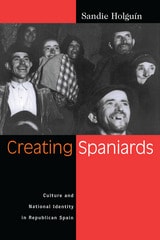
Creating Spaniards
Culture and National Identity in Republican SpainSandie Holguin
University of Wisconsin Press, 2002
Creating Spaniards is a cultural and intellectual history that explains the intersection of politics and culture, and the formation of a national identity, during Spain’s Second Republic and Civil War. It counters recent scholarship claiming that leaders of the Second Republic had no programs for "inventing traditions" to encourage a Spanish national identity.
Focusing on the Second Republic, 1931–1936, Sandie Holguín illustrates how various intellectuals and politicians of the Republican–Socialist coalition used theater, literature, and film to aid the construction of a unified Spanish culture and history. She uses memoirs, journals, newspapers, parliamentary debates, and archival sources in her examination of the impact that cultural reforms had on the transformation of one of Europe’s oldest states.

Danger Zones
Homosexuality, National Identity, and Mexican CultureClaudia Schaefer
University of Arizona Press, 1996
Contents:
1. El diario de José Toledo: The Fantasies of a Middle-Class Bureaucrat
2. The Power of Subversive Imagination: Utopian Discourse in the Novels of Luis Zapata and José Rafael Calva
3. On the Cutting Edge: El jinete azul and the Aesthetics of the Abyss
4. Monobodies, Antibodies, and the Body Politic: Sara Levi Calderón’s Dos mujeres
5. Just Another Material Girl? La hermana secreta de Angélica María and the Seduction of the Popular
6. From "Infernal Realms of Delinquency" to Cozy Cabañas in Cuernavaca: José Joaquín Blanco’s Visions of Homosexuality
Eco-Nationalism
Anti-Nuclear Activism and National Identity in Russia, Lithuania, and UkraineJane I. Dawson
Duke University Press, 1996
Dawson combines a theoretical framework based on models of social movements with extensive field research to compare the ways in which nationalism, regionalism, and other political demands were incorporated into anti-nuclear movements in Russia, Lithuania, Ukraine, Armenia, Tatarstan, and Crimea. These comparative case studies form the core of the book and trace differences among the various regional movements to the distinctive national identities of groups involved. Reflecting the new opportunities for research that have become available since the late 1980s, these studies draw upon Dawson’s extended on-site observation of local movements through 1995 and her unique access to movement activists and their personal archives.
Analyzing and documenting a development with sobering and potentially devastating implications for nuclear power safety in the former USSR and beyond, Eco-nationalism’s examination of social activism in late and postcommunist societies will interest readers concerned with the politics of global environmentalism and the process of democratization in the post-Soviet world.

Exclusive Revolutionaries
Liberal Politics, Social Experience, and National Identity in the Austrian Empire, 1848-1914Pieter M. Judson
University of Michigan Press, 1996
In the mid-1800s, Judson argues, German liberal activists built an effective political movement whose ideology was rooted in its members' social experience in voluntary associations. The liberals were committed to the creation of a market economy based on personal property rights, to a society based on the values of individual self-improvement and personal respectability, and to a fundamental distinction between active and passive citizenship. They were determined to achieve a harmonious community of free peoples, in which personal enlightenment would bring an end to the divisive influence of localism, ethnicity, religion, and feudal social hierarchy.
Yet after 1880, as newer, more radical mass political movements threatened their political fortunes, the liberals forged a German nationalist politics based increasingly on ethnic identity. Their emphasis on national identity became a way for former liberals to hold together an increasingly diverse coalition of German speakers who had little in common outside of their shared language. Only "Germanness" bridged the dangerous gulf between social classes. This nationalism helped the liberals to compete for power in the multinational, multicultural Austrian Empire down to 1914, but it left a legacy of nationalist extremism and tolerance of anti-Semitism that continues to influence political cultures in the former lands of the Habsburg Monarchy today.

Fear, Anxiety, and National Identity
Immigration and Belonging in North America and Western Europesimon
Russell Sage Foundation, 2015
Fifty years of large-scale immigration has brought significant ethnic, racial, and religious diversity to North America and Western Europe, but has also prompted hostile backlashes. In Fear, Anxiety, and National Identity, a distinguished multidisciplinary group of scholars examine whether and how immigrants and their offspring have been included in the prevailing national identity in the societies where they now live and to what extent they remain perpetual foreigners in the eyes of the long-established native-born. What specific social forces in each country account for the barriers immigrants and their children face, and how do anxieties about immigrant integration and national identity differ on the two sides of the Atlantic?
Western European countries such as Germany, the Netherlands, and the United Kingdom have witnessed a significant increase in Muslim immigrants, which has given rise to nativist groups that question their belonging. Contributors Thomas Faist and Christian Ulbricht discuss how German politicians have implicitly compared the purported “backward” values of Muslim immigrants with the German idea of Leitkultur, or a society that values civil liberties and human rights, reinforcing the symbolic exclusion of Muslim immigrants. Similarly, Marieke Slootman and Jan Willem Duyvendak find that in the Netherlands, the conception of citizenship has shifted to focus less on political rights and duties and more on cultural norms and values. In this context, Turkish and Moroccan Muslim immigrants face increasing pressure to adopt “Dutch” culture, yet are simultaneously portrayed as having regressive views on gender and sexuality that make them unable to assimilate.
Religion is less of a barrier to immigrants’ inclusion in the United States, where instead undocumented status drives much of the political and social marginalization of immigrants. As Mary C. Waters and Philip Kasinitz note, undocumented immigrants in the United States. are ineligible for the services and freedoms that citizens take for granted and often live in fear of detention and deportation. Yet, as Irene Bloemraad points out, Americans’ conception of national identity expanded to be more inclusive of immigrants and their children with political mobilization and changes in law, institutions, and culture in the wake of the Civil Rights Movement. Canadians’ views also dramatically expanded in recent decades, with multiculturalism now an important part of their national identity, in contrast to Europeans’ fear that diversity undermines national solidarity.
With immigration to North America and Western Europe a continuing reality, each region will have to confront anti-immigrant sentiments that create barriers for and threaten the inclusion of newcomers. Fear, Anxiety, and National Identity investigates the multifaceted connections among immigration, belonging, and citizenship, and provides new ways of thinking about national identity.

Hispanicism and Early US Literature
Spain, Mexico, Cuba, and the Origins of US National IdentityJohn C. Havard
University of Alabama Press, 2018
Revealing how Spain, Mexico, and Cuba helped shape the literary origins of American national identity.
In Hispanicism and Early US Literature, author John C. Havard posits that representations of Spain, Spanish America, Spanishness, and Spanish Americanness are integral elements in the evolution of early national and antebellum US literature. He argues that Spanish-speaking countries have long held a broad fascination for Americans and that stock narratives regarding these peoples were central to the period’s US literature.
Beginning with the work of eighteenth-century literary nationalists such as Joel Barlow, US literature has been drawn to reflect on Spain and Spanish America. Such reflection was often inspired by geopolitical conflicts such as US expansion into Spanish Louisiana and the US-Mexican War. Havard terms the discourse emerging from these reflections “Hispanicism.” This discourse was used to portray the dominant viewpoint of classical liberalism that propounded an American exceptionalism premised on the idea that Hispanophone peoples were comparatively lacking the capacity for self-determination, hence rationalizing imperialism. On the conservative side were warnings against progress through conquest.
Havard delves into selected works of early national and antebellum literature on Spain and Spanish America to illuminate US national identity. Poetry and novels by Joel Barlow, James Fenimore Cooper, and Herman Melville are mined to further his arguments regarding identity, liberalism, and conservatism. Understudied authors Mary Peabody Mann and José Antonio Saco are held up to contrast American and Cuban views on Hispanicism and Cuban annexation as well as to develop the focus on nationality and ideology via differences in views on liberalism.
More than just a work of literary criticism, there is a substantial amount of cultural and political history discussed. Havard’s use of archival sources such as political articles and personal correspondence elucidates not just literary genres and movements such as early national epic poetry, abolitionist fiction, and the American Renaissance, but also US prominent culture.

Looking for Mexico
Modern Visual Culture and National IdentityJohn Mraz
Duke University Press, 2009
Turning to film, Mraz compares portrayals of the Mexican Revolution by Fernando de Fuentes to the later movies of Emilio Fernández and Gabriel Figueroa. He considers major stars of Golden Age cinema as gender archetypes for mexicanidad, juxtaposing the charros (hacienda cowboys) embodied by Pedro Infante, Pedro Armendáriz, and Jorge Negrete with the effacing women: the mother, Indian, and shrew as played by Sara García, Dolores del Río, and María Félix. Mraz also analyzes the leading comedians of the Mexican screen, representations of the 1968 student revolt, and depictions of Frida Kahlo in films made by Paul Leduc and Julie Taymor. Filled with more than fifty illustrations, Looking for Mexico is an exuberant plunge into Mexico’s national identity, its visual culture, and the connections between the two.
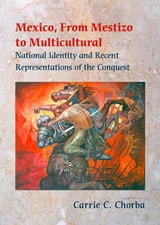
Mexico, From Mestizo to Multicultural
National Identity and Recent Representations of the ConquestCarrie C. Chorba
Vanderbilt University Press, 2006
Throughout the twentieth century, the post-revolutionary Mexican State had used mestizaje as a symbol of national unity and social integration. By the end of the millennium, however, Mexico had gone from a PRI-dominated, economically protectionist nation to a more democratic, economically globalizing one. More importantly, the homogenizing, mestizophile national identity that pervaded Mexico throughout the past century had given way to official admission of Mexico's ethnic and linguistic diversity--or 'pluriculture' according to President Salinas's 1992 constitutional revision.
This book is the first interdisciplinary study of literary, cinematic, and graphic images of Mexican national identity in the 1980s and '90s. Discussing, in depth, writings, films, and cartoons from a vast array of contemporary sources, Carrie C. Chorba creates a social history of this important shift.

Modern Japanese Cuisine
Food, Power and National IdentityKatarzyna J. Cwiertka
Reaktion Books, 2015
Katarzyna J. Cwiertka demonstrates that key shifts in the Japanese diet were, in many cases, a consequence of modern imperialism. Exploring reforms in military catering and home cooking, wartime food management and the rise of urban gastronomy, Cwiertka shows how Japan’s numerous regional cuisines were eventually replaced by a set of foods and practices with which the majority of Japanese today ardently identify.
The result of over a decade of research, Modern Japanese Cuisine is a fascinating look at the historical roots of some of the world’s best cooking and will provide appetizing reading for scholars of Japanese culture and foodies alike.
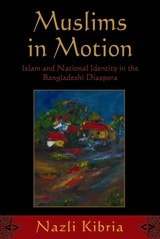
Muslims in Motion
Islam and National Identity in the Bangladeshi DiasporaKibria, Nazli
Rutgers University Press, 2011
In Muslims in Motion, Nazli Kibria provides a comparative look at Bangladeshi Muslims in different global contexts--including Britain, the U.S., the Middle East, and Malaysia. Kibria examines international migrant flows from Bangladesh, and considers how such migrations continue to shape Islamization in these areas. Having conducted more than 200 in-depth interviews, she explores how, in societies as different as these, migrant Muslims, in their everyday lives, strive to achieve economic gains, sustain community and family life, and realize a sense of dignity and honor.
Muslims in Motion offers fresh insights into the prominence of Islam in these communities, especially an Islam defined by fundamentalist movements and ideologies. Kibria also focuses on the complex significance of nationality--with rich analyses of the diaspora, the role of gender and class, and the multiple identities of the migrants, she shows how nationality can be both a critical source of support and also of difficulty for many in their efforts to attain lives of dignity. By bringing to life a vast range of experiences, this book challenges prevailing stereotypes of Muslims.

National Identity
Anthony D. Smith
University of Nevada Press, 1993

National Identity in Indian Popular Cinema, 1947-1987
By Sumita S. Chakravarty
University of Texas Press, 1993
Although Indian popular cinema has a long history and is familiar to audiences around the world, it has rarely been systematically studied. This book offers the first detailed account of the popular film as it has grown and changed during the tumultuous decades of Indian nationhood. The study focuses on the cinema’s characteristic forms, its range of meanings and pleasures, and, above all, its ideological construction of Indian national identity.
Informed by theoretical developments in film theory, cultural studies, postcolonial discourse, and “Third World” cinema, the book identifies the major genres and movements within Bombay cinema since Independence and uses them to enter larger cultural debates about questions of identity, authenticity, citizenship, and collectivity. Chakravarty examines numerous films of the period, including Guide (Vijay Anand, 1965), Shri 420 [The gentleman cheat] (Raj Kapoor, 1955), and Bhumika [The role] (Shyam Benegal, 1977). She shows how “imperso-nation,” played out in masquerade and disguise, has characterized the representation of national identity in popular films, so that concerns and conflicts over class, communal, and regional differences are obsessively evoked, explored, and neutralized.
These findings will be of interest to film and area specialists, as well as general readers in film studies.

National Identity of Romanians in Transylvania
Sorin Mitu
Central European University Press, 2001
This meticulously researched and elegantly written book is the most authoritative study of the emergence of modern Romanian identity in Transylvania during the eighteenth and nineteenth centuries. Based upon a plethora of contemporary published sources, Mitu approaches national identity from a variety of perspectives - from within the Romanian community itself and their reaction to the image others had of them.
The author sheds new light on the problems of self-evaluation using a method he describes as "functional analysis" to examine a complex set of ideologies and propaganda. This approach helps the reader to understand the intricate web of contemporary Romanian nationalism.
National Identity of Romanians in Transylvania appeals to scholars of modern Romanian history, those focusing on the Habsburg Monarchy and the study of modern nationalism. The book is an important contribution to the expanding debate on nationalism and national identity from an East European perspective.

Negotiating Spain and Catalonia
Competing Narratives of National IdentityFernando León-Solís
Intellect Books, 2013
The two case studies included in this book (dealing with the Football World Cups of 1994 and 2002, and the general elections of 1996 and 2000) examine competing discourses of Spain, Catalonia and their national identities, as constructed in the Spanish press. The conservative discourse offers traditional and unified images of Spain close to the stereotype, whereas more liberal visions of the country regard 'Europeanism' and 'reason' (not 'passive') as the values Spain should aspire to. From a peripheral perspective, Catalan self-definition is of a people that is hardworking, thoughtful, truly European, and different from the rest of the Spaniards.
However, these differences between the discourses are not always so clear-cut. Central to Negotiating Spain and Catalonia is the idea of the constant renegotiation of Spanish and Catalan identities in order to adapt them to the political circumstance: both case studies show how radically different narratives of Spanishness and Catalanicity offered in the turbulent political past tend to merge into the more tranquil present.

Osiris, Volume 24
National Identity: The Role of Science and TechnologyEdited by Carol E. Harrison and Ann Johnson
University of Chicago Press, 2009

Pride, Not Prejudice
National Identity as a Pacifying Force in East AsiaEunbin Chung
University of Michigan Press, 2022
As shown by China’s relationship to Japan, and Japan’s relationship to South Korea, even growing regional economic interdependencies are not enough to overcome bitter memories grounded in earlier wars, invasions, and periods of colonial domination. Although efforts to ease historical animosity have been made, few have proven to be successful in Northeast Asia. In previous research scholars anticipated an improvement in relations through thick economic interdependence or increased societal contact. In economic terms, however, Japan and China already trade heavily: Japan has emerged as China’s largest trading partner and China as second largest to Japan. Societal contact is already intense, as millions of Chinese, Koreans, and Japanese visit one another’s countries annually as students, tourists, and on business trips. But these developments have not alleviated international distrust and negative perception, or resolved disagreement on what constitutes “adequate reparation” regarding the countries’ painful history.
Noticing clashes of strong nationalisms around the world in areas like Northeast Asia, numerous studies have suggested that more peaceful relations are likely only if countries submerge or paper over existing national identities by promoting universalism. Pride, Not Prejudice argues, to the contrary, that affirmation of national identities may be a more effective way to build international cooperation. If each national population reflects on the values of their national identity, trust and positive perception can increase between countries. This idea is consistent with the theoretical foundation that those who have a clear, secure, and content sense of self, in turn, can be more open, evenhanded, and less defensive toward others. In addition, this reduced defensiveness also enhances guilt admission by past “inflictors” of conflict and colonialism. Eunbin Chung borrows the social psychological theory of self-affirmation and applies it to an international context to argue that affirmation of a national identity, or reflecting on what it means to be part of one’s country, can increase trust, guilt recognition, and positive perception between countries.
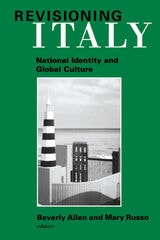
Revisioning Italy
National Identity and Global CultureBeverly Allen
University of Minnesota Press, 1997
Explores Italian national identity.
More than any other nation, Italy—from its imperial past to its subordinate present, from its colonial forays to its splendid isolation—embodies the myriad and contradictory historical forms of nationhood. This volume covers a range of subjects drawn from Italy and abroad to study the historical and contemporary formations of Italian national identity. In doing so, the work illuminates Italy past and present as well as the local and global dimensions of national identity in general.
Whether considering opera or Ninja Turtles, these essays reveal how cultural identity is constructed and manipulated-an issue made urgent by the influx of African, Indochinese, and Eastern European immigrants into Italy today. Exile, nationalism, and imagined communities are the topics of several essays, including Antonio Negri’s reflection on his own experience of political militancy and exile. Others focus on Italy’s colonial “unconscious,” Mussolini’s adventures in North Africa, and racism from the late nineteenth century to the present. By analyzing Italy’s European and Mediterranean identities, its highly regional character, its north-south economic imbalance, and its ethnic complexity, this truly interdisciplinary volume resists the hierarchizing and monumentalizing of traditional Italian studies in the United States. It will inform and redirect our understanding of what constitutes “Italy.”Contributors: Mohamed Aden; John Agnew, Syracuse U; Ayele Bekerie, Cornell U; Elaine K. Chang, Rutgers U; Antonio Marazzi, U of Padua, Italy; Francesca Miller, U of California, Davis; Antonio Negri, U of Paris VIII, France; Graziella Parati, Dartmouth College; Karen Pinkus, Northwestern U; Paul Robinson, Stanford U; Pasquale Verdicchio, U of California, San Diego; Marguerite R. Waller, U of California, Riverside; and David Ward, Wellesley College.
The American Girl Goes to War
Women and National Identity in U.S. Silent FilmLiz Clarke
Rutgers University Press, 2022
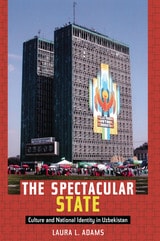
The Spectacular State
Culture and National Identity in UzbekistanLaura L. Adams
Duke University Press, 2010
Adams draws on her observations and interviews conducted with artists, intellectuals, and bureaucrats involved in the production of Uzbekistan’s national culture. These elites used globalized cultural forms such as Olympics-style spectacle to showcase local, national, and international aspects of official culture. While these state-sponsored extravaganzas were intended to be displays of Uzbekistan’s ethnic and civic national identity, Adams found that cultural renewal in the decade after Uzbekistan’s independence was not so much a rejection of Soviet power as it was a re-appropriation of Soviet methods of control and ideas about culture. The public sphere became more restricted than it had been in Soviet times, even as Soviet-era ideas about ethnic and national identity paved the way for Uzbekistan to join a more open global community.
Transported to Botany Bay
Class, National Identity, and the Literary Figure of the Australian ConvictDorice Williams Elliott
Ohio University Press, 2019
Literary representations of British convicts exiled to Australia were the most likely way that the typical English reader would learn about the new colonies there. In Transported to Botany Bay, Dorice Williams Elliott examines how writers—from canonical ones such as Dickens and Trollope to others who were themselves convicts—used the figure of the felon exiled to Australia to construct class, race, and national identity as intertwined.
Even as England’s supposedly ancient social structure was preserved and venerated as the “true” England, the transportation of some 168,000 convicts facilitated the birth of a new nation with more fluid class relations for those who didn’t fit into the prevailing national image. In analyzing novels, broadsides, and first-person accounts, Elliott demonstrates how Britain linked class, race, and national identity at a key historical moment when it was still negotiating its relationship with its empire. The events and incidents depicted as taking place literally on the other side of the world, she argues, deeply affected people’s sense of their place in their own society, with transnational implications that are still relevant today.