Results by title
10 books match the query 'Organizations'

Managerial Psychology
Managing Behavior in OrganizationsHarold J. Leavitt and Homa Bahrami
University of Chicago Press, 1988
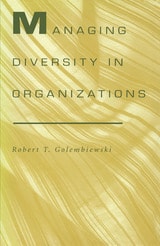
Managing Diversity in Organizations
Robert T. Golembiewski
University of Alabama Press, 1995
Managing Diversity in Organizations focuses on a key issue that organizations are facing—diversity. It is here, and it is growing. The only question now is how well we deal with diversity, especially in organizational contexts.
Golembiewski identifies the many forces and factors propelling us into the age of diversity in organizations—ethical, political, philosophic, demographic, and so on—and details the historical and contemporary approaches. Most practice has focused on a "level playing field" or equal opportunity and "tilting the playing field" or equal outcomes. This volume focuses on diversity as a strategic device rather than as a nicety rooted in behavioral and organizational research. Managing diversity successfully in organizations requires a thorough understanding of management infrastructure that is consistent with diversity--especially structures of work, policies, and procedures that institutionalize and build diversity.

Module 6
Balancing Access and Privacy in the Records of OrganizationsAll rights reserved. No part of this publication may be reproduced, stored in a retrieval system, or transmitted in any form or by any means without prior permission from the publisher.
Society of American Archivists, 2015
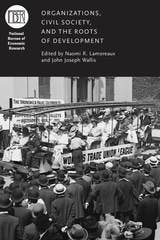
Organizations, Civil Society, and the Roots of Development
Edited by Naomi R. Lamoreaux and John Joseph Wallis
University of Chicago Press, 2017
The contributions to Organizations, Civil Society, and the Roots of Development seek to answer this question through an exploration of how developing nations throughout the eighteenth and nineteenth centuries, including the United States, United Kingdom, France, and Germany, made the transition to allowing their citizens the right to form organizations. The transition, contributors show, was not an easy one. Neither political changes brought about by revolution nor subsequent economic growth led directly to open access. In fact, initial patterns of change were in the opposite direction, as political coalitions restricted access to specific organizations for the purpose of maintaining political control. Ultimately, however, it became clear that these restrictions threatened the foundation of social and political order. Tracing the path of these modern civil societies, Organizations, Civil Society, and the Roots of Development is an invaluable contribution to all interested in today’s developing countries and the challenges they face in developing this organizational capacity.

Planning the Urban Region
A Comparative Study of Policies and OrganizationsPeter Self
University of Alabama Press, 1982
In tandem with an analysis of the basic purpose and rationale of urban planning, Peter Self discusses the achievements and failures of different types of planning authorities. Planning the Urban Region surveys in turn the planning of city governments, metro governments, and regional bodies as they attempt to guide the growth and character of large urban areas—within whose sprawl live roughly one-half of the populations of Western countries—with examples drawn from the United States, Great Britain, Canada, Australia, Sweden, and France.
Self argues that the urban region is at a political and organizational crossroads, as it must grapple with the problems of urban sprawl: the social effects of land use and housing, conflicts between local communities and the metro organizations, environmental issues, and the capacity of governmental systems to handle complex issues. Planning the Urban Region is a valuable contribution to the literature on the future of cities and urban regions and should materially inform the debate on the place of public planning in shaping that future.
Politics, Policy, and Organizations
Frontiers in the Scientific Study of BureaucracyGeorge A. Krause & Kenneth J. Meier, Editors
University of Michigan Press, 2003
Regulation, Organizations, and Politics
Motor Freight Policy at the Interstate Commerce CommissionLawrence S. Rothenberg
University of Michigan Press, 1994

Shaping Science
Organizations, Decisions, and Culture on NASA’s TeamsJanet Vertesi
University of Chicago Press, 2020
In Shaping Science, Janet Vertesi draws on a decade of immersive ethnography with NASA’s robotic spacecraft teams to create a comparative account of two great space missions of the early 2000s. Although these missions featured robotic explorers on the frontiers of the solar system bravely investigating new worlds, their commands were issued from millions of miles away by a very human team. By examining the two teams’ formal structures, decision-making techniques, and informal work practices in the day-to-day process of mission planning, Vertesi shows just how deeply entangled a team’s local organizational context is with the knowledge they produce about other worlds.
Using extensive, embedded experiences on two NASA spacecraft teams, this is the first book to apply organizational studies of work to the laboratory environment in order to analyze the production of scientific knowledge itself. Engaging and deeply researched, Shaping Science demonstrates the significant influence that the social organization of a scientific team can have on the practices of that team and the results they yield.

Trial Courts as Organizations
Brian J Ostrom, Charles W Ostrom, Jr., Roger A Hanson and Matthew Kleiman
Temple University Press, 2007
Court administrators and judges have long acknowledged that culture plays an important role in the function of trial courts. Trial Courts as Organizations provides a comprehensive framework for understanding this organizational culture, along with a set of steps and tools to assess and measure the current and preferred culture.
The authors examine how courts operate, what characteristics they may display, and how they function as a unit to preserve judicial independence, strengthen organizational leadership, and influence court performance. They identify four different types of institutional cultures using a systematic analysis of alternative values on how work is done. Each culture is shown to have its own strengths and weaknesses in achieving values, such as timely case resolution, access to court services, and procedural justice. Accordingly, the authors find judges and administrators prefer a definite pattern of different cultures, called a "mosaic," to guide how their courts operate in the future.

Trust and Distrust In Organizations
Dilemmas and ApproachesRoderick M. Kramer
Russell Sage Foundation, 2004