Results by title
32 books match the query 'Printed Music'
Alzira
Tragedia lirica in Three Acts by Salvadore CammaranoGiuseppe Verdi
University of Chicago Press, 1995
Because the success of the premiere was not repeated, Alzira fell out of the repertory and no orchestral score was ever published. The critical edition, based on Verdi's autograph score and important secondary sources, provides the first reliable full score of the work. It is complemented by an introduction tracing the opera's genesis, sources and performance history and practices. Together with the detailed critical commentary, discussing problems and ambiguities in the sources, the edition provides scholars and performers alike with unequalled means for interpretation and study of this poorly known work.
An Alabama Songbook
Ballads, Folksongs, and Spirituals Collected by Byron ArnoldRobert W. Halli Jr.
University of Alabama Press, 2004
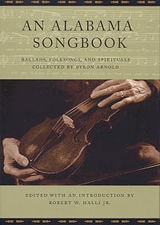
Alabama is a state rich in folksong tradition, from old English ballads sung along the Tennessee River to children’s game songs played in Mobile, from the rhythmic work songs of the railroad gandy dancers of Gadsden to the spirituals of the Black Belt. The musical heritage of blacks and whites, rich and poor, hill folk and cotton farmers, these songs endure as a living part of the state’s varied past.
In the mid 1940s Byron Arnold, an eager young music professor from The University of Alabama, set out to find and record as many of these songs as he could and was rewarded by unstinting cooperation from many informants. Mrs. Julia Greer Marechal of Mobile, for example, was 90 years old, blind, and a semi-invalid, but she sang for Arnold for three hours, allowing the recording of 33 songs and exhausting Arnold and his technician. Helped by such living repositories as Mrs. Marechal, the Arnold collection grew to well over 500 songs, augmented by field notes and remarkable biographical information on the singers.
An Alabama Songbook is the result of Arnold’s efforts and those of his informants across the state and has been shaped by Robert W. Halli Jr. into a narrative enriched by more than 200 significant songs-lullabies, Civil War anthems, African-American gospel and secular songs, fiddle tunes, temperance songs, love ballads, play-party rhymes, and work songs. In the tradition of Alan Lomax’s The Folk Songs of North America and Vance Randolph’s Ozark Folksongs, this volume will appeal to general audiences, folklorists, ethnomusicologists, preservationists, traditional musicians, and historians.
Attila
Dramma lirico in a Prologue and Three ActsGiuseppe Verdi
University of Chicago Press, 2013
Verdi’s Attila, his ninth opera, had its premiere at Venice’s Teatro La Fenice in March 1846. Based on the German play Attila, King of the Huns, the libretto has its own storied history: as Verdi fell seriously ill before the work’s completion, the main librettist moved permanently to Madrid, leaving the last act of Attila only a sketch. It was then that Verdi called upon Francesco Maria Piave, the librettist for two of his earlier works, who at the composer’s behest scratched plans for a large choral finale and decided instead to concentrate on the dramatic roles of the protagonists.
In years since, Attila has become one of Verdi’s most popular and oft-staged early works. The composer's inimitable vitality, soaring arcs of melody, grand choruses, and passion are here amply apparent. This critical edition, based on Verdi’s autograph full score preserved at the British Library, restores the opera’s original text and accurately reflects the composer's colorful and elaborate musical setting, while Helen M. Greenwald’s masterful introduction discusses the opera’s origins, sources, and performance questions, and her critical commentary details editorial problems and their solutions.
Chamber Music
Giuseppe Verdi
University of Chicago Press, 2011
Verdi wrote as gifts for admirers the three original piano pieces—“Romance sans paroles,” “Valzer,” and “Album Leaf for Francesco Florimo”—also included here, and these critical editions are based on the autograph scores or, in the case of “Romance sans paroles,” on photographs of the never-released original. Editor Gundula Kreuzer details the origins, sources, and performance questions of all these works in her skillful introduction, and her critical commentary explains editorial problems and solutions.
The instrumental parts are also available as Quartetto (1873): Four Parts for String Quartet (ISBN 978-0-226-85321-5), extracted from this full score.
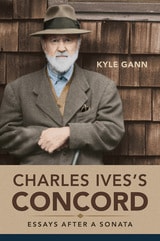
Charles Ives's Concord
Essays after a SonataKyle Gann
University of Illinois Press, 2021
Ernani
Dramma lirico in Four Acts by Francesco Maria PiaveGiuseppe Verdi
University of Chicago Press, 1985

Gender, Sex, and Sexuality in Musical Theatre
He/She/They Could Have Danced All NightEdited by Kelly Kessler
Intellect Books, 2023
Critics and fans alike often mistake theatrical song and dance as simplistic, heteronormative, and traditional. This collection troubles this over-idealized notion of musical theatre, tackling divas, chorus boys, and the Rockettes; hit shows such as Hamilton and Spring Awakening; and lesser-known but groundbreaking gems like Erin Markey’s A Ride on The Irish Cream and Kirsten Childs’s Bella: An American Tall Tale.
The book takes a broad look at musical theater across a range of intersecting lenses including race, nation, form, dance, casting, marketing, pedagogy, industry, stardom, politics, and platform. Undermining the musical form’s conservative façade, scholars drive home the fact that gender and desire have long been at the heart of the musical. This exciting and vibrant collection of articles takes sex, sexuality, and gendered complexity out of the musical’s liner notes and back above the marquee.
Giovanna d'Arco
Dramma lirico in Four Acts by Temistocle SoleraGiuseppe Verdi
University of Chicago Press, 2009
This critical edition of Giovanna d’Arco, the first publication in full score, is based on the composer’s autograph score preserved in the archives of Verdi’s publisher, Casa Ricordi. It restores the opera’s original text, which had been heavily censored, and accurately reflects Verdi’s colorful and elaborate musical setting. Editor Alberto Rizzuti’s introduction discusses the opera’s origins, sources, and performance questions, while the critical commentary details editorial problems and solutions.
Hymns / Inni
Giuseppe Verdi
University of Chicago Press, 2007
This newest volume in The Works of Giuseppe Verdi series comprises his only two surviving secular choral works: Inno popolare, or Hymn of the People, for unaccompanied male chorus, and Inno delle nazioni, or Hymn of the Nations, for tenor solo, chorus, and orchestra.
Verdi wrote the brief Inno popolare in 1848 at the behest of the Italian philosopher and patriot Giuseppe Mazzini, intending that it become an anthem for Italy at a time when the country had just driven away its Austrian overlords. He wrote no more independent patriotic pieces until he was asked in 1861 to represent his country with a patriotic composition at a musical jubilee during London’s International Exhibition of 1862. The resulting piece was Inno delle nazioni, the critical edition of which is based on Verdi’s autograph score, preserved at the British Library. Other important sources include the composer's musical sketches, recently discovered in the Verdi family villa, and the performing parts Toscanini used for a BBC broadcast in 1943.
I masnadieri
Melodramma tragico in Four Parts by Andrea MaffeiGiuseppe Verdi Edited by Roberta Montemorra Marvin
University of Chicago Press, 2000
The critical edition is the first publication of I masnadieri in full score. Based on the composer's autograph and on important secondary sources such as the performing parts mentioned above, this edition provides scholars and performers alike with unequaled means for interpretation and study of one of Verdi's less well known works. The detailed critical commentary discusses problems and ambiguities in the sources, while a wide-ranging introduction to the score traces the opera's genesis, sources, and performance history and practices.
Il corsaro
Melodramma tragico in Three Acts, Libretto by Francesco Maria PiaveGiuseppe Verdi Edited by Elizabeth Hudson
University of Chicago Press, 1998
The full score of Il corsaro, published here for the first time, as well as recent revivals based on pre-publication proofs of this critical edition, reveal the work to be far more rewarding than even Verdi himself would later admit. Showing the gradual consolidation of Verdi's mature style through his contacts with French opera, Il corsaro well repays the renewed attention it is receiving.
Il trovatore
Critical Edition Study ScoreGiuseppe Verdi
University of Chicago Press, 2016
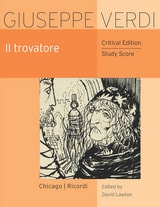
Based on Verdi’s autograph score and an examination of important secondary sources, including contemporary manuscript copies and performing parts, this edition of Il trovatore identifies and resolves numerous ambiguities of harmony, melodic detail, text, and phrasing that have marred previous scores. Scholars and performers alike will find a wealth of information in the critical apparatus to inform their research and interpretations. The introduction to the score outlines the work’s genesis, sources, and performance history, while the critical commentary discusses all editorial decisions.
Il trovatore
Dramma in Four Parts by Salvadore CammaranoGiuseppe Verdi
University of Chicago Press, 1993
The lengthy introduction to the score discusses the work's genesis, sources, and performance history as well as issues of instrumental and vocal performance practice, production and staging, and problems of notation. As an added feature of the introduction is an original study by Carlos Matteo Mossa of the creation of the libretto, based on the original draft and numerous other autograph documents.
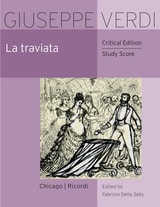
La traviata
Critical Edition Study ScoreGiuseppe Verdi
University of Chicago Press, 2017
The University of Chicago Press, in collaboration with Casa Ricordi, has undertaken to publish the first critical edition of the complete works of Giuseppe Verdi. The series, based exclusively on original sources, is the only one to present authentic versions of all of the composer’s works; together with his operas, the critical edition presents his songs, his choral music and sacred pieces, and his string quartet and other instrumental works.
The Works of Giuseppe Verdi will be an invaluable standard reference work—a necessary acquisition for all music libraries and a joy to own for all lovers of opera. The new series of study scores presents an adaptation of each critical edition that provides scholars with an affordable and portable option for exploring Verdi’s oeuvre. The study scores have been designed to distinguish editors’ marks from Verdi’s own notations while remaining clear enough for use in performance. The introduction to each score discusses the work’s sources, composition, and performance history, as well as performance practices, instrumentation, and problems of notation. The newest editions of the study scores examine two of Verdi’s three-act operas: La traviata and Rigoletto.
La traviata
Melodramma in Three Acts, Libretto by Francesco Maria PiaveGiuseppe Verdi
University of Chicago Press, 1997
This critical edition presents the 1854 version as the main score, and also makes available for the first time in full score the original 1853 settings of the revised pieces. For this edition Fabrizio della Seta used not only the composer's autograph and many secondary sources, but also Verdi's previously unknown sketches. These sketches helped corroborate the original readings and illuminate the work's compositional stages. The editor's wide-ranging introduction traces the opera's genesis, sources, performance history and practices, and a detailed critical commentary discusses source problems and ambiguities.

Le trouvère
Opera in Four Acts by Salvadore Cammarano, French Translation by Émilien PaciniGiuseppe Verdi
University of Chicago Press, 2025
By the time Le trouvère premiered at the Paris Opéra in 1857, Giuseppe Verdi had first-hand knowledge of the unique demands of French theater. He had adapted his earlier work I Lombardi alla prima crociata (La Scala, 1843) as Jérusalem in 1847, and in 1855 he composed Les vêpres siciliennes, especially for the Opéra. Il trovatore, set in Spain against the backdrop of civil unrest, was especially suited to Parisian tastes, which required spectacular performances with plenty of choreography. Verdi expanded the score with a four-part ballet in the third act and rewrote the ending, where he introduced a reprise of his celebrated “Miserere,” which is first heard at the start of the fourth act. By all accounts, the resulting work displayed extraordinary musical and dramatic efficacy and, after a successful premiere, Le trouvère remained in the Opéra repertory through the opening decades of the twentieth century.
There is no extant autograph manuscript for Le trouvère. This critical edition is based primarily on a manuscript full score used at the premiere and during rehearsals, preserved at the Bibliothèque de l’Opéra in Paris. Editor David Lawton’s introduction to this edition discusses the origins, rehearsals, and reception of Le trouvère, the numerous sources preserved in French, Belgian, Italian, and British archives, and performance issues including staging, vocal style, and orchestral considerations.
Luisa Miller
Melodramma tragico in Three Acts by Salvadore CammaranoGiuseppe Verdi
University of Chicago Press, 1992
Luisa Miller, a milestone in the maturation of Verdi's style, is the fifth work to be published in The Works of Giuseppe Verdi. Following the strict requirements of the series, this edition is based on Verdi's autograph and other authentic sources, and has been reviewed by a distinguished editorial board—Philip Gossett (general editor), Julian Budden, Martin Chusid, Francesco Degrada, Ursula Günter, Giorgio Pestelli, and Pierluigi Petrobelli. It is available as a two-volume set: a full orchestral score and a critical commentary. The newly set score is printed on acid-free paper and beautifully bound in an oversized format. The introduction to the score discusses the work's genesis, sources, and performance history as well as performance practice, instrumentation, and problems of notation. The critical commentary discusses editorial decisions and identifies the sources of alternate readings of the music and libretto.
Macbeth
Melodramma in Four Acts. Libretto by Francesco Maria PiaveGiuseppe Verdi
University of Chicago Press, 2005
Published in three volumes, this critical edition of Macbeth is the only one based entirely on autograph sources. Containing the later version as the principal score, it is the first edition to consult the composer's manuscripts of the revised pieces, preserved at the Bibliothèque Nationale in Paris. An appendix contains the earlier movements, and David Lawton provides a wide-ranging introduction to the opera's complex history. This critical edition of Macbeth includes here for the first time Verdi's preferred text—the version he set to music—as well as his own stage directions and thus offers the most vivid and dramatic reading to date.
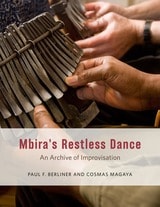
Mbira's Restless Dance
An Archive of ImprovisationPaul F. Berliner and Cosmas Magaya
University of Chicago Press, 2020
Mbira’s Restless Dance is written to be played. This two-volume, spiral-bound set features musical transcriptions of thirty-nine compositions and variations, annotated with the master player’s advice on technique and performance, his notes and observations, and commentary by Berliner. Enhanced with extensive website audiovisuals, Mbira’s Restless Dance is in effect a series of masterclasses with Magaya, suitable for experienced mbira players and those learning the fundamentals.
Together with Berliner's The Art of Mbira, in which he provides an indispensable historical and cultural guide to mbira in a changing world, Mbira's Restless Dance breaks new ground in the depth and specificity of its exploration of an African musical tradition, and in the entwining of the authors’ collaborative voices. It is a testament to the powerful relationship between music and social life—and the rewards of lifelong musical study, performance, and friendship.
Messa da Requiem for the Anniversary of the Death of Manzoni, 22 May 1874
Giuseppe Verdi Edited by David Rosen
University of Chicago Press, 1990
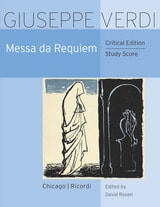
Messa da Requiem
Critical Edition Study ScoreGiuseppe Verdi
University of Chicago Press, 2016
This edition of Messa da Requiem is based on Verdi’s autograph score and other original sources. The appendices include two pieces from the compositional history of the Requiem: an early version of the Libera me, composed in 1869 as part of a collaborative work planned as a memorial to Rossini; and the Liber scriptus, which in the original score of the Manzoni memorial Requiem was composed as a fugue for chorus. The introduction to the score traces the complex compositional and performance histories of the Requiem and discusses the work’s problems of instrumentation and notation, while the critical commentary gives a full description of the sources and an account of all editorial decisions.
Nabucodonosor
Dramma lirico in Four Parts by Temistocle SoleraGiuseppe Verdi
University of Chicago Press, 1988
Quartetto
Four Parts for String QuartetGiuseppe Verdi
University of Chicago Press, 2011
Rigoletto
Critical Edition Study ScoreGiuseppe Verdi
University of Chicago Press, 2017
The University of Chicago Press, in collaboration with Casa Ricordi, has undertaken to publish the first critical edition of the complete works of Giuseppe Verdi. The series, based exclusively on original sources, is the only one to present authentic versions of all of the composer’s works; together with his operas, the critical edition presents his songs, his choral music and sacred pieces, and his string quartet and other instrumental works.
The Works of Giuseppe Verdi will be an invaluable standard reference work—a necessary acquisition for all music libraries and a joy to own for all lovers of opera. The new series of study scores presents an adaptation of each critical edition that provides scholars with an affordable and portable option for exploring Verdi’s oeuvre. The study scores have been designed to distinguish editors’ marks from Verdi’s own notations while remaining clear enough for use in performance. The introduction to each score discusses the work’s sources, composition, and performance history, as well as performance practices, instrumentation, and problems of notation. The newest editions of the study scores examine two of Verdi’s three-act operas: La traviata and Rigoletto.
Rigoletto
Melodramma in Three Acts by Francesco Maria PiaveGiuseppe Verdi
University of Chicago Press, 1983
Stiffelio
Libretto (in three acts) by Francesco Maria PiaveGiuseppe Verdi
University of Chicago Press, 2003
Not until 1992 was it revealed that Verdi's heirs possessed not only most of the canceled score, but also sixty pages of sketches for Stiffelio. These were used for the preliminary score of the critical edition, premiered in 1993 at New York's Metropolitan Opera. It was the first time Stiffelio was performed as Verdi wrote it. It has been enthusiastically received around the world.
With the publication of the critical edition, the first in full orchestral score, Stiffelio should take its rightful place in the Verdi canon.
The Chigi Codex
Sacred Music from Burgundy and France; Vatican City, Biblioteca Apostolica Vaticana, MS Chigi C VIII 234Edited by Edward F. Houghton
University of Chicago Press, 2027
Compiled between 1500 and 1504, The Chigi Codex contains the complete contents of an extraordinary illuminated manuscript, an anthology of forty polyphonic masses and motets associated with the royal courts of France and Burgundy. This edition includes nearly the complete oeuvre of Johannes Ockeghem, five motets by Johannes Regis, and compositions by Josquin des Prez, Henricus Isaac, Antoine Busnoys, Pierre de la Rue, Jean Mouton, Alexander Agricola, and others. Twelve works are unique to The Chigi Codex; seven motets were added by a Spanish scribe after 1515. The complete contents are presented here with transcriptions of the music accessible to musicians today, with a critical commentary on the music and concordant sources. The Codex transmits works that were copied in manuscripts and prints throughout Europe later in the sixteenth century.
In addition to its monumental repertory, The Chigi Codex includes notable works of visual art in the double-folio openings of thirty-six works with miniature paintings, coats of arms, inhabited capitals, family mottos, bizarre creatures, and colorful borders, all in the famed Ghent-Bruges style. Herbert Kellman discusses these as well as the history of the Codex and its long journey from its original patron, the Burgundian seigneur Philippe Bouton, to the Spanish families Folch de Cardona and Fernández de Córdoba, and finally to Rome and to the library of Fabio Chigi, Pope Alexander VII. The Chigi library is now an important part of the Vatican Library.
Making the manuscript accessible to the public and musicians, this edition of The Chigi Codex supports the study, performance, and understanding of its music and art in the musical, cultural, and historical contexts of its creation.
The Medici Codex of 1518, Volume 1
Historical Introduction and CommentaryEdited by Edward E. Lowinsky
University of Chicago Press, 1968
It is invaluable for transmitting the excellent readings of the repertory of the French Royal Chapel and a number of political motets of great musical and historical interest that reflect events at the French court and are unique to this collection.
Edward E. Lowinsky presents this anthology as part of a series containing critical editions of major sources of fifteenth- and sixteenth-century music in their entirety.
The Medici Codex of 1518, Volume 2
TranscriptionEdited by Edward E. Lowinsky
University of Chicago Press, 1968
It is invaluable for transmitting the excellent readings of the repertory of the French Royal Chapel and a number of political motets of great musical and historical interest that reflect events at the French court and are unique to this collection.
Edward E. Lowinsky presents this anthology as part of a series containing critical editions of major sources of fifteenth- and sixteenth-century music in their entirety.
The Medici Codex of 1518, Volume 3
Facsimile EditionEdited by Edward E. Lowinsky
University of Chicago Press, 1968
It is invaluable for transmitting the excellent readings of the repertory of the French Royal Chapel and a number of political motets of great musical and historical interest that reflect events at the French court and are unique to this collection.
Edward E. Lowinsky presents this anthology as part of a series containing critical editions of major sources of fifteenth- and sixteenth-century music in their entirety.
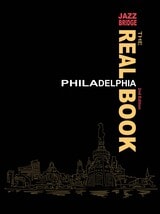
The Real Philadelphia Book
Jazz Bridge
Temple University Press, 2022
The Real Philadelphia Book, compiled by Jazz Bridge and editors David Dzubinski and Suzanne Cloud, is a collection of more than 200 original jazz and blues compositions. Arranged alphabetically by song title, the sheet music showcases work by generations of Philadelphia musicians. This volume, which is “what every aspiring jazz musician needs to know,” features tunes from Grammy Award-winners Jimmy Heath, Grover Washington, Jr., and Christian McBride, as well as legends such as Joey DeFrancesco, Ray Bryant, and Robin and Duane Eubanks. Also included are rare compositions by jazz greats Bobby Timmons, Hank Mobley, and Lee Morgan, in addition to music by local luminaries, Rhenda Fearrington, Monnette Sudler, and Kaylé Brecher.
The aim of The Real Philadelphia Book is to help the jazz community make deeper, stronger connections while also formally documenting much of the important music created in the Philadelphia metro area by both well- and lesser-known musicians.
Including an index of composers, The Real Philadelphia Bookwill enhance and add to the rich Philadelphia jazz and blues tradition and make the Philly jazz catalogue more easily available to musicians, jazz students and educators around the world.
Un giorno di regno
Melodramma giocoso in Two Acts by Felice RomaniGiuseppe Verdi
University of Chicago Press, 2021
This critical edition, based on Verdi’s autograph manuscript, offers the first publication of the opera in full score. Editor Francesco Izzo contextualizes Un giorno di regno in his introductory discussion of the work’s origins, sources, and performances. In addition, appendices provide alternative musical readings and reconstruct lost versions of segments of the musical numbers, while the critical commentary explores editorial problems and answers.