Results by title
19 books match the query 'Public housing'
Blueprint for Disaster
The Unraveling of Chicago Public HousingD. Bradford Hunt
University of Chicago Press, 2009
Now considered a dysfunctional mess, Chicago’s public housing projects once had long waiting lists of would-be residents hoping to leave the slums behind. So what went wrong? To answer this complicated question, D. Bradford Hunt traces public housing’s history in Chicago from its New Deal roots through current mayor Richard M. Daley’s Plan for Transformation. In the process, he chronicles the Chicago Housing Authority’s own transformation from the city’s most progressive government agency to its largest slumlord.
Challenging explanations that attribute the projects’ decline primarily to racial discrimination and real estate interests, Hunt argues that well-intentioned but misguided policy decisions—ranging from design choices to maintenance contracts—also paved the road to failure. Moreover, administrators who fully understood the potential drawbacks did not try to halt such deeply flawed projects as Cabrini-Green and the Robert Taylor Homes. These massive high-rise complexes housed unprecedented numbers of children but relatively few adults, engendering disorder that pushed out the working class and, consequently, the rents needed to maintain the buildings. The resulting combination of fiscal crisis, managerial incompetence, and social unrest plunged the CHA into a quagmire from which it is still struggling to emerge.
Blueprint for Disaster, then,is an urgent reminder of the havoc poorly conceived policy can wreak on our most vulnerable citizens.
Brownsville, Brooklyn
Blacks, Jews, and the Changing Face of the GhettoWendell E. Pritchett
University of Chicago Press, 2001
The story of these two different, but in many ways similar, Brownsvilles is compellingly told in this probing new work. Focusing on the interaction of Brownsville residents with New York's political and institutional elites, Wendell Pritchett shows how the profound economic and social changes of post-World War II America affected the area. He covers a number of pivotal episodes in Brownsville's history as well: the rise and fall of interracial organizations, the struggles to deal with deteriorating housing, and the battles over local schools that culminated in the famous 1968 Teachers Strike. Far from just a cautionary tale of failed policies and institutional neglect, the story of Brownsville's transformation, he finds, is one of mutual struggle and frustrated cooperation among whites, blacks, and Latinos.
Ultimately, Brownsville, Brooklyn reminds us how working-class neighborhoods have played, and continue to play, a central role in American history. It is a story that needs to be read by all those concerned with the many challenges facing America's cities today.
Crossing the Class and Color Lines
From Public Housing to White SuburbiaLeonard S. Rubinowitz and James E. Rosenbaum
University of Chicago Press, 2000
"This book's history of Chicago public housing should be required reading for anyone interested in social policy in the United States."—Jens Ludwig, Social Service Review
"[The authors'] work is rightly cited as one of the important precedents in the field. . . . This is a remarkable, unassailable accomplishment and this book is an important record of their scholarly contribution."—John M. Goering, Ethnic and Racial Studies
Driven from New Orleans
How Nonprofits Betray Public Housing and Promote PrivatizationJohn Arena
University of Minnesota Press, 2012
In the early 1980s the tenant leaders of the New Orleans St. Thomas public housing development and their activist allies were militant, uncompromising defenders of the city’s public housing communities. Yet ten years later these same leaders became actively involved in a planning effort to privatize and downsize their community—an effort that would drastically reduce the number of affordable apartments. What happened? John Arena—a longtime community and labor activist in New Orleans—explores this drastic change in Driven from New Orleans, exposing the social disaster visited on the city’s black urban poor long before the natural disaster of Katrina magnified their plight.
Arena argues that the key to understanding New Orleans’s public housing transformation from public to private is the co-optation of grassroots activists into a government and foundation-funded nonprofit complex. He shows how the nonprofit model created new political allegiances and financial benefits for activists, moving them into a strategy of insider negotiations that put the profit-making agenda of real estate interests above the material needs of black public housing residents. In their turn, white developers and the city’s black political elite embraced this newfound political “realism” because it legitimized the regressive policies of removing poor people and massively downsizing public housing, all in the guise of creating a new racially integrated, “mixed-income” community.
In tracing how this shift occurred, Driven from New Orleans reveals the true nature, and the true cost, of reforms promoted by an alliance of a neoliberal government, nonprofits, community activists, and powerful real estate interests.
Making a Better World
Public Housing, the Red Scare, and the Direction of Modern Los AngelesDon Parson
University of Minnesota Press, 2005
Poetics of Repair
Contemporary Arts and Afterlives of Colonial-Era Mass Housing in the MaghrebKatarzyna Pieprzak
Duke University Press, 2025
Policing the Project
State Violence and the Dismantling of Chicago Public HousingMadeleine Hamlin
University of Chicago Press, 2027
Shows how policing shaped the trajectory of public housing in Chicago and paved the way for its eradication and privatization.
Public housing should be a great public good, providing an essential basic need for people with lower incomes. Unfortunately, in the United States, policymakers turned their backs on public housing early on. Intended to be a utopia for the working poor, public housing in many cities became characterized by racial isolation, extreme poverty, and infrastructural breakdown, all of which left residents vulnerable to crime. State abandonment had one major exception, however: policing. In Policing the Project, geographer Madeleine Hamlin details how police played an important role in Chicago’s public housing from its origins in 1937 to the eve of its demolition at the turn of the millennium.
Based on archival data as well as extensive interviews with former residents and police officers, Hamlin describes the progressive institutional entanglement of public housing and policing as it unfurled over the course of the twentieth century. Policing the Project transcends mere description of how policing impacted everyday life for public housing residents, instead considering how policing shaped the institution of public housing as a whole. Hamlin argues that policing conditioned public housing’s downfall: draining housing budgets while exacerbating rather than mitigating crime and violence. Thus, policing played an important role in shaping the dramatic transformation of Chicago’s housing landscape, which entailed widespread privatization and the displacement of tens of thousands of Black Chicagoans.
Public Subsidy, Private Accumulation
The Political Economy of Singapore's Public HousingBeng Huat Chua
National University of Singapore Press, 2024
The achievement of Singapore’s national public housing program is impressive by any standard. Within a year of its first election victory in 1959, the People's Action Party began to deliver on its promises. By the 1980s, 85% of the population had been rehoused in modern flats. Now, decades later, the provision of public housing shapes Singapore's environment. The standard accounts of this remarkable transformation leave many questions unanswered, from the historical to urgent matters of current policy. Why was housing such a priority in the 1960s? How did the provision of social welfare via public housing shape Singapore's industrialization and development over the last 50 years? Looking forward, can the HDB continue to be both a source of affordable housing for young families and a mechanism for retirement savings? What will happen when 99-year leases expire?
Public Subsidy, Private Accumulation is a culmination of Chua Beng Huat's study of Singapore's public housing system, its dynamics, and the ways it functions in Singapore's politics. The book will be of interest to citizens and to scholars of the political economy of Asian development, social welfare provision, and Singapore.
Purging the Poorest
Public Housing and the Design Politics of Twice-Cleared CommunitiesLawrence J. Vale
University of Chicago Press, 2013
Shameful Victory
The Los Angeles Dodgers, the Red Scare, and the Hidden History of Chavez RavineJohn H. M. Laslett
University of Arizona Press, 2015
John H. M. Laslett offers a new interpretation of the Chavez Ravine tragedy, paying special attention to the early history of the barrio, the reform of Los Angeles's destructive urban renewal policies, and the influence of the evictions on the collective memory of the Mexican American community.
In addition to examining the political decisions made by power brokers at city hall, Shameful Victory argues that the tragedy exerted a much greater influence on the history of the Los Angeles civil rights movement than has hitherto been appreciated. The author also sheds fresh light on how the community grew, on the experience of individual home owners who were evicted from the barrio, and on the influence that the event had on the development of recent Chicano/a popular music, drama, and literature.

Showdown in Desire
The Black Panthers Take a Stand in New OrleansOrissa Arend
University of Arkansas Press, 2009
The Hidden War
Crime and the Tragedy of Public Housing in ChicagoPopkin, Susan J
Rutgers University Press, 2000
Since the late 1970s, the high-rise developments of the Chicago Housing Authority (CHA) have been dominated by gang violence and drugs, creating a sense of hopelessness among residents. Despite a lengthy war on crime, costing hundreds of millions of dollars, the CHA has been unable to reduce the violence that makes life intolerable. Focusing on three developments—Rockwell Gardens, Henry Horner Homes, and Harold Ickes Homes—Sue Popkin and her co-authors interview residents, community leaders, and CHA staff. The Hidden War chronicles the many failed efforts of the CHA to combat crime and improve its developments, offering a vivid portrait of what life is like when lived among bullets, graffiti, and broken plumbing.
Most families living in these developments are headed by African American single mothers. The authors reveal the dilemmas facing women and children who are often victims or witnesses of violent crime, and yet are dependent on the perpetrators and their drug-dominant economy. The CHA—plagued by financial scandals, managerial incompetence, and inconsistent funding—is no match for thegang-dominated social order. Even well-intentioned initiatives such as the recent effort to demolish and “revitalize” the worst developments seem to be ineffective at combating crime, while the drastic changes leave many vulnerable families facing an uncertain future. The Hidden War sends a humbling message to policy makers and prognosticators who claim to know the right way to “solve poverty.”
The Last Neighborhood Cops
The Rise and Fall of Community Policing in New York Public HousingUmbach, Fritz
Rutgers University Press, 2011
The Last Neighborhood Cops reveals the forgotten history of the residents and cops who forged community policing in the public housing complexes of New York City during the second half of the twentieth century. Through a combination of poignant storytelling and historical analysis, Fritz Umbach draws on buried and confidential police records and voices of retired officers and older residents to help explore the rise and fall of the HAPD's community-based strategy, while questioning its tactical effectiveness. The result is a unique perspective on contemporary debates of community policing and historical developments chronicling the influence of poor and working-class populations on public policy making.
The Poorhouse
Subsidized Housing in ChicagoDevereux Bowly Jr.
Southern Illinois University Press, 2012
Chicago seems an ideal environment for public housing because of the city’s relatively young age among major cities and well-deserved reputation for technology, innovation, and architecture. Yet The Poorhouse: Subsidized Housing in Chicago shows that the city’s experience on the whole has been a negative one, raising serious questions about the nature of subsidized housing and whether we should have it and, if so, in what form.
Bowly, a native of the city, provides a detailed examination of subsidized housing in the nation’s third-largest city. Now in its second edition, The Poorhouse looks at the history of public housing and subsidized housing in Chicago from 1895 to the present day. Five new chapters that cover the decline and federal takeover of the Chicago Housing Authority, and its more recent “transformation,” which involved the demolition of the CHA family high-rise buildings and in some cases their replacement with low-risemixed income housing on the same sites. Fifty new photos supplement this edition.
Certificate of Excellence from the Illinois State Historical Society, 2013
The Projects
Gang and Non-Gang Families in East Los AngelesBy James Diego Vigil
University of Texas Press, 2007
2008 — ALLA Prize for Best Book on Latina/o Anthropology
The Pico Gardens housing development in East Los Angeles has a high percentage of resident families with a history of persistent poverty, gang involvement, and crime. In some families, members of three generations have belonged to gangs. Many other Pico Gardens families, however, have managed to avoid the cycle of gang involvement.
In this work, Vigil adds to the tradition of poverty research and elaborates on the association of family dynamics and gang membership. The main objective of his research was to discover what factors make some families more vulnerable to gang membership, and why gang resistance was evidenced in similarly situated non-gang-involved families. Providing rich, in-depth interviews and observations, Vigil examines the wide variations in income and social capital that exist among the ostensibly poor, mostly Mexican American residents. Vigil documents how families connect and interact with social agencies in greater East Los Angeles to help chart the routines and rhythms of the lives of public housing residents. He presents family life histories to augment and provide texture to the quantitative information.
By studying life in Pico Gardens, Vigil feels we can better understand how human agency interacts with structural factors to produce the reality that families living in all public housing developments must contend with daily.
The War on Slums in the Southwest
Public Housing and Slum Clearance in Texas, Arizona, and New Mexico, 1935-1965Robert B Fairbanks
Temple University Press, 2016
In The War on Slums in the Southwest, Robert Fairbanks provides compelling and probing case studies of economic problems and public housing plights in Albuquerque, Dallas, Houston, Phoenix and San Antonio. He provides brief histories of each city--all of which expanded dynamically between 1935 and 1965--and how they responded to slums under the Housing Acts of 1937, 1949, and 1954.
Despite being a region where conservative politics has ruled, these Southwestern cities often handled population growth, urban planning, and economic development in ways that closely followed the national account of efforts to eliminate slums and provide public housing for the needy. The War on Slums in the Southwest therefore corrects some misconceptions about the role of slum clearance and public housing in this region as Fairbanks integrates urban policy into the larger understanding of federal and state-based housing policies.
Uprooted
Race, Public Housing, and the Archaeology of Four Lost New Orleans NeighborhoodsD. Ryan Gray
University of Alabama Press, 2020
The archaeology of four New Orleans neighborhoods that were replaced by public housing projects
Uprooted: Race, Public Housing, and the Archaeology of Four Lost New Orleans Neighborhoods uses archaeological research on four neighborhoods that were razed during the construction of public housing in World War II–era New Orleans. Although each of these neighborhoods was identified as a “slum” historically, the material record challenges the simplicity of this designation. D. Ryan Gray provides evidence of the inventiveness of former residents who were marginalized by class, color, or gender and whose everyday strategies of survival, subsistence, and spirituality challenged the city’s developing racial and social hierarchies.
These neighborhoods initially appear to have been quite distinct, ranging from the working-class Irish Channel, to the relatively affluent Creole of Color–dominated Lafitte area, to the former location of Storyville, the city’s experiment in semilegal prostitution. Archaeological and historical investigations suggest that race was the crucial factor in the areas’ selection for clearance. Each neighborhood manifested a particular perceived racial disorder, where race intersected with ethnicity, class, or gender in ways that defied the norms of Jim Crow segregation.
Gray’s research makes use of both primary documents—including census records, city directories, and even the brothel advertising guides called “Blue Books”—and archaeological data to examine what this entailed at a variety of scales, reconstructing narratives of the households and communities affected by clearance. Public housing, both in New Orleans and elsewhere, imposed a new kind of control on urban life that had the effect of making cities both more segregated and less equal. The story of the neighborhoods that were destroyed provides a reminder that their erasure was not an inevitable outcome, and that a more equitable and just city is still possible today. A critical examination of the rise of public housing helps inform the ongoing debates over its demise, especially in light of the changing face of post-Katrina New Orleans.
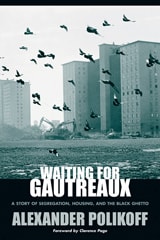
Waiting for Gautreaux
A Story of Segregation, Housing, and the Black GhettoAlexander Polikoff
Northwestern University Press, 2007
On his thirty-ninth birthday in 1966, Alexander Polikoff, a volunteer ACLU attorney and partner in a Chicago law firm, met some friends to discuss a pro bono case. Over lunch, the four talked about the Chicago Housing Authority construction program. All the new public housing, it seemed, was going into black neighborhoods. If discrimination was prohibited in public schools, wasn't it also prohibited in public housing?
And so began Gautreaux v. CHA and HUD, a case that from its rocky beginnings would roll on year after year, decade after decade, carrying Polikoff and his colleagues to the nation's Supreme Court (to face then-solicitor general Robert Bork); establishing precedents for suits against the discriminatory policies of local housing authorities, often abetted by HUD; and setting the stage for a nationwide experiment aimed at ending the concentration--and racialization--of poverty through public housing. Sometimes Kafkaesque, sometimes simply inspiring, and never less than absorbing, the story of Gautreaux, told by its principal lawyer, moves with ease through local and national civil rights history, legal details, political matters, and the personal costs--and rewards--of a commitment to fairness, equality, and justice. Both the memoir of a dedicated lawyer, and the narrative of a tenacious pursuit of equality, this story--itself a critical, still-unfolding chapter in recent American history--urges us to take an essential step in ending the racial inequality that Alexis de Toqueville prophetically named America's "most formidable evil."
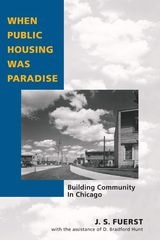
When Public Housing Was Paradise
BUILDING COMMUNITY IN CHICAGOJ. S. Fuerst, with the assistance of D. Bradford Hunt
University of Illinois Press, 2003
J. S. Fuerst has been involved with public housing in Chicago for more than half a century. He retired from Loyola University, where he was a professor of social welfare policy. He was the editor of Public Housing in Europe and America. D. Bradford Hunt is an assistant professor of social science at Roosevelt University. John Hope Franklin is James B. Duke Professor Emeritus of History at Duke University. He has served as president of the Organization of American Historians, the American Historical Association, and many more.