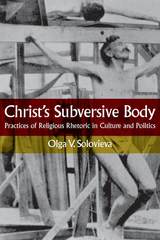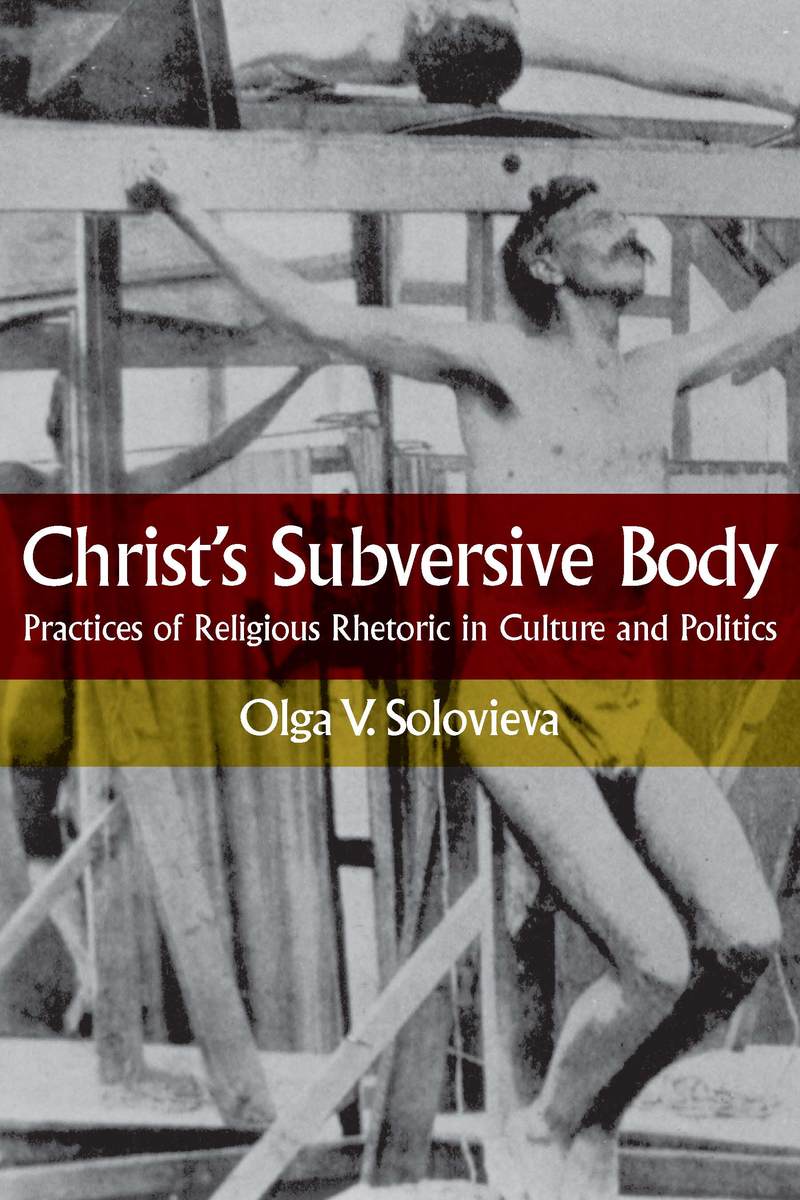
Christ's Subversive Body: Practices of Religious Rhetoric in Culture and Politics
Northwestern University Press, 2018
Cloth: 978-0-8101-3600-7 | Paper: 978-0-8101-3599-4 | eISBN: 978-0-8101-3601-4
Library of Congress Classification PN57.J47S65 2018
Dewey Decimal Classification 809.93351
Cloth: 978-0-8101-3600-7 | Paper: 978-0-8101-3599-4 | eISBN: 978-0-8101-3601-4
Library of Congress Classification PN57.J47S65 2018
Dewey Decimal Classification 809.93351
ABOUT THIS BOOK | AUTHOR BIOGRAPHY | REVIEWS | TOC | REQUEST ACCESSIBLE FILE
ABOUT THIS BOOK
Christ's Subversive Body offers a fascinating exploration of six historical examples of politically or culturally subversive usages of the body of Christ. Shining a light on the enabling potential of religious rhetoric, Solovieva examines how in moments of crisis or transition throughout Western history the body of Christ has been deployed in a variety of discourses, including recent neo- and theoconservative movements in the United States.
Solovieva’s survey includes the iconoclastic polemics of Epiphanius at the moment of struggles for supremacy between the Roman state and the Christian church, the mystical theologico-political alchemy of an anonymous treatise circulated at the Council of Constance, Lavater’s counter-Enlightenment visions of the afterlife expressd through physiognomy, Dostoevsky’s refashioning of ethical communities, Pier Paolo Pasolini’s attempts to provoke the “scandal” of Jesus’s mission once more in the modern world, and the elaboration of a political theology subordinating democratic dissent to the higher unity of a corporately conceived “unitary executive” in early twenty-first-century America.
Solovieva presents her findings not as an entry into theological or Christological debates but rather as a study in comparative discourse analysis. She demonstrates how these uses of Christ’s body are triggered by moments of epistemological, political, and representational crisis in the history of Western civilization.
Solovieva’s survey includes the iconoclastic polemics of Epiphanius at the moment of struggles for supremacy between the Roman state and the Christian church, the mystical theologico-political alchemy of an anonymous treatise circulated at the Council of Constance, Lavater’s counter-Enlightenment visions of the afterlife expressd through physiognomy, Dostoevsky’s refashioning of ethical communities, Pier Paolo Pasolini’s attempts to provoke the “scandal” of Jesus’s mission once more in the modern world, and the elaboration of a political theology subordinating democratic dissent to the higher unity of a corporately conceived “unitary executive” in early twenty-first-century America.
Solovieva presents her findings not as an entry into theological or Christological debates but rather as a study in comparative discourse analysis. She demonstrates how these uses of Christ’s body are triggered by moments of epistemological, political, and representational crisis in the history of Western civilization.
See other books on: Christianity and culture | Christianity and literature | In motion pictures | Jesus Christ | Practices
See other titles from Northwestern University Press