
 A SCHOLARLY BOOK REPOSITORY
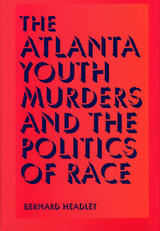
At least twenty-nine black children and young adults were murdered by an Atlanta serial killer between the summer of 1979 and the spring of 1981. Drawing national media attention, the “Atlanta tragedy,” as it became known, was immediately labeled a hate crime. However, when a young black man was arrested and convicted for the killings, public attention quickly shifted. Noted criminologist Bernard Headley was in Atlanta as the tragedy unfolded and provides here a thoughtful exploration of the social and political implications of the case both locally and nationally. Focusing on a singular historical event, Headley exposes broader tensions of race and class in contemporary America.
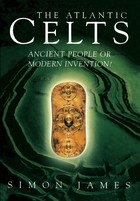
The Celtic peoples hold a fundamental place in the British national conscious-ness. In this book Simon James surveys ancient and modern ideas of the Celts and challenges them in the light of revolutionary new thinking on the Iron Age peoples of Britain. Examining how ethnic and national identities are constructed, he presents an alternative history of the British Isles, proposing that the idea of insular Celtic identity is really a product of the rise of nationalism in the eighteenth century. He considers whether the “Celticness” of the British Isles is a romantic, even politically dangerous, falsification of history, with implications for the debate on self-government for the Celtic regions of the United Kingdom.
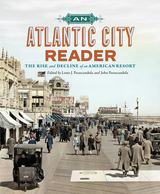
As Atlantic City grew to become one of the largest tourist destinations on the East Coast, it loomed ever larger in the imaginations of American writers. Generation upon generation of novelists, journalists, musicians, and poets visited Atlantic City and left with vivid impressions of its kaleidoscopic delights and its seedy underbelly.
This new reader collects all of these diverse perspectives on the city in one place, including accounts of Atlantic City by such famous visitors as Walt Whitman, William Carlos Williams, Fanny Hurst, Arthur Conan Doyle, Damon Runyon, Langston Hughes, Elmore Leonard, and Bruce Springsteen. Arranged chronologically, the anthology traces the city’s history from its humble beginnings as a quiet health resort to its rapid ascent to the world’s playground, its gradual decline, and its hopeful if tenuous future. Together, the pieces in this collection take us inside the city’s glitz, glamor, and gambling palaces, but they also don’t shy away from its troubling histories of racial discrimination, political corruption, and urban decay. Compiling fiction, poetry, drama, memoirs, newspaper stories, and magazine reports, The Atlantic City Reader presents an engaging and multifaceted portrait of this iconic resort town.
With The Atlantic Divide in Antitrust, Daniel J. Gifford and Robert T. Kudrle explore many of the main contested areas of contemporary antitrust, including mergers, price discrimination, predatory pricing, and intellectual property. After identifying how prevailing analyses differ across these areas, they then examine the policy ramifications. Several themes run throughout the book, including differences in the amount of discretion firms have in dealing with purchasers, the weight given to the welfare of various market participants, and whether competition tends to be viewed as an efficiency-generating process or as rivalry. The authors conclude with forecasts and suggestions for how greater compatibility might ultimately be attained.
Describing the transatlantic "double-cross" of literary influence, Weisbuch documents both the American desire to create a literature distinctly different from English models and the English insistence that any such attempt could only fail. The American response, as he demonstrates, was to make strengths out of national disadvantages by rethinking history, time, and traditional concepts of the self, and by reinterpreting and ridiculing major British texts in mocking allusions and scornful parodies.
Weisbuch approaches a precise characterization of this "double-cross" by focusing on paired sets of English and American texts. Investigations of the causes, motives, and literary results of the struggle alternate with detailed analyses of several test cases. Weisbuch considers Melville's challenge to Dickens, Thoreau's response to Coleridge and Wordsworth, Hawthorne's adaptation of Keats and influence on Eliot, Whitman's competition with Arnold, and Poe's reshaping of Shelley. Adding a new dimension to the exploration of an emerging aesthetic consciousness, Atlantic Double-Cross provides important insights into the creation of the American literary canon.


The west has long gripped the imagination. In Atlantic Isles, Gareth Roddy examines the cultural and political prominence of the "westward gaze," which flourished in late-nineteenth century Britain and Ireland. From Cornish cliffs and Welsh mountains to Hebridean islands and the Connemara highlands, the west was an imagined geography that transcended the national territories of these isles. In the west, geologists uncovered ancient layers of rock, ethnologists described older racial "types," philologists looked for the survival of Celtic languages, and antiquarians and archaeologists marveled at megalithic monuments at the Atlantic coastline.
This book draws on wide-ranging contemporary sources, including works of geology, philology, ethnology, history, geography, archaeology, folklore, literature, sociology, and an extensive collection of travel writing that popularized western landscapes among readers and tourists who explored the increasingly accessible west by road, rail, and steamer. Atlantic Isles reveals that western landscapes were especially powerful spaces of modern enchantment, where stories of sunken lands and mythical islands produced a sense of mystery and wonder in a supposedly disenchanted world. The significance of western landscapes for national identities is well known, but this book demonstrates that the west was also central to debates about Britishness and to the bold attempt to construct a narrative of multinational union that claimed deep historical roots at a time when the subject of Home Rule periodically dominated political debate.
Curtin combines modern research and statistical methods with his broad knowledge of the field to present the first book-length quantitative analysis of the Atlantic slave trade. Its basic evidence suggests revision of currently held opinions concerning the place of the slave trade in the economies of the Old World nations and their American colonies.
Among the questions these essays address are: the social cost to Africa of this forced migration; the role of slavery in the economic development of Europe and the United States; the short-term and long-term effects of the slave trade on black mortality, health, and life in the New World; and the racial and cultural consequences of the abolition of slavery. Some of these essays originally appeared in recent issues of Social Science History; the editors have added new material, along with an introduction placing each essay in the context of current debates.
Based on extensive archival research and detailed historical examination, this collection constitutes an important contribution to the study of an issue of enduring significance. It is sure to become a standard reference on the Atlantic slave trade for years to come.
Contributors. Ralph A. Austen, Ronald Bailey, William Darity, Jr., Seymour Drescher, Stanley L. Engerman, David Barry Gaspar, Clarence Grim, Brian Higgins, Jan S. Hogendorn, Joseph E. Inikori, Kenneth Kiple, Martin A. Klein, Paul E. Lovejoy, Patrick Manning, Joseph C. Miller, Johannes Postma, Woodruff Smith, Thomas Wilson

Translated by Simon Pare, this unique account follows Ransmayr across the globe: from the shadow of Java’s volcanoes to the rapids of the Mekong and Danube Rivers, from the drift ice of the Arctic Circle to Himalayan passes, and on to the disenchanted islands of the South Pacific. Ransmayr begins again and again with, “I saw. . .” recounting to the reader the stories of continents, eras, and landscapes of the soul. Like maps, the episodes come together to become a book of the world—one that charts the life and death, happiness and fate of people bound up in images of breathtaking beauty.
“One of the German language’s most gifted young novelists.”—Library Journal, on The Terrors of Ice and Darkness
Edited by historian Nancy S. Seasholes, this landmark volume captures all aspects of Boston’s past in a series of fifty-seven stunning full-color spreads. Each section features newly created thematic maps that focus on moments and topics in that history. These maps are accompanied by hundreds of historical and contemporary illustrations and explanatory text from historians and other expert contributors. They illuminate a wide range of topics including Boston’s physical and economic development, changing demography, and social and cultural life. In lavishly produced detail, The Atlas of Boston History offers a vivid, refreshing perspective on the development of this iconic American city.
Contributors
Robert J. Allison, Robert Charles Anderson, John Avault, Joseph Bagley, Charles Bahne, Laurie Baise, J. L. Bell, Rebekah Bryer, Aubrey Butts, Benjamin L. Carp, Amy D. Finstein, Gerald Gamm, Richard Garver, Katherine Grandjean, Michelle Granshaw, James Green, Dean Grodzins, Karl Haglund, Ruth-Ann M. Harris, Arthur Krim, Stephanie Kruel, Kerima M. Lewis, Noam Maggor, Dane A. Morrison, James C. O’Connell, Mark Peterson, Marshall Pontrelli, Gayle Sawtelle, Nancy S. Seasholes, Reed Ueda, Lawrence J. Vale, Jim Vrabel, Sam Bass Warner, Jay Wickersham, and Susan Wilson
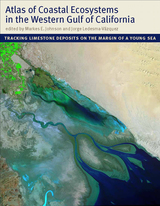
With an emphasis on the intricate workings of the Gulf, a team of scientists led by Markes E. Johnson and Jorge Ledesma-Vázquez explores how marine invertebrates such as corals and bivalves, as well as certain algae, contribute to the operation of a vast “organic engine” that acts as a significant carbon trap. The Atlas reveals that the role of these organisms in the ecology of the Gulf was greatly underestimated in the past. The organisms that live in these environments (or provide the sediments for beaches and dunes) are mass producers of calcium carbonate. Until now, no book has considered the centrality of calcium carbonate production as it functions today across multiple ecosystems and how it has evolved over time.
An important work of scholarship that also evokes the region’s natural splendor, the Atlas will be of interest to a wide range of scientists, including geologists, paleontologists, marine biologists, ecologists, and conservation biologists.
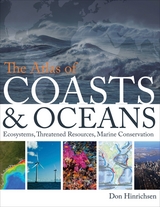
Oceans drive the world’s climate, nurture marine ecosystems full of aquatic life, and provide shipping lanes that have defined the global economy for centuries. And few realize that half of the world’s population lives in a coastal region within easy reach of one. Yet human activities such as commercial fishing, coastal real estate development, and industrial pollution have taken their toll on the seas. The first book of its kind, The Atlas of Coasts and Oceans documents the fraught relationship between humans and the earth’s largest bodies of water—and outlines the conservation steps needed to protect the marine environment for generations to come.
The Atlas offers a fascinating and often sobering account of how urbanization, climate change, offshore oil drilling, shipping routes, global tourism, and maritime conflict have had a profound impact on the world’s oceans and coasts. Combining text and images in visually engaging, thematically organized map spreads, this volume addresses the ecological, environmental, and economic importance of marine phenomena such as coral reefs, eroding shorelines, hurricanes, and fish populations—and how development threatens to destroy the ultimate source of all life on the “blue planet.” Lavishly illustrated with global and regional maps, from the Arabian Gulf to the Great Barrier Reef, from the Black Sea to the Mediterranean, and all the other major global waterways, The Atlas of Coasts and Oceans will be the definitive companion to any study of its subject for years to come.
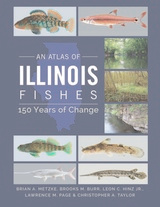
Scientifically up-to-date and illustrated with over 240 color photos, An Atlas of Illinois Fishes is a benchmark in the study of Illinois’s ever-changing fish communities and the habitats that support them.

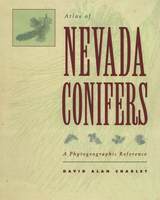
Atlas of Nevada Conifers is a major scientific contribution to our understanding of the ecology of Nevada. It documents in great detail the distribution of all native conifer species in the state—critical information because of the primary ecological importance of conifers for all organisms and because of the lack of documentation of these distributions in the scientific literature before now. Charlet maps and documents the exact location of herbarium records for 1,600 individual trees. The data found in 23 tables and 22 range maps will serve as a primary reference for botanists, land managers, and conservation biologists for years to come.

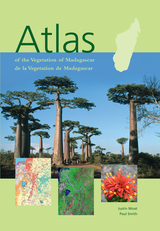
This first vegetation atlas for Madagascar, supported by the Critical Ecosystem Partnership Fund, has combined vegetation data from fieldwork and satellite images into a map-based information system. The result is a conservation tool which will help Madagascar’s government and people to plan a more sustainable future. This atlas is also of great use to anyone studying or visiting the island.
Presented in both French and English, the atlas gives a brief history of vegetation mapping in Madagascar; the methodology used in compiling these new maps; and detailed descriptions of each vegetation type, illustrated with photographs and diagrams. Trends in deforestation, extent of occurrence and levels of protection are assessed for each vegetation type. Additional information includes roads, trails, rivers, airports, reserves and a full place name index.
The atlas comprises 36 maps in A3 format, all in high resolution colour.

Terry Root has used the data from the 1963-72 counts to provide the first large-scale biogeographical account of birds wintering in North America. Using sophisticated computer techniques, Root has translated the data into both traditional contour maps and innovative new maps that stimulate three dimensions. The maps show at a glance that, for example, the Baltimore Oriole winters primarily along the eastern seaboard, with the densest populations in Florida between Tallahassee and Gainesville and in North Carolina from Rocky Mount to the Croatan National Forest.
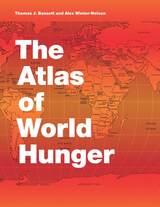
Earlier this year, President Obama declared one of his top priorities to be “making sure that people are able to get enough to eat.” The United States spends about five billion dollars on food aid and related programs each year, but still, both domestically and internationally, millions of people are hungry. In 2006, the Food and Agricultural Organization of the United Nations counted 850 million hungry people worldwide, but as food prices soared, an additional 100 million or more who were vulnerable succumbed to food insecurity.
If hunger were simply a matter of food production, no one would go without. There is more than enough food produced annually to provide every living person with a healthy diet, yet so many suffer from food shortages, unsafe water, and malnutrition every year. That’s because hunger is a complex political, economic, and ecological phenomenon. The interplay of these forces produces a geography of hunger that Thomas J. Bassett and Alex Winter-Nelson illuminate in this empowering book. The Atlas of World Hunger uses a conceptual framework informed by geography and agricultural economics to present a hunger index that combines food availability, household access, and nutritional outcomes into a single tool—one that delivers a fuller understanding of the scope of global hunger, its underlying mechanisms, and the ways in which the goals for ending hunger can be achieved. The first depiction of the geography of hunger worldwide, the Atlas will be an important resource for teachers, students, and anyone else interested in understanding the geography and causes of hunger. This knowledge, the authors argue, is a critical first step toward eliminating unnecessary suffering in a world of plenty.
In this illustrated exploration of Warburg and his great work, Georges Didi-Huberman leaps from Mnemosyne Atlas into a set of musings on the relation between suffering and knowledge in Western thought, and on the creative results of associative thinking. Deploying writing that delights in dramatic jump cuts reminiscent of Warburg’s idiosyncratic juxtapositions, and drawing on a set of sources that ranges from ancient Babylon to Walter Benjamin, Atlas, or the Anxious Gay Science is rich in Didi-Huberman’s trademark combination of elan and insight.

Virgil. Chaucer. Petrarch. These names resonate with many as cornerstones of European culture. Yet, in Atlas’s Bones, D. Vance Smith reveals that much of what is claimed as European culture up to the Middle Ages—its great themes in literature, its sources in political thought, its religious beliefs—originated in the writings of African thinkers like Augustine, Fulgentius, and Martianus Capella, or Europeans who thought extensively about Africa. In fact, a third of Virgil’s Aeneid takes place in Africa. Francis Petrarch believed his most important achievement was his epic Africa; while Geoffrey Chaucer wrote repeatedly about the figures of Scipio Africanus, actually two different men who defeated and destroyed Carthage.
Smith tells the story of how Europe created a false “medieval” version of Africa to acquire resources and power during the era of imperialism and colonialism. The first half of the book, “Reading Africa,” traces Egypt’s, Libya’s, and Carthage’s influence on classical and medieval thinking about Africa, highlighting often ignored literary and legendary traditions, for example, that Alexander the Great named himself the son of an African god. The second part, “Writing Africa,” focuses on how the different cultures of the two great African cities—Carthage and Alexandria—shaped modern literary criticism and political theology and examines the cross-influences of modern anthropology, medieval studies, and colonial law.
Atlas’s Bones firmly re-establishes the significance of Africa in European intellectual history. It will be essential reading for anyone seeking to understand how much of Africa informs our artistic and cultural world.

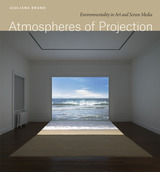
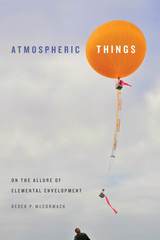
Projection has long been transforming space, from shadow plays to camera obscuras and magic lantern shows. Our fascination with projection is alive on the walls of museums and galleries and woven into our daily lives. Giuliana Bruno explores the histories of projection and atmosphere in visual culture and their continued importance to contemporary artists who are reinventing the projective imagination with atmospheric thinking and the use of elemental media.
To explain our fascination with projection and atmosphere, Bruno traverses psychoanalysis, environmental philosophy, architecture, the history of science, visual art, and moving image culture to see how projective mechanisms and their environments have developed over time. She reveals how atmosphere is formed and mediated, how it can change, and what projection can do to modify a site. In so doing, she gives new life to the alchemic possibilities of transformative projective atmospheres. Showing how their “environmentality” produces sites of exchange and relationality, this book binds art to the ecology of atmosphere.
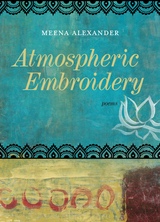
In this haunting collection of poems we travel through zones of violence to reach the crystalline depths of words: Meena Alexander writes, "So landscape becomes us, / Also an interior space bristling with light." At the heart of this book is the poem cycle "Indian Ocean Blues," a sustained meditation on the journey of the poet as a young child from India to Sudan. There are poems inspired by the drawings of children from war-torn Darfur and others set in present-day New York City. These sensual lyrics of body, memory, and place evoke the fragile, shifting nature of dwelling in our times.
In this study, Emma Wilson closely analyzes the range of Egoyan's films and their visual textures, emotional control, and perverse beauty. Offering a full-scale chronological overview of Egoyan's work on films up to and including Where the Truth Lies, Wilson shows the persistence and development of certain structures and themes in Egoyan's cinema: questions of exile and nostalgia, trauma and healing, the family and sexuality. While drawing on ideas about intercultural cinema, Wilson also sets Egoyan's films in the context of contemporary Canadian cinema and European art-house cinema. Egoyan's own comments on his films thread throughout Wilson's analyses, and the book features a recent interview with the director.
The advent of the Atomic Age challenged purveyors of popular culture to explain to the general public the complex scientific and social issues of atomic power. Atomic Comics examines how comic books, comic strips, and other cartoon media represented the Atomic Age from the early 1920s to the present. Through the exploits of superhero figures such as Atomic Man and Spiderman, as well as an array of nuclear adversaries and atomic-themed adventures, the public acquired a new scientific vocabulary and discovered the major controversies surrounding nuclear science. Ferenc Morton Szasz’s thoughtful analysis of the themes, content, and imagery of scores of comics that appeared largely in the United States and Japan offers a fascinating perspective on the way popular culture shaped American comprehension of the fissioned atom for more than three generations.
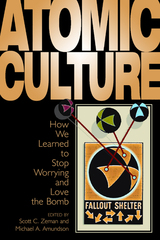
Despite the growing interest in atomic culture and history, the body of relevant scholarship is relatively sparse. Atomic Culture opens new doors into the field by providing a substantive, engaging, and historically based consideration of the topic that will appeal to students and scholars of the Atomic Age as well as general readers.
Contributors include Michael A. Amundson, Mick Broderick, Peter Goin, John Hunner, Ferenc M. Szasz, A. Costandina Titus, Peter C. van Wyck, and Scott C. Zeman.

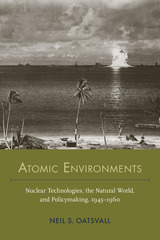
Demonstrates how policymakers influenced environmental science during the early nuclear age
In Atomic Environments: Nuclear Technologies, the Natural World, and Policymaking, 1945–1960, Neil S. Oatsvall examines how top officials in the Truman and Eisenhower administrations used environmental science to develop nuclear strategy at the beginning of the Cold War. While many people were involved in research and analysis during the period in question, it was at highest levels of executive decision-making where environmental science and nuclear science most clearly combined to shape the nation’s policies.
Oatsvall clearly demonstrates how the natural world and the scientific disciplines that study it became integral parts of nuclear science rather than adversarial fields of knowledge. But while nuclear technologies heavily depended on environmental science to develop, those same technologies frequently caused great harm to the natural world. Moreover, while some individuals expressed real anxieties about the damage wrought by nuclear technologies, policymakers as a class consistently made choices that privileged nuclear boosterism and secrecy, prioritizing institutional values over the lives and living systems that they were ostensibly charged to protect.
By scrutinizing institutional policymaking practices and agendas at the birth of the nuclear age, a constant set of values becomes clear. Oatsvall reveals an emerging technocratic class that routinely valued knowledge about the environment to help create and maintain a nuclear arsenal, despite its existential threat to life on earth and the negative effects many nuclear technologies had on ecosystems and the American people alike. Although policymakers took their charge to protect and advance the welfare of the United States and its people seriously, Atomic Environments demonstrates how they often failed to do so because their allegiance to the US nuclear hierarchy blinded them to the real risks and dangers of the nuclear age.
Akira Mizuta Lippit focuses on historical moments in which such modes of avisuality came into being—the arrival of cinema, which brought imagination to life; psychoanalysis, which exposed the psyche; the discovery of x-rays, which disclosed the inside of the body; and the “catastrophic light” of Hiroshima and Nagasaki, which instituted an era of atomic discourses.
With a taut, poetic style, Lippit produces speculative readings of secret and shadow archives and visual structures or phenomenologies of the inside, charting the materiality of what both can and cannot be seen in the radioactive light of the twentieth century.
Akira Mizuta Lippit is professor of cinema, comparative literature, and Japanese culture at the University of Southern California. He is the author of Electric Animal: Toward a Rhetoric of Wildlife (Minnesota, 2000).
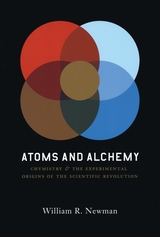
Tracing the alchemical roots of Robert Boyle’s famous mechanical philosophy, Newman shows that alchemy contributed to the mechanization of nature, a movement that lay at the very heart of scientific discovery. Boyle and his predecessors—figures like the mysterious medieval Geber or the Lutheran professor Daniel Sennert—provided convincing experimental proof that matter is made up of enduring particles at the microlevel. At the same time, Newman argues that alchemists created the operational criterion of an “atomic” element as the last point of analysis, thereby contributing a key feature to the development of later chemistry. Atomsand Alchemy thus provokes a refreshing debate about the origins of modern science and will be welcomed—and deliberated—by all who are interested in the development of scientific theory and practice.
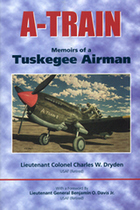
A moving personal account of a man’s flight for freedom—above the clouds and beyond prejudice—by one of the first Tuskegee airmen.
A-Train is the story of one of the black Americans who, during World War II, graduated from Tuskegee (AL) Flying School and served as a pilot in the Army Air Corps’ 99th Pursuit Squadron. Charles W. Dryden presents a fast-paced, balanced, and personal account of what it was like to prepare for a career traditionally closed to African Americans, how he coped with the frustrations and dangers of combat, and how he, along with many fellow black pilots, navigators, bombardiers, and crewmen, emerged with a magnificent war record.
Under the command of Colonel Benjamin O. Davis Jr., the Tuskegee airmen fought over North Africa, Sicily, and Europe, escorting American bomber crews who respected their "no-losses" record. Some were shot down, many of them were killed or captured by the enemy, and several won medals of valor and honor. But the airmen still faced great barriers of racial prejudice in the armed forces and at home. As a member of that elite group of young pilots who fought for their country overseas while being denied civil liberties at home, Dryden presents an eloquent story that will touch every reader.
An essential collection of Dwight Macdonald’s prophetic essays on politics, art, and violence in twentieth-century America.
What does extreme violence do to human values? Does the concept of collective guilt make sense in assessing responsibility for genocide? Has modern mechanized society forever destroyed the possibility of peaceful resistance through art and civil disobedience? Atrocities of the Mind presents anew Dwight Macdonald, one of America’s foremost literary journalists and political activists, grappling with the hard questions of his time—and ours.
In this collection, Macdonald writes about major events—the Holocaust, the atomic bombing of Hiroshima, Gandhi’s assassination, the Vietnam War, and social phenomena such as mass shootings, campus protests, and police brutality—with clear-sighted and buoyant prose. He writes incisively about the cinema of Alfred Hitchcock and Roman Polanski, praises Dorothy Day’s pacifism, and reports circulating an antiwar petition in the White House Rose Garden. And not without effect: his essay “Our Invisible Poor” is said to have spurred the Johnson administration’s War on Poverty.
Norman Mailer memorably called Macdonald “a man with whom one might seldom agree but could never disrespect because he always told the truth as he saw the truth—a man therefore of the most incorruptible integrity.” In our America, reeling from political violence, Macdonald’s truth-telling reminds us how we got here and who we might still become.
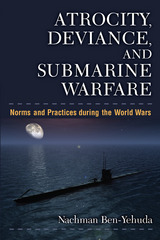
In the early 20th century, the diesel-electric submarine made possible a new type of unrestricted naval warfare. Such brutal practices as targeting passenger, cargo, and hospital ships not only violated previous international agreements; they were targeted explicitly at civilians. A deviant form of warfare quickly became the norm.
In Atrocity, Deviance, and Submarine Warfare, Nachman Ben-Yehuda recounts the evolution of submarine warfare, explains the nature of its deviance, documents its atrocities, and places these developments in the context of changing national identities and definitions of the ethical, at both social and individual levels. Introducing the concept of cultural cores, he traces the changes in cultural myths, collective memory, and the understanding of unconventionality and deviance prior to the outbreak of World War I. Significant changes in cultural cores, Ben-Yehuda concludes, permitted the rise of wartime atrocities at sea.
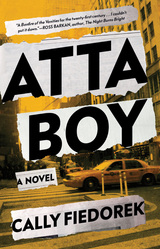
A Vulture Best Book of 2024
In December 2018, we meet Rudy Coyle, a bar owner’s son from Flushing, Queens, in the throes of a major quarter-life crisis. Cut out of the family business, he gets a Hail Mary job as a night doorman in a storied Park Avenue apartment building, where he comes under the wing of the family in 4E, the Cohens.
Jacob “Jake” Cohen, the fast-talking patriarch, is one of a generation of financiers who made hundreds of millions of dollars in the cutthroat taxi medallion industry in the early 2000s, largely by preying on the hopes and dreams of impoverished immigrant drivers. As Jake tries to stop the bleed from the debt crisis now plaguing his company, clawing back his assets from an increasingly dangerous coterie of Russian American associates, Rudy gets promoted from doorman to errand boy to bodyguard to something like Jake’s right-hand man.
By turns a gripping portrait of corruption and a tender family dramedy, Atta Boy combines the urban cool of Richard Price with the glossy, uptown charm of Taffy Brodesser-Akner. Here is a novel richly attuned to its time and place, but with something for everyone—high-wire prose and a story wedding ripped from the headlines, social realism with the warmth, angst, and humor of its indelible voices.
"There is a wealth of information and thought in this book; it does not have a weak or uninteresting chapter, starting with the Preface by Emde, and as a whole, it forms a sort of seminar."—John E. Bates, Contemporary Psychology
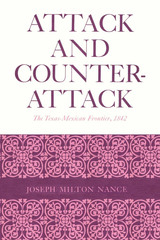
It is 1842—a dramatic year in the history of Texas-Mexican relations. After five years of uneasy peace, of futile negotiations, of border raids and temporary, unofficial truces, a series of military actions upsets the precarious balance between the two countries. Once more the Mexican Army marches on Texas soil; once more the frontier settlers strengthen their strongholds for defense or gather their belongings for flight. Twice San Antonio falls to Mexican generals; twice the Texans assemble armies for the invasion of Mexico. It is 1842—a year of attack and counterattack.
This is the story that Joseph Milton Nance relates, with a definitiveness and immediacy which come from many years of meticulous research. The exciting story of 1842 is a story of emotions which had simmered through the long, insecure years and which now boil out in blustery threats and demands for vengeance. The Texans threaten to march beyond the Sierra Madres and raise their flag at Monterrey; the Mexicans promise to subdue this upstart Texas and to teach its treacherous inhabitants their place. With communications poor and imaginations fertile, rumors magnify chance banditry into military raids, military raids into full-scale invasions. Newspapers incite their readers with superdramatic, intoxicating accounts of the events. Texans and Mexicans alike respond with a kind of madness that has little or no method. Texas solicits volunteers, calls out troops, plans invasions, and assembles her armies, completely disregarding the fact that her treasury is practically empty—there is little money to buy guns. Meanwhile, in Mexico, where gold and silver are needed for other purposes, “invasions” of Texas are launched—but they are only brief forays more suitable for impressive publicity than for permanent gains.
Still, the conflicts of threat and retaliation, so often futile, are frequently dignified by idealism, friendship, courage, and determination. Both Mexicans and Texans are fighting and dying for liberty, defending their homes against foreign invaders, establishing and maintaining friendships that cross racial and national boundaries, struggling with conflicting loyalties, and—all the while—striving to wrest a living for themselves and their families from the grudging frontier.
Attack and Counterattack, continuing the account which was begun in After San Jacinto, tells from original sources the full story of Texas-Mexican relations from the time of the Santa Fe Expedition through the return of the Somervell Expedition from the Rio Grande. These books examine in great detail and with careful accuracy a period of Texas history that had not heretofore been thoroughly studied and that had seldom been given unbiased treatment. The source materials compiled in the notes and bibliography—particularly the military reports, letters, diaries, contemporary newspapers, and broadsides—will be a valuable tool for any scholar who wishes to study this or related periods.
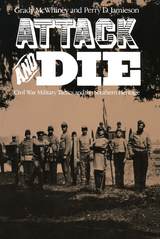
Why did the Confederacy lose so many men? The authors contend that the Confederates bled themselves nearly to death in the first three years of the war by making costly attacks more often than the Federals. Offensive tactics, which had been used successfully by Americans in the Mexican War, were much less effective in the 1860s because an improved weapon—the rifle—had given increased strength to defenders. This book describes tactical theory in the 1850s and suggests how each related to Civil War tactics. It also considers the development of tactics in all three arms of the service during the Civil War.
In examining the Civil War the book separates Southern from Northern tactical practice and discusses Confederate military history in the context of Southern social history. Although the Southerners could have offset their numerical disadvantage by remaining on the defensive and forcing the Federals to attack, they failed to do so. The authors argue that the Southerners’ consistent favoring of offensive warfare was attributable, in large measure, to their Celtic heritage: they fought with the same courageous dash and reckless abandon that had characterized their Celtic forebears since ancient times. The Southerners of the Civil War generation were prisoners of their social and cultural history: they attacked courageously and were killed—on battlefields so totally defended by the Federals that “not even a chicken could get through.”
"[O]ne leaves this book feeling enriched and challenged. Pitkin prompts us to rethink our understanding of Arendt and to demythologize the pervasive sense of political helplessness Arendt herself sought so hard to articulate. . . . [A] cause for celebration."—Peter Baehr, Times Literary Supplement
"[Arendt] is certainly among the most original and outstanding political theorists of the twentieth century. . . . It is difficult to imagine a hostile critic examining more effectively than Pitkin . . . Arendt's concept of the social, for hostility would inhibit the acquisition of the mastery of Arendt's texts that Pitkin displays at every turn."—Peter Berkowitz, New Republic
Charles Bernstein is our postmodern jester of American poesy, equal part surveyor of democratic vistas and scholar of avant-garde sensibilities. In a career spanning thirty-five years and forty books, he has challenged and provoked us with writing that is decidedly unafraid of the tensions between ordinary and poetic language, and between everyday life and its adversaries. Attack of the Difficult Poems, his latest collection of essays, gathers some of his most memorably irreverent work while addressing seriously and comprehensively the state of contemporary humanities, the teaching of unconventional forms, fresh approaches to translation, the history of language media, and the connections between poetry and visual art.
Applying an array of essayistic styles, Attack of the Difficult Poems ardently engages with the promise of its title. Bernstein introduces his key theme of the difficulty of poems and defends, often in comedic ways, not just difficult poetry but poetry itself. Bernstein never loses his ingenious ability to argue or his consummate attention to detail. Along the way, he offers a wide-ranging critique of literature’s place in the academy, taking on the vexed role of innovation and approaching it from the perspective of both teacher and practitioner.
From blues artists to Tin Pan Alley song lyricists to Second Wave modernist poets, The Attack of the Difficult Poems sounds both a battle cry and a lament for the task of the language maker and the fate of invention.

The definition and understanding of "terrorism" is in a state of unprecedented evolution. No longer are acts of terrorism rare and far-flung. Following the horrendous attacks on the World Trade Center and the Pentagon, U.S. citizens have had their eyes opened to a new world where this nightmare stalks the daily news and is never far from consciousness.
Attacking Terrorism brings together some of the world's finest experts, people who have made the study of this rising menace their life's work, to provide a comprehensive picture of the challenges and opportunities of the campaign against international terrorism. Part one, "The Nature of Terrorism," provides an overview and foundation for the current campaign, placing it within the political and historical context of previous threats and responses. Part two, "The Responses to Terrorism," looks at the range of policy instruments required in an effective strategy against terrorism.
The contributors to this volume bring finely honed analyses and nuanced perspectives to the terrorist realities of the twenty-first century—history, analyses, and perspectives that have been too often oversimplified or myopic. They bring a new depth of understanding and myriad new dimensions to the crisis of terrorism. And they reach into aspects of counterterrorism that broaden our grasp on such important tools as diplomacy, intelligence and counterintelligence, psycho-political means, international law, criminal law enforcement, military force, foreign aid, and homeland security, showing not only how these tools are currently being employed but how often they are being underutilized as well.
Attacking Terrorism demonstrates that there are no easy answers—and that the road toward victory will be long and arduous, frightening and dangerous—but as Audrey Kurth Cronin states in her introduction, "As the campaign against international terrorism unfolds, a crucial forward-looking process of strategic reassessment is under way in the United States, and this book is intended to be a part of it."
In a fast-paced, complicated, and evermore dangerous world it is easy to become self-absorbed and consumed with our own problems. There is one place, however, where we put our self-centered concerns aside, and our deep, common humanity is profoundly touched. That place is where sick children dwell.
It is no less difficult—and perhaps even more difficult in many ways—for physicians who have chosen to attend to the health and well-being of gravely ill or dying children. Margaret Mohrmann has devoted most of her professional life to them, and in Attending Children she shares the remarkable education those children and their families have given her. Her narratives are both painful and hopeful, tragic and funny, full of remarkable characters and sometimes bizarre families.
Mohrmann has sifted through her thirty years as a pediatrician, and with poignancy, humor, and uncompromising honesty, she shares her sometimes stumbling but always deeply caring journey through a land where, sometimes, small hands have to be let go too soon. She introduces us to not only the physical challenges she, her colleagues, and her patients encounter, but the spiritual ones as well.
Attending Children is a unique experience as Mohrmann takes the reader on a doctor's rounds over many years to meet the faces and the struggles, the heartaches and the joys of being a pediatrician. In the case of Margaret Mohrmann and her patients, no one could ask for better teachers.
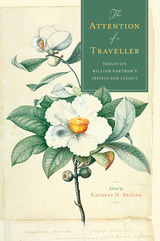
An interdisciplinary reevaluation of William Bartram’s Travels, illuminating the natural, cultural, and intellectual landscapes of the eighteenth‑century Southeast through diverse scholarly lenses.
William Bartram, author of Travels through North and South Carolina, Georgia, East and West Florida, the Cherokee Country, the Extensive Territories of the Muscogulees, or Creek Confederacy, and the Country of the Chactaws, was colonial America’s first native born naturalist and artist, and the first author in the modern genre of writers who portrayed nature through personal experience as well as scientific observation. His book, first published in 1791, was based on his journeys through southern Indian nations and Britain’s southern colonies in the years just prior to the American Revolution and provides descriptions of the natural and cultural environments of what would soon become the American South. Scholars and general readers alike have long appreciated Bartram’s lush, vivid prose, his clarity of observation and evident wonder at the landscapes he traversed, and his engagement with the native nations whose lands he traveled through.
The Attention of a Traveller: Essays on William Bartram’s “Travels” and Legacy offers an interdisciplinary assessment of Bartram’s influence and evolving legacy, opening new avenues of research concerning the flora, fauna, and people connected to Bartram and his writings. Featuring 13 essays divided into five sections, contributors to the volume weave together scholarly perspectives from geology, art history, literary criticism, geography, and philosophy, alongside the more traditional Bartram-affiliated disciplines of biology and history. The collection concludes with a comprehensive treatment of the book as a material historical artifact.
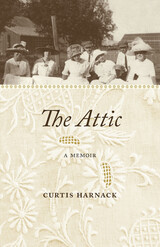
In The Attic, his sequel to the classic We Have All Gone Away, Curtis Harnack returns to his rural Iowa homeplace to sift through an attic full of the trash and treasures left behind by the thirteen children in two generations who grew up in the big farmhouse.
The language of classical Greek literature has been extensively studied since the Renaissance, and the most generally admired approach to Greek grammar and syntax has long been K. W. Krüger's Griechische Sprachlehre. In this translation Guy L. Cooper III accepts Krüger's simple and transparent organization, but greatly expands the substance of the earlier work by increasing the total number of citations from the original texts. Research since 1875, especially the contributions of Basil Lanneau Gildersleeve, is incorporated so as to create a reference work, in English, which covers the full range of this complex subject.
Krüger's original paragraph numbering has been maintained so that references in previously published works can be followed directly in the new work. However, every paragraph and chapter has been revised and expanded, opening up new subheadings within Krüger's format. The English has moved away from Krüger's laconic style to a more flowing, readable presentation, without jargon and unexplained technical language. A complete index of passages cited and the impressive number of citations make the work a running syntactic commentary on the whole range of Attic prose literature. The net result is a new comprehensive reference work, an essential reference for libraries and personal collections alike.
Guy L. Cooper III is Professor Emeritus of Classics, University of North Carolina at Asheville.
Volume 2
cloth ISBN 0-472-10844-1
Set of Volumes 1 & 2
cloth ISBN 0-472-10844-1
The language of classical Greek literature has been extensively studied since the Renaissance, and the most generally admired approach to Greek grammar and syntax has long been K. W. Krüger's Griechische Sprachlehre. In this translation Guy L. Cooper III accepts Krüger's simple and transparent organization, but greatly expands the substance of the earlier work by increasing the total number of citations from the original texts. Research since 1875, especially the contributions of Basil Lanneau Gildersleeve, is incorporated so as to create a reference work, in English, which covers the full range of this complex subject.
Krüger's original paragraph numbering has been maintained so that references in previously published works can be followed directly in the new work. However, every paragraph and chapter has been revised and expanded, opening up new subheadings within Krüger's format. The English has moved away from Krüger's laconic style to a more flowing, readable presentation, without jargon and unexplained technical language. A complete index of passages cited and the impressive number of citations make the work a running syntactic commentary on the whole range of Attic prose literature. The net result is a new comprehensive reference work, an essential reference for libraries and personal collections alike.
Guy L. Cooper III is Professor Emeritus of Classics, University of North Carolina at Asheville.
Verdi’s Attila, his ninth opera, had its premiere at Venice’s Teatro La Fenice in March 1846. Based on the German play Attila, King of the Huns, the libretto has its own storied history: as Verdi fell seriously ill before the work’s completion, the main librettist moved permanently to Madrid, leaving the last act of Attila only a sketch. It was then that Verdi called upon Francesco Maria Piave, the librettist for two of his earlier works, who at the composer’s behest scratched plans for a large choral finale and decided instead to concentrate on the dramatic roles of the protagonists.
In years since, Attila has become one of Verdi’s most popular and oft-staged early works. The composer's inimitable vitality, soaring arcs of melody, grand choruses, and passion are here amply apparent. This critical edition, based on Verdi’s autograph full score preserved at the British Library, restores the opera’s original text and accurately reflects the composer's colorful and elaborate musical setting, while Helen M. Greenwald’s masterful introduction discusses the opera’s origins, sources, and performance questions, and her critical commentary details editorial problems and their solutions.

The second volume in the Studies in Interpretation series delves further into the intricacies of sign language interpreting in five distinctive chapters. In the first chapter, Lawrence Forestal investigates the shifting attitudes of Deaf leaders toward sign language interpreters. Forestal notes how older leaders think of interpreters as their friends in exchanges, whereas Deaf individuals who attended mainstream schools possessed different feelings about interpreting.
Frank J. Harrington observes in his chapter on British Sign Language-English interpreters in higher education that they cannot be viewed in isolation since all participants and the environment have a real impact on the way events unfold. In Chapter Three, Maree Madden explores the prevalence of chronic occupational physical injury among Australian Sign Language interpreters due to the stress created by constant demand and the lack of recognition of their professional rights.
Susan M. Mather assesses and identifies regulators used by teachers and interpreters in mainstreaming classrooms. Her study supports other findings, including the success of ethnographic methods in providing insights into human interaction and intercultural communication within classroom settings. The fifth chapter views how interpreters convey innuendo, a complicated undertaking at best. Author Shaun Tray conducts a thorough examination of innuendo in American Sign Language, then points the way toward future research based upon ethnography, gender, and other key factors.

Published for the first time in 1957, Attorney for the Damned collects Darrow’s most influential summations and supplements them with scene-setting explanations and comprehensive notes by Arthur Weinberg. Darrow confronts issues that remain relevant over half a century after his death: First Amendment rights, capital punishment, and the separation of church and state. With an insightful forward by Justice William O. Douglas, this volume serves as a powerful reminder of Darrow’s relevance today.


Tom Gunning is the author of multiple books and nearly two hundred essays that have defined the field of cinema and media studies. His works have transformed our understanding of early cinema and the American avant-garde and reset the terms of many central debates in film and media history and theory. His 1986 essay “The Cinema of Attractions” is among the most cited essays on film ever published. Gunning’s writings articulate a distinctive and powerful model for thinking about cinema’s history and likely future, addressing the full range of moving-image media, from film to still photography to digital media. His discussions draw on stage melodrama and magic lantern shows, as well as criminology, world’s fairs, and Spiritualism, surveying the medium as a cultural phenomenon informed by the industrial and information ages, psychiatry, urban experience, discourses on art and aesthetics, and more.
This collection brings together twenty-six essays that showcase the depth and range of Gunning’s scholarship, including four that have never before been published. Together, they solidify Gunning’s place as a scholar who has transformed the way generations of scholars, archivists, critics, and artists think about cinema.

One of those survivors, Nick Golodoff, became a prisoner of war at just six years old. He was among the dozens of Unangan Attu residents swept away to Hokkaido, and one of only twenty-five to survive. Attu Boy tells Golodoff’s story of these harrowing years as he found both friendship and cruelty at the hands of the Japanese. It offers a rare look at the lives of civilian prisoners and their captors in WWII-era Japan. It also tells of Golodoff’s bittersweet return to a homeland torn apart by occupation and forced internments. Interwoven with other voices from Attu, this richly illustrated memoir is a testament to the struggles, triumphs, and heartbreak of lives disrupted by war.
This compelling work delves into the personal narratives of Hiaki (Yaqui) individuals who endured the tumultuous period from 1900 to 1930, when they faced systematic attacks, conscription, deportation, and enslavement under Mexican government policies. Presented in both the original Hiaki language and English translation, these accounts offer an unparalleled glimpse into the lives of those who resisted and survived the era’s harsh realities. The narratives describe military engagements, the struggles of refugee life, forced labor, and the resilience of families under extreme duress. This work provides a unique and unvarnished account of the impacts of Mexican colonialism and aggression on individuals and families, completely from the Hiaki perspective.
Au Te Waate / We Remember It is not just a historical account but a linguistic treasure, preserving the naturally produced speech of five Hiaki speakers from a previous era. Transcriptions of interviews recorded by author Maria Fernanda Leyva with family members and friends provide invaluable insights into the Hiaki language. The interviews document and preserve the narrative styles, vocabulary, and grammatical constructions of the time.
This work also serves as a crucial resource for scholars of linguistics and history alike, capturing dialect variation and illustrating the linguistic evolution of the Hiaki community. Additionally, for Hiaki people studying their own language, this book stands as a rich repository of cultural and linguistic heritage, meticulously maintained through side-by-side translations and contextual historical introductions.
The narratives in this book are anchored by the experiences of five Hiaki speakers, whose stories of displacement, survival, and resistance provide a deeply personal perspective on the broader historical events of the Porfirio Díaz dictatorship and the early years of the Mexican Revolution. Au Te Waate / We Remember It stands as an important record, preserving these critical voices for future generations and offering profound insights into the resilience of the Hiaki people.
In Aubade: A Teacher's Notebook Fowlie writes at length of his life as a teacher at Duke University, his friendships with students and colleagues, his appreciation of movies, plays, travels, friends and books he has enjoyed and that have enhanced his life. This is an account of the life of a dedicated teacher who is also a writer-critic. Fowlie assesses his own sense of identity and the manner in which he transmits the values his studies have for him to his students through major literary texts. Aubade delineates Fowlies discovery, via his students, of the forms of a new culture arising alongside the old, which he integrates into his own intellectual life, broadening its horizons.
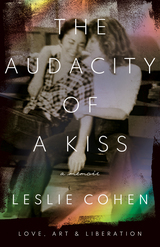
Rendered in bronze, covered in white lacquer, two women sit together on a park bench in Greenwich Village. One of the women touches the thigh of her partner as they gaze into each other’s eyes. The two women are part of George Segal’s iconic sculpture “Gay Liberation,” but these powerful symbols were modeled on real people: Leslie Cohen and her partner (now wife) Beth Suskin.
In this evocative memoir, Cohen tells the story of a love that has lasted for over fifty years. Transporting the reader to the pivotal time when brave gay women and men carved out spaces where they could live and love freely, she recounts both her personal struggles and the accomplishments she achieved as part of New York’s gay and feminist communities. Foremost among these was her 1976 cofounding of the groundbreaking women’s nightclub Sahara, which played host to such luminaries as Betty Friedan, Gloria Steinem, Pat Benatar, Ntozake Shange, Rita Mae Brown, Adrienne Rich, Patti Smith, Bella Abzug, and Jane Fonda. The Audacity of a Kiss is a moving and inspiring tale of how love, art, and solidarity can overcome oppression.
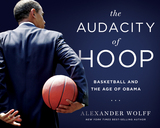
While basketball didn’t take up residence in the White House in January 2009, the game nonetheless played an outsized role in forming the man who did. In The Audacity of Hoop, celebrated sportswriter Alexander Wolff examines Barack Obama, the person and president, by the light of basketball. This game helped Obama explore his identity, keep a cool head, impress his future wife, and define himself as a candidate.
Wolff chronicles Obama’s love of the game from age 10, on the campaign trail—where it eventually took on talismanic meaning—and throughout his two terms in office. More than 125 photographs illustrate Obama dribbling, shooting free throws, playing pickup games, cooling off with George Clooney, challenging his special assistant Reggie Love for a rebound, and taking basketball to political meetings. There is also an assessment of Obama’s influence on the NBA, including a dawning political consciousness in the league’s locker rooms.
Sidebars reveal the evolution of the president’s playing style, “Baracketology”—a not-entirely-scientific art of filling out the commander in chief’s NCAA tournament bracket—and a timeline charts Obama’s personal and professional highlights.
Equal parts biographical sketch, political narrative, and cultural history, The Audacity of Hoop shows how the game became a touchstone in Obama’s exercise of the power of the presidency.
Contributors: Kofi Agawu, Philip V. Bohlman. Michael Denning, Brent Hayes Edwards, Nan Enstad, Andrew Jones, Josh Kun, Morgan Luker, Jairo Moreno, Tejumola Olaniyan, Marc Perry, Ronald Radano, Nitasha Sharma, Micol Seigel, Gavin Steingo, Penny Von Eschen, Amanda Weidman.
Blending cultural studies and the history of communication technology, Sterne follows modern sound technologies back through a historical labyrinth. Along the way, he encounters capitalists and inventors, musicians and philosophers, embalmers and grave robbers, doctors and patients, deaf children and their teachers, professionals and hobbyists, folklorists and tribal singers. The Audible Past tracks the connections between the history of sound and the defining features of modernity: from developments in medicine, physics, and philosophy to the tumultuous shifts of industrial capitalism, colonialism, urbanization, modern technology, and the rise of a new middle class.
A provocative history of sound, The Audible Past challenges theoretical commonplaces such as the philosophical privilege of the speaking subject, the visual bias in theories of modernity, and static descriptions of nature. It will interest those in cultural studies, media and communication studies, the new musicology, and the history of technology.
The audience—the community of readers who will use the texts a writer produces—must be an important influence on the writer for his or her work to be effective.
Robert Brooke and John Hendricks examine the difficult task of teaching "writing for an audience" in a classroom where students know that the teacher, not the addressed audience, assigns the grade.
The authors describe in detail a particular writing class, taught by Brooke and observed by Hendricks, that attempted to teach writing for an audience. By combining the experiences from their study with student reactions to the class, they draw some conclusions about the dynamics of teaching writing and about learning in general.

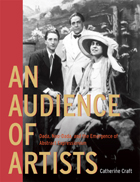
The term Neo-Dada surfaced in New York in the late 1950s and was used to characterize young artists like Robert Rauschenberg and Jasper Johns whose art appeared at odds with the serious emotional and painterly interests of the then-dominant movement, Abstract Expressionism. Neo-Dada quickly became the word of choice in the early 1960s to designate experimental art, including assemblage, performance, Pop art, and nascent forms of minimal and conceptual art.

![front cover of Audio Companion to Norsk, nordmenn og Norge 1 [DOWNLOADABLE MP3]](https://www.bibliovault.org/thumbs/978-0-299-08805-7-thumb.jpg)
Audio Companion to Norsk, nordmenn og Norge 1 is the audio component designed to complement the textbook and workbook of the beginning Norwegian language series Norsk, nordmenn og Norge 1. The audio companion supplements the language textbook, Norsk, nordmenn og Norge 1, by Kathleen Stokker and Odd Haddal, by featuring listening exercises tied to each chapter of the textbook. The audio companion also contains listening exercises and dictations related to each chapter of the beginning Norwegian language workbook Workbook for Norsk, nordmenn og Norge 1 by Louis E. Janus. The final four tracks of the audio companion are dedicated to pronunciation exercises covered in the workbook.
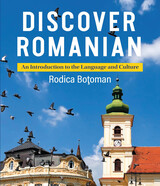
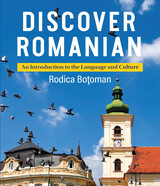
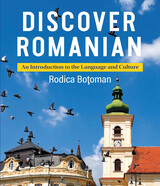
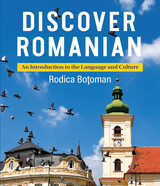
This comprehensive introduction to Romanian for English-speaking students emphasizes communication with a complete treatment of grammar, an extensive vocabulary, and a focus on the four major language skills—listening, speaking, reading, and writing. Cultural information, an integral part of the textbook, is presented both formally, in sections on culture and civilization, and informally, as the setting for dialogues and exercises. Tables of verb conjugations and a glossary round out the book’s primary materials.
Straightforward and accessible, Discover Romanian is an essential textbook for all those teaching and learning the language and provides important information for those seeking to understand Romanian culture. Together with the accompanying audio files and workbook, it provides a complete language course.

This comprehensive introduction to Romanian for English-speaking students emphasizes communication with a complete treatment of grammar, an extensive vocabulary, and a focus on the four major language skills—listening, speaking, reading, and writing. Cultural information, an integral part of the textbook, is presented both formally, in sections on culture and civilization, and informally, as the setting for dialogues and exercises. Tables of verb conjugations and a glossary round out the book’s primary materials.
Straightforward and accessible, Discover Romanian is an essential textbook for all those teaching and learning the language and provides important information for those seeking to understand Romanian culture. Together with the accompanying audio files and workbook, it provides a complete language course.
This comprehensive introduction to Romanian for English-speaking students emphasizes communication with a complete treatment of grammar, an extensive vocabulary, and a focus on the four major language skills—listening, speaking, reading, and writing. Cultural information, an integral part of the textbook, is presented both formally, in sections on culture and civilization, and informally, as the setting for dialogues and exercises. Tables of verb conjugations and a glossary round out the book’s primary materials.
Straightforward and accessible, Discover Romanian is an essential textbook for all those teaching and learning the language and provides important information for those seeking to understand Romanian culture. Together with the accompanying audio files and workbook, it provides a complete language course.
This comprehensive introduction to Romanian for English-speaking students emphasizes communication with a complete treatment of grammar, an extensive vocabulary, and a focus on the four major language skills—listening, speaking, reading, and writing. Cultural information, an integral part of the textbook, is presented both formally, in sections on culture and civilization, and informally, as the setting for dialogues and exercises. Tables of verb conjugations and a glossary round out the book’s primary materials.
Straightforward and accessible, Discover Romanian is an essential textbook for all those teaching and learning the language and provides important information for those seeking to understand Romanian culture. Together with the accompanying audio files and workbook, it provides a complete language course.
This comprehensive introduction to Romanian for English-speaking students emphasizes communication with a complete treatment of grammar, an extensive vocabulary, and a focus on the four major language skills—listening, speaking, reading, and writing. Cultural information, an integral part of the textbook, is presented both formally, in sections on culture and civilization, and informally, as the setting for dialogues and exercises. Tables of verb conjugations and a glossary round out the book’s primary materials.
Straightforward and accessible, Discover Romanian is an essential textbook for all those teaching and learning the language and provides important information for those seeking to understand Romanian culture. Together with the accompanying audio files and workbook, it provides a complete language course.
This comprehensive introduction to Romanian for English-speaking students emphasizes communication with a complete treatment of grammar, an extensive vocabulary, and a focus on the four major language skills—listening, speaking, reading, and writing. Cultural information, an integral part of the textbook, is presented both formally, in sections on culture and civilization, and informally, as the setting for dialogues and exercises. Tables of verb conjugations and a glossary round out the book’s primary materials.
Straightforward and accessible, Discover Romanian is an essential textbook for all those teaching and learning the language and provides important information for those seeking to understand Romanian culture. Together with the accompanying audio files and workbook, it provides a complete language course.
This comprehensive introduction to Romanian for English-speaking students emphasizes communication with a complete treatment of grammar, an extensive vocabulary, and a focus on the four major language skills—listening, speaking, reading, and writing. Cultural information, an integral part of the textbook, is presented both formally, in sections on culture and civilization, and informally, as the setting for dialogues and exercises. Tables of verb conjugations and a glossary round out the book’s primary materials.
Straightforward and accessible, Discover Romanian is an essential textbook for all those teaching and learning the language and provides important information for those seeking to understand Romanian culture. Together with the accompanying audio files and workbook, it provides a complete language course.
This comprehensive introduction to Romanian for English-speaking students emphasizes communication with a complete treatment of grammar, an extensive vocabulary, and a focus on the four major language skills—listening, speaking, reading, and writing. Cultural information, an integral part of the textbook, is presented both formally, in sections on culture and civilization, and informally, as the setting for dialogues and exercises. Tables of verb conjugations and a glossary round out the book’s primary materials.
Straightforward and accessible, Discover Romanian is an essential textbook for all those teaching and learning the language and provides important information for those seeking to understand Romanian culture. Together with the accompanying audio files and workbook, it provides a complete language course.
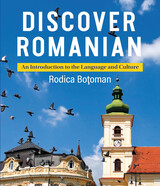
This comprehensive introduction to Romanian for English-speaking students emphasizes communication with a complete treatment of grammar, an extensive vocabulary, and a focus on the four major language skills—listening, speaking, reading, and writing. Cultural information, an integral part of the textbook, is presented both formally, in sections on culture and civilization, and informally, as the setting for dialogues and exercises. Tables of verb conjugations and a glossary round out the book’s primary materials.
Straightforward and accessible, Discover Romanian is an essential textbook for all those teaching and learning the language and provides important information for those seeking to understand Romanian culture. Together with the accompanying audio files and workbook, it provides a complete language course.
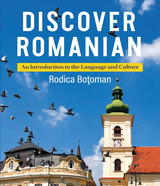
This comprehensive introduction to Romanian for English-speaking students emphasizes communication with a complete treatment of grammar, an extensive vocabulary, and a focus on the four major language skills—listening, speaking, reading, and writing. Cultural information, an integral part of the textbook, is presented both formally, in sections on culture and civilization, and informally, as the setting for dialogues and exercises. Tables of verb conjugations and a glossary round out the book’s primary materials.
Straightforward and accessible, Discover Romanian is an essential textbook for all those teaching and learning the language and provides important information for those seeking to understand Romanian culture. Together with the accompanying audio files and workbook, it provides a complete language course.
READERS
Browse our collection.
PUBLISHERS
See BiblioVault's publisher services.
STUDENT SERVICES
Files for college accessibility offices.
RECENTLY PUBLISHED


UChicago Accessibility Resources
home | accessibility | search | about | contact us
BiblioVault ® 2001 - 2026
The University of Chicago Press