
 A SCHOLARLY BOOK REPOSITORY
33 start with A start with A
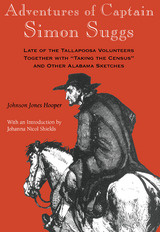
Originally published in 1845, Adventures of Captain Simon Suggs is a series of sketches written in part to parody some the campaign literature of the era. The character, Simon Suggs, with his motto, “it is good to be shifty in a new country,” fully incarnates a backwoods version of the national archetypes now know as the confidence man, the grafter, the professional flim-flam artist supremely skilled in the arts by which a man gets along in the world. This classic volume of good humor is set in the rough-and-tumble world of frontier life and politics.

With the retirement of an aging and ill George Wallace, both the issues and candidates contending for the office were able to set the course of Alabama politics for generations to follow. Whereas the Wallace regimes were particular to Alabama, and the gubernatorial campaign was conducted in a partial vacuum with his absence, Alabama also experienced a wave of partisan realignment. A once solidly Democratic South was undergoing a tectonic political shift as white voters in large numbers abandoned their traditional Democratic political home for the revived Republicans, a party shaped in many respects by the Wallace presidential bids of 1968 and 1972 and the Reagan revolution of the 1980s.
Alabama's own Democratic Party contributed to this massive shift with self-destructive campaign behavior that disgusted many of its traditional voters who wound up staying home or voting for a little-known Republican. From the gubernatorial election of 1986 came the shaky balance between the two parties that exists today.
After Wallace recollects and analyzes how these shifts occurred, citing extensive newspaper coverage from the time as well as personal observations and poll data collected by the authors. This volume is certain to be a valuable work for any political scientist, especially those with an interest in Alabama or southern politics.
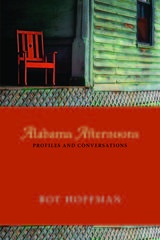
Alabama Afternoons is a collection of portraits of many notable Alabamians, famous and obscure, profiled by award-winning journalist and novelist Roy Hoffman. Written as Sunday feature stories for the Mobile Press-Register with additional pieces from the New York Times, Preservation, and Garden & Gun, these profiles preserve the individual stories—and the individual voices within the stories—that help to define one of the most distinctive states in the union.
Hoffman recounts his personal visits with writer Mary Ward Brown in her library in Hamburg, with photographer William Christenberry in a field in Newbern, and with storyteller Kathryn Tucker Windham and folk artist Charlie “Tin Man” Lucas at their neighboring houses in Selma. Also highlighted are the lives of numerous alumni of The University of Alabama—among them Mel Allen, the “Voice of the Yankees” from 1939 to 1964; Forrest Gump author Winston Groom; and Vivian Malone and James Hood, the two students who entered the schoolhouse door in 1963. Hoffman profiles distinguished Auburn University alumni as well, including Eugene Sledge, renowned World War II veteran and memoirist, and Neil Davis, the outspoken, nationally visible editor of the Lee County Bulletin.
Hoffman also profiles major and minor players in the civil rights movement, from Johnnie Carr, raised in segregated Montgomery and later president of the Montgomery Improvement Association; and George Wallace Jr., son of the four-time governor; to Theresa Burroughs, a Greensboro beautician trampled in the march over the Edmund Pettus Bridge; and Diane McWhorter, whose award- winning book explores the trouble- filled Birmingham civil rights experience. Juxtaposed with these are accounts of lesser-known individuals, such as Sarah Hamm, who attempts to preserve the fading Jewish culture in Eufaula; Edward Carl, who was butler and chauffeur to Bellingrath Gardens founder Walter Bellingrath in Theodore; and cousins William Bolton and Herbert Henson, caretakers of the coon dog cemetery in Russellville.
Hoffman’s compilation of life stories creates an engaging and compelling look into what it means to be from, and shaped by, Alabama. “Alabama Afternoons,” he writes in the introduction, “is a small part of the even bigger question of what it means to be an American.”
Read an article about domestic lives by Roy Hoffman in the New York Times here: http://www.nytimes.com/2010/11/25/garden/25Domestic.html
Brings together the nation's leading scholars on the prehistory and early history of Alabama and the southeastern US
This fascinating collection was born of a concern with Alabama's past and the need to explore and explain that legacy, so often hidden by the veils of time, ignorance, or misunderstanding. In 1981 The University of Alabama celebrated its 150th anniversary, and each College contributed to the celebration by sponsoring a special symposium. The College of Arts and Sciences brought together the nation's leading scholars on the prehistory and early history of Alabama and the Southeastern United States, and for two memorable days in September 1981 several hundred interested listeners heard those scholars present their interpretations of Alabama's remarkable past.
The organizers of the symposium deliberately chose to focus on Alabama's history before statehood. Alabama as a constituent state of the Old South is well known. Alabama as a home of Indian cultures and civilizations of a high order, as an object of desire, exploration, and conquest in the sixteenth century, and as a borderland disputed by rival European nationalities for almost 300 years is less well known. The resulting essays in this collection prove as interesting, enlightening, and provocative to the casual reader as to the professional scholar, for they are intended to bring to the general reader artifacts and documents that reveal the realities and romance of that older Alabama.
Topics in the collection range from the Mississippian Period in archaeology and the de Soto expedition (and other early European explorations and settlements of Alabama) to the 1780 Siege of Mobile.

Forging Alabama’s legacy: The definitive history of every blast furnace from pioneer charcoal fires to industrial giants.
Alabama Blast Furnaces by Joseph H. Woodward II offers the only comprehensive history of every blast furnace constructed in Alabama between 1815 and 1940, tracing a vital chapter in the state's iron and steel legacy. Beginning with the pioneering Cedar Creek charcoal furnace in 1815, Woodward meticulously chronicles four distinct eras:
Pioneer Era (1815–1861): Early, locally focused furnaces that laid the foundation of Alabama’s iron industry;
Civil War Era (1861–1865): Furnaces mobilized for the Confederate war effort, including Northern raids, labor shortages,
and innovation under duress;
Reconstruction Era (1866–1879): Transition from stone-stack furnaces toward iron- and steel-shelled technology; and
Modern Era (1880–1940): The rise of large-scale coke-fired plants that propelled Alabama onto the national and international stage.
The heart of the book is a rich series of illustrated, furnace-by-furnace histories—capturing specifics on every site, including four that were built but never operated. With 50 detailed illustrations and rigorous documentation, this reissue—part of the Library of Alabama Classics series—features a new introduction by historian James R. Bennett, who situates Woodward’s work in its historical context and underscores its lasting relevance.
Originally compiled in 1940 by a member of the Woodward Iron Company family, the volume remains a seminal reference for scholars, students, and industrial history enthusiasts. Its thorough scope ensures every furnace—whether a modest pioneer operation or a towering industrial complex—has its story preserved. As one reviewer notes, this work covers furnaces that “made Alabama internationally significant in the iron and steel industry,” offering a level of detail unmatched in regional history.

A detailed guide to 102 canoe trips on the Cahaba River and 40 other creeks and rivers within the state.
John H. Foshee’s popular and informative Alabama Canoe Rides and Float Trips has been a favorite of canoeing enthusiasts since 1975, providing a detailed guide to 102 canoe trips on the Cahaba River and 40 other creeks and rivers within the state. The trips highlighted in the book range from 3½ to 14 miles in length, with difficulty factors varying from leisurely float trips to Class 4 rapids.
This handy guide will assist beginning and expert canoeists in the selection of and preparation for a variety of float experiences. The author gives suggestions for river safety and makes recommendations for equipment. In addition, he points out major danger areas and obstacles that may be encountered and includes information on river access and use of topographical maps. An appendix contains brief descriptions of the rides, including their put-ins and take-outs, and follows the general format of the individual trip descriptions.
A visually rich survey of two hundred years of Alabama fine arts and artists
Alabama artists have been an integral part of the story of the state, reflecting a wide-ranging and multihued sense of place through images of the land and its people. Quilts, pottery, visionary paintings, sculpture, photography, folk art, and abstract art have all contributed to diverse visions of Alabama’s culture and environment. The works of art included in this volume have all emerged from a distinctive milieu that has nourished the creation of powerful visual expressions, statements that are both universal and indigenous.
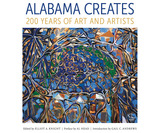
Published to coincide with the state’s bicentennial, Alabama Creates: 200 Years of Art and Artists features ninety-four of Alabama’s most accomplished, noteworthy, and influential practitioners of the fine arts from 1819 to the present. The book highlights a broad spectrum of artists who worked in the state, from its early days to its current and contemporary scene, exhibiting the full scope and breadth of Alabama art.
This retrospective volume features biographical sketches and representative examples of each artist’s most masterful works. Alabamians like Gay Burke, William Christenberry, Roger Brown, Thornton Dial, Frank Fleming, the Gee’s Bend Quilters, Lonnie Holley, Dale Kennington, Charlie Lucas, Kerry James Marshall, David Parrish, and Bill Traylor are compared and considered with other nationally significant artists.
Alabama Creates is divided into four historical periods, each spanning roughly fifty years and introduced by editor Elliot A. Knight. Knight contextualizes each era with information about the development of Alabama art museums and institutions and the evolution of college and university art departments. The book also contains an overview of the state’s artistic heritage by Gail C. Andrews, director emerita of the Birmingham Museum of Art. Alabama Creates conveys in a sweeping and captivating way the depth of talent, the range of creativity, and the lasting contributions these artists have made to Alabama’s extraordinarily rich visual and artistic heritage.

Alabamians have always been a singing people. The settlers who moved into the various sections of the state brought with them songs which reflected their national origins and geographical backgrounds, and as they spread into the hills and over the lowlands they created new songs out of the conditions under which they lived. Also, they absorbed songs from outside sources whenever these pieces could be adapted to their sentiments and ways of life. Thus, by a process of memory, composition and recreation they developed a rich body of folk songs. The following collection a part of the effort to discover and preserve these songs.
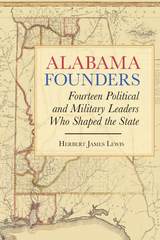
While much has been written about the significant events in the history of early Alabama, there has been little information available about the people who participated in those events. In Alabama Founders:Fourteen Political and Military Leaders Who Shaped the State Herbert James Lewis provides an important examination of the lives of fourteen political and military leaders. These were the men who opened Alabama for settlement, secured Alabama’s status as a territory in 1817 and as a state in 1819, and helped lay the foundation for the political and economic infrastructure of Alabama in its early years as a state.
While well researched and thorough, this book does not purport to be a definitive history of Alabama’s founding. Lewis has instead narrowed his focus to only those he believes to be key figures—in clearing the territory for settlement, serving in the territorial government, working to achieve statehood, playing a key role at the Constitutional Convention of 1819, or being elected to important offices in the first years of statehood.
The founders who readied the Alabama Territory for statehood include Judge Harry Toulmin, Henry Hitchcock, and Reuben Saffold II. William Wyatt Bibb and his brother Thomas Bibb respectively served as the first two governors of the state, and Charles Tait, known as the “Patron of Alabama,” shepherded Alabama’s admission bill through the US Senate. Military figures who played roles in surveying and clearing the territory for further settlement and development include General John Coffee, Andrew Jackson’s aide and land surveyor, and Samuel Dale, frontiersman and hero of the “Canoe Fight.” Those who were instrumental to the outcome of the Constitutional Convention of 1819 and served the state well in its early days include John W. Walker, Clement Comer Clay, Gabriel Moore, Israel Pickens, and William Rufus King.

This collection of biographical essays, written by thirty-four noted historians and political scientists, chronicles the times, careers, challenges, leadership, and legacies of the fifty-seven men and one woman who have served as the state's highest elected official. The book is organized chronologically into six sections that cover Alabama’s years as a US territory and its early statehood, the 1840s through the Civil War and Reconstruction, the late nineteenth-century Bourbon era, twentieth-century progressive and wartime governors, the Civil Rights era and George Wallace’s period of influence, and recent chief executives in the post-Wallace era.
The political careers of these fifty-eight individuals reflect the story of Alabama itself. Taken together, these essays provide a unified history of the state, with its recurring themes of race, federal-state relations, tensions between north and south Alabama, economic development, taxation, and education.
Alabama Governors expertly delineates the decisions and challenges of the chief executives, their policy initiatives, their accomplishments and failures, and the lasting impact of their terms. The book also includes the true and sometimes scandalous anecdotes that pepper Alabama’s storied history. Several of the state's early governors fought duels; one killed his wife's lover. A Reconstruction era-governor barricaded himself in his office and refused to give it up when voters failed to reelect him. A twentieth-century governor, an alumnus of Yale, served as an officer in the Ku Klux Klan.
This entirely updated and revised edition includes enlarged and enhanced images of each governor. Published as Alabama prepares for its sixty-fourth gubernatorial election, Alabama Governors is certain to become a valuable resource for teachers, students, librarians, journalists, and anyone interested in the colorful history of Alabama politics.
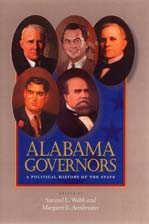
The story of Alabama's governors has been often bizarre, occasionally inspiring, but never dull. Several of the state's early governors fought duels; one killed his wife's lover. A Reconstruction era-governor barricaded himself in his administrative office and refused to give it up when voters failed to reelect him. A 20th-century governor, an alumnus of Yale, married his first cousin and served as an officer in the Ku Klux Klan.
This collection of biographical essays, written by 34 noted historians and political scientists, chronicles the foibles and idiosyncrasies, in and out of office, of those who have served as the state's highest elected official. It also describes their courage; their meaningful policy initiatives; their accomplishments and failures; the complex factors that led to their actions or inaction; and the enormous consequences of their choices on the state's behalf.
Taken together, the essays provide a unified history of the state, with its recurring themes of race, federal-state relations, economic development, taxation, and education. Alabama Governors is certain to become an invaluable resource for teachers, students, librarians, journalists, and anyone interested in the colorful history and politics of the state.

An authoritative popular history that places the state in regional and national context.
Penned by one of Alabama’s most distinguished historians, this masterful work offers a sweeping yet intimate portrait of a century that reshaped both the state and the nation. With clarity, wit, and deep insight, the author traces the dramatic arc of the 20th century—from the dawn of flight and the rise of industrial power to revolutions in psychology, literature, and morality—all through the lens of Alabama’s unique experience.
Far more than a catalog of events, this book is a meditation on transformation. It captures the spirit of Alabamians as they confronted change with determination and vision, reckoning with the promises and perils of modernity. The author’s deep respect for archival sources and fellow scholars is matched by his gift for storytelling, making this an accessible and compelling read for both academics and general audiences.
With a voice honed by decades of scholarship and a heart rooted in Southern soil, the author brings history to life—illuminating how one state mirrored the nation’s evolution while forging its own path. This is essential reading for anyone seeking to understand Alabama’s place in the American story.
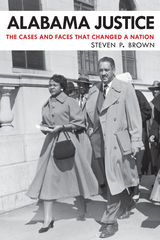
WINNER OF THE ANNE B. & JAMES B. MCMILLAN PRIZE IN SOUTHERN HISTORY
Examines the legacies of eight momentous US Supreme Court decisions that have their origins in Alabama legal disputes.
Unknown to many, Alabama has played a remarkable role in a number of Supreme Court rulings that continue to touch the lives of every American. In Alabama Justice: The Cases and Faces That Changed a Nation, Steven P. Brown has identified eight landmark cases that deal with religion, voting rights, libel, gender discrimination, and other issues, all originating from legal disputes in Alabama.
Written in a concise and accessible manner, each case law chapter begins with the circumstances that created the dispute. Brown then provides historical and constitutional background for the issue followed by a review of the path of litigation. Excerpts from the Court’s ruling in the case are also presented, along with a brief account of the aftermath and significance of the decision. The First Amendment (New York Times v. Sullivan), racial redistricting (Gomillion v. Lightfoot), the Equal Protection Clause of the Fourteenth Amendment (Frontiero v. Richardson), and prayer in public schools (Wallace v. Jaffree) are among the pivotal issues stamped indelibly by disputes with their origins in Alabama legal, political, and cultural landscapes. By examining such landmark twentieth-century milestones and eras such as the Scottsboro Boys trial, the Civil Rights movement, and the fight for women’s rights through a legal lens, Brown sheds new and unexpected light on the ways that events in Alabama have shaped the nation.
In addition to his analysis of cases, Brown discusses the three associate Supreme Court justices from Alabama to the Supreme Court: John McKinley, John Archibald Campbell, and Hugo Black. Their cumulative influence on constitutional interpretation, the institution of the Court, and the day-to-day rights and liberties enjoyed by every American is impossible to measure. A closing chapter examines the careers and contributions of these three Alabamians.

Why does Alabama rank so low on many of the indicators of quality of life? Why did some of the most dramatic developments in the civil rights revolution of the 1960s take place in Alabama? Why is it that a few interest groups seem to have the most political power in Alabama? William H. Stewart’s Alabama Politics in the Twenty-First Century explores these questions and more, illuminating many of the often misunderstood details of contemporary Alabama politics in this cohesive and comprehensive publication.
The Alabama state government, especially as a specimen of Deep South politics, is a topic of frequent discussion by its general public—second only to college football. However, there remains a surprising lack of literature focusing on the workings of the state’s bureaucracy in an extensive and systematic way. Bearing in mind the Yellowhammer State’s long and rich political history, Stewart concentrates on Alabama’s statecraft from the first decade of the twenty-first century through the November 2010 elections and considers what the widespread Republican victories mean for their constituents. He also studies several different themes prominent during the 2010 elections, including the growing number and influence of special interest groups, the respective polarization of whites and blacks into the Republican and Democratic parties, and the increasingly unwieldy state constitution.
This fascinating and revealing text provides a wealth of information about an extremely complex state government. Featuring detailed descriptions of important concepts and events presented in a thorough and intelligible manner, Alabama Politics in the Twenty-First Century is perfect for scholars, students, everyday Alabamians, or anyone who wants the inside scoop on the subtle inner workings of the Cotton State’s politics.

A comprehensive, illustrated history that shows Alabama's important role in the development of the nation's railroad system
Alabama Railroads is the first extensive history of the state’s railway system, from the chartering of the Tuscumbia Railway Company in January 1830, to the maturity of the system in the latter half of the 20th century, when Amtrak assumed control of the nation’s passenger service.
Railroads built Alabama. Without them the state’s vast natural resources could not have been developed. Scores of Alabama towns, including the city of Birmingham, owe their existence to the railroads. Moreover, Alabama legislators were instrumental in securing passage of momentous land grant legislation that brought the railroad—and settlers—to every section of the American frontier.
During the Civil War, the state’s rail system was a primary objective of Union raiders, and an Alabama rail connection into Chattanooga proved to be a vital key to victory. After the war, the railroad shaped politics and economic development in the state. Indeed, most of the important events of the first 100 years of Alabama history were influenced in a significant manner by the railroad. Alabama Railroads chronicles these events—from land grant legislation and the strategic importance of Alabama’s railroads in the Civil War to the founding of Birmingham and the development of the state’s agricultural, mineral, and timber regions.
Wayne Cline traces the development of all the major lines as well as the most prominent short lines, from the day in 1832 when the first horse-drawn cars rolled over primitive tracks at Tuscumbia, to the night in 1971 at Sylacauga when the final operating order was issued for one of the 20th century’s most famous streamliners. Along the way we meet the varied cast of colorful characters who pioneered the railway system that serves the state today. With more than 100 rare and vintage illustrations from the 19th and early 20th centuries, Alabama Railroads places Alabama’s rail heritage in a national context and allows students of southern history as well as railroad enthusiasts to view this Deep South state from an entirely fresh perspective.
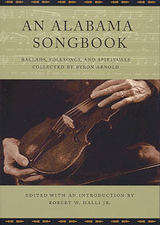
Alabama is a state rich in folksong tradition, from old English ballads sung along the Tennessee River to children’s game songs played in Mobile, from the rhythmic work songs of the railroad gandy dancers of Gadsden to the spirituals of the Black Belt. The musical heritage of blacks and whites, rich and poor, hill folk and cotton farmers, these songs endure as a living part of the state’s varied past.
In the mid 1940s Byron Arnold, an eager young music professor from The University of Alabama, set out to find and record as many of these songs as he could and was rewarded by unstinting cooperation from many informants. Mrs. Julia Greer Marechal of Mobile, for example, was 90 years old, blind, and a semi-invalid, but she sang for Arnold for three hours, allowing the recording of 33 songs and exhausting Arnold and his technician. Helped by such living repositories as Mrs. Marechal, the Arnold collection grew to well over 500 songs, augmented by field notes and remarkable biographical information on the singers.
An Alabama Songbook is the result of Arnold’s efforts and those of his informants across the state and has been shaped by Robert W. Halli Jr. into a narrative enriched by more than 200 significant songs-lullabies, Civil War anthems, African-American gospel and secular songs, fiddle tunes, temperance songs, love ballads, play-party rhymes, and work songs. In the tradition of Alan Lomax’s The Folk Songs of North America and Vance Randolph’s Ozark Folksongs, this volume will appeal to general audiences, folklorists, ethnomusicologists, preservationists, traditional musicians, and historians.
A definitive bicentennial history of Alabama and its place in the American South.
Alabama: The History of a Deep South State, Bicentennial Edition is a comprehensive narrative account of the state from its earliest days to the present. This edition, updated to celebrate the state’s bicentennial year, offers a detailed survey of the colorful, dramatic, and often controversial turns in Alabama’s evolution. Organized chronologically and divided into three main sections—the first concluding in 1865, the second in 1920, and the third bringing the story to the present—makes clear and interprets the major events that occurred during Alabama’s history within the larger context of the South and the nation.
Once the home of aboriginal inhabitants, Alabama was claimed and occupied by a number of European nations prior to becoming a permanent part of the United States in 1819. A cotton and slave state for more than half of the nineteenth century, Alabama seceded in 1861 to join the Confederate States of America, and occupied an uneasy and uncertain place in America’s post-Civil War landscape. Alabama’s role in the twentieth century has been equally tumultuous and dramatic.
General readers as well as scholars will welcome this up-to-date and scrupulously researched history of Alabama, which examines such traditional subjects as politics, military history, economics, race, and class. It contains essential accounts devoted to Native Americans, women, and the environment, as well as detailed coverage of health, education, organized labor, civil rights, and the many cultural developments, from literature to sport, that have enriched Alabama’s history. The stories of individual leaders, from politicians to creative artists, are also highlighted. A key facet of this landmark historical narrative is the strong emphasis placed on the common everyday people of Alabama, those who have been rightly described as the “bone and sinew” of the state.
The story of Alabama—where history shaped a state and a nation.
Alabama: The Making of an American State is itself a watershed event in the long and storied history of the state of Alabama. Here, presented for the first time ever in a single, magnificently illustrated volume, Edwin C. Bridges conveys the magisterial sweep of Alabama’s rich, difficult, and remarkable history with verve, eloquence, and an unblinking eye.
From Alabama’s earliest fossil records to its settlement by Native Americans and later by European settlers and African slaves, from its territorial birth pangs and statehood through the upheavals of the Civil War and the civil rights movement, Bridges makes evident in clear, direct storytelling the unique social, political, economic, and cultural forces that have indelibly shaped this historically rich and unique American region.
Illustrated lavishly with maps, archival photographs, and archaeological artifacts, as well as art works, portraiture, and specimens of Alabama craftsmanship—many never before published—Alabama: The Making of an American State makes evident as rarely seen before Alabama’s most significant struggles, conflicts, achievements, and developments.
Drawn from decades of research and the deep archival holdings of the Alabama Department of Archives and History, this volume will be the definitive resource for decades to come for anyone seeking a broad understanding of Alabama’s evolving legacy.

Alabama Wildlife, Volume 5 offers a comprehensive update and provides a wealth of new information concerning changes and developments relative to the conservation status of wild animal populations of the state that have occurred in the decade since publication of the previous four volumes in 2004. Enhancements include the addition of any new or rediscovered taxon, species priority status changes, and taxonomic changes, plus the addition of the crayfishes, which were left out previously because so little was known about these understudied taxa.
A complete taxonomic checklist is included, which lists each imperiled taxon along with its priority designation followed by detailed species accounts. The eighty-four crayfish species accounts are comprised of a physical description (including a photograph, when available), distribution map, habitat summary, key life history, ecological information, basis for its status classification, and specific conservation and management recommendations. This revised expansion of the Alabama Wildlife set will be helpful to those seeking to broaden their knowledge of Alabama’s vast wildlife resources and will greatly influence future studies in the conservation of many of the imperiled species.
No other state has embraced and preserved its civil rights history more thoroughly than Alabama. Nor is there a place where that history is richer. Alabama’s Civil Rights Trail tells of Alabama’s great civil rights events, as well as its lesser-known moments, in a compact and accessible narrative, paired with a practical guide to Alabama’s preserved civil rights sites and monuments.
In this history of Alabama’s civil rights movement, Cradle of Freedom (University of Alabama Press, 2004), Frye Gaillard contends that Alabama played the lead role in a historic movement that made all citizens of the nation, black and white, more free. This book, geared toward the casual traveler and the serious student alike, showcases in a vividly illustrated and compelling manner, valuable and rich details. It provides a user-friendly, graphic tool for the growing number of travelers, students, and civil rights pilgrims who visit the state annually.
The story of the civil rights movement in Alabama is told city by city, region by region, and town by town, with entries on Montgomery, Birmingham, Selma, Tuscaloosa, Tuskegee, and Mobile, as well as chapters on the Black Belt and the Alabama hill country. Smaller but important locales such as Greensboro, Monroeville, and Scottsboro are included, as are more obscure sites like Hale County’s Safe House Black History Museum and the birthplace of the Black Panther Party in Lowndes County
Among the villains, heroes, rogues and demigods who inhabit Southern folklore, Stephen S. Renfroe deserves a place. In the twentieth-century a few popular magazine and newspaper articles have been written about Renfroe, while Carl Carmer’s Stars Fell on Alabama, published in 1934, devoted several pages to him. Other than this, all is previously know about the enigmatic sheriff who because an outlaw is in the form of a legend.
In general, Renfroe appeared in the Black Belt town of Livingston, Alabama in the late 1860s and quickly became a member of the Ku Klux Klan. Allegedly playing a major role in driving out carpetbaggers and ridding Sumter County of Radical Republican rule, he was awarded with the office of sheriff. However, he reverted to a pattern of crime that earned him disgrace and ostracism.
As to his origins, his background, and the details of his career—much has been speculated but little has been documented. Although no statue commemorates Renfroe’s role as a statesman, educator, or solider (his highest military rank was that of private), a case can be made that he helped shape the course of politics in Alabama’s Black Belt.

Patricia Foster’s lyrical yet often painful memoir explores the life of a white middle-class girl who grew up in rural south Alabama in the 1950s and 1960s, a time and place that did not tolerate deviation from traditional gender roles. Her mother raised Foster and her sister as “honorary boys,” girls with the ambition of men but the temperament of women.
An unhappy, intelligent woman who kept a heartbreaking secret from everyone close to her, Foster's mother was driven by a repressed rage that fed her obsession for middle-class respectability. By the time Foster reached age fifteen, her efforts to reconcile the contradictory expectations that she be at once ambitious and restrained had left her nervous and needy inside even while she tried to cultivate the appearance of the model student, sister, and daughter. It was only a psychological and physical breakdown that helped her to realize that she couldn't save her driven, complicated mother and must struggle instead for both understanding and autonomy.
The definitive biography Amelia Gayle Gorgas, one of the most influential people in the history of the University of Alabama
Amelia Gayle Gorgas: A Biography is a richly documented and deeply compelling portrait of one of Alabama’s most influential nineteenth‑century women. Drawing on the unparalleled depth of the Gayle‑Gorgas Collection—letters, journals, family papers, and contemporary accounts—this biography argues that Amelia’s life offers enduring insight into the resilience, intellect, and quiet leadership that shaped Southern society before, during, and after the Civil War.
Far more than the daughter of a governor, wife of Confederate ordnance chief Josiah Gorgas, or mother of famed physician William Crawford Gorgas, Amelia emerges here as a figure of remarkable adaptability and personal strength. The book traces her journey from a lively Greensboro childhood through the upheavals of war‑torn Richmond, the hardships of Reconstruction‑era Alabama, and her transformative service as librarian at The University of Alabama. Its chapters illuminate the themes that define her legacy: intellectual curiosity without formal schooling, deft management of family and community crises, a gift for nurturing students and soldiers alike, and an ability to thrive in environments as varied as Maine, Charleston, Sewanee, and Tuscaloosa.
Vivid storytelling blends seamlessly with meticulous scholarship, giving readers both an intimate family narrative and a sweeping social history of the nineteenth‑century South. This biography will appeal especially to readers of Southern history, women’s history, university and library heritage, Civil War studies, and anyone drawn to strong, quietly trailblazing figures whose lives illuminate broader cultural change. Amelia’s story endures because it speaks to the universal work of holding families, institutions, and communities together in times of profound upheaval.
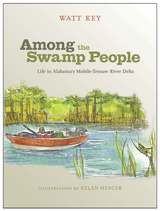
Among the Swamp People is the story of author Watt Key’s discovery of the Mobile-Tensaw River Delta. “The swamp” consists of almost 260,000 acres of wetlands located just north of Mobile Bay. There he leases a habitable outcropping of land and constructs a primitive cabin from driftwood to serve as a private getaway. His story is one that chronicles the beauties of the delta’s unparalleled natural wonders, the difficulties of survival within it, and an extraordinary community of characters—by turns generous and violent, gracious and paranoid, hilarious and reckless—who live, thrive, and perish there.
There is no way into the delta except by small boat. To most it would appear a maze of rivers and creeks between stunted swamp trees and mud. Key observes that there are few places where one can step out of a boat without “sinking to the knees in muck the consistency of axle grease. It is the only place I know where gloom and beauty can coexist at such extremes. And it never occurred to me that a land seemingly so bleak could hide such beauty and adventure.”
It also chronicles Key’s maturation as a writer, from a twenty-five-year-old computer programmer with no formal training as a writer to a highly successful, award-winning writer of fiction for a young adult audience with three acclaimed novels published to date.
In learning to make a place for himself in the wild, as in learning to write, Key’s story is one of “hoping someone—even if just myself—would find value in my creations.”
Ante-Bellum Alabama: Town and Country was written to give the reader insight into important facets of Alabama’s ante-bellum history. Presented in the form of case studies from the pre-Civil War period, the book deals with a city, a town, a planter’s family, rural social life, attitudes concerning race, and Alabama’s early agricultural and industrial development.
Ante-bellum Alabama’s primary interest was agriculture; the chief crop was King Cotton; and most of the people were agriculturalists. Towns and cities came into existence to supply the agricultural needs of the state and to process and distribute farm commodities. Similarly, Alabama’s industrial development began with the manufacture of implements for farm use, in response to the state’s agricultural needs. Rural-agriculture influences dominated the American scene; and in this respect Alabama was typical of her region as well as of most of the United States.
David L. DeJarnette, the founder of scientific archaeology in the state of Alabama, reports on archaeological surveys and excavations undertaken in the Chattahoochee River Valley between 1947 and 1962. The three contributors, Wesley R. Hurt, Edward B. Kurjack, and Fred Lamar Pearson Jr., each made signal contributions to the archaeology of the southeastern states. With their mentor, David L. DeJarnette, they worked out a viable cultural chronology of the region from the earliest Paleoindian and Archaic foragers to the period of early European-Indian contact. They excavated key sites, including the Woodland period Shorter Mound, the protohistoric Abercrombie village, and Spanish Fort Apalachicola, in addition to a number of important Creek Indian town sites of the eighteenth century. All are here, illustrated abundantly by site photographs, maps, and of course, the artifacts recovered from these remarkable investigations.
Copublication with the Historic Chattahoochee Commission
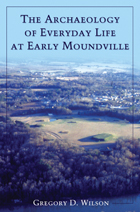
Complex Mississippian polities were neither developed nor sustained in a vacuum. A broad range of small-scale social groups played a variety of roles in the emergence of regionally organized political hierarchies that governed large-scale ceremonial centers. Recent research has revealed the extent to which interactions among corporately organized clans led to the development, success, and collapse of Moundville. These insights into Moundville’s social complexity are based primarily on the study of monumental architecture and mortuary ceremonialism. Less is known about how everyday domestic practices produced and were produced by broader networks of power and inequality in the region.
Wilson’s research addresses this gap in our understanding by analyzing and interpreting large-scale architectural and ceramic data sets from domestic contexts. This study has revealed that the early Mississippian Moundville community consisted of numerous spatially discrete multi-household groups, similar to ethnohistorically described kin groups from the southeastern United States. Hosting feasts, dances, and other ceremonial events were important strategies by which elite groups created social debts and legitimized their positions of authority. Non-elite groups, on the other hand, maintained considerable economic and ritual autonomy through diversified production activities, risk sharing, and household ceremonialism. Organizational changes in Moundville’s residential occupation highlight the different ways kin groups defined and redefined their corporate status and identities over the long term.
Built on a flat terrace overlooking the Black Warrior River in Alabama, the Moundville ceremonial center was at its height a densely occupied town of approximately 1,000 residents, with at least 29 earthen mounds surrounding a central plaza. Today Moundville is not only one of the largest and best-preserved Mississippian sites in the United States but also one of the most intensively studied. This volume brings together nine Moundville specialists who trace the site’s evolution and eventual decline.
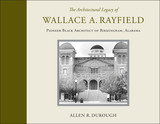
A priceless material legacy documenting Wallace Rayfield’s life and work on two continents.
In the early 1990s, while cleaning out the barn on his property in Bessemer, Alabama, Allen Durough discovered the remnants of the lifework of African American architect Wallace A. Rayfield, including several hundred of Rayfield’s drawings, floor plans, business advertisements, family portraits, and graphic art pieces. This book gathers that priceless material legacy into a cohesive whole, reproducing 159 illustrations that document Rayfield’s life and work on two continents.
Born in Macon, Georgia, in 1873, Rayfield apprenticed as a young man with the noted architectural firm A. B. Mullet and Company in Washington, DC, before attending Howard University, Pratt Polytechnic Institute, and ultimately graduating with a bachelor of architecture degree from Columbia University. He returned south to teach at the Tuskegee Institute and then to establish W. A. Rayfield & Co., Architects, in Birmingham, Alabama. From there he designed buildings for construction across the south (many by mail order) and even in Africa. Rayfield specialized in church architecture, and many of his designs were for black congregations within the state, most notably the Sixteenth Street Baptist Church in Birmingham. But he also designed schools, office buildings, and private homes. After falling into bankruptcy during the Great Depression, he died in obscurity.
Durough includes catalog-style descriptive entries and illustrations of Rayfield’s designs for six types of structures: residences, churches, schools, commercial buildings, fraternal buildings, and barns. These entries contain location, commissioning data, and brief structural notes, providing a useful resource for architectural historians and preservationists. A listing of the 359 known Rayfield structures detail their locations in 19 states, plan date, building type, and name. Also included is a biographical sketch of Rayfield, an overview of his publications, and a survey of his professional artwork and advertisements.
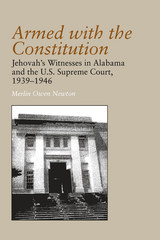
Armed with the Constitution stresses the courage of a black man, Rosco Jones, and a white woman, Grace Marsh, who dared to challenge the status quo in Alabama in the early 1940s. These two Jehovah’s Witnesses helped to lay a foundation for testing the constitutionality of state and local laws, establishing precedents that the Civil Rights movement, the feminist movement, and similar forces could follow. Newton has prepared a finely woven tale of oral, legal, and social history that opens a window on the world of the Jehovah’s Witnesses in Alabama.
More than a legal study, this book is also a dramatic history of two powerful personalities whose total commitment to their faith enabled them to carry the Jehovah’s Witnesses’ battle from rural Alabama to the halls of the U.S. Supreme Court.
During the decades of Bourbon ascendancy after 1874, Alabama institutions like those in other southern states were dominated by whites. Former slave and sharecropper Jack Turner refused to accept a society so structured. Highly intelligent, physically imposing, and an orator of persuasive talents, Turner was fearless before whites and emerged as a leader of his race. He helped to forge a political alliance between blacks and whites that defeated and humiliated the Bourbons in Choctaw County, the heart of the Black Belt, in the election of 1882. That summer, after a series of bogus charges and arrests, Turner was accused of planning to lead his private army of blacks in a general slaughter of the county whites. Justice was forgotten in the resultant fear and hysteria.
READERS
Browse our collection.
PUBLISHERS
See BiblioVault's publisher services.
STUDENT SERVICES
Files for college accessibility offices.
RECENTLY PUBLISHED





UChicago Accessibility Resources
home | accessibility | search | about | contact us
BiblioVault ® 2001 - 2026
The University of Chicago Press