
 A SCHOLARLY BOOK REPOSITORY
285 start with C start with C

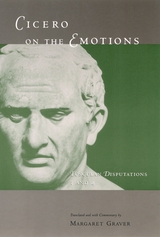
Margaret Graver's elegant and idiomatic translation makes Cicero's work accessible not just to classicists but to anyone interested in ancient philosophy and psychotherapy or in the philosophy of emotion. The accompanying commentary explains the philosophical concepts discussed in the text and supplies many helpful parallels from Greek sources.
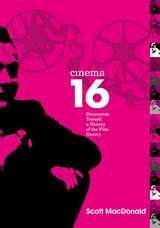
Vogel's commitment to the broadest range of cinema practice led him to develop a programming strategy, inherited from the European cine-club movement, that involved confronting audiences with such a wide range of cinematic forms that viewers left the theater considering not only the often remarkable films Vogel showed, but the place of Cinema itself in modern life.
Cinema 16: Documents Toward a History of the Film Society is the first book on Cinema 16. Scott MacDonald provides a sense of the life and work of the society, using the complete Cinema 16 program announcements, selected letters between Vogel and the filmmakers whose films he showed; selections from the program notes that accompanied Cinema 16 screenings, theoretical essays by Vogel on curating independent cinema; conversations between MacDonald and Cinema 16 members; photographs and stills; and a variety of other documents.
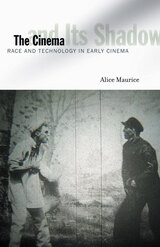
The Cinema and Its Shadow argues that race has defined the cinematic apparatus since the earliest motion pictures, especially at times of technological transition. In particular, this work explores how racial difference became central to the resolving of cinematic problems: the stationary camera, narrative form, realism, the synchronization of image and sound, and, perhaps most fundamentally, the immaterial image—the cinema’s “shadow,” which figures both the material reality of the screen image and its racist past.
Discussing early “race subjects,” Alice Maurice demonstrates that these films influenced cinematic narrative in lasting ways by helping to determine the relation between stillness and motion, spectacle and narrative drive. The book examines how motion picture technology related to race, embodiment, and authenticity at specific junctures in cinema’s development, including the advent of narratives, feature films, and sound. In close readings of such films as The Cheat, Shadows, and Hallelujah!, Maurice reveals how the rhetoric of race repeatedly embodies film technology, endowing it with a powerful mix of authenticity and magic. In this way, the racialized subject became the perfect medium for showing off, shoring up, and reintroducing the cinematic apparatus at various points in the history of American film.
Moving beyond analyzing race in purely thematic or ideological terms, Maurice traces how it shaped the formal and technological means of the cinema.
Featuring interviews with filmmaker Ken Burns, Oscar-nominated editor Jay Cassidy, producer John Sloss, and more, this masterpiece provides insights into how a Midwestern college town developed a robust underground art film community that inspired those across the country. Variety’s Owen Glieberman says, “Frank Uhle has captured the moment when cinema became, for a new generation, a kind of religion, with its own rituals and sacred texts and a spirit of exploratory mystery that has all but vanished from the culture.”
This is a must-have book for cinema and media aficionados, film archivists, and anyone interested in the cultural history of Ann Arbor.
This book was published in collaboration with Fifth Avenue Press at Ann Arbor District Library. Learn more about their publishing program here. You can also see their collection, including vintage flyers, photos, film schedules, here.
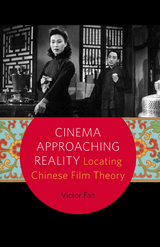
In Cinema Approaching Reality, Victor Fan brings together, for the first time, Chinese and Euro-American film theories and theorists to engage in critical debates about film in Shanghai and Hong Kong from the 1920s through 1940s. His point of departure is a term popularly employed by Chinese film critics during this period, bizhen, often translated as “lifelike” but best understood as “approaching reality.” What these Chinese theorists mean, in Fan’s reading, is that the cinematographic image is not a form of total reality, but it can allow spectators to apprehend an effect as though they had been there at the time when an event actually happened.
Fan suggests that the phrase “approaching reality” can help to renegotiate an aporia (blind spot) that influential French film critic André Bazin wrestled with: the cinematographic image is a trace of reality, yet reality is absent in the cinematographic image, and the cinema makes present this absence as it reactivates the passage of time. Fan enriches Bazinian cinematic ontology with discussions on cinematic reality in Republican China and colonial Hong Kong, putting Western theorists—from Bazin and Kracauer to Baudrillard, Agamben, and Deleuze—into dialogue with their Chinese counterparts. The result is an eye-opening exploration of the potentialities in approaching cinema anew, especially in the photographic materiality following its digital turn.

A PDF version of this book is available for free in open access via the OAPEN Library platform, www.oapen.org It has been made available under a Creative Commons Attribution 4.0 International Public License and is part of Knowledge Unlatched.
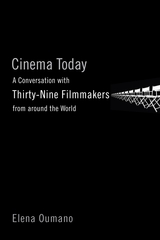
Can't spare the time from work or class? Travel expense too great? What? You can't even find such a collaborative event?
Then imagine curling up with a good book, maybe a shot of espresso in hand, and becoming engrossed in the exciting and informative conversation that Elena Oumano has ingeniously crafted from her personal and individual interviews with these artists. Straying far from the usual choppy question-and-answer format, Cinema Today saves you from plowing through another tedious read, in which the same topics and issues are directed to each subject, over and over-an experience that is like being trapped in a revolving door.
Oumano stops that revolving door by following a lively symposium-in-print format, with the filmmakers' words and thoughts grouped together under various key cinema topics. It is as though these experts are speaking to each other and you are their audience--collectively they reflect on and explore issues and concerns of modern filmmaking, from the practical to the aesthetic, including the process, cinematic rhythm and structure, and the many aspects of the media: business, the viewer, and cinema's place in society. Whether you are a movie lover, a serious student of cinema, or simply interested in how we communicate in today's global village through films that so profoundly affect the world, Cinema Today is for you.

Péter Forgács, based in Budapest, is best known for his award-winning films built on home movies from the 1930s to the 1960s that document ordinary lives soon to intersect with offscreen historical events. Cinema’s Alchemist offers a sustained exploration of the imagination and skill with which Forgács reshapes such film footage, originally intended for private and personal viewing, into extraordinary films dedicated to remembering the past in ways that matter for our future.
Contributors: Whitney Davis, U of California, Berkeley; László F. Földényi, U of Theatre, Film and Television, Budapest; Marsha Kinder, U of Southern California; Tamás Korányi; Scott MacDonald, Hamilton College; Tyrus Miller, U of California, Santa Cruz; Roger Odin, U of Paris III Sorbonne–Nouvelle; Catherine Portuges, U of Massachusetts Amherst; Michael S. Roth, Wesleyan U; Kaja Silverman, U of Pennsylvania; Ernst van Alphen, Leiden U, the Netherlands; Malin Wahlberg, Stockholm U.

Do contemporary big-budget blockbuster films like Gravity move something in us that is fundamentally the same as what avant-garde and experimental films have done for more than a century? In a powerful challenge to mainstream film theory, Cinema’s Bodily Illusions demonstrates that this is the case.
Scott C. Richmond bridges genres and periods by focusing, most palpably, on cinema’s power to evoke illusions: feeling like you’re flying through space, experiencing 3D without glasses, or even hallucinating. He argues that cinema is, first and foremost, a technology to modulate perception. He presents a theory of cinema as a proprioceptive technology: cinema becomes art by modulating viewers’ embodied sense of space. It works primarily not at the level of the intellect but at the level of the body. Richmond develops his theory through examples of direct perceptual illusion in cinema: hallucinatory flicker phenomena in Tony Conrad’s The Flicker, eerie depth effects in Marcel Duchamp’s Anémic Cinéma, the illusion of bodily movement through onscreen space in Stanley Kubrick’s 2001, Godfrey Reggio’s Koyaanisqatsi, and Alfonso Cuarón’s Gravity. In doing so he combines insights from Maurice Merleau-Ponty’s phenomenology of perception and James J. Gibson’s ecological approach to perception. The result is his distinctive ecological phenomenology, which allows us to refocus on the cinema’s perceptual, rather than representational, power.
Arguing against modernist habits of mind in film theory and aesthetics, and the attendant proclamations of cinema’s death or irrelevance, Richmond demonstrates that cinema’s proprioceptive aesthetics make it an urgent site of contemporary inquiry.
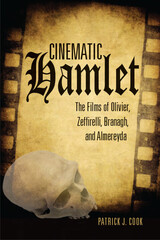
Hamlet has inspired four outstanding film adaptations that continue to delight a wide and varied audience and to offer provocative new interpretations of Shakespeare’s most popular play. Cinematic Hamlet contains the first scene-by-scene analysis of the methods used by Laurence Olivier, Franco Zeffirelli, Kenneth Branagh, and Michael Almereyda to translate Hamlet into highly distinctive and remarkably effective films.
Applying recent developments in neuroscience and psychology, Patrick J. Cook argues that film is a medium deploying an abundance of devices whose task it is to direct attention away from the film’s viewing processes and toward the object represented. Through careful analysis of each film’s devices, he explores the ways in which four brilliant directors rework the play into a radically different medium, engaging the viewer through powerful instinctive drives and creating audiovisual vehicles that support and complement Shakespeare’s words and story.
Cinematic Hamlet will prove to be indispensable for anyone wishing to understand how these films rework Shakespeare into the powerful medium of film.

City of Women delves into the misfortunes that New York City's laboring women suffered and the problems that resulted. Looking at how and why a community of women workers came into existence, Christine Stansell analyzes the social conflicts surrounding laboring women and they social pressure these conflicts brought to bear on others. The result is a fascinating journey into economic relations and cultural forms that influenced working women's lives—one that reveals at last the female city concealed within America's first great metropolis.

First published in 2003, City on Fire is a gripping, intimate account of the explosions of two ships loaded with ammonium nitrate fertilizer that demolished Texas City, Texas, in April 1947, in one of the most catastrophic disasters in American history.
The glittering skyscrapers of such films as On the Town have shadowed the characteristic seedy streets in which desperate, passionate stories have played out-as in Scandal Sheet and The Pawnbroker. In other films, the city is a cauldron of bright lights, technology, empire, egotism, fear, hunger, and change--the scenic epitome of America in the modern age.
From Street Scene and Breakfast at Tiffany's to Rosemary's Baby, The Warriors, and 25th Hour, the sixteen essays in this book explore the cinematic representation of New York as a city of experience, as a locus of ideographic characters and spaces, as a city of moves and traps, and as a site of allurement and danger. Contributors consider the work of Woody Allen, Blake Edwards, Alfred Hitchcock, Gregory La Cava, Spike Lee, Sidney Lumet, Vincente Minnelli, Roman Polanski, Martin Scorsese, Andy Warhol, and numerous others.
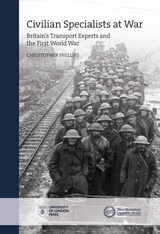
In Civilian Specialists at War, Christopher Phillips examines the relationship between industrial society and industrial warfare through the lens of Britain’s transport experts. Phillips analyzes the multiple connections between the army, the government, and the senior executives of some of prewar Britain’s largest industrial enterprises, revealing that civilian transport experts were a key component of Britain’s strategies in World War I. This book also details the application of recognizably civilian technologies and methods to the prosecution of war, and documents how transport experts were constrained by the political and military requirements of coalition warfare.
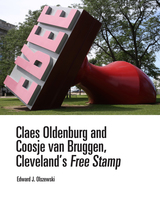
In 1985, the Sohio oil company commissioned Claes Oldenburg and Coosje van Bruggen to design and construct a large outdoor sculpture for its new corporate headquarters in Cleveland, Ohio. The result was Free Stamp, a bold and distinctive installation that captured both a Pop Art sensibility and a connection to the city’s industrial past. Sohio executives approved the design, and work was already underway, when British Petroleum acquired the company. The new owners quickly decided that the sculpture was “inappropriate” for their building and attempted to rid themselves of Free Stamp by donating it to the city of Cleveland—a gift that the city initially had no desire to accept. After much debate and public protest, the sculpture found a home in Willard Park, where it stands today.
This is the first study of any sculpture by Oldenburg and van Bruggen to examine the genesis of their art from conception to installation. Edward J. Olszewski has put together a fascinating narrative based on interviews with the artists, archival material from city records, and in-house corporate memoranda, as well as letters to the editor and political cartoons. He traces the development of the sculpture from the artists’ first sketches and models to the installation of the completed work in its urban environment.
Recent battles in Washington over how to fix America’s fiscal failures strengthened the widespread impression that economic issues sharply divide average citizens. Indeed, many commentators split Americans into two opposing groups: uncompromising supporters of unfettered free markets and advocates for government solutions to economic problems. But such dichotomies, Benjamin Page and Lawrence Jacobs contend, ring false. In Class War? they present compelling evidence that most Americans favor free enterprise and practical government programs to distribute wealth more equitably.
At every income level and in both major political parties, majorities embrace conservative egalitarianism—a philosophy that prizes individualism and self-reliance as well as public intervention to help Americans pursue these ideals on a level playing field. Drawing on hundreds of opinion studies spanning more than seventy years, including a new comprehensive survey, Page and Jacobs reveal that this worldview translates to broad support for policies aimed at narrowing the gap between rich and poor and creating genuine opportunity for all. They find, for example, that across economic, geographical, and ideological lines, most Americans support higher minimum wages, improved public education, wider access to universal health insurance coverage, and the use of tax dollars to fund these programs.
In this surprising and heartening assessment, Page and Jacobs provide our new administration with a popular mandate to combat the economic inequity that plagues our nation.


Classics in Film and Fiction looks at a wide range of texts and their adaptations. Authors discussed are Shakespeare, Charlotte Bronte, Henry James, Franz Kafka, Thomas Mann, Virginia Woolf, Nathaniel Hawthorne, Arthur Miller, Truman Capote and Lewis Carroll. Book to film adaptations analysed include Jane Eyre, The Crucible, The Tempest and Alice in Wonderland. The collection also evaluates the term 'classic' in a wider context, including a comparison of Joyce's Ulysses with Hitchcock's Rear Window. Throughout, the contributors challenge the dichotomy between high culture and pop culture.
Clear Grammar 3 introduces high-intermediate grammar. Clear Grammar 3, 2nd Ed., includes
- phrasal verbs
- infinitives and gerunds
- participial adjectives: -ing and -ed
- prepositions after verbs, adjectives, and nouns
- passive voice
- adjective clauses
- adverbs
- connectors
- review of verb tenses
Clear Grammar 3 concludes with a review of this volume’s contents of high-intermediate grammar points.
Clear Grammar is a four-level grammar series that features a unique combination of useful grammar information written inclearlanguage with activities that promote more accurate and fluent writing, speaking, reading, and vocabulary usage. Important features of the new editions of Clear Grammar include:
- More user-friendly charts to accompany grammar explanations
- High-frequency, corpus-informed vocabulary related to each grammar point
- Grammar discovery tasks using students’ inductive learning skills
- A greater variety and more activities, including practice online (www.press.umich.edu/esl/compsite/cleargrammar/)
- Many more activities at the longer discourse level
- The addition of reading practice at the end, plus a critical-reading task
- More writing practice, including one on editing student writing and another for original student writing
- Two vocabulary practice activities per unit, with one on collocations; plus many one-minute lessons showing the connection between grammar and vocabulary
- More speaking practice, with activities that require students to speak and listen to each other while using the target grammar
- Support for teachers in the form of indicators that reference how to teach the grammar points in the Clear Grammar series from Keys to Teaching Grammar for English Language Learners by Keith S. Folse (978-0-472-03220-4).

A Clinician’s Guide to Progressive Supranuclear Palsy emphasizes early diagnostic signs, medication options, non-pharmacologic management and palliative care. It offers a quick overview of the complications of PSP most likely to prompt an ER visit; a widening spectrum of PSP variants; and ample description of the genetics, epidemiology, natural history, pathology, molecular biology and neurochemistry of PSP. The PSP Rating Scale used in the book is a convenient tool for clinicians in routine practice and the leading PSP clinical measure world-wide. Golbe provides a practical and useful guidebook to help all clinicians learn and battle this complex disorder.
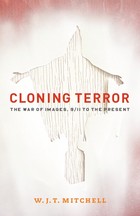
The phrase “War on Terror” has quietly been retired from official usage, but it persists in the American psyche, and our understanding of it is hardly complete. Nor will it be, W. J. T Mitchell argues, without a grasp of the images that it spawned, and that spawned it.
Exploring the role of verbal and visual images in the War on Terror, Mitchell finds a conflict whose shaky metaphoric and imaginary conception has created its own reality. At the same time, Mitchell locates in the concept of clones and cloning an anxiety about new forms of image-making that has amplified the political effects of the War on Terror. Cloning and terror, he argues, share an uncanny structural resemblance, shuttling back and forth between imaginary and real, metaphoric and literal manifestations. In Mitchell’s startling analysis, cloning terror emerges as the inevitable metaphor for the way in which the War on Terror has not only helped recruit more fighters to the jihadist cause but undermined the American constitution with “faith-based” foreign and domestic policies.
Bringing together the hooded prisoners of Abu Ghraib with the cloned stormtroopers of the Star Wars saga, Mitchell draws attention to the figures of faceless anonymity that stalk the ever-shifting and unlocatable “fronts” of the War on Terror. A striking new investigation of the role of images from our foremost scholar of iconology, Cloning Terror will expand our understanding of the visual legacy of a new kind of war and reframe our understanding of contemporary biopower and biopolitics.
Explore new routes into the burgeoning field of biblical literature and film theory
The present collection of essays is a sequel to the groundbreaking Semeia 74 issue, published in 1996, entitled Biblical Glamour and Hollywood Glitz. These new essays showcase the divergent approaches from film studies and cultural studies that can be used in the visual analysis of biblical and religious themes, narratives, and characters in cinema. It is the first volume that specifically addresses issues of methodology, theory, and analysis in the study between bible and film. As such, this collection is of interest to scholars in film studies and theology/religion/biblical studies, who are invested in doing interdisciplinary research in the expanding field of religion and film.
Features
- Specific focus on methods of film analysis, rather than the more common focus on thematic analysis in the study of religion, Bible, and film.
- Visual analysis in the encounter between Bible and film
- Fourteen essays and an introduction by top scholars in the field
In Closed Circuits, Garrett Stewart analyzes a broad spectrum of films, from M and Rear Window through The Conversation to Déjà Vu, Source Code, and The Bourne Legacy, in which cinema has articulated—and performed—the drama of inspection’s unreturned look. While mainstays of the thriller, both the act and the technology of surveillance, Stewart argues, speak to something more foundational in the very work of cinema. The shared axis of montage and espionage—with editing designed to draw us in and make us forget the omnipresence of the narrative camera—extends to larger questions about the politics of an oversight regime that is increasingly remote and robotic. To such a global technopticon, one telltale response is a proliferating mode of digitally enhanced “surveillancinema.”


Widely praised when first published in France, The Coherence of Kant's Doctrine of Freedom articulates and interrelates the disparate senses of freedom in Kant's work. Bernard Carnois organizes all Kant's usages into a logical "grammar," isolating and defining the individual meanings and pointing out their implications and limits. In a first step, he shows how Kant's notion of intelligible character makes possible a synthesis of transcendental freedom, as a problematic concept of theoretical reason, and practical freedom, as a fact demonstrated by experience. He then develops the concept of freedom under the rubric of the will's autonomy in the context of the moral law. And finally, Carnois persistently explores the role of negativity in Kant's idea of freedom. For within the magisterial coherence of the system the imperfection of human finitude is inscribed. This introduces the "history" of our freedom—a freedom which posits itself, but then inevitably denies itself, even while preserving the possibility of its regeneration.
The only work in English to consider in detail all of Kant's writings on freedom, this book also introduces French Kant scholars whose works have often been unavailable to English-speaking readers. As both an interpretation of Kant and a trenchant analysis of the relationship between ethical commitments and metaphysical assumptions, it will be a useful addition to moral, religious, and political philosophy as well as to Kant scholarship.

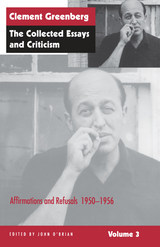
With the inclusion of critical exchanges between Greenberg and F. R. Leavis, Fairfield Porter, Thomas B. Hess, Herbert Read, Max Kozloff, and Robert Goldwater, these volumes are essential sources in the ongoing debate over modern art. For each volume, John O'Brian has furnished an introduction, a selected bibliography, and a brief summary of events that places the criticism in its artistic and historical context.

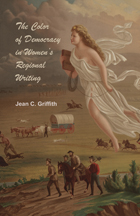
American regionalism has become a contested subject in literary studies alongside the ubiquitous triad of race, class, and gender. The Color of Democracy in Women's Regional Writing enters into the heart of an ongoing debate in the field about the significance of regional fiction at the end of the 19th century. Jean Griffith presents the innovative view that regional writing provided Edith Wharton, Ellen Glasgow, and Willa Cather with the means to explore social transformation in a form of fiction already closely associated with women readers and writers.
Griffith provides new readings of texts by these authors; she places them alongside the works of their contemporaries, including William Faulkner and Langston Hughes, to show regionalism's responses to the debate over who was capable of democratic participation and reading regionalism's changing mediations between natives and strangers as reflections of the changing face of democracy.
This insightful work enriches the current debate about whether regionalism critiques hierarchies or participates in nationalist and racist agendas and will be of great interest to those invested in regional writing or the works of these significant authors.
In 1858, Cyprian Clamorgan wrote a brief but immensely readable book entitled The Colored Aristocracy of St. Louis. The grandson of a white voyageur and a mulatto woman, he was himself a member of the "colored aristocracy." In a setting where the vast majority of African Americans were slaves, and where those who were free generally lived in abject poverty, Clamorgan's "aristocrats" were exceptional people. Wealthy, educated, and articulate, these men and women occupied a "middle ground." Their material advantages removed them from the mass of African Americans, but their race barred them from membership in white society.
The Colored Aristocracy of St. Louis is both a serious analysis of the social and legal disabilities under which African Americans of all classes labored and a settling of old scores. Somewhat malicious, Clamorgan enjoyed pointing out the foibles of his friends and enemies, but his book had a serious message as well. "He endeavored to convince white Americans that race was not an absolute, that the black community was not a monolith, that class, education, and especially wealth, should count for something."
Despite its fascinating insights into antebellum St. Louis, Clamorgan's book has been virtually ignored since its initial publication. Using deeds, church records, court cases, and other primary sources, Winch reacquaints readers with this important book and establishes its place in the context of African American history. This annotated edition of The Colored Aristocracy of St. Louis includes an introductory essay on African Americans in St. Louis before the Civil War, as well as an account of the lives of the author and the members of his remarkable family—a family that was truly at the heart of the city's "colored aristocracy" for four generations.
A witty and perceptive commentary on race and class, The Colored Aristocracy of St. Louis is a remarkable story about a largely forgotten segment of nineteenth-century society. Scholars and general readers alike will appreciate Clamorgan's insights into one of antebellum America's most important communities.
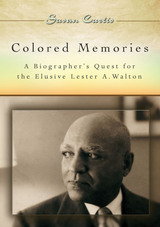
Lester A. Walton was a well-known public figure in his day. An African American journalist, cultural critic, diplomat, and political activist, he was an adviser to presidents and industrialists in a career that spanned the first six decades of the twentieth century. He was a steadfast champion of democracy and lived to see the passage of major civil rights legislation. But one word best describes Walton today: forgotten.
Exploring the contours of this extraordinary life, Susan Curtis seeks to discover why our collective memory of Walton has failed. In a unique narrative of historical research, she recounts a fifteen-year journey, from the streets of Harlem and “The Ville” in St. Louis to scattered archives and obscure public records, as she uncovers the mysterious circumstances surrounding Walton’s disappearance from national consciousness. And despite numerous roadblocks and dead ends in her quest, she tells how she came to know this emblematic citizen of the American Century in surprising ways.
In this unconventional book—a postmodern ghost story, an unprecedented experiment in life-writing—Curtis shares her discoveries as a researcher. Relating her frustrating search through long-overlooked documents to discover this forgotten man, she offers insight into how America’s obsession with race has made Walton’s story unwelcome. She explores the treachery, duplicity, and archival accidents that transformed a man dedicated to the fulfillment of American democracy into a shadowy figure.
Combining anecdotal memories with the investigative instincts of the historian, Curtis embraces the subjectivity of her research to show that what a society forgets or suppresses is just as important as what it includes in its history. Colored Memories is a highly original work that not only introduces readers to a once-influential figure but also invites us to reconsider how we view, understand, and preserve the past.
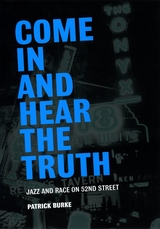
Come In and Hear the Truth uses a range of materials, from classic photographs to original interviews with musicians, to bring the street’s vibrant history to life and to shed new light on the interracial contacts and collaborations it generated.
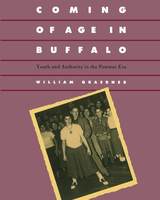
Pegged pants poodle skirts, record hops, rock ‘n’ roll, soda shops: in the interval between the bombing of Hiroshima and the assassination of John F. Kennedy, these were distinguishing marks of the "typical" postwar teenager-if there was a "typical" teenager. In this richly illustrated account of Youth in postwar Buffalo, William Graebner argues that the so-called Youth culture was really a variety of "disparate subcultures, united by age but in conflict over class, race, ethnicity, and gender." Using scrap books, oral histories, school Yearbooks, and material culture, he shows how Buffalo teenagers were products of diverse and often antagonistic subcultures. The innocuous strains of "Rock Around the Clock" muffled the seething gang loyalties and countercultural influence of James Dean, Marlon Brando, and Buffalo’s own "Hound Dog" Lorenz. Racial antipathies once held in check spilled out on Memorial Day, 1956, when white and black Youth clashed on board a take Erie pleasure boat in a "riot" that recast the city’s race relations for decades to come.
While exploring the diversity within Youth subcultures, Graebner examines the ways in which adults—educators, clergy, representatives of the media, and other authorities—sought to contain this generation. The Hi-Teen Club, Buffalo Plan dress code, record hops, graduation ceremonies, film censorship, and restrictions on secret societies and on corner lounging were all forms of social engineering that reinforced social and economic boundaries that were at the heart of the dominant culture. The prevailing adult influence on activities, attitudes, and style served to redirect the "misguided Youth" of the fifties and to obliterate their image from public memory. Although the media still portrays this decade as the golden age of cultural homogeneity, the diversity in musical preferences, hair and clothing styles, and allegiances to disc jockeys suggest the wide diversity of Youth experiences and challenges to adult authority that were part of coming of age in postwar America.
In this absorbing memoir, Merrill D. Peterson traces his progress from a young Kansas Republican to a "Left Liberal," Democrat by reconstructing how the New Republic singularly influenced his intellectual development and academic career during some of the most turbulent years in American history—the final years of the Great Depression through World War II and the beginnings of the Cold War. Peterson recalls how, as a young man, he was guided to intellectual maturity by such extraordinary individuals as Max Lerner, Archibald MacLeish, Vincent Sheean, Alfred Kazin, Lewis Mumford, and Malcolm Cowley—all contributors to this important magazine. We look back, with Peterson, and see how their views are inextricably reflected in his own developing worldview.
Peterson was introduced to this liberal weekly by one of his teachers during his senior year of high school (1938-1939). For the next ten years, the magazine served as his principal guide to the politics and culture of the times. Now, at seventy-eight years of age, Peterson revisits the magazine that he read so eagerly during those early, impressionable years. With considerable skill and charm, Peterson weaves together the fresh reading, the history of the country during the 1940s, and his own personal history to give us the heart of the book. In addition, he includes brief essays on Vernon L. Parrington, Lewis Mumford, and Max Lerner, the three American writers and intellectuals he believes had the most influence on him.
Peterson discusses several turning points in his young life, but he focuses primarily on his education and the role the magazine played in it. The book concludes when Peterson, with a Ph.D. in the history of American civilization, accepts his first academic appointment, at Brandeis University, and approaches the publication of his first book. Thus, a critical chapter in his life comes to a close.
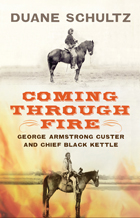
The cold dawn of November 27, 1868, was the moment George Armstrong Custer had longed for ever since the Civil War ended three years before. It was also the moment Black Kettle of the Cheyenne nation had feared ever since he had survived the deadly attack on his people at Sand Creek, Colorado Territory. Custer, who gloried in battle, was no longer the national hero, the celebrity he had been in wartime. He was a forgotten man who had failed in his first Indian campaign the year before. He needed a resounding victory to resurrect the attention he craved, and the sleepy Cheyenne village along the banks of the Washita River—ironically near present-day Cheyenne, Oklahoma—proved irresistible. Custer led his 7th U.S. Cavalry in an early morning charge that wiped out the encampment, killing those who resisted and some of those who fled. Black Kettle’s Cheyenne had signed documents of peace with the U.S. Government as they had done before Sand Creek, but once again that did not protect them. Custer ordered his troops to capture women and children and traveled with these prisoners as a way to shield his column from a retaliatory strike on their way back to their post. Called both a massacre and a battle, the action at the Washita River returned Custer to national prominence as the “greatest Indian fighter of all.”
Coming Through Fire: George Armstrong Custer and Chief Black Kettle tells the converging stories of a Civil War hero and a native warrior who met along the Washita River. Black Kettle had given up fighting—he had “come through the fire”— and made his mark on treaty after treaty to try to save the Cheyenne and their way of life from the encroachments of the U.S. government and white settlers. He watched the government breach the terms of each treaty, yet he continued to work for a compromise, knowing that negotiations were the only way his people could survive. But the flood of wagon trains and settlements, the killing of the great buffalo herds, the new diseases and broken promises, political ambition, naked greed, and continuing restrictions on land, food, and shelter persisted. As the U.S. Army, including Custer, continued to attack and forceably move Indians to reservations despite treaties indicating otherwise, Black Kettle’s dreams of peace were shattered. He ended his life face down in the freezing waters of the Washita River, shot by one of Custer’s troopers. The “greatest Indian fighter” would not survive the Indian Wars either, cut down near the Little Big Horn River, in part for his actions against Black Kettle and the Cheyenne.
Coming through the Fire, with its fiercely intelligent, passionate, and clear-eyed view of race and class conflict, makes a major contribution to understanding—and thereby healing—the terrible rift that has opened up in the heart of America. Lincoln explores the nature of biracial relationships, the issue of transracial adoption, violence—particularly black-on-black violence—the “endangered” black male, racism as power, the relationship between Blacks and Jews, our multicultural melting pot, and Minister Louis Farrakhan.Without sidestepping painful issues, or sacrificing a righteous anger, the author argues for “no-fault reconciliation,” for mutual recognition of the human endowment we share regardless of race, preparing us as a nation for the true multiculture tomorrow will demand.
Readers familiar with Lincoln’s earlier groundbreaking work on the Black Muslims and on the black church will be eagerly awaiting the publication of Coming through the Fire. Others will simply find C. Eric Lincoln’s personal story and his exploration of survival and race in America to be absorbing and compelling reading.
Previously available only in an expensive hardcover set, Commentaries on the Laws of England is published here in four separate volumes, each one affordably priced in a paperback edition. These works are facsimiles of the eighteenth-century first edition and are undistorted by later interpolations. Each volume deals with a particular field of law and carries with it an introduction by a leading contemporary scholar.
Introducing this third volume, Of Private Wrongs, John H. Langbein discusses Blackstone's account of procedure and jurisdiction, jury trial, and equity. He also examines Blackstone's uneasy attitude toward the celebrated legal frictions of English civil procedure.

Commentary on Thucydides, Book 3 remedies this situation by offering detailed linguistic explanations and grammatical clarifications designed to appeal both to seasoned Classicists and to a broader group of non-specialist readers who may still be developing their Greek language skills. Starting with 428 BCE, Book 3 covers a critical period of the Peloponnesian War in which the conflict began to manifest its extraordinary violence and scale. The book contains influential and controversial discussions, including Thucydides’ own analysis of the nature of war and the ways that it teaches “lessons of violence” to individuals and states. Book 3 also features the famous Mytilenean Debate, an argument premised on the thesis that all international relations are, or should be, fundamentally amoral. Educated readers have always looked to Thucydides in turbulent times, and this commentary will open up his text to a wider audience.
Forgoing discussions of technology, Shelton instead concentrates on the communication principles that can motivate an audience to achieve a particular goal—a goal that must be realistic, worthwhile, and appropriate. His inventive approach coalesces theory of the media with its philosophy, analysis, history, and application, as well as his own informed personal opinions. This valuable guide examines how to effectively encode information in motion-media by using in-depth communication analysis and pertinent filmic design. Throughout, Shelton emphasizes that kinetic visuals, rather than audio, are the defining elements of the best motion-media communication. Organized into five parts that can be used independently or in sequence, the volume frames key topics in the industry that collectively form a cohesive strategy for motion-media design and production. First, Shelton discusses the essence of the medium as a communication tool. In the second part, he addresses the forms and functions of motion-media. The third part details communication analysis and its application. Next, Shelton delves into script design, distribution, and career growth. Lastly, he offers advice on business aspects of the profession. Told from the vantage point of a seasoned expert, Communicating Ideas with Film, Video, and Multimedia is a “how to do it” book as well as a treatise on “why to do it.” Shelton’s narrative is complemented by twenty-six illustrations (including multimedia flowcharts, sample forms, and photographs of some of the great documentary filmmakers), a variety of script formats, and a listing of the all-time best documentary films.
Communication and Development was first published in 1966. Minnesota Archive Editions uses digital technology to make long-unavailable books once again accessible, and are published unaltered from the original University of Minnesota Press editions.
What role does communication play in the economic, social, and political development of a community? The results of the study reported here, based on comprehensive field work in two small villages in India, throw considerable light on that question, one which is of fundamental importance to those concerned with rates and patterns of growth in any developing country.
In this study, the term "communication" refers to a social process—the flow of information, the circulation of knowledge and ideas in society, the propagation and internalization of thoughts. It does not refer to the media or means of communication, such as electronics, roads and railways, or vehicles.
The two villages studied, both in South India, were at contrasting stages of development. One was becoming industrialized, while the other still clung to such traditional ways as the barter system. To carry out the field work for his study, Dr. Rao lived in these villages for several months, talking at length with the people, obtaining information about their attitudes, beliefs, and opinions, and observing them and their surroundings with a trained eye. He also checked official records for pertinent information. He analyzes his findings from a psychological and sociological standpoint and, in addition, provides an intimate description of the village life.
The book will be of particular interest to communications specialists, anthropologists, sociologists, political scientists, economists, and others concerned with studies of the developing countries in Asia, Africa, and Latin America.
Winner of the Ralph Bunche Award, American Political Science Association
No socialist organization has ever had a more profound effect on black life than the Communist Party did in Harlem during the Depression. Mark Naison describes how the party won the early endorsement of such people as Adam Clayton Powell Jr. and how its support of racial equality and integration impressed black intellectuals, including Richard Wright, Langston Hughes, and Paul Robeson.
This meticulously researched work, largely based on primary materials and interviews with leading black Communists from the 1930s, is the first to fully explore this provocative encounter between whites and blacks. It provides a detailed look at an exciting period of reform, as well as an intimate portrait of Harlem in the 1920s and 30s, at the high point of its influence and pride.
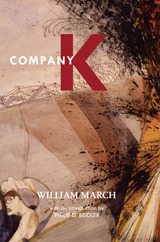
Through fragmented testimonies of Marines, the novel exposes the psychological and moral wreckage left in the wake of modern warfare.
This book was originally published in 1933. It is the first novel by William March, pen name for William Edward Campbell. Stemming directly from the author's experiences with the US Marines in France during World War I, the book consists of 113 sketches, or chapters, tracing the fictional Company K's war exploits and providing an emotional history of the men of the company that extends beyond the boundaries of the war itself.
William Edward Campbell served courageously in France as evidenced by his chestful of medals and certificates, including the Croix de Guerre, the Distinguished Service Cross, and the Navy Cross. However, without the medals and citations we would know of his bravery. For it is clear in the pages of Company K that this book was written by a man who had been to war, who had clearly seen his share of the worst of it, who had somehow survived, and who had committed himself afterward to the new bravery of sense-making embodied in the creation of major literary art. It is of that bravery that we still have the record of magnificent achievement, the brave terrible gift of Company K.

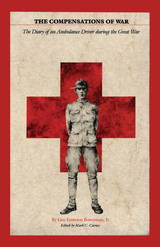
In 1917, shortly after the United States’ declaration of war on Germany, Guy Emerson Bowerman, Jr., enlisted in the American army’s ambulance service. Like other young ambulance drivers—Hemingway, Dos Passos, Cummings, Cowley—Bowerman longed to “see the show.” He was glad to learn that the ambulance units were leaving for France right away.
For seventeen months, until the armistice of November 1918, Bowerman kept an almost daily diary of the war. To read his words today is to live the war with an immediacy and vividness of detail that is astonishing.
Only twenty when he enlisted, Bowerman was an idealistic, if snobbish, young man who exulted that his section was made up mostly of young “Yalies” like himself. But he expected the war to change him, and it did. In the end he writes that he and his compatriots scarcely remember a world at peace. "The old life was gone forever. . ."
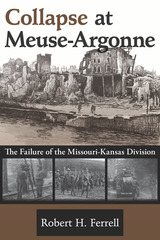
Guy Bowerman’s unit was attached to a French infantry division stationed near Verdun. Sent to halt the German drive to Paris in 1918, the division participated in the decisive counterattack of July and tracked the routed Germans through Belgium. Then, “unwarned,” Bowerman and his comrades were “plunged into … a life of peace.” Into this life, he writes, they walked “bewildered,” like “men fearing ambush.”
This remarkable chronicle of one young man’s rite of passage is destined to become a classic in the literature of the Great War.
For the Centennial Edition two of the original translations have been replaced. In the original publication David Grene translated only one of the three Theban plays, Oedipus the King. Now he has added his own translations of the remaining two, Oedipus at Colonus and Antigone, thus bringing a new unity of tone and style to this group. Grene has also revised his earlier translation of Prometheus Bound and rendered some of the former prose sections in verse. These new translations replace the originals included in the paperback volumes Sophocles I (which contains all three Theban plays), Aeschylus II, Greek Tragedies, Volume I, and Greek Tragedies, Volume III, all of which are now being published in second editions.
All other volumes contain the translations of the tragedies of Aeschylus, Sophocles, and Euripides for the most part from the original versions first published in the 1940s and 1950s. These translations have been the choice of generations of teachers and students, selling in the past forty years over three million copies.
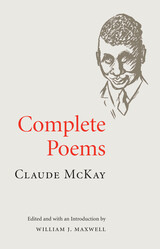
Containing more than three hundred poems, including nearly a hundred previously unpublished works, this unique collection showcases the intellectual range of Claude McKay (1889-1948), the Jamaican-born poet and novelist whose life and work were marked by restless travel and steadfast social protest. McKay's first poems were composed in rural Jamaican creole and launched his lifelong commitment to representing everyday black culture from the bottom up. Migrating to New York, he reinvigorated the English sonnet and helped spark the Harlem Renaissance with poems such as "If We Must Die." After coming under scrutiny for his communism, he traveled throughout Europe and North Africa for twelve years and returned to Harlem in 1934, having denounced Stalin's Soviet Union. By then, McKay's pristine "violent sonnets" were giving way to confessional lyrics informed by his newfound Catholicism.
McKay's verse eludes easy definition, yet this complete anthology, vividly introduced and carefully annotated by William J. Maxwell, acquaints readers with the full transnational evolution of a major voice in twentieth-century poetry.
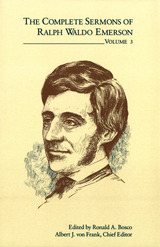
The forty-five sermons collected in Volume 3 were composed and first delivered between October 1830 and November 1831. During that time Emerson's first wife, Ellen Tucker Emerson, died of tuberculosis, a loss that deeply affected Emerson.
Transcribed and edited from manuscripts in Harvard's University's Houghton Library, the sermons are presented in a clear text approximating as nearly as possible the original version delivered to Emerson's congregation. As well as the detailed chronology, explanatory footnotes, and textual endnotes found in previous volumes, this one contains a comprehensive index.
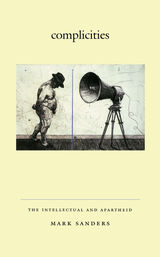
Sanders gives detailed analyses of widely divergent thinkers: Afrikaner nationalist poet N. P. van Wyk Louw, Drum writer Bloke Modisane, Xhosa novelist A. C. Jordan, Afrikaner dissident Breyten Breytenbach, and Black Consciousness leader Steve Biko. Drawing on theorists including Derrida, Sartre, and Fanon, and paying particular attention to the linguistic intricacy of the literary and political texts considered, Sanders shows how complicity emerges as a predicament for intellectuals across the ideological and social spectrum. Through discussions of the colonial intellectuals Olive Schreiner and Sol T. Plaatje and of post-apartheid feminist critiques of the Truth and Reconciliation Commission, Complicities reveals how sexual difference joins with race to further complicate issues of collusion.
Complicities sheds new light on the history and literature of twentieth-century South Africa as it weighs into debates about the role of the intellectual in public life.
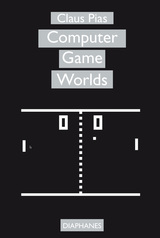
With Computer Game Worlds, Claus Pias sets out to answer these questions. Tracing computer games from their earliest forms to the unstoppable commercial and cultural phenomena they have become today, Pias then provides a careful epistemological reconstruction of the process of playing games, both at computers and by computers themselves. The book makes a valuable theoretical contribution to the ongoing discussion about computer games.
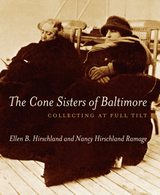
This richly illustrated biography documents their lives from a unique perspective: that of their great-niece, who wrote this book with her daughter. Ellen B. Hirschland and Nancy Hirschland Ramage delve into Claribel’s and Etta’s world, following the sisters through letters and personal stories as they travel to meet some of the artists whose works would turn their adjoining apartments into a gallery. They bought art by Manet, Gauguin, and Cézanne, as well as of Picasso and Matisse, whom they came to know well. The sisters’ experiences in Paris from 1901 through the 1920s provide an exceptional view of the bright artistic ferment in the city at that time. They were two Victorian women from Baltimore buying avant-garde masterpieces, attending salons with friends Gertrude and Leo Stein, and building a collection that would initially enrage the conservative people around them. Only with time would their keen eyes and unwavering taste prove them right.
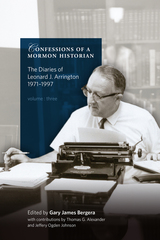
Leonard Arrington (1917–99) was born an Idaho chicken rancher whose early interests seemed not to extend much beyond the American west. Throughout his life, he tended to project a folksy persona, although nothing was farther from the truth.
He was, in fact, an intellectually oriented, academically driven young man, determined to explore the historical, economic, cultural, and religious issues of his time. After distinguishing himself at the University of North Carolina (Chapel Hill) and serving in the army during World War II in North Africa and Italy, Arrington accepted a professorship at Utah State University. In 1972 he was called as the LDS Church Historian—an office he held for ten years until, following a stormy tenure full of controversy over whether the “New Mormon History” he championed was appropriate for the church, he was quietly released and transferred, along with the entire Church History Division, to Brigham Young University. It was hoped that this would remove the impression in people’s minds that his writings were church-approved.
His personal diaries reveal a man who was firmly committed to his church, as well as to rigorous historical scholarship. His eye for detail made him an important observer of “church headquarters culture.”
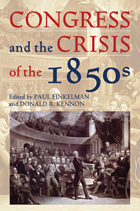
During the long decade from 1848 to 1861 America was like a train speeding down the track, without an engineer or brakes. The new territories acquired from Mexico had vastly increased the size of the nation, but debate over their status—and more importantly the status of slavery within them—paralyzed the nation. Southerners gained access to the territories and a draconian fugitive slave law in the Compromise of 1850, but this only exacerbated sectional tensions. Virtually all northerners, even those who supported the law because they believed that it would preserve the union, despised being turned into slave catchers. In 1854, in the Kansas-Nebraska Act, Congress repealed the ban on slavery in the remaining unorganized territories. In 1857, in the Dred Scott case, the Supreme Court held that all bans on slavery in the territories were unconstitutional. Meanwhile, northern whites, free blacks, and fugitive slaves resisted the enforcement of the 1850 fugitive slave law. In Congress members carried weapons and Representative Preston Brooks assaulted Senator Charles Sumner with a cane, nearly killing him. This was the decade of the 1850s and these were the issues Congress grappled with.
This volume of new essays examines many of these issues, helping us better understand the failure of political leadership in the decade that led to the Civil War.
Contributors
Spencer R. Crew
Paul Finkelman
Matthew Glassman
Amy S. Greenberg
Martin J. Hershock
Michael F. Holt
Brooks D. Simpson
Jenny Wahl
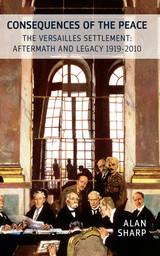
This revised and updated edition of The Consequences of the Peace sets the ramifications of the Paris Peace treaties—for good or ill—within a long-term context. Alan Sharp presents new materials in order to argue that the responsibility for Europe’s continuing interwar instability cannot be wholly attributed to the peacemakers of 1919–23. Marking the centenary of World War I and the approaching centenary of the Peace Conference itself, this book is a clear and concise guide to the global legacy of the Versailles Settlement.
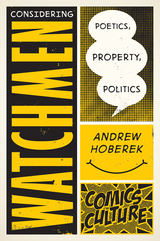
Demonstrating a keen eye for historical detail, Considering Watchmen gives readers a new appreciation of just how radical Moore and Gibbons’s blend of gritty realism and formal experimentation was back in 1986. The book also considers Watchmen’s place in the history of the comics industry, reading the graphic novel’s playful critique of superhero marketing alongside Alan Moore’s public statements about the rights to the franchise. Andrew Hoberek examines how Moore and Gibbons engaged with the emerging discourses of neoconservatism and neoliberal capitalism, ideologies that have only become more prominent in subsequent years.
Watchmen’s influences on the superhero comic and graphic novel are undeniable, but Hoberek reveals how it has also had profound effects on literature as a whole. He suggests that Watchmen not only proved that superhero comics could rise to the status of literature—it also helped to inspire a generation of writers who are redefining the boundaries of the literary, from Jonathan Lethem to Junot Díaz. Hoberek delivers insight and analysis worthy of satisfying serious readers of the genre while shedding new light on Watchmen as both an artistic accomplishment and a book of ideas.

READERS
Browse our collection.
PUBLISHERS
See BiblioVault's publisher services.
STUDENT SERVICES
Files for college accessibility offices.
RECENTLY PUBLISHED



UChicago Accessibility Resources
home | accessibility | search | about | contact us
BiblioVault ® 2001 - 2026
The University of Chicago Press