front cover of Calculus for the Modern Engineer
Calculus for the Modern Engineer
Math and Programming at the Scale of Life
Jessy Grizzle
Michigan Publishing Services, 2026

In the ever-evolving landscape of engineering education, calculus stands as a foundational pillar, yet its teaching methods have remained largely unchanged for decades. This textbook is born out of a deep-seated need for reform. Traditional calculus courses struggle to incorporate relevant, real-world examples. The disconnect between mathematical theory and its real-world uses hinders the learning process and fails to fully engage students in the practical applications of calculus. A second core issue lies not in the examples used but in the selection of material and the overemphasis on lengthy, manual calculations that lack meaningful context. This book represents a radical departure from conventional approaches, inspired by Prof. Grizzle’s experience developing and teaching the first-semester course ROB 101 Computational Linear Algebra. Its goal is to breathe life into mathematics through programming and realistic examples. It begins by placing integration at the beginning of the learning process, starting with sums and progressing to integration, which is not only more intuitive but also lends itself well to programming applications, such as calculating the change in position of mobile robots from velocity curves. Following integration, the book delves into differentiation (both single-variable and multivariable) and its myriad applications. Traditional methods of computing integrals, such as antiderivatives and substitution methods, are then introduced and framed within the context of both manual calculations and modern symbolic tools. The journey continues through improper integrals, ordinary differential equations (ODEs), Laplace Transforms, and Feedback Control, encompassing a breadth of topics rarely seen in a single calculus course.  

[more]

front cover of Canaries in the Code Mine
Canaries in the Code Mine
Precarity and the Future of Tech Work
Max Papadantonakis
Temple University Press, 2025
The idea that the tech industry is a secure field with jobs and opportunities for growth is a myth. There is widespread precarity among software developers, who experience uncertainty, anxiety, and imposter syndrome as technological advancements threaten job security. Max Papadantonakis investigates this phenomenon in his revealing study, Canaries in the Code Mine. He indicates that precarity is not just about the risk of losing one’s job; it is about living in a career where basic needs and rights are not guaranteed.

Interviewing 120 software developers from leading tech firms, Papadantonakis shows how temporary contracts, project cancellations, and company downsizing undermine the security of even highly skilled professionals. He also highlights the systemic inequalities that shape the tech industry, showing how age, race, and gender often dictate the opportunities and responsibilities software developers have—or are denied.  

Canaries in the Code Mine highlights a disturbing reality of privilege and vulnerability within the tech industry. Papadantonakis engages in a critical discourse on the evolving nature of work in the digital era, emphasizing the need to shape an equitable future in the rapidly evolving landscape.

[more]

logo for University of Chicago Press
Chicago Guide to Preparing Electronic Manuscripts
The University of Chicago Press
University of Chicago Press, 1987
This guide to preparing manuscripts on computer offers authors and publishers practical assistance on how to use authors' disks or tapes for typesetting. When the thirteenth edition of The Chicago Manual of Style was published in 1982, the impact of personal computers on the publishing process had just begun to be felt. This new book supplements information in the Chicago Manual by covering the rapidly changing subject of electronic manuscripts. Since the early 1980s more and more authors have been producing manuscripts on computers and expecting their publishers to make use of the electronic version. For a number of reasons, including the proliferation of incompatible machines and software, however, publishers have not always found it easy to work with electronic manuscripts. The University of Chicago Press has been doing so since 1981, and in this book passes on the results of six years' experience with preparing such manuscripts and converting them to type.
[more]

front cover of China and the Internet
China and the Internet
Using New Media for Development and Social Change
Song Shi
Rutgers University Press, 2024
Two oversimplified narratives have long dominated news reports and academic studies of China’s Internet: one lauding its potentials to boost commerce, the other bemoaning state control and measures against the forces of political transformations. This bifurcation obscures the complexity of the dynamic forces operating on the Chinese Internet and the diversity of Internet-related phenomena. China and the Internet analyzes how Chinese activists, NGOs, and government offices have used the Internet to fight rural malnutrition, the digital divide, the COVID-19 pandemic, and other urgent problems affecting millions of people. It presents five theoretically informed case studies of how new media have been used in interventions for development and social change, including how activists battled against COVID-19. In addition, this book applies a Communication for Development approach to examine the use and impact of China’s Internet. Although it is widely used internationally in Internet studies, Communication for Development has not been rigorously applied in studies of China’s Internet. This approach offers a new perspective to examine the Internet and related phenomena in Chinese society.
[more]

front cover of Chromatic Algorithms
Chromatic Algorithms
Synthetic Color, Computer Art, and Aesthetics after Code
Carolyn L. Kane
University of Chicago Press, 2014
These days, we take for granted that our computer screens—and even our phones—will show us images in vibrant full color. Digital color is a fundamental part of how we use our devices, but we never give a thought to how it is produced or how it came about.
           
Chromatic Algorithms reveals the fascinating history behind digital color, tracing it from the work of a few brilliant computer scientists and experimentally minded artists in the late 1960s and early ‘70s through to its appearance in commercial software in the early 1990s. Mixing philosophy of technology, aesthetics, and media analysis, Carolyn Kane shows how revolutionary the earliest computer-generated colors were—built with the massive postwar number-crunching machines, these first examples of “computer art” were so fantastic that artists and computer scientists regarded them as psychedelic, even revolutionary, harbingers of a better future for humans and machines. But, Kane shows, the explosive growth of personal computing and its accompanying need for off-the-shelf software led to standardization and the gradual closing of the experimental field in which computer artists had thrived.
           
Even so, the gap between the bright, bold presence of color onscreen and the increasing abstraction of its underlying code continues to lure artists and designers from a wide range of fields, and Kane draws on their work to pose fascinating questions about the relationships among art, code, science, and media in the twenty-first century.
[more]

front cover of Coderspeak
Coderspeak
The Language of Computer Programmers
Guilherme Orlandini Heurich
University College London, 2024
Coderspeak delves into the hidden world of software development, offering a combined anthropological and technical approach that explores the coder community's impact on our digital landscape.

Software applications have taken over our lives. We use and are used by software many times a day. Nevertheless, we know very little about the invisibly ubiquitous workers who write software. Who are they and how do they perceive their practice? How does that shape how they collaborate to build the myriad of apps that we use every day? And how does that impact the users of apps?

Coderspeak provides a critical approach to the digital transformation of our world through an engaging and thoughtful analysis of the people who write software applications. It is a focused and in-depth look at one programming language and its community, Ruby, based on ethnographic research at a London company and conversations with members of the wider Ruby community in Europe, the Americas, and Japan.

This book shows that the place where people write code, the language they write it in, and the stories shared by that community are crucial in questioning and unpacking what it means to be a coder. Understanding this social group is essential if we are to grasp a future (and a present) in which computer programming increasingly dominates our lives.

 
[more]

front cover of Cognitive Sensing Technologies and Applications
Cognitive Sensing Technologies and Applications
G.R. Sinha
The Institution of Engineering and Technology, 2023
Cognitive sensing systems combined with IoTs and smart technologies are used in countless applications such as industrial robotics, computer-aided diagnosis, brain-computer interface (BCI), human-computer interaction (HCI), telemedicine, driverless cars and smart energy systems.
[more]

front cover of Collaborative Language Engineering
Collaborative Language Engineering
A Case Study in Efficient Grammar-Based Processing
Edited by Stephan Oepen, Dan Flickinger, Jun-ichi Tsujii, and Hans Uszkoreit
CSLI, 2001
Following high hopes and subsequent disillusionment in the late 1980s, the past decade of work in language engineering has seen a dramatic increase in the power and sophistication of statistical approaches to natural language processing, along with a growing recognition that these methods alone cannot meet the full range of demands for applications of NLP. While statistical methods, often described as 'shallow' processing techniques, can bring real advantages in robustness and efficiency, they do not provide the precise, reliable representations of meaning which more conventional symbolic grammars can supply for natural language. A consistent, fine-grained mapping between form and meaning is of critical importance in some NLP applications, including machine translation, speech prosthesis, and automated email response. Recent advances in grammar development and processing implementations offer hope of meeting these demands for precision.

This volume provides an update on the state of the art in the development and application of broad-coverage declarative grammars built on sound linguistic foundations - the 'deep' processing paradigm - and presents several aspects of an international research effort to produce comprehensive, re-usable grammars and efficient technology for parsing and generating with such grammars.

[more]

front cover of Collected Papers of Martin Kay
Collected Papers of Martin Kay
A Half Century of Computational Linguistics
Martin Kay, with the editorial assistance of Dan Flickinger and Stephan Oepen
CSLI, 2010
Since the dawn of the age of computers, researchers have been pushing the limits of available processing power to tackle the formidable challenge of developing software that can understand ordinary human language.  At the forefront of this quest for the past fifty years, Martin Kay has been a constant source of new algorithms which have proven fundamental to progress in computational linguistics. Collected Papers of Martin Kay, the first comprehensive collection of his works to date, opens a window into the growth of an increasingly important field of scientific research and development. 
 
 
[more]

logo for The Institution of Engineering and Technology
Computer Control of Real-Time Processes
S. Bennett
The Institution of Engineering and Technology, 1990
This book provides an introduction to many aspects of computer control. It covers techniques or control algorithm design and tuning of controllers; computer communications; parallel processing; and software design and implementation. The theoretical material is supported by case studies covering power systems control, robot manipulators, liquid natural as vaporisers, batch control of chemical processes; and active control of aircraft.
[more]

front cover of Computer Vision and Recognition Systems Using Machine and Deep Learning Approaches
Computer Vision and Recognition Systems Using Machine and Deep Learning Approaches
Fundamentals, technologies and applications
Chiranji Lal Chowdhary
The Institution of Engineering and Technology, 2021
Computer vision is an interdisciplinary scientific field that deals with how computers obtain, store, interpret and understand digital images or videos using artificial intelligence based on neural networks, machine learning and deep learning methodologies. They are used in countless applications such as image retrieval and classification, driving and transport monitoring, medical diagnostics and aerial monitoring.
[more]

logo for Intellect Books
Computers and Art
Second Edition
Edited by Stuart Mealing
Intellect Books, 2002
Computers and Art provides insightful perspectives on the use of the computer as a tool for artists. The approaches taken vary from its historical, philosophical and practical implications to the use of computer technology in art practice. The contributors include an art critic, an educator, a practising artist and a researcher. Mealing looks at the potential for future developments in the field, looking at both the artistic and the computational aspects of the field.
[more]

front cover of Computers in Education
Computers in Education
A Half-Century of Innovation
Robert Smith
CSLI, 2015
Described by the New York Times as a visionary “pioneer in computerized learning,” Patrick Suppes (1922-2014) and his many collaborators at Stanford University conducted research on the development, commercialization, and use of computers in education from 1963 to 2013. Computers in Education synthesizes this wealth of scholarship into a single succinct volume that highlights the profound interconnections of technology in education. By capturing the great breadth and depth of this research, this book offers an accessible introduction to Suppes’s striking work.
[more]

logo for University of Minnesota Press
Computers, Surveillance, and Privacy
David Lyon and Elia Zureik, Editors
University of Minnesota Press, 1996

Computers, Surveillance, and Privacy was first published in 1996. Minnesota Archive Editions uses digital technology to make long-unavailable books once again accessible, and are published unaltered from the original University of Minnesota Press editions.

From computer networks to grocery store checkout scanners, it is easier and easier for governments, employers, advertisers, and individuals to gather detailed and sophisticated information about each of us. In this important new collection, the authors question the impact of these new technologies of surveillance on our privacy and our culture.

Although surveillance-literally some people "watching over" others-is as old as social relationships themselves, with the advent of the computer age this phenomenon has acquired new and distinctive meanings. Technological advances have made it possible for surveillance to become increasingly global and integrated-both commercial and government-related personal data flows more frequently across national boundaries, and the flow between private and public sectors has increased as well.

Addressing issues of the global integration of surveillance, social control, new information technologies, privacy violation and protection, and workplace surveillance, the contributors to Computers, Surveillance, and Privacy grapple with the ramifications of these concerns for society today. Timely and provocative, this collection will be of vital interest to anyone concerned with resistance to social control and incursions into privacy.

Contributors: Jonathan P. Allen, Colin J. Bennett, Simon G. Davies, Oscar H. Gandy Jr., Calvin C. Gotlieb, Rob Kling, Gary T. Marx, Abbe Mowshowitz, Judith A. Perrolle, Mark Poster, Priscilla M. Regan, James B. Rule.

David Lyon is professor of sociology at Queen's University, Canada. His previous books include The Electronic Eye: The Rise of Surveillance Society (Minnesota, 1994). Elia Zureik is also professor of sociology at Queen's University, Canada, and coedited (with Dianne Hartling) The Social Context of the New Information and Communication Technologies (1987).

[more]

front cover of The Computer's Voice
The Computer's Voice
From Star Trek to Siri
Liz W. Faber
University of Minnesota Press, 2020

A deconstruction of gender through the voices of Siri, HAL 9000, and other computers that talk

Although computer-based personal assistants like Siri are increasingly ubiquitous, few users stop to ask what it means that some assistants are gendered female, others male. Why is Star Trek’s computer coded as female, while HAL 9000 in 2001: A Space Odyssey is heard as male? By examining how gender is built into these devices, author Liz W. Faber explores contentious questions around gender: its fundamental constructedness, the rigidity of the gender binary, and culturally situated attitudes on male and female embodiment.

Faber begins by considering talking spaceships like those in Star Trek, the film Dark Star, and the TV series Quark, revealing the ideologies that underlie space-age progress. She then moves on to an intrepid decade-by-decade investigation of computer voices, tracing the evolution from the masculine voices of the ’70s and ’80s to the feminine ones of the ’90s and ’00s. Faber ends her account in the present, with incisive looks at the film Her and Siri herself.

Going beyond current scholarship on robots and AI to focus on voice-interactive computers, The Computer’s Voice breaks new ground in questions surrounding media, technology, and gender. It makes important contributions to conversations around the gender gap and the increasing acceptance of transgender people. 
[more]

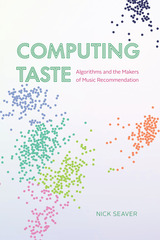
front cover of Computing Taste
Computing Taste
Algorithms and the Makers of Music Recommendation
Nick Seaver
University of Chicago Press, 2022
Meet the people who design the algorithms that capture our musical tastes.
 
The people who make music recommender systems have lofty goals: they want to broaden listeners’ horizons and help obscure musicians find audiences, taking advantage of the enormous catalogs offered by companies like Spotify, Apple Music, and Pandora. But for their critics, recommender systems seem to embody all the potential harms of algorithms: they flatten culture into numbers, they normalize ever-broadening data collection, and they profile their users for commercial ends. Drawing on years of ethnographic fieldwork, anthropologist Nick Seaver describes how the makers of music recommendation navigate these tensions: how product managers understand their relationship with the users they want to help and to capture; how scientists conceive of listening itself as a kind of data processing; and how engineers imagine the geography of the world of music as a space they care for and control.
 
Computing Taste rehumanizes the algorithmic systems that shape our world, drawing attention to the people who build and maintain them. In this vividly theorized book, Seaver brings the thinking of programmers into conversation with the discipline of anthropology, opening up the cultural world of computation in a wide-ranging exploration that travels from cosmology to calculation, myth to machine learning, and captivation to care.

[more]

front cover of Control-Based Operating System Design
Control-Based Operating System Design
Alberto Leva
The Institution of Engineering and Technology, 2013
Control-Based Operating System Design describes the application of system- and control-theoretical methods to the design of computer operating system components. It argues that computer operating system components should not be first 'designed' and then 'endowed with control', but rather when possible conceived from the outset as controllers, synthesised and assessed in the system-theoretical world of dynamic models, and then realised as control algorithms. Doing so is certainly a significant perspective shift with respect to current practices in operating system design, but the payoff is significant too. In some sense, adopting the suggested attitude means viewing computing systems as cyber-physical ones, where the operating system plays the computational role, the physical elements are the managed resources, and the various (control) functionalities to be realised, interact and co-operate as a network.
[more]

front cover of Conversation and Community
Conversation and Community
Chat in a Virtual World
Lynn Cherny
CSLI, 1999
Conversation and Community is an examination of the speech community in an Internet 'virtual community'. Based on ethnographic research on a community of users of a MUD, or 'multi-user dimension', the book describes a close-knit community united in features of their language use, shared history, and relationships to other online communities. The author invokes the notion of register, or the variety of speech adapted to the communication situation, in her discussion of how users overcome the limitations of the typed, text medium and exploit its affordances for comfortable communication. Routines, conventional vocabulary and abbreviations, syntactic and semantic phenomena, and special turn-taking and repair strategies distinguish the MUD community's register. Because the MUD is programmable, commands may be added which reflect, alter, or reinforce the linguistic practices and culture of the community; competent speakers must also know the commands that produce the correct linguistic forms.
[more]

front cover of The Cost of Free Shipping
The Cost of Free Shipping
Amazon in the Global Economy
Jake Alimahomed-Wilson
Pluto Press, 2021

Winner of the United Association for Labor Education Book Award 2021, this is essential reading for everyone who wants to understand the role of Amazon in our economy and society. With Amazon, supply-chain, and unionization in the news, it is both timely and incredibly informative.

Amazon is the most powerful corporation on the planet and its CEO, Jeff Bezos, has become one of the richest individuals in history, and one of the few people to profit from a global pandemic. Its dominance has reshaped the global economy itself: we live in the age of “Amazon Capitalism.” 

“One-click” instant consumerism and its immense variety of products has made Amazon a worldwide household name, with over 60% of US households subscribing to Amazon Prime. In turn, these subscribers are surveilled by the corporation. Amazon is also one of the world's largest logistics companies, resulting in weakened unions and lowered labor standards.

The company has also become the largest provider of cloud-computing services and home surveillance systems, not to mention the ubiquitous Alexa.

With cutting-edge analyses, this book looks at the many dark facets of the corporation, including automation, surveillance, tech work, workers' struggles, algorithmic challenges, the disruption of local democracy and much more. The Cost of Free Shipping shows how Amazon represents a fundamental shift in global capitalism that we should name, interrogate, and be primed to resist.

 

[more]

front cover of The Counterfeit Coin
The Counterfeit Coin
Videogames and Fantasies of Empowerment
Christopher Goetz
Rutgers University Press, 2023
The Counterfeit Coin argues that games and related entertainment media have become almost inseparable from fantasy. In turn, these media are making fantasy itself visible in new ways. Though apparently asocial and egocentric—an internal mental image expressing the fulfillment of some wish—fantasy has become a key term in social contestations of the emerging medium. At issue is whose fantasies are catered to, who feels powerful and gets their way, and who is left out. This book seeks to undo the monolith of commercial gaming by locating multiplicity and difference within fantasy itself. It introduces and tracks three broad fantasy traditions that dynamically connect apparently distinct strata of a game (story and play), that join games to other media, and that encircle players in pleasurable loops as they follow these connections.
[more]

front cover of Craft Obsession
Craft Obsession
The Social Rhetorics of Beer
Jeff Rice
Southern Illinois University Press, 2016
Denied access to traditional advertising platforms by lack of resources, craft breweries have proliferated despite these challenges by embracing social media platforms, and by creating an obsessed culture of fans. In Craft Obsession, Jeff Rice uses craft beer as a case study to demonstrate how social media platforms such as Facebook and Twitter function to shape stories about craft.

Rice weaves together theories of writing, narrative, new media, and rhetoric with a personal story of his passion for craft beer. He identifies six key elements of social media rhetoric—anecdotes, repetition, aggregation, delivery, sharing, and imagery—and examines how each helps to transform small, personal experiences with craft into a more widespread movement. When shared via social media, craft anecdotes—such as the first time one had a beer—interrupt and repeat one another, building a sense of familiarity and identity among otherwise unconnected people. Aggregation, the practice of joining unlike items into one space, builds on this network identity, establishing a connection to particular brands or locations, both real and virtual. The public releases of craft beers are used to explore the concept of craft delivery, which involves multiple actors across multiple spaces and results in multiple meanings. Finally, Rice highlights how personal sharing operates within the community of craft beer enthusiasts, who share online images of acquiring, trading for, and consuming a wide variety of beers. These shared stories and images, while personal for each individual, reflect the dependence of craft on systems of involvement. Throughout, Rice relates and reflects on his own experience as a craft beer enthusiast and his participation via social media in these systems.

Both an objective scholarly study and an engaging personal narrative about craft beer, Craft Obsession provides valuable insights into digital writing, storytelling, and social media.

[more]

front cover of Creating Generative AI Policies
Creating Generative AI Policies
A Guide for Public and Academic Libraries
Robin Hastings
American Library Association, 2026

Though it’s challenging to set policies for a technology that is so young and still in flux, the need is urgent. Because usage of AI presents both opportunities and risks, libraries must be proactive. The WEF (World Economic Forum) predicts that while there may be a loss of 92 million jobs to various AI tools, they see 170 million new jobs and roles emerging from the use of this new technology. Whether or not this proves correct, there are already digital literacy skills, including a basic understanding of the technology around AI, that libraries can help their patrons master; and because of data privacy, security, and ethics issues, library workers require clear AI policies too. Technology expert Hastings highlights the first attempts of libraries across the country to set up policies for the use of AI in their organizations, as well as policies created by cities and other similar institutions, to guide stakeholders in creating their own smart, forward-thinking course of action. Succinct and pragmatic, this timely resource 

  • provides a short overview of Generative AI history, basic technical knowledge, and the key arguments put forth by those in favor and those opposed to this technology;
  • offers advice on discovering how library staff encounter AI in their day-to-day work, both in their own usage and by patrons, to inform what policies the library needs and which policies to consider adjusting for particular use cases;
  • includes separate chapters focusing on staff-side policy and patron/public-facing policy, delving into essential considerations like staff training, privacy and data protection, security, AI usage for reference, patron education and AI literacy, and setting limits and boundaries on patron AI use;
  • suggests useful approaches to ensure that AI policies are easy to follow and understand by library workers, patrons, and the wider community; 
  • discusses how to craft flexible procedures that can be updated as AI continues to change, drawing on technology management best practices; and
  • offers links to additional resources like sample policy documents and a curated reading list for understanding the environment around AI. 
[more]

front cover of Critical Making in the Age of AI
Critical Making in the Age of AI
Emily Johnson and Anastasia Salter
Amherst College Press, 2025
Critical Making in the Age of AI invites students, teachers, learners, and digital humanists to explore making as scholarship. Inspired by the craft traditions of textile arts, this book combines a survey of forms of alternative scholarly communication—such as comics, GIFs, maps, games, and generative AI—and a pattern book, where patterns serve as starting points that makers can reimagine and remix. Firmly grounded in the humanities and utilizing free tools and platforms (including Twine, Voyant, and Tracery) wherever possible, this engaging and accessible guide to digital methods introduces and puts into practice concepts that are essential to preparing students to navigate a changing landscape of media and information without investing in proprietary software, dedicated lab space, or expensive creative tools.

The book’s eight patterns are especially appropriate for those just beginning to explore digital scholarly methods, and one goal of Critical Making in the Age of AI is to provide structure for work that is both meaningful and achievable with limited resources and time. By centering critical making through a design-justice and feminist lens, the coauthors model how inclusive and expansive approaches to making in research and teaching are vital to shaping the humanities of the future.
[more]

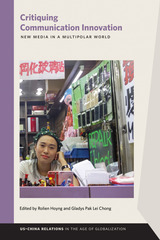
front cover of Critiquing Communication Innovation
Critiquing Communication Innovation
New Media in a Multipolar World
Rolien Hoyng
Michigan State University Press, 2022
Challenges to Silicon Valley’s dominant role in conjuring and patenting the world’s technological futures are arising around the world. As digital media technologies emerge from new, globally dispersed locations, a multipolar order of communication innovation seems to be in the making. Yet recovering our ability to imagine futures otherwise requires negotiating conditions—economic, geopolitical, sociocultural, and ecological—rather than reproducing them under the pretext of breaking with the present. The essays in this volume examine research on such conditions critically and comparatively in a variety of geographies. Paying due attention to China’s rise as an innovative platform society and AI powerhouse, this book addresses the broader question of a shifting world order and trends that are shaped by China’s influence but that extend beyond its borders. Looking at multipolar communication innovation through various critical lenses, our technological futures simultaneously appear to be old, new, and uncertain, while the infrastructures and platforms underpinning communication innovation both affiliate communities and set them apart.
[more]

logo for The Institution of Engineering and Technology
Cryptography for Intelligent Healthcare Systems
Foundations and emerging architectures, Volume 1
Agbotiname Lucky Imoize
The Institution of Engineering and Technology, 2026
Intelligent healthcare systems refer to the use of technologies, such as IoT, big data, AI, and machine learning, to improve the quality and efficiency of healthcare delivery. Healthcare data is both valuable and sensitive, and patients' data is increasingly at risk from cyber attacks on medical devices and critical healthcare infrastructure, posing serious risks to patient health and safety or compromising sensitive user data. As healthcare provision relies upon numerous interconnected systems, to facilitate the diagnosis or treatment of patients' health conditions, these systems rely on advanced cryptography to secure and protect sensitive user information.
[more]

logo for The Institution of Engineering and Technology
Cryptography for Intelligent Healthcare Systems
Privacy, governance and deployment, Volume 2
Agbotiname Lucky Imoize
The Institution of Engineering and Technology, 2026
Intelligent healthcare systems refer to the use of technologies, such as IoT, big data, AI, and machine learning, to improve the quality and efficiency of healthcare delivery. Healthcare data is both valuable and sensitive, and patients' data is increasingly at risk from cyber attacks on medical devices and critical healthcare infrastructure, posing serious risks to patient health and safety or compromising sensitive user data. As healthcare provision relies upon numerous interconnected systems, to facilitate the diagnosis or treatment of patients' health conditions, these systems rely on advanced cryptography to secure and protect sensitive user information.
[more]

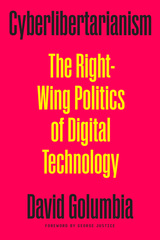
front cover of Cyberlibertarianism
Cyberlibertarianism
The Right-Wing Politics of Digital Technology
David Golumbia
University of Minnesota Press, 2024

An urgent reckoning with digital technology’s fundamentally right-wing legal and economic underpinnings

In a timely challenge to the potent political role of digital technology, Cyberlibertarianism argues that right-wing ideology was built into both the technical and social construction of the digital world from the start. Leveraging more than a decade of research, David Golumbia traces how digital evangelism has driven the worldwide shift toward the political right, concealing inequality, xenophobia, dishonesty, and massive corporate concentrations of wealth and power beneath the utopian presumption of digital technology as an inherent social good. 

Providing an incisive critique of the push for open access and open-source software and the legal battles over online censorship and net neutrality, Cyberlibertarianism details how the purportedly democratic internet has been employed as an organizing tool for terror and hate groups and political disinformation campaigns. As he unpacks our naively utopian conception of the digital world, Golumbia highlights technology’s role in the advancement of hyperindividualist and antigovernment agendas, demonstrating how Silicon Valley corporations and right-wing economists; antiestablishment figures such as Julian Assange, Elon Musk, Peter Thiel, Edward Snowden, and Mark Zuckerberg; and seemingly positive voices such as John Perry Barlow, Cory Doctorow, the Electronic Freedom Foundation, and Wikipedia all have worked to hamper regulation and weaken legal safeguards against exploitation.

Drawing from a wide range of thought in digital theory, economics, law, and political philosophy as well as detailed research and Golumbia’s own experience as a software developer, Cyberlibertarianism serves as a clarion call to reevaluate the fraught politics of the internet. In the hope of providing a way of working toward a more genuinely democratic and egalitarian future for digital technology, this magisterial work insists that we must first understand the veiled dogmas from which it has been constructed.

Retail e-book files for this title are screen-reader friendly.
[more]

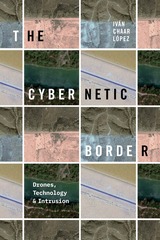
front cover of The Cybernetic Border
The Cybernetic Border
Drones, Technology, and Intrusion
Iván Chaar López
Duke University Press, 2024
In The Cybernetic Border, Iván Chaar López argues that the settler US nation requires the production and targeting of a racialized enemy that threatens the empire. The cybernetic border is organized through practices of data capture, storage, processing, circulation, and communication that police bodies and constitute the nation as a bounded, territorial space. Chaar López historicizes the US government’s use of border enforcement technologies on Mexicans, Arabs, and Muslims from the mid-twentieth century to the present, showing how data systems are presented as solutions to unauthorized border crossing. Contrary to enduring fantasies of the purported neutrality of drones, smart walls, artificial intelligence, and biometric technologies, the cybernetic border represents the consolidation of calculation and automation in the exercise of racialized violence. Chaar López draws on corporate, military, and government records, promotional documents and films, technical reports, news reporting, surveillance footage, and activist and artist practices. These materials reveal how logics of enmity are embedded into information infrastructures that shape border control and modern sovereignty.
[more]

front cover of Cyber-Proletariat
Cyber-Proletariat
Global Labour in the Digital Vortex
Nick Dyer-Witheford
Pluto Press, 2015
The utopian promise of the internet, much talked about even a few years ago, has given way to the information highway’s brutal realities: coltan mines in the Congo, electronics factories in China, devastated neighborhoods in Detroit. In Cyber-Proletariat, Nick Dyer-Witheford shows the dark side of the information revolution through an unsparing analysis of class power and computerization. He reveals how technology facilitates growing polarization between wealthy elites and precarious workers and how class dominates everything from expanding online surveillance to intensifying robotization. At the same time he looks at possibilities for information technology within radical movements, casting contemporary economic and social struggles in the blue glow of the computer screen.
            Cyber-Proletariat brings Marxist analysis to bear on a range of modern informational technologies. The result is a book indispensable to social theorists and hacktivists alike and essential reading for anyone who wants to understand how Silicon Valley shapes the way we live today.
[more]

front cover of Cybersecurity in Banking
Cybersecurity in Banking
Shriram K. Vasudevan
The Institution of Engineering and Technology, 2026
Technology plays a pivotal role in today's financial landscape. Ensuring cybersecurity and safety in the banking sector has become paramount. The pervasive integration of technology in banking operations has brought unprecedented convenience but also heightened the vulnerability of financial institutions to cyber threats. High-profile breaches and the potential consequences of compromised financial data have underscored the urgency of comprehensively addressing cyber security and safety in banking.
[more]

front cover of Cybersecurity in Emerging Healthcare Systems
Cybersecurity in Emerging Healthcare Systems
Agbotiname Lucky Imoize
The Institution of Engineering and Technology, 2024
Emerging healthcare networks are interconnected physical systems that use cyber technologies for interaction and functionality. The proliferation of massive internet-of-things (IoT) devices enables remote and distributed access to cutting-edge diagnostics and treatment options in modern healthcare systems. New security vulnerabilities are emerging due to the increasing complexity of the healthcare architecture, in particular, threats to medical devices and critical infrastructure pose significant concerns owing to their potential risks to patient health and safety. In recent times, patients have been exposed to high risks from attacks capable of disrupting critical medical infrastructure, communications facilities, and services, interfering with medical devices, or compromising sensitive user data.
[more]

front cover of Cyberspaces Of Everyday Life
Cyberspaces Of Everyday Life
Mark Nunes
University of Minnesota Press, 2006
Networks and computer-mediated communication now penetrate the spaces of everyday life at a fundamental level. We communicate, work, bank, date, check the weather, and fuel conspiracy theories online. In each instance, users interact with network technology as much more than a computational device.

Cyberspaces of Everyday Life provides a critical framework for understanding how the Internet takes part in the production of social space. Mark Nunes draws on the spatial analysis work of Henri Lefebvre to make sense of cyberspace as a social product. Looking at online education, he explores the ways in which the Internet restructures the university. Nunes also examines social uses of the World Wide Web and illustrates the ways online communication alters the relation between the global and the local. He also applies Deleuzian theory to emphasize computer-mediated communications’ performative elements of spatial production.

Addressing the social and cultural implications of spam and anti-spam legislation, as well as how the burst Internet stock bubble and the Patriot Act have affected the relationship between networked spaces and daily living, Cyberspaces of Everyday Life sheds new light on the question of virtual space and its role in the offline world.

Mark Nunes is associate professor and chair of the English, Technical Communication, and Media Arts Department at Southern Polytechnic State University.
[more]

front cover of Cyberwar and Revolution
Cyberwar and Revolution
Digital Subterfuge in Global Capitalism
Nick Dyer-Witheford
University of Minnesota Press, 2019

Uncovering the class conflicts, geopolitical dynamics, and aggressive capitalism propelling the militarization of the internet


Global surveillance, computational propaganda, online espionage, virtual recruiting, massive data breaches, hacked nuclear centrifuges and power grids—concerns about cyberwar have been mounting, rising to a fever pitch after the alleged Russian hacking of the U.S. presidential election and the Cambridge Analytica scandal. Although cyberwar is widely discussed, few accounts undertake a deep, critical view of its roots and consequences. 

Analyzing the new militarization of the internet, Cyberwar and Revolution argues that digital warfare is not a bug in the logic of global capitalism but rather a feature of its chaotic, disorderly unconscious. Urgently confronting the concept of cyberwar through the lens of both Marxist critical theory and psychoanalysis, Nick Dyer-Witheford and Svitlana Matviyenko provide a wide-ranging examination of the class conflicts and geopolitical dynamics propelling war across digital networks.

Investigating the subjectivities that cyberwar mobilizes, exploits, and bewilders, and revealing how it permeates the fabric of everyday life and implicates us all in its design, this book also highlights the critical importance of the emergent resistance to this digital militarism—hacktivism, digital worker dissent, and off-the-grid activism—for effecting different, better futures.

[more]

front cover of Cyberwars in the Middle East
Cyberwars in the Middle East
Ahmed Al-Rawi
Rutgers University Press, 2021
Cyberwars in the Middle East argues that hacking is a form of online political disruption whose influence flows vertically in two directions (top-bottom or bottom-up) or horizontally. These hacking activities are performed along three political dimensions: international, regional, and local. Author Ahmed Al-Rawi argues that political hacking is an aggressive and militant form of public communication employed by tech-savvy individuals, regardless of their affiliations, in order to influence politics and policies. Kenneth Waltz’s structural realism theory is linked to this argument as it provides a relevant framework to explain why nation-states employ cyber tools against each other.

On the one hand, nation-states as well as their affiliated hacking groups like cyber warriors employ hacking as offensive and defensive tools in connection to the cyber activity or inactivity of other nation-states, such as the role of Russian Trolls disseminating disinformation on social media during the US 2016 presidential election. This is regarded as a horizontal flow of political disruption. Sometimes, nation-states, like the UAE, Saudi Arabia, and Bahrain, use hacking and surveillance tactics as a vertical flow (top-bottom) form of online political disruption by targeting their own citizens due to their oppositional or activists’ political views. On the other hand, regular hackers who are often politically independent practice a form of bottom-top political disruption to address issues related to the internal politics of their respective nation-states such as the case of a number of Iraqi, Saudi, and Algerian hackers. In some cases, other hackers target ordinary citizens to express opposition to their political or ideological views which is regarded as a horizontal form of online political disruption. This book is the first of its kind to shine a light on many ways that governments and hackers are perpetrating cyber attacks in the Middle East and beyond, and to show the ripple effect of these attacks.
 
[more]


Send via email Share on Facebook Share on Twitter