
 A SCHOLARLY BOOK REPOSITORY
119 start with D start with D
Modernity rules our lives by clock and calendar, dividing the stream of time into units and coordinating every passing moment with the universal globe. Henry David Thoreau subverted both clock and calendar, using them not to regulate time’s passing but to open up and explore its presence. This little volume thus embodies, in small compass, Thoreau’s own ambition to “live in season”—to turn with the living sundial of the world, and, by attuning ourselves to nature, to heal our modern sense of discontinuity with our surroundings.
Ralph Waldo Emerson noted with awe that from flowers alone, Thoreau could tell the calendar date within two days; children remembered long into adulthood how Thoreau showed them white waterlilies awakening not by the face of a clock but at the first touch of the sun. As Thoreau wrote in Walden, “Time is but the stream I go a-fishing in. I drink at it; but while I drink I see the sandy bottom and detect how shallow it is.”
Drawn from the full range of Thoreau’s journals and published writings, and arranged according to season, The Daily Henry David Thoreau allows us to discover the endless variation and surprise to be found in the repetitions of mundane cycles. Thoreau saw in the kernel of each day an earth enchanted, one he honed into sentences tuned with an artist’s eye and a musician’s ear. Thoreau’s world lives on in his writing so that we, too, may discover, even in a fallen world, a beauty worth defending.
“How many a man has dated a new era in his life from the reading of a book,” wrote Henry David Thoreau in Walden. Today that book continues to provoke, inspire, and change lives all over the world, and each rereading is fresh and challenging. Yet as Thoreau's countless admirers know, there is more to the man than Walden. An engineer, poet, teacher, naturalist, lecturer, and political activist, he truly had multiple lives to lead, and each one speaks forcefully to us today.
Sponsored by the Thoreau Society, the brief, handsomely presented books in this series offer the thoughts of a great writer on a variety of topics, some that we readily associate with him, some that may be surprising. Each volume includes selections from his familiar published works as well as from less well known lectures, letters, and journal entries. The books include original engravings by renowned illustrator and book artist Barry Moser.
The vital role of dance in enacting the embodied experiences of Indigenous peoples
In Dancing Indigenous Worlds, Jacqueline Shea Murphy brings contemporary Indigenous dance makers into the spotlight, putting critical dance studies and Indigenous studies in conversation with one another in fresh and exciting new ways. Exploring Indigenous dance from North America and Aotearoa (New Zealand), she shows how dance artists communicate Indigenous ways of being, as well as generate a political force, engaging Indigenous understandings and histories.
Following specific dance works over time, Shea Murphy interweaves analysis, personal narrative, and written contributions from multiple dance artists, demonstrating dance’s crucial work in asserting and enacting Indigenous worldviews and the embodied experiences of Indigenous peoples. As Shea Murphy asserts, these dance-making practices can not only disrupt the structures that European colonization feeds upon and strives to maintain, but they can also recalibrate contemporary dance.
Based on more than twenty years of relationship building and research, Shea Murphy’s work contributes to growing, and largely underreported, discourses on decolonizing dance studies, and the geopolitical, gendered, racial, and relational meanings that dance theorizes and negotiates. She also includes discussions about the ethics of writing about Indigenous knowledge and peoples as a non-Indigenous scholar, and models approaches for doing so within structures of ongoing reciprocal, respectful, responsible action.

In response to a scarcity of writings on the intersections between dance and Christianity, Dancing to Transform examines the religious lives of American Christians who, despite the historically tenuous place of dance within Christianity, are also professional dancers.
Through a multi-site study of four professional dance companies, Wright conducted participant-observations and ethnographic interviews with artistic directors, choreographers, and company members who self-identify as Christian. She then analyzed choreography from each company to determine how concert dance becomes religious and what effects danced religious practices have for these participants. Her research reveals that the participants turn what they perceive as secular professional dance into different kinds of religious practices in order to actualize individual and communal religious identities—they dance to transform.
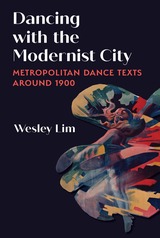
Drawing on cultural, literary, dance, performance, and queer studies, Dancing with the Modernist City analyzes an array of material from 1896 to 1914—essays, novels, short stories, poetry, newspaper articles, photographs, posters, drawings, and early film. It argues that these writers and artists created a genre called the metropolitan dance text, which depicts dancing figures not on a traditional stage, but with the streets, advertising pillars, theaters, cafes, squares, and even hospitals of an urban setting. Breaking away from the historically male, heteronormative view, this posthumanist mode of writing highlights the visual and episodic unexpectedness of urban encounters. These literary depictions question traditional conceptualizations of space and performance by making the protagonist and the reader feel like they embody the dancer and the movement. In doing so, they upset the conventional depictions of performance and urban spaces in ways paralleling modern dance.
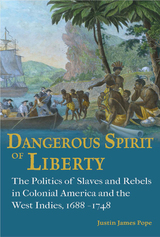
Dangerous Spirit of Liberty's distinguishing feature is its focus on the role of communication in the development of a rebellious early eighteenth-century Atlantic. Most historians of slavery have presupposed that slave unrest was confined to small locales in the first half of the eighteenth century. In fact, slaves found ways to share news across provinces to great effect. Benefiting from research in the archives of Great Britain, Spain, Barbados, Bermuda, Jamaica, Antigua, the U.S. Virgin Islands, and the mainland United States, the book reveals new evidence of slave communication networks and shows how people of African ancestry shared rumors of emancipation and rebellion in this period. Slaves laboring in colonial commerce and working aboard ships helped foster an increasingly restive Black community. Banished slaves, convicted conspirators accused of plotting insurrection, carried their experiences with them in exile to neighboring colonies. By reconstructing the path of news, the book reveals rumors and reports that particularly resonated among slaves in the early eighteenth century.
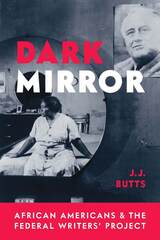
Published by University of Delaware Press. Distributed worldwide by Rutgers University Press.

The biblical image of David and Goliath captures fittingly the nature of the war that Russia, the world’s largest country by surface area, unleashed on neighboring Ukraine, a country that—while still the largest on the European continent—is almost thirty times smaller and has only over a quarter of Russia’s population. Yet Ukraine’s stubborn resistance proves that it is possible to mount a successful defense against an enormously larger, more populous, and better equipped enemy, even despite its threats of nuclear apocalypse should Ukraine refuse to submit and the West dare to interfere. This volume shows that history can help reveal the reasons for Ukraine’s resolve and success on the battlefield and in the public arena.
Collected in David and Goliath for the first time are short essays, commentaries, and interviews written and given by Serhii Plokhy, the world’s preeminent scholar of Ukrainian history, on the eve and during the first two years of Russia’s full-scale invasion of Ukraine. Plokhy draws our attention to the unique nature of the truly historic events of the largest war in Europe since the end of World War II.
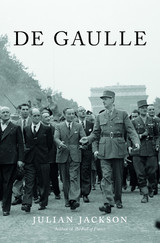
Winner of the Duff Cooper Prize
Winner of the Elizabeth Longford Prize
A New Yorker, Financial Times, Spectator, Times, and Telegraph Book of the Year
In this definitive biography of the mythic general who refused to accept the Nazi domination of France, Julian Jackson captures Charles de Gaulle as never before. Drawing on unpublished letters, memoirs, and papers from the recently opened de Gaulle archive, he shows how this volatile visionary of staunch faith and conservative beliefs infuriated Churchill, challenged American hegemony, recognized the limitations of colonial ambitions in Algeria and Vietnam, and put a broken France back at the center of world affairs.
“With a fluent style and near-total command of existing and newly available sources…Julian Jackson has come closer than anyone before him to demystifying this conservative at war with the status quo, for whom national interests were inseparable from personal honor.”
—Richard Norton Smith, Wall Street Journal
“A sweeping-yet-concise introduction to the most brilliant, infuriating, and ineffably French of men.”
—Ross Douthat, New York Times
“Classically composed and authoritative…Jackson writes wonderful political history.”
—Adam Gopnik, New Yorker
“A remarkable book in which the man widely chosen as the Greatest Frenchman is dissected, intelligently and lucidly, then put together again in an extraordinary fair-minded, highly readable portrait. Throughout, the book tells a thrilling story.”
—Antonia Fraser, New Statesman
“Makes awesome reading, and is a tribute to the fascination of its subject, and to Jackson’s mastery of it…A triumph, and hugely readable.”
—Max Hastings, Sunday Times
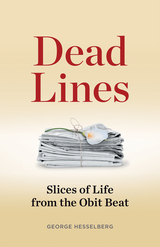
In more than forty years at the Wisconsin State Journal, Hesselberg frequently found himself writing about fatal accidents, crime investigations, and the deaths of the wealthy, famous, or notorious. But he was most drawn to the curious, the unknown, and the unsung—the deaths that normally wouldn’t make much of a splash, if any mention at all, in the news columns of a daily paper.
Digging deeper, he uncovered the extraordinary among the ordinary, memorializing the lives of a sword designer, a radio villain, a pioneering female detective, a homeless woman who spoke fluent French, a beloved classroom tarantula, and many more. Their stories are alternately amusing, sad, surprising, and profound. Together they speak to a shared human experience and inspire us to see the people around us with new eyes, valuing the lives while they are still being lived.
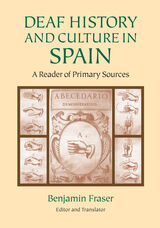
In this landmark reader, Benjamin Fraser offers in five parts 44 Spanish documents dating from 1417 to the present, translated for the first time to trace the turbulent history of Deaf culture in Spain. Part I: The Birth of Oralism and Deafness as Metaphor illustrates the predominant impression of deafness as isolation, exemplified by Teresa de Cartagena writings in 1455-60 about deafness as an island. Part II: The Return to Deaf Education highlights writers who wished to restore “the Spanish ‘Art’” of educating deaf students. Lorenzo Hervás y Panduro wrote The Spanish School of Deafmutes, or Method of Teaching Them to Write and Speak the Spanish Language in 1795. Yet, Madrid’s Royal School for Deaf-Mutes, which opened in 1805, taught deaf students using methodical signs adopted from France’s Abbé de l’Epée.
Readings in Part III :The Contemporary Deaf Experience reveal considerations from the 1970s to the ‘90s of Deaf culture and linguistics similar to those in the United States, typified by the works of Inés Polo and Félix-Jesús Pinedo Peydró. The fourth part, The Recognition of Deaf Language and Culture, marks the expansion of academic research in Spain. María Angeles Rodríguez González spearheaded Spanish Sign Language (LSE) linguistics in 1992 with her publication Sign Language. The final part, A Selection of Deaf Poetry, concludes these documents with verse in Spanish spoken dialects rather than LSE, indicating that the evolution of the Deaf experience in Spain continues on its own path today.

In the tense years of the early Cold War, American and Soviet women conducted a remarkable pen-pal correspondence that enabled them to see each other as friends rather than enemies.
In a compelling new perspective on the early Cold War, prizewinning historian Alexis Peri explores correspondence between American and Soviet women begun in the last years of World War II and continuing into the 1950s. Previously unexamined, the women’s letters movingly demonstrate the power of the personal, as the pen pals engaged in a “diplomacy of the heart” that led them to question why their countries were so divided.
Both Soviet and American women faced a patriarchal backlash after World War II that marginalized them professionally and politically. The pen pals discussed common challenges they faced, such as unequal pay and the difficulties of balancing motherhood with a career. Each side evinced curiosity about the other’s world, asking questions about family and marriage, work conditions, educational opportunities, and religion. The women advocated peace and cooperation but at times disagreed strongly over social and economic issues, such as racial segregation in the United States and mandatory labor in the Soviet Union. At first both governments saw no risk in the communications, as women were presumed to have little influence and no knowledge of state secrets, but eventually Cold War paranoia set in. Amid the Red Scare, the House Un-American Activities Committee even accused some of the American women of being communist agents.
A rare and poignant tale, Dear Unknown Friend offers a glimpse of the Cold War through the perspectives of women who tried to move beyond the label of “enemy” and understand, even befriend, people across increasingly bitter political divides.
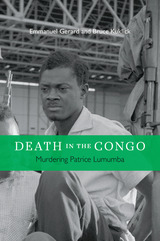
Death in the Congo is a gripping account of a murder that became one of the defining events in postcolonial African history. It is no less the story of the untimely death of a national dream, a hope-filled vision very different from what the war-ravaged Democratic Republic of the Congo became in the second half of the twentieth century.
When Belgium relinquished colonial control in June 1960, a charismatic thirty-five-year-old African nationalist, Patrice Lumumba, became prime minister of the new republic. Yet stability immediately broke down. A mutinous Congolese Army spread havoc, while Katanga Province in southeast Congo seceded altogether. Belgium dispatched its military to protect its citizens, and the United Nations soon intervened with its own peacekeeping troops. Meanwhile, behind the scenes, both the Soviet Union and the United States maneuvered to turn the crisis to their Cold War advantage. A coup in September, secretly aided by the UN, toppled Lumumba’s government. In January 1961, armed men drove Lumumba to a secluded corner of the Katanga bush, stood him up beside a hastily dug grave, and shot him. His rule as Africa’s first democratically elected leader had lasted ten weeks.
More than fifty years later, the murky circumstances and tragic symbolism of Lumumba’s assassination still trouble many people around the world. Emmanuel Gerard and Bruce Kuklick pursue events through a web of international politics, revealing a tangled history in which many people—black and white, well-meaning and ruthless, African, European, and American—bear responsibility for this crime.
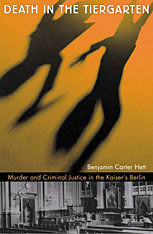
From Alexanderplatz, the bustling Berlin square ringed by bleak slums, to Moabit, site of the city's most feared prison, Death in the Tiergarten illuminates the culture of criminal justice in late imperial Germany. In vivid prose, Benjamin Hett examines daily movement through the Berlin criminal courts and the lawyers, judges, jurors, thieves, pimps, and murderers who inhabited this world.
Drawing on previously untapped sources, including court records, pamphlet literature, and pulp novels, Hett examines how the law reflected the broader urban culture and politics of a rapidly changing city. In this book, German criminal law looks very different from conventional narratives of a rigid, static system with authoritarian continuities traceable from Bismarck to Hitler. From the murder trial of Anna and Hermann Heinze in 1891 to the surprising treatment of the notorious Captain of Koepenick in 1906, Hett illuminates a transformation in the criminal justice system that unleashed a culture war fought over issues of permissiveness versus discipline, the boundaries of public discussion of crime and sexuality, and the role of gender in the courts.
Trained in both the law and history, Hett offers a uniquely valuable perspective on the dynamic intersections of law and society, and presents an impressive new view of early twentieth-century German history.
Co-winner of the Yad Vashem International Book Prize for Holocaust Research
From January 1945, in the last months of the Third Reich, about 250,000 inmates of concentration camps perished on death marches and in countless incidents of mass slaughter. They were murdered with merciless brutality by their SS guards, by army and police units, and often by gangs of civilians as they passed through German and Austrian towns and villages. Even in the bloody annals of the Nazi regime, this final death blow was unique in character and scope.
In this first comprehensive attempt to answer the questions raised by this final murderous rampage, the author draws on the testimonies of victims, perpetrators, and bystanders. Hunting through archives throughout the world, Daniel Blatman sets out to explain—to the extent that is possible—the effort invested by mankind’s most lethal regime in liquidating the remnants of the enemies of the “Aryan race” before it abandoned the stage of history. What were the characteristics of this last Nazi genocide? How was it linked to the earlier stages, the slaughter of millions in concentration camps? How did the prevailing chaos help to create the conditions that made the final murderous rampage possible?
In its exploration of a topic nearly neglected in the current history of the Shoah, this book offers unusual insight into the workings, and the unraveling, of the Nazi regime. It combines micro-historical accounts of representative massacres with an overall analysis of the collapse of the Third Reich, helping us to understand a seemingly inexplicable chapter in history.


A comprehensive study of ephemera in twentieth-century literature—and its relevance to the twenty-first century
“Nothing ever really disappears from the internet” has become a common warning of the digital age. But the twentieth century was filled with ephemera—items that were designed to disappear forever—and these objects played crucial roles in some of that century’s greatest works of literature. In The Death of Things, author Sarah Wasserman delivers the first comprehensive study addressing the role ephemera played in twentieth-century fiction and its relevance to contemporary digital culture.
Representing the experience of perpetual change and loss, ephemera was central to great works by major novelists like Don DeLillo, Ralph Ellison, and Marilynne Robinson. Following the lives and deaths of objects, Wasserman imagines new uses of urban space, new forms of visibility for marginalized groups, and new conceptions of the marginal itself. She also inquires into present-day conundrums: our fascination with the durable, our concerns with the digital, and our curiosity about what new fictional narratives have to say about deletion and preservation.
The Death of Things offers readers fascinating, original angles on how objects shape our world. Creating an alternate literary history of the twentieth century, Wasserman delivers an insightful and idiosyncratic journey through objects that were once vital but are now forgotten.
Of central importance in this second volume is Kant’s explicit justification of the death penalty in the Metaphysics of Morals. Thoroughly deconstructing Kant’s position—which holds the death penalty as exemplary of the eye-for-an-eye Talionic law—Derrida exposes numerous damning contradictions and exceptions. Keeping the current death penalty in the United States in view, he further explores the “anesthesial logic” he analyzed in volume one, addressing the themes of cruelty and pain through texts by Robespierre and Freud, reading Heidegger, and—in a fascinating, improvised final session—the nineteenth-century Spanish Catholic thinker Donoso Cortés. Ultimately, Derrida shows that the rationality of the death penalty as represented by Kant involves an imposition of knowledge and calculability on a fundamental condition of non-knowledge—that we don’t otherwise know what or when our deaths will be. In this way, the death penalty acts out a phantasm of mastery over one’s own death.
Derrida’s thoughts arrive at a particular moment in history: when the death penalty in the United States is the closest it has ever been to abolition, and yet when the arguments on all sides are as confused as ever. His powerful analysis will prove to be a paramount contribution to this debate as well as a lasting entry in his celebrated oeuvre.

In 1884, the Chancellor of the German Empire, Otto von Bismarck, convened a conference in Berlin to organize the division of the African continent among the industrial and military powers of the time. The result was a profound dismemberment of Africa’s original political structures, which, driven by nationalism and a barbaric ethos of rule, had a lasting impact on the continent’s political, socioeconomic, cultural, and spiritual development. One hundred and forty years after the Berlin Conference, it seems more than urgent to disentangle this complex of colonial appropriation, identify its after-effects, and question its epistemological legacy—all the more so as Europe searches for a new positioning in the changing geopolitical balance of power.
This multidisciplinary anthology takes up the idea of a transnational performative utopia to explore the possibilities of refabulating the world order and its future. Between creative action and resistance, memory and foresight, Deberlinization opens up perspectives on trans-African cohesion and outlines a new poetics of sovereignty.
In a stunningly original look at the American Declaration of Independence, David Armitage reveals the document in a new light: through the eyes of the rest of the world. Not only did the Declaration announce the entry of the United States onto the world stage, it became the model for other countries to follow.
Armitage examines the Declaration as a political, legal, and intellectual document, and is the first to treat it entirely within a broad international framework. He shows how the Declaration arose within a global moment in the late eighteenth century similar to our own. He uses over one hundred declarations of independence written since 1776 to show the influence and role the U.S. Declaration has played in creating a world of states out of a world of empires. He discusses why the framers’ language of natural rights did not resonate in Britain, how the document was interpreted in the rest of the world, whether the Declaration established a new nation or a collection of states, and where and how the Declaration has had an overt influence on independence movements—from Haiti to Vietnam, and from Venezuela to Rhodesia.
Included is the text of the U.S. Declaration of Independence and sample declarations from around the world. An eye-opening list of declarations of independence since 1776 is compiled here for the first time. This unique global perspective demonstrates the singular role of the United States document as a founding statement of our modern world.
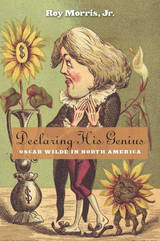
Arriving at the port of New York in 1882, a 27-year-old Oscar Wilde quipped he had “nothing to declare but my genius.” But as Roy Morris, Jr., reveals in this sparkling narrative, Wilde was, for the first time in his life, underselling himself. A chronicle of the sensation that was Wilde’s eleven-month speaking tour of America, Declaring His Genius offers an indelible portrait of both Oscar Wilde and the Gilded Age.
Wilde covered 15,000 miles, delivered 140 lectures, and met everyone who was anyone. Dressed in satin knee britches and black silk stockings, the long-haired apostle of the British Aesthetic Movement alternately shocked, entertained, and enlightened a spellbound nation. Harvard students attending one of his lectures sported Wildean costume, clutching sunflowers and affecting world-weary poses. Denver prostitutes enticed customers by crying: “We know what makes a cat wild, but what makes Oscar Wilde?” Whitman hoisted a glass to his health, while Ambrose Bierce denounced him as a fraud.
Wilde helped alter the way post–Civil War Americans—still reeling from the most destructive conflict in their history—understood themselves. In an era that saw rapid technological changes, social upheaval, and an ever-widening gap between rich and poor, he delivered a powerful anti-materialistic message about art and the need for beauty. Yet Wilde too was changed by his tour. Having conquered America, a savvier, more mature writer was ready to take on the rest of the world. Neither Wilde nor America would ever be the same.
These essays, originally delivered as the 2010 Kenneth Nebenzahl, Jr., Lectures in the History of Cartography at the Newberry Library, encompass more than two centuries and three continents—Latin America, Africa, and Asia. Ranging from the late eighteenth century through the mid-twentieth, contributors study topics from mapping and national identity in late colonial Mexico to the enduring complications created by the partition of British India and the racialized organization of space in apartheid and post-apartheid South Africa. A vital contribution to studies of both colonization and cartography, Decolonizing the Map is the first book to systematically and comprehensively examine the engagement of mapping in the long—and clearly unfinished—parallel processes of decolonization and nation building in the modern world.
The transcript from this historic trial, long thought destroyed or hidden, unearths a piece of the British colonial archive at a critical point in the Mau Mau Rebellion. Its discovery and landmark publication unsettles an already contentious Kenyan history and its reverberations in the postcolonial present.
Perhaps no figure embodied the ambiguities, colonial fears, and collective imaginations of Kenya’s decolonization era more than Dedan Kimathi, the self-proclaimed field marshal of the rebel forces that took to the forests to fight colonial rule in the 1950s. Kimathi personified many of the contradictions that the Mau Mau Rebellion represented: rebel statesman, literate peasant, modern traditionalist. His capture and trial in 1956, and subsequent execution, for many marked the end of the rebellion and turned Kimathi into a patriotic martyr.
Here, the entire trial transcript is available for the first time. This critical edition also includes provocative contributions from leading Mau Mau scholars reflecting on the meaning of the rich documents offered here and the figure of Kimathi in a much wider field of historical and contemporary concerns. These include the nature of colonial justice; the moral arguments over rebellion, nationalism, and the end of empire; and the complexities of memory and memorialization in contemporary Kenya.
Contributors: David Anderson, Simon Gikandi, Nicholas Githuku, Lotte Hughes, and John Lonsdale. Introductory note by Willy Mutunga.

Daniel weaves his narrative with newspaper and firsthand accounts, interviews and survivors, official reports, and over 140 contemporary photographs. The story of the common refugee who suffered most of the effects of the flood emerges alongside the details of the massive rescue and relief operation—one of the largest ever mounted in the United States. The title, Deep’n as It Come, is a phrase from Cora Lee Campbell’s early description of he approaching water, which, Daniel writes, “moved at a pace of some fourteen miles per day,” and in its movement and sound, “had the eeriness of a full eclipse of t he sun, unsettling, chilling.”
“The contradictions of sorrow and humor. . . death and salvation, despair and hope, calm and panic—all reveal the human dimension” in this compassionate and unforgettable portrait of common people confronting a great natural disaster.
Define and Rule focuses on the turn in late nineteenth-century colonial statecraft when Britain abandoned the attempt to eradicate difference between conqueror and conquered and introduced a new idea of governance, as the definition and management of difference. Mahmood Mamdani explores how lines were drawn between settler and native as distinct political identities, and between natives according to tribe. Out of that colonial experience issued a modern language of pluralism and difference.
A mid-nineteenth-century crisis of empire attracted the attention of British intellectuals and led to a reconception of the colonial mission, and to reforms in India, British Malaya, and the Dutch East Indies. The new politics, inspired by Sir Henry Maine, established that natives were bound by geography and custom, rather than history and law, and made this the basis of administrative practice.
Maine’s theories were later translated into “native administration” in the African colonies. Mamdani takes the case of Sudan to demonstrate how colonial law established tribal identity as the basis for determining access to land and political power, and follows this law’s legacy to contemporary Darfur. He considers the intellectual and political dimensions of African movements toward decolonization by focusing on two key figures: the Nigerian historian Yusuf Bala Usman, who argued for an alternative to colonial historiography, and Tanzania’s first president, Mwalimu Julius Nyerere, who realized that colonialism’s political logic was legal and administrative, not military, and could be dismantled through nonviolent reforms.
Presenting fresh insights on the internal dynamics and global contexts that shaped foreign relations in early modern Japan, Robert I. Hellyer challenges the still largely accepted wisdom that the Tokugawa shogunate, guided by an ideology of seclusion, stifled intercourse with the outside world, especially in the eighteenth and nineteenth centuries.
Examining diplomacy, coastal defense, and foreign trade, this study demonstrates that while the shogunate created the broader framework, foreign relations were actually implemented through cooperative but sometimes competitive relationships with the Satsuma and Tsushima domains, which themselves held largely independent ties with neighboring states. Successive Tokugawa leaders also proactively revised foreign trade, especially with China, taking steps that mirrored the commercial stances of other Asian and Western states.
In the nineteenth century, the system of foreign relations continued to evolve, with Satsuma gaining a greater share of foreign trade and Tsushima assuming more responsibility in coastal defense. The two domains subsequently played key roles in Japan’s transition from using early modern East Asian practices of foreign relations to the national adoption of international relations, especially the recasting of foreign trade and the centralization of foreign relations authority, in the years surrounding the Meiji Restoration of 1868.

In The Defoliation of America: Agent Orange Chemicals, Citizens, and Protests, Amy M. Hay profiles the attitudes, understandings, and motivations of grassroots activists who rose to fight the use of phenoxy herbicides, or Agent Orange chemicals as they are commonly known, in various aspects of American life during the post-WWII era. Hay focuses her analysis on citizen responses to illuminate how regulatory policies were understood, challenged, and negotiated, contributing to a growing body of research on chemical regulatory policies, risk society, and hazardous chemicals. This volume uncovers new understandings about the authority of the state and its obligation to society, the role of scientific authority and expertise, and the protests made by various groups of citizens.
First introduced in 1946, phenoxy herbicides mimic hormones in broadleaf plants, causing them to “grow to death” while grass, grains, and other monocots remain unaffected. By the 1950s, millions of pounds of these chemicals were produced annually for use in brush control, weed eradication, forest management, and other agricultural applications. Pockets of skepticism and resistance began to appear by the late 1950s, and the trend intensified after 1962 when Rachel Carson’s Silent Spring directed mainstream attention to the harm modern chemicals were causing in the natural world. It wasn’t until the Vietnam War, however, when nearly 19 million gallons of Agent Orange and related herbicides were sprayed to clear the canopy and destroy crops in Southeast Asia, that the long-term damage associated with this group of chemicals began to attract widespread attention and alarm.
Using a wide array of sources and an interdisciplinary approach, Hay contributes to the robust fields of chemical toxicity, regulation, environmental management, and public health. This study of the scientists, health and environmental activists, and veterans who fought US chemical regulatory policies and practices reveals the mechanisms, obligations, and constraints of state and scientific authority in mid-twentieth-century America. Hay also shows how these disparate and mostly forgotten citizen groups challenged the political consensus and contested government and industry narratives of chemical safety.
Originally published as a special issue of South Atlantic Quarterly (Summer 1997), this volume includes essays from some of the most prominent American, Australian, British, and French scholars and translators of Deleuze’s writing. These essays, ranging from film, television, art, and literature to philosophy, psychoanalysis, geology, and cultural studies, reflect the broad interests of Deleuze himself. Providing both an introduction and critique of Deleuze, this volume will engage those readers interested in literary and cultural theory, philosophy, and the future of those areas of study in which Deleuze worked.
Contributors. Ronald Bogue, Ian Buchanan, André Pierre Colombat, Tom Conley, Manuel DeLanda, Tessa Dwyer, Jerry Aline Flieger, Eugene Holland, Fredric Jameson, Jean-Clet Martin, John Mullarkey, D. N. Rodowick, Horst Ruthrof, Charles J. Stivale
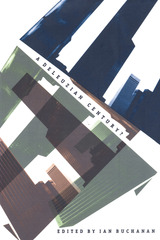
To show us how Deleuze’s philosophy works, Buchanan begins with Melville’s notion that “a great book is always the inverse of another book that could only be written in the soul, with silence and blood.” Buchanan demonstrates that the figure of two books—one written in ink and the other written in blood—lies at the center of Deleuze’s hermeneutics and that a special relation must be established in order to read the second book from the first. This relation is Deleuzism. By explicating elemental concepts in Deleuze—desire, flow, the nomad—Buchanan finds that, despite Deleuze’s self-declared moratorium on dialectics, he was in several important respects a dialectician. In essays that address the “prehistory” of Deleuze’s philosophy, his methodology, and the utopic dimensions of his thought, Buchanan extracts an apparatus of social critique that arises from the philosopher’s utopian impulse.
Deleuzism is a work that will engage all those with an interest in the twentieth-century’s most original philosopher.
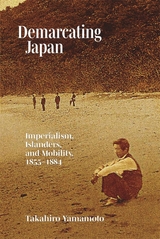
Histories of remote islands around Japan are usually told through the prism of territorial disputes. In contrast, Takahiro Yamamoto contends that the transformation of the islands from ambiguous border zones to a territorialized space emerged out of multilateral power relations. Sakhalin, the Kuril Islands, Tsushima, the Bonin Islands, and the Ryukyu Islands became the subject of inter-imperial negotiations during the formative years of modern Japan as empires nudged each other to secure their status with minimal costs rather than fighting a territorial scramble. Based on multiarchival, multilingual research, Demarcating Japan argues that the transformation of border islands should be understood as an interconnected process, where inter-local referencing played a key role in the outcome: Japan’s geographical expansion in the face of domineering Extra-Asian empires.
Underneath this multilateral process were the connections forged by individuals. Translators, doctors, traffickers, castaways, and indigenous hunters crisscrossed border regions and enacted violence, exchanged knowledge, and forged friendships. Although their motivations were eclectic and their interactions transcended national borders, the linkages they created were essential in driving territorialization forward. Demarcating Japan demonstrates the crucial role of nonstate actors in formulating a territory.
This classic study of democratic principles is thus now more relevant than ever. A renowned historian of antiquity and political philosophy, Sir M.I. Finley offers a comparative analysis of Greek and modern conceptions of democracy. As he puts the ancient Greeks in dialogue with their contemporary counterparts, Finley tackles some of the most pressing issues of our day, including public apathy, partisanship, consensus politics, distrust of professional politicians, and the limits of free speech.
Including three lectures that Finley delivered at Rutgers University, plus two additional essays that further illuminate his thinking, Democracy Ancient and Modern explores the dramatic differences between the close-knit civil society of the ancient Greeks and our own atomized mass societies. By mapping out democracy’s past and its present manifestations, this book helps us plot a course for democracy’s future.
The two new essays, "Athenian Dialogues" and "Censorship in Classical Antiquity" combine with "Leaders and Followers," "Democracy, Consensus, and the National Interest," "Socrates and After" to make this book an unusual inquiry. Few contemporary writers are able to bring to the subject the depth of learning and the persuasive power of language that Sir M. I. Finley brings.
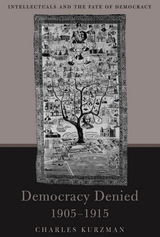
In the decade before World War I, a wave of democratic revolutions swept the globe, consuming more than a quarter of the world’s population. Revolution transformed Russia, Iran, the Ottoman Empire, Portugal, Mexico, and China. In each case, a pro-democracy movement unseated a long-standing autocracy with startling speed. The nascent democratic regime held elections, convened parliament, and allowed freedom of the press and freedom of association. But the new governments failed in many instances to uphold the rights and freedoms that they proclaimed. Coups d’état soon undermined the democratic experiments.
How do we account for these unexpected democracies, and for their rapid extinction? In Democracy Denied, Charles Kurzman proposes that the collective agent most directly responsible for democratization was the emerging class of modern intellectuals, a group that had gained a global identity and a near-messianic sense of mission following the Dreyfus Affair of 1898.
Each chapter of Democracy Denied focuses on a single angle of this story, covering all six cases by examining newspaper accounts, memoirs, and government reports. This thoroughly interdisciplinary treatment of the early-twentieth-century upheavals promises to reshape debates about the social origins of democracy, the causes of democratic collapse, the political roles of intellectuals, and the international flow of ideas.
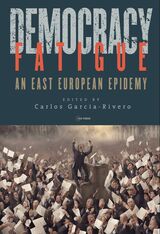
Over the early 21st century, democracy worldwide has deteriorated significantly. At the same time, new populist forces have appeared that challenge democracies through legal reforms. The stark contrast between Eastern and Western Europe in this respect is the focus of this collection of essays.
The authors consider the 2008-2012 economic crisis to be at the root of the success of the populist parties and the rise of cultural backlash against liberal values. In turn, European governments’ responses to the crisis—mainly austerity measures demanded by IMF and the EU— help explain desenchantment with the European Union. These policies made the wider public feel that they were being left out of politics, and populist parties promised to return power to them.
The contributors argue that polarization of the electorate can set in motion a radicalization that strengthens authoritarians at the expense of democrats. They also demonstrate that Eastern and Western Europe differ in their attitudes to the decline in quality of democracy. The studies consider how satisfied people are with the political changes they witness, and argue that seemingly more authoritarian attitudes in the East explain why people feel more satisfied with a defective democracy that empowers the populist-authoritarian political actors that they support.
A searing argument—and work of meticulous scholarship—about how American political scientists misinterpreted the elite theory of democracy and in so doing made our political system vulnerable to oligarchic takeover.
Do competitive elections secure democracy, or might they undermine it by breeding popular disillusionment with liberal norms and procedures? The so-called Italian School of Elitism, comprising Vilfredo Pareto, Gaetano Mosca, and Robert Michels, voiced this very concern. They feared that defining democracy exclusively through representative practices creates unrealistic expectations of what elections can achieve, generating mass demoralization and disillusionment with popular government.
The Italian School’s concern has gone unheeded, even as their elite theory has been foundational for political science in the United States. Democratic Elitism argues that scholars have misinterpreted the Italians as conservative, antidemocratic figures who championed the equation of democracy with representative practices to restrain popular participation in politics. Natasha Piano contends not only that the Italian School’s thought has been distorted but also that theorists have ignored its main objective: to contain demagogues and plutocrats who prey on the cynicism of the masses. We ought to view these thinkers not as elite theorists of democracy but as democratic theorists of elitism.
The Italian School’s original writings do not reject electoral politics; they emphasize the power and promise of democracy beyond the ballot. Elections undoubtedly are an essential component of functioning democracies, but in order to preserve their legitimacy we must understand their true capacities and limitations. It is past time to dispel the delusion that we need only elections to solve political crises, or else mass publics, dissatisfied with the status quo, will fall deeper into the arms of authoritarians who capture and pervert formal democratic institutions to serve their own ends.

The Italian Risorgimento, the movement for national independence and unification, is as significant to Italian history as the American Revolution is to United States history. Liberal supporters of constitutional monarchy triumphed in the political struggles of the Risorgimento, yet democratic activists and thinkers like Mazzini, Garibaldi, Pisacane, and Ferrari were major participants in those struggles.
By reconstructing the lives and political careers of 146 such activists and thinkers, Clara M. Lovett explores the democratic movement's impact on the development of modern Italy. She shows that three main principles—secularism, political egalitarianism, and a concern for social justice—sustained the movement throughout its development and became its legacy after the unification. By exploring the social context of the movement and the specific experiences of its members, she explains why the democrats failed to lead Italy's unification in 1860 and why some of them became Italy's early professional politicians.

In his previous book, Demos Assembled, historian Stephen W. Sawyer offered a transatlantic account of the birth and transformation of the modern democratic state. In Demos Rising, he presents readers of political history with a prequel whose ambitious claim is that a genuine demos became possible in France only with the development of government regulation and administration. Focusing on democracy as a form of administration rather than as a form of sovereignty allows Sawyer to explore urban planning, work and private enterprise, health administration, and much more as cornerstones of a self-governing society of equals.
Examining the period between 1800 and 1850, Sawyer studies a set of thinkers who debated at length over the material problems of everyday life, sparking calls for political action and social reform in the face of conflict wreaked by deforestation, urbanization, health crises, labor relations, industrial capitalism, religious tensions, and imperial expansion. The solutions to these problems, Sawyer argues, were sought—and sometimes found—not through elections, as one might assume, but rather through the “care for all” promised by modern administrative power, regulatory intervention, and social welfare programs. By studying this profound transformation in governance, the book wagers, we can better understand the origin and meaning of democracy—even when events in our own time have thrown the concept into doubt.
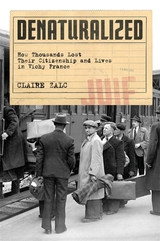
“In Denaturalized, Claire Zalc combines the precision of the scholar with the passion of a storyteller…This is a deftly written book. Zalc combines in an accessible style (smoothly translated by Catherine Porter) the stories of people trapped within a bureaucracy that was as obsessed, perhaps, with clearing files as with hunting Jews. In other words, Zalc reminds us how cruel the banality of indifference could be.”—Wall Street Journal
Winner of the Prix d’histoire de la justice
A leading historian radically revises our understanding of the fate of Jews under the Vichy regime.
Thousands of naturalized French men and women had their citizenship revoked by the Vichy government during the Second World War. Once denaturalized, these men and women, mostly Jews who were later sent to concentration camps, ceased being French on official records and walked off the pages of history. As a result, we have for decades severely underestimated the number of French Jews murdered by Nazis during the Holocaust. In Denaturalized, Claire Zalc unearths this tragic record and rewrites World War II history.
At its core, this is a detective story. How do we trace a citizen made alien by the law? How do we solve a murder when the body has vanished? Faced with the absence of straightforward evidence, Zalc turned to the original naturalization papers in order to uncover how denaturalization later occurred. She discovered that, in many cases, the very officials who granted citizenship to foreigners before 1940 were the ones who retracted it under Vichy rule.
The idea of citizenship has always existed alongside the threat of its revocation, and this is especially true for those who are naturalized citizens of a modern state. At a time when the status of millions of naturalized citizens in the United States and around the world is under greater scrutiny, Denaturalized turns our attention to the precariousness of the naturalized experience—the darkness that can befall those who suddenly find themselves legally cast out.
Winner of the Lionel Gelber Prize
National Book Critics Circle Award Finalist
An Economist Best Book of the Year | A Financial Times Book of the Year | A Wall Street Journal Book of the Year | A Washington Post Book of the Year | A Bloomberg News Book of the Year | An Esquire China Book of the Year | A Gates Notes Top Read of the Year
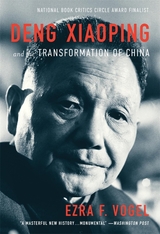
Perhaps no one in the twentieth century had a greater long-term impact on world history than Deng Xiaoping. And no scholar of contemporary East Asian history and culture is better qualified than Ezra Vogel to disentangle the many contradictions embodied in the life and legacy of China’s boldest strategist.
Once described by Mao Zedong as a “needle inside a ball of cotton,” Deng was the pragmatic yet disciplined driving force behind China’s radical transformation in the late twentieth century. He confronted the damage wrought by the Cultural Revolution, dissolved Mao’s cult of personality, and loosened the economic and social policies that had stunted China’s growth. Obsessed with modernization and technology, Deng opened trade relations with the West, which lifted hundreds of millions of his countrymen out of poverty. Yet at the same time he answered to his authoritarian roots, most notably when he ordered the crackdown in June 1989 at Tiananmen Square.
Deng’s youthful commitment to the Communist Party was cemented in Paris in the early 1920s, among a group of Chinese student-workers that also included Zhou Enlai. Deng returned home in 1927 to join the Chinese Revolution on the ground floor. In the fifty years of his tumultuous rise to power, he endured accusations, purges, and even exile before becoming China’s preeminent leader from 1978 to 1989 and again in 1992. When he reached the top, Deng saw an opportunity to creatively destroy much of the economic system he had helped build for five decades as a loyal follower of Mao—and he did not hesitate.


Jacques Derrida and Jürgen Habermas have long represented opposite camps in contemporary thought. Derrida, who pioneered the intellectual style of inquiry known as deconstruction, ushered in the postmodern age with his dramatic critique of reason; Habermas, on the other hand, has consistently argued in defense of reason, modernity, and the legacy of the Enlightenment. Their many differences led to a long-standing, if scattered, dialogue, evidence of which has been available in only bits and pieces. But now, for the first time, TheDerrida-Habermas Reader brings these pieces together, along with a collection of essays documenting the intellectual relationship between two of the twentieth century’s preeminent thinkers.
Taken together, Derrida and Habermas’s writings—combined here with contributions by other prominent philosophers and social theorists—tell the story of the two thinkers’ provocative engagement with each other’s ideas. Beyond exploring the conflict between Derrida’s deconstruction and Habermas’s communicative rationality, they show how the Derrida-Habermas encounter changed over the years, becoming more theoretically productive without ever collapsing into mutual rejection or simple compromise.
Lasse Thomassen has divided the essays—including works on philosophy and literature, ethics, politics, and international law—into four parts that cover the full range of thought in which Derrida and Habermas engaged. The last of these sections fittingly includes the thinkers’ jointly signed work on European solidarity and the Iraq War, highlighting the hopes they held in common despite their differences. The wide breadth of this book, along with Thomassen’s lucid introductions to each section, makes The Derrida-Habermas Reader an ideal starting point for anyone interested in one of the most dynamic intellectual debates of our time.

Who was Arminius Vámbéry? A poverty-stricken, Jewish autodidact; a linguist, traveler, and writer—or a sometime Zionist, inspiration for Dracula’s nemesis, and British secret agent? Vámbéry wrote his own story many times over, and it was these often highly embroidered accounts of journeys through Persia and Central Asia that saw him acclaimed in Victorian England as an intrepid explorer and daring adventurer. Against the backdrop of the “Great Game,” in which Russia and Britain jostled for territory, influence, and control of the borders and gateways to India and its wealth, Vámbéry played the roles of hero and double-dealer, of fascinated witness and imperialist charlatan.
The Dervish Bowl is the story of these competing narratives and a compelling investigation of both the ever-changing persona Vámbéry created for himself and the man who emerges from his private correspondence and the accounts of both his friends and his enemies, many of whom were themselves major players in the geopolitical adventures of the volatile nineteenth century—a time when Britain’s ambitions for her empire were at their height, yet nothing and no one was quite as they seemed.

Descartes and his Contemporaries recreates the tumultuous intellectual community of seventeenth-century Europe and provides a detailed, modern analysis of the Meditations in its historical context. The book's chapters examine the arguments and positions of each of the objectors—Hobbes, Gassendi, Arnauld, Morin, Caterus, Bourdin, and others whose views were compiled by Mersenne. They illuminate Descartes' relationships to the scholastics and particularly the Jesuits, to Mersenne's circle with its debates about the natural sciences, to the Epicurean movements of his day, and to the Augustinian tradition. Providing a glimpse of the interactions among leading 17th-century intellectuals as they grappled with major philosophical issues, this book sheds light on how Descartes' thought developed and was articulated in opposition to the ideas of his contemporaries.

Descartes, an acknowledged founder of modern philosophy, is identified particularly with mind-body dualism--the view that the mind is an incorporeal entity. But this view was not entirely original with Descartes, and in fact to a significant extent it was widely accepted by the Aristotelian scholastics who preceded him, although they entertained a different conception of the nature of mind, body, and the relationship between them. In her first book, Marleen Rozemond explicates Descartes's aim to provide a metaphysics that would accommodate mechanistic science and supplant scholasticism.
Her approach includes discussion of central differences from and similarities to the scholastics and how these discriminations affected Descartes's defense of the incorporeity of the mind and the mechanistic conception of body. Confronting the question of how, in his view, mind and body are united, she examines his defense of this union on the basis of sensation. In the course of her argument, she focuses on a few of the scholastics to whom Descartes referred in his own writings: Thomas Aquinas, Francisco Suárez, Eustachius of St. Paul, and the Jesuits of Coimbra. This new systematic account of Descartes's dualism amply demonstrates why he still deserves serious study and respect for his extraordinary philosophical achievements.
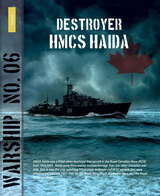
Nowadays she is the only surviving Tribal-class destroyer out of 27 units that were constructed between 1937-1945 for the Royal Navy, Royal Australian Navy, and the Royal Canadian Navy.

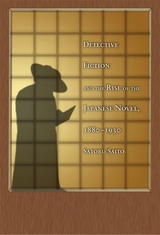
In Detective Fiction and the Rise of the Japanese Novel, Satoru Saito sheds light on the deep structural and conceptual similarities between detective fiction and the novel in prewar Japan. Arguing that the interactions between the two genres were not marginal occurrences but instead critical moments of literary engagement, Saito demonstrates how detective fiction provided Japanese authors with the necessary frameworks through which to examine and critique the nature and implications of Japan’s literary formations and its modernizing society.
Through a series of close readings of literary texts by canonical writers of Japanese literature and detective fiction, including Tsubouchi Shoyo, Natsume Soseki, Shimazaki Toson, Sato Haruo, Kuroiwa Ruiko, and Edogawa Ranpo, Saito explores how the detective story functioned to mediate the tenuous relationships between literature and society as well as between subject and authority that made literary texts significant as political acts. By foregrounding the often implicit and contradictory strategies of literary texts—choice of narrative forms, symbolic mappings, and intertextual evocations among others—this study examines in detail the intricate interactions between detective fiction and the novel that shaped the development of modern Japanese literature.

Japan’s “Christian Century” began in 1549 with the arrival of Jesuit missionaries led by Saint Francis Xavier, and ended in 1639 when the Tokugawa regime issued the final Sakoku Edict prohibiting all traffic with Catholic lands. “Sakoku”—national isolation—would for more than two centuries be the sum total of the regime’s approach to foreign affairs. This policy was accompanied by the persecution of Christians inside Japan, a course of action for which the missionaries and their zealots were in part responsible because of their dogmatic orthodoxy. The Christians insisted that “Deus” was owed supreme loyalty, while the Tokugawa critics insisted on the prior importance of performing one’s role within the secular order, and denounced the subversive doctrine whose First Commandment seemed to permit rebellion against the state.
In discussing the collision of ideas and historical processes, George Elison explores the attitudes and procedures of the missionaries, describes the entanglements in politics that contributed heavily to their doom, and shows the many levels of the Japanese response to Christianity. Central to his book are translations of four seventeenth-century, anti-Christian polemical tracts.
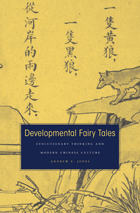
In 1992 Deng Xiaoping famously declared, “Development is the only hard imperative.” What ensued was the transformation of China from a socialist state to a capitalist market economy. The spirit of development has since become the prevailing creed of the People’s Republic, helping to bring about unprecedented modern prosperity, but also creating new forms of poverty, staggering social upheaval, physical dislocation, and environmental destruction.
In Developmental Fairy Tales, Andrew F. Jones asserts that the groundwork for this recent transformation was laid in the late nineteenth century, with the translation of the evolutionary works of Lamarck, Darwin, and Spencer into Chinese letters. He traces the ways that the evolutionary narrative itself evolved into a form of vernacular knowledge which dissolved the boundaries between beast and man and reframed childhood development as a recapitulation of civilizational ascent, through which a beleaguered China might struggle for existence and claim a place in the modern world-system.
This narrative left an indelible imprint on China’s literature and popular media, from children’s primers to print culture, from fairy tales to filmmaking. Jones’s analysis offers an innovative and interdisciplinary angle of vision on China’s cultural evolution. He focuses especially on China’s foremost modern writer and public intellectual, Lu Xun, in whose work the fierce contradictions of his generation’s developmentalist aspirations became the stuff of pedagogical parable. Developmental Fairy Tales revises our understanding of literature’s role in the making of modern China by revising our understanding of developmentalism’s role in modern Chinese literature.
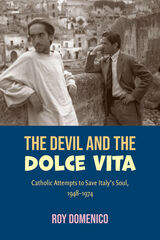
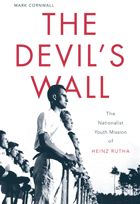
Legend has it that twenty miles of volcanic rock rising through the landscape of northern Bohemia was the work of the devil, who separated the warring Czechs and Germans by building a wall. The nineteenth-century invention of the Devil’s Wall was evidence of rising ethnic tensions. In interwar Czechoslovakia, Sudeten German nationalists conceived a radical mission to try to restore German influence across the region. Mark Cornwall tells the story of Heinz Rutha, an internationally recognized figure in his day, who was the pioneer of a youth movement that emphasized male bonding in its quest to reassert German dominance over Czech space.
Through a narrative that unravels the threads of Rutha’s own repressed sexuality, Cornwall shows how Czech authorities misinterpreted Rutha’s mission as sexual deviance and in 1937 charged him with corrupting adolescents. The resulting scandal led to Rutha’s imprisonment, suicide, and excommunication from the nationalist cause he had devoted his life to furthering. Cornwall is the first historian to tackle the long-taboo subject of how youth, homosexuality, and nationalism intersected in a fascist environment. The Devil’s Wall also challenges the notion that all Sudeten German nationalists were Nazis, and supplies a fresh explanation for Britain’s appeasement of Hitler, showing why the British might justifiably have supported the 1930s Sudeten German cause. In this readable biography of an ardent German Bohemian who participated as perpetrator, witness, and victim, Cornwall radically reassesses the Czech-German struggle of early twentieth-century Europe.
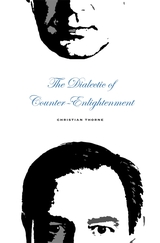
In this wide-ranging, ambitious, and engaging study, Christian Thorne confronts the history and enduring legacy of anti-foundationalist thought.
Anti-foundationalism—the skeptical line of thought that contends our beliefs cannot be authoritatively grounded and that most of what passes for knowledge is a sham—has become one of the dominant positions in contemporary criticism. Thorne argues that despite its ascendance, anti-foundationalism is wrong. In The Dialectic of Counter-Enlightenment, he uses deft readings of a range of texts to offer new perspectives on the ongoing clash between philosophy and comprehensive doubt.
The problem with anti-foundationalism is not, as is often thought, that it radiates uncertainty or will unglue the university, but instead that it is a system of thought—with set habits that generate unearned certainties. The shelves are full of histories of modern philosophy, but the history of the resistance to philosophical thought remains to be told. At its heart, The Dialectic of Counter-Enlightenment is a plea not to take doubt at its word—a plea for the return of a vanished philosophical intelligence and for the retirement of an anti-Enlightenment thinking that commits, over and over again, the very crimes that it lays at Enlightenment’s door.

Judith Malina’s newly restored diaries from a critical early decade in her personal, artistic, and political development
Judith Malina’s diaries from 1947 to 1957 are brought back into print in this volume, which charts her cofounding of The Living Theatre with husband and lifelong artistic partner Julian Beck. In these diaries, she narrates her developing political commitments and her expansive collaborations and personal relationships, as well as a moving account of her time in prison with activist Dorothy Day. This new edition features Kate Bredeson’s comprehensive introduction, which offers a detailed examination of Malina’s life and work in this period, along with additional historical context of these years and never-before-published photographs from Malina’s personal archives.
The Diaries of Judith Malina is a four-volume set that publishes for the first time together the edited diaries of radical theater director, actor, and activist Judith Malina from 1947 to 1971, the most influential period of her remarkable and storied career. A committed anarchist and pacifist, Malina made theater as a way to stoke revolutionary action. Her diaries showcase her political and social observations, cultural commentary, self-reflection, and wit. This expertly prepared set invites us to recognize Malina for her accomplishments not only as an artist and an activist but as one of the great literary diarists.
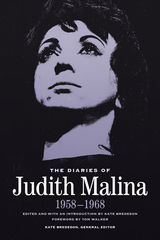
A previously unpublished volume of diaries recording Judith Malina’s extraordinary life and career in a moment of cultural revolution
Judith Malina’s diaries from the pivotal years of 1958 to 1968 are presented here in print for the first time. Meticulously edited and with an essential introduction by Kate Bredeson that offers a detailed discussion of Malina’s life and works during this period, the volume includes additional historical context and never-before-published photographs from Malina’s personal archives, as well as an illuminating foreword by Living Theatre archivist and longtime company member Tom Walker. This decade covers some of the most important years of Malina’s life and in the history of The Living Theatre, from career-defining productions of The Connection and The Brig to the company’s self-imposed European exile, when they created their signature works, including Paradise Now, Antigone, and Frankenstein.
The Diaries of Judith Malina is a four-volume set that publishes for the first time together the edited diaries of radical theater director, actor, and activist Judith Malina from 1947 to 1971, the most influential period of her remarkable and storied career. A committed anarchist and pacifist, Malina made theater as a way to engage in revolutionary action. Her diaries showcase her political and social observations, cultural commentary, self-reflection, and wit. This expertly prepared set invites us to recognize Malina for her accomplishments not only as an artist and an activist but as one of the great literary diarists.

A newly restored edition of Judith Malina’s legendary diaries narrating a key moment of social, political, and cultural upheaval
Originally published by Judith Malina as The Enormous Despair, this slim, gripping collection of diaries from a pivotal period between 1968 and 1969 follows The Living Theatre’s return to the United States after their years of self-exile in Europe, their increasing notoriety and frequent arrests, and their cross-country touring. In these pages, Malina wrestles with the company’s artistic and political efforts during a moment of societal crisis and grapples with their future. Kate Bredeson’s introduction contextualizes Malina’s life and work in this period, while additional historical context and never-before-published photographs add new detail and depth to a stirring account of American social and political history.
The Diaries of Judith Malina is a four-volume set that publishes for the first time together the edited diaries of radical theater director, actor, and activist Judith Malina from 1947 to 1971, the most influential period of her remarkable and storied career. A committed anarchist and pacifist, Malina made theater as a way to engage in revolutionary action. Her diaries showcase her political and social observations, her cultural commentary, her self-reflection, and her wit. This expertly prepared set invites us to recognize Malina for her accomplishments not only as an artist and an activist but as one of the great literary diarists.

Judith Malina’s never-before-published diaries describing a period of profound personal and professional transformation
The years 1969 to 1971 saw The Living Theatre’s greatest rupture, reckoning with its desire to leave its defining productions from the 1960s behind and move forward with new artistic works and practices. In these previously unpublished diaries, Judith Malina recounts these pivotal years, describing her transformative time in Brazil, including her experiences of daily life in jail while awaiting trial with her company members. This meticulously edited volume includes Kate Bredeson’s introduction, examining Malina’s life and work in this period, as well as additional historical context and never-before-published photographs. Living Theatre member Ilion Troya offers a foreword that provides new context for understanding the volume’s historical significance.
The Diaries of Judith Malina is a four-volume set that publishes for the first time together the edited diaries of radical theater director, actor, and activist Judith Malina from 1947 to 1971, the most influential period of her remarkable and storied career. A committed anarchist and pacifist, Malina made theater as a way to engage in revolutionary action. Her diaries showcase her political and social observations, cultural commentary, self-reflection, and wit. This expertly prepared set invites us to recognize Malina for her accomplishments not only as an artist and an activist but as one of the great literary diarists.
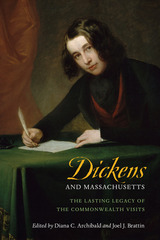
Charles Dickens traveled to North America twice, in 1842 and twenty-five years later in 1867–68, and on both trips Massachusetts was part of his itinerary. Although many aspects of his U.S. travels disappointed him, Massachusetts was the one state that met and even exceeded Dickens's expectations for “the republic of [his] imagination.” From the mills of Lowell to the Perkins School for the Blind, it offered an alternate vision of America that influenced his future writings, while the deep and lasting friendships he formed with Bostonians gave him enduring ties to the commonwealth.
This volume provides insight from leading scholars who have begun to reassess the significance of Massachusetts in the author's life and work. The collection begins with a broad biographical and historical overview taken from the full-length narrative of the award-winning exhibition Dickens and Massachusetts: A Tale of Power and Transformation, which attracted thousands of visitors while on display in Lowell. Abundant images from the exhibition, many of them difficult to find elsewhere, enhance the story of Dickens's relationship with the vibrant cultural and intellectual life of Massachusetts. The second section includes essays that consider the importance of Dickens's many connections to the commonwealth.
In addition to the volume editors, contributors include Chelsea Bray, Iain Crawford, Andre DeCuir, Natalie McKnight, Lillian Nayder, and Kit Polga.
The Diehards is a study of the 112 peers who voted against the Parliament Bill of 1911. In voting against this bill, which abolished the veto power of the House of Lords, the diehards defied the leadership of their own party. Other Unionists were willing to capitulate in response to the Liberal government's threat to create enough new peers to swamp the upper chamber, but the diehards were ready to “die in the last ditch.”
There has never been a satisfactory explanation of diehard intransigence. A mistake of contemporaries and of later historians has been to characterize the diehards as “backwoodsmen” who cared little about national politics and barely knew their way to the House of Lords. But in fact, as Gregory Phillips shows, they were among the most politically active members of the peerage. They can be seen as radical conservatives, willing to countenance drastic changes in certain aspects of politics and society in order to preserve as much as possible of their traditional position and way of life.
Utilizing a wide range of public and private papers, Phillips has given us an economic, social, and political study of Edwardian England that substantially alters our understanding of this crisis in British constitutional history.
This collection of essays focuses on teaching at the intersection of early modern literature, book history, and digital media. It considers how teaching different fields and methods of study can be enhanced and facilitated by digital technologies. The volume provides a snapshot of current thinking on digital pedagogy as practiced by leading scholars in the field and offers a series of models that may be adapted, personalized, and repurposed by future teachers seeking to bring digital methodologies to their classrooms. Supplementary materials for this title are available on the Iter Press website (iterpress.org): see under Books/Supplementary Materials.

This illuminating work examines the social, cultural, political, and economic dimensions of the Communist takeover of China. Instead of dwelling on elite politics and policy-making processes, Dilemmas of Victory seeks to understand how the 1949-1953 period was experienced by various groups, including industrialists, filmmakers, ethnic minorities, educators, rural midwives, philanthropists, stand-up comics, and scientists.
A stellar group of authors that includes Frederic Wakeman, Elizabeth Perry, Sherman Cochran, Perry Link, Joseph Esherick, and Chen Jian shows that the Communists sometimes achieved a remarkably smooth takeover, yet at other times appeared shockingly incompetent. Shanghai and Beijing experienced it in ways that differed dramatically from Xinjiang, Tibet, and Dalian. Out of necessity, the new regime often showed restraint and flexibility, courting the influential and educated. Furthermore, many policies of the old Nationalist regime were quietly embraced by the new Communist rulers.
Based on previously unseen archival documents as well as oral histories, these lively, readable essays provide the fullest picture to date of the early years of the People's Republic, which were far more pluralistic, diverse, and hopeful than the Maoist decades that followed.
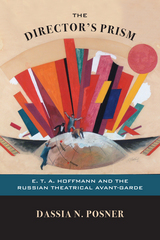
Shortlist, 2019 Prague Quadrennial Best Scenography and Design Publication Award
The Director's Prism investigates how and why three of Russia's most innovative directors— Vsevolod Meyerhold, Alexander Tairov, and Sergei Eisenstein—used the fantastical tales of German Romantic writer E. T. A. Hoffmann to reinvent the rules of theatrical practice. Because the rise of the director and the Russian cult of Hoffmann closely coincided, Posner argues, many characteristics we associate with avant-garde theater—subjective perspective, breaking through the fourth wall, activating the spectator as a co-creator—become uniquely legible in the context of this engagement. Posner examines the artistic poetics of Meyerhold's grotesque, Tairov's mime-drama, and Eisenstein's theatrical attraction through production analyses, based on extensive archival research, that challenge the notion of theater as a mirror to life, instead viewing the director as a prism through whom life is refracted. A resource for scholars and practitioners alike, this groundbreaking study provides a fresh, provocative perspective on experimental theater, intercultural borrowings, and the nature of the creative process.

Dependent on the extractive practices of fossil-fueled industrial capitalism, chemical photography’s emulsions and films were highly sensitive to polluted atmospheres, and photographic companies had to work hard to control this sensitivity. Drawing on histories of empire, coal, and chemistry and from the archives of British photographic manufacturer Ilford Limited, Michelle Henning exposes the ways photography shaped how we see and understand the atmosphere while leaving its toxic residues in the air, soil, and water.
Structured as thirty-six short chapters and with over seventy illustrations, this innovative book begins in interwar London, follows the supply of Ilford products to photographers on the West African coast, and considers photography as a military technology linked to the development of chemical warfare. Combining close readings of photographs with discussions of low-light, tropical, and aerial photography, Henning examines the extraction and development of photographic materials, their role in the current environmental crisis, and how they have shaped experiences of time and the environment.

The surprising story of the sixteenth-century Lutheran scholar who became Europe’s foremost authority on Ottoman Greece, shedding new light on the place of Greek culture and religion in the Western imagination.
In the late sixteenth century, a German Lutheran scholar named Martin Crusius compiled an exceptionally rich record of Greek life under Ottoman rule. Although he never left his home in the university town of Tübingen, Crusius spent decades annotating books and manuscripts, corresponding with the Greek Orthodox Patriarch, and interviewing Greek Orthodox alms-seekers. Ultimately, he gathered his research into a seminal work called the Turcograecia, which served for centuries as Europe’s foremost source on Ottoman Greece. Yet as Richard Calis reveals, Crusius’s massive—and largely untapped—archive has much more to tell us about how early modern Europeans negotiated cultural and religious difference.
In particular, Crusius’s work illuminates Western European views of the religious “other” within Christianity: the Greek Orthodox Christians living under Ottoman rule, a group both familiar and foreign. Many Western Europeans, including Crusius, developed narratives of Greek cultural and religious decline under Ottoman rule. Crusius’s records, however, reveal in exceptional detail how such stories developed. His interactions with his Greek Orthodox visitors, and with a vast network of correspondents, show that Greeks’ own narratives of hardship entwined in complex ways with Western Europeans’ orientalist views of the Ottoman world. They also reflect the religious tensions that undergirded these exchanges, fueled by Crusius’s fervent desire to spread Lutheran belief across Ottoman Greece and the wider world.
A lively intellectual history drawn from a forgotten archive, The Discovery of Ottoman Greece is also a perceptive character study, in which Crusius takes his place in the history of ethnography, Lutheran reform, and European philhellenism.
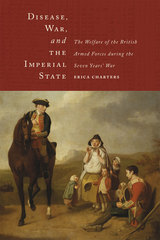
In Disease, War, and the Imperial State, Erica Charters demonstrates how disease played a vital role in shaping strategy and campaigning, British state policy, and imperial relations during the Seven Years’ War. Military medicine was a crucial component of the British war effort; it was central to both eighteenth-century scientific innovation and the moral authority of the British state. Looking beyond the traditional focus of the British state as a fiscal war-making machine, Charters uncovers an imperial state conspicuously attending to the welfare of its armed forces, investing in medical research, and responding to local public opinion. Charters shows military medicine to be a credible scientific endeavor that was similarly responsive to local conditions and demands.
Disease, War, and the Imperial State is an engaging study of early modern warfare and statecraft, one focused on the endless and laborious task of managing manpower in the face of virulent disease in the field, political opposition at home, and the clamor of public opinion in both Britain and its colonies.
In earlier times, a woman knew she was pregnant when she experienced “quickening”—she felt movement within her. Today a woman relies on what she sees in a test result or a digital sonogram image to confirm her pregnancy. A private experience once mediated by women themselves has become a public experience interpreted and controlled by medical professionals. In Disembodying Women, Barbara Duden takes a closer look at this contemporary transformation of women’s experience of pregnancy. She suggests that advances in technology and parallel changes in public discourse have refrained pregnancy as a managed process, the mother as an ecosystem, and the fetus as an endangered species.
Drawing on extensive historical research, Duden traces the graphic techniques-from anatomists’ drawings to woodcuts to X-rays and ultrasound-used to “flay” the female body and turn it inside out. Emphasizing the iconic power of the visual within twentieth-century culture, Duden follows the process by which the pregnant woman’s flesh has been peeled away to uncover scientific data. Lennart Nilsson’s now-famous photographs of the embryo published in Life magazine in the mid-1960s stand in stark contrast to representations of the invisible unborn in medieval iconography or sixteenth-century painting. Illumination has given way to illustration, ideogram to facsimile, the contemplative intuition of the body to a scientific analysis of its component parts.
New ways of seeing the body produce new ways of experiencing the body. Because technology allows us to penetrate that once secret enclosure of the womb, the image of the fetus, exposed to public gaze, has eclipsed that of woman in the public mind. Society, anxious about the health of the global environment, has focused on protecting “life” in the maternal ecosystem, in effect, pitting fetus against mother.
Duden’s reading of the body lends a unique historical and philosophical perspective to contemporary debate over fetal rights, reproductive technologies, abortion, and the right to privacy. This provocative work should reinvigorate that debate by calling into question contemporary certainties and the policies and programs they serve to justify.
An illuminating history of religious and political controversy in nineteenth-century Bengal, where Protestant missionary activity spurred a Christian conversion “panic” that indelibly shaped the trajectory of Hindu and Muslim politics.
In 1813, the British Crown adopted a policy officially permitting Protestant missionaries to evangelize among the empire’s Indian subjects. The ramifications proved enormous and long-lasting. While the number of conversions was small—Christian converts never represented more than 1.5 percent of India’s population during the nineteenth century—Bengal’s majority faith communities responded in ways that sharply politicized religious identity, leading to the permanent ejection of religious minorities from Indian ideals of nationhood.
Mou Banerjee details what happened as Hindus and Muslims grew increasingly suspicious of converts, missionaries, and evangelically minded British authorities. Fearing that converts would subvert resistance to British imperialism, Hindu and Muslim critics used their influence to define the new Christians as a threatening “other” outside the bounds of authentic Indian selfhood. The meaning of conversion was passionately debated in the burgeoning sphere of print media, and individual converts were accused of betrayal and ostracized by their neighbors. Yet, Banerjee argues, the effects of the panic extended far beyond the lives of those who suffered directly. As Christian converts were erased from the Indian political community, that community itself was reconfigured as one consecrated in faith. While India’s emerging nationalist narratives would have been impossible in the absence of secular Enlightenment thought, the evolution of cohesive communal identity was also deeply entwined with suspicion toward religious minorities.
Recovering the perspectives of Indian Christian converts as well as their detractors, The Disinherited is an eloquent account of religious marginalization that helps to explain the shape of Indian nationalist politics in today’s era of Hindu majoritarianism.
Disney Culture proposes that there is still a unifying Disney ethos, one that can be traced back to the corporate philosophy that Walt Disney himself developed back in the 1920s. Yet, as cultural historian John Wills demonstrates, Disney’s values have also adapted to changing social climates. At the same time, the world of Disney has profoundly shaped how Americans view the world.
Wills offers a nuanced take on the corporate ideologies running through animated and live-action Disney movies from Frozen to Fantasia, from Mary Poppins to Star Wars: The Force Awakens. But Disney Culture encompasses much more than just movies as it explores the intersections between Disney’s business practices and its cultural mythmaking. Welcome to “the Disney Way.”
In the absence of specialized programs of study, abstract discussions of China in Latin America took shape in contingent critical infrastructures built at the crossroads of the literary market, cultural diplomacy, and commerce. As Rosario Hubert reveals, modernism flourishes comparatively, in contexts where cultural criticism is a creative and cosmopolitan practice.
Disoriented Disciplines: China, Latin America, and the Shape of World Literature understands translation as a material act of transfer, decentering the authority of the text and connecting seemingly untranslatable cultural traditions. In this book, chinoiserie, “coolie” testimonies, Maoist prints, visual poetry, and Cold War memoirs compose a massive archive of primary sources that cannot be read or deciphered with the conventional tools of literary criticism. As Hubert demonstrates, even canonical Latin American authors, including Jorge Luis Borges, Octavio Paz, and Haroldo de Campos, write about China from the edges of philology, mediating the concrete as well as the sensorial.
Advocating for indiscipline as a core method of comparative literary studies, Disoriented Disciplines challenges us to interrogate the traditional contours of the archives and approaches that define the geopolitics of knowledge.

In a remote Himalayan village in 1721, the Jesuit priest Ippolito Desideri awaited permission from Rome to continue his mission to convert the Tibetan people to Christianity. In the meantime, he forged ahead with an ambitious project: a treatise, written in classical Tibetan, that would refute key Buddhist doctrines. If he could convince the Buddhist monks that these doctrines were false, thought Desideri, he would dispel the darkness of idolatry from Tibet.
Offering a fascinating glimpse into the historical encounter between Christianity and Buddhism, Dispelling the Darkness brings Desideri’s Tibetan writings to readers of English for the first time. This authoritative study provides extended excerpts from Inquiry concerning the Doctrines of Previous Lives and Emptiness, Desideri’s unfinished masterpiece, as well as a full translation of Essence of the Christian Religion, a companion work that broadens his refutation of Buddhism. Desideri possessed an unusually sophisticated understanding of Buddhism and a masterful command of the classical Tibetan language. He believed that only careful argumentation could demolish the philosophical foundations of Buddhism, especially the doctrines of rebirth and emptiness that prevented belief in the existence of God. Donald Lopez and Thupten Jinpa’s detailed commentary reveals how Desideri deftly used Tibetan literary conventions and passages from Buddhist scriptures to make his case.
When the Vatican refused Desideri’s petition, he returned to Rome, his manuscripts in tow, where they languished unread in archives. Dispelling the Darkness brings these vital texts to light after centuries of neglect.
Through an engaging exploration of the concept of “never again” (nunca más/nunca mais) and close analysis of photography exhibits, audiovisual installations, and other art forms in spaces of cultural memory, the book explores how aesthetic interventions can suggest alternative ways of framing human rights subjectivity beyond the rhetoric of liberal humanitarianism. The book visits sites of memory, two of which functioned as detention and torture centers during dictatorships, to highlight the tensions between the testimonial tenor of permanent exhibits and the aesthetic interventions of temporary installations there. Rajca thus introduces perspectives that both undo common understandings of authoritarian violence and its effects as well as reconfigure who or what are made visible as subjects of memory and human rights in postdictatorship countries.
Dissensual Subjects offers much to those concerned with numerous interlocking fields: memory, human rights, political subjectivity, aesthetics, cultural studies, visual culture, Southern Cone studies, postdictatorship studies, and sites of memory.

Between 1772 and 1795, Russia, Prussia, and Austria concluded agreements to annex and eradicate the Commonwealth of Poland-Lithuania. With the partitioning of Poland, the dioceses of the Uniate Church (later known as the Greek Catholic Church) were fractured by the borders of three regional hegemons.
Larry Wolff's deeply engaging account of these events delves into the politics of the Episcopal elite, the Vatican, and the three rulers behind the partitions: Catherine II of Russia, Frederick II of Prussia, and Joseph II of Austria. Wolff uses correspondence with bishops in the Uniate Church and ministerial communiqués to reveal the nature of state policy as it unfolded.
Disunion within the Union adopts methodologies from the history of popular culture pioneered by Natalie Zemon Davis (The Return of Martin Guerre) and Carlo Ginzburg (The Cheese and the Worms) to explore religious experience on a popular level, especially questions of confessional identity and practices of piety. This detailed study of the responses of common Uniate parishioners, as well as of their bishops and hierarchs, to the pressure of the partitions paints a vivid portrait of conflict, accommodation, and survival in a church subject to the grand designs of the late eighteenth century’s premier absolutist powers.
What has Germany made of its Nazi past?
A significant new look at the legacy of the Nazi regime, this book exposes the workings of past beliefs and political interests on how—and how differently—the two Germanys have recalled the crimes of Nazism, from the anti-Nazi emigration of the 1930s through the establishment of a day of remembrance for the victims of National Socialism in 1996.
Why, Jeffrey Herf asks, would German politicians raise the specter of the Holocaust at all, in view of the considerable depth and breadth of support its authors and their agenda had found in Nazi Germany? Why did the public memory of Nazi anti-Jewish persecution and the Holocaust emerge, if selectively, in West Germany, yet was repressed and marginalized in “anti-fascist” East Germany? And how do the politics of left and right come into play in this divided memory? The answers reveal the surprising relationship between how the crimes of Nazism were publicly recalled and how East and West Germany separately evolved a Communist dictatorship and a liberal democracy. This book, for the first time, points to the impact of the Cold War confrontation in both West and East Germany on the public memory of anti-Jewish persecution and the Holocaust.
Konrad Adenauer, Theodor Heuss, Kurt Schumacher, Willy Brandt, Richard von Weizsacker, and Helmut Kohl in the West and Walter Ulbricht, Wilhelm Pieck, Otto Grotewohl, Paul Merker, and Erich Honnecker in the East are among the many national figures whose private and public papers and statements Herf examines. His work makes the German memory of Nazism—suppressed on the one hand and selective on the other, from Nuremberg to Bitburg—comprehensible within the historical context of the ideologies and experiences of pre-1945 German and European history as well as within the international context of shifting alliances from World War II to the Cold War. Drawing on West German and recently opened East German archives, this book is a significant contribution to the history of belief that shaped public memory of Germany’s recent past.

At a time when Western nations are being urged to confront their colonial past, this book examines a major archive, revealing the scale of the Spanish colonial enterprise in South and Central America.
Established in 1785, the Archivo General de Indias in Seville holds roughly three hundred years of Spanish colonial history in the Americas. It houses 8,000 charts and around ninety million documents—among them Christopher Columbus’s logbook and the famous Treaty of Tordesillas which, mediated by the Pope and signed in 1494, entitled the Spanish and Portuguese kings to divide the world between them. With this treaty as a starting point, the historian Martin Zimmermann journeys into the age of discovery and recounts stories of dangerous passages, encounters with the unknown, colonial brutality, and the power of cartographers, illustrating the insatiable lust of colonialists to conquer, exploit, and own the world. Ursula Schulz-Dornburg’s photographs show the archive before its redevelopment in 2002, offering a unique view into one of Europe’s most significant archives.
Stroll through any American or European city today and you probably won’t get far before seeing a dog being taken for a walk. It’s expected that these domesticated animals can easily navigate sidewalks, streets, and other foundational elements of our built environment. But what if our cities were actually shaped in response to dogs more than we ever realized?
Chris Pearson’s Dogopolis boldly and convincingly asserts that human-canine relations were a crucial factor in the formation of modern urban living. Focusing on New York, London, and Paris from the early nineteenth century into the 1930s, Pearson shows that human reactions to dogs significantly remolded them and other contemporary western cities. It’s an unalterable fact that dogs—often filthy, bellicose, and sometimes off-putting—run away, spread rabies, defecate, and breed wherever they like, so as dogs became a more and more common in nineteenth-century middle-class life, cities had to respond to people’s fear of them and revulsion at their least desirable traits. The gradual integration of dogs into city life centered on disgust at dirt, fear of crime and vagrancy, and the promotion of humanitarian sentiments. On the other hand, dogs are some people’s most beloved animal companions, and human compassion and affection for pets and strays were equally powerful forces in shaping urban modernity. Dogopolis details the complex interrelations among emotions, sentiment, and the ways we manifest our feelings toward what we love—showing that together they can actually reshape society.
Dogopolis presents a surprising source for urban innovation in the history of three major cities: human-canine relationships.
Stroll through any American or European city today and you probably won’t get far before seeing a dog being taken for a walk. It’s expected that these domesticated animals can easily navigate sidewalks, streets, and other foundational elements of our built environment. But what if our cities were actually shaped in response to dogs more than we ever realized?
Chris Pearson’s Dogopolis boldly and convincingly asserts that human-canine relations were a crucial factor in the formation of modern urban living. Focusing on New York, London, and Paris from the early nineteenth century into the 1930s, Pearson shows that human reactions to dogs significantly remolded them and other contemporary western cities. It’s an unalterable fact that dogs—often filthy, bellicose, and sometimes off-putting—run away, spread rabies, defecate, and breed wherever they like, so as dogs became a more and more common in nineteenth-century middle-class life, cities had to respond to people’s fear of them and revulsion at their least desirable traits. The gradual integration of dogs into city life centered on disgust at dirt, fear of crime and vagrancy, and the promotion of humanitarian sentiments. On the other hand, dogs are some people’s most beloved animal companions, and human compassion and affection for pets and strays were equally powerful forces in shaping urban modernity. Dogopolis details the complex interrelations among emotions, sentiment, and the ways we manifest our feelings toward what we love—showing that together they can actually reshape society.
Domestications traces a genealogy of American global engagement with the Global South since World War II. Hosam Aboul-Ela reads American writers contrapuntally against intellectuals from the Global South in their common—yet ideologically divergent—concerns with hegemony, world domination, and uneven development. Using Edward Said’s Culture and Imperialism as a model, Aboul-Ela explores the nature of U.S. imperialism’s relationship to literary culture through an exploration of five key terms from the postcolonial bibliography: novel, idea, perspective, gender, and space.
Within this framework the book examines juxtapositions including that of Paul Bowles’s Morocco with North African intellectuals’ critique of Orientalism, the global treatment of Vietnamese liberation movements with the American narrative of personal trauma in the novels of Tim O’Brien and Hollywood film, and the war on terror’s philosophical idealism with Korean and post-Arab nationalist materialist archival fiction.
Domestications departs from other recent studies of world literature in its emphases not only on U.S. imperialism but also on intellectuals working in the Global South and writing in languages other than English and French. Although rooted in comparative literature, its readings address issues of key concern to scholars in American studies, postcolonial studies, literary theory, and Middle Eastern studies.
With a foreword by Arnold I. Davidson and Daniele Lorenzini.
In his final book, renowned philosopher Pierre Hadot explores Goethe’s relationship with ancient spiritual exercises—transformative acts of intellect, imagination, or will. Goethe sought both an intense experience of the present moment as well as a kind of cosmic consciousness, both of which are rooted in ancient philosophical practices. These practices shaped Goethe’s audacious contrast to the traditional maxim memento mori (Don’t forget that you will die) with the aim of transforming our ordinary consciousness. Ultimately, Hadot reveals how Goethe cultivated a deep love for life that brings to the forefront a new maxim: Don’t forget to live.

READERS
Browse our collection.
PUBLISHERS
See BiblioVault's publisher services.
STUDENT SERVICES
Files for college accessibility offices.
RECENTLY PUBLISHED




UChicago Accessibility Resources
home | accessibility | search | about | contact us
BiblioVault ® 2001 - 2026
The University of Chicago Press