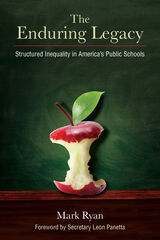
front cover of The Enduring Legacy
The Enduring Legacy
Structured Inequality in America's Public Schools
Mark Ryan
University of Michigan Press, 2020
Enduring Legacy describes a multifaceted paradox—a constant struggle between those who espouse a message of hope and inclusion and others who systematically plan for exclusion. Structured inequality in the nation’s schools is deeply connected to social stratification within American society. This paradox began in the eighteenth century and has proved an enduring legacy. Mark Ryan provides historical, political, and pedagogical contexts for teacher candidates—not only to comprehend the nature of racial segregation but, as future educators, to understand their own professional responsibilities, both in the community and in the school, to strive for an integrated classroom where all children have a chance to succeed. The goal of providing every child a world-class education is an ethical imperative, an inherent necessity for a functioning pluralistic democracy. The challenge is both great and growing, for teachers today will face an evermore segregated American classroom.
[more]

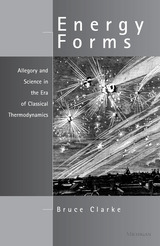
front cover of Energy Forms
Energy Forms
Allegory and Science in the Era of Classical Thermodynamics
Bruce Clarke
University of Michigan Press, 2001
This book follows the interplay between allegory and physics in Europe from the inception of the laws of thermodynamics in the 1850s to the cultural acceptance of the theory of relativity in the 1920s. Bruce Clarke delves into the cultural poetics of this emergence, as well as using allegory theory to link the literature of that era to the consolidation of modern physics in England. In his examination of these correlating topics the author displays not only an impressive grasp on the scientific climate of that era, but also comprehensive knowledge of late nineteenth- and early twentieth-century literature.
The book begins with an overview of the interconnections between allegory in literature and allegory in science, then analyzes the interaction between energy and entropy and their personification in the literature of the times. Energy Forms draws on the writing of well-known literary and scientific authors including H. G. Wells, Camille Flammarion, Charles Howard Hinton and D. H. Lawrence, among others. The focus then shifts to the broad cultural tension between thermodynamic malaise and electromagnetic aspiration. Energy Forms uncovers the works of important but overlooked authors in the fields of science and literature and will appeal especially to those who are intrigued by interdisciplinary studies.
Bruce Clarke is Professor of English,Texas Tech University. He is the author of Dora Marsden and Early Modernism: Gender, Individualism, Science; Allegories of Writing: The Subject of Metamorphosis; and editor of The Body and the Text: Comparative Essays in Literature and Medicine.
[more]

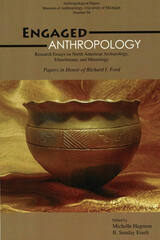
front cover of Engaged Anthropology
Engaged Anthropology
Research Essays on North American Archaeology, Ethnobotany, and Museology
Edited by Michelle Hegmon and B. Sunday Eiselt
University of Michigan Press, 2005
This collection of essays is based on the 2005 Society for American Archaeology symposium and presents research that epitomizes Richard I. Ford’s approach of engaged anthropology. This transdisciplinary approach integrates archaeological research with perspectives from ethnography, history, and ecology, and engages the anthropologist with Native partners and with socio-natural landscapes. Research papers largely focus on the U.S. Southwest, but also consider other areas of North America, issues related to museums collections, and indigenous approaches to materials research.
[more]

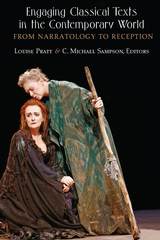
front cover of Engaging Classical Texts in the Contemporary World
Engaging Classical Texts in the Contemporary World
From Narratology to Reception
Louise Pratt and C. Michael Sampson, Editors
University of Michigan Press, 2018
Contemporary classicists often find themselves advocating for the value and relevance of Greco-Roman literature and culture, whether in the classroom, or social media, or newsprint and magazines. In this collection, twelve top scholars apply major critical approaches from other academic fields to open new channels for dialogue between ancient texts and the contemporary world.

This volume considers perennial favorites of classical literature—the Iliad and Odyssey, Greek tragedy, Roman comedy, the Argonautica, and Ovid’s Metamorphoses—and their influence on popular entertainment from Shakespeare’s plays to Hollywood’s toga films. It also engages with unusual and intriguing texts across the centuries, including a curious group of epigrams by Artemidorus found on the island sanctuary of Thera, mysterious fragments of two Aeschylean tragedies, and modern-day North African novels. These essays engage an array of theoretical approaches from other fields—narratology, cognitive literary theory, feminist theory, New Historicist approaches to gender and sexuality, and politeness theory—without forsaking more traditional philological methods. A new look at hospitality in the Argonautica shows its roots in the changed historical circumstances of the Hellenistic world. The doubleness of Helen and her phantom in Euripides’ Helen is even more complex than previously noted. Particularly illuminating is the recurrent application of reception studies, yielding new takes on the ancient reception of Homer by Apollonius and of Aeschylus by Macrobius, the reception of Plautus by Shakespeare, and more contemporary examples from the worlds of cinema and literature.

Students and scholars of classics will find much in these new interpretations and approaches to familiar texts that will expand their intellectual horizons. Specialists in other fields, particularly English, comparative literature, film studies, and gender and sexuality studies, will also find these essays directly relevant to their work.
[more]

front cover of Engineering Stability
Engineering Stability
Rebuilding the State in Twenty-First Century Chinese Universities
Yan Xiaojun
University of Michigan Press, 2024
While the processes of founding a new state or constructing a new political order after a transition have been well-studied, there has been much less attention to how regimes that survive major political crises purposefully reinvent a postcrisis state to respond to updated concepts, new circumstances, changed social demands, and a realigned elite consensus. In Engineering Stability, Yan Xiaojun examines the Chinese Communist Party’s efforts to reassert control and restore order on university campuses in the post-Tiananmen era. Since prominent national universities serve the nation-state as training grounds for the country’s future political, economic, and cultural elites, public life on university campuses has immediate political relevance. 

Drawing on rich materials gathered from in-depth field research in China during the Xi Jinping era, Engineering Stability invites scholars of comparative politics, state theory, contentious politics, and political development to rethink and reimagine how what Yan calls “a compromised autocratic state” is rebuilt within and from itself after overcoming a traumatic moment of vulnerability. The book further details the four types of infrastructure — institutional, significative, regulatory, and incentivizing — that state rebuilders need to overhaul, and looks into the campaign of state rebuilding in post-Tiananmen Chinese universities and its implications for our understanding of politics in general.
[more]

front cover of English for Dispute Resolution
English for Dispute Resolution
Mastering Negotiation, Mediation, and Alternative Dispute Resolution
Barrie J. Roberts
University of Michigan Press, 2025
English for Dispute Resolution shows intermediate to advanced-level ESL students and professionals how to negotiate and mediate in English. Following the approaches often used in US law and business schools to teach Alternative Dispute Resolution (ADR), the book balances readings on ADR theory and strategies with activities, practice role plays, and self-reflection. It provides complex information and step-by-step instructions in plain English, clearly explains key ADR terms and idioms, and highlights cross-cultural communication issues that readers may encounter.

Whether they are using English for Dispute Resolution as a self-study resource or a course textbook, readers can use the book to develop their own unique negotiation and mediation styles in English and improve their professional-level English skills and soft skills for any purpose. Chapters introduce Alternative Dispute Resolution, negotiation ethics, competitive and collaborative negotiation, negotiation game theory, apologies, drafting written agreements, and mediation. After an engaging hypothetical case that introduces the chapter’s key points, each chapter provides warm-up questions, readings about dispute resolution theory and strategies, language tips, and activities and sample phrases to practice applying chapter lessons to real-world disputes. Chapters also invite readers to explore topics of interest, such as dispute resolution in their home countries, personal and professional lives, and current events, and the growing use of Artificial Intelligence (AI) in ADR. Readers will simultaneously build confidence in their English and cross-cultural dispute resolution skills.

English for Dispute Resolution offers readers:
  • Lessons that explain the theories behind Alternative Dispute Resolution, negotiation ethics, competitive and collaborative negotiation, and mediation
  • Activities that help them develop their own unique negotiation strategies and styles along with critical thinking, problem-solving, reading, writing, listening, and speaking.
  • Step-by-step guidance, sample sentences, and practice activities for applying chapter lessons to real-world disputes.
  • Opportunities to explore topics of interest, such as dispute resolution in their home countries, personal and professional lives and current events, and the growing use of Artificial Intelligence (AI) in ADR.
  • Key ADR terms and idioms in plain, accessible English.
  • Specific tips to improve cross-cultural communication for negotiating and mediating in English.
  • A companion website with downloadable checklists, forms, and sample language that can be used for classroom role-plays and real-world negotiations and mediations.
ESL and ESP instructors can use this book along with The Teaching Guide for English for Dispute Resolution to supplement Legal or Business English courses, teach new standalone negotiation or mediation courses, build students’ soft skills, or to add engaging activities and role-plays to ESL courses.
[more]

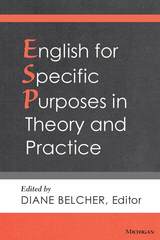
front cover of English for Specific Purposes in Theory and Practice
English for Specific Purposes in Theory and Practice
Diane Belcher, Editor
University of Michigan Press, 2009

The field of English for Specific Purposes (ESP) is among the richest areas of second language research and practice because increasing globalization and changing technologies spawn new modes of intercultural connection and new occasions for second language use. English for Specific Purposes in Theory and Practice compasses this burgeoning field by presenting new research and commentary from some of the field’s leading scholars.

This volume explores ESP from academic (secondary and tertiary), occupational (business, medical, and legal), and socio-cultural perspectives. Recurring motifs throughout the volume are the effects of globalization, English as a lingua franca, and the impact of migrant populations. One of the major questions this volume seeks to answer is, How can ESP instructors meet their own teacher knowledge needs? Also considered is, How have ESP practitioners succeeded in gaining control of the knowledge they need to address their students’ needs?

[more]

front cover of English in Today's Research World
English in Today's Research World
A Writing Guide
John M. Swales and Christine B. Feak
University of Michigan Press, 2000
The authors of Academic Writing for Graduate Students have written a book for the next level of second language writing. English in Today's Research World offers students a very high level of writing instruction, with a specific focus on the projects students undertake--such as dissertations and conference abstracts--at the end of their university work or as they begin careers in research or academia.
In addition to instruction on writing for publication, English in Today's Research World provides needed advice on applications, recommendations, and requests--types of communications that are particularly vulnerable to influences from national cultural expectations and conventions and that, therefore, place the NNS writer at increased disadvantage.
The text is both a reference manual and a course book, so that researchers can continue to use the book after they have completed their formal education. New ESL/EFL teachers can use English in Today's Research World as a reference book for themselves or as a teaching aid in the classroom.

[more]

front cover of The English Language Common Law Workbook
The English Language Common Law Workbook
A Resource for Students Studying English-medium Law Degrees
Ian Collins and David Brody
University of Michigan Press, 2025
While thousands of international students study for Masters of Laws (LLM) degrees or other legal qualifications every year in the U.S. and other common law jurisdictions, many struggle to acculturate to the language demands of law school. Even with international exam scores demonstrating high levels of English, these students need to understand the concepts of common law to be successful. Since the hurdles to achieving success in EMI Law courses are greater than simply the challenge of mastering discipline-specific terminology, or learning particular grammar structures in legal texts, students need a resource that will help them learn to “think like a common law lawyer.”

The English Language Common Law Workbook is designed to support students in developing the core competencies necessary for studying in a common law context. It provides readings and exercises based on authentic legal materials for practicing critical reading and writing skills. In particular, it includes an extensive number of statutes and cases and accompanying exercises that give students an opportunity to work with the type of sources they will encounter in English-medium law degree programs. By emphasizing common law principles throughout, the book helps international students coming from non–common law jurisdictions familiarize themselves with how statutes and cases in common law countries are written and structured. Students are supported in critically reading statutes and cases by focusing on key terminology and language structures. Finally, the book supports students in applying the skills they learn to construct basic case briefs and answer hypothetical legal questions using the IRAC structure.
CEFR Levels: B2–C2

[more]

logo for University of Michigan Press
English Pronunciation
Excercises in Sound Segments, Intonation, and Rhythm
Robert Lado and Charles C. Fries
University of Michigan Press, 1954
English Pronunciation: Exercises in Sound Segments, Intonation, and Rhythm, authored by Robert Lado, Charles C. Fries, and the Staff of the English Language Institute, is a comprehensive guide for mastering the intricacies of English pronunciation. This book is designed to improve the learner's ability to recognize and produce the sounds of English through a series of well-structured lessons and practical exercises. Starting with an introductory lesson designed to familiarize students with the phonemic alphabet and intonation markings, the book then progresses through a series of lessons that address both vowel and consonant contrasts, intonation patterns, rhythm, and stress. Each lesson includes drills for both recognition and production, emphasizing the importance of practice in achieving accurate pronunciation. The material is particularly focused on the needs of Spanish-speaking learners, with numerous aids and detailed articulatory descriptions to facilitate learning. Teachers will find tips on classroom atmosphere, individual differences, and specific teaching techniques that ensure effective learning. The latter part of the book continues to refine pronunciation skills, introducing more complex consonant clusters and combinations and providing supplementary information on English pronunciation irregularities and dialectal variations. By the end of the book, students are expected to have a solid grasp of English sound segments, intonation, and rhythm, enabling them to speak accurately and fluently.
[more]

front cover of English Rule in Gascony, 1199-1259
English Rule in Gascony, 1199-1259
With Special Reference to the Towns
Frank Burr Marsh, Ph.D.
University of Michigan Press, 1912
This volume is a brief history of sixty years of English rule in Gascony, the southwestern region of present-day France. Marsh’s particular concern is how the various towns of the region were affected by decades of political upheavals. Beginning with the controversy over John’s ascension to the throne following the death of his brother, Richard I, Marsh shows how difficulties at the local level contributed to and resulted from the larger instabilities of the time. He also considers the alliances and factions among Gascony’s small towns as they met with a succession of English kings. The book concludes with the treaty between Henry II and Louis IX, ceding control of the region to France. An appendix lists the mayors of Bordeaux during this period.
[more]

front cover of English Sentence Structure
English Sentence Structure
Robert Krohn and the Staff of the Michigan English Language Institute
University of Michigan Press, 1957
Part of the classic Michigan Rainbow series.
English Sentence Structure presents and clarifies all facets of the sentence for beginning and intermediate students. Oral drills, examples, and written exercises form a pattern of regular review and self-evaluation. Each lesson is coordinated with English Pattern Practices.
[more]

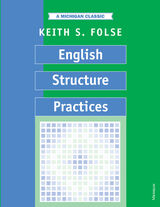
front cover of English Structure Practices
English Structure Practices
Keith S. Folse
University of Michigan Press, 1983
This workbook, which may be used independently or in conjunction with English Sentence Structure, contains more than 400 exercises that cover beginning- and intermediate-level grammar points such as tenses, articles, count and noncount nouns, modals, verbals, relative clauses, passive voice, adverbs, and conditional sentences.
This is the workbook to accompany English Sentence Structure.
[more]

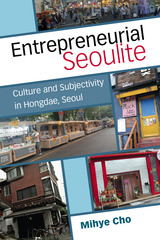
front cover of Entrepreneurial Seoulite
Entrepreneurial Seoulite
Culture and Subjectivity in Hongdae, Seoul
Mihye Cho
University of Michigan Press, 2019
Entrepreneurial Seoulite might be read as a memoir on Hongdae based on the author’s observations as a member of South Korea’s Generation X. During the 1990’s, Hongdae became widely known as a cool place associated with discourses on alternative music, independent labels, and club culture. Today, Hongdae is well known for its youth culture and nightlife, as well as its gentrification. 

Recent research on Korean culture approaches the K-wave phenomenon from the perspectives of cultural consumption, media analysis, and cultural management and policy. Meanwhile, studies on Seoul have centered on its transformation as a global, creative city. Rather than examining the K-wave or the city itself, this book explores the experience of living through the city-in-transition, focusing on the relationship between “the ideology that justified engagement in capitalism” and the “subjectification process.” The book aims to understand the project to institutionalize a cultural district in Hongdae as a demonstration of the coevolution of ideologies and citizenship in a society undergoing rapid liberalization—politically, culturally, and economically. 

A cultural turn took place in Korea during the 1990s, amid the economic prosperity driven by state-led industrialization and the collapse of the military dictatorship due to democratization movements. Cultural critiques, emerging as an alternative to social movements, proliferated to assert the freedom and autonomy of individuals against regulatory systems and institutions. The nation was hit by the Asian financial crisis in 1997, and witnessed massive economic restructuring including layoffs, stakeouts, and a prevalence of contingent employment. As a result, the entire nation had to find new engines of economic growth while experiencing a creative destruction. At the center of this national transformation, Seoul has sought to recreate itself from a mega city to a global city, equipped with cutting-edge knowledge industries and infrastructures.

By juxtaposing the cultural turn and cultural/creative city-making, Entrepreneurial Seoulite interrogates the formation of new citizen subjectivity, namely the enterprising self, in post-Fordist Seoul. What kinds of logic guide individuals in the engagement of new urban realities in rapidly liberalized Seoul—culturally and economically? In order to explore this query, Mihye Cho draws on Weber’s concept of “the spirit of capitalism” on the formation of a new economic agency focusing on the re-configuration of meanings, and seeks to capture a transformative moment detailing when and how capitalism requests a different spirit and lifestyle of its participants. Likewise, this book approaches the enterprising self as the new spirit of post-Fordist Seoul and explores the ways in which people in Seoul internalize and negotiate this new enterprising self.
 
[more]

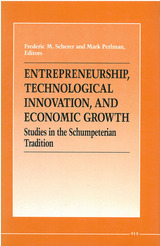
front cover of Entrepreneurship, Technological Innovation, and Economic Growth
Entrepreneurship, Technological Innovation, and Economic Growth
Studies in the Schumpeterian Tradition
Frederic M. Scherer and Mark Perlman, Editors
University of Michigan Press, 1992
Papers presented at the third biennial meeting of the International J. A. Schumpeter Society
[more]

front cover of Enveloping Worlds
Enveloping Worlds
Toward a Discourse of Immersive Performance
E.B. Hunter and Scott Magelssen, Editors
University of Michigan Press, 2025
Enveloping Worlds is a collection of essays that analyzes the phenomenon of immersive, participatory performance as it has developed in the US. As this collection demonstrates, immersive performance offers three-dimensional multisensory experiences, inviting audience members to be participants in the unfolding of the story, and challenging pre-existing ideas about the function of performance and entertainment. Enveloping Worlds questions audience agency and choice, the space and boundaries of performance, modes of immersion, empathy and engagement, and ethical considerations through fifteen essays. 

Case studies in the volume include the Choctaw Cultural Center in Oklahoma and Choctaw sovereignty; a Black artist’s autoethnographic performance challenging White audiences’ entitlement to full inclusion; Immersive Van Gogh experiences and their scenographers; telephone performance during the COVID-19 lockdowns; Diane Paulus’s The Donkey Show; the Battle of Atlanta panorama; an antebellum-themed department store display from the 1920s; escape rooms at Disney Parks; remotely staged plays about aging and dementia; tiki bars; anachronistic costuming at Renaissance Festivals; the technologies that shape the boundaries of immersive worlds; and tabletop role-playing games. Taken together, these essays contribute a rich discussion of immersive performance across radically different contexts, offering analytical models and terminology with which to clarify and advance this emergent discourse.
[more]

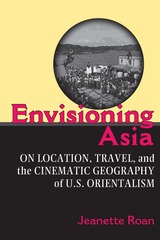
front cover of Envisioning Asia
Envisioning Asia
On Location, Travel, and the Cinematic Geography of U.S. Orientalism
Jeanette Roan
University of Michigan Press, 2010

"Whereas some other scholars read selected films mainly to illustrate political arguments, Roan never loses sight of the particularities of film as a distinctive cultural form and practice. Her drive to see 'cinema as a mechanism of American orientalism' results in not just a textual analysis of these films, but also a history of their material production and distribution."
---Josephine Lee, University of Minnesota

"Envisioning Asia offers an exciting new contribution to our understandings of the historical developments of American Orientalism. Jeannette Roan deftly situates changing cinematic technologies within the context of U.S. imperial agendas in this richly nuanced analysis of 'shooting on location' in Asia in early 20th century American cinema."
---Wendy Kozol, Oberlin College

"Through her vivid illustration of the role of American cinema in the material, visual, and ideological production of Asia, Jeanette Roan takes the reader on a journey to Asia through a very different route from the virtual travel taken by the viewers of the films she discusses."
---Mari Yoshihara, University of Hawai'i at Manoa

The birth of cinema coincides with the beginnings of U.S. expansion overseas, and the classic Hollywood era coincides with the rise of the United States as a global superpower. In Envisioning Asia, Jeanette Roan argues that throughout this period, the cinema's function as a form of virtual travel, coupled with its purported "authenticity," served to advance America's shifting interests in Asia. Its ability to fulfill this imperial role depended, however, not only on the cinematic representations themselves but on the marketing of the films' production histories---and, in particular, their use of Asian locations. Roan demonstrates this point in relation to a wide range of productions, offering an engaging and useful survey of a largely neglected body of film. Not only that, by focusing on the material practices involved in shooting films on location---that is, the actual travels, negotiations, and labor of making a film---she moves beyond formal analysis to produce a richly detailed history of American interests, attitudes, and cultural practices during the first half of the twentieth century.

Jeanette Roan is Adjunct Professor of Visual Studies at California College of the Arts and author of "Exotic Explorations: Travels to Asia and the Pacific in Early Cinema" in Re/collecting Early Asian America: Essays in Cultural History (2002).

Cover art: Publicity still, Tokyo File 212 (Dorrell McGowan and Stuart McGowan, 1951). The accompanying text reads: "Hundreds of spectators gather on the sidelines as technicians prepare to photograph a parade scene in 'Tokyo File 212,' a Breakston-McGowan Production filmed in Japan for RKO Radio distribution." Courtesy of the Academy of Motion Picture Arts and Sciences.
[more]

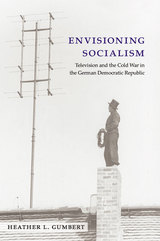
front cover of Envisioning Socialism
Envisioning Socialism
Television and the Cold War in the German Democratic Republic
Heather L. Gumbert
University of Michigan Press, 2014

Envisioning Socialism examines television and the power it exercised to define the East Germans’ view of socialism during the first decades of the German Democratic Republic. In the first book in English to examine this topic, Heather L. Gumbert traces how television became a medium prized for its communicative and entertainment value. She explores the difficulties GDR authorities had defining and executing a clear vision of the society they hoped to establish, and she explains how television helped to stabilize GDR society in a way that ultimately worked against the utopian vision the authorities thought they were cultivating.

Gumbert challenges those who would dismiss East German television as a tool of repression that couldn’t compete with the West or capture the imagination of East Germans. Instead, she shows how, by the early 1960s, television was a model of the kind of socialist realist art that could appeal to authorities and audiences. Ultimately, this socialist vision was overcome by the challenges that the international market in media products and technologies posed to nation-building in the postwar period.

A history of ideas and perceptions examining both real and mediated historical conditions, Envisioning Socialism considers television as a technology, an institution, and a medium of social relations and cultural knowledge. The book will be welcomed in undergraduate and graduate courses in German and media history, the history of postwar Socialism, and the history of science and technologies.
[more]

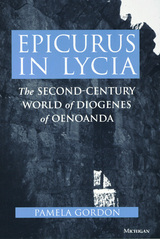
front cover of Epicurus in Lycia
Epicurus in Lycia
The Second-Century World of Diogenes of Oenoanda
Pamela Gordon
University of Michigan Press, 1996
Brings to life the controversial philosophers Diogenes and Epicurus
[more]

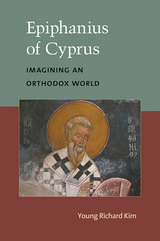
front cover of Epiphanius of Cyprus
Epiphanius of Cyprus
Imagining an Orthodox World
Young Richard Kim
University of Michigan Press, 2015
Epiphanius of Cyprus offers the first complete biography in English of Epiphanius, lead bishop of Cyprus in the late fourth century CE and author of the Panarion, a massive encyclopedia of heresies. Imagining himself a defender of orthodoxy, he became an active heresy-hunter, involving himself in the most significant theological and ecclesiastical debates of his day.

Young Richard Kim studies the bishop as a historical person and a self-constructed persona, as mediated within the pages of the Panarion. Kim’s “micro-readings” of the Panarion present a close look at autobiographical anecdotes, situated in historical contexts, that profoundly shaped both Epiphanius’ character and how he wanted his readers to perceive him. “Macro-readings” examine portions of the Panarion that reflected how Epiphanius imagined his world, characterized by an orthodoxy that had existed since Creation and was preserved through the generations. In the final chapter, Kim considers Epiphanius’ life after the publication of the Panarion and how he spent years “living” the pages of his heresiology.

Kim brings a more balanced perspective to a controversial figure, recognizing shortcomings but also understanding them in light of Epiphanius’ own world. The bishop appears not as a buffoon, but as someone who knew how to use the power of the rhetoric of orthodoxy to augment his own authority. Quintessentially late antique, he embodied the contentious transition from the classical past to the medieval and Byzantine worlds.

This book will be of broad interest to students and scholars of ancient history, classics, and religious studies.
[more]

front cover of Equal Freedom
Equal Freedom
Stephen Darwall, Editor
University of Michigan Press, 1995
"Egalitarian" and "libertarian" are frequently seen as opposing political labels. These two views and their oppositions are the topic of this collection of important essays by an exceptionally distinguished group of thinkers.This collection of essays can be read as a critique of libertarianism. A libertarian, in contemporary discussion, is one who supports no more than a minimal state--a government that protects individuals from assault, murder, theft, and other invasions of their "Lockean" rights, but otherwise does not interfere with voluntary economic or personal activity. "Egalitarian," on the other hand, generally refers to someone who is prepared to favor such interference if it is necessary to reduce substantial inequalities of certain kinds and if, perhaps, it is democratically authorized.Several of the essays, those of John Rawls, T. M. Scanlon, G. A. Cohen, and Ronald Dworkin, advance different versions of this liberal egalitarian line of argument. Each maintains that the ideas of freedom and equality enter into moral and political philosophy at a more fundamental level than the substantive, rights-determining norms on which libertarianism makes its stand. Each proposes a distinctive vision of this fundamental role. And each argues, on this basis, for egalitarian moral or political principles. Amartya Sen's essay can also be placed within a broadly liberal egalitarian tradition, although it is less an argument for substantive equality (and against libertarianism) than a discussion of what form a reasonable egalitarianism might take. Finally, Quentin Skinner directly criticizes libertarianism in ways that arguably tend to support egalitarianism, although this is not his primary aim.This book offers deep thinking across one of the main fissures of current political debate. It will thus be of interest to all with a serious interest in the fundamentals of political beliefs and action.
[more]

front cover of Equal Justice in the Balance
Equal Justice in the Balance
America's Legal Responses to the Emerging Terrorist Threat
Raneta Lawson Mack and Michael J. Kelly
University of Michigan Press, 2004
"We are in difficult times for the protection of our liberties. Nonetheless, citizens are showing an increased willingness to resist the erosion of the U.S. Constitution. . . . Lawson Mack and Kelly stress the importance of not giving up these fundamental rights and conclude with a message of optimism, noting an increased backlash against the administration's more draconian measures. Although the landscape is still quite bleak, change is in the air."
-Michael Ratner, President, Center for Constitutional Rights, from the foreword

"A compelling and sophisticated critique of the U.S. government's post-9/11 actions. Mack and Kelly set the stage with the historical perspective on America's response to terrorism and the assessment of terrorist threats, before launching into a comprehensive analysis of the USA Patriot Act. Their hard-hitting approach and easy-to-read style makes for a fascinating treatment of the government's legislative and executive response to the attacks."
-Michael P. Scharf, Case Western Reserve University School of Law


With its sweeping critique of the USA Patriot Act and the Bush administration's maneuvers in pursuit of terrorists, Equal Justice in the Balance is a sobering and exacting look at American legal responses to terrorism, both before and after 9/11.

The authors detail wide-ranging and persuasive evidence that American antiterrorism legislation has led to serious infringements of our civil rights. They show us how deviations from our fundamental principles of fairness and justice in times of heightened national anxiety-whether the Red Scare, World War II, or the War on Terrorism-have resulted in overreaction and excess, later requiring apologies and reparations to those victimized by a paranoia-driven justice system.

While terrorist attacks-especially on a large scale and on American soil-damage our national pride and sense of security, the authors offer powerful arguments for why we must allow our judicial infrastructure, imperfect as it is, to respond without undue interference from the politics of anger and vengeance.


[more]

front cover of The Era of Great Disasters
The Era of Great Disasters
Japan and Its Three Major Earthquakes
Makoto Iokibe; Translated by Tony Gonzalez
University of Michigan Press, 2020
The Era of Great Disasters examines modern disaster response in Japan, from the changing earthquake preparations and regulations, to immediate emergency procedures from the national, prefectural, and city levels, and finally the evolving efforts of rebuilding and preparing for the next great disaster in the hopes of minimizing their tragic effects. This book focuses on three major earthquakes from Japan’s modern history. The first is the 1923 Great Kantō Earthquake, which struck the capital region. The second is the 1995 Great Hanshin-Awaji Earthquake, affecting the area between Kobe and Osaka. The third is the 2011 Great East Japan Earthquake, the magnitude 9.0 quake that struck off the Pacific coast of the Tōhoku region, causing a devastating tsunami and the nuclear accident. While the events of (and around) each of these earthquakes are unique, Professor Iokibe brings his deep expertise and personal experience to each disaster, unveiling not only the disasters themselves but the humanity underneath. In each case, he gives attention and gratitude to those who labored to save lives and restore the communities affected, from the individuals on the scene to government officials and military personnel and emergency responders, in hope that we might learn from the past and move forward with greater wisdom, knowledge, and common purpose.
[more]

front cover of ESC
ESC
Sonic Adventure in the Anthropocene
Jacob Smith
University of Michigan Press, 2019
ESC is a work of experimental audio-based scholarship combining sound studies, radio history, and environmental criticism. This unique project is a fully open access, fully digital suite of audiographic essays, presented as a ten-part podcast series, combining spoken commentary, clips from classic radio dramas, excerpts from films and television shows, news reports, and the work of contemporary sound artists. A brief written essay on the ESC website provides a helpful introduction and context for this project.

ESC takes as its point of departure the CBS Radio adventure series Escape (1947–54). The postwar years saw both a decline in popularity for American radio drama, and the dawn of the Anthropocene era, with human beings emerging as the primary force affecting the earth’s systems.

Jacob Smith considers Escape’s adventure stories from an ecocritical perspective, analyzing the geographic, sociopolitical, and ecological details of the stories to reveal how they are steeped in social and environmental history.

The work of contemporary sound artists and field recordists underscores the relevance of sound in these narratives and demonstrates audio’s potential as a key medium for scholarship. ESC features recordings by some of the most prominent sound artists working in this area, including Daniel Blinkhorn, Peter Cusak, David Dunn, JLIAT, Christina Kubisch, Francisco López, Sally Ann McIntyre, Chris Watson, and Jana Winderen.

ESC makes the urgency of our critical ecological moment audible in a new way. The audio essays articulate what it means to live in an Anthropocene era and posit alternative ways of conceptualizing our historical moment. ESC sharpens our ability to listen and respond to our world with greater ecological awareness.

All publication resources for ESC, including the introductory essay, audio materials, and backmatter, are available on 
Fulcrum. The audio materials are also available on Apple Podcasts.
[more]

front cover of The ESL Writer's Handbook
The ESL Writer's Handbook
Janine Carlock, Maeve Eberhardt, Jaime Horst, Lionel Menasche
University of Michigan Press, 2010

The ESL Writer’s Handbook is a reference work for ESL students who are taking college-level courses. Because its purpose is to provide help with the broad variety of writing questions students may have when working on school assignments, the text focuses on

English for Academic Purposes. Unlike other handbooks on the market, this book’s sole purpose is to address the issues of second language learners.

This spiral-bound Handbook complements a student writer’s dictionary, thesaurus, and grammar reference book. It would be suitable as a text for an advanced ESL writing course when used together with the companion Workbook (978-0-472-03404-8). The Handbook is concise and easily navigated; is accessible, with clear and direct explanatory language; features information on both APA and MLA styles (including a sample paper for each); and includes many examples from ESL student writers to provide realistic models.

            Included as special features in the Handbook are:

•         The topic selection is based on ESL writers’ needs as observed by the authors over many years.

•         The coverage of topics is more complete than the limited amount usually provided for ESL writers in first language or L1 handbooks.

•         The explanatory language is appropriate for ESL students, in contrast to the more complex and idiomatic language of other English handbooks.

•         The level of detail is more manageable for ESL students, compared to what is in other English handbooks.

  • Many of the examples of paragraphs, essays, research papers, and exercise sentences were written by ESL students; this encourages users of this Handbook to realize that they can also become effective writers.
[more]

front cover of The ESL Writer's Handbook, 2nd Ed.
The ESL Writer's Handbook, 2nd Ed.
Janine Carlock, Maeve Eberhardt, Jaime Horst, Lionel Menasche
University of Michigan Press, 2018
The ESL Writer’s Handbook is a reference work for ESL students who are taking college-level courses. Because its purpose is to provide help with the broad variety of writing questions students may have when working on school assignments, the text focuses on English for Academic Purposes. Unlike other handbooks on the market, this book’s sole purpose is to address the issues of second language learners.

The spiral-bound Handbook complements a student writer’s dictionary, thesaurus, and grammar reference book. It would be suitable as a text for an advanced ESL writing course when used together with the companion Workbook (978-0-472-03726-1).

The new edition features significant revisions to Sections 3 and 4; in particular, both APA and MLA style guides have been updated and new sample papers for each are included. The new edition includes new and revised exercises and many new samples of student writing.

Like its predecessor, the 2nd Edition has these special features: 
  • The topic selection is based on ESL writers’ needs as observed by the authors over many years.
  • The coverage of topics is more complete than the limited amount usually provided for ESL writers in first language or L1 handbooks.
  • The explanatory language is appropriate for ESL students, in contrast to the more complex and idiomatic language of other English handbooks.
  • Many of the examples of paragraphs, essays, research papers, and exercise sentences were written by ESL students to help users realize that they too can become effective writers.
[more]

front cover of The ESL Writer's Handbook, 3rd Edition
The ESL Writer's Handbook, 3rd Edition
Janine Carlock, Maeve Eberhardt, Jaime Horst
University of Michigan Press, 2025
The 3rd edition of The ESL Writer’s Handbook continues to be a valuable resource that offers non-native English speakers, particularly international students, a foundation in the basics of the academic writing genre they need to succeed in high school– or college-level writing. By focusing on English for Academic Purposes, it helps address the broad variety of writing questions students may have while working on school assignments. It can act as a complement to a student’s dictionary, thesaurus, and grammar reference book, or as a core text in an advanced-level ESL writing course. With explanatory language that avoids unnecessary idioms and incorporates writing examples from real international students, The ESL Writer’s Handbook will help students build their confidence in English language writing.

In addition to updated style guides, sample student papers, writing examples, and exercises, the 3rd edition highlights “tech tips” on different technologies that may be useful to students, explains inclusive language, and expands the section on taking notes as a research tool.

With this handbook, students will learn:
  • The concept of genre and apply it to unpacking assignments and writing effectively.
  • The process for generating ideas, structuring those ideas into a paper, and checking over a paper before turning it in.
  • Five common patterns for organizing an academic essay: narrative, process, comparison/contrast, cause and effect, and argument. 
  • Different steps for creating a good research paper, including major citation styles. 
  • Guidance for addressing the grammar, punctuation, and style issues most often encountered by international students writing in English. 
  • How to differentiate between other types of writing U.S. undergraduate students are expected to complete, such as emails, resumes, cover letters, and personal statements.
CEFR Levels: B1C2
[more]

logo for University of Michigan Press
Essays and Studies in English and Comparative Literature
Members of the English Department of the University of Michigan
University of Michigan Press, 1935
Essays and Studies in English and Comparative Literature is a collection of scholarly works authored by members of the University of Michigan's English Department. It investigates various aspects of English and comparative literature, including studies on Middle English dialect characteristics, fifteenth-century spellings, place-name derivations, and early treatises on Latin grammar. In addition, it explores the origins and developments of specific linguistic features such as the voiceless preterit and past participle inflections of English irregular weak verbs. This comprehensive examination of historical and linguistic topics contributes significant insights to the field of literary studies.
[more]

logo for University of Michigan Press
Essays and Studies in English and Comparative Literature
Members of the English Department of the University of Michigan
University of Michigan Press, 1932
Essays and Studies in English and Comparative Literature is a collection of scholarly essays written by members of the English Department of the University of Michigan. The book features in-depth studies on diverse topics such as the traditional development of the character Diomede, peculiarities in Shakespearean texts, the Italianate background of The Merry Wives of Windsor, and political aspects in Dryden's works. Contributors explore the aesthetic theories of Shelley, Keats, and Poe, and offer a bibliographical essay on Chrétien de Troyes, among other significant literary examinations. This compilation reflects the academic rigor and critical insights of its esteemed authors, providing valuable contributions to English and Comparative Literature studies.
[more]

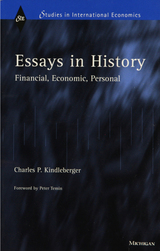
front cover of Essays in History
Essays in History
Financial, Economic, Personal
Charles P. Kindleberger
University of Michigan Press, 1999
Essays in History is a collection of papers and articles covering a breathtaking span across the twentieth century and delving into such diverse topics as economic and financial crises in the sixteenth century, retirement reading for bankers, and a first-hand account of the genesis and formation of the Marshall Plan. Who else to explore such far-flung topics and bring such intelligence and wit to them but Charles P. Kindleberger?Readers will find here a strong view on the need for economic history to guide theoretical research. They will also detect Kindleberger’s doubtfulness regarding economic theory based on assumptions that all participants in society are honest, well informed, and make their judgments independently. And finally, readers will be led to the conclusion that, in light of these views, those who think that finance and the economy should be completely unregulated are woefully misguided.The book’s foreword by Peter Temin, economics professor at MIT and former student and colleague of Kindleberger’s, provides a warm and informative introduction to the life and work of this formidable economist and delightful writer.
[more]

front cover of Essays on Archaeological Methods
Essays on Archaeological Methods
Edited by James B. Griffin
University of Michigan Press, 1951
James B. Griffin edited this collection of essays, written by leading archaeologists of the time, on best practices for field and laboratory work. The hope was to improve the practice of archaeology and stimulate further research. Contributions by Albert C. Spaulding, Junius Bird, Frederick R. Matson, and others.
[more]

front cover of Essays on the Modern Japanese Church
Essays on the Modern Japanese Church
Christianity in Meiji Japan
Yamaji Aizan; Translated by Graham Squires, with Introductory Essays by Graham Squires and A. Hamish Ion
University of Michigan Press, 2000
Essays on the Modern Japanese Church (Gendai Nihon kyokai shiron), published in 1906, was the first Japanese-language history of Christianity in Meiji Japan. Yamaji Aizan’s firsthand account describes the reintroduction of Christianity to Japan—its development, rapid expansion, and decline—and its place in the social, political, and intellectual life of the Meiji period. Yamaji’s overall argument is that Christianity played a crucial role in shaping the growth and development of modern Japan.
Yamaji was a strong opponent of the government-sponsored “emperor-system ideology,” and through his historical writing he tried to show how Japan had a tradition of tolerance and openness at a time when government-sponsored intellectuals were arguing for greater conformity and submissiveness to the state on the basis of Japanese “national character.”
Essays is important not only in terms of religious history but also because it highlights broad trends in the history of Meiji Japan. Introductory chapters explore the significance of the work in terms of the life and thought of its author and its influence on subsequent interpretations of Meiji Christianity.
[more]

front cover of Essential Actions for Academic Writing
Essential Actions for Academic Writing
A Genre-Based Approach
Nigel A. Caplan and Ann M. Johns
University of Michigan Press, 2022
Essential Actions for Academic Writing is a writing textbook for all beginning academic students, undergraduate or graduate, to help them understand how to write effectively throughout their academic and professional careers. Essential Actions combines genre research, proven pedagogical practices, and short readings to help students writing in their first, second, or additional languages to develop their rhetorical flexibility by exploring and practicing the key actions that will appear in academic assignments, such as explaining, summarizing, synthesizing, and arguing. 

Part I:
  • Introduces students to rhetorical situation, genre, register, source use, and a framework for understanding how to approach any new writing task.
  • Demonstrates that all writing responds to a context that includes the writer’s identity, the reader’s expectations, the purpose of the text, and the conventions that shape it.
Part II:
  • Explores the essential actions of academic writing (explain, summarize, synthesize, report and interpret data, argue, respond, and analyze).
  • Provides examples of the genres and language that support each action. 
Part III:
  • Offers four extended projects that combine the essential actions in different genres and contexts. 
[more]

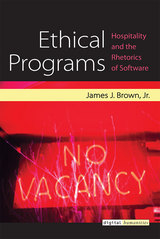
front cover of Ethical Programs
Ethical Programs
Hospitality and the Rhetorics of Software
James J. Brown, Jr.
University of Michigan Press, 2015
Living in a networked world means never really getting to decide in any thoroughgoing way who or what enters your “space” (your laptop, your iPhone, your thermostat . . . your home). With this as a basic frame-of-reference, James J. Brown’s Ethical Programs examines and explores the rhetorical potential and problems of a hospitality ethos suited to a new era of hosts and guests. Brown reads a range of computational strategies and actors including the general principles underwriting the Transmission Control Protocol (TCP), which determines how packets of information can travel through the internet, to the Obama election campaign’s use of the power of protocols to reach voters, harvest their data, incentivize and, ultimately, shape their participation in the campaign. In demonstrating the kind of rhetorical spaces networked software establishes and the access it permits, prevents, and molds, Brown makes a major contribution to the emergent discourse of software studies as a major component of efforts in broad fields including media studies, rhetorical studies, and cultural studies.
[more]

front cover of Ethnic Cues
Ethnic Cues
The Role of Shared Ethnicity in Latino Political Participation
Matt A. Barreto
University of Michigan Press, 2012

"New theoretical propositions, original data, and rigorous empirical tests are what one looks for in cutting-edge social science. Fortunately, all three are apparent in Ethnic Cues. The author has pushed his thinking to develop new ways of understanding and explaining patterns of Latino voting behavior."
---Luis Ricardo Fraga, University of Washington, Seattle

"Matt Barreto investigates some of the ramifications of two new related developments in American political life: the stunning growth of the Latino immigrant population in recent decades and the accompanying exponential explosion in the number of Latino candidates running for political office at the local, state, and national levels."
---Reuel R. Rogers, Northwestern University

Until recently, much of the research on political participation has resisted the idea that Latino voters rely on ethnic cues. The discussion has become increasingly salient as political strategists have learned to define individual voting blocs and mobilize them in support of a candidate. Nourished by the debate over immigration, the search for the Latino voter has now blossomed into a national political obsession.

Against this background, Matt A. Barreto assays the influence of ethnic identification on Latinos' voting behavior. Barreto asks whether the presence of co-ethnic candidates actually does mobilize Latino voters in support of these candidates. His analysis of in-depth candidate interviews, public opinion surveys, official election results, and statistics finds that it does. He goes on to describe the dynamic of voting in the Latino community and sharpens our appreciation of how ethnic considerations influence the electoral choices of Americans more generally. In a time of intensely focused campaign appeals, Barreto's work has much to tell us about the mechanics of public opinion and the role of race and ethnicity in voting behavior.

Matt A. Barreto is Associate Professor of Political Science at the University of Washington and Director of the Washington Institute for the Study of Ethnicity, Race, and Sexuality (WISER).

Cover art credit: © iStockphoto.com/P_Wei
[more]

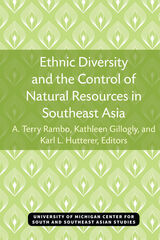
front cover of Ethnic Diversity and the Control of Natural Resources in Southeast Asia
Ethnic Diversity and the Control of Natural Resources in Southeast Asia
A. Terry Rambo, Kathleen Gillogly, and Karl L. Hutterrer, Editors
University of Michigan Press, 1988
The authors consider the ways in which the high degree of ethnic diversity within the region is related to the nature of tropical Asian environments, on the one hand, and the nature of Southeast Asian political systems and the ways in which they manipulate natural resources, on the other. Rather than focus on defining the phenomenon of ethnicity, this book examines the different social evolutionary contexts in which the phenomenon is manifested.
Companion volume to Cultural Values and Human Ecology in Southeast Asia (Michigan Papers no. 27).
[more]

front cover of Ethnic Drag
Ethnic Drag
Performing Race, Nation, Sexuality in West Germany
Katrin Sieg
University of Michigan Press, 2002
The Holocaust is considered a singularly atrocious event in human history, and many people have studied its causes. Yet few questions have been asked about the ways in which West Germans have "forgotten," unlearned, or reconstructed the racial beliefs at the core of the Nazi state in order to build a democratic society. This study looks at ethnic drag (Ethnomaskerade) as one particular kind of performance that reveals how postwar Germans lived, disavowed, and contested "Germanness" in its complex racial, national, and sexual dimensions.
Using engaging case studies, Ethnic Drag traces the classical and travestied traditions of Jewish impersonation from the eighteenth century onward to construct a pre-history of postwar ethnic drag. It examines how, shortly after World War II, mass culture and popular practices facilitated the repression and refashioning of Nazi racial precepts. During a time when American occupation authorities insisted on remembrance and redress for the Holocaust, the Wild West emerged as a displaced theater of the racial imagination, where the roles of victim, avenger, and perpetrator of genocide were reassigned.
Ethnic Drag is an accessible and sophisticated, critical and entertaining book that examines the phenomenon of cultural masquerade in order to examine racial feeling, thought, and behavior in postwar German culture. Contributing to considerations of drag in postcolonial, feminist, and queer scholarships, this book will be of interest to people in German studies, theater performance, ethnic studies, and women's/queer studies.
Katrin Sieg is Associate Professor, Department of German and Center for German and European Studies, Georgetown University.
[more]

logo for University of Michigan Press
Ethnic Drag
Performing Race, Nation, Sexuality in West Germany
Katrin Sieg
University of Michigan Press, 2002
The Holocaust is considered a singularly atrocious event in human history, and many people have studied its causes. Yet few questions have been asked about the ways in which West Germans have "forgotten," unlearned, or reconstructed the racial beliefs at the core of the Nazi state in order to build a democratic society. This study looks at ethnic drag (Ethnomaskerade) as one particular kind of performance that reveals how postwar Germans lived, disavowed, and contested "Germanness" in its complex racial, national, and sexual dimensions.
Using engaging case studies, Ethnic Drag traces the classical and travestied traditions of Jewish impersonation from the eighteenth century onward to construct a pre-history of postwar ethnic drag. It examines how, shortly after World War II, mass culture and popular practices facilitated the repression and refashioning of Nazi racial precepts. During a time when American occupation authorities insisted on remembrance and redress for the Holocaust, the Wild West emerged as a displaced theater of the racial imagination, where the roles of victim, avenger, and perpetrator of genocide were reassigned.
Ethnic Drag is an accessible and sophisticated, critical and entertaining book that examines the phenomenon of cultural masquerade in order to examine racial feeling, thought, and behavior in postwar German culture. Contributing to considerations of drag in postcolonial, feminist, and queer scholarships, this book will be of interest to people in German studies, theater performance, ethnic studies, and women's/queer studies.
Katrin Sieg is Associate Professor, Department of German and Center for German and European Studies, Georgetown University.
[more]

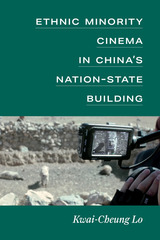
front cover of Ethnic Minority Cinema in China’s Nation-State Building
Ethnic Minority Cinema in China’s Nation-State Building
Kwai-Cheung Lo
University of Michigan Press, 2025
Ethnic Minority Cinema in China’s Nation-State Building investigates the relationship between cinematic productions about non-Han ethnic minorities and China’s nation-state building project from the early Republican era of the 1920s to the current authoritarian regime in the twenty-first century. Kwai-Cheung Lo argues that the glossy, but superficial, cinematic depictions of non-Han ethnic minorities manufactured and manipulated by state authorities have deeply penetrated the Chinese public’s conception of what an ideal multiethnic nation should be like as well as what it means to be Chinese under political unification. 

Lo understands these representations of ethnic minorities as part of a larger ecosystem and the cultures, values, and life practices of non-Han ethnic minorities as closely entwined with environmental issues and politics. This intertwining, Lo argues, suggests a crisis in “objectification and identification” of both people and the environment, that plays out in cinema featuring ethnic minorities. Lo traces these depictions of Chinese ethnic minority groups in films created by both Han-majority and non-Han filmmakers, examining how these representations became a site in which state authorities, Han and non-Han communities, and foreign agencies compete and interact under the larger context of building and imagining the Chinese nation-state.
 
[more]

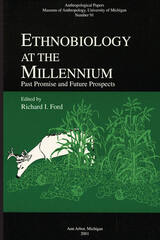
front cover of Ethnobiology at the Millennium
Ethnobiology at the Millennium
Past Promise and Future Prospects
Edited by Richard I. Ford
University of Michigan Press, 2001
A collection of papers from the Ethnobiology 2000 millennium conference in Ann Arbor. Contributions by Richard Ford, Elizabeth Wing, Steven Weber, Paul Minnis, Karen Adams, Eugene Hunn, Cecil Brown, Catherine Fowler, Nancy Turner, and Eugene Anderson.
[more]

front cover of The Ethnobotanical Laboratory at the University of Michigan
The Ethnobotanical Laboratory at the University of Michigan
Melvin R. Gilmore
University of Michigan Press, 1932
In 1932, with this slim but important volume, the University of Michigan Museum of Anthropology began its publication series.Melvin R. Gilmore, a preeminent ethnobotanist, joined the Museum as its first curator of ethnology in 1929 and in 1930 established the Ethnobotanical Laboratory: the largest such collection in North America. He became director of the laboratory in 1938. In this volume, he discusses the establishment of the laboratory and the importance of ethnobotanical research.Nearly a century later, the Ethnobotanical Laboratory is still unique for its extensive collection of archaeological and systematic comparative wood, seeds, and plant parts from around the world, and for its ethnographic examples of how traditional cultures collect, store, process, and use these plants.
[more]

front cover of Euripides and the Instruction of the Athenians
Euripides and the Instruction of the Athenians
Justina Gregory
University of Michigan Press, 1997
Political by its very nature, Greek tragedy reflects on how life should be lived in the polis, and especially the polis that was democratic Athens. Instructional as well, drama frequently concerns itself with the audience's moral education. Euripides and the Instruction of the Athenians draws on these political and didactic functions of tragedy for a close analysis of five plays: Alcestis, Hippolytus, Hecuba, Heracles, and Trojan Women. Clearly written and persuasively argued, this volume addresses itself to all who are interested in Greek tragedy. Nonspecialists and scholars alike will deepen their understanding of this complex writer and the tumultuous period in which he lived.
". . . a lucid presentation of the positive side of Euripidean tragedy, and a thoughtful reminder of the political implications of Greek tragedy." --American Journal of Philology
". . . the principal defect of [this] otherwise excellent study is that it is too short." --Erich Segal, Classical Review
". . . a most stimulating book throughout . . . ." --Greece and Rome
Justina Gregory is Professor of Classics, Smith College, where she is head of the department. She has been the recipient of Fulbright and Woodrow Wilson fellowships.
[more]

front cover of The European Union and the Rise of Regionalist Parties
The European Union and the Rise of Regionalist Parties
Seth K. Jolly
University of Michigan Press, 2015
Rather than weakening the forces of nationalism among member states, the expanding power of the European Union actually fosters conditions favorable to regionalist movements within traditional nation-states. Using a cross-national, quantitative study of the advent of regionalist political parties and their success in national parliamentary elections since the 1960s, along with a detailed case study of the fortunes of the pro-independence Scottish National Party, Seth K. Jolly demonstrates that supranational integration and subnational fragmentation are not merely coincidental but related in a theoretical and predictable way.

At the core of his argument, Jolly posits the Viability Theory: the theory that the EU makes smaller states more viable and more politically attractive by diminishing the relative economic and political advantages of larger-sized states. European integration allows regionalist groups to make credible claims that they do not need the state to survive because their regions are part of the EU, which provides access to markets, financial institutions, foreign policy, and other benefits. Ultimately, Jolly emphasizes, scholars and policy-makers must recognize that the benefits of European integration come with the challenge of increased regionalist mobilization that has the potential to reshape the national boundaries of Europe.

[more]

front cover of European-Russian Power Relations in Turbulent Times
European-Russian Power Relations in Turbulent Times
Mai’a K. Davis Cross and Ireneusz Pawel Karolewski, Editors
University of Michigan Press, 2021
The Russia-Europe relationship is deteriorating, signaling the darkest era yet in security on the continent since the end of the Cold War. In addition, the growing influence of the Trump administration has destabilized the transatlantic security community, compelling Europe—especially the European Union—to rethink its relations with Russia.

The volume editors’ primary goal is to illuminate the nature of the deteriorating security relationship between Europe and Russia, and the key implications for its future. While the book is timely, the editors and contributors also draw out long-term lessons from this era of diplomatic degeneration to show how increasing cooperation between two regions can devolve into rapidly escalating conflict. While it is possible that the relationship between Russia and Europe can ultimately be restored, it is also necessary to understand why it was undermined in the first place. The fact that these transformations occur under the backdrop of an uncertain transatlantic relationship makes this investigation all the more pressing.

Each chapter in this volume addresses three dimensions of the problem: first, how and why the power status quo that had existed since the end of the Cold War has changed in recent years, as evidenced by Russia’s newly aggressive posturing; second, the extent to which the EU’s power has been enabled or constrained in light of Russia’s actions; and third, the risks entailed in Europe’s reactive power—that is, the tendency to act after-the-fact instead of proactively toward Russia—in light of the transatlantic divide under Trump.
 
[more]

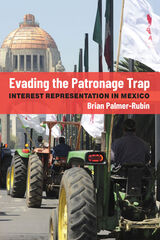
front cover of Evading the Patronage Trap
Evading the Patronage Trap
Interest Representation in Mexico
Brian Palmer-Rubin
University of Michigan Press, 2022

Why have Latin American democracies proven unable to confront the structural inequalities that cripple their economies and stymie social mobility? Brian Palmer-Rubin contends that we may lay the blame on these countries’ systems of interest representation, which exhibit “biased pluralism,” a system in which the demands of organizations representing economic elites—especially large corporations—predominate. A more inclusive model of representation would not only require a more encompassing and empowered set of institutions to represent workers, but would also feature spaces for non-eliteproducers—such as farmers and small-business owners to have a say in sectoral economic policies.

With analysis drawing on over 100 interviews, an original survey, and official government data, this book focuses on such organizations and develops an account of biased pluralism in developing countries typified by the centrality of patronage—discretionarily allocated state benefits. Rather than serving as conduits for demand-making about development models, political parties and interest organizations often broker state subsidies or social programs, augmenting the short-term income of beneficiaries, but doing little to improve their long-term economic prospects. When organizations become diverted into patronage politics, the economic demands of the masses go unheard in the policies that most affect their lives, and along the way, their economic interests go unrepresented.
[more]

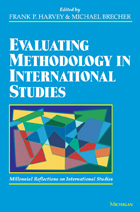
front cover of Evaluating Methodology in International Studies
Evaluating Methodology in International Studies
Frank P. Harvey and Michael Brecher, Editors
University of Michigan Press, 2009

Evaluating Methodology in International Studies offers a unique collection of original essays by world-renowned political scientists. The essays address the state of the discipline in regard to the methodology of researching global politics, focusing in particular on formal modeling, quantitative methods, and qualitative approaches in International Studies.

The authors reflect on the strengths and weaknesses of current methodology and suggest ways to advance theory and research in International Studies. This volume is essential reading for methods courses and will be of interest to scholars and students alike.

See table of contents and excerpts.

Frank P. Harvey is Professor of Political Science and Director of the Centre for Foreign Policy Studies at Dalhousie University.

Michael Brecher is the R.B. Angus Professor of Political Science at McGill University and past president of the International Studies Association.

Millennial Reflections on International Studies

This volume is part of the Millennial Reflections on International Studies project in which forty-five prominent scholars engage in self-critical, state-of-the-art reflection on international studies to stimulate debates about successes and failures and to address the larger questions of progress in the discipline.

Other paperbacks from this project:
Realism and Institutionalism in International Studies
Conflict, Security, Foreign Policy, and International Political Economy: Past Paths and Future Directions in International Studies
Critical Perspectives in International Studies

The full collection of essays is available in the handbook Millennial Reflections on International Studies.
[more]

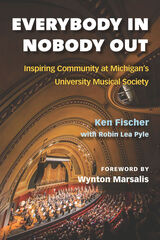
front cover of Everybody In, Nobody Out
Everybody In, Nobody Out
Inspiring Community at Michigan's University Musical Society
Ken Fischer with Robin Lea Pyle
University of Michigan Press, 2020
Housed on the campus of the University of Michigan in Ann Arbor, the University Musical Society is one of the oldest performing arts presenters in the country. A past recipient of the National Medal of Arts, the nation’s highest public artistic honor, UMS connects audiences with wide-ranging performances in music, dance, and theater each season.Between 1987 and 2017, UMS was led by Ken Fischer, who over three decades pursued an ambitious campaign to expand and diversify the organization’s programming and audiences—initiatives inspired by Fischer’s overarching philosophy toward promoting the arts, “Everybody In, Nobody Out.”

The approach not only deepened UMS’s engagement with the university and southeast Michigan communities, it led to exemplary partnerships with distinguished artists across the world. Under Fischer’s leadership, UMS hosted numerous breakthrough performances, including the Vienna Philharmonic’s final tour with Leonard Bernstein, appearances by then relatively unknown opera singer Cecilia Bartoli, a multiyear partnership with the Royal Shakespeare Company, and artists as diverse as Yo-Yo Ma, Jawole Willa Jo Zollar, Elizabeth Streb, and Nusrat Fateh Ali Khan.

Though peppered with colorful anecdotes of how these successes came to be, this book is neither a history of UMS nor a memoir of Fischer’s significant accomplishments with the organization. Rather it is a reflection on the power of the performing arts to engage and enrich communities—not by handing down cultural enrichment from on high, but by meeting communities where they live and helping them preserve cultural heritage, incubate talent, and find ways to make community voices heard.
[more]

front cover of Everyday English 1500-1700
Everyday English 1500-1700
A Reader
Bridget Cusack, Editor
University of Michigan Press, 1998
What kind of language did ordinary men and women use in the seventeenth century? Everyday English 1500-1700 addresses this question by bringing together and explaining more than sixty nonliterary texts from the early modern period, ranging from witnesses' depositions to church wardens' accounts, and from letters and journals to constables' presentments and scurrilous abuse shouted in the marketplace.
This unique source book of essential documents designed for courses on Early Modern English is designed as a teaching text with full guidance to each text, including glossary, explanatory and background notes, and suggested topics for linguistic evaluation. Everyday English takes an up-to-the-minute approach by focusing on language as it was used and spoken at the time.
This wide-ranging collection for the first time makes available to students a corpus of examples of the ordinary, nonstandard language of the man and woman in the street, coming from areas as diverse as England, Scotland, and America. The emphasis throughout is on providing as much assistance as possible to the reader to aid understanding and appreciation of both the linguistic features and the everyday lifestyles of the time.
"The only book a really conscientious teacher of the history and structure of Early Modern English would use for source texts." --Roger Lass, University of Cape Town
Bridget Cusack was lecturer in English Language, University of Edinburgh.
[more]

front cover of Everyday Leadership
Everyday Leadership
Getting Results in Business, Politics, and Life
Daniel Granholm Mulhern
University of Michigan Press, 2007

“A book that truly speaks to everyone. . . . Always practical, often inspiring, this is more a reference book than a self-improvement text, and a great read for any would-be leader.”
—Roger Penske, owner of Penske Corporation and Penske Racing

“Sound, practical advice driven home with real-world examples. . . . This is a must-read book for anyone who wants to make a positive difference in the lives of others in their community, their business, or their family.”
—Dennis W. Archer, former mayor of Detroit

Everyday Leadership is a treasure chest of engaging stories, practical tips, and rich insights into how we each can make a difference in the world when we take responsibility for the personal power that we have. . . . once you’ve taken Everyday Leadership to heart you’ll leave this world a little bit better than you found it.”
—Jim Kouzes, coauthor of The Leadership Challenge

Everyday Leadership taught me as much about how to be a better person as it did about being a better leader. In fact, it revealed how much the two are the same. Excellent and helpful reading for anyone.”
—Marianne Williamson, author of Return to Love and Everyday Grace

Everyday Leadership offers strategies to improve leadership skills, achieve results, and gain greater satisfaction in these hectic times. It speaks to the everyday leader, whether that person is a principal, pastor, parent, or CEO.

Daniel Granholm Mulhern brings the art of management down to earth, presenting stories that illuminate some of the best ideas about real human leadership. He offers practical steps to achieve the goal of leading well in our lives through creating a vision, communicating that vision, and living it in simple yet powerful ways.

Daniel Granholm Mulhern is the “First Gentleman” of the State of Michigan and an accomplished consultant, business coach, and motivational speaker. In addition to the personal support and counsel he offers his wife, Governor Jennifer Mulhern Granholm, Dan contributes his professional expertise, spearheading the effort to make Michigan’s state government a model for the nation as a “great place to do great work!” Dan also chairs the Michigan Community Service Commission, which promotes and coordinates volunteer efforts across the state.

[more]

front cover of Everyone’s Theater
Everyone’s Theater
Literature and Daily Life in England, 1860–1914
Michael Meeuwis
University of Michigan Press, 2019

Nearly all residents of England and its colonies between 1860 and 1914 were active theatergoers, and many participated in the amateur theatricals that defined late Victorian life. The Victorian theater was not an abstract figuration of the world as a stage, but a media system enmeshed in mass lived experience that fulfilled in actuality the concept of a theatergoing nation. Everyone’s Theater turns to local history, the words of everyday Victorians found in their diaries and production records, to recover this lost chapter of theater history in which amateur drama domesticates the stage. Professional actors and playwrights struggled to make their productions compatible with ideas and techniques that could be safely reproduced in the home—and in amateur performances from Canada to India. This became the first true English national theater: a society whose myriad classes found common ground in theatrical display. Everyone’s Theater provides new ways to extend Victorian literature into the dimension of voice, sound, and embodiment, and to appreciate the pleasures of Victorian theatricality.

[more]

front cover of Everywoman Her Own Theology
Everywoman Her Own Theology
On the Poetry of Alicia Suskin Ostriker
Martha Nell Smith and Julie R. Enszer, Editors
University of Michigan Press, 2018
Alicia Ostriker’s artistic and intellectual productions as a poet, critic, and essayist over the past 50 years are protean and have been profoundly influential to generations of readers, writers, and critics. In all her writings, both the feminist and the human engage fiercely with the material and metaphysical world. Ostriker is a poet concerned with questions of social justice, equality, religion, and how to live in a world marked by both beauty and tragedy.

Everywoman Her Own Theology: On the Poetry of Alicia Suskin Ostriker engages Ostriker’s poetry from throughout her career, including her first volume Songs, her award-winning collection The Imaginary Lover, and her more recent work in the collections No Heaven, the volcano sequence, The Old Woman, the Tulip, and the Dog, and Waiting for the Light. Like her literary criticism and essays, Ostriker’s poetry explores themes of feminism, Jewish life, family, and social justice.

With insightful essays—some newly written for this collection—poets and literary critics including Toi Derricotte, Daisy Fried, Cynthia Hogue, Tony Hoagland, and Eleanor Wilner illuminate and open new pathways for critical engagement with Alicia Ostriker’s lifetime of poetic work.

[more]

front cover of Evita, Inevitably
Evita, Inevitably
Performing Argentina's Female Icons Before and After Eva Perón
Jean Graham-Jones
University of Michigan Press, 2014
Evita, Inevitably sheds new light on the history and culture of Argentina by examining the performances and reception of the country’s most iconic female figures, in particular, Eva Perón, who rose from poverty to become a powerful international figure. The book links the Evita legend to a broader pattern of female iconicity from the mid-nineteenth century onward, reading Evita against the performances of other female icons: Camila O’Gorman, executed by firing squad over her affair with a Jesuit priest; Difunta Correa, a devotional figure who has achieved near-sainthood; cumbia-pop performer Gilda; the country’s patron saint, the Virgin of Luján; and finally, Argentina’s president, Cristina Fernández de Kirchner. Employing the tools of discursive, visual, and performance analysis, Jean Graham-Jones studies theatrical performance, literature, film, folklore, Catholic iconography, and Internet culture to document the ways in which these “femicons” have been staged.
[more]

front cover of Evolution and Culture
Evolution and Culture
Marshall D. Sahlins and Elman R. Service, Editors
University of Michigan Press, 1960
A unified interpretation of the evolution of species, humanity, and society
[more]

front cover of The Evolution of Agrarian Institutions
The Evolution of Agrarian Institutions
A Comparative Study of Post-Socialist Hungary and Bulgaria
Mieke Meurs
University of Michigan Press, 2001
The Evolution of Agrarian Institutions studies the unexpectedly slow and uneven growth of private agriculture in postsocialist East-Central Europe. Comparing developments in Hungary and Bulgaria, Mieke Meurs offers an explanation for this slow growth and examines its implications for efficiency and income distribution in postsocialist agriculture.
With the collapse of the state socialist regimes in East-Central Europe, it was widely expected that collectivized agriculture would quickly be remade in the glowing image of China--a patchwork of small, privately run farms yielding rapid increases in output and incomes. However, the European experience has been quite different; while socialist collective farms have disappeared, collective forms of organization have persisted, and private farming has been slow to emerge. Meurs argues that an understanding of the causes of the slow emergence of private farming is essential to effective policy intervention in agriculture. This book contributes to such an understanding through analyzing variations in farm organization and rural market development and comparing agricultural restructuring in Hungary and Bulgaria.
The Evolution of Agrarian Institutions is unique in its combination of original survey data, published data on land use, and published historical data. It also tests two institutionalist explanations for the pace and direction of change in agricultural organization. This book will be of interest to economists, political scientists, sociologists, scholars working in the area of rural development in emerging countries, and anyone with an interest in transitional economics.
Mieke Meurs is Associate Professor of Economics, American University.
[more]

front cover of The Evolution of American Legislatures
The Evolution of American Legislatures
Colonies, Territories, and States, 1619-2009
Peverill Squire
University of Michigan Press, 2014

The institutional development of American legislatures, beginning with the first colonial assembly of 1619, has been marked by continuity as well as change. Peverill Squire draws upon a wealth of primary sources to document this institutional history. Beginning with the ways in which colonial assemblies followed the precedents of British institutions, Squire traces the fundamental ways they evolved to become distinct. He next charts the formation of the first state legislatures and the Constitutional Congress, describes the creation of territorial and new state legislatures, and examines the institutionalization of state legislatures in the nineteenth century and their professionalization since 1900.

With his conclusion, Squire discusses the historical trajectory of American legislatures and suggests how they might further develop over the coming decades. While Squire's approach will appeal to historians, his focus on the evolution of rules, procedures, and standing committee systems, as well as member salaries, legislative sessions, staff, and facilities, will be valuable to political scientists and legislative scholars.

[more]

front cover of The Evolution of Settlement Systems in the Region of Vohémar, Northeast Madagascar
The Evolution of Settlement Systems in the Region of Vohémar, Northeast Madagascar
Henry T. Wright, Robert E. Dewar, Chantal Radimilahy, and Lucien Marie Aimé Rakotozafy
University of Michigan Press, 2021
On the northeast coast of Madagascar, near the town of Vohémar, is a large cemetery dating to the fourteenth century. During World War II, French troops excavated the site but left no comprehensive report. University of Michigan archaeologist Henry T. Wright led an intensive archaeological survey in the region, hoping to find evidence of earlier settlements. In four seasons, the researchers found evidence of several settlements dating to different periods: a large port site dating to the same era as the cemetery; early estuarine villages of the 7th and 8th centuries; and a rock shelter with microlithic tools. In this study, Wright presents the survey results in detail, including the evidence for settlements as well as illustrations of the ceramics and stone tools.
[more]

front cover of Evolutionary Concepts in Contemporary Economics
Evolutionary Concepts in Contemporary Economics
Richard W. England, Editor
University of Michigan Press, 1994
A view of new work in economics taking an evolutionary approach.
[more]

front cover of An Exaltation of Forms
An Exaltation of Forms
Contemporary Poets Celebrate the Diversity of Their Art
Annie Finch and Kathrine Varnes, Editors
University of Michigan Press, 2002
At once handbook, reader, and guide to the literary tastes and wisdom of poets, An Exaltation of Forms is an indispensable resource certain to find a dedicated audience among poetry lovers. The editors invited over fifty contemporary poets to select a poetic meter, stanza, or form, describe it, recount its history, and provide favorite examples. The essays represent a remarkably diverse range of literary styles and approaches, and show how the forms of contemporary English-language poetry derive from a wealth of different traditions.

The forms range from hendecasyllabics to prose poetry, haiku to procedural poetry, sonnets to blues, rap to fractal verse. The range of poets included is equally impressive--from Amiri Baraka to John Frederick Nims, from Maxine Kumin to Marilyn Hacker, from Agha Shahid Ali to Pat Mora, from W. D. Snodgrass to Charles Bernstein. Achieving this level of eclecticism is a remarkable feat, especially given the strong opinions held by members of the various camps (e.g., the New Formalists, LANGUAGE poets, feminist and multicultural poets) that exist within today's poetry community. Poets who might never occupy the same room here occupy the same pages, perhaps for the first time. The net effect is a book that will surprise, inform, and delight a wide range of readers, whether as reference book, pleasure reading, or classroom text.

Poet, translator, and critic Annie Finch is director of the Stonecoast low-residency MFA program at the University of Southern Maine. She is author of The Ghost of Meter: Culture and Prosody in American Free Verse, Eve, and Calendars. She is the winner of the eleventh annual Robert Fitzgerald Prosody Award for scholars who have made a lasting contribution to the art and science of versification.

Kathrine Varnes teaches English at the University of Missouri-Columbia. She is the author of the book of poems, The Paragon. Her poems and essays have appeared in many books and journals.
[more]

front cover of Excavation at San José Mogote 1
Excavation at San José Mogote 1
The Household Archaeology
Kent V. Flannery and Joyce Marcus with a multidimensional scaling of houses by Robert G. Reynolds
University of Michigan Press, 2005
San José Mogote, an early village and chiefly center in Mexico’s Oaxaca Valley, was excavated over a fifteen-year period. This volume reports in detail on every Early and Middle Formative house recovered, including a complete inventory of artifacts, features, plants, animal bones, and craft raw materials by house, with extensive piece-plotting of items on house floors and dooryards.
[more]

front cover of Excavations at Cerro Tilcajete
Excavations at Cerro Tilcajete
A Monte Albán II Administrative Center in the Valley of Oaxaca
Christina Elson
University of Michigan Press, 2007
This volume, part of a series on the prehistory and human ecology of the Valley of Oaxaca, Mexico, focuses on Cerro Tilcajete, a secondary administrative center below Monte Albán, the capital of the prehispanic Zapotec state.
[more]

front cover of Excavations at Quachilco
Excavations at Quachilco
A Report on the 1977 Season of the Palo Blanco Project in the Tehuacan Valley
Robert D. Drennan
University of Michigan Press, 1978
In this volume, Robert D. Drennan presents results of two seasons of archaeological research on the Palo Blanco Project in the Tehuacán Valley of Mexico. He reports on the surface survey and excavations at the central plaza and surrounding areas, including the outlying barrios.
[more]

front cover of Excavations at San José Mogote 2
Excavations at San José Mogote 2
The Cognitive Archaeology
Kent V. Flannery and Joyce Marcus with contributions by Chris L. Moser, Ronald Spores, Dudley M. Varner, Judith Francis Zeitlin, and Robert N. Zeitlin
University of Michigan Press, 2005
San José Mogote is a 60-70 ha Formative site in the northern Valley of Oaxaca, Mexico, which was occupied for a thousand years before the city of Monte Albán was founded. Filling 432 pages and utilizing more than 400 photographs and line drawings, this book describes in detail more than 35 public buildings, including men’s houses, one-room temples, a performance platform, two-room state temples, a ballcourt, and two types of palaces.
[more]

front cover of Excavations at Santo Domingo Tomaltepec
Excavations at Santo Domingo Tomaltepec
Evolution of a Formative Community in the Valley of Oaxaca, Mexico
Michael E. Whalon
University of Michigan Press, 1981
In 1974, Michael E. Whalen excavated the Formative site of Tomaltepec, a village with houses, public buildings, and a large cemetery. Here he reports on the results of the excavation and provides a regional perspective on Formative period development in the Valley of Oaxaca.
[more]

front cover of Exclusionary Violence
Exclusionary Violence
Antisemitic Riots in Modern German History
Christhard Hoffmann, Werner Bergmann, and Helmut Walser Smith, Editors
University of Michigan Press, 2002
Whereas a large body of scholarly literature exists on German antisemitism in general, pre-Nazi histories of violence against Jews in the nineteenth and twentieth centuries have been widely neglected. This coherent and well-focused collection of essays is the first comprehensive work in any language dealing with antisemitic pogroms in modern German history from the Hep Hep riots of 1819 to the Reichskristallnacht. In the Western mind, outbursts of collective violence against Jews have been largely identified with Tzarist Russia and the medieval crusade massacres. However, by narrating pogroms as archaic, historians have overlooked their significance to the development of modern antisemitism in Germany and Europe as well as the reasons for its continued presence in the contemporary world. The evidence presented in this volume suggests that acts of exclusionary violence were not dead-end streets of futile protest. Rather, they were rehearsals for new kinds of destruction. The integration of various perspectives and the close cooperation of scholars from different disciplines is a major achievement of this volume, which will be of interest to advanced undergraduates, graduate students, academics and the general reader in a variety of disciplines, including German studies, Jewish studies, Holocaust and genocide studies, ethnic relations, history, and the social sciences in general.
[more]

logo for University of Michigan Press
Exclusive Revolutionaries
Liberal Politics, Social Experience, and National Identity in the Austrian Empire, 1848-1914
Pieter M. Judson
University of Michigan Press, 1996
Exclusive Revolutionaries traces the development of German liberal and later nationalist political culture in imperial Austria from the revolutions of 1848 to the outbreak of World War I. Drawing on archival research from several regions of the former Habsburg Monarchy, Pieter M. Judson provides a clear, chronological political narrative that demonstrates the continuing influence of liberal ideas and values well after the defeat of liberal political parties.

In the mid-1800s, Judson argues, German liberal activists built an effective political movement whose ideology was rooted in its members' social experience in voluntary associations. The liberals were committed to the creation of a market economy based on personal property rights, to a society based on the values of individual self-improvement and personal respectability, and to a fundamental distinction between active and passive citizenship. They were determined to achieve a harmonious community of free peoples, in which personal enlightenment would bring an end to the divisive influence of localism, ethnicity, religion, and feudal social hierarchy.

Yet after 1880, as newer, more radical mass political movements threatened their political fortunes, the liberals forged a German nationalist politics based increasingly on ethnic identity. Their emphasis on national identity became a way for former liberals to hold together an increasingly diverse coalition of German speakers who had little in common outside of their shared language. Only "Germanness" bridged the dangerous gulf between social classes. This nationalism helped the liberals to compete for power in the multinational, multicultural Austrian Empire down to 1914, but it left a legacy of nationalist extremism and tolerance of anti-Semitism that continues to influence political cultures in the former lands of the Habsburg Monarchy today.
 
Exclusive Revolutionaries will interest social and cultural historians of nineteenth-century Europe, and of Germany and Central Europe in particular.
 
Pieter M. Judson is Professor of History, Swarthmore College.  He is the recipient of a fellowship from the John Simon Guggenheim Foundation.
[more]

logo for University of Michigan Press
Exit of a Hero
Photography and the Visual Culture of Commemoration in Southern Nigeria
Okechukwu Nwafor
University of Michigan Press, 2026

In Exit of a Hero, Okechukwu Nwafor explores the cultural, political, and socioeconomic implications of photography in commemorative practices in southern Nigeria from the nineteenth century to the present. Focusing on obituary and commemorative photographs of late nineteenth and early twentieth-century Lagos to contemporary funeral posters, booklets, and social media posts, Nwafor tracks the historical evolution of the iconic and heroic image. He argues that the quest to produce an ideal memorial body is not just a personal aesthetic choice but a deliberate photographic project that resonates with the Igbo aspirations for heroic achievement. 

Exit of a Hero asserts that the visual canonization transforms the deceased from a fallible being to an unimpeachable character who transcends underachievement, imperfection, and failed social performance to emerge as a saintly icon of the Igbo public sphere. In seeking an alternative, hyper-visible public self, social media reclaims the lost hero image of the deceased, reconstituting the contested Igbo public space as a lived reality where heroes and icons are actively and eternally commemorated. Nwafor unveils the creative imaginations of colonial subjects and postcolonial citizens as memorialization has become entangled within the intersecting discursive spaces of print culture and the public sphere.

[more]

front cover of Expedition Escape from the Classroom
Expedition Escape from the Classroom
Political Outings on the Campus and the Anxiety of Teaching IR
Oded Löwenheim
University of Michigan Press, 2024
Despite facing profound teaching anxiety stemming from the politically intense surroundings in Israel and his own writer’s block, Oded Löwenheim crafted an innovative college course that breaks free from the traditional classroom setting to explore the depths of Jerusalem’s Mount Scopus campus. He takes his class—and by extension, the reader—to explore the political and historical imprints scattered throughout Mount Scopus, such as the Jerusalem British War Cemetery, the botanical garden of the campus, and the bomb shelter of the Harry S. Truman Research Institute. Drawing from a rich tapestry of disciplines that include political geography, botany, literature, history, and archaeology, this book invites readers to find the international in the everyday.

Expedition Escape from the Classroom offers a unique narrative where teaching and its inherent challenges intersect with the intricacies of global politics, history, and identity. While recounting his academic experiment, Löwenheim grapples with the changing landscape of academia in a neoliberal age, while illustrating how personal vulnerabilities can transform into powerful tools for growth, exploration, and enlightenment. Whether you’re an educator, student, or just a curious reader, Expedition Escape from the Classroom promises a journey of reflection, critical thinking, and profound revelations.
[more]

front cover of Expelled to a Friendlier Place
Expelled to a Friendlier Place
A Study of Effective Alternative Schools
Martin Gold and David W. Mann
University of Michigan Press, 1984
Disruptive, delinquent adolescents—is there any hope for a change in their attitude toward schools and themselves? Martin Gold and David W. Mann describe the effects of three model alternative schools on the behavioral and scholastic performance of disruptive adolescents and present a detailed look at the students' varying experiences in these programs. The reasons for positive improvements in some students and the absence of improvement in others are traced to specific features of the alternative schools' programs. With the increasing occurrences of delinquency in our schools, this study should be of concern not only to educators, but also to community planners and state personnel dealing with delinquency.
[more]

front cover of The Experience of Modernity
The Experience of Modernity
Chinese Autobiography of the Early Twentieth Century
Janet Ng
University of Michigan Press, 2003
Autobiography of the first half of the twentieth century was used variously by different groups of writers to interrogate, negotiate, and even to program the social and political progress of China. However, despite the popularity and success of this genre, it has also been the most forgotten in literary and historical discussions. Personal stories and individual expressions seem to have had no place in 1920s, 1930s, and 1940s China, smothered instead by the grander rhetoric of nationalism. For this reason, autobiography's popularity during the era is an odd phenomenon and also an important genre for study.
The May Fourth Era (1917-40) began as a movement to make the classical literary language accessible to the common people and became a broader political movement against imperialism. The writing of autobiography was influenced by the idea of literature's social and political mission, yet at the same time autobiography was a uniquely potent venue for individual expression. Janet Ng examines this notion in The Experience of Modernity within the framework of autobiographical writings by Chen Hengzhe, Lu Xun, Hu Shi, Xie Bingying, Xiao Hong, Eileen Chang, Yu Dafu, and Shen Congwen.
Janet Ng is Assistant Professor of Asian Literature, the College of Staten.
[more]

front cover of Experimental Foundations of Political Science
Experimental Foundations of Political Science
Donald R. Kinder and Thomas R. Palfrey, Editors
University of Michigan Press, 1993
Shows the range and power of experimental methods in political science
[more]

front cover of Explaining Social Institutions
Explaining Social Institutions
Jack Knight and Itai Sened, Editors
University of Michigan Press, 1998
How is it that people with different and often conflicting interests can band together, overcome coordination problems, and create stable institutions that regulate the interactions among members of the group? Explaining Social Institutions leads us significantly closer to understanding how such institutions come to be.
Much of the work being done under the rubric of "new institutionalism" focuses on how institutions shape social, economic, and political outcomes. This emphasis on influence has provided students of economics, political science, and political economy with surprisingly little theory to account for the origins of such institutions. Yet without understanding how institutions form and consequently develop influence, much of the other work lacks context. The contributors fill this void by utilizing a variety of perspectives and theoretical approaches. The twin focus of these articles on the origins of institutions and the development of institutional influence yield innovative and suggestive outcomes. Topics range from the framing of the United States Constitution to debate over the Senate at the Federal Convention; from equilibrium and social institutions to democratic stability.
Contributors include Randall Calvert, Jon Elster, Avner Greif, Jack Knight, Paul Milgrom, Douglass North, William Riker, Norman Schofield, Itai Sened, and Barry Weingast.
Jack Knight is Assistant Professor of Political Science, Washington University, St. Louis. Itai Sened is Assistant Professor of Political Science, Tel Aviv University.
[more]

front cover of Explorations in Early Southeast Asian History
Explorations in Early Southeast Asian History
The Origins of Southeast Asian Statecraft
Kenneth R. Hall and John K. Whitmore, Editors
University of Michigan Press, 1976
While following the probes of foreign individuals into various obscure parts of Southeast Asia over the centuries is a diverting and entertaining pastime, the purpose of this volume is to investigate this past with the mind, to question and postulate upon the historical patterns that have developed from earlier study of the area, and to bring concepts from other areas and disciplines to bear on the existing information. The product of this effort, as it is encompassed in this volume, is not an attempt at the definitive study of any of the topics. It is rather a series of speculations on the directions feasible for the further study of the Southeast Asian past. As such, the answers proposed in these essays are really questions. Are the ideas presented here true within the specific historical contexts for which they have been developed? If so, can we use these ideas, or variations of them, to interpret the history of other parts of Southeast Asia? If not, what other ideas may be brought to bear on these situations in order to understand them? The ultimate aim of this volume is thus a challenge to the profession at large not only to criticize what we have done, but also to go beyond our postulations and create new ones. [xi]
[more]

front cover of Explorations in Ottoman Prehistory
Explorations in Ottoman Prehistory
Rudi Paul Lindner
University of Michigan Press, 2007

The origins of the Ottomans, whose enterprise ruled much of the Near East for more than half a millennium, have long tantalized and eluded scholars, many of whom have thrown up their hands in exasperation. While the later fourteenth- and fifteenth-century history of the Ottomans has become better known, the earlier years have proved an alluring and recalcitrant puzzle. A reconsideration of the sources and a canvass of new ones has long been overdue. Rudi Paul Lindner’s Explorations in Ottoman Prehistory is the first book in over sixty years to reassess the overture to Ottoman history.

In addition to conducting a critical examination of the Ottoman chronicles and the Byzantine annals, Lindner develops hitherto unutilized geographic data and previously unknown numismatic evidence and also draws on travelers’ descriptions of the Anatolian landscape in an earlier epoch. By investigating who the Ottomans were, where they came from, and where they settled and why, as well as what sort of relationships they had with their neighbors in the late thirteenth and early fourteenth centuries, Lindner makes an engaging and lucid contribution to an otherwise very small store of knowledge of Ottoman history in the early stages of the empire.

Rudi Paul Lindner is Professor of History at the University of Michigan and author of Nomads and Ottomans in Medieval Anatolia,part of Indiana University’s Uralic and Altaic Series.
[more]

front cover of Exploring Options in Academic Writing
Exploring Options in Academic Writing
Effective Vocabulary and Grammar Use
Jan Frodesen and Margi Wald
University of Michigan Press, 2016
Exploring Options is designed to help student writers develop their knowledge and use of academic language to meet the demands of college- and university-level writing assignments. It draws on the research identifying lexical and grammatical patterns across academic contexts and provides authentic reading contexts for structured vocabulary learning. Recognizing that vocabulary choices in writing often require consideration of grammatical structure, Exploring Options focuses on specific kinds of lexico-grammatical decisions—that is, the ones involving the interaction between vocabulary and grammar--that students face in shaping, connecting, and restructuring their ideas. The book helps writers learn how to effectively use resources such as learner dictionaries, thesauruses, and concordancers to improve academic word knowledge.
 
Following a unit on using resources for vocabulary development, the contents are divided into three parts: Showing Relationships within Sentences, Connecting and Focusing across Sentences, and Qualifying Statements and Reporting Research. Part 1 focuses on verbs and modifiers that express increases and decreases, verbs and abstract nouns that describe change, connectors and verbs describing causal relationships, and parallel structures. Part 2 explores the words that help connect ideas and add cohesion. Part 3 discusses how to express degrees of certainty and accuracy and the use of reporting verbs. 
[more]

front cover of Exploring the Public Effects of Religious Communication on Politics
Exploring the Public Effects of Religious Communication on Politics
Brian Calfano, Editor
University of Michigan Press, 2021

Though not all people are religious believers, religion has played important historic roles in developing political systems, parties, and policies—affecting believers and nonbelievers alike. This is particularly true in the United States, where scholars have devoted considerable attention to a variety of political phenomena at the intersection of religious belief and identity, including social movements, voting behavior, public opinion, and public policy. These outcomes are motivated by “identity boundary-making” among the religiously affiliated. The contributors to this volume examine two main factors that influence religious identity: the communication of religious ideas and the perceptions of people (including elites) in communicating said ideas.

Exploring the Public Effects of Religious Communication on Politics examines an array of religious communication phenomena. These include the media’s role in furthering religious narratives about minority groups, religious strategies that interest groups use to advance their appeal, the variable strength of Islamophobia in cross-national contexts, what qualifies as an “evangelical” identity, and clergy representation of religious and institutional teachings. The volume also provides ways for readers to think about developing new insights into the influence religious communication has on political outcomes.
[more]

front cover of The Extraordinary Decade
The Extraordinary Decade
Literary Memoirs
By P.V. Annenkov, Edited by Arthur P. Mendel, Translated by Irwin R. Titunik
University of Michigan Press, 1981
Russia in the 1840s seethed with intellectual radicalism. The reactionary government of Alexander I and of his successor, Nicholas I ,had dispelled all hope among the intelligentsia of reforming Russia, and both Westerners and Slavophiles sought ways to eradicate the recent past and to found a new Russia, new in government, in social structure, and in philosophy.Pavel V. Annenkov was an intimate friend of the radical intellectuals—Belinsky, Herzen, Bakunin, and Botkin—as well as of the foremost literary figures of the day—Turgenev, Tolstoy, and Gogol. In his memoirs, Annenkov gives penetrating insights into the nature of this "extraordinary decade," the 1840s, and personal portraits of the many famous men who made it extraordinary.Annenkov focuses on his good friend V. G. Belinsky, the influential literary critic and political philosopher. He analyzes the critical relationship between Belinsky and Gogol and the events leading to Belinsky's writing of his famous letter to Gogol; he demonstrates the influence of Hegelian philosophy on Belinsky's life; and he tells how the effect of Lermontov's writings finally led Belinsky to change his whole outlook.Being a great traveler, Annenkov was aware of the political and intellectual currents of the day throughout Europe, and in the course of his memoirs he describes the effect of politics on different modes of contemporary thought as well as the effect of European thought on the Russian intelligentsia.Annenkov himself was not a radical; he preferred to remain detached. But his recollections convey all the immediacy of a decade of intellectual ferment, and his observations provide not only an intriguing picture of Russia in the 1840s but also opportunity for comparisons with later decades in Russian history.
[more]

front cover of Extreme Pursuits
Extreme Pursuits
Travel/Writing in an Age of Globalization
Graham Huggan
University of Michigan Press, 2009

Recent figures suggest that there will be 1.6 billion arrivals at world airports by the year 2020. Extreme Pursuits looks at the new conditions of global travel and the unease, even paranoia, that underlies them---at the opportunities they offer for alternative identities and their oscillation between remembered and anticipated states. Graham Huggan offers a provocative account of what is happening to travel at a time characterized by extremes of social and political instability in which adrenaline-filled travelers appear correspondingly determined to take risks. It includes discussions of the links between tourism and terrorism, of contemporary modes of disaster tourism, and of the writing that derives from these; but it also confirms the existence of more responsible forms of travel/writing that demonstrate awareness of a chronically endangered world.

Extreme Pursuits is the first study of its kind to link travel writing explicitly with structural changes in the global tourist industry. The book makes clear that travel writing can no longer take refuge in the classic distinctions (traveler versus tourist, foreigner versus native) on which it previously depended. Such distinctions---which were dubious in the first place---no longer make sense in an increasingly globalized world. Huggan argues accordingly that the category "travel writing" must include experimental ethnography and prose fiction; that it should concern itself with other kinds of travel practices, such as those related to Holocaust deportation and migrant labor; and that it should encompass representations of travelers and "traveling cultures" that appear in popular media, especially TV and film.

Graham Huggan is Professor of Commonwealth and Postcolonial Literatures at the University of Leeds. He is the coauthor, with Patrick Holland, of Tourists with Typewriters: Critical Reflections on Contemporary Travel Writing (University of Michigan Press) and coauthor, with Helen Tiffin, of Postcolonial Ecocriticism (Routledge).

Illustration: "Shadow Wall," 2006 © Shaun Tan.
[more]

front cover of The Eye of Command
The Eye of Command
Kimberly Kagan
University of Michigan Press, 2006
Published in 1976, Sir John Keegan's The Face of Battle was a groundbreaking work in military history studies, providing narrative techniques that served as a model for countless subsequent scholarly and popular military histories. Keegan's approach to understanding battles stressed the importance of small unit actions and personal heroism, an approach widely employed in the narratives produced by reporters embedded with American combat troops in Iraq.

Challenging Keegan's seminal work, The Eye of Command offers a new approach to studying and narrating battles, based upon an analysis of the works of the Roman military authors Julius Caesar and Ammianus Marcellinus. Kimberly Kagan argues that historians cannot explain a battle's outcome solely on the basis of soldiers' accounts of small-unit actions. A commander's view, exemplified in Caesar's narratives, helps explain the significance of a battle's major events, how they relate to one another and how they lead to a battle's outcome. The "eye of command" approach also answers fundamental questions about the way commanders perceive battles as they fight them-questions modern military historians have largely ignored.

"The Eye of Command is a remarkable book-smart, thoughtful, clear, vigorous, factual but creative, and grounded in the practical. It is at once scholarly and readable, combining classical scholarship and military theory. Rarely have I come across a book that makes two-thousand-year-old events seem so alive."
-Barry Strauss, Professor of History, Cornell University

"In a work well written, concisely presented, and convincingly argued, Kagan uses examples from Caesar's Gallic Wars to challenge John Keegan's focus on lower-echelon experiences of battle in favor of 'The eye of command': a narrative technique emphasizing decisions and events that shape a battle's outcome."
-Dennis Showalter, Professor of History, Colorado College

"To know whether a battle is won or lost is not enough. Kagan's deep analysis of theory and practice points to a new way of understanding complex army-commander and small-unit perspectives that can properly claim the status of history."
-Gordon Williams, Thacher Professor of Latin Emeritus, Yale University

Kimberly Kagan was an Assistant Professor of History at the United States Military Academy between 2000 and 2005. Since then, she has served as a lecturer in International Affairs, History, and the Humanities at Yale University and as an adjunct professor at Georgetown's Edmund A. Walsh School of Foreign Service and at American University's Department of History. She received her Ph.D. in Ancient History from Yale University.

[more]

front cover of Ezra Pound and China
Ezra Pound and China
Zhaoming Qian, Editor
University of Michigan Press, 2003
Ezra Pound and China, the first collection to explore the American poet's career-long relationship with China, considers how Pound's engagement with the Orient broadens the textual, cultural, and political boundaries of his modernism. The book's contributors discuss, among other topics, issues of cultural transmission; the influence of Pound's Chinese studies on twentieth-century poetics; the importance of his work to contemporary theories of translation; and the effects of Confucianism, Buddhism, and Taoism on Pound's political and economic thought.
Richly illustrated, the book draws readers closer to the heart of Pound's vision. Ezra Pound and China will become an invaluable resource to students and scholars of Pound, cultural studies, translation theory, poetics, Confucianism, and literary transmission and reception.
Zhaoming Qian is Professor of English, the University of New Orleans.
[more]


Send via email Share on Facebook Share on Twitter