
 A SCHOLARLY BOOK REPOSITORY
14 start with H start with H
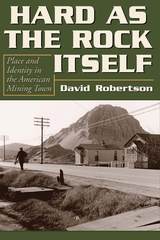
Robertson documents the history of Toluca, Illinois; Cokedale, Colorado; and Picher, Oklahoma, from the mineral discovery phase through mine closure, telling for the first time how these century-old mining towns have survived and how sense of place has played a vital role.
Acknowledging the hardships that mining's social, environmental, and economic legacies have created for current residents, Robertson argues that the industry's influences also have contributed to the creation of strong, cohesive communities in which residents have always identified with the severe landscape and challenging, but rewarding way of life.
Robertson contends that the tough, unpretentious appearance of mining landscapes mirrors qualities that residents value in themselves, confirming that a strong sense of place in mining regions, as elsewhere, is not necessarily wedded to an attractive aesthetic or even to a thriving economy.
Mining historians, geographers, and other students of place in the American landscape will find fascinating material in Hard As the Rock Itself.
While Heidegger’s affiliation with National Socialism is well known, the anti-Semitic dimension of that engagement could not be fully told until now. Trawny traces Heidegger’s development of a grand “narrative” of the history of being, the “being-historical thinking” at the center of Heidegger’s work after Being and Time. Two of the protagonists of this narrative are well known to Heidegger’s readers: the Greeks and the Germans. The world-historical antagonist of this narrative, however, has remained hitherto undisclosed: the Jews, or, more specifically, “world Judaism.” As Trawny shows, world Judaism emerges as a racialized, destructive, and technological threat to the German homeland, indeed, to any homeland whatsoever. Trawny pinpoints recurrent, anti-Semitic themes in the Notebooks, including Heidegger’s adoption of crude cultural stereotypes, his assigning of racial reasons to philosophical decisions (even undermining his Jewish teacher, Edmund Husserl), his endorsement of a Jewish “world conspiracy,” and his first published remarks on the extermination camps and gas chambers (under the troubling aegis of a Jewish “self-annihilation”). Trawny concludes with a thoughtful meditation on how Heidegger’s achievements might still be valued despite these horrifying facets. Unflinching and systematic, this is one of the most important assessments of one of the most important philosophers in our history.
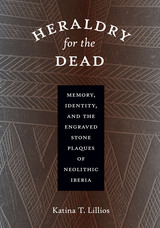
In the late 1800s, archaeologists began discovering engraved stone plaques in Neolithic (3500-2500 BC) graves in southern Portugal and Spain. About the size of one's palm, usually made of slate, and incised with geometric or, more rarely, zoomorphic and anthropomorphic designs, these plaques have mystified generations of researchers. What do their symbols signify? How were the plaques produced? Were they worn during an individual's lifetime, or only made at the time of their death? Why, indeed, were the plaques made at all?
Employing an eclectic range of theoretical and methodological lenses, Katina Lillios surveys all that is currently known about the Iberian engraved stone plaques and advances her own carefully considered hypotheses about their manufacture and meanings. After analyzing data on the plaques' workmanship and distribution, she builds a convincing case that the majority of the Iberian plaques were genealogical records of the dead that served as durable markers of regional and local group identities. Such records, she argues, would have contributed toward legitimating and perpetuating an ideology of inherited social difference in the Iberian Late Neolithic.
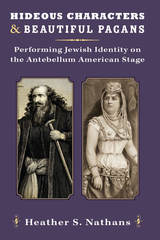
Using an eclectic range of sources including theatrical reviews, diaries, letters, cartoons, portraiture, tax records, rumors flying around the tavern, and more, Heather S. Nathans has listened for the echoes of vanished audiences who witnessed and responded to these stereotypes onstage, from the earliest appearance of Shylock on an American stage in 1752 to Jewish theater artists on the eve of the Civil War. The book integrates social, political, and cultural histories, with an examination of those texts (both dramatic and literary) that shaped the stage Jew.
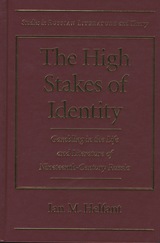
During the reigns of Alexander I and Nicholas I, Ian Helfant argues, gambling became an essential proving-ground and symbolic locus for noble identity in Russia--a way for the nobility to assert its values (fearlessness, disdain for money, implacable self-possession, deification of whim and will, and stylish performance) against nineteenth-century economics and bourgeois sentimentality. In <i>The High Stakes of Identity</i> Helfant's twin concerns are to analyze the structural components of the myth of the noble "beau joueur" and to show how gambling performances in society and in literature reciprocally reinforced, complicated, and eventually disintegrated its mystique.
Using a broad variety of sources--memoiristic, epistolary, journalistic, legal, fictional, theatrical--Helfant reconstructs both the prevalence and the particular codes of gambling's cultural system in the first few decades of the nineteenth century. These codes allow him to interpret the iconoclastic performances of truly legendary gamblers and to assess the importance and purpose of gambling in works ranging from Pushkin's "Queen of Spades" to Lermontov's "Masquerade." Throughout, Helfant gives voice to the rich variety of discourses, from tsarist laws to moralistic tracts, that came to bear on the culture of gambling in the 1830s and eventually led to its displacement as the key marker of nobility.
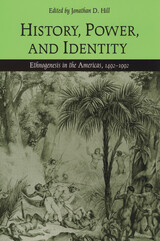
For the past five centuries, indigenous and African American communities throughout the Americas have sought to maintain and recreate enduring identities under conditions of radical change and discontinuity. The essays in this groundbreaking volume document this cultural activity—this ethnogenesis—within and against the broader contexts of domination; the authors simultaneously encompass the entanglements of local communities in the webs of national and global power relations as well as people's unique abilities to gain control over their history and identity.
By defining ethnogenesis as the synthesis of people's cultural and political struggles, History, Power, and Identity breaks out of the implicit contrast between isolated local cultures and dynamic global history. From the northeastern plains of North America to Amazonia, colonial and independent states in the Americas interacted with vast multilingual and multicultural networks, resulting in the historical emergence of new ethnic identities and the disappearance of many earlier ones. The importance of African, indigenous American, and European religions, myths, and symbols, as historical cornerstones in the building of new ethnic identities, emerges as one of the central themes of this convincing collection.
This alternate history—where, among many scenarios, Hitler is assassinated, Japan does not bomb Pearl Harbor, and Franklin Delano Roosevelt is succeeded after two terms by Robert A. Taft—does cause us to review and better appreciate history. As Gurock tells his tale, he concludes every chapter with a short section that describes what actually happened and, thus, further educates the reader.
Exploring how Southern Jews forged identity, community, and belonging in the evolving landscape of the New South.
Homelands is a case study of a unique ethnic group in North America—small-town southern Jews. Both Jews and southerners, Leonard Rogoff points out, have long struggled with questions of identity and whether to retain their differences or try to assimilate into the national culture. Rogoff shows how, as immigrant Jews became small-town southerners, they constantly renegotiated their identities and reinvented their histories.
The Durham-Chapel Hill Jewish community was formed during the 1880s and 1890s, when the South was recovering from the Reconstruction era and Jews were experiencing ever-growing immigration as well as challenging the religious traditionalism of the previous 4,000 years. Durham and Chapel Hill Jews, recent arrivals from the traditional societies of eastern Europe, assimilated and secularized as they lessened their differences with other Americans. Some Jews assimilated through intermarriage and conversion, but the trajectory of the community as a whole was toward retaining their religious and ethnic differences while attempting to integrate with their neighbors.
The Durham-Chapel Hill area is uniquely suited to the study of the southern Jewish experience, Rogoff maintains, because the region is exemplary of two major trends: the national population movement southward and the rise of Jews into the professions. The Jewish peddler and storekeeper of the 1880s and the doctor and professor of the 1990s, Rogoff says, are representative figures of both Jewish upward mobility and southern progress.
Wesley Bernardini now draws on an unconventional source, Hopi traditional knowledge, to show how hypotheses that are developed from oral tradition can stimulate new and productive ways to think about the archaeological record. Focusing on insights that oral tradition has to offer about general processes of prehistoric migration and identity formation, he describes how each Hopi clan acquired its particular identity from the experiences it accumulated on its unique migration pathway. This pattern of “serial migration” by small social groups often saw the formation of villages by clans that briefly came together and then moved off again independently, producing considerable social diversity both within and among villages.
Using Anderson Mesa and Homol’ovi as case studies, Bernardini presents architectural and demographic data suggesting that the fourteenth century occupation of these regions was characterized by population flux and diversity consistent with the serial migration model. He offers an analysis of rock art motifs—focusing on those used as clan symbols—to evaluate the diversity of group identities, then presents a compositional analysis of Jeddito Yellow Ware pottery to evaluate the diversity of these groups’ eventual migration destinations.
Evidence supporting serial migration greatly complicates existing notions of links between ancient and modern social groups, with important implications for the implementation of the Native American Graves Protection and Repatriation Act. Bernardini’s work clearly demonstrates that studies of cultural affiliation must take into account the fluid nature of population movements and identity in the prehistoric landscape. It takes a decisive step toward better understanding the major demographic change that occurred on the Colorado Plateau from 1275 to 1400 and presents a strategy for improving the reconstruction of cultural identity in the past.
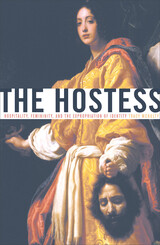
The meaning of hospitality in Western thought—from the Bible to Derrida
The evolution of the idea of hospitality can be traced alongside the development of Western civilization. Etymologically, the host is the “master,” but this identity is established through expropriation and loss—the best host is the one who gives the most, ultimately relinquishing what defines him as master.
In The Hostess, Tracy McNulty asks, What are the implications for personhood of sharing a person—a wife or daughter—as an act of hospitality? In many traditions, the hostess is viewed not as a subject but as the master’s property. A foreign presence that both sustains and undercuts him, the hostess embodies the interplay of self and other within the host’s own identity.
Here McNulty combines critical readings of the Bible and Pierre Klossowski’s trilogy The Laws of Hospitality with analyses of exogamous marital exchange, theological works from the Talmud to Aquinas, the writings of Kant and Nietzsche, and the theory of femininity in the work of Freud and Lacan. Ultimately, she contends, hospitality involves the boundary between the proper and the improper, affecting the subject as well as interpersonal relations.
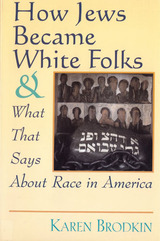
The history of Jews in the United States is one of racial change that provides useful insights on race in America. Prevailing classifications have sometimes assigned Jews to the white race and at other times have created an off-white racial designation for them. Those changes in racial assignment have shaped the ways American Jews of different eras have constructed their ethnoracial identities. Brodkin illustrates these changes through an analysis of her own family's multi-generational experience. She shows how Jews experience a kind of double vision that comes from racial middleness: on the one hand, marginality with regard to whiteness; on the other, whiteness and belonging with regard to blackness.
Class and gender are key elements of race-making in American history. Brodkin suggests that this country's racial assignment of individuals and groupsconstitutes an institutionalized system of occupational and residential segregation, is a key element in misguided public policy, and serves as a pernicious foundational principle in the construction of nationhood. Alternatives available to non-white and alien "others" have been either to whiten or to be consigned to an inferior underclass unworthy of full citizenship. The American ethnoracial map-who is assigned to each of these poles-is continually changing, although the binary of black and white is not. As a result, the structure within which Americans form their ethnoracial, gender, and class identities is distressingly stable. Brodkin questions the means by which Americans construct their political identities and what is required to weaken the hold of this governing myth.
READERS
Browse our collection.
PUBLISHERS
See BiblioVault's publisher services.
STUDENT SERVICES
Files for college accessibility offices.
RECENTLY PUBLISHED




UChicago Accessibility Resources
home | accessibility | search | about | contact us
BiblioVault ® 2001 - 2026
The University of Chicago Press