logo for Intellect Books
Into the Story 2
More Stories! More Drama!
Carole Miller and Juliana Saxton
Intellect Books, 2016
Following the first collection of story drama structures, Into the Story 2: More Stories! More Drama! presents a well-argued approach to the value of children’s picture books as a way to look at contemporary issues of social justice while building connections that promote a literacy that is multi-dimensional. Story drama structures offer teachers opportunities for the rich conversations and deep reflections that foster habits of mind critical for life in the twenty-first century. This new volume, piloted internationally over the last decade, will become an invaluable resource for uncovering curricula in ways that are fresh and innovative for students and teachers of all levels.
[more]

front cover of Into the Universe of Technical Images
Into the Universe of Technical Images
Vilém Flusser
University of Minnesota Press, 2010
Poised between hope and despair for a humanity facing an urgent communication crisis, this work by Vilém Flusser forecasts either the first truly human, infinitely creative society in history or a society of unbearable, oppressive sameness, locked in a pattern it cannot change. First published in German in 1985 and now available in English for the first time, Into the Universe of Technical Images outlines the history of communication technology as a process of increasing abstraction.

Flusser charts how communication evolved from direct interaction with the world to mediation through various technologies. The invention of writing marked one significant shift; the invention of photography marked another, heralding the current age of the technical image. The automation of the processing of technical images carries both promise and threat: the promise of freeing humans to play and invent and the threat for networks of automation to proceed independently of humans.
[more]

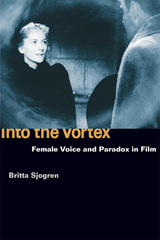
front cover of Into the Vortex
Into the Vortex
Female Voice and Paradox in Film
Britta Sjogren
University of Illinois Press, 2010
Into the Vortex challenges and rethinks feminist film theory's brilliant but often pessimistic reflections on the workings of sound and voice in film. Including close readings of major film theorists such as Kaja Silverman and Mary Ann Doane, Britta H. Sjogren offers an alternative to image-centered scenarios that dominate feminist film theory's critique of the representation of sexual difference. 
Sjogren focuses on a rash of 1940s Hollywood films in which the female voice bears a marked formal presence to demonstrate the ways that the feminine is expressed and difference is sustained. She argues that these films capitalize on particular particular psychoanalytic, narratological and discursive contradictions to bring out and express difference, rather than to contain or close it down. Exploring the vigorous dynamic engendered by contradiction and paradox, Sjogren charts a way out of the pessimistic, monolithic view of patriarchy and cinema's representation of women's voices.

 
[more]

front cover of Into the Wastelands
Into the Wastelands
Stephen Barber
Diaphanes, 2025
“Only the wastelands can save us now.”

An urban investigator has been commissioned by a global corporation to determine how cities worldwide are being engulfed and destroyed by the wastelands that are mysteriously appearing at their heart. They are being "wastelanded," generating turmoil and catastrophic technological meltdown in every global megalopolis. Throughout his inquiries he discovers that the world’s cities are becoming apocalyptic, experiencing ecocide. The investigator himself will have to travel to the "true north" to escape that endpoint.

Today, urban imaginaries and speculative fictions often depict abandoned wastelands and ruinous cities that hold the expansive potential to engulf all urban and environmental space and render it entirely apocalyptic.

In his novel Into the Wastelands Stephen Barber examines urgent aspects of our wasted realities through fictional narratives: How does the figure of the proliferating, infinitely expansive wasteland enable us to understand that point of rupture for urban futures? Does the wasteland allow us to accurately assess the contemporary dynamic between the apocalyptic and the urban?

 
[more]

front cover of Into The Wilderness Dream
Into The Wilderness Dream
Donald A Barclay
University of Utah Press, 1994

Not just an exploration of our early Western European roots, these rich chronicles read as literature, first-person narratives of the greatest exploration adventures in historic times.

From the Platonic vision of Atlantis to Arthur’s Avalon, pre-Columbus Europeans imagined fabulous lands to the west—and after 1492, initial reports of a new world filled with golden El Dorados, warrior queens, and Fountains of Youth merely provided confirmation.

Although these dreams were soon tempered by reality, explorers continued to set off with expectation that shaped what they say, how they saw, and how they reacted. This complex of attitudes continues to affect the way we view our world, and these accounts provide an excellent source for insight into the metaphorical systems that have permeated European and American writing about the West since the Sixteenth century.

Into the Wilderness Dreams draws from the best of three dozen accounts by the Spanish, French, English, and American explorers who came before Lewis and Clark, and explores the roots of present Western Euro-American culture.
[more]

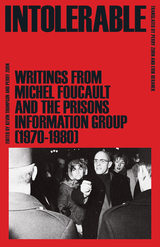
front cover of Intolerable
Intolerable
Writings from Michel Foucault and the Prisons Information Group (1970–1980)
Michel Foucault
University of Minnesota Press, 2020

A groundbreaking collection of writings by Michel Foucault and the Prisons Information Group documenting their efforts to expose France’s inhumane treatment of prisoners

Founded by Michel Foucault and others in 1970–71, the Prisons Information Group (GIP) circulated information about the inhumane conditions within the French prison system. Intolerable makes available for the first time in English a fully annotated compilation of materials produced by the GIP during its brief but influential existence, including an exclusive new interview with GIP member Hélène Cixous and writings by Gilles Deleuze and Jean Genet. 

These archival documents—public announcements, manifestos, reports, pamphlets, interventions, press conference statements, interviews, and round table discussions—trace the GIP’s establishment in post-1968 political turmoil, the new models of social activism it pioneered, the prison revolts it supported across France, and the retrospective assessments that followed its denouement. At the same time, Intolerable offers a rich, concrete exploration of Foucault’s concept of resistance, providing a new understanding of the arc of his intellectual development and the genesis of his most influential book, Discipline and Punish.

Presenting the account of France’s most vibrant prison resistance movement in its own words and on its own terms, this significant and relevant collection also connects the approach and activities of the GIP to radical prison resistance movements today.
[more]

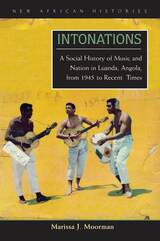
front cover of Intonations
Intonations
A Social History of Music and Nation in Luanda, Angola, from 1945 to Recent Times
Marissa J. Moorman
Ohio University Press, 2008

Intonations tells the story of how Angola’s urban residents in the late colonial period (roughly 1945–74) used music to talk back to their colonial oppressors and, more importantly, to define what it meant to be Angolan and what they hoped to gain from independence. A compilation of Angolan music is included in CD format.

Marissa J. Moorman presents a social and cultural history of the relationship between Angolan culture and politics. She argues that it was in and through popular urban music, produced mainly in the musseques (urban shantytowns) of the capital city, Luanda, that Angolans forged the nation and developed expectations about nationalism. Through careful archival work and extensive interviews with musicians and those who attended performances in bars, community centers, and cinemas, Moorman explores the ways in which the urban poor imagined the nation.

The spread of radio technology and the establishment of a recording industry in the early 1970s reterritorialized an urban-produced sound and cultural ethos by transporting music throughout the country. When the formerly exiled independent movements returned to Angola in 1975, they found a population receptive to their nationalist message but with different expectations about the promises of independence. In producing and consuming music, Angolans formed a new image of independence and nationalist politics.

[more]

front cover of Intown Living
Intown Living
A Different American Dream
Ann Breen and Dick Rigby
Island Press, 2005
After decades of abandonment, cities across North America are experiencing a renaissance. A new generation is seeking greater excitement and diversity than the typical suburban subdivision offers and many people are instead looking to make their homes in lively urban environments.

In Intown Living, authors Ann Breen and Dick Rigby document this movement, arguing that if properly nurtured, it could help slow current patterns of sprawling development and help revitalize America's cities. They illustrate the many benefits of city living and offer strategies and encouragement for public officials and private developers to team up and expand central city housing opportunities.

The authors present in-depth studies of eight cities--Atlanta; Dallas; Houston; Memphis; Minneapolis; New Orleans; Portland, Oregon; and Vancouver, British Columbia--that are experiencing this type of renaissance, and consider common elements shared by the cities, as well as their differences.

Intown Living is an important new resource for a wide audience of professionals involved with urban design and planning. It will also be of interest to the many people concerned with historic preservation or smart growth, and for students and researchers involved with urban studies and related fields.

[more]

front cover of Intoxicated
Intoxicated
Race, Disability, and Chemical Intimacy across Empire
Mel Y. Chen
Duke University Press, 2023
In Intoxicated Mel Y. Chen explores the ongoing imperial relationship between race, sexuality, and disability. They focus on nineteenth-century biopolitical archives in England and Australia to show how mutual entanglements of race and disability take form through toxicity. Examining English scientist John Langdon Down’s characterization of white intellectual disability as Asian interiority and Queensland’s racialization and targeting of Aboriginal peoples through its ostensible concern with black opium, Chen explores how the colonial administration of race and disability gives rise to “intoxicated” subjects often shadowed by slowness. Chen charts the ongoing reverberations of these chemical entanglements in art and contemporary moments of political and economic conflict or agitation. Although intoxicated subjects may be affected by ongoing pollution or discredited as agents of failure, Chen affirmatively identifies queer/crip forms of unlearning and worldmaking under imperialism. Exemplifying an undisciplined thinking that resists linear or accretive methods of inquiry, Chen unsettles conventional understandings of slowness and agitation, intellectual method, and the toxic ordinary.
[more]

front cover of Intoxicated Ways of Knowing
Intoxicated Ways of Knowing
The Untold Story of Intoxicants and the Biological Subject in Nineteenth-Century Germany
Matthew Perkins-McVey
University of Chicago Press, 2026
Argues that intoxication was fundamental to German physiological, psychological, and psychiatric research during the nineteenth century.
 
Intoxicating substances can be found lurking in every corner of modern life, and Matthew Perkins-McVey’s pathbreaking book offers the untold story of how they were implicated in shifting perceptions of embodiment found in the emerging sciences of the body and mind in late-nineteenth-century Germany. Their use in this experimental context gave rise to a dynamic conception of the subject within the scientific, psychological, philosophical, and sociological milieu of the era. The history of the modern biological subject, Perkins-McVey argues, turns on “intoxicated ways of knowing.”
 
Intoxicated Ways of Knowing identifies the state of intoxication as a tacit form of thinking and knowing with the body. Intoxicants force us to feel, intervening directly in our perceptional awareness, and, Perkins-McVey contends, they bring latent conceptual associations into the foreground of conscious thought, engendering new ways of knowing the world. The book unfurls how intoxicants affected nineteenth-century German science and how, ultimately, the connection between mental life and intoxication is taken up in the works of Friedrich Nietzsche, Max Weber, and Sigmund Freud, bringing the biological subject out of the lab and into the worlds of philosophy, psychoanalysis, sociology, and politics.

[more]

front cover of Intoxication
Intoxication
An Ethnography of Effervescent Revelry
Sébastien Tutenges
Rutgers University Press, 2023
For two decades, Sébastien Tutenges has conducted research in bars, nightclubs, festivals, drug dens, nightlife resorts, and underground dance parties in a quest to answer a fundamental question: Why do people across cultures gather regularly to intoxicate themselves?

Vivid and at times deeply personal, this book offers new insights into a wide variety of intoxicating experiences, from the intimate feeling of connection among concertgoers to the adrenaline-fueled rush of a fight, to the thrill of jumping off a balcony into a swimming pool. Tutenges shows what it means and feels to move beyond the ordinary into altered states in which the transgressive, spectacular, and unexpected take place.

He argues that the primary aim of group intoxication is the religious experience that Émile Durkheim calls collective effervescence, the essence of which is a sense of connecting with other people and being part of a larger whole. This experience is empowering and emboldening and may lead to crime and deviance, but it is at the same time vital to our humanity because it strengthens social bonds and solidarity.

The book fills important gaps in Durkheim’s social theory and contributes to current debates in micro-sociology as well as cultural criminology and cultural sociology. Here, for the first time, readers will discover a detailed account of collective effervescence in contemporary society that includes: an explanation of what collective effervescence is; a description of the conditions that generate collective effervescence; a typology of the varieties of collective effervescence; a discussion of how collective effervescence manifests in the realm of nightlife, politics, sports, and religion; and an analysis of how commercial forces amplify and capitalize on the universal human need for intoxication.

This book is also freely available online as an open access digital edition.
Download the open access ebook here.
[more]

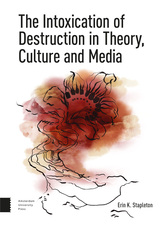
front cover of The Intoxication of Destruction in Theory, Culture and Media
The Intoxication of Destruction in Theory, Culture and Media
A Philosophy of Expenditure after Georges Bataille
Erin K. Stapleton
Amsterdam University Press, 2022
This book examines the desire for, and intoxication with destruction as it appears in cultural objects and representation, arguing that all cultural and aesthetic value is fundamentally predicated on its own fragility, as well as the living transience of those who make and encounter it. Beginning with a philosophy of expenditure after Georges Bataille, each chapter maps different operations of destruction in media and culture. These operations are expressed and located in representations of human extinction and explosive architecture, in execution and in eroticism, and in media and digital archives, which constitute a further destabilization of the notion of destruction in the dynamic between aspirational immortality and material volatility embedded in the archival systems of digital cultures.
[more]

front cover of Intrasite Spatial Analysis of Mobile and Semisedentary Peoples
Intrasite Spatial Analysis of Mobile and Semisedentary Peoples
Analytical Approaches to Reconstructing Occupation History
Edited by Amy E. Clark and Joseph A. M. Gingerich
University of Utah Press, 2022
Describing the nature and meaning of artifact spatial patterning can be highly subjective, yet many patterns can be quantified to create general models that are comparable across time periods and geographic space. The authors employ various techniques in this endeavor, including large sample sizes, model-driven analyses of the ethnographic record, bone and lithic refitting, and a careful consideration of artifact attributes that elucidate spatial patterning. Such detailed analyses allow archaeologists to better interpret site formation processes and address large-scale anthropological questions.

This volume includes studies that span archaeological and ethnographic contexts, from highly mobile Paleoindian foragers to semi-sedentary preagriculturalists of the Epipaleolithic and modern pastoralists in Mongolia. The authors hold that commonalities in human behavior lead to similar patterns in the organization and maintenance of space by people. They present a series of ideas and approaches to make it easier to recognize universals in human behaviors, which allow archaeologists to better compare intrasite spatial patterns. The book creates a baseline for new intrasite spatial analyses in the twenty-first century.
[more]

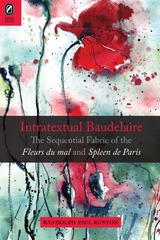
front cover of Intratextual Baudelaire
Intratextual Baudelaire
The Sequential Fabric of the Fleurs du mal and Spleen de Paris
Randolph Paul Runyon
The Ohio State University Press, 2010
Intratextual Baudelaire: The Sequential Fabric of the Fleurs du mal and Spleen de Paris by Randolph Paul Runyon provides a new and provocative answer to the question that has intrigued readers for years: did the poet arrange the Fleurs du mal in a meaningful order? Runyon believes so, but not in the way most have conceived the question.
 
Barbey d’Aurevilly’s claim that there was a “secret architecture” hidden in the Fleurs has long misled scholars by leading them to look for some overarching hierarchical organization, when they should have been looking for how the poems actually fit together, each to each, in the sequential fabric of the text. This is what Runyon has done, in a meticulous reading of every poem and its place in the sequence. Intratextual Baudelaire provides the most thorough analysis available of the textual changes Baudelaire made between the first and second editions and shows why he made them: so that the sequential structure would be preserved despite the addition of new poems and the deletion of those judged obscene.
 
Extending his analysis to the Spleen de Paris with the same attention to detail and awareness of textual changes, Runyon shows that Baudelaire’s prose-poem collection displays the same rigorous sequential structure. Both collections are revealed as marvels of self-referential intratextuality. Whether one agrees with Runyon or not, Intratextual Baudelaire will certainly generate discussion among French studies scholars.
[more]

front cover of Intrepid Explorer
Intrepid Explorer
The Autobiography of the World's Best Mine Finder
J. David Lowell
University of Arizona Press, 2014
When seven-year-old Dave Lowell was camped out at his father’s mine in the hills of southern Arizona in 1935, he knew he had found his calling. “Life couldn’t get any better than this,” he recalls. “I didn’t know what science was, but wisps of scientific thought were already working into my plan.” So began the legendary career of the engineer, geologist, explorer, and international businessman whose life is recounted in his own words in this captivating book.

An Arizona native with family roots in territorial times, Lowell grew from modest beginnings on a ranch near Nogales to become a major world figure in the fields of minerals, mining, and economic geology. He has personally discovered more copper than anyone in history and has developed multibillion-dollar gold and copper mines that have changed the economies of nations. And although he has consulted for corporations in the field of mining, he has largely operated as an independent agent and explorer, the architect of his own path and success.

His life’s story unfolds in four stages: his early education in his field, on-the-job learning at sites in the United States and Mexico, development of exploration strategies, and finally, the launch of his own enterprises and companies. Recurring themes in Lowell’s life include the strict personal, ethical, and tactical policies he requires of his colleagues; his devotion to his family; and his distaste for being away from the field in a corporate office, even to this day. The magnitude of Lowell’s overall success is evident in his list of mine discoveries, as well as in his scientific achievements and the enormous respect his friends and colleagues have had for him throughout his lengthy career, which he continues to zealously pursue.
[more]

front cover of Intrepid Lover of Perfect Grace
Intrepid Lover of Perfect Grace
The Life and Thought of Prosper of Aquitaine
Alexander Y. Hwang
Catholic University of America Press, 2009
Intrepid Lover of Perfect Grace provides students and scholars with the first biography of Prosper of Aquitaine (388-455) and the first book-length study in English of this important figure in the history of Christianity
[more]

front cover of Intricate Relations
Intricate Relations
Sexual and Economic Desire in American Fiction, 1789-1814
Karen A. Weyler
University of Iowa Press, 2005

Intricate Relations charts the development of the novel in and beyond the early republic in relation to these two thematic and intricately connected centers: sexuality and economics. By reading fiction written by Americans between 1789 and 1814 alongside medical theory, political and economic tracts, and pedagogical literature of all kinds, Karen Weyler recreates and illuminates the larger, sometimes opaque, cultural context in which novels were written, published, and read.

In 1799, the novelist Charles Brockden Brown used the evocative phrase “intricate relations” to describe the complex imbrication of sexual and economic relations in the early republic. Exploring these relationships, he argued, is the chief job of the “moral historian,” a label that most novelists of the era embraced. In a republic anxious about burgeoning individualism in the 1790s and the first two decades of the nineteenth century, the novel foregrounded sexual and economic desires and explored ways to regulate the manner in which they were expressed and gratified.

In Intricate Relations, Weyler argues that understanding how these issues underlie the novel as a genre is fundamental to understanding both the novels themselves and their role in American literary culture. Situating fiction amid other popular genres illuminates how novelists such as Charles Brockden Brown, Hannah Foster, Samuel Relf, Susanna Rowson, Rebecca Rush, and Sally Wood synthesized and iterated many of the concerns expressed in other forms of public discourse, a strategy that helped legitimate their chosen genre and make it a viable venue for discussion in the decades following the revolution.

Weyler’s passionate and persuasive study offers new insights into the civic role of fiction in the early republic and will be of great interest to literary theorists and scholars in women’s and American studies.
[more]

front cover of Intricate Thicket
Intricate Thicket
Reading Late Modernist Poetries
Mark Scroggins
University of Alabama Press, 2015
In Intricate Thicket: Reading Late Modernist Poetries, Mark Scroggins writes with wit and dash about a fascinating range of key twentieth- and twenty-first-century poets and writers. In nineteen lively and accessible essays, he persuasively argues that the innovations of modernist verse were not replaced by postmodernism, but rather those innovations continue to infuse contemporary writing and poetry with intellectual and aesthetic richness.
 
In these essays, Scroggins reviews the legacy of Louis Zukofsky, delineates the exceptional influence of the Black Mountain poets, and provides close readings of a wealth of examples of poetic works from poets who have carried the modernist legacy into contemporary poetry. He traces with an insider’s keen observation the careers of many of the most dynamic, innovative, and celebrated poets of the past half-century, among them Ian Hamilton Finlay, Ronald Johnson, Rae Armantrout, Harryette Mullen, and Anne Carson.
 
In a concluding pair of essays, Scroggins situates his own practice within the broad currents he has described. He reflects on his own aesthetics as a contemporary poet and, drawing on his extensive study and writing about Louis Zukofsky, examines the practical and theoretical challenges of literary biography.
 
While the core of these essays is the interpretation of poetry, Scroggins also offers clear aesthetic evaluations of the successes and failures of the poetries he examines. Scroggins engages with complex and challenging works, and yet his highly accessible descriptions and criticisms avoid theoretical entanglements and specialized jargon. Intricate Thicket yields subtle and multifaceted insights to experts and newcomers alike.

[more]

logo for Harvard University Press
Intrinsic Factors
William Bosworth Castle and the Development of Hematology and Clinical Investigation at Boston City Hospital
Anand B. Karnad
Harvard University Press

Dr. W. B. Castle (1897–1990), who played a major role in the emergence of hematology as a scientific discipline in the first half of this century, was instrumental in establishing the worldwide reputation of the Thorndike Memorial Laboratory and the Harvard Medical Unit at Boston City Hospital. In the first comprehensive biography of Castle, Anand Karnad highlights the golden age of medicine and hematology in Boston. Castle’s early experiments solved the puzzle of pernicious anemia and were the building blocks for a series of experiments on that disease that stand as one of the finest examples of clinical research ever conducted.

Castle and his group also made pioneering contributions to hemoglobin physiology, mechanisms of hemolysis, splenic function, and sickle cell anemia. Under his leadership, the Thorndike Memorial Laboratory attracted the best and the brightest talent, many of whom are present-day leaders in the world of medicine and science. Intrinsic Factors is the story of Castle’s life and work.

[more]

logo for St. Augustine's Press
Intro Summa Theologiae Thomas Aquinas
John Of St. Thomas
John Of St. Thomas
St. Augustine's Press, 2004

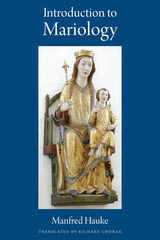
front cover of Introducation to Mariology
Introducation to Mariology
Manfred Hauke
Catholic University of America Press, 2020
In Introduction to Mariology, Fr. Manfred Hauke provides a synthesis of Mariology and the biblical fundaments and development of Marian doctrine. While it works as a comprehensive introduction suitable for courses on the subject, it is in reality a panoramic view on the entire Marian doctrine, and as such will be essential for the theological formation of seminarians, priests, theologians, and all kinds of educated Catholics. With an unparalleled bibliographic citation of Marian literature across a dozen languages, it is also a perfect gateway to further research on the subject. It begins with Biblical doctrine, which is important especially for the dialogue with Protestant denominations: Catholic Mariology can be traced in its “embryonic” state already in Holy Scripture. From there Hauke presents a historical overview of the whole development of Marian doctrine, before developing further historical details in the subsequent chapters dedicated to systematic issues. The first systematic step approaches the figure of Mary through her role in the mystery of the Covenant between God and redeemed humanity; her being “Mother of God” and companion of the Redeemer is the “fundamental principle.” Then the four established Marian dogmas are presented: divine maternity, virginity, Immaculate Conception (in a chapter on Mary’s holiness more broadly), and bodily Assumption. A close look is given to maternal mediation which includes a part dedicated to the “Mater Unitatis”. A stand alone chapter is dedicated to Marian apparitions; authentic apparitions are presented as a part of prophetic charisma. The last chapter presents the basics on Marian devotion which culminates in the consecration to Mary (as a response to her maternal mediation). Already available in Spanish, Italian, Portugese, and Korean, this landmark work is published here for the first time in English.
[more]

front cover of Introducción a la historia de la lengua española
Introducción a la historia de la lengua española
segunda edición
Melvyn C. Resnick and Robert M. Hammond
Georgetown University Press, 2015

Introducción a la historia de la lengua española es una introducción completa a la historia externa e interna de la lengua española desde sus orígenes indoeuropeos hasta la lengua moderna de más de 400 millones de personas. Los autores escudriñan los cambios fonológicos, morfológicos, sintácticos semánticos y léxicos que caracterizan la evolución de la lengua española desde sus orígenes latinos.

El foco de este libro es el español moderno. Los autores abordan cuestiones tan fundamentales como: ¿De dónde proviene el español? ¿Cómo llegó a ser la lengua que conocemos hoy en día? ¿Cómo se relaciona genética y culturalmente con los demás lenguas romances y a las lenguas no romances? ¿Cuáles son los efectos del bilingüismo en las áreas donde el español coexiste con otras lenguas?

La segunda edición incluye numerosos ejercicios, una sección de preguntas de repaso al final de cada capítulo, y una extensa bibliografía. El libro está actualizado y ampliado en gran medida en el alcance y profundidad; sin embargo, respeta y conserva la estructura y el enfoque pedagógicos de la primera edición para el uso con los estudiantes que no tienen conocimientos previos en la lingüística. En los cursos avanzados y de posgrado, el programa puede incorporar asignaciones adicionales y secciones, incluyendo la opción "Temas y datos adicionales" que acompañan a cada capítulo.

[more]

logo for Georgetown University Press
Introducción a la historia de la lengua española
segunda edición
Melvyn C. Resnick and Robert M. Hammond
Georgetown University Press, 2015

Introducción a la historia de la lengua española is a comprehensive introduction to the internal and external history of the Spanish language from its Indo-European ancestry to the present-day language of over 400 million people. The authors examine the phonological, morphological, syntactic, semantic, and lexical changes that characterize the evolution of Spanish from its Latin origins. But Spanish has not evolved in isolation in its spread across Spain and to Africa, the Americas, Asia, and islands of the Pacific Ocean. The foreign, sociological, and political influences that contribute to the uniqueness, diversity, and unity of a world language are essential aspects of the study of its history.

The focus of this book is modern Spanish. The authors address such fundamental questions as: Where does Spanish come from? How did it become the language we know today? How is it related genetically and culturally to other Romance and non-Romance languages? What are the effects of bilingualism in areas where Spanish coexists with other languages?

Introducción a la historia de la lengua española includes numerous exercises, a section of study questions at the end of each chapter, and an extensive bibliography. The second edition is updated and greatly expanded in scope and depth, yet it carefully maintains the structure and pedagogical approach of the first edition for use with students who have no prior background in linguistics. In advanced and graduate-level courses, the syllabus can incorporate additional assignments and sections, including the optional “Temas y datos adicionales” that accompany each chapter.

[more]

logo for Georgetown University Press
Introducción a la Traductología
Gerardo Vázquez-Ayora
Georgetown University Press, 1977

Introduccion a la Traductologia integrates the theoretical and practical aspects of translation.
[more]

logo for Georgetown University Press
Introducción a la Traductología
Gerardo Vázquez-Ayora
Georgetown University Press

front cover of Introducing a New Economics
Introducing a New Economics
Pluralist, Sustainable and Progressive
Jack Reardon, Maria Alejandra Caporale Madi and Molly Scott Cato
Pluto Press, 2015
Students and lecturers worldwide increasingly reject the narrow curricula and lack of intellectual diversity that characterize mainstream economics. They demand that the real world should be brought back into the classroom in order to most effectively confront current crises. Introducing a New Economics is a groundbreaking textbook that heralds this revolution in the teaching of economics. With a firm commitment to theoretical, methodological, and disciplinary pluralism, the authors challenge the institutional education hegemony head on. This unique textbook reflects a new ethos of economics teaching that highlights sustainability and justice through its discussion of work, employment, power, capital, markets, money, and debt. A progressive work, it will set the standard for the growing heterodox economics movement for years to come.
 
[more]

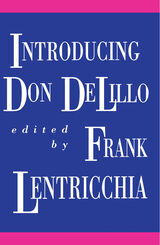
front cover of Introducing Don DeLillo
Introducing Don DeLillo
Frank Lentricchia
Duke University Press, 1991
If you want to find out what a rock critic, a syndicated columnist, and scholars of American literature have to say about one of America’s most important contemporary novelists, turn to Introducing Don DeLillo. Placing the author’s work in a cultural context, this is the first book-length collection on DeLillo, adding considerably to the emerging critical discourse on his work.
Diversity is the key to this striking assemblage of cultural criticism edited by Frank Lentricchia. Special features include an expanded version of the Rolling Stone interview with the author (“An Outsider in this Society”) and the extraordinary tenth chapter of DeLillo’s Ratner’s Star. Accessibly written and entertaining, the collection will be of great interest to both students and scholars of contemporary American literature as well as to general readers interested in DeLillo’s work.

Contributors. Frank Lentricchia, Anthony Decurtis, Daniel Aaron, Hal Crowther, John A. McClure, Eugene Goodheart, Charles Molesworth, Dennis A. Foster, and John Frow

[more]

logo for Duke University Press
Introducing Don DeLillo
Frank Lentricchia
Duke University Press
If you want to find out what a rock critic, a syndicated columnist, and scholars of American literature have to say about one of America’s most important contemporary novelists, turn to Introducing Don DeLillo. Placing the author’s work in a cultural context, this is the first book-length collection on DeLillo, adding considerably to the emerging critical discourse on his work.
Diversity is the key to this striking assemblage of cultural criticism edited by Frank Lentricchia. Special features include an expanded version of the Rolling Stone interview with the author (“An Outsider in this Society”) and the extraordinary tenth chapter of DeLillo’s Ratner’s Star. Accessibly written and entertaining, the collection will be of great interest to both students and scholars of contemporary American literature as well as to general readers interested in DeLillo’s work.

Contributors. Frank Lentricchia, Anthony Decurtis, Daniel Aaron, Hal Crowther, John A. McClure, Eugene Goodheart, Charles Molesworth, Dennis A. Foster, and John Frow

[more]

logo for Georgetown University Press
Introducing Linguistic Morphology
Second Edition
Laurie Bauer
Georgetown University Press, 2003

A newly expanded and updated edition of one of the best-selling introductions to linguistic morphology—the study and description of word formations in languages—that deals with inflection, derivation, and compounding, the system of word-forming elements and processes in a language. Basic concepts are introduced, with an abundance of examples from a range of familiar and exotic languages, followed by a discussion of, among other topics, the definition of word-form, productivity, inflection versus derivation, and the position of morphology to phonology—the science of speech sounds, especially the history and theory of sound changes in a language. Along with two new chapters discussing morphology and the brain and how morphology arises, changes, and disappears, this new edition includes exercises and a glossary of key terms.

[more]

logo for American Library Association
Introducing RDA
A Guide to the Basics
Chris Oliver
American Library Association, 2010

front cover of Introducing RDA
Introducing RDA
A Guide To The Basics After 3R
Chris Oliver
American Library Association, 2021

Since Oliver’s guide was first published in 2010, thousands of LIS students, records managers, and catalogers and other library professionals have relied on its clear, plainspoken explanation of RDA: Resource Description and Access as their first step towards becoming acquainted with the cataloging standard. Now, reflecting the changes to RDA after the completion of the 3R Project, Oliver brings her Special Report up to date. This essential primer

  • concisely explains what RDA is, its basic features, and the main factors in its development;
  • describes RDA’s relationship to the international standards and models that continue to influence its evolution;
  • provides an overview of the latest developments, focusing on the impact of the 3R Project, the results of aligning RDA with IFLA’s Library Reference Model (LRM), and the outcomes of internationalization;
  • illustrates how information is organized in the post 3R Toolkit and explains how to navigate through this new structure; and
  • discusses how RDA continues to enable improved resource discovery both in traditional and new applications, including the linked data environment.
[more]

front cover of Introducing Swedenborg
Introducing Swedenborg
Correspondences
Gary Lachman
Swedenborg Foundation Publishers, 2021
Emanuel Swedenborg’s system of correspondences is one of the most influential theories in the history of ideas. Instrumental in the rise of Romanticism, Symbolism and Modernism, and cited as key to the work of Goethe, R.W. Emerson, Honoré de Balzac, Charles Baudelaire, Wassily Kandinsky and Arnold Schoenberg, to name but a few, it offers to poets, artists, writers and composers a blueprint for navigating the gap between the material world and non-material values. In this brief introduction, Gary Lachman gives an accessible overview of the many fascinating ways in which Swedenborg’s idea has impacted upon the past 250 years.
[more]

logo for Harvard University Press
The Introduction of the Ironclad Warship
James Phinney Baxter, 3rd
Harvard University Press
By 1860 the death-knell of the old wooden battleship had sounded; and when the news of the combat of the Monitor and the Merrimack crossed the Atlantic, nearly one hundred armored vessels were already built, building, or authorized in Europe. This sudden transformation of the European navies engendered a series of war scares and contributed in large measure to the breakdown of the entente cordiale between England and France. The material here first published throws fresh light on the diplomacy of the fifties and early sixties, and illustrates in striking fashion the cost of naval rivalry in terms of international suspicion. Professor Baxter’s chapters will accordingly be of deep interest to all students of diplomatic history as well as of naval history and naval architecture.
[more]

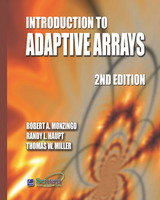
front cover of Introduction to Adaptive Arrays
Introduction to Adaptive Arrays
Robert A. Monzingo
The Institution of Engineering and Technology, 2011
This second edition is an extensive modernization of the bestselling introduction to the subject of adaptive array sensor systems. With the number of applications of adaptive array sensor systems growing each year, this look at the principles and fundamental techniques that are critical to these systems is more important than ever before.
[more]

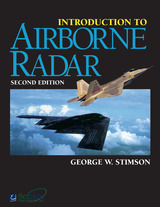
front cover of Introduction to Airborne Radar
Introduction to Airborne Radar
Geroge W. Stimson
The Institution of Engineering and Technology, 1998
Introduction to Airborne Radar is the revision of the classic book privately published by Hughes Aircraft Company in 1983. Lavishly produced in full color, the book was quite unlike any commercially published radar book produced by the major technical publishers. The combination of clear, understandable writing and the unparalleled illustrations established the text-reference as a 'must-have' for engineers, technicians, pilots, and even sales and marketing people within the radar and aerospace industry. The book was authored by veteran Hughes engineer and Technical Manager George W. Stimson, a publications specialist. Individual chapters were thoroughly reviewed by the appropriate experts within the Hughes Radar Systems Group. The book was initially available 1983-1987 only to those within the Hughes family: employees and customers, primarily the military. Restriction was lifted in 1987. Hughes went through three printings and 40,000 copies 1983-1993, mostly by word-of-mouth testimonials and demand. Upon retirement from Hughes, George Stimson successfully negotiated for the rights to the book and made an agreement with SciTech Publishing to do a major revision of the text to update it. The resulting Second Edition has been overwhelmingly positive and a best-seller. Second Edition The revision is extensive: thirteen entirely new chapters cover the technological advances over the fifteen years since publication, two chapters considered obsolete have been deleted entirely, three chapters are extensively rewritten and updated, two chapters have been given new sections, and fourteen chapters have been given minor tweaks, corrections, and polishing. The book has grown from 32 chapters to 44 chapters in 584 efficiently-designed pages. Efforts have been made to bring more even-handed coverage to radars developed outside of Hughes Aircraft, while older and less important Hughes radars have been deleted or abbreviated. Chapter 44 catalogs many of the cutting edge radars in functioning aircraft and near-service aircraft in early stages of production. The book's appeal is to a diverse audience: from military pilots and radar officers eager to gain a sound technical understanding of the complex systems that their lives depend upon, on up through technicians, marketing, and sales people, to the radar system design specialists, who may 'know all that stuff' but who deeply admire the expression and thus use the book to teach others who have questions. The market encompasses companies directly involved in the radar business and those on the periphery, college professors of engineering and physics themselves, along with students in aviation, aeronautics, and electromagnetics and radar courses. The cross-disciplinary and multi-level demand for the book shows that the book should not be pigeon-holed as just a radar book for electrical engineers. Virtually anybody with a knowledge of high school algebra, trigonometry, and physics will be able to read and absorb most of the material.
[more]

logo for University of Minnesota Press
An Introduction to Ancient Iranian Religion
Readings from the Avesta and the Achaemenid Inscriptions
William W. Malandra, EditorTranslated by William W. Malandra
University of Minnesota Press, 1983

An Introduction to Ancient Iranian Religion was first published in 1983. Minnesota Archive Editions uses digital technology to make long-unavailable books once again accessible, and are published unaltered from the original University of Minnesota Press editions.

When Persia fell to Islam in the mid-seventh century, the ancient Iranian religion of Zoroastrianism all but disappeared (although it is still practiced by small groups in India and Iran). As one of the dominant religions of antiquity, it influenced the Judeo- Christian tradition as well as some forms of gnosticism. Despite its age and venerable place in the history of world religions, Zoroastrianism remains little known outside of a few philologists and historians of religion. Because of the difficulty of translation, there is little primary textual material available for nonspecialists; the few translations that do exist are quite old.

In An Introduction to Ancient Iranian Religion, William Malandra provides not only modern English translations of the sacred texts but also a comprehensive introduction to the subject of Zoroastrianism itself. In an introductory essay Malandra outlines the main features of Zoroastrianism in its historical, cultural, and spiritual setting. His new translations of readings from the Avesta, the sacred book of Zoroastrianism, and selections from the Achaemenid inscriptions of the great kings Darius and Xerxes are accompanied by interpretive notes that allow students to make their way through this difficult material. This book is, therefore, not just a collection of texts but a selfcontained introduction to Zoroastrianism that can be used by the nonspecialist without recourse to additional interpretive works.

[more]

front cover of Introduction to Animal Rights
Introduction to Animal Rights
Your Child or the Dog?
Gary L. Francione, foreword by Alan Watson
Temple University Press, 2000
Two-thirds of Americans  polled by the Associated Press agree with the following statement: "An animal's right to live free of suffering should be just as important as a person's right to live free of suffering." More than 50 percent of Americans believe that it is wrong to kill animals to make fur coats or to hunt them for sport. But these same Americans eat hamburgers, take their children to circuses and rodeos, and use products developed with animal testing. How do we justify our inconsistency?

In this easy-to-read introduction, animal rights advocate Gary Francione looks at our conventional moral thinking bout animals. Using examples, analogies, and thought-experiments, he reveals the dramatic inconsistency between what we say we believe about animals and how we actually treat them.

Introduction to Animal Rights: Your Child or the Dog? provides a guidebook to examining our social and personal ethical beliefs. It takes us through concepts of property and equal consideration to arrive at the basic contention of animal rights: that everyone -- human and  non-human -- has the right not to be treated as a means to an end. Along the way, it illuminates concepts and theories that all of us use but few of us understand -- the nature of "rights" and "interests," for example, and the theories of Locke, Descartes, and Bentham.

Filled with fascinating information and cogent arguments, this is a book that you may love or hate, but that will not fail to inform, enlighten, and educate.
[more]

front cover of Introduction to Aristotle
Introduction to Aristotle
Second Edition, Revised and Enlarged
Aristotle
University of Chicago Press, 1974
Since the publication of the original edition in 1947, Richard McKeon's Introduction to Aristotle has become the standard text for a variety of courses in philosophy and the humanities. For this revised and enlarged edition, Professor McKeon has completely rewritten his General Introduction and his introductions to the particular works. He has also expanded the collection to include material from On the Parts of Animals and the Rhetoric.

Aristotle's contribution to Western civilization is enormous. Our language, our distinctions, our ways of thinking, all are profoundly affected by his work. Since an understanding of Aristotle is indispensable for the understanding of our own culture, the ready availability of his work is crucial.

This collection, for students and general readers alike, provides in one volume Posterior Analytics (Logic), De Anima (On the Soul), Nicomachean Ethics, and Poetics, complete and unabridged, together with generous selections from Physics, On the Parts of Animals, Metaphysics, Politics, and Rhetoric. These works, together with Professor McKeon's revised introductions, provide a convenient and thorough exposure to the works of Aristotle and to the structural interrelations in the Aristotelian system of thought.
[more]

front cover of Introduction to Biomechatronics
Introduction to Biomechatronics
Graham M. Brooker
The Institution of Engineering and Technology, 2012
This is the age of biomechatronics, a time where mechanics and electronics can interact with human muscle, skeleton, and nervous systems to assist or replace limbs, senses, and even organs damaged by trauma, birth defects, or disease. Introduction to Biomechatronics provides biomedical engineering students and professionals with the fundamental mechatronic (mechanics, electronics, robotics) engineering knowledge they need to analyze and design devices that improve lives. The first half of the book provides the engineering background to understand all the components of a biomechatronic system: the human subject, stimulus or actuation, transducers and sensors, signal conditioning elements, recording and display, and feedback elements. It also includes the major functional systems of the body to which biomechatronics can be applied including: biochemical, nervous, cardiovascular, respiratory, and musculoskeletal. The second half discusses five broadly based inventions from a historical perspective and supported by the relevant technical detail and engineering analysis. It begins with the development of hearing prostheses including middle-ear implantable hearing devices and the amazingly successful cochlear implant. This is followed by sensory substitution and visual prostheses that researchers hope will do the same for the blind as the cochlear implant has done for the deaf. The last three chapters are more mechatronic in focus, examining artificial hearts, respiratory aids from the iron lung to the latest CPAP devices, and finally artificial limbs from the first hooks and peg legs to limbs that move and have a sense of touch.
[more]

logo for The Institution of Engineering and Technology
Introduction to Biomechatronics
Mechatronic considerations, Volume 1
Graham M. Brooker
The Institution of Engineering and Technology, 2025
Introduction to Biomechatronics, Second Edition, combines fundamental mechatronic (mechanics, electronics, robotics) engineering knowledge with state-of-the-art device designs that improve quality of life for patients worldwide. This new edition is comprehensively updated and includes new chapters on brain-machine interfaces and exoskeletons.
[more]

logo for The Institution of Engineering and Technology
Introduction to Biomechatronics
Systems and applications, Volume 2
Graham M. Brooker
The Institution of Engineering and Technology, 2025
Introduction to Biomechatronics, Second Edition, combines fundamental mechatronic (mechanics, electronics, robotics) engineering knowledge with state-of-the-art device designs that improve quality of life for patients worldwide. This new edition is comprehensively updated and includes new chapters on brain-machine interfaces and exoskeletons.
[more]

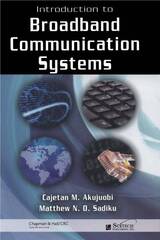
front cover of Introduction to Broadband Communication Systems
Introduction to Broadband Communication Systems
Cajetan M. Akujuobi
The Institution of Engineering and Technology, 2008
Broadband networks, such as asynchronous transfer mode (ATM), frame relay, and leased lines, allow us to easily access multimedia services (data, voice, and video) in one package. Exploring why broadband networks are important in modern-day telecommunications, Introduction to Broadband Communication Systems covers the concepts and components of both standard and emerging broadband communication network systems.
[more]

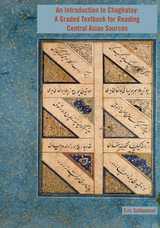
front cover of An Introduction to Chaghatay
An Introduction to Chaghatay
A Graded Textbook for Reading Central Asian Sources
Eric Schluessel
Michigan Publishing Services, 2018
The Chaghatay language was used across Central Asia from the 1400s through the 1950s. Chroniclers, clerks, and poets in modern-day Afghanistan, Xinjiang, Uzbekistan, and beyond wrote countless volumes of text in Chaghatay, from the famed Baburnama to the documents of everyday life. However, even more and more material in Chaghatay is becoming available to scholars, few are able to read the language with ease.

An Introduction to Chaghatay is the first textbook in over a century to introduce this language to English-speaking students. This book is designed to build a foundation in reading Chaghatay without assuming any background knowledge on the part of the reader. These graded, cumulative lessons include common vocabulary, accessible grammar explanations, and examples of Chaghatay manuscripts. Authentic texts introduce the student to different genres, including hagiographies, documents, “stories of the prophets,” and newspapers while introducing critical skills in paleography.

Eric Schluessel is Assistant Professor of Chinese History and Politics at the University of Montana. He holds a PhD in History and East Asian Languages from Harvard University, an MA in Linguistics from the School of Oriental and African Studies, and an MA in Central Eurasian Studies from Indiana University. He is the author of several articles on the history of Chinese Central Asia and is currently preparing a critical edition and translation of Mullah Musa Sayrami’s Tarikh-i Hamidi, a chronicle of Xinjiang in the nineteenth century.

 
[more]

front cover of An Introduction to Chinese Poetry
An Introduction to Chinese Poetry
From the Canon of Poetry to the Lyrics of the Song Dynasty
Michael A. Fuller
Harvard University Press, 2017

This innovative textbook for learning classical Chinese poetry moves beyond the traditional anthology of poems translated into English and instead brings readers—including those with no knowledge of Chinese—as close as possible to the texture of the poems in their original language. The first two chapters introduce the features of classical Chinese that are important for poetry and then survey the formal and rhetorical conventions of classical poetry. The core chapters present the major poets and poems of the Chinese poetic tradition from earliest times to the lyrics of the Song Dynasty (960–1279).

Each chapter begins with an overview of the historical context for the poetry of a particular period and provides a brief biography for each poet. Each of the poems appears in the original Chinese with a word-by-word translation, followed by Fuller’s unadorned translation, and a more polished version by modern translators. A question-based study guide highlights the important issues in reading and understanding each particular text.

Designed for classroom use and for self-study, the textbook’s goal is to help the reader appreciate both the distinctive voices of the major writers in the Chinese poetic tradition and the grand contours of the development of that tradition.

[more]

front cover of Introduction to Classical and New Testament Greek
Introduction to Classical and New Testament Greek
A Unified Approach
Michael Boler
Catholic University of America Press, 2020
The defining feature of this textbook is the treatment of classical and New Testament Greek as one language using primary sources. All the example sentences the students will translate are real Greek sentences, half of which are taken from classical literature and philosophy and half of which are directly from the New Testament. The advantage of this approach is that it highlights the linguistic, literary, and historical connections between classical Greece and early Christianity. Rather than having students memorize isolated tables and artificial sentences, Michael Boler spent years combing through thousands of pages of literature, philosophy, and scripture to find short, powerful sentences that not only teach the grammatical concepts in each chapter, but also contain seeds of wisdom that will spark wonder and discussion. Introduction to New Testament and Classical Greek is born out of classroom experience in a Catholic liberal arts university whose students were disappointed to be forced to choose between textbooks that taught classical Greek in isolation and ones that focused exclusively on the New Testament. By the end of this book, students will have read over 200 lines of scripture and an equal amount of ancient literature from Homer to Aristotle. They will also have the grammatical knowledge to continue to read classical and New Testament Greek. Each chapter contains a section at the end that delves deeply into the etymology and background of the words and passages encountered in the respective chapter. Professors will thus be able to use these chapters as a bridge to philosophical, theological, historical, and literary topics that will enrich the class.
[more]

front cover of An Introduction to Coastal Zone Management
An Introduction to Coastal Zone Management
Second Edition
Timothy Beatley, David J. Brower, and Anna K. Schwab
Island Press, 2002
An Introduction to Coastal Zone Management, Second Edition offers a comprehensive overview of coastal planning and management issues for students and professionals in the field. Since publication of the first edition in 1994, population growth and increasing development pressures on our coasts have made the need for forward-looking, creative, and sustainable visions for the future even greater. This completely updated and revised edition includes:
  • significantly updated data and statistics including discussions of population and growth trends, federal and state coastal expenditures, disaster assistance expenditures, and damage levels from hurricanes and coastal storms
  • updated legislative and programmatic material, including the Stafford Act and mitigation assistance programs, and changes in the Coastal Zone Management Act
  • expanded coverage of physical and biological attributes and conditions of the coastal zone
  • expanded and updated discussions of innovative local coastal management
  • new chapters on creative coastal design and development and lessons from coastal programs in other countries

An Introduction to Coastal Zone Management, Second Edition is the only available book that addresses the serious coastal trends and pressures in the U.S., assesses the current policy and planning framework, and puts forth a compelling vision for future management and sustainable coastal planning. It is an important resource for undergraduate and graduate students of coastal planning as well as for local and state officials, residents of coastal communities, environmental advocates, developers, and others concerned with coastal issues.
[more]

logo for American Library Association
An Introduction to Collection Development for School Librarians
Mona Kerby
American Library Association, 2019

logo for Harvard University Press
Introduction to Demography
Revised edition
Mortimer Spiegelman
Harvard University Press

front cover of Introduction to Digital Wireless Communications
Introduction to Digital Wireless Communications
Hong-Chuan Yang
The Institution of Engineering and Technology, 2017
This book provides an efficient introduction to fundamental and advanced digital transmission technologies in current and future wireless communication systems. The objective is to help students and engineers quickly grasp the operating principles and design trade-offs of various wireless transmission technologies, which will enable them to carry out product development or perform academic research in the field.
[more]

front cover of Introduction to Dynamic Macroeconomic Theory
Introduction to Dynamic Macroeconomic Theory
An Overlapping Generations Approach
George McCandless and Neil Wallace
Harvard University Press, 1991

Economies are constantly in flux, and economists have long sought reliable means of analyzing their dynamic properties. This book provides a succinct and accessible exposition of modern dynamic (or intertemporal) macroeconomics. The authors use a microeconomics-based general equilibrium framework, specifically the overlapping generations model, which assumes that in every period there are two generations which overlap. This model allows the authors to fully describe economies over time and to employ traditional welfare analysis to judge the effects of various policies. By choosing to keep the mathematical level simple and to use the same modeling framework throughout, the authors are able to address many subtle economic issues. They analyze savings, social security systems, the determination of interest rates and asset prices for different types of assets, Ricardian equivalence, business cycles, chaos theory, investment, growth, and a variety of monetary phenomena.

Introduction to Dynamic Macroeconomic Theory will become a classic of economic exposition and a standard teaching and reference tool for intertemporal macroeconomics and the overlapping generations model. The writing is exceptionally clear. Each result is illustrated with analytical derivations, graphically, and by worked out examples. Exercises, which are strategically placed, are an integral part of the book.
[more]

front cover of Introduction to Electronic Warfare Modeling and Simulation
Introduction to Electronic Warfare Modeling and Simulation
David L. Adamy
The Institution of Engineering and Technology, 2006
This unique book covers the whole field of electronic warfare modeling and simulation at a systems level, including chapters that describe basic electronic warfare (EW) concepts. Written by a well-known expert in the field with more than 24 years of experience, the book explores EW applications and techniques and the radio frequency spectrum, with primary emphasis on HF (high frequency) to microwave. A detailed resource for entry-level engineering personnel in EW, military personnel with no radio or communications engineering background, technicians and software professionals, the work helps you understand the basic concepts required for modeling and simulation, as well as fidelity and other practical aspects of simulation design and application. You get clear explanations of important mathematical concepts, such as decibel notation and spherical trigonometry. This informative reference explains how to facilitate the generation of realistic computer models of EW equipment. Moreover, it describes specific types of EW equipment, how they work and how each is mathematically modeled. The book concludes with a description of the various types of models and simulations and the ways they are applied to training and equipment testing tasks.
[more]

front cover of An Introduction to Empire in the New Testament
An Introduction to Empire in the New Testament
Adam Winn
SBL Press, 2016

Explore how empire is a crucial foreground for reading and interpreting the New Testament

In the last three decades, significant attention has been given to the way in which New Testament texts engage and respond to the imperial world in which they were written. The purpose of the present volume is to introduce students and non-specialists to the growing subfield of New Testament studies known as empire studies. Contributors seek to make readers aware of the significant work that has already been produced, while also pointing them to new ways in which this field is moving forward. The contributors are Bruce W. Longenecker, Richard A. Horsley, Warren Carter, Adam Winn, Eric D. Barreto, Beth M. Sheppard, Neil Elliot, James R. Harrison, Harry O. Maier, Deborah Krause, Jason A.Whitlark, Matthew R. Hauge, Kelly D. Liebengood, and Davina C. Lopez.

Features:
  • Essays from a diverse group of interpreters who at times have differing presuppositions, methods, and concerns
  • Articles introduce students and non-specialists to the Roman imperial realities regularly encountered by first and second century Christians
  • Contributions explore the strategies employed by early Christians to respond to the Roman empire
  • [more]

    front cover of An Introduction to Fractional Control
    An Introduction to Fractional Control
    Duarte Valério
    The Institution of Engineering and Technology, 2012
    Fractional control techniques provide an effective way to control dynamic behaviours, using fractional differential equations. This can include the control of fractional plants, the control of a plant using a fractional controller, or the control of a plant so that the controlled system will have a fractional behaviour to achieve a performance that would otherwise be hard to come by.
    [more]

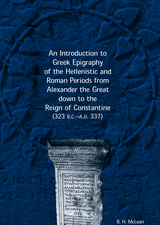
    front cover of An Introduction to Greek Epigraphy of the Hellenistic and Roman Periods from Alexander the Great down to the Reign of Constantine
    An Introduction to Greek Epigraphy of the Hellenistic and Roman Periods from Alexander the Great down to the Reign of Constantine
    B. H. McLean
    University of Michigan Press, 2011

    “In short, this is a reference work of the best kind. For the beginner, it is indispensable. And for those who already know something about its subject matter, the book is in many ways useful, informative, and interesting. We all owe a debt to [the author] for undertaking this significant project, and for completing it so well.”
    —Michael Peachin, Classical World

    “. . . provides invaluable road maps for non-epigraphers faced with passages of inscribed Greek.”
    —Graham Shipley, Bryn Mawr Classical Review

    Greek inscriptions form a valuable resource for the study of all aspects of the Greco-Roman world. They are primary witnesses to society's laws and institutions, religious habits, and language. This volume provides students with the tools to take advantage of the historical value of these treasures. It examines letter forms, ancient names, and ancient calendars, knowledge of which is essential in reading inscriptions of all kinds.

    B. H. McLean discusses the classification of inscriptions into their various categories and analyzes particular types of inscriptions, including decrees, honorary inscriptions, dedications, funerary inscriptions, and manumissions. Finally, McLean includes special topics that bear upon the interpretation of specific features of inscriptions, such as Greek and Roman administrative titles and functions.

    [more]

    logo for Ohio University Press
    An Introduction To Hegel
    The Stages of Modern Philosophy
    Howard P. Kainz
    Ohio University Press, 1996

    In a sense it would be inappropriate to speak of “Hegel’s system of philosophy,” because Hegel thought that in the strict sense there is only one system of philosophy evolving in the Western world. In Hegel’s view, although at times philosophy’s history seems to be a chaotic series of crisscrossing interpretations of meanings and values, with no consensus, there has been a teleological development and consistent progress in philosophy and philosophizing from the beginning; Hegel held that his own version of “German idealism” was simply bringing to final expression the latest refinements of an ongoing, perennial system.

    If we take Hegel at his word, then one of the best entries into his system would be through the history of philosophy, showing how systems and schools of thought prior to Hegel led up to his system. The most important currents to focus on, however, would be in modern philosophy, in which especially intensive changes led ultimately to German idealism and Hegel’s immediate predecessors.

    Fortunately, Hegel lectured extensively on the history of modern philosophy and structured his lectures in such a way as to throw light on the status of the “one system” of Western philosophy at the time — the status to which Hegel felt he had been contributing and was continuing to contribute. These lectures are of interest, first of all, as a systematic chronicle of philosophical positions in the heyday of modern philosophy, from Bacon to Hegel. Second, they are interesting because Hegel’s critical comments on his predecessors clarify his own positions: for example, the dialectic method and the importance of triplicity, the relationship of philosophy to the scientific method, the necessity for avoidance of the extremes of empiricism and of idealism, the subject/object problematic, the “identity” of rationality and reality, and the technical meaning in Hegel’s philosophy of “absolute,” “infinity,” and the “idea.”

    [more]

    front cover of Introduction to Husserlian Phenomenology
    Introduction to Husserlian Phenomenology
    Rudolf Bernet, Iso Kern, and Eduard Marbach
    Northwestern University Press, 1993
    This comprehensive study of Husserl's phenomenology concentrates on Husserl's emphasis on the theory of knowledge. The authors develop a synthetic overview of phenomenology and its relation to logic, mathematics, the natural and human sciences, and philosophy. The result is an example of philology at its best, avoiding technical language and making Husserl's thought accessible to a variety of readers.
    [more]

    front cover of An Introduction to Immigrant Incorporation Studies
    An Introduction to Immigrant Incorporation Studies
    European Perspectives
    Edited by Marco Martiniello and Jan Rath
    Amsterdam University Press, 2014
    Focusing mainly on the European experience including Eastern Europe, this important volume offers an advanced introduction to immigrant incorporation studies from a historical, empirical and theoretical perspective. Beyond incorporation theories, renowned scholars in the field explore incorporation in action in different fields, policy issues and normative dimensions.
    [more]

    front cover of An Introduction to Interdisciplinary Research
    An Introduction to Interdisciplinary Research
    Theory and Practice
    Edited by Steph Menken and Machiel Keestra
    Amsterdam University Press, 2016
    One of the major areas of emphasis in academia in recent years has been interdisciplinary research, a trend that promises new insights and innovations rooted in cross-disciplinary collaboration. This book is designed to help students understand the tools required for stepping beyond traditional disciplinary boundaries and applying knowledge and insights from multiple fields. Relentlessly focused on practical applications, the book will enable students to plan and execute their own interdisciplinary research projects.
    [more]

    front cover of An Introduction to International Migration Studies
    An Introduction to International Migration Studies
    European Perspectives
    Edited by Marco Martiniello and Jan Rath
    Amsterdam University Press, 2013
    Focusing mainly on the European experience including Eastern Europe, this important volume offers an advanced introduction to immigrant incorporation studies from a historical, empirical and theoretical perspective. Beyond incorporation theories, renowned scholars in the field explore incorporation in action in different fields, policy issues and normative dimensions.
    [more]

    logo for Leiden University Press
    Introduction to International Studies
    Maurits Berger
    Leiden University Press, 2025
    "International Studies aims to understand the global complexities of the world in which we live today. Central in these complexities is the position of the human individual, who is both an actor and reactor in global events. This textbook introduces three I's – interests, identities, ideas – that provide a framework to understand human behaviour in today's world. The role of people is further elaborated in the three spatial dimensions of the local, regional, and global level. This gives International Studies the character of a 3-D chessboard with human players. Unique in this textbook is the framework of global scopes used for analysis of the global complexities: global structures (such as economics, belief systems, states, intergovernmental organizations), global trends (such as nationalism, power changes, secularization, identity), and global challenges (such as sustainable development, climate change, pandemics, unwanted migration). This textbook approaches International Studies as a field of study that enables students to navigate the framework of the three I's, the three spatial dimensions and the three global scopes. The International Studies student will acquire a broad overview of the various fields and disciplines and, as a consequence, the ability to move across traditional academic boundaries.
    [more]

    logo for Georgetown University Press
    Introduction to Jewish and Catholic Bioethics
    A Comparative Analysis
    Aaron L. Mackler
    Georgetown University Press, 2003

    Leavened with compassion, common sense, and a readable style, this introduction to complicated bioethical issues from both Jewish and Catholic perspectives is as informative as it is undaunting. Aaron Mackler takes the reader through methodology in Roman Catholic moral theology and compares and contrasts it with methodology as it is practiced in Jewish ethics. He then skillfully wends his way through many topics foremost on the contemporary ethical agenda for both Jewish and Catholic ethicists: euthanasia and assisted suicide, end-of-life decisions, abortion, in vitro fertilization, and the ever-growing problem of justice regarding access to health care and medical resources. A concluding chapter summarizes general tendencies in the comparison of the two traditions, and addresses the significance of convergence and divergence between these traditions for moral thinkers within each faith community, and generally in western democracies such as the United States.

    As Mackler overviews these issues, he points out the divergences and the commonalities between the two traditions—clarifying each position and outlining the structure of thinking that supports them. At the heart of both Catholic and Jewish perspectives on bioethics is a life-affirming core, and while there may be differences in the "why" of those ethical divergences, and in the "how" each arrived at varying—or the same—conclusions, both traditions, in the words of James McCartney as quoted in the introduction, "are guided by the principle that life is precious; that we are bidden to preserve and guard our health; that we are bidden to intervene in nature to raise the human estate; and that our lives are not our own, but are part of the legacy bequeathed to us by the Creator." This book has been carefully crafted in that spirit.
    [more]

    front cover of An Introduction to Legal Reasoning
    An Introduction to Legal Reasoning
    Edward H. Levi
    University of Chicago Press, 2013
    Originally published in 1949, An Introduction to Legal Reasoning is widely acknowledged as a classic text. As its opening sentence states, “This is an attempt to describe generally the process of legal reasoning in the field of case law and in the interpretation of statutes and of the Constitution.” In elegant and lucid prose, Edward H. Levi does just that in a concise manner, providing an intellectual foundation for generations of students as well as general readers.

    For this edition, the book includes a substantial new foreword by leading contemporary legal scholar Frederick Schauer that helpfully places this foundational book into its historical and legal contexts, explaining its continuing value and relevance to understanding the role of analogical reasoning in the law. This volume will continue to be of great value to students of logic, ethics, and political philosophy, as well as to members of the legal profession and everyone concerned with problems of government and jurisprudence.
    [more]

    front cover of An Introduction to Legal Reasoning
    An Introduction to Legal Reasoning
    Edward H. Levi
    University of Chicago Press, 2013
    This is an auto-narrated audiobook version of this book.

    Originally published in 1949, An Introduction to Legal Reasoning is widely acknowledged as a classic text. As its opening sentence states, “This is an attempt to describe generally the process of legal reasoning in the field of case law and in the interpretation of statutes and of the Constitution.” In elegant and lucid prose, Edward H. Levi does just that in a concise manner, providing an intellectual foundation for generations of students as well as general readers.

    For this edition, the book includes a substantial new foreword by leading contemporary legal scholar Frederick Schauer that helpfully places this foundational book into its historical and legal contexts, explaining its continuing value and relevance to understanding the role of analogical reasoning in the law. This volume will continue to be of great value to students of logic, ethics, and political philosophy, as well as to members of the legal profession and everyone concerned with problems of government and jurisprudence.
    [more]

    front cover of An Introduction to Legal Reasoning
    An Introduction to Legal Reasoning
    Edward H. Levi
    University of Chicago Press, 1962
    This volume will be of interest and value to students of logic, ethics, and political philosophy, as well as to members of the legal profession and to everyone concerned with problems of government and jurisprudence. By citing a large number of cases, the author makes his presentation of the processes of judicial interpretation particularly lucid.
    [more]

    logo for Harvard University Press
    An Introduction to Literary Chinese
    First Edition
    Michael A. Fuller
    Harvard University Press, 1999
    This textbook for beginning students contains 35 lessons of increasing difficulty designed to introduce students to the basic patterns of Classical Chinese and to provide practice in reading a variety of texts. The lessons are structured to encourage students to do more work with dictionaries and other references as they progress through the book. The Introduction provides an overview of the grammar of Literary Chinese. Part I presents eight lessons on sentence structure, parts of speech, verbs, and negatives. Part II consists of sixteen intermediate-level lessons, and Part III offers five advanced-level selections. Part IV has six lessons based on Tang and Song dynasty prose and poetry.

    [more]

    logo for Harvard University Press
    An Introduction to Literary Chinese
    Revised Edition
    Michael A. Fuller
    Harvard University Press, 2004

    This textbook for beginning students contains 35 lessons of increasing difficulty designed to introduce students to the basic patterns of Classical Chinese and to provide practice in reading a variety of texts. The lessons are structured to encourage students to do more work with dictionaries and other references as they progress through the book.

    The Introduction provides an overview of the grammar of Literary Chinese. Part I presents eight lessons on sentence structure, parts of speech, verbs, and negatives. Part II consists of sixteen intermediate-level lessons, and Part III offers five advanced-level selections. Part IV has six lessons based on Tang and Song dynasty prose and poetry.

    [more]

    front cover of An Introduction to Literary Chinese
    An Introduction to Literary Chinese
    Second Edition
    Michael A. Fuller
    Harvard University Press, 2024

    The second edition of An Introduction to Literary Chinese incorporates recent developments in linguistics and has been expanded to include a lesson on Buddhist texts. Beginning with an overview of literary Chinese—its phonology, morphology, and syntax, as well as a short account of the nature of the writing system—the textbook then presents thirty-six lessons of increasing difficulty designed to introduce students to the basic patterns of the language and give them practice in reading a variety of texts.

    Part I presents eight lessons on the basic syntactic components in literary Chinese. Each lesson begins with an overview of its topic, introduces an exemplary text, and provides a glossary, notes, and practice exercises. The sixteen lessons in Part II use increasingly long and complex texts to introduce styles of narrative and argumentation in literary Chinese and, at the same time, solidify students’ grasp of the syntax. The advanced texts in the six lessons in Part III introduce students to central authors and philosophical traditions in premodern China and broaden the process of reading to include elements of cultural and historical interpretation. Part IV has six lessons comprising important Tang and Song dynasty prose and poetic texts.

    [more]

    front cover of An Introduction to Mathematical Statistics
    An Introduction to Mathematical Statistics
    Fetsje Bijma, Marianne Jonker, and Aad van der Vaart
    Amsterdam University Press, 2017
    Statistics is the science that focuses on drawing conclusions from data, by modeling and analyzing the data using probabilistic models. In 'An Introduction to Mathematical Statistics' the authors describe key concepts from statistics and give a mathematical basis for important statistical methods. Much attention is paid to the sound application of those methods to data.

    The three main topics in statistics are estimators, tests, and confidence regions. The authors illustrate these in many examples, with a separate chapter on regression models, including linear regression and analysis of variance. They also discuss the optimality of estimators and tests, as well as the selection of the best-fitting model.Each chapter ends with a case study in which the described statistical methods are applied.

    This book assumes a basic knowledge of probability theory, calculus, and linear algebra.
    [more]

    front cover of Introduction to Metadata
    Introduction to Metadata
    Third Edition
    Murtha Baca
    J. Paul Getty Trust, The, 2016
    Metadata provides a means of indexing, accessing, preserving, and discovering digital resources. The volume of digital information available over electronic networks has created a pressing need for standards that ensure correct and proper use and interpretation of the data by its owners and users. Well-crafted metadata is needed more now than ever before and helps users to locate, retrieve, and manage information in this vast and complex universe.
     
    The third edition of Introduction to Metadata, first published in 1998, provides an overview of metadata, including its types, roles, and characteristics; a discussion of metadata as it relates to Web resources; and a description of methods, tools, standards, and protocols for publishing and disseminating digital collections. This revised edition is an indispensable resource in the field, addressing advances in standards such as Linked Open Data, changes in intellectual property law, and new computing technologies, and offering an expanded glossary of essential terms.
     
    [more]

    logo for Catholic University of America Press
    Introduction to Middle Welsh
    Joshua Byron Smith
    Catholic University of America Press, 2026
    Introduction to Middle Welsh offers a comprehensive introduction to Middle Welsh grammar, leading the student through sixty chapters of carefully scaf­folded exercises and readings. Written in an engaging style and aimed toward learners without any knowledge of Modern Welsh, this book guides students to a high intermediate level of proficiency with the language, focusing par­ticularly on prose. The first twenty chapters employ both original Middle Welsh sentences and simplified sentences based on originals, allowing learners to master basic grammatical concepts without being overwhelmed by vocabulary. New vo­cabulary is introduced at the end of each lesson, so that learners can complete the exercises and translation without looking up words in the glossary. The glossary, for its part, contains over 1,500 vocabulary items, which provides students with many of the most commonly used words in Middle Welsh liter­ature. When available, useful etymologies are also provided, making connec­tions to languages that students might already know. In addition to several hundred carefully chosen sentences for translation exercises, Introduction to Middle Welsh includes eighteen selections from literature, ranging from poetry to law, showing the variety of the Middle Welsh literary corpus. Ideal for the classroom or self-taught learners, Introduction to Middle Welsh will appeal to those with an interest in Welsh, medieval literature, and Celtic studies.
    [more]

    front cover of Introduction to Moral Theology (Catholic Moral Thought, Volume 1)
    Introduction to Moral Theology (Catholic Moral Thought, Volume 1)
    Romanus Cessario, O.P.
    Catholic University of America Press, 2001
    The present volume, the first in the new Catholic Moral Thought series, responds to the need for a new introduction to the basic and central elements of Catholic moral theology written in the light of Veritatis splendor.
    [more]

    front cover of Introduction to Moral Theology, revised edition
    Introduction to Moral Theology, revised edition
    Romanus Cessario
    Catholic University of America Press, 2013
    Originally published in 2001, Introduction to Moral Theology responded to the need for a new introduction to the basic and central elements of Catholic moral theology written in the light of Veritatis splendor. Since then, it has become a standard text for students and a reputable resource on such topics as moral theology and the good of the human person created in God's image; natural law; principles of human action; determination of the moral good through objects, ends, and circumstances; and the virtues, gifts of the Holy Spirit, and the Beatitudes.
    [more]

    front cover of An Introduction to Moroccan Arabic and Culture
    An Introduction to Moroccan Arabic and Culture
    Abdellah Chekayri
    Georgetown University Press, 2011

    An Introduction to Moroccan Arabic and Culture and the accompanying multimedia DVD are designed to enable students to communicate effectively using Moroccan Arabic. Since Moroccan Arabic is rarely written or used in formal communication, the strength of the book lies in training learners in speaking and listening skills that can be used in everyday situations.

    Upon completing this course, students should be able to:
    • greet people
    • introduce themselves
    • ask and reply to simple questions
    • use days and numbers in context
    • order food
    • shop
    • make appointments and reservations
    • give directions
    • talk about future plans
    • use common idiomatic expressions

    Each chapter includes:
    • cultural introductions to social, religious, or cultural aspects of Moroccan society
    • listening comprehension exercises
    • vocabulary exercises
    • dialogues and texts
    • conversation practice
    • grammar instruction on how native speakers structure their speech
    • interactive and video materials to support cultural understanding, listening, speaking, and grammar explanations

    The book uses Romanized transcription alongside Arabic script for the first three chapters and thereafter only the Arabic script. It also includes a glossary and answer key. It requires approximately 120 contact hours, plus 180-240 additional hours of preparation outside class. A novice student should reach the intermediate-mid level of proficiency by the end of this course.

    [more]

    front cover of Introduction to Natural Language Semantics
    Introduction to Natural Language Semantics
    Henriëtte de Swart
    CSLI, 1998
    Semantics is defined as the study of meaning expressed by elements of a language or combinations thereof. Utterances are not just noises or scribbles, they are used to convey information, and they are linked with kinds of events and with states of mind.

    This text examines what issues semantics, as a theory of meaning, should address; determining what the meanings of words of the language are and how to semantically combine elements of a language to build up complex meanings. Logical languages are then developed as formal metalanguages to natural language. Subsequent chapters address propositional logic, the syntax and semantics of (first-order) predicate logic as an extension of propositional logic, and Generalized Quantifier theory. Going beyond extensional theory, Henri'tte de Swart relativizes the interpretation of expressions to times to account for verbal tense, time adverbials and temporal connectives and introduces possible worlds to model intensions, modal adverbs and modal auxiliaries.

    This broad overview of natural language semantics should cover most of the points addressed in an introductory course. Numerous exercises punctuate each chapter and an example exam based on the materials presented is included, making this volume a perfect textbook and resource for any undergraduate or graduate-level introductory course in semantics.
    [more]

    logo for Harvard University Press
    Introduction to Newton’s “Principia”
    I. Bernard Cohen
    Harvard University Press, 1971

    front cover of Introduction to Non-Marxism
    Introduction to Non-Marxism
    François Laruelle
    University of Minnesota Press, 2014

    Following the collapse of the communist states it was assumed that Marxist philosophy had collapsed with it. In Introduction to Non-Marxism, François Laruelle aims to recover Marxism along with its failure by asking the question “What is to be done with Marxism itself?”

    To answer, Laruelle resists the temptation to make Marxism more palatable after the death of metaphysics by transforming Marxism into a mere social science or by simply embracing with evangelical fervor the idea of communism. Instead Laruelle proposes a heretical science of Marxism that will investigate Marxism in both its failure and power so as to fashion new theoretical tools.

    In the course of engaging with the material of Marxism, Laruelle takes on the philosophy of Marx along with important philosophers who have extended that philosophy including Althusser, Balibar, Negri as well as the attempt at a phenomenological Marxism found in the work of Michel Henry. Through this engagement Laruelle develops with great precision the history and function of his concept of determination-in-the-last-instance. In the midst of the assumed failure of Marxism and the defections and resentment that followed, Laruelle’s non-Marxism responds with the bold declaration: “Do not give up on theory!”
    [more]

    front cover of Introduction to Nordic Cultures
    Introduction to Nordic Cultures
    Edited by Annika Lindskog and Jakob Stougaard-Nielsen
    University College London, 2020
    Introduction to Nordic Cultures is an innovative, interdisciplinary introduction to Nordic history, cultures, and societies from medieval times to today. The textbook spans the whole Nordic region, covering historical periods from the Viking Age to modern society, and engages with a range of subjects: from runic inscriptions on iron rings and stone monuments, via eighteenth-century scientists, Ibsen’s dramas and turn-of-the-century travel, to twentieth-century health films and the welfare state, nature ideology, Greenlandic literature, Nordic Noir, migration, ‘new’ Scandinavians, and stereotypes of the Nordic. This book provides fundamental knowledge and insights into the history and structures of Nordic societies while constructing critical analyses around specific case studies that help build an informed picture of how societies grow and of the interplay between history, politics, culture, geography, and people.
     
    [more]

    front cover of An Introduction to Nuclear Astrophysics
    An Introduction to Nuclear Astrophysics
    Richard N. Boyd
    University of Chicago Press, 2008
    Nuclear astrophysics is the study of how all naturally occurring elements formed and evolved into our present universe via nuclear processes, beginning with the Big Bang and continuing today in astrophysical objects such as stars, x-ray bursters, and supernovae. Emerging from traditional studies in astrophysics and particle research, this cross-disciplinary field touches upon astronomy, astrophysics, cosmology, and particle physics.

    In An Introduction to Nuclear Astrophysics, author Richard Boyd includes basic nomenclature and information so that students from astronomy or physics can quickly orient themselves in the material. Subsequent chapters describe earthbound and space born instruments operating in service to nuclear astrophysics worldwide; background topics such as nuclear and neutrino physics, scattering formalism, and thermonuclear reaction rates; and information on galactic chemical evolution, solar nucleosynthesis, s- and r-processes, and gamma-ray bursts. Each chapter includes problem sets  against which students may test their knowledge before moving ahead, and the author has included copious references intended to guide students to further study.

    An Introduction to Nuclear Astrophysics
    is an essential textbook for undergraduate and graduate students in astronomy and astrophysics.  It is also an invaluable overview of the subject for researchers in nuclear astrophysics and related fields.  
    [more]

    front cover of Introduction to Old Javanese Language and Literature
    Introduction to Old Javanese Language and Literature
    A Kawi Prose Anthology
    Mary S. Zurbuchen
    University of Michigan Press, 1976
    The oldest and most extensive written language of Southeast Asia is Old Javanese, or Kawi. It is the oldest language in terms of written records, and the most extensive in the number and variety of its texts. Javanese literature has taken many forms. At various times, prose stories, sung poetry or other metrical types, chronicles, scientific, legal, and philosophical treatises, prayers, chants, songs, and folklore were all written down. Yet relatively few texts are available in English. The unstudied texts remaining are an unexplored record of Javanese culture as well as a language still alive as a literary medium in Bali.
    Introduction to Old Javanese Language and Literature represents a first step toward remedying the dearth of Old Javanese texts available to English-speaking students. The ideal teaching companion, this anthology offers transliterated original texts with facing-page English translations. Theanthology focuses on prose selections, since their straightforward style and syntax offer the beginning student the most rewarding experience. Four sections make up the collection. Part I offers several short readings as the most accessible entry point into Old Javanese. Part II contains two moralistic fables from an Old Javanese retelling of the Hindu Pañcatantra cycle. Part III takes up the epic, providing excerpts from one of the books of the Old Javanese retelling of the Mahābhārata. Part IV offers excerpts from two chronicles, the generic conventions of which challenge received notions of history writing because of their supernaturalism and folkloric elements.
    Includes introduction, glossary, and notes.
    [more]

    front cover of An Introduction to Personalism
    An Introduction to Personalism
    Juan Manuel Burgos
    Catholic University of America Press, 2018
    Much has been written about the great personalist philosophers of the 20th century – including Jacques Maritain and Emmanuel Mournier, Martin Buber and Emmanuel Levinas, Dietrich von Hildebrand and Edith Stein, Max Scheler and Karol Wojtyla (later Pope John Paul II) – but few books cover the personalist movement as a whole. An Introduction to Personalism fills that gap.

    Juan Manuel Burgos shows the reader how personalist philosophy was born in response to the tragedies of two World Wars, the Great Depression, and the totalitarian regimes of the 1930s. Through a revitalization of the concept of the person, an array of thinkers developed a philosophy both rooted in the best of the intellectual tradition and capable of dialoguing with contemporary concerns.

    Burgos then delves into the potent ideas of more than twenty thinkers who have contributed to the growth of personalism, including Romano Guardini, Gabriel Marcel, Xavier Zubiri, and Michael Polanyi. Burgos’s encyclopedic knowledge of the movement allows for a concise and well-rounded perspective on each of the personalists studied.

    An Introduction to Personalism concludes with a synthesis of personalist thought, bringing together the brightest insights of each personalist philosopher into an organic whole. Burgos argues that personalism is not an eclectic hodge-podge, but a full-fledged school of philosophy, and gives a dynamic and rigorous exposition of the key features of the personalist position.

    Our times are marked by numerous and often contradictory ideas about the human person. An Introduction to Personalism presents an engaging anthropological vision capable of taking the lead in the debate about the meaning of human existence and of winning hearts and minds for the cause of the dignity of every person in the 21st century and beyond.
    [more]

    front cover of Introduction To Poetics
    Introduction To Poetics
    Tzvetan Todorov
    University of Minnesota Press, 1981

    front cover of Introduction to Probability for Data Science
    Introduction to Probability for Data Science
    Stanley Chan
    Michigan Publishing Services, 2021
    [from the Preface] This introductory textbook in undergraduate probability emphasizes the inseparability between data (computing) and probability (theory) in our time. It examines the motivationintuition, and implication of the probabilistic tools used in science and engineering:
    1. Motivation: In the ocean of mathematical definitions, theorems, and equations, why should we spend our time on this particular topic but not another?
    2. Intuition: When going through the deviations, is there a geometric interpretation or physics beyond those equations?
    3. Implication: After we have learned a topic, what new problems can we solve?
    [more]

    front cover of Introduction to Public Librarianship
    Introduction to Public Librarianship
    Kathleen de la Peña McCook
    American Library Association, 2018

    Put simply, there is no text about public librarianship more rigorous or comprehensive than McCook's survey. Now, the REFORMA Lifetime Achievement Award-winning author has teamed up with noted public library scholar and advocate Bossaller to update and expand her work to incorporate the field's renewed emphasis on outcomes and transformation. This "essential tool" (Library Journal) remains the definitive handbook on this branch of the profession. It covers every aspect of the public library, from its earliest history through its current incarnation on the cutting edge of the information environment, including

    • statistics, standards, planning, evaluations, and results;
    • legal issues, funding, and politics;
    • organization, administration, and staffing;
    • all aspects of library technology, from structure and infrastructure to websites and makerspaces;
    • adult services, youth services, and children's services;
    • associations, state library agencies, and other professional organizations;
    • global perspectives on public libraries; and
    • advocacy, outreach, and human rights.

    Exhaustively researched and expansive in its scope, this benchmark text continues to serve both LIS students and working professionals.

    [more]

    logo for American Library Association
    Introduction to Public Librarianship
    Kathleen de la Peña McCook
    American Library Association, 2011

    logo for American Library Association
    Introduction to Public Librarianship
    American Library Association
    American Library Association, 2004

    front cover of Introduction to Quantum Computing for Business
    Introduction to Quantum Computing for Business
    Koen Groenland
    Amsterdam University Press, 2025
    How will businesses use quantum technology in the future? What problems will a quantum computer solve? How long will it take before these devices become commercially relevant?
    With the first generation of quantum computers on the horizon, understanding their impact is more relevant than ever. Luckily, you don’t need a physics degree to understand the functionality of these computers – just like you don’t need to know how a transistor works to excel in conventional IT.
    This book is the perfect introduction to the opportunities and threats of quantum technologies. It equips you with the necessary knowledge to join cutting-edge discussions and make strategic decisions.

    [more]

    front cover of Introduction to Radar Target Recognition
    Introduction to Radar Target Recognition
    P. Tait
    The Institution of Engineering and Technology, 2006
    This book text provides an overview of the radar target recognition process and covers the key techniques being developed for operational systems. It is based on the fundamental scientific principles of high resolution radar, and explains how the underlying techniques can be used in real systems, taking into account the characteristics of practical radar system designs and component limitations. It also addresses operational aspects, such as how high resolution modes would fit in with other functions such as detection and tracking.
    [more]

    logo for American Library Association
    Introduction to Reference Sources in Health Science
    American Library Association
    American Library Association, 2008

    logo for American Library Association
    Introduction to Reference Sources in the Health Sciences
    Jeffrey T. Huber
    American Library Association, 2014

    front cover of Introduction to Restoration Ecology
    Introduction to Restoration Ecology
    Evelyn A. Howell, John A. Harrington, and Stephen B. Glass
    Island Press, 2011
    Introduction to Restoration Ecology equips students and emerging practitioners with the knowledge, tools, and critical thinking skills needed to tackle complex ecological restoration challenges. Blending science, design, and real-world application, this interdisciplinary text provides a practical framework for restoring degraded ecosystems in diverse environments and cultural contexts.

    Developed by a team of ecologists and landscape architects with decades of experience in both teaching and on-the-ground restoration work, the book introduces a step-by-step process rooted in ecological theory and tested through years of classroom instruction at the University of Wisconsin–Madison. Rather than offering a one-size-fits-all solution, the authors emphasize adaptability—helping readers navigate the uncertainty, variability, and site-specific constraints that shape real-world restoration efforts.

    Each chapter is enriched with “Food for Thought” prompts that encourage students to reflect on the material, apply concepts to current conservation issues, and engage with the social, political, and ethical dimensions of ecological work. The result is a resource that fosters both scientific literacy and professional judgment.

    Whether preparing for careers in environmental science, conservation planning, or land management, readers will come away with a grounded, flexible approach to ecological restoration—one that recognizes the importance of collaboration, context, and creativity in restoring resilient landscapes.

    [more]

    front cover of An Introduction to RF Stealth
    An Introduction to RF Stealth
    David Lynch Jr.
    The Institution of Engineering and Technology, 2021
    This expanded, revised and updated new edition of Introduction to RF Stealth covers two major topics: Low Observables and Low Probability of Intercept (LO and LPI) of radars and data links, collectively sometimes called Stealth. Each chapter includes examples, student exercises and references. Worked simulations are available that illustrate the techniques described.
    [more]

    logo for The Institution of Engineering and Technology
    Introduction to RF Stealth
    David L. Lynch Jr.
    The Institution of Engineering and Technology, 2004
    This is the only book focused on the complete aspects of RF Stealth design. It is the first book to present and explain first order methods for the design of active and passive stealth properties. Everything from Electronic Order of Battle to key component design is covered.
    [more]

    logo for Ohio University Press
    An Introduction to Richard Wagner’s Der Ring des Nibelungen
    A Handbook
    William O. Cord
    Ohio University Press, 1995

    Today, more than a century after its first performance, Richard Wagner’s The Ring of Nibelung endures as one of the most significant artistic creations in the history of opera. This monumental work not only altered previously accepted concepts of music and drama but also inspired creative and intellectual efforts far beyond the field of opera.

    Previous studies of the Ring have appealed only to those already acquainted in some way with the Wagnerian art. For the uninitiated, Wagner and his landmark creation have seemed forbidding, and those eager to learn about the masterpiece have faced a vast and frequently esoteric body of commentary. Professor Cord addresses the interests of the non-specialist by taking the reader first into Wagner’s unique intent, and then through the complete history of the Ring.

    Cord, who has attended forty performances of the Ring, considers the conception of the poem, its development into a music-drama exemplifying Wagnerian thought, its introduction to the world, and the reactions and interpretation it elicits.

    [more]

    front cover of Introduction to Sacramental Theology
    Introduction to Sacramental Theology
    Signs of Christ in the Flesh
    Jose Granados
    Catholic University of America Press, 2021
    Introduction to Sacramental Theology presents a complete overview of sacramental theology from the viewpoint of the body. This viewpoint is supported, in the first place, by Revelation, for which the sacraments are the place where we enter into contact with the body of the risen Jesus. It is a viewpoint, secondly, which is firmly rooted in our concrete human bodily experience, thus allowing for a strong connection between faith and life, creation and redemption. From this point of view, the treatise on the sacraments occupies a strategic role. For the sacraments appear, not as the last of a series of topics (after dealing with Creation, Christ, the Church), but as the original place in which to stand in order to contemplate the entire Christian mystery. This point of view of the body, which resonates with contemporary philosophy, sheds fruitful light on classical themes, such as the relationship of the sacraments with creation, the composition of the sacramental sign, the efficacy of the sacraments, the sacramental character, the role of the minister, or the relationship of the sacrament with the Church as a sacrament. As a result of this approach, the Eucharist takes on a central role, since this is the sacrament where the body of Jesus is made present. The rest of the sacraments are seen as prolongations of the eucharistic body, so as to fill all the time and space of the faithful. This foundation of the theology of the sacraments in eucharistic theology is supported by an analysis of the patristic and medieval tradition. In order to support its conclusions, Introduction to Sacramental Theology examines the doctrine of Scripture (especially St. John and St. Paul), the main patristic and medieval authors (St. Augustine, Hugh of St. Victor, St. Bonaventure, St. Thomas Aquinas), the response of Trent to the protestant challenges, up to modern authors such as Scheeben, Rahner, Ratzinger, or Chauvet, including the teaching of Vatican II about the Church as a kind of sacrament.
    [more]

    logo for The Institution of Engineering and Technology
    An Introduction to Satellite Communications
    D.I. Dalgleish
    The Institution of Engineering and Technology, 1989
    The aim of this book is to give a clear and concise exposition of the principles and practice of satellite communications by describing the development of communications-satellite services. It will be useful both to engineers who have worked in other fields of telecommunication and to students.
    [more]

    front cover of Introduction to Scholastic Theology
    Introduction to Scholastic Theology
    Ulrich G. Leinsle
    Catholic University of America Press, 2010
    With this book, distinguished historian of philosophy Ulrich Leinsle offers the first comprehensive introduction to scholastic theology -- a textbook for both Protestant and Catholic students.
    [more]

    logo for Harvard University Press
    Introduction to Semantics and Formalization of Logic
    Rudolf Carnap
    Harvard University Press

    front cover of Introduction to Sensors for Ranging and Imaging
    Introduction to Sensors for Ranging and Imaging
    Graham Brooker
    The Institution of Engineering and Technology, 2009
    This is a comprehensive textbook and reference that provides a solid background in active sensing technology. Beginning with a historical overview and an introductory section on signal generation, filtering and modulation, it follows with a section on radiometry (infrared and microwave) as a background to the active sensing process. The core of the book is concerned with active sensing, starting with the basics of time-of-flight sensors (operational principles, components), and goes through the derivation of the radar range equation, and the detection of echo signals, both fundamental to the understanding of radar, sonar and lidar imaging. Several chapters cover signal propagation of both electromagnetic and acoustic energy, target characteristics, stealth and clutter. The remainder of the book involves the basics of the range measurement process, active imaging with an emphasis on noise and linear frequency modulation techniques, Doppler processing, and target tracking.
    [more]

    front cover of An Introduction to Sociocultural Anthropology
    An Introduction to Sociocultural Anthropology
    Adaptations, Structures, Meanings
    David Haines
    University Press of Colorado, 2017

    An Introduction to Sociocultural Anthropology exposes students to the cultural detail and personal experiences that lie in the anthropological record and extends their anthropological understanding to contemporary issues.

    The book is divided into three parts that focus on the main themes of the discipline: ecological adaptations, structural arrangements, and interpretive meanings. Each chapter provides an overview of a particular topic and then presents two case examples that illuminate the range of variation in traditional and contemporary societies. New case examples include herders’ climate change adaptations in the Arctic, matrilineal Muslims in Indonesia, Google’s AI winning the Asian game Go, mass migration in China, cross-cultural differences in the use of social media, and the North American response to the Syrian refugee crisis. Instructors will also have digital access to all the book’s illustrations for class review.

    Covering the full range of sociocultural anthropology in a compact approach, this revised and updated edition of Cultural Anthropology: Adaptations, Structures, Meanings is a holistic, accessible, and socially relevant guide to the discipline for students at all levels.
    [more]

    front cover of Introduction to Statistics and Econometrics
    Introduction to Statistics and Econometrics
    Takeshi Amemiya
    Harvard University Press, 1994

    This outstanding text by a foremost econometrician combines instruction in probability and statistics with econometrics in a rigorous but relatively nontechnical manner. Unlike many statistics texts, it discusses regression analysis in depth. And unlike many econometrics texts, it offers a thorough treatment of statistics. Although its only mathematical requirement is multivariate calculus, it challenges the student to think deeply about basic concepts.

    The coverage of probability and statistics includes best prediction and best linear prediction, the joint distribution of a continuous and discrete random variable, large sample theory, and the properties of the maximum likelihood estimator. Exercises at the end of each chapter reinforce the many illustrative examples and diagrams. Believing that students should acquire the habit of questioning conventional statistical techniques, Takeshi Amemiya discusses the problem of choosing estimators and compares various criteria for ranking them. He also evaluates classical hypothesis testing critically, giving the realistic case of testing a composite null against a composite alternative. He frequently adopts a Bayesian approach because it provides a useful pedagogical framework for discussing many fundamental issues in statistical inference.

    Turning to regression, Amemiya presents the classical bivariate model in the conventional summation notation. He follows with a brief introduction to matrix analysis and multiple regression in matrix notation. Finally, he describes various generalizations of the classical regression model and certain other statistical models extensively used in econometrics and other applications in social science.

    [more]


    Send via email Share on Facebook Share on Twitter