front cover of Japan After Japan
Japan After Japan
Social and Cultural Life from the Recessionary 1990s to the Present
Tomiko Yoda and Harry Harootunian, eds.
Duke University Press, 2006
The prolonged downturn in the Japanese economy that began during the recessionary 1990s triggered a complex set of reactions both within Japan and abroad, reshaping not only the country’s economy but also its politics, society, and culture. In Japan After Japan, scholars of history, anthropology, literature, and film explore the profound transformations in Japan since the early 1990s, providing complex analyses of a nation in transition, linking its present to its past and connecting local situations to global developments.

Several of the essayists reflect on the politics of history, considering changes in the relationship between Japan and the United States, the complex legacy of Japanese colonialism, Japan’s chronic unease with its wartime history, and the postwar consolidation of an ethnocentric and racist nationalism. Others analyze anxieties related to the role of children in society and the weakening of the gendered divide between workplace and home. Turning to popular culture, contributors scrutinize the avid consumption of “real events” in formats including police shows, quiz shows, and live Web camera feeds; the creation, distribution, and reception of Pokémon, the game-based franchise that became a worldwide cultural phenomenon; and the ways that the behavior of zealous fans of anime both reinforces and clashes with corporate interests. Focusing on contemporary social and political movements, one essay relates how a local citizens’ group pressed the Japanese government to turn an international exposition, the Aichi Expo 2005, into a more environmentally conscious project. Another essay offers both a survey of emerging political movements and a manifesto identifying new possibilities for radical politics in Japan. Together the contributors to Japan After Japan present much-needed insight into the wide-ranging transformations of Japanese society that began in the 1990s.

Contributors. Anne Allison, Andrea G. Arai, Eric Cazdyn, Leo Ching, Harry Harootunian, Marilyn Ivy, Sabu Kohso, J. Victor Koschmann, Thomas LaMarre, Masao Miyoshi, Yutaka Nagahara, Naoki Sakai, Tomiko Yoda, Yoshimi Shunya, Mitsuhiro Yoshimoto
[more]

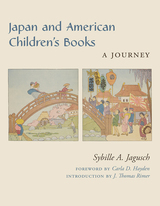
front cover of Japan and American Children's Books
Japan and American Children's Books
A Journey
Sybille Jagusch
Rutgers University Press, 2021

For generations, children’s books provided American readers with their first impressions of Japan. Seemingly authoritative, and full of fascinating details about daily life in a distant land, these publications often presented a mixture of facts, stereotypes, and complete fabrications. 
 
This volume takes readers on a journey through nearly 200 years of American children’s books depicting Japanese culture, starting with the illustrated journal of a boy who accompanied Commodore Matthew Perry on his historic voyage in the 1850s. Along the way, it traces the important role that representations of Japan played in the evolution of children’s literature, including the early works of Edward Stratemeyer, who went on to create such iconic characters as Nancy Drew. It also considers how American children’s books about Japan have gradually become more realistic with more Japanese-American authors entering the field, and with texts grappling with such serious subjects as internment camps and the bombing of Hiroshima and Nagasaki.
 
Drawing from the Library of Congress’s massive collection, Sybille A. Jagusch presents long passages from many different types of Japanese-themed children’s books and periodicals—including travelogues, histories, rare picture books, folktale collections, and boys’ adventure stories—to give readers a fascinating look at these striking texts.

Published by Rutgers University Press, in association with the Library of Congress.
[more]

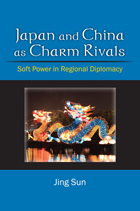
front cover of Japan and China as Charm Rivals
Japan and China as Charm Rivals
Soft Power in Regional Diplomacy
Jing Sun
University of Michigan Press, 2013

In international relations today, influence is as essential as military and economic might. Consequently, leaders promote favorable images of the state in order to attract allies and win support for their policies. Jing Sun, an expert on international relations and a former journalist, refers to such soft power campaigns as "charm offensives."

Sun focuses on the competition between China and Japan for the allegiance of South Korea, Taiwan, and other states in the region. He finds that, instead of adopting a one-size-fits-all approach, the Chinese and the Japanese deploy customized charm campaigns for each target state, taking into consideration the target's culture, international position, and political values. He then evaluates the effectiveness of individual campaigns from the perspective of the target state, on the basis of public opinion polls, media coverage, and the response from state leaders.

A deep, comparative study, Japan and China as Charm Rivalsenriches our understanding of soft power by revealing deliberate image campaign efforts and offering a method for assessing the effectiveness of such charm offensives.

[more]

front cover of Japan in the World
Japan in the World
Masao Miyoshi and H. D. Harootunian, eds.
Duke University Press, 1993
Since the end of World War II, Japan has determinately remained outside the current of world events and uninvolved in the processes determining global history and politics. In Japan and the World, distinguished scholars, novelists, and intellectuals articulate how Japan—despite unprecedented economic prowess in securing dominance in the world's market—is caught in a complex dependency with the United States. Drawing on critical and postmodernist theory, this timely volume situates this dependency in a broader historical context and assesses Japan's current dealings in international politics, society, and culture.
Among the many topics covered are: racism in U.S.-Japanese relations; productivity and workplace discourse; Western cultural hegemony; the constructing of a Japanese cultural history; and the place of the novelist in today's world. Originally published as a special issue of boundary 2 (Fall 1991), this edition includes four new essays on Japanese industrial revolution; the place of English studies in Japan; how American cultural, historical, and political discourse represented Japan and in turn how America's version of Japan became Japan's version of itself; and an "archaeology" of hegemonic relationships between Japan and America and Britain in the first half of the twentieth century.

Contributors. Eqbal Ahmad, Perry Anderson, Bruce Cumings, Arif Dirlik, H.D. Harootunian, Kazuo Ishuro, Fredric Jameson, Kojin Karatani, Oe Kenzaburo, Masao Miyoshi, Tetsuo Najita, Leslie Pincus, Naoki Sakai, Miriam Silverberg, Christena Turner, Rob Wilson, Mitsuhiro Yoshimoto
[more]

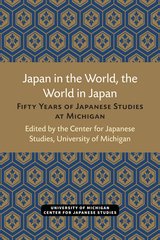
front cover of Japan in the World, the World in Japan
Japan in the World, the World in Japan
Fifty Years of Japanese Studies at Michigan
Edited by the Center for Japanese Studies, University of Michigan
University of Michigan Press, 2001
In fall 1997 the Center for Japanese Studies at The University of Michigan celebrated its fiftieth anniversary. The November symposium featured more than fifty speakers, moderators, and musicians who celebrated the occasion and offered reminiscences on the Center's multifaceted scholarly and professional missions, discussions of the accomplishments of its al-umni/ae, and perspectives on wartime and postwar Japan-U.S. relations. As the first American interdisciplinary institute devoted to education and research on Japan, The University of Michigan Center for Japanese Studies has a path-making legacy. This volume, which includes the public presentations from the November 1997 symposium, reflects that legacy and the university's long and continuing involvement in Asia, which dates back to the 1870s.
[more]

logo for University of Minnesota Press
The Japan of Pure Invention
Gilbert and Sullivan’s The Mikado
Josephine Lee
University of Minnesota Press, 2010
Long before Sofia Coppola’s Lost in Translation, long before Barthes explicated his empire of signs, even before Puccini’s Madame Butterfly, Gilbert and Sullivan’s The Mikadopresented its own distinctive version of Japan. Set in a fictional town called Titipu and populated by characters named Yum-Yum, Nanki-Poo, and Pooh-Bah, the opera has remained popular since its premiere in 1885.
 
Tracing the history of The Mikado’s performances from Victorian times to the present, Josephine Lee reveals the continuing viability of the play’s surprisingly complex racial dynamics as they have been adapted to different times and settings. Lee connects yellowface performance to blackface minstrelsy, showing how productions of the 1938–39 Swing Mikado and Hot Mikado, among others, were used to promote African American racial uplift. She also looks at a host of contemporary productions and adaptations, including Mike Leigh’s film Topsy-Turvy and performances of The Mikado in Japan, to reflect on anxieties about race as they are articulated through new visions of the town of Titipu.
 
The Mikado creates racial fantasies, draws audience members into them, and deftly weaves them into cultural memory. For countless people who had never been to Japan, The Mikado served as the basis for imagining what “Japanese” was.
[more]

front cover of Japan
Japan
The Intellectual Foundations of Modern Japanese Politics
Tetsuo Najita
University of Chicago Press, 1980
Historians have long been aware of the richness and complexity of the intellectual history of modern Japanese politics. Najita's study, however, is the first in a Western language to present a consistent and broad synthesis of this subject. Najita elucidates the political dynamics of the past two hundred years of Japanese history by focusing on the interplay of restorationism and bureaucratism within the context of Japan's modern revolution, the Meiji Restoration.
[more]

front cover of Japanese American Midwives
Japanese American Midwives
Culture, Community, and Health Politics, 1880-1950
Susan L. Smith
University of Illinois Press, 2005

In the late nineteenth century, Japan's modernizing quest for empire transformed midwifery into a new woman's profession. With the rise of Japanese immigration to the United States, Japanese midwives (sanba) served as cultural brokers as well as birth attendants for Issei women. They actively participated in the creation of Japanese American community and culture as preservers of Japanese birthing customs and agents of cultural change. 

Japanese American Midwives reveals the dynamic relationship between this welfare state and the history of women and health. Susan L. Smith blends midwives' individual stories with astute analysis to demonstrate the impossibility of clearly separating domestic policy from foreign policy, public health from racial politics, medical care from women's caregiving, and the history of women and health from national and international politics. By setting the history of Japanese American midwives in this larger context, Smith reveals little-known ethnic, racial, and regional aspects of women's history and the history of medicine.

[more]

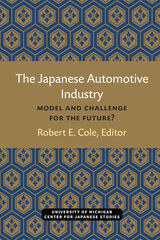
front cover of The Japanese Automotive Industry
The Japanese Automotive Industry
Model and Challenge for the Future?
Robert E. Cole, Editor
University of Michigan Press, 1981
As the University of Michigan Center for Japanese Studies reflected on the deteriorating position of the domestic auto industry in the fall of 1980, and the strong competitive threat being posed by the Japanese automakers, we were struck by the extraordinary low quality of the public discussion of these critical issues. The national importance of the issues seemed only matched by the superficiality of the analyses being offered. The tendency to think in terms of scapegoats was particularly evident. The Japanese as the basic cause of our problems has been a particularly notable theme. To be sure, cooperation with the Japanese in formulating a rational overall trade policy may be an important part of the solution. It has also been fashionable to blame it all on American auto industry management for not concentrating on the production of small cars when "everyone knew" that was the thing to do. Alternatively, government meddling was blamed for all our problems. Clearly, the complex problem we faced required more penetrating analyses. It seemed therefore, that the time was ripe for a public seminar which moved beyond the rhetoric of the moment and probed some of the deeper causes of our problems and possible directions for future policy.
In holding the January 1981 auto conference, the Center took it as their task to begin addressing the critical issues facing the industry, with particular, but not exclusive, attention to examining the role of the Japanese auto industry. They had in mind not to simply conduct a rational discussion of the trade issue but to probe the sources of Japanese competitive strength, especially those features whose study might profit them.
In these proceedings, they bring those discussions to a wider audience. Question and answer sessions at the conference were necessarily short and a few speakers delivered abbreviated remarks; this volume restores a number of omissions, and provides additional answers to some pertinent questions put by the audience. The Center hopes to encourage the serious problem-solving these complex issues demand. Far too much time has been spent trying to fix the blame. [intro]
[more]

front cover of Japanese Cities
Japanese Cities
edited by Kuniko Fujita and Richard Child Hill
Temple University Press, 1993

Japan is the world's second most powerful economy and one of the most urbanized nations on earth. Yet English-language literature contains remarkable little about cities in Japan. This collection of original essays on Japanese urban and industrial development covers a broad spectrum of city experiences. Leading Japanese and Western urbanists analyze Japan's largest metropolitan areas (Tokyo, Osaka, Nagoya); proto-typical industrial cities (Kamaishi, Kitakyushu, Toyota); high technology urban satellites (Kanagawa); and smaller, more traditionally organized industrial districts (Tsubame). This book demonstrates how Japan's flexible economic growth strategies and changing relationship to the world economy have produced a uniquely Japanese pattern of urban development in this century.

Throughout the essays that describe individual cities, contributors provide commentary on each city's twentieth-century history and functional relations with other cities and focus on the dynamic linkage between global relations and local activities. They examine the role of government—central, prefectural, and local—in the restructuring of Japanese industrial and urban life. One essay is devoted to the urbanization process in pre-World War II Japan; another considers urban planning on the western Pacific Rim. This is the first book that analyzes how the economic transformation of Japan has restructured Japanese cities and how urban and regional development policies have kept pace with (and in some ways effected) changes in the economy.

This comprehensive study of Japanese cities provides interdisciplinary coverage of urban development issues of interest to the fields of economics, business, sociology, political science, history, Asian and Japanese studies, and urban planning.

[more]

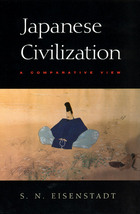
front cover of Japanese Civilization
Japanese Civilization
A Comparative View
S. N. Eisenstadt
University of Chicago Press, 1996
S. N. Eisenstadt, one of the world's leading social theorists, provides a monumental synthesis of Japanese history, religion, culture, and social organization. Equipped with a thorough command of the literature, Eisenstadt explores the Japanese historical legacy and its impact on the Japanese experience of modernity. Eschewing the polemicism of structuralist or culturalist approaches, he expands his investigative framework to include a keenly systematic, broadly comparative analysis. What emerges is an innovative new construction, focusing on the nonideological character of Japanese civilization as well as its infinite capacity to recreate community through an ongoing past.

[more]

logo for Southern Illinois University Press
Japanese Corrections
Managing Convicted Offenders in an Orderly Society
Elmer H. Johnson
Southern Illinois University Press, 1996

In his analysis of the current Japanese corrections system, internationally respected criminologist Elmer H. Johnson focuses on three basic questions: What are the characteristics of the major programmatic elements? How do various personnel carry out their programmatic responsibilities? Why are the various duties and activities carried out in a particular way?

Johnson points out that compared with the United States, where prison populations are huge and often violent, Japan incarcerates relatively few criminals. In 1989, for example, Japan locked up only 34 out of every 100,000 citizens while the United States imprisoned people at a rate of 271 per 100,000. Examining the cultural differences leading to this disparity, Johnson notes that in Japan prosecutors are reluctant to refer defendants for trial and the courts often suspend sentences for convicted felons.

In Japan, two bureaus—the Correction Bureau and the Rehabilitation Bureau—administer all Japanese correctional activities. Placing these bureaus in the organizational scheme of the Ministry of Justice, Johnson traces the history, describes the organizational ideologies, and outlines the special features of each.

A central feature of the Japanese penal system is the industrial prison, a concept that met such fierce opposition in the United States that it lost almost all access to the free market by the 1940s. Johnson traces the history of the industrial prison, noting particularly that the industrial operations in adult institutions explain in part why there is almost no violence and why few try to escape. Juvenile institutions enjoy similar success; even though they produce no industrial products, the juvenile training schools emphasize education, vocational training, and counseling.

Japanese correctional officers rely heavily on the community and on unsalaried volunteer probation officers for supervision of probationers and parolees. Although Japanese courts regard probationary supervision as too punitive for most convicted defendants and return many to the community without supervision, the probation caseload is weighty. Johnson describes the responsibilities and operations of the Regional Parole Boards. He also discusses the aid hostels (halfway houses) that are primarily operated by private organizations and that serve released or paroled prisoners.

Johnson sums up by noting that both the Correction Bureau and the Rehabilitation Bureau depend on the overall operations of police, prosecutors, and judges. More broadly, he asserts, both bureaus are creatures of Japanese society and culture. The assets and disadvantages of the bureaus reflect society’s reluctance to sentence defendants to prison and, to a lesser extent, the reluctance to place them on probationary supervision.

 

[more]

front cover of Japanese Counterculture
Japanese Counterculture
The Antiestablishment Art of Terayama Shuji
Steven C. Ridgely
University of Minnesota Press, 2010
Terayama Shuji (1935-1983) was an avant-garde Japanese poet, dramatist, film director, and photographer known for his highly provocative work. In this inventive and revealing work, Steven Ridgely examines Terayama's life and art to show that a conventional notion of him does not do full justice to the meaning and importance of his wide-ranging, often playful body of work.

Ridgely places Terayama at the center of Japanese and global counterculture and finds in his work a larger story about the history of postwar Japanese art and culture. He sees Terayama as reflecting the most significant events of his day: young poets seizing control of haiku and tanka in the 1950s, radio drama experimenting with form and content after the cultural shift to television around 1960, young assistant directors given free rein in the New Wave as cinema combated television, underground theatre in the politicized late 1960s, and experimental short film through the 1970s after both the studio system and art house cinema had collapsed.

Featuring close readings of Terayama's art, Ridgely demonstrates how across his oeuvre there are patterns that sidestep existing power structures, never offering direct opposition but nevertheless making the opposition plain. And, he claims, there is always in Terayama's work a broad call for seeking out or creating pockets of fiction-where we are made aware that things are not what they seem-and to use otherness in those spaces to take a clearer view of reality.
[more]

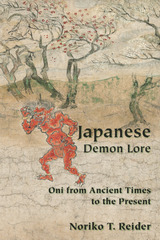
front cover of Japanese Demon Lore
Japanese Demon Lore
Oni from Ancient Times to the Present
Noriko Reider
Utah State University Press, 2010

Oni, ubiquitous supernatural figures in Japanese literature, lore, art, and religion, usually appear as demons or ogres. Characteristically threatening, monstrous creatures with ugly features and fearful habits, including cannibalism, they also can be harbingers of prosperity, beautiful and sexual, and especially in modern contexts, even cute and lovable. There has been much ambiguity in their character and identity over their long history. Usually male, their female manifestations convey distinctivly gendered social and cultural meanings.

Oni appear frequently in various arts and media, from Noh theater and picture scrolls to modern fiction and political propaganda, They remain common figures in popular Japanese anime, manga, and film and are becoming embedded in American and international popular culture through such media. Noriko Reiderýs book is the first in English devoted to oni. Reider fully examines their cultural history, multifaceted roles, and complex significance as "others" to the Japanese.

[more]

logo for University of Minnesota Press
Japanese Documentary Film
The Meiji Era Through Hiroshima
Abe Mark Nornes
University of Minnesota Press, 2003
Among Asian countries—where until recently documentary filmmaking was largely the domain of central governments—Japan was exceptional for the vigor of its nonfiction film industry. And yet, for all its aesthetic, historical, and political interest, the Japanese documentary remains little known and largely unstudied outside of Japan. This is the first English-language study of the subject, an enlightening close look at the first fifty years of documentary film theory and practice in Japan. Beginning with films made by foreigners in the nineteenth century and concluding with the first two films made after Japan’s surrender in 1945, Abé Mark Nornes moves from a “prehistory of the documentary,” through innovations of the proletarian film movement, to the hardening of style and conventions that started with the Manchurian Incident films and continued through the Pacific War. Nornes draws on a wide variety of archival sources—including Japanese studio records, secret police reports, government memos, letters, military tribunal testimonies, and more—to chart shifts in documentary style against developments in the history of modern Japan. Abé Mark Nornes is associate professor at the University of Michigan, where he teaches in the Department of Asian Languages and Cultures and the Program in Film and Video Studies.
[more]

logo for Ohio University Press
Japanese Empire in the Tropics
Selected Documents and Reports of the Japanese Period in Sarawak, Northwest Borneo, 1941–1945
Ooi Keat Gin
Ohio University Press, 1997

Although the Japanese interregnum was brief, its dramatic commencement and equally dramatic conclusion represented a watershed in the history of the young state of Sarawak.

In recent years, there has been a groundswell of interest in the war years, culminating in an attempt at reassessment of the Japanese occupation in Southeast Asia by Western and Japanese scholars as well as by those from Southeast Asia.

Presented here in a two-volume edition is a history of the Japanese occupation of Sarawak narrated through the compelling testimonies of the actual participants based on their recollections, memoirs, and correspondence.

[more]

logo for Ohio University Press
The Japanese Experience in Indonesia
Selected Memoirs of 1942-1945
Anthony Reid
Ohio University Press, 1986

Although the wartime Japanese military administration of Indonesia was critical to the making of modern Indonesia, it remains shrouded in mystery, in part because of the systematic destruction of records following the Japanese surrender. These excerpts from personal memoirs of individual Japanese soldiers and administrators provide unique glimpses of the occupation—from the Japanese landing on Java and the Dutch surrender, to the independence proclamation in Jakarta, to the violence in Surabaya following the Japanese surrender. Through the eyes of Japanese at all levels of responsibility, we see the internal Indonesian turmoil, the struggle toward an independence movement, and the efforts of some Japanese to promote independence, despite the policies of imperial headquarters.

Not only does this collection illuminate modern Indonesian history, it provides students of Japanese history with a feeling for the variety of Japanese responses to the war effort. The Japanese Experience in Indonesia will therefore be of interest to Southeast and East Asian historians and political scientists, as well as to those with a more general interest in World War II.

[more]

front cover of Japanese Foodways, Past and Present
Japanese Foodways, Past and Present
Edited by Eric C. Rath and Stephanie Assmann
University of Illinois Press, 2010
Spanning nearly six hundred years of Japanese food culture, Japanese Foodways, Past and Present considers the production, consumption, and circulation of Japanese foods from the mid-fifteenth century to the present day in contexts that are political, economic, cultural, social, and religious. Diverse contributors--including anthropologists, historians, sociologists, a tea master, and a chef--address a range of issues such as medieval banquet cuisine, the tea ceremony, table manners, cookbooks in modern times, food during the U.S. occupation period, eating and dining out during wartimes, the role of heirloom vegetables in the revitalization of rural areas, children's lunches, and the gentrification of blue-collar foods.
 
Framed by two reoccurring themes--food in relation to place and food in relation to status--the collection considers the complicated relationships between the globalization of foodways and the integrity of national identity through eating habits. Focusing on the consumption of Western foods, heirloom foods, once-taboo foods, and contemporary Japanese cuisines, Japanese Foodways, Past and Present shows how Japanese concerns for and consumption of food has relevance and resonance with other foodways around the world.
 
Contributors are Stephanie Assmann, Gary Soka Cadwallader, Katarzyna Cwiertka, Satomi Fukutomi, Shoko Higashiyotsuyanagi, Joseph R. Justice, Michael Kinski, Barak Kushner, Bridget Love, Joji Nozawa, Tomoko Onabe, Eric C. Rath, Akira Shimizu, George Solt, David E. Wells, and Miho Yasuhara.
[more]

front cover of Japanese Law
Japanese Law
An Economic Approach
J. Mark Ramseyer and Minoru Nakazato
University of Chicago Press, 1998
In this introduction to Japanese law, J. Mark Ramseyer and Minoru Nakazato combine an economic approach with a clear and often amusing account of the law itself to challenge commonly held ideas about the law. Arguing against such things as the assumption that Japanese law differs from law in the United States and the idea that law plays only a trivial role in Japan or is culturally determined, this book will be recognized as a major contribution to the understanding of Japanese law.

"A compelling economic analysis. . . . This book remains one of the few concerning Japanese law that successfully brings to life the legal culture of Japan." —Bonnie L. Dixon, New York Law Journal
[more]

front cover of Japanese Monetary Policy
Japanese Monetary Policy
Edited by Kenneth J. Singleton
University of Chicago Press, 1993
How has the Bank of Japan (BOJ) helped shape Japan's economic growth during the past two decades? This book comprehensively explores the relations between financial market liberalization and BOJ policies and examines the ways in which these policies promoted economic growth in the 1980s. The authors argue that the structure of Japan's financial markets, particularly restrictions on money-market transactions and the key role of commercial banks in financing corporate investments, allowed the BOJ to influence Japan's economic success.

The first two chapters provide the most in-depth English-language discussion of the BOJ's operating procedures and policymaker's views about how BOJ actions affect the Japanese business cycle. Chapter three explores the impact of the BOJ's distinctive window guidance policy on corporate investment, while chapter four looks at how monetary policy affects the term structure of interest rates in Japan. The final two chapters examine the overall effect of monetary policy on real aggregate economic activity.

This volume will prove invaluable not only to economists interested in the technical operating procedures of the BOJ, but also to those interested in the Japanese economy and in the operation and outcome of monetary reform in general.
[more]

front cover of The Japanese 'New Woman'
The Japanese 'New Woman'
Images of Gender and Modernity
Lowy, Dina
Rutgers University Press, 2007

The dawn of the twentieth century in Japan witnessed the rise of a peculiar problem: the “Woman Problem.” This, at least, was the term used in an ongoing debate among the government and various intellectuals over how to define gender roles. While the government worked hard to promote the “good wife, wise mother” paradigm, certain female members of society had other notions about how to engage with their world.

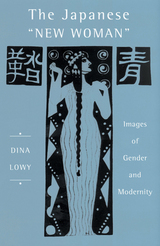
In The Japanese “New Woman,” Dina Lowy focuses on this new female image as it was revealed, discussed, and debated in popular newspapers and magazines in the 1910s, as well as on the lives of a specific group of women—members of the feminist literary organization known as the Seitosha. These women drew on a variety of sources, including Zen training, Western writings and ideas, and Japanese morals and arts as they tried to open up new spaces for female activity beyond the confines of the home. Lowy shows how the Seitosha set a precedent that would be emulated in the decades to follow as Japanese women continued to question the patriarchal order, experiment with alternative visions, and pursue their rights in a variety of forms.  This work also provides a context for comparative studies of New Women, gender debates, and the modernizing process.
[more]

front cover of The Japanese On Trial
The Japanese On Trial
Allied War Crimes Operations in the East, 1945–1951
By Philip R. Piccigallo
University of Texas Press, 1979

This comprehensive treatment of post–World War II Allied war crimes trials in the Far East is a significant contribution to a neglected subject. While the Nuremberg and, to a lesser degree, Tokyo tribunals have received considerable attention, this is the first full-length assessment of the entire Far East operation, which involved some 5,700 accused and 2,200 trials.

After discussing the Tokyo trial, Piccigallo systematically examines the operations of each Allied nation, documenting procedure and machinery as well as the details of actual trials (including hitherto unpublished photographs) and ending with a statistical summary of cases.

This study allows a completely new assessment of the Far East proceedings: with a few exceptions, the trials were carefully and fairly conducted, the efforts of defense counsel and the elaborate review procedures being especially noteworthy. Piccigallo’s approach to this emotion-filled subject is straightforward and evenhanded throughout. He concludes with a discussion of the broader implications of such war crimes trials, a matter of interest to the general reader as well as to specialists in history, law, and international affairs.

[more]

front cover of The Japanese Television Cartel
The Japanese Television Cartel
A Study Based on "Matsushita v. Zenith"
David Schwartzman
University of Michigan Press, 1993
The Japanese Television Cartel examines the argument that Japanese television manufacturers dumped televisions in the United States as part of a long-run strategy to dominate the market. This issue is used to explore the related general issues— ones of extraordinary importance that are continually in the forefront of public policy.David Schwartzman builds his argument around the landmark case of Matsushita v. Zenith, in which Zenith, by then the last remaining U.S. television manufacturer, contended that the Japanese manufacturer had manipulated the U.S. market to the detriment of domestic firms. Zenith lost, but the author insists the decision was erroneous and that dumping did occur.The Supreme Court refused to reverse the case; it took the view that because predation is unprofitable, the Japanese manufacturer could not have been guilty of that charge. The author nonetheless maintains that the analysis underlying this argument is predicated on a domestic dominant firm, the predatory losses of which would exceed those of the victimized fringe firms. But in the case of a foreign predator, its immediate losses would be smaller than those of its victims because its initial market share is small. This is just one of several criticisms of the basis of the Court’s argument and a prime example of the applicability of the economic theory developed by the author.The Japanese Television Cartel deserves the attention of all who are concerned with U.S. policy on international trade and international economic competition.
[more]

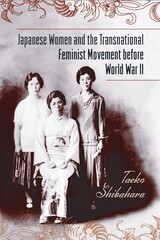
front cover of Japanese Women and the Transnational Feminist Movement before World War II
Japanese Women and the Transnational Feminist Movement before World War II
Taeko Shibahara
Temple University Press, 2014

This book traces the development of feminist consciousness in Japan from 1871 to 1941. Taeko Shibahara uncovers some fascinating histories as she examines how middle-class women navigated between domestic and international influences to form ideologies and strategies for reform. They negotiated a humanitarian space as Japan expanded its nationalist, militarist, imperialist, and patriarchal power. 


Focusing on these women's political awakening and activism, Shibahara shows how Japanese feminists channeled and adapted ideas selected from international movements and from interactions with mainly American social activists. 


Japanese Women and the Transnational Feminist Movement before World War II also connects the development of international contacts with the particular contributions of Ichikawa Fusae to the suffrage movement, Ishimoto Shidzue to the birth control movement, and Gauntlett Tsune to the peace movement by touching on issues of poverty, prostitution, and temperance. The result provides a window through which to view the Japanese women's rights movement with a broader perspective.
[more]

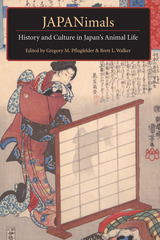
front cover of JAPANimals
JAPANimals
History and Culture in Japan’s Animal Life
Gregory M. Pflugfelder and Brett L. Walker, Editors
University of Michigan Press, 2005
From swift steeds to ritually slaughtered deer to symbolic serpents, nonhuman animals of every stripe have participated from the earliest of times in the construction of the cultural community that we know as Japan. Yet the historical accounts that have hitherto prevailed, claim the authors of this innovative volume, relegate our fellow animals to a silent and benign “nature” that lies beyond the realm of narrative and agency. What happens when we restore nonhuman creatures to the field of historical vision?
This book challenges many of the fundamental assumptions that have shaped contemporary scholarship on Japan, engaging from new perspectives questions of economic growth, isolation from and interaction with the outside world, the tools of conquest and empire, and the character of modernity. Essay by essay, this provocative collection compels readers to acknowledge the diversity of living beings who exist at the ragged edges of our human, as well as our historical, horizons.
[more]

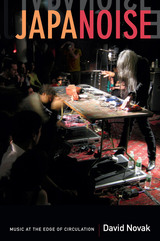
front cover of Japanoise
Japanoise
Music at the Edge of Circulation
David Novak
Duke University Press, 2013
Noise, an underground music made through an amalgam of feedback, distortion, and electronic effects, first emerged as a genre in the 1980s, circulating on cassette tapes traded between fans in Japan, Europe, and North America. With its cultivated obscurity, ear-shattering sound, and over-the-top performances, Noise has captured the imagination of a small but passionate transnational audience.

For its scattered listeners, Noise always seems to be new and to come from somewhere else: in North America, it was called "Japanoise." But does Noise really belong to Japan? Is it even music at all? And why has Noise become such a compelling metaphor for the complexities of globalization and participatory media at the turn of the millennium?

In Japanoise, David Novak draws on more than a decade of research in Japan and the United States to trace the "cultural feedback" that generates and sustains Noise. He provides a rich ethnographic account of live performances, the circulation of recordings, and the lives and creative practices of musicians and listeners. He explores the technologies of Noise and the productive distortions of its networks. Capturing the textures of feedback—its sonic and cultural layers and vibrations—Novak describes musical circulation through sound and listening, recording and performance, international exchange, and the social interpretations of media.
[more]

front cover of Japan's American Interlude
Japan's American Interlude
Kazuo Kawai
University of Chicago Press, 1979
How did the Japanese themselves respond to the American occupation? How were the sweeping reforms—political, social, and economic—of SCAP's program received? How permanent was their effect, and why did some succeed and others fail completely? How successful in the long view was the democratization induced by MacArthur's "artificial revolution"? And what tendencies existing in fundamental Japanese attitudes and history might account for this peculiar success?

The author, Japanese-born and educated in America, a political scientist and journalist, brings his unique experience and knowledge to bear on these questions. The result is a book which tells the story of the American occupation of Japan from the Japanese point of view.
[more]

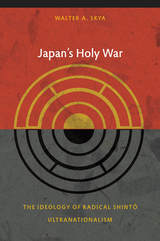
front cover of Japan's Holy War
Japan's Holy War
The Ideology of Radical Shinto Ultranationalism
Walter A. Skya
Duke University Press, 2009
Japan’s Holy War reveals how a radical religious ideology drove the Japanese to imperial expansion and global war. Bringing to light a wealth of new information, Walter A. Skya demonstrates that whatever other motives the Japanese had for waging war in Asia and the Pacific, for many the war was the fulfillment of a religious mandate. In the early twentieth century, a fervent nationalism developed within State Shintō. This ultranationalism gained widespread military and public support and led to rampant terrorism; between 1921 and 1936 three serving and two former prime ministers were assassinated. Shintō ultranationalist societies fomented a discourse calling for the abolition of parliamentary government and unlimited Japanese expansion.

Skya documents a transformation in the ideology of State Shintō in the late nineteenth century and the early twentieth. He shows that within the religion, support for the German-inspired theory of constitutional monarchy that had underpinned the Meiji Constitution gave way to a theory of absolute monarchy advocated by the constitutional scholar Hozumi Yatsuka in the late 1890s. That, in turn, was superseded by a totalitarian ideology centered on the emperor: an ideology advanced by the political theorists Uesugi Shinkichi and Kakehi Katsuhiko in the 1910s and 1920s. Examining the connections between various forms of Shintō nationalism and the state, Skya demonstrates that where the Meiji oligarchs had constructed a quasi-religious, quasi-secular state, Hozumi Yatsuka desired a traditional theocratic state. Uesugi Shinkichi and Kakehi Katsuhiko went further, encouraging radical, militant forms of extreme religious nationalism. Skya suggests that the creeping democracy and secularization of Japan’s political order in the early twentieth century were the principal causes of the terrorism of the 1930s, which ultimately led to a holy war against Western civilization.

[more]

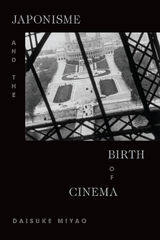
front cover of Japonisme and the Birth of Cinema
Japonisme and the Birth of Cinema
Daisuke Miyao
Duke University Press, 2020
In Japonisme and the Birth of Cinema, Daisuke Miyao explores the influence of Japanese art on the development of early cinematic visual style, particularly the actualité films made by the Lumière brothers between 1895 and 1905. Examining nearly 1,500 Lumière films, Miyao contends that more than being documents of everyday life, they provided a medium for experimenting with aesthetic and cinematic styles imported from Japan. Miyao further analyzes the Lumière films produced in Japan as a negotiation between French Orientalism and Japanese aesthetics. The Lumière films, Miyao shows, are best understood within a media ecology of photography, painting, and cinema, all indebted to the compositional principles of Japonisme and the new ideas of kinetic realism it inspired. The Lumière brothers and their cinematographers shared the contemporaneous obsession among Impressionist and Post-Impressionist artists about how to instantly and physically capture the movements of living things in the world. Their engagement with Japonisme, he concludes, constituted a rich and productive two-way conversation between East and West.
[more]

front cover of Jazz Exiles
Jazz Exiles
Bill Moody
University of Nevada Press, 2000
The Jazz Exiles chronicles the expatriate movement of American jazz musicians during the post-World War II era. While the term "exiles" normally conjures up images of ousted Third World leaders or deposed kings, it is as much a part of the jazz vocabulary as improvization or Birdland. Like the American writers of the 1920s who went to Europe and became Gertrude Stein's "lost generation", jazz musicians from the United States also made the Atlantic crossing at a steadily increasing rate until many of the major names in jazz lived or worked almost exclusively abroad. Throughout "The Jazz Exiles", the musicians speak for themselves in describing their motivation for joining the exodus to Europe which is now regarded as the third largest migration in jazz history. The exiles include many of the biggest names in jazz - Dexter Gordon, Johnny Griffin, Phil Woods, Coleman Hawkins, Louis Armstrong, Stan Getz, Benny Carter, and Bud Powell, among others. This work also assesses the impact of foreign residence on the careers of these musicians and on the history of jazz. Moody, a jazz musician himself, charts the movement of American musicians to Europe from a historical perspective and examines the exile experience from a number of sociological and economic viewpoints, all of which are factors in understanding jazz history. With stories narrated through personal interviews in the musicians' own words, "The Jazz Exiles" aims to shed new light on America's attitude toward its own original art form and examines the dilemma of the American artist both at home and abroad. Jazz aficionados, rhythm and blues fans - in fact, anyone who appreciates American music - should read the stories of these jazz exiles. "
[more]

front cover of Jazz Journeys to Japan
Jazz Journeys to Japan
The Heart Within
William Minor
University of Michigan Press, 2004

Part music history, part cultural meditation, part travel narrative, Jazz Journeys to Japan is the first book to address the experiences of individual players -- Japanese jazz greats such as Toshiko Akiyoshi, Masahiko Satoh, Makoto Ozone, and Yosuke Yamashita.
William Minor navigates the converging streams of Western music and Eastern tradition, revealing through interviews with musicians, critics, and producers the unique synthesis that results from this convergence. And, turning conventional wisdom on its ear, he disproves the widely held notion that Japanese jazz artists don't "swing." Along the way, we experience Minor's growing appreciation of Japanese culture, which mirrors his subjects' discovery of American jazz.
William Minor's previous books include Unzipped Souls: A Jazz Journey through the Soviet Union, and Monterey Jazz Festival: Forty Legendary Years. He has written for Downbeat, Jazz Times, Jazz Notes, Coda, and Swing Journal.
[more]

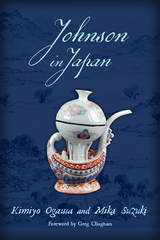
front cover of Johnson in Japan
Johnson in Japan
Kimiyo Ogawa
Bucknell University Press, 2021
The study and reception of Samuel Johnson’s work has long been embedded in Japanese literary culture. The essays in this collection reflect that history and influence, underscoring the richness of Johnson scholarship in Japan, while exploring broader conditions in Japanese academia today. In examining Johnson’s works such as the Rambler (1750-52), Rasselas (1759), Lives of the Most Eminent English Poets (1779-81), and Journey to the Western Islands of Scotland (1775), the contributors—all members of the half-century-old Johnson Society of Japan—also engage with the work of other important English writers, namely Shakespeare, Mary Shelley, Jane Austen, and Matthew Arnold, and later Japanese writers, including Natsume Soseki (1867-1916). If the state of Johnson studies in Japan is unfamiliar to Western academics, this volume offers a unique opportunity to appreciate Johnson’s centrality to Japanese education and intellectual life, and to reassess how he may be perceived in a different cultural context.

Published by Bucknell University Press. Distributed worldwide by Rutgers University Press.
[more]


Send via email Share on Facebook Share on Twitter