
 A SCHOLARLY BOOK REPOSITORY
206 start with P start with P

“In reminding us to look at and listen to the actual words on the page...Vendler invites us to expand our response to experience, and to find in it—if we are both attentive and lucky—beauty and solace.”
—Christopher Benfey, New York Review of Books
The grand dame of poetic criticism defends lyric poetry as a product of fierce intelligence as much as creative inspiration.
Poetry has often been considered an irrational genre, more expressive than logical, more meditative than given to coherent argument. And yet, in each of the four very different poets she considers here, Helen Vendler reveals a style of thinking in operation. All poets of any value are thinkers, she argues, even if no two think alike.
The four poets taken up in this volume—Alexander Pope, Walt Whitman, Emily Dickinson, and William Butler Yeats—come from three different centuries and three different nations, and their styles of thinking are characteristically idiosyncratic. Vendler gives us Pope performing as a satiric miniaturizer, remaking in verse the form of the essay; Whitman writing as a poet of repetitive insistence for whom thinking must be followed by rethinking; Dickinson experimenting with plot to characterize life’s unfolding; and Yeats thinking in images, using montage in lieu of argument.
With customary lucidity and vigor, Vendler pores over these poets’ lines to find evidence of thought in lyric, from subtle stylistic shifts that embody changes of mind to images that serve as condensations of concepts and emotions. Far more than in (frequently well-worn) themes, she demonstrates that poetic genius resides in open-ended contemplation: the interminable work of recalling, evaluating, and structuring experience in verse. Never linear or merely propositional, poems show us the human mind in process, inviting us to participate in experiential discoveries as they unfold.

In this study of Miles Poindexter, Insurgent Republican turned conservative, Howard W. Allen reaches beyond the traditional bounds of biography to present a history of the United States Congress during the Progressive era and the early years after World War I.
A congressman (1909–13)and a senator (1913–23), Miles Poindexter of Washington State was an outspoken, progressive reformer before World War I. He struggled to protect “the people” from “special interests,” particularly defending the interest of his section against eastern “colonialism.” A man with a penchant for absolute positions, Poindexter became caught up in the emotionalism of the Insurgent Republican revolt. At one time or another he championed Socialists, the IWW, the striking textile workers in Lawrence, Massachusetts—all unlikely causes for a middle-class lawyer from Spokane.
Regarding foreign policy, Poindexter was an uncompromising nationalist who, with Theodore Roosevelt, declared himself a member of the Progressive party in 1912.
After 1917 Poindexter actively tried to suppress opponents of the war. Following the war his targets were “Bolshevists” and other radicals. He also developed intense hostility toward Socialists, the IWW, and organized labor, fearing radicalism and labor. Reversing his former position, he allied himself with the eastern businessmen and regular Republicans in the Senate. Campaigning for the presidency in 1920, he appealed without success to the most conservative members of the party. He was defeated b a progressive Democrat in his 1922 bid for reelection to the Senate.
Allen examines the traditional sources—archival collections, newspaper files, and congressional reports. When he combines this material with a quantitative analysis of roll-call votes throughout Senator Poindexter’s years in Congress, he creates a remarkably useful method never before attempted in political biography.
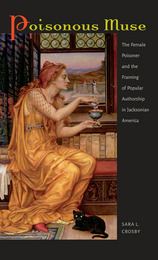
This difference in outcome doesn’t mean that poisonous women didn’t preoccupy Americans. In the decades following Andrew Jackson’s first presidential bid, Americans buzzed over women who used poison to kill men. They produced and devoured reams of ephemeral newsprint, cheap trial transcripts, and sensational “true” pamphlets, as well as novels, plays, and poems. Female poisoners served as crucial elements in the literary manifestos of writers from Nathaniel Hawthorne and Edgar Allan Poe to George Lippard and the cheap pamphleteer E. E. Barclay, but these characters were given a strangely positive spin, appearing as innocent victims, avenging heroes, or engaging humbugs.
The reason for this poison predilection lies in the political logic of metaphor. Nineteenth-century Britain strove to rein in democratic and populist movements by labeling popular print “poison” and its providers “poisoners,” drawing on centuries of established metaphor that negatively associated poison, women, and popular speech or writing. Jacksonian America, by contrast, was ideologically committed to the popular—although what and who counted as such was up for serious debate. The literary gadfly John Neal called on his fellow Jacksonian writers to defy British critical standards, saying, “Let us have poison.” Poisonous Muse investigates how they answered, how they deployed the figure of the female poisoner to theorize popular authorship, to validate or undermine it, and to fight over its limits, particularly its political, gendered, and racial boundaries.
Poisonous Muse tracks the progress of this debate from approximately 1820 to 1845. Uncovering forgotten writers and restoring forgotten context to well-remembered authors, it seeks to understand Jacksonian print culture from the inside out, through its own poisonous language.

The police forces of the transition countries in Central and Eastern Europe have to undergo profound reform to be able to respond to the needs of society; to serve the public and not just the government, and to prove that they can effectively combat crime. This volume is the result of a survey by the Hungarian Helsinki Committee concerning the mode and extent of changes police forces of the post-communist countries have undergone since 1989 – 1990. Information is provided about the relevant tasks, organization, personnel, accountability, and international relations of the national police forces and about the coercive measures they are entitled to use.
Written by internationally acknowledged experts of policing and representatives of human-rights organizations, Police in Transition deals with the questions of transition, European trends in the governance of the police, the relationship between police and criminality, the role of the police in the constitutional framework, the limits of policing, police brutality, civilian oversight of the police and the possibilities of a democratic reform of police forces in Central and Eastern Europe.

Founded by Peter the Great in 1718, Russia’s police were key instruments of tsarist power. In the reign of Alexander II (1855-1881), local police forces took on new importance. The liberation of 23 million serfs from landlord control, growing fear of crime, and the terrorist violence of the closing years challenged law enforcement with new tasks that made worse what was already a staggering burden. (“I am obliged to inform Your Imperial Highness that the police often fail to carry out their assignments and, when they do execute them, they do so poorly because of their moral corruption…”) This book describes the regime’s decades-long struggle to reform and strengthen the police. The author reviews the local police’s role and performance in the mid-nineteenth century and the implications of the largely unsuccessful effort to transform them. From a longer-term perspective, the study considers how the police’s systemic weaknesses undermined tsarist rule, impeded a range of liberalizing reforms, perpetuated reliance on the military to maintain law and order, and gave rise to vigilante justice.
While its primary focus is on European Russia, the analysis also covers much of the imperial periphery, discussing the police systems in the Baltic Provinces, Congress Poland, the Caucasus, Central Asia, and Siberia.

Polish Literature and the Holocaust: Eyewitness Testimonies,1942–1947 is a particularly timely book in view of the continuing debate about the attitudes of Poles toward the Jews during the war. The literary voices from the past that Brenner examines posit questions that are as pertinent now as they were then. And so, while this book speaks to readers who are interested in literary responses to the Holocaust, it also illuminates the universal issue of the responsibility of witnesses toward the victims of any atrocity.
This book represents Ringelbaum's attempt to answer the questions he knew history would ask about the Polish people: what did the Poles do while millions of Jews were being led to the stake? What did the Polish underground do? What did the Government-in-Exile do? Was it inevitable that the Jews, looking their last on this world, should have to see indifference or even gladness on the faces of their neighbors? These questions have haunted Polish-Jewish relations for the last fifty years. Behind them are forces that have haunted Polish-Jewish relations for a thousand years.

Based on two international conferences at Princeton University and the Central European University, this is a handy guide to the problem of corruption in transition countries, with an important comparative content. Political Corruption in Transition is distinguished from similar publications by at least two features: by the quality of the carefully selected and edited essays ans by its original treatment. Instead of the usual preaching and excommunications, this Skeptic`s Handbook represents down-to-earth realism.
Combines general issues with case studies and original research. The geographic coverage is wide, though it is ideas rather than a geography that drive the volume`s organization.

In Hungary, which fell under Soviet influence at the end of World War II, those who had participated in the wartime atrocities were tried by so called people’s courts. This book analyses this process in an objective, quantitative way, contributing to the present timely discussion on the Hungarian war guilt. The authors apply a special focus on the gender aspect of the trials.
Political justice had a specific nature in Hungary. War criminals began to be brought to trial while fighting was still underway in the western part of the country, well before the Nuremberg trials. Not only crimes committed during the war were tried in the same frame but also post-war ones. As far as the post-war period is concerned, legal proceedings regarding these crimes were most often launched on the basis of Act VII of 1946. This act of law concerned “the criminal law protection of the democratic constitutional order and the republic” and its basic aim was to facilitate the creation of a communist dictatorship and to deal with perceived or real enemies of the regime.
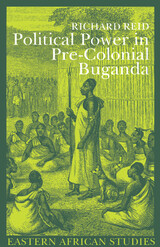
Blessed with fertile and well-watered soil, East Africa’s kingdom of Buganda supported a relatively dense population and became a major regional power by the mid-nineteenth century. This complex and fascinating state has also long been in need of a thorough study that cuts through the image of autocracy and military might.
Political Power in Pre-Colonial Buganda explores the material basis of Ganda political power, gives us a new understanding of what Ganda power meant in real terms, and relates the story of how the kingdom used the resources at its disposal to meet the challenges that confronted it. Reid further explains how these same challenges ultimately limited Buganda’s dominance of the East African great lakes region.

Scholars normally emphasize the contrast between the two great eighteenth-century thinkers Jean-Jacques Rousseau and Adam Smith. Rousseau is seen as a critic of modernity, Smith as an apologist. Istvan Hont, however, finds significant commonalities in their work, arguing that both were theorists of commercial society and from surprisingly similar perspectives.
In making his case, Hont begins with the concept of commercial society and explains why that concept has much in common with what the German philosopher Immanuel Kant called unsocial sociability. This is why many earlier scholars used to refer to an Adam Smith Problem and, in a somewhat different way, to a Jean-Jacques Rousseau Problem. The two problems—and the questions about the relationship between individualism and altruism that they raised—were, in fact, more similar than has usually been thought because both arose from the more fundamental problems generated by thinking about morality and politics in a commercial society. Commerce entails reciprocity, but a commercial society also entails involuntary social interdependence, relentless economic competition, and intermittent interstate rivalry. This was the world to which Rousseau and Smith belonged, and Politics in Commercial Society is an account of how they thought about it.
Building his argument on the similarity between Smith’s and Rousseau’s theoretical concerns, Hont shows the relevance of commercial society to modern politics—the politics of the nation-state, global commerce, international competition, social inequality, and democratic accountability.
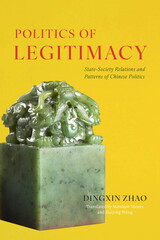
The Chinese communist state has survived massive social changes, including the introduction of capitalist markets, an ongoing explosion of technological innovation, and an unprecedented jump in wealth and education, accompanied by a major cultural transformation. How has China managed to maintain its power even as the ground has so profoundly shifted? In Politics of Legitimacy, Dingxin Zhao argues that state power can be legitimized in three ideal-typical ways: a set of values upheld by the state (ideological legitimacy), recognized political processes such as regular competitive elections (procedural legitimacy), and the state’s capacity to provide public goods (performance legitimacy).
Building on this theoretical framework, Zhao analyzes different aspects of Chinese politics, including the tragic ending of the 1989 pro-democracy movement, the weak development of mass-based nationalism in post-Mao China, the reasons behind China’s economic success, the anti-establishment tendency of the Chinese mass media and social media, and the sources of political tension in China, despite a superb economy. Moreover, Zhao’s innovative framework is widely applicable beyond China, shifting our attention from regime-type categories to the tools and relationships that determine their survival or collapse, and illuminating the current global emergence of conservatism and religious nationalism.
Showing the political importance of play in postwar French literature
In postwar France, authors approached writing ludically, placing rules and conditions on language and on the context of composition itself. They eliminated “e’s” and feminized texts; they traveled according to strict rules and invented outright silly public personas. The Politics of Play: Oulipo and the Legacy of French Literary Ludics is a comprehensive examination of how and why French authors turned to these ludic methods to grapple with their political moment.
These writers were responding to a range of historical upheavals, from the rise and fall of French feminist and Third-Worldist groups to the aftermath of international socialism both at home, in the former Parisian Belt and in France more broadly, and abroad, in post-Yugoslavia Balkan states and elsewhere. Juxtaposing an array of case studies and drawing on cross-disciplinary methodologies, Aubrey Gabel reads three generations of the formalist literary group Oulipo, including Raymond Queneau, Georges Perec, and Jacques Jouet, alongside writers not traditionally deemed ludic—or sometimes not even conventionally known as novelists—such as the lesbian activist-writer Monique Wittig and the editor François Maspero. Gabel argues that literary ludics serve as both an authorial strategy and a political form: playful methods allow writers not only to represent history in code but also to intervene creatively—as political actors—in the fraught social fields of midcentury France and beyond.
Published by University of Delaware Press. Distributed worldwide by Rutgers University Press.
The Scottish economist John Law has been described as the architect of modern central banking. His “System,” established in Regency France between 1716 and 1720, saw the founding of a bank issuing paper money and the establishment of state commercial and colonial enterprises aimed at consolidating public debt. What at first seemed like financial wizardry, however, resulted in rampant speculation and, ultimately, economic collapse. In The Politics of Utopia, historian Arnaud Orain offers a provocative rereading of this well-known episode.
Starting his story in the seventeenth century, Orain reconstructs the figures and ideas, long predating Law, that anticipated and laid the groundwork for the System, which, he argues, is best understood as a failed social utopia aimed at the total transformation of society. Overturning familiar narratives of this seismic event, this book rewrites a stunning chapter in economic history by dealing with the cultural, colonial, religious, and political dimensions of the (in)famous System up to the French Revolution, revealing new lessons for today’s fraught financial landscape.
From Plato through the nineteenth century, the West could draw on comprehensive political visions to guide government and society. Now, for the first time in more than two thousand years, Tracy B. Strong contends, we have lost our foundational supports. In the words of Hannah Arendt, the state of political thought in the twentieth and twenty-first centuries has left us effectively “thinking without a banister.”

The Battle of Poltava has long been recognized as a crucial event in the geopolitical history of Europe and a decisive point in the Great Northern War between Sweden and the Russian Empire. The Russian victory at Poltava contributed to the decline of Sweden as a Great Power and was a major setback to Ukrainian independence. Hetman Ivan Mazepa, who joined forces with the Swedish king Charles XII against Tsar Peter I, remains a controversial figure even today.
In 2009, the Harvard Ukrainian Research Institute gathered scholars from around the globe and from many fields of study—history, military affairs, philology, linguistics, literature, art history, music—to mark the 300th anniversary of the battle. This book is a collection of their papers on such topics as the international, Russian, and Ukrainian contexts of the battle; Mazepa in European culture; the language and literature of the period; art and architecture; history and memory; and fact, fiction, and the literary imagination. Mazepa himself is the focus of many of the articles—a hero to Ukrainians but a treacherous figure to Russians. This book provides a fresh look at this watershed event and sheds new light on the legacies of the battle’s major players.
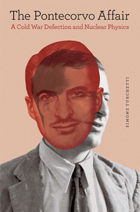


The Vatican’s dealings with the Weimar Republic and the Third Reich have long been swathed in myth and speculation. After almost seventy years, the crucial records for the years leading up to 1939 were finally opened to the public, revealing the bitter conflicts that raged behind the walls of the Holy See. Anti-Semites and philo-Semites, adroit diplomats and dogmatic fundamentalists, influential bishops and powerful cardinals argued passionately over the best way to contend with the intellectual and political currents of the modern age: liberalism, communism, fascism, and National Socialism. Hubert Wolf explains why a philo-Semitic association was dissolved even as anti-Semitism was condemned, how the Vatican concluded a concordat with the Third Reich in 1933, why Hitler’s Mein Kampf was never proscribed by the Church, and what factors surrounded the Pope’s silence on the persecution of the Jews.
In rich detail, Wolf presents astonishing findings from the recently opened Vatican archives—discoveries that clarify the relations between National Socialism and the Vatican. He illuminates the thinking of the popes, cardinals, and bishops who saw themselves in a historic struggle against evil. Never have the inner workings of the Vatican—its most important decisions and actions—been portrayed so fully and vividly.

A radical reconceptualization of modernism, this book traces the appearance of the modern artist to the Paris of the 1830s and links the emergence of an enduring modernist aesthetic to the fleeting forms of popular culture. Contrary to conventional views of a private self retreating from history and modernity, Popular Bohemia shows us the modernist as a public persona parodying the stereotypes of commercial mass culture. Here we see how the modern artist—alternately assuming the roles of the melodramatic hero, the urban flâneur, the female hysteric, the tribal primitive—created his own version of an expressive, public modernity in opposition to an increasingly repressive and conformist bourgeois culture. And here we see how a specifically modern aesthetic culture in nineteenth-century Paris came about, not in opposition to commercial popular culture, but in close alliance with it.
Popular Bohemia revises dominant historical narratives about modernism from the perspective of a theoretically informed cultural history that spans the period between 1830 and 1914. In doing so, it reconnects the intellectual history of avant-garde art with the cultural history of bohemia and the social history of the urban experience to reveal the circumstances in which a truly modernist culture emerged.
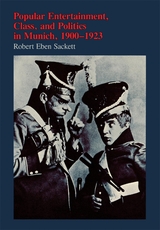
From the turn of the century until 1923, the year of the National Socialist putsch, popular entertainment in Munich reflected the sentiments and ideas of its largely middle-class audience. While industrialization, rapid urbanization, World War I, and the German Revolution of 1918–19 created an atmosphere of turbulent change, performances on Munich's popular stages gave voice to the continuity of several basic attitudes: patriotism; nostalgia for a preindustrial, rural community; hostility toward Jews; and increasing anxiety over social status. In songs, monologues, skits, and one-act plays, popular entertainers articulated views common to Munich's traditional middle class of tradesmen and shopkeepers and its “new” or white-collar middle class of clerks and minor officials. Folksingers Karl Valentin and Weiss Ferdl serve as examples of this relationship between politics and culture. They shared their audience's class background and sympathies, and in the cabarets and music halls their songs dealt with vexed social and political issues.
This intriguing book in cultural history adds to our understanding of social conditions preparing the way for political change. A model case study, it explores the roots of Nazism in a large urban setting.

Suzannah Biernoff draws on a wide variety of sources mainly from WWI but also contemporary photography and computer games. Each chapter revolves around particular images: Marine Wedding is discussed alongside Stuart Griffiths’ portraits of British veterans; Henry Tonks’ drawings of WWI facial casualties are compared to the medical photographs in the Gillies Archives; the production of portrait masks for the severely disfigured is approached through the lens of documentary film and photography; and finally the haunting image of one of Tonks’s patients reappears in BioShock, a highly successful computer game. The book simultaneously addresses a neglected area in disability studies; puts disfigurement on the agenda for art history and visual studies; and makes a timely and provocative contribution to the literature on the First World War.
The interviews included in this volume offer a multifaceted view of Derrida. "Implications: Interview with Henri Ronse" contains a succinct statement of principles. "Seminology and Grammatology: Interview with Julia Kristeva" provides important clarifications of the role played by linguistics in Derrida's work. "Positions: Interview with Jean-Louis Houdebine and Guy Scarpetta" is a wide-ranging discussion that touches on many of the polemics that Derrida's work has provoked.
Alan Bass, whose translation of Writing and Difference was highly praised for its clarity, accuracy, and readability, has provided extremely useful critical notes, full of vital information, including historical background.

Rastogi creates a narratology for postcolonial disaster fiction and brings concepts from Disaster Studies into the realm of literary analysis.

The first section of essays returns to the category of the “post-modern” and argues for the usefulness of key concepts and themes from postmodernism to the study of contemporary literature, or reevaluates postmodernism in light of recent developments in the field and historical and economic changes in the late twentieth and early twenty-first centuries. These essays take the contemporary abandonments of postmodernism as an occasion to assess the current states of postmodernity. After that, the essays move to address the critical shift away from postmodernism as a description of the present, and toward a new sense of postmodernism as just one category among many that scholars can use to describe the recent past. The final section looks forward and explores the question of what comes after the postwar/postmodern.
Taken together, these essays from leading and emerging scholars on the state of twenty-first-century literary studies provide a number of frameworks for approaching contemporary literature as influenced by, yet distinct from, postmodernism. The result is an indispensable guide that seeks to represent and understand the major overhauling of postwar American literary studies that is currently underway.

From Kant to Kierkegaard, from Hegel to Heidegger, continental philosophers have indelibly shaped the trajectory of Western thought since the eighteenth century. Although much has been written about these monumental thinkers, students and scholars lack a definitive guide to the entire scope of the continental tradition. The most comprehensive reference work to date, this eight-volume History of Continental Philosophy will both encapsulate the subject and reorient our understanding of it. Beginning with an overview of Kant’s philosophy and its initial reception, the History traces the evolution of continental philosophy through major figures as well as movements such as existentialism, phenomenology, hermeneutics, and poststructuralism. The final volume outlines the current state of the field, bringing the work of both historical and modern thinkers to bear on such contemporary topics as feminism, globalization, and the environment. Throughout, the volumes examine important philosophical figures and developments in their historical, political, and cultural contexts.
The first reference of its kind, A History of Continental Philosophy has been written and edited by internationally recognized experts with a commitment to explaining complex thinkers, texts, and movements in rigorous yet jargon-free essays suitable for both undergraduates and seasoned specialists. These volumes also elucidate ongoing debates about the nature of continental and analytic philosophy, surveying the distinctive, sometimes overlapping characteristics and approaches of each tradition. Featuring helpful overviews of major topics and plotting road maps to their underlying contexts, A History of Continental Philosophy is destined to be the resource of first and last resort for students and scholars alike.

Plebiscites, or referendums, are epitomes of direct democracy and the right of self-determination. While direct democracy has always been a key subject in the theory and practice of western liberal democracies, the issue of self-determination has been propelled to the fore by the hegemonistic moves of Russia. By providing a historical analysis of the post-World War One plebiscites, this book deals with enduring, painfully contemporary, and in in any case fundamental, concepts.
The contributors to this edited volume approach the referendums comparatively. After grounding the analysis theoretically, the authors look at detailed aspects of individual cases, with the two plebiscites held in the Danish-German border region of Schleswig in the winter of 1920 as points of departure. They then extend the exploration through the inter-war period and address the effects of border delimitations on everyday life or gender roles in the context of ethnic mobilization. Finally, the book places the post-World War One plebiscites in a long-term perspective. The concluding essays assess, among others, the applicability of plebiscitary solutions to contemporary conflicts, taking into consideration issues of borders, religion, language, identity, and minority rights.
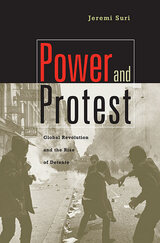
In a brilliantly-conceived book, Jeremi Suri puts the tumultuous 1960s into a truly international perspective in the first study to examine the connections between great power diplomacy and global social protest. Profoundly disturbed by increasing social and political discontent, Cold War powers united on the international front, in the policy of detente. Though reflecting traditional balance of power considerations, detente thus also developed from a common urge for stability among leaders who by the late 1960s were worried about increasingly threatening domestic social activism.
In the early part of the decade, Cold War pressures simultaneously inspired activists and constrained leaders; within a few years activism turned revolutionary on a global scale. Suri examines the decade through leaders and protesters on three continents, including Mao Zedong, Charles de Gaulle, Martin Luther King Jr., Daniel Cohn-Bendit, and Aleksandr Solzhenitsyn. He describes connections between policy and protest from the Berkeley riots to the Prague Spring, from the Paris strikes to massive unrest in Wuhan, China.
Designed to protect the existing political order and repress movements for change, detente gradually isolated politics from the public. The growth of distrust and disillusion in nearly every society left a lasting legacy of global unrest, fragmentation, and unprecedented public skepticism toward authority.


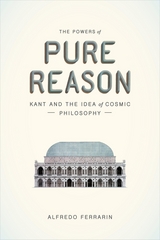
Ferrarin blows the dust off of two egregiously overlooked sections of the First Critique—the Transcendental Dialectic and the Doctrine of Method. There he discovers what he argues is the Critique’s greatest achievement: a conception of the unity of reason and an exploration of the powers it has to reach beyond itself and legislate over the world. With this in mind, Ferrarin dismantles the common vision of Kant as a philosopher writing separately on epistemology, ethics, and aesthetics and natural teleology, showing that the three Critiques are united by this underlying theme: the autonomy and teleology of reason, its power and ends. The result is a refreshing new view of Kant, and of reason itself.

Hayden White borrows the title for The Practical Past from philosopher Michael Oakeshott, who used the term to describe the accessible material and literary-artistic artifacts that individuals and institutions draw on for guidance in quotidian affairs. The Practical Past, then, forms both a summa of White’s work to be drawn upon and a new direction in his thinking about the writing of history.
White’s monumental Metahistory: The Historical Imagination in Nineteenth-Century Europe (1973) challenged many of the commonplaces of professional historical writing and wider assumptions about the ontology of history itself. It formed the basis of his argument that we can never recover “what actually happened”in the past and cannot really access even material culture in context. Forty years on, White sees “professional history" as falling prey to narrow specialization, and he calls upon historians to take seriously the practical past of explicitly “artistic” works, such as novels and dramas, and literary theorists likewise to engage historians.

Jean-Paul Sartre’s Critique of Dialectical Reason, released to great fanfare in 1960, has since then receded in philosophical visibility. As Sartre’s reputation is now making a comeback, it is time for a reappraisal of his later work. In Practice, Power, and Forms of Life, philosopher Terry Pinkard interprets Sartre’s late work as a fundamental reworking of his earlier ideas, especially in terms of his understanding of the possibility of communal action as genuinely free, which the French philosopher had previously argued was impossible.
Pinkard reveals how Sartre was drawn back to Hegel, a move that was itself incited by Sartre’s newfound interest in Marxism. Pinkard argues that Sartre constructed a novel position on freedom that has yet to be adequately taken up and analyzed within philosophy and political theory. Through Sartre, Pinkard advances an argument that contributes to the history of philosophy as well as key debates on action and freedom.

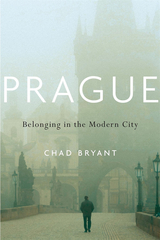
A poignant reflection on alienation and belonging, told through the lives of five remarkable people who struggled against nationalism and intolerance in one of Europe’s most stunning cities.
What does it mean to belong somewhere? For many of Prague’s inhabitants, belonging has been linked to the nation, embodied in the capital city. Grandiose medieval buildings and monuments to national heroes boast of a glorious, shared history. Past governments, democratic and Communist, layered the city with architecture that melded politics and nationhood. Not all inhabitants, however, felt included in these efforts to nurture national belonging. Socialists, dissidents, Jews, Germans, and Vietnamese—all have been subject to hatred and political persecution in the city they called home.
Chad Bryant tells the stories of five marginalized individuals who, over the last two centuries, forged their own notions of belonging in one of Europe’s great cities. An aspiring guidebook writer, a German-speaking newspaperman, a Bolshevik carpenter, an actress of mixed heritage who came of age during the Communist terror, and a Czech-speaking Vietnamese blogger: none of them is famous, but their lives are revealing. They speak to tensions between exclusionary nationalism and on-the-ground diversity. In their struggles against alienation and dislocation, they forged alternative communities in cafes, workplaces, and online. While strolling park paths, joining political marches, or writing about their lives, these outsiders came to embody a city that, on its surface, was built for others.
A powerful and creative meditation on place and nation, the individual and community, Prague envisions how cohesion and difference might coexist as it acknowledges a need common to all.
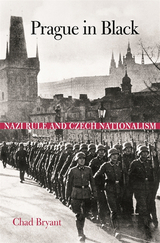
In September 1938, the Munich Agreement delivered the Sudetenland to Germany. Six months later, Hitler’s troops marched unopposed into Prague and established the Protectorate of Bohemia and Moravia—the first non-German territory to be occupied by Nazi Germany. Although Czechs outnumbered Germans thirty to one, Nazi leaders were determined to make the region entirely German.
Chad Bryant explores the origins and implementation of these plans as part of a wider history of Nazi rule and its consequences for the region. To make the Protectorate German, half the Czech population (and all Jews) would be expelled or killed, with the other half assimilated into a German national community with the correct racial and cultural composition. With the arrival of Reinhard Heydrich, Germanization measures accelerated. People faced mounting pressure from all sides. The Nazis required their subjects to act (and speak) German, while Czech patriots, and exiled leaders, pressed their countrymen to act as “good Czechs.”
By destroying democratic institutions, harnessing the economy, redefining citizenship, murdering the Jews, and creating a climate of terror, the Nazi occupation set the stage for the postwar expulsion of Czechoslovakia’s three million Germans and for the Communists’ rise to power in 1948. The region, Bryant shows, became entirely Czech, but not before Nazi rulers and their postwar successors had changed forever what it meant to be Czech, or German.

A detailed, empirically grounded account of the Prague Spring.
Prague Spring 1968 focuses on the key political and social developments between January and August, while situating them within the broader context of the deepening crisis of Czechoslovak state socialism since 1967. Structured chronologically into five parts, the book traces the fall of Antonín Novotný, the rise of Alexander Dubček and the reform project known as “socialism with a human face,” the rapid emancipation of media and civil society, the escalating conflict with the Soviet Union and its allies, and the Warsaw Pact invasion, followed by the Moscow negotiations. Drawing primarily on edited archival sources and critically engaging with extensive Czech and international scholarship, the study analyzes the Prague Spring as a distinctive democratization process centered on the transformation of the Communist Party’s leading role. Emphasizing empathetic historical interpretation, it provides a nuanced portrayal of key actors and decision-making dynamics, highlighting both the possibilities and structural limits of reform within a non-democratic socialist system.

Presented in a highly readable form, the book offers top-level documents from Kremlin Politburo meetings, multi-lateral sessions of the Warsaw Pact leading up to the decision to invade, and even transcriptions of KGB-recorded phone conversations between Leonid Brezhnev and Alexander Dubcek. Once highly classified American documents from the National Security Council, CIA, and other relevant agencies acquired through the U.S. Freedom of Information Act have also been included.
In order to provide a historical and political context, the editors have included an introductory essay for each section of the volume. A chronology, glossary, and bibliography offer further background information for the reader. As members of the commission appointed by Václav Havel to investigate the events of 1967-1970, the editors have a unique Czech-Slovak perspective to offer to foreign audiences.

A hundred years ago Catholic believers young and old, rich and poor, would fill churches on holy days, drawn together in prayer and in the conviction that they, the laypeople, needed the clergy and patron saints to mediate between them and their God. Today a Catholic believer in America is as likely as not to find God for herself.
This book traces dramatic changes in the practice of faith among American Catholics through evolving ideas about prayer. Where so many have seen the movement of American Catholics away from traditional devotional practices as a symptom of encroaching secularism, author James P. McCartin shows how the changing practice of prayer itself was the primary catalyst behind Catholics’ growing sense of spiritual independence.
Prayers of the Faithful reveals how, over the decades, Catholics’ ways of praying underwent a significant shift alongside the larger transformations of American society and culture. The book documents the novel ways of praying that transcended the formal rites of earlier generations. Whether “praying in tongues” or working on behalf of social justice or participating in public protests as outpourings of prayer, lay Catholics consistently expanded their notions of praying. And in doing so, McCartin suggests, they reshaped and redefined American Catholicism. By examining the spiritual life of prayer over the twentieth century, this book thus opens up new ways of understanding Catholics, their church, and their place in American life.
A strikingly original account of Theodor Adorno’s work as a critique animated by happiness—now in paperback.
"Gordon’s confidently gripping and persistently subtle interpretation brings a new tone to the debate about Adorno’s negativism."—Jürgen Habermas
Theodor Adorno is often portrayed as a totalizing negativist, a scowling contrarian who looked upon modern society with despair. Peter E. Gordon thinks we have this wrong: if Adorno is uncompromising in his critique, it is because he sees in modernity an unfulfilled possibility of human flourishing. In a damaged world, Gordon argues, all happiness is likewise damaged but not wholly absent. Through a comprehensive rereading of Adorno’s work, A Precarious Happiness recovers Adorno’s commitment to traces of happiness—fragments of the good amid the bad. Ultimately, Gordon argues that social criticism, while exposing falsehoods, must also cast a vision for an unrealized better world.

The recent vast upsurge in social science scholarship on job precarity has generally little to say about earlier forms of this phenomenon. Eloisa Betti’s monograph convincingly demonstrates on the example of Italy that even in the post-war phase of Keynesian stability and welfare state, precarious labor was an underlying feature of economic development. She examines how in this short period exceptional politics of labor stability prevailed. The volume then presents the processes whereby labor precarity regained momentum— under the name of flexibility— in the post-Fordist phase from the early 1980s, taking on new forms in the Craxi and Berlusconi eras.
Multiple actors are addressed in the analysis. The book gives voice to intellectuals, scholars, politicians and trade unionists as they have framed the concept and debates on precarious work from the 1950s onwards. Views of labor law experts, politicians and public servants are investigated in regard to labor regulations. Positions of the very precarians are explored, ranging from rural women, industrial homeworkers and blue-collar workers to physicians, university researchers and trainees, unveiling the emergence of anti-precarity social movements. The continuous role of women’s associations and feminist groups in opposing labor precarity since the 1950s is prominently exposed.
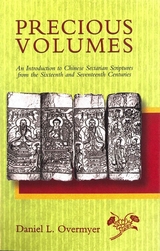
“Precious volumes,” or pao-chüan, were produced by popular sects in the Ming and early Qing dynasties. These scriptures were believed to have been divinely revealed to sect leaders and contain teachings and ritual instructions that provide valuable information about a lively and widespread religious tradition outside mainstream Confucianism, Taoism, and Buddhism. Largely neglected until now, they testify to the imagination and devotion of popular religious leaders.
This book, the most detailed and comprehensive study of pao-chüan in any language, studies 34 early examples of this literature in order to understand the origins and development of this textual tradition. Although the work focuses on content and structure, it also treats the social context of these works as well as their transmission and ritual use.
In Pregnancy in the Victorian Novel—the first book-length study of the topic—Livia Arndal Woods traces the connections between literary treatments of pregnancy and the medicalization of pregnancy and childbirth occurring over the long nineteenth century. Woods uses the problem of pregnancy in the Victorian novel (in which pregnancy is treated modestly as a rule and only rarely as an embodied experience) to advocate for “somatic reading,” a practice attuned to impressions of the body on the page and in our own messy lived experiences.
Examining works by Emily Brontë, Charlotte Mary Yonge, Anthony Trollope, George Eliot, Thomas Hardy and others, Woods considers instances of pregnancy that are tied to representations of immodesty, poverty, and medical diagnosis. These representations, Woods argues, should be understood in the arc of Anglo-American modernity and its aftershocks, connecting backward to early modern witch trials and forward to the criminalization of women for pregnancy outcomes in twenty-first-century America. Ultimately, she makes the case that by clearing space for the personal and anecdotal in scholarship, somatic reading helps us analyze with uncertainty rather than against it and allows for richer and more relevant textual interpretation.
“Pre-modern philosophy” means the line of reflection that started with Plato andvAristotle, passed through Augustine and Boethius, and reached its acme in Aquinas, Scotus, and Suarez. The whole line was harshly judged by Descartes, then mocked by the empiricsts of the 18th Century. Why, then, did Pope Leo XII make a determined effort to revive it? And, more importantly, why was the revival a stunning success by the middle of the 20th Century?
The answers to both questions are found in a famous German book, Philosophie der Vorzeit by Josef Kleutgen, now available for the first time in English. Pre-ModernPhilosophy Defended shaped and strengthened Pope Leo’s resolve. It showed how inaccurate the harsh judgments had been and how sadly inferior the modern replacements from Descartes to Hegel had turned out to be in many respects.
Not in all. Kleutgen was no knee-jerk reactionary. He made no bones about the obsolete status of pre-Newtonian physics and cosmology. Rather, he focused on the central boast of “modern” thought, namely, that it had turned at least to the “subject” and had provided a long-needed thing called a “critique of knowledge.”
This book is must reading for intellectual historians and for philosophers working today in epistemology. But most of all, it is essential reading for laity and clergy concerned about revivals of modernism in the church. What was modernism, after all, but an attempt to make the Church revise her theology in the “light” of Kant or Hegel? This is why every Modernist knew Kleutgen’s name and hated this book.
Here is the first English translation (from the German) of the master work of Josef Kleutgen, the nineteenth century social philosopher whose thought lies at, or near, the heart of Catholic Social Thought. Kleutgen is widely and rightly seen as the shadow author of the social encyclicals of Leo XII. Leo’s Rerum Novarum remains the origin and constant reference point of all Catholic Social Teaching. And Popes since have dated their own social encyclicals from Rerum Novarum – hence, Quadragesimo anno and Centesimus annus. —Gerard V. Bradley, University of Notre Dame
Pre-Modern Philosophy Defended is must reading for intellectual historians and for philosophers working today in epistemology. And it is essential reading for laity and clergy concerned about revivals of modernism in the church. What was modernism, after all, but an attempt to make the Church revise her theology in the ‘light’ of Kant or Hegel? This is why every Modernist knew Kleutgen's name and hated Philosophie der Vorzeit (Pre-Modern Philosophy Defended).
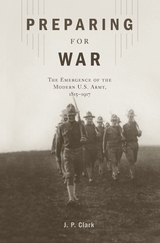
The U.S. Army has always regarded preparing for war as its peacetime role, but how it fulfilled that duty has changed dramatically over time. J. P. Clark traces the evolution of the Army between the War of 1812 and World War I, showing how differing personal experiences of war and peace among successive generations of professional soldiers left their mark upon the Army and its ways.
Nineteenth-century officers believed that generalship and battlefield command were more a matter of innate ability than anything institutions could teach. They saw no benefit in conceptual preparation beyond mastering technical skills like engineering and gunnery. Thus, preparations for war were largely confined to maintaining equipment and fortifications and instilling discipline in the enlisted ranks through parade ground drill. By World War I, however, Progressive Era concepts of professionalism had infiltrated the Army. Younger officers took for granted that war’s complexity required them to be trained to think and act alike—a notion that would have offended earlier generations. Preparing for War concludes by demonstrating how these new notions set the conditions for many of the successes—and some of the failures—of General Pershing’s American Expeditionary Forces.
A Prescription for Adversity makes the revolutionary case that Ambrose Bierce, far from being a bitter misanthrope, was instead both a compassionate and moral author. Berkove, focusing on Bierce's short fiction, establishes the necessity of recognizing the pattern of his intellectual and literary development over the course of his career. The author shows that Bierce, probably the American author with the most extensive experience of the Civil War, turned to classical Stoicism and English and French Enlightenment literature in his postwar search for meaning. Bierce's fiction arose from his ultimately unsatisfying encounters with the philosophies those sources offered, but the moral commitment as well as the literary techniques of heir authors, particularly Jonathan Swift, inspired him. Dating Bierce's fiction, and introducing uncollected journalism, correspondence, and important new literary history and biographical information, Berkove brings new insights to a number of stories, including "A Son of the Gods" and "A Horseman in the Sky," but especially "An Occurrence at Owl Creek Bridge," and presents compelling readings of the Parenticide Club tales and "Moxon's Master." A Prescription for Adversity substantiates how Bierce at his best is one of the few American authors who rises to the level of Mark Twain, and the only one who touches Jonathan Swift.
A work of both biography and literary criticism, this book rescues Ambrose Bierce and his literature from the neglect to which it has been assigned by "ill-founded, obtuse and unproductive approaches based on skewed notions of his personality and forced or facile readings of individual stories."

The focus of Present Past is her life after the Shoah. Rejecting stereotypes of survivors as traumatized or broken, Schieber is stark yet exuberant, formidable yet nuanced. The woman who emerges in Schieber’s Present Past is a multifaceted, heterogeneous figure—poet, artist, and survivor. In it, she plays the passionate observer who dispassionately curates the kaleidoscopic memories of her tumultuous personal and professional life in Belgrade, Prague, Tel Aviv, New York, and Chicago.
Organized into thirteen chapters, each a blend of images, poems, and narrative, this moving new work offers myriad points of entry to readers of these genres, those fascinated in the relationship between the Holocaust and art, as well as readers interested in memory and survivorship.
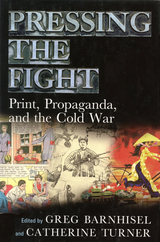
In this volume, scholars from a variety of disciplines explore the myriad ways print was used in the Cold War. Looking at materials ranging from textbooks and cookbooks to art catalogs, newspaper comics, and travel guides, they analyze not only the content of printed matter but also the material circumstances of its production, the people and institutions that disseminated it, and the audiences that consumed it. Among the topics discussed are the infiltration of book publishing by propagandists East and West; the distribution of pro-American printed matter in postwar Japan through libraries, schools, and consulates; and the collaboration of foundations, academia, and the government in the promotion of high culture as evidence of the superiority of Western values.
At the same time, many of the qualities that made print the preferred medium of official propaganda also made it an effective instrument for challenging Cold War orthodoxies at home and abroad. Because printed materials were relatively easy to transport, to copy, and to share, they could just as well be used to bridge differences among people and cultures as to exploit them. They also provided a vehicle for disseminating satire and other expressions of dissent.
In addition to the volume editors, contributors include Ed Brunner, Russell Cobb, Laura Jane Gifford, Patricia Hills, Christian Kanig, Scott Laderman, Amanda Laugesen, Martin Manning, Kristin Matthews, Hiromi Ochi, Amy Reddinger, and James Smith. Together their essays move beyond traditional Cold War narratives to gauge the role of a crucial cultural medium in the ideological battle between the superpowers and their surrogates.
Published by Bucknell University Press. Distributed worldwide by Rutgers University Press.
“A superb, field-changing book…A true classic.”
—Sunil Amrith
“Makes a major contribution towards a necessary discussion of the politics of aid.”
—Times Higher Education
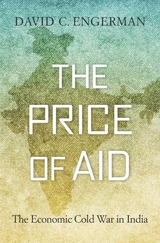
Debates over foreign aid are often strangely ahistorical. Economists argue about effectiveness—how to make aid work—while critics bemoan money wasted on corruption, ignoring the fundamentally political character of aid. The Price of Aid exposes the geopolitical calculus underpinning development assistance, and its costs.
India stood at the center of American and Soviet aid competition throughout the Cold War, as both superpowers saw developmental aid as a way of pursuing their geopolitical goals by economic means. Drawing on recently declassified files from seven countries, David Engerman shows how Indian leaders used Cold War competition to win battles at home, eroding the Indian state in the process. As China spends freely in Africa, the political stakes of foreign aid are rising once again.
“A magnificent book. Anyone who seeks to understand contemporary India and its development struggles will have to start here. Engerman’s work is not only enlightening, it turns much of what we thought we knew about India, foreign aid, and the Cold War in South Asia upside down.”
—O. A. Westad, author of The Cold War
“An outstanding history…Drawing on an unprecedented array of official and private archives in India, Russia, the United States, and Britain, Engerman offers a superb account—one that integrates the ideologies and policies of the superpowers with a sharp analysis of the push-and-pull of policymaking in India. This is a landmark study of independent India as well as the Cold War.”
—Srinath Raghavan, author of India’s War
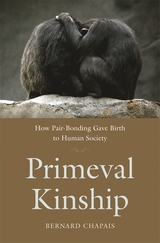
At some point in the course of evolution—from a primeval social organization of early hominids—all human societies, past and present, would emerge. In this account of the dawn of human society, Bernard Chapais shows that our knowledge about kinship and society in nonhuman primates supports, and informs, ideas first put forward by the distinguished social anthropologist, Claude Lévi-Strauss.
Chapais contends that only a few evolutionary steps were required to bridge the gap between the kinship structures of our closest relatives—chimpanzees and bonobos—and the human kinship configuration. The pivotal event, the author proposes, was the evolution of sexual alliances. Pair-bonding transformed a social organization loosely based on kinship into one exhibiting the strong hold of kinship and affinity. The implication is that the gap between chimpanzee societies and pre-linguistic hominid societies is narrower than we might think.
Many books on kinship have been written by social anthropologists, but Primeval Kinship is the first book dedicated to the evolutionary origins of human kinship. And perhaps equally important, it is the first book to suggest that the study of kinship and social organization can provide a link between social and biological anthropology.
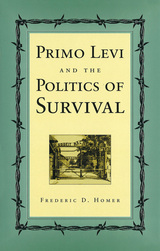
At the age of twenty-five, Primo Levi was sent to Hell. Levi, an Italian chemist from Turin, was one of many swept up in the Holocaust of World War II and sent to die in the German concentration camp in Auschwitz. Of the 650 people transported to the camp in his group, only 15 men and 9 women survived. After Soviet liberation of the camp in 1945, Levi wrote books, essays, short stories, poetry, and a novel, in which he painstakingly described the horrors of his experience at Auschwitz. He also spent the rest of his life struggling with the fact that he was not among those who were killed.
In Primo Levi and the Politics of Survival, Frederic D. Homer looks at Primo Levi's life but, more important, shows him to be a significant political philosopher. In the course of his writings, Levi asked and answered his most haunting question: can someone be brutalized by a terrifying experience and, upon return to "ordinary life," recover from the physical and moral destruction he has suffered? Levi used this question to develop a philosophy positing that although man is no match for life, he can become better prepared to contend with the tragedies in life.
According to Levi, the horrors of the world occur because of the strength of human tendencies, which make relationships between human beings exceedingly fragile. He believed that we are ill-constituted beings who have tendencies toward violence and domination, dividing ourselves into Us and Them, with very shallow loyalties. He also maintained that our only refuge is in education and responsibility, which may counter these tendencies. Homer calls Levi's philosophy "optimistic pessimism."
As Homer demonstrates, Levi took his past experiences into account to determine that goodwill and democratic institutions do not come easily to people. Liberal society is to be earned through discipline and responsibility toward our weaknesses. Levi's answer is "civilized liberalism." To achieve this we must counter some of our most stubborn tendencies.
Homer also explores the impact of Levi's death, an apparent suicide, on the way in which his work and theories have been perceived. While several critics discount Levi's work because of the nature of his death, Homer argues that his death is consistent with his philosophy. A book rich in brutally honest philosophy, Primo Levi and the Politics of Survival compels one to look at serious questions about life, tragedy, optimism, solidarity, violence, and human nature.

The Princess Nun tells the story of Bunchi (1619–1697), daughter of Emperor Go-Mizunoo and founder of Enshōji. Bunchi advocated strict adherence to monastic precepts while devoting herself to the posthumous welfare of her family. As the first full-length biographical study of a premodern Japanese nun, this book incorporates issues of gender and social status into its discussion of Bunchi’s ascetic practice and religious reforms to rewrite the history of Buddhist reform and Tokugawa religion.
Gina Cogan’s approach moves beyond the dichotomy of oppression and liberation that dogs the study of non-Western and premodern women to show how Bunchi’s aristocratic status enabled her to carry out reforms despite her gender, while simultaneously acknowledging how that same status contributed to their conservative nature. Cogan’s analysis of how Bunchi used her prestigious position to further her goals places the book in conversation with other works on powerful religious women, like Hildegard of Bingen and Teresa of Avila. Through its illumination of the relationship between the court and the shogunate and its analysis of the practice of courtly Buddhism from a female perspective, this study brings historical depth and fresh theoretical insight into the role of gender and class in early Edo Buddhism.

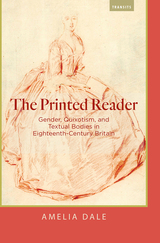
The Printed Reader explores the transformative power of reading in the eighteenth century, and how this was expressed in the fascination with Don Quixote and in a proliferation of narratives about quixotic readers, readers who attempt to reproduce and embody their readings. Through intersecting readings of quixotic narratives, including work by Charlotte Lennox, Laurence Sterne, George Colman, Richard Graves, and Elizabeth Hamilton, Amelia Dale argues that literature was envisaged as imprinting—most crucially, in gendered terms—the reader’s mind, character, and body. The Printed Reader brings together key debates concerning quixotic narratives, print culture, sensibility, empiricism, book history, and the material text, connecting developments in print technology to gendered conceptualizations of quixotism. Tracing the meanings of quixotic readers’ bodies, The Printed Reader claims the social and political text that is the quixotic reader is structured by the experiential, affective, and sexual resonances of imprinting and impressions.
Published by Bucknell University Press. Distributed worldwide by Rutgers University Press.
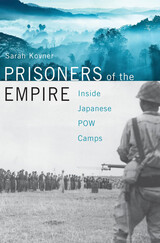
A pathbreaking account of World War II POW camps, challenging the longstanding belief that the Japanese Empire systematically mistreated Allied prisoners.
In only five months, from the attack on Pearl Harbor in December 1941 to the fall of Corregidor in May 1942, the Japanese Empire took prisoner more than 140,000 Allied servicemen and 130,000 civilians from a dozen different countries. From Manchuria to Java, Burma to New Guinea, the Japanese army hastily set up over seven hundred camps to imprison these unfortunates. In the chaos, 40 percent of American POWs did not survive. More Australians died in captivity than were killed in combat.
Sarah Kovner offers the first portrait of detention in the Pacific theater that explains why so many suffered. She follows Allied servicemen in Singapore and the Philippines transported to Japan on “hellships” and singled out for hard labor, but also describes the experience of guards and camp commanders, who were completely unprepared for the task. Much of the worst treatment resulted from a lack of planning, poor training, and bureaucratic incoherence rather than an established policy of debasing and tormenting prisoners. The struggle of POWs tended to be greatest where Tokyo exercised the least control, and many were killed by Allied bombs and torpedoes rather than deliberate mistreatment.
By going beyond the horrific accounts of captivity to actually explain why inmates were neglected and abused, Prisoners of the Empire contributes to ongoing debates over POW treatment across myriad war zones, even to the present day.
Depictions of the Holocaust in history, literature, and film became a focus of intense academic debate in the 1980s and 1990s. Today, with the passing of the eyewitness generation and the rise of comparative genocide studies, the Holocaust’s privileged place not only in scholarly discourse but across Western society has been called into question.
Probing the Ethics of Holocaust Culture is a searching reappraisal of the debates and controversies that have shaped Holocaust studies over a quarter century. This landmark volume brings international scholars of the founding generation of Holocaust studies into conversation with a new generation of historians, artists, and writers who have challenged the limits of representation through their scholarly and cultural practices. Focusing on the public memorial cultures, testimonial narratives, and artifacts of cultural memory and history generated by Holocaust remembrance, the volume examines how Holocaust culture has become institutionalized, globalized, and variously contested. Organized around three interlocking themes—the stakes of narrative, the remediation of the archive, and the politics of exceptionality—the essays in this volume explore the complex ethics surrounding the discourses, artifacts, and institutions of Holocaust remembrance.
From contrasting viewpoints and, in particular, from the multiple perspectives of genocide studies, the authors question if and why the Holocaust should remain the ultimate test case for ethics and a unique reference point for how we understand genocide and crimes against humanity.
Can the Holocaust be compellingly described or represented? Or is there some core aspect of the extermination of the Jews of Europe which resists our powers of depiction, of theory, of narrative? In this volume, twenty scholars probe the moral, epistemological, and aesthetic limits of an account or portrayal of the Nazi horror.
Christopher Browning, Hayden White, Carlo Ginzburg, Martin Jay, Dominick LaCapra, and others focus first on the general question: can the record of his historical event be established objectively through documents and witnesses, or is every historical interpretation informed by the perspective of its narrator? The suggestion that all historical accounts are determined by a preestablished narrative choice raises the ethical and intellectual issues of various forms of relativization. In more specific terms, what are the possibilities of historicizing National Socialism without minimizing the historical place of the Holocaust?
Also at issue are the problems related to an artistic representation, particularly the dilemmas posed by aestheticization. John Felstiner, Yael S. Feldman, Sidra Ezrahi, Eric Santner, and Anton Kaes grapple with these questions and confront the inadequacy of words in the face of the Holocaust. Others address the problem of fitting Nazi policies and atrocities into the history of Western thought and science. The book concludes with Geoffrey Hartman’s evocative meditation on memory.
These essays expose to scrutiny questions that have a pressing claim on our attention, our conscience, and our cultural memory. First presented at a conference organized by Saul Friedlander, they are now made available for the wide consideration and discussion they merit.
In Profiles and Plotlines, Katherine Johnston engages this energetic reformation of contemporary literature to account for a society and economy of frenetic counting. Fiction and poetry are capable of addressing precisely that for which algorithms cannot or do not account: the effects of profile culture; the ideologies and supposed truth-power of data; the gendered and racialized dynamics of watching and being watched; and the politics of who counts and what gets counted. Johnston analyzes prescient work by contemporary authors such as Jennifer Egan, Claudia Rankine, Mohsin Hamid, and William Gibson to probe how the claims of data surveillance serve to make lives seem legible, intelligible, and sometimes even expendable.
Faith in progress is a characteristic we often associate with the Victorian era. Victorian intellectuals and free-thinkers who believed in progress and wrote history from a progressive point of view—men such as Leslie Stephen, John Morley, W. E. H. Lecky, and James Anthony Froude—are usually thought to have done so because they were optimistic about their own times. Their optimism has been seen as the result of a successful Liberal campaign for political reform in the sixties and seventies, carried out in alliance with religious dissenters—a campaign that removed religion from the arena of public debate.
Jeffrey Paul von Arx challenges this long-standing view of the Victorian intellectual aristocracy. He sees them as preoccupied with and even fearful of a religious resurgence throughout their careers, and demonstrates that their loss of confidence in contemporary liberalism began with their disillusionment over the effects of the Franchise Reform Act of 1867. He portrays their championing of the idea of progress as motivated not by optimism about the present, but by their desire to explain away and reverse if possible contemporary religious and political trends, such as the new mass politics in England and Ireland.
This is the first book to explore how pessimism could be the psychological basis for the Victorians’ progressive conception of history. Throughout, von Arx skillfully interweaves threads of religion, politics, and history, showing how ideas in one sphere cannot be understood without reference to the others.
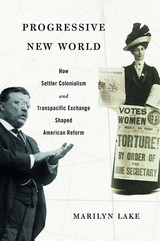
The paradox of progressivism continues to fascinate more than one hundred years on. Democratic but elitist, emancipatory but coercive, advanced and assimilationist, Progressivism was defined by its contradictions. In a bold new argument, Marilyn Lake points to the significance of turn-of-the-twentieth-century exchanges between American and Australasian reformers who shared racial sensibilities, along with a commitment to forging an ideal social order. Progressive New World demonstrates that race and reform were mutually supportive as Progressivism became the political logic of settler colonialism.
White settlers in the United States, who saw themselves as path-breakers and pioneers, were inspired by the state experiments of Australia and New Zealand that helped shape their commitment to an active state, women’s and workers’ rights, mothers’ pensions, and child welfare. Both settler societies defined themselves as New World, against Old World feudal and aristocratic societies and Indigenous peoples deemed backward and primitive.
In conversations, conferences, correspondence, and collaboration, transpacific networks were animated by a sense of racial kinship and investment in social justice. While “Asiatics” and “Blacks” would be excluded, segregated, or deported, Indians and Aborigines would be assimilated or absorbed. The political mobilizations of Indigenous progressives—in the Society of American Indians and the Australian Aborigines’ Progressive Association—testified to the power of Progressive thought but also to its repressive underpinnings. Burdened by the legacies of dispossession and displacement, Indigenous reformers sought recognition and redress in differently imagined new worlds and thus redefined the meaning of Progressivism itself.

In The Prohibition Hangover, Garrett Peck explores the often-contradictory social history of alcohol in America, from the end of Prohibition in 1933 to the twenty-first century. For Peck, Repeal left American society wondering whether alcohol was a consumer product or a controlled substance, an accepted staple of social culture or a danger to society. Today the legal drinking age, binge drinking, the neo-prohibitionist movement led by Mothers Against Drunk Driving, the 2005 Supreme Court decision in Granholm v. Heald that rejected discriminatory curbs on wine sales, the health benefits of red wine, advertising, and other issues remain highly contested.
Based on primary research, including hundreds of interviews with those on all sides, clergy, bar and restaurant owners, public health advocates, citizen crusaders, industry representatives, and more, as well as secondary sources, The Prohibition Hangover provides a panoramic assessment of alcohol in American culture. Traveling through the California wine country, the beer barrel backroads of New England and Pennsylvania, and the blue hills of Kentucky's bourbon trail, Peck places the concerns surrounding alcohol use within the broader context of American history, religious traditions, and governance.
Society is constantly evolving, and so are our drinking habits. Cutting through the froth and discarding the maraschino cherries, The Prohibition Hangover examines the modern American temperament toward drink amid the $189-billion-dollar-a-year industry that defines itself by the production, distribution, marketing, and consumption of alcoholic beverages.
A new and original history of the forces that shaped the twentieth and twenty-first centuries.
We thought we knew the story of the twentieth century. For many in the West, after the two world conflicts and the long cold war, the verdict was clear: democratic values had prevailed over dictatorship. But if the twentieth century meant the triumph of liberalism, as many intellectuals proclaimed, why have the era’s darker impulses—ethnic nationalism, racist violence, and populist authoritarianism—revived?
The Project-State and Its Rivals offers a radical alternative interpretation that takes us from the transforming challenges of the world wars to our own time. Instead of the traditional narrative of domestic politics and international relations, Charles S. Maier looks to the political and economic impulses that propelled societies through a century when territorial states and transnational forces both claimed power, engaging sometimes as rivals and sometimes as allies. Maier focuses on recurring institutional constellations: project-states including both democracies and dictatorships that sought not just to retain power but to transform their societies; new forms of imperial domination; global networks of finance; and the international associations, foundations, and NGOs that tried to shape public life through allegedly apolitical appeals to science and ethics.
In this account, which draws on the author’s studies over half a century, Maier invites a rethinking of the long twentieth century. His history of state entanglements with capital, the decline of public projects, and the fragility of governance explains the fraying of our own civic culture—but also allows hope for its recovery.

Socialist doctrines had an important influence on Korean writers and intellectuals of the early twentieth century. From the 1910s through the 1940s, a veritable wave of anarchist, Marxist, nationalist, and feminist leftist groups swept the cultural scene with differing agendas as well as shared demands for equality and social justice. In The Proletarian Wave, Sunyoung Park reconstructs the complex mosaic of colonial leftist culture by focusing on literature as its most fertile and enduring expression. The book combines a general overview of the literary left with the intellectual portraits of four writers whose works exemplify the stylistic range and colonial inflection of socialist culture in a rapidly modernizing Korea. Bridging Marxist theory and postcolonial studies, Park confronts Western preconceptions about third-world socialist cultures while interrogating modern cultural history from a post–Cold War global perspective.
The Proletarian Wave provides the first historical account in English of the complex interrelations of literature and socialist ideology in colonial Korea. It details the origins, development, and influence of a movement that has shaped twentieth-century Korean politics and aesthetics alike through an analysis that simultaneously engages some of the most debated and pressing issues of literary historiography, Marxist criticism, and postcolonial cultural studies.
Hunan province has long interested students of modern China. A citadel of orthodoxy in the nineteenth century and a mainspring of revolution in the twentieth, it is an ideal focus for a study of the great transformation that occurred during the last two decades of the Ch'ing dynasty.
Hunan's experience illuminates key questions. How did foreign imperialism affect Chinese society? What ties bound the provinces to the central government, and how were these ties loosened to permit the secession movement of 1911? Why did nationalism emerge so abruptly and strongly after 1895? How did it differ from the antiforeignism that preceded it, and what did it contribute to the movement against the dynasty? As nationalism became strong, why did social revolution remain weak?
Since Hunanese leadership, moving from orthodoxy through revolution, constitutes one of the great continuities in China's modern history, the answers that a study of Hunan gives to these questions are relevant to larger patterns of change in China as a whole. Charlton Lewis has written a valuable handbook of national as well as provincial events during the turbulent period around the turn of the century.
Published by University of Delaware Press. Distributed worldwide by Rutgers University Press.
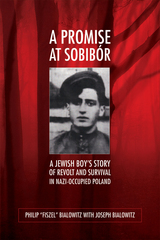
A Promise at Sobibór is the story of Fiszel Bialowitz, a teenaged Polish Jew who escaped the Nazi gas chambers. Between April 1942 and October 1943, about 250,000 Jews from European countries and the Soviet Union were sent to the Nazi death camp at Sobibór in occupied Poland. Sobibór was not a transit camp or work camp: its sole purpose was efficient mass murder. On October 14, 1943, approximately half of the 650 or so prisoners still alive at Sobibór undertook a daring and precisely planned revolt, killing SS officers and fleeing through minefields and machine-gun fire into the surrounding forests, farms, and towns. Only about forty-two of them, including Fiszel, are known to have survived to the end of the war.
Philip (Fiszel) Bialowitz, now an American citizen, tells his eyewitness story here in the real-time perspective of his own boyhood, from his childhood before the war and his internment in the brutal Izbica ghetto to his harrowing six months at Sobibór—including his involvement in the revolt and desperate mass escape—and his rescue by courageous Polish farmers. He also recounts the challenges of life following the war as a teenaged displaced person, and his eventual efforts as a witness to the truth of the Holocaust.
In 1943 the heroic leaders of the revolt at Sobibór, Sasha Perchersky and Leon Feldhendler, implored fellow prisoners to promise that anyone who survived would tell the story of Sobibór: not just of the horrific atrocities committed there, but of the courage and humanity of those who fought back. Bialowitz has kept that promise.
Best Books for General Audiences, selected by the American Association for School Libraries
Best Books for High Schools, selected by the American Association for School Libraries
Best Books for Special Interests, selected by the Public Library Association
"Diggins, an eminent historian of American intellectual life, has written a timely and impressive book charting the rich history of American pragmatism and placing William James, Charles Peirce, John Dewey, George Herbert Mead, Sidney Hook, and Richard Rorty in their times and in the light of contemporary concerns. The book also draws on an alternative set of American thinkers to explore the blind spots in the pragmatic temper."—William Connolly, New York Times Book Review
"An extraordinarily ambitious work of both analysis and synthesis. . . . Diggins's book is rewarding in its thoughtfulness and its nuanced presentation of ideas."—Daniel J. Silver, Commentary
"Diggins's superbly informed book comprises a comprehensive history of American pragmatic thought. . . . It contains expert descriptions of James, John Dewey and Charles Sanders Peirce, the first generation of American pragmatists. . . . Diggins is just as good on the revival of pragmatism that's taken place over the last 20 years in America. . . . [A] richly intelligent book."—Mark Edmundson, Washington Post Book World

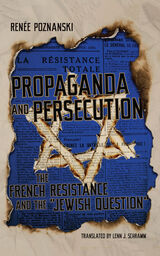
Poznanski argues that Jews in France suffered a double persecution: one led by the Vichy government, the other imposed by the Nazis. Marginalization and exclusion soon led to internment and deportation to terrifying places. Meanwhile, a propaganda war developed between the Resistance and the official voice of Vichy. Poznanski draws on a breathtaking array of sources, especially clandestine publications and French-language BBC transmissions, to show how the Resistance both fought and accommodated the deeply entrenched antisemitism within French society. Her close readings of propaganda texts against public opinions probe ambiguities and silences in Resistance writing about the persecution of the Jews and, in parallel, the numerous and detailed denunciations that could be read in the Jewish clandestine press. This extensive synthesis extends to the post-Liberation period, during which the ongoing persecution of Jews in Europe and North Africa would be portrayed as secondary to the suffering of the nation.
The winner of the 2009 Henri Hertz Prize by the Chancellerie des Universités de Paris, Sorbonne, Propaganda and Persecution makes major contributions to the study of the Resistance and of antisemitism. Lenn J. Schramm’s English translation brings Poznanski’s dynamic prose to life.
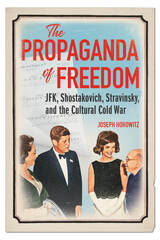
Eloquently extolled by President John F. Kennedy, the idea that only artists in free societies can produce great art became a bedrock assumption of the Cold War. That this conviction defied centuries of historical evidence--to say nothing of achievements within the Soviet Union--failed to impact impregnable cultural Cold War doctrine.
Joseph Horowitz writes: “That so many fine minds could have cheapened freedom by over-praising it, turning it into a reductionist propaganda mantra, is one measure of the intellectual cost of the Cold War.” He shows how the efforts of the CIA-funded Congress for Cultural Freedom were distorted by an anti-totalitarian “psychology of exile” traceable to its secretary general, the displaced Russian aristocrat/composer Nicolas Nabokov, and to Nabokov’s hero Igor Stravinsky.
In counterpoint, Horowitz investigates personal, social, and political factors that actually shape the creative act. He here focuses on Stravinsky, who in Los Angeles experienced a “freedom not to matter,” and Dmitri Shostakovich, who was both victim and beneficiary of Soviet cultural policies. He also takes a fresh look at cultural exchange and explores paradoxical similarities and differences framing the popularization of classical music in the Soviet Union and the United States. In closing, he assesses the Kennedy administration’s arts advocacy initiatives and their pertinence to today’s fraught American national identity.
Challenging long-entrenched myths, The Propaganda of Freedom newly explores the tangled relationship between the ideology of freedom and ideals of cultural achievement.



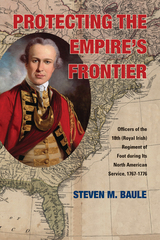
Protecting the Empire’s Frontier tells stories of the roughly eighty officers who served in the 18th (Royal Irish) Regiment of Foot, which served British interests in America during the crucial period from 1767 through 1776. The Royal Irish was one of the most wide-ranging regiments in America, with companies serving on the Illinois frontier, at Fort Pitt, and in Boston, New York, and Philadelphia, with some companies taken as far afield as Florida, Spanish Louisiana, and present-day Maine. When the regiment was returned to England in 1776, some of the officers remained in America on staff assignments. Others joined provincial regiments, and a few joined the American revolutionary army, taking up arms against their king and former colleagues.
Using a wide range of archival resources previously untapped by scholars, the text goes beyond just these officers’ service in the regiment and tells the story of the men who included governors, a college president, land speculators, physicians, and officers in many other British regular and provincial regiments. Included in these ranks were an Irishman who would serve in the U.S. Congress and as an American general at Yorktown; a landed aristocrat who represented Bath as a member of Parliament; and a naval surgeon on the ship transporting Benjamin Franklin to France. This is the history of the American Revolutionary period from a most gripping and everyday perspective.
An epilogue covers the Royal Irish’s history after returning to England and its part in defending against both the Franco-Spanish invasion attempt and the Gordon Rioters. With an essay on sources and a complete bibliography, this is a treat for professional and amateur historians alike.

Protestant Diplomacy and the Near East was first published in 1971. Minnesota Archive Editions uses digital technology to make long-unavailable books once again accessible, and are published unaltered from the original University of Minnesota Press editions.
For understand of the Middle East today, it is essential to know something of the historical background of that region, traditionally known as the Near East. In tracing the influence of American Protestant missionary activities on American foreign policy and diplomacy in the Near East, Professor Grabill contributes significantly to an understanding of contemporary affairs.
It becomes clear, in this account, that missionaries and philanthropists were the most influential force in the United States' relations with the Near East through the First World War and its aftermath. An important turning point in the history occurred in 1915 when officials of the Ottoman Empire massacred or deported several hundred thousand Turkish Armenians, among whom were the principal constituents of the American missionaries. This prompted the mission groups to shift their emphasis from evangelism and education to the development of the second largest relief organization in the United States history ) eventually called Near East Relief). Through powerful lobbying, the missionaries got their government to consider seriously a protectorate over Armenia or all of Asia Minor. Despite their political failure, the religionists succeeded as cultural frontiersmen through their colleges, such as the American University of Beirut, and their technical assistance programs, which showed the way for the Fulbright, foreign aid, and Peace Corps programs.
The archives of the American Board of Commissioners for Foreign Missions
(Congregational) and the Presbyterian Board of Missions provided rich source material for this book. The illustrations include photographs and maps.
This book is about some of the largest events of the twentieth century, about international war, economic collapse, new science and technologies, and about the transformation of an old mill town region into a modern American metropolis. But it sees those sweeping changes through the eyes of fourteen particular Bostonians, in an ambitious attempt to understand the disorienting experiences of recent history. These lives span the years from 1850 to 1980, a time when Boston, like all American cities, was being rebuilt according to the continually changing specifications of science, engineering, mass wealth, and big corporations.
From Boston Brahmins to self-made millionaires, Sam Warner, Jr., brings us into the diverse worlds of Robert Grant, judge and popular novelist; Mary Antin, mystic and advocate for immigrants; Fred Allen, radio comedian; Charles A. Stone and Edwin S. Webster, electrical engineers; Laura Elizabeth Richards, reformist clubwoman; Emily Greene Balch, economist and winner of the Nobel Peace Prize; William Madison Wood, textile magnate; Fred Erwin Beal, socialist labor organizer; Louise Andrews Kent, suburban housewife and writer; Vannevar Bush, science administrator; Laurence K. Marshall, electronics entrepreneur; James Bryant Conant, university president and educational reformer; and Rachel Carson, renowned science writer.
These varied lives have been deftly brought together to illuminate the many contradictory qualifies of today’s metropolitan life: ambitions for education and pervasive social neglect; conspicuous luxuries and endemic poverty; elaborate science and a poisoned environment; far-reaching cooperative networks of strangers and narrow, segregated neighborhoods; the multiplication of women’s roles and the entrapment of women in the home.
Individual experience—how one person lived as a child in a family and in a particular place, how people did their work—can bring renewed insight to the conflicts of modern life. This engrossing story speaks from an urge to recapture history through human lives and to examine its meaning as authentic experience. As Alfred Kazin expresses it, we are a nation of men and women who have endeavored to escape traditions, and therefore self-discovery is our preoccupation and delight.
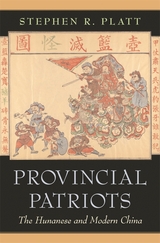
From the Taiping Rebellion in the mid-nineteenth century to the Chinese Communist movement in the twentieth, no province in China gave rise to as many reformers, military officers, and revolutionaries as did Hunan. Stephen Platt offers the first comprehensive study of why Hunan wielded such disproportionate influence.
Covering a span of eight decades, this book portrays three generations of Hunanese scholar-activists who held their provincial loyalties above their allegiances to a questionable Chinese empire. The renaissance of Hunan centered around the revival of Wang Fuzhi, a local hermit scholar from the seventeenth century whose iconoclastic writings were deemed a remarkable match for "Western" ideas of progress, humanism, and nationalism. Advocates of reform and revolution thus framed their projects as the continuance of a local tradition--the natural destiny of the Hunanese people--creating a tradition of reform and nationalism that culminated in the 1920s with a Hunanese independence movement led by the young Mao Zedong.
By putting provincial Hunan at the center of this narrative, Platt uncovers an unexpected and surprising story of modern China that sheds light on the current resurgence of regionalism in the country.
Struminski's study concentrates on text-critical, biographical, and linguistic aspects of the Speech in order to demonstrate that the original (no longer extant) was in Ukrainian and that it was an actual speech delivered at the Warsaw Diet, not a parody of such a speech as has been assumed. The author has discovered hitherto unknown copies of the text and archival materials concerning the historical Meleško. With the use of this data Struminski was able to build a stemma for the interrelationship of the extant copies and to reconstruct the archetype of the text.
Further, the author has established little known facts of Meleško's life and connected them with the origin of the Speech. The study concludes with a full glossary to the text, with translation of all foreign words into English.
The work will be useful to experts and students in the field of Slavic languages and literature.
Long ignored by historians and repudiated in their time, practitioners of private law opened the way toward Japan’s legal modernity. From the seventeenth to the turn of the twentieth century, lawyers and their predecessors changed society in ways that first samurai and then the state could not. During the Edo period (1600–1868), they worked from the shadows to bend the shogun’s law to suit the market needs of merchants and the justice concerns of peasants. Over the course of the nineteenth century, legal practitioners changed law from a tool for rule into a new epistemology and laid the foundation for parliamentary politics during the Meiji era (1868–1912).
This social and political history argues that legal modernity sprouted from indigenous roots and helped delineate a budding nation’s public and private spheres. Tracing the transition of law regimes from Edo to Meiji, Darryl E. Flaherty shows how the legal profession emerged as a force for change in modern Japan and highlights its lasting contributions in founding private universities, political parties, and a national association of lawyers that contributed to legal reform during the twentieth century.
In 1753, at the request of the London Jewish community, the Peiham administration passed an act repealing the religious test that prevented Jewish aliens from being naturalized. This act, formally known as the Jewish Naturalization Act, was of negligible practical importance, but political opponents exploited the issue for an upcoming election campaign. The "Jew Bill" became a battle cry that swept across England. The Peiham administration, sensing the political damage that could be caused by the bill, bowed to the clamor and then took the initiative in defeating its own act.
This book is the first thorough account of that notorious but little-understood episode in English history. Using a largely narrative form the author first discusses the position of the Jews in the mid-eighteenth century and explains why they sought and obtained passage of the bill. He then recounts the beginnings of opposition to it and discusses the religious, economic, political, and psychological reasons for the opposition. He describes in detail the propaganda campaign against the bill and the resultant effect on the election.
The author concludes that this was not an isolated explosion of anti-Semitism, but rather a renewal of a long-standing debate over general naturalization policy. He further concludes that Parliament was more sensitive to public opinion than is generally supposed and that the terms "Whig supremacy" or "trusteeship" are not entirely accurate.
The reader will find that this study reveals much of the English political system of that era: the style and structure of parliamentary politics and electioneering; religious attitudes and economic notions; and the methods and ethical and intellectual standards of journalism and political propaganda.
The period covered by the material published in this volume marks the transition in Eric Voegelin's career from Louisiana to Munich. After twenty years in the United States, in 1958 Voegelin accepted an invitation to fill the political science chair at Ludwig Maximilian University, a position left vacant throughout the Nazi period and last occupied by the famous Max Weber, who had died in 1920.
The themes most prominent in the fourteen items reprinted here reflect the concerns of a transition, not only in a scholar's career, and in the momentous shifts in world politics taking place around him, but also in the development of his understanding of the stratification of reality and the attendant demands for a science of human affairs adequate to the challenges posed by the persistent crisis of the West in its latest configurations and by contemporary philosophy.
Several of the items herein originated as talks to a specific organization on problems facing German democratization and the development of a market economy amid the ruins of a fragmented culture and infrastructure in a society without historically evolved institutional supports for a satisfactory social and political order. Accordingly, pragmatic matters occupy a central place in a number of these pieces, especially the overriding question of how Germany could move from an illiberal and ideological political order into a modern liberal democratic one.
Those accustomed to the theoretical profundity of Voegelin's writings may find welcome relief in the down-to-earth, commonsensical drift of this material addressed, often, to laymen and businessmen. But, of course, the philosophical subject matter lurks everywhere. It finds full expression in several instances as the controlling context of even the least pretentious presentations. One of the attractions of these essays is what the author brings forward as serviceable elementary guideposts under adverse conditions of intellectual disarray, social decay, and turmoil.
READERS
Browse our collection.
PUBLISHERS
See BiblioVault's publisher services.
STUDENT SERVICES
Files for college accessibility offices.
RECENTLY PUBLISHED






UChicago Accessibility Resources
home | accessibility | search | about | contact us
BiblioVault ® 2001 - 2026
The University of Chicago Press