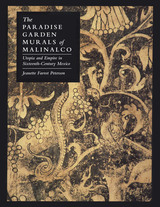
front cover of The Paradise Garden Murals of Malinalco
The Paradise Garden Murals of Malinalco
Utopia and Empire in Sixteenth-Century Mexico
By Jeanette Favrot Peterson
University of Texas Press, 1993

Winner, Charles Rufus Morey Award, 1993

The valley of Malinalco, Mexico, long renowned for its monolithic Aztec temples, is a microcosm of the historical changes that occurred in the centuries preceding and following the Spanish conquest in the sixteenth century. In particular, the garden frescoes uncovered in 1974 at the Augustinian monastery of Malinalco document the collision of the European search for Utopia with the reality of colonial life.

In this study, Jeanette F. Peterson examines the murals within the dual heritage of pre-Hispanic and European muralism to reveal how the wall paintings promoted the political and religious agendas of the Spanish conquerors while preserving a record of pre-Columbian rituals and imagery. She finds that the utopian themes portrayed at Malinalco and other Augustinian monasteries were integrated into a religious and political ideology that, in part, camouflaged the harsh realities of colonial policies toward the native population.

That the murals were ultimately whitewashed at the end of the sixteenth century suggests that the "spiritual conquest" failed. Peterson argues that the incorporation of native features ultimately worked to undermine the orthodoxy of the Christian message. She places the murals' imagery within the pre-Columbian tlacuilo (scribe-painter) tradition, traces a "Sahagún connection" between the Malinalco muralists and the native artists working at the Franciscan school of Tlatelolco, and explores mural painting as an artistic response to acculturation.

The book is beautifully illustrated with 137 black-and-white figures, including photographs and line drawings. For everyone interested in the encounter between European and Native American cultures, it will be essential reading.
[more]

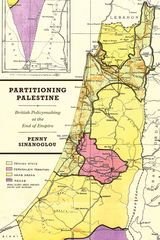
front cover of Partitioning Palestine
Partitioning Palestine
British Policymaking at the End of Empire
Penny Sinanoglou
University of Chicago Press, 2019
Partitioning Palestine is the first history of the ideological and political forces that led to the idea of partition—that is, a division of territory and sovereignty—in British mandate Palestine in the first half of the twentieth century. Inverting the spate of narratives that focus on how the idea contributed to, or hindered, the development of future Israeli and Palestinian states, Penny Sinanoglou asks instead what drove and constrained British policymaking around partition, and why partition was simultaneously so appealing to British policymakers yet ultimately proved so difficult for them to enact. Taking a broad view not only of local and regional factors, but also of Palestine’s place in the British empire and its status as a League of Nations mandate, Sinanoglou deftly recasts the story of partition in Palestine as a struggle to maintain imperial control. After all, British partition plans imagined space both for a Zionist state indebted to Britain and for continued British control over key geostrategic assets, depending in large part on the forced movement of Arab populations. With her detailed look at the development of the idea of partition from its origins in the 1920s, Sinanoglou makes a bold contribution to our understanding of the complex interplay between internationalism and imperialism at the end of the British empire and reveals the legacies of British partitionist thinking in the broader history of decolonization in the modern Middle East.
[more]

front cover of Penalties of Empire
Penalties of Empire
Capital Trials in Colonial Hong Kong
Christopher Munn
Hong Kong University Press, 2025
An eye-opening study of the evolution of the death penalty in Hong Kong.

"We must have a procedure – if we are going to hang anyone – that is just," said Chief Justice Sir Francis Piggott in 1909, on discovering that Chinese persons accused of murder were being denied interpretation in Hong Kong’s courts. Due process, no matter how costly or inconvenient, was "one of the penalties of empire," he declared.

Penalties of Empire explores how judges, juries, and lawyers strove to deliver justice during the 150 years when the death penalty was in force in Hong Kong. Nine main chapters focus on key capital trials in the first century of British rule. Among the cases are piracies, assassinations, crimes of passion, and murders committed from desperation. These chapters describe the proceedings and participants in court. They also examine the public debates surrounding each case and the exercise of mercy by governors. Two final chapters discuss the decline of the death penalty after World War II, its suspension after 1966, and the controversies leading to its formal abolition in 1993. Penalties of Empire traces the evolution of criminal justice at its highest levels. It also offers a prism for understanding some of the broader forces at work in Hong Kong’s history.
[more]

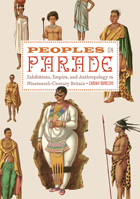
front cover of Peoples on Parade
Peoples on Parade
Exhibitions, Empire, and Anthropology in Nineteenth-Century Britain
Sadiah Qureshi
University of Chicago Press, 2011
In May 1853, Charles Dickens paid a visit to the “savages at Hyde Park Corner,” an exhibition of thirteen imported Zulus performing cultural rites ranging from songs and dances to a “witch-hunt” and marriage ceremony. Dickens was not the only Londoner intrigued by these “living curiosities”: displayed foreign peoples provided some of the most popular public entertainments of their day. At first, such shows tended to be small-scale entrepreneurial speculations of just a single person or a small group. By the end of the century, performers were being imported by the hundreds and housed in purpose-built “native” villages for months at a time, delighting the crowds and allowing scientists and journalists the opportunity to reflect on racial difference, foreign policy, slavery, missionary work, and empire.
 
Peoples on Parade provides the first substantial overview of these human exhibitions in nineteenth-century Britain. Sadiah Qureshi considers these shows in their entirety—their production, promotion, management, and performance—to understand why they proved so commercially successful, how they shaped performers’ lives, how they were interpreted by their audiences, and what kinds of lasting influence they may have had on notions of race and empire. Qureshi supports her analysis with diverse visual materials, including promotional ephemera, travel paintings, theatrical scenery, art prints, and photography, and thus contributes to the wider understanding of the relationship between science and visual culture in the nineteenth century.
 
Through Qureshi’s vibrant telling and stunning images, readers will see how human exhibitions have left behind a lasting legacy both in the formation of early anthropological inquiry and in the creation of broader public attitudes toward racial difference.
[more]

front cover of Phantom Byzantium
Phantom Byzantium
Europe, Empire, and Identity from Late Antiquity to World War II
Anthony Kaldellis
University of Chicago Press
How the West appropriated aspects of the eastern Roman empire while portraying it as inferior.
 
Unveiling the ideological foundations of Byzantine studies, Phantom Byzantium is a pioneering survey of western European perceptions of the eastern Roman empire (also known as Byzantium) spanning late antiquity to World War II. Through ten chronological chapters, Anthony Kaldellis makes the case that western Europe gradually formed its identity by adopting prestigious cultural elements from the eastern empire but simultaneously portraying the east as inferior. The West modeled its Roman imperial style on Constantinople while minimizing the latter as Greek rather than Roman; appropriated a host of Christian traditions from the east while casting the east as schismatic, heretical, or treacherous; and, during the Renaissance, used classical Hellenic philology from Greek scholars before marginalizing them as unworthy bearers of that tradition. This orientalizing impulse worked to buttress western exceptionalism and resulted in the fictitious construction of “Byzantium” as Europe’s evil doppelgänger, embodying the worst versions of traditions fundamental to European identity and casting the region as despotic, superstitious, and degenerate.

Explaining the creation, history, and functions of the ideological construct of Byzantium in the western imagination and European self-fashioning, this book has critical implications for contemporary views of European history.
 
[more]

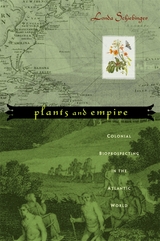
front cover of Plants and Empire
Plants and Empire
Colonial Bioprospecting in the Atlantic World
Londa Schiebinger
Harvard University Press, 2007

Plants seldom figure in the grand narratives of war, peace, or even everyday life yet they are often at the center of high intrigue. In the eighteenth century, epic scientific voyages were sponsored by European imperial powers to explore the natural riches of the New World, and uncover the botanical secrets of its people. Bioprospectors brought back medicines, luxuries, and staples for their king and country. Risking their lives to discover exotic plants, these daredevil explorers joined with their sponsors to create a global culture of botany.

But some secrets were unearthed only to be lost again. In this moving account of the abuses of indigenous Caribbean people and African slaves, Schiebinger describes how slave women brewed the "peacock flower" into an abortifacient, to ensure that they would bear no children into oppression. Yet, impeded by trade winds of prevailing opinion, knowledge of West Indian abortifacients never flowed into Europe. A rich history of discovery and loss, Plants and Empire explores the movement, triumph, and extinction of knowledge in the course of encounters between Europeans and the Caribbean populations.

[more]

logo for Harvard University Press
The Politics of German Child Welfare from the Empire to the Federal Republic
Edward Dickinson
Harvard University Press, 1996

The model of the development of child welfare policy presented here illuminates the complexity of the struggles from which modern social policy emerged, and accounts for the ways in which similar policies could be adapted to changing political systems--monarchical, republican, or fascist. Following a period of policy innovation, rapid institutional expansion, and intensifying ideological conflict before the First World War, Dickinson shows, the period from 1918 to 1961 saw a succession of efforts to reconcile competing policy agendas within different political contexts: the corporatist-democratic compromise worked out in the early years of the Weimar Republic, which broke down in the economic and political crisis at the end of the 1920s; the disastrous Nazi synthesis of authoritarianism and racism; and a revitalized corporatist-democratic framework, stabilized on the basis of the antitotalitarian consensus and of psychotherapeutic theory and practice, after 1949.

Historians of modern Germany and of the welfare state will find this a challenging and illuminating approach to important theoretical and historical questions.

[more]

front cover of Practical Matter
Practical Matter
Newton’s Science in the Service of Industry and Empire, 1687–1851
Margaret C. Jacob and Larry Stewart
Harvard University Press, 2006
Margaret Jacob and Larry Stewart examine the profound transformation that began in 1687. From the year when Newton published his Principia to the Crystal Palace Exhibition of 1851, science gradually became central to Western thought and economic development. The book aims at a general audience and examines how, despite powerful opposition on the Continent, a Newtonian understanding gained acceptance and practical application. By the mid-eighteenth century the new science had achieved ascendancy, and the race was on to apply Newtonian mechanics to industry and manufacturing. They end the story with the temple to scientific and technological progress that was the Crystal Palace exhibition. Choosing their examples carefully, Jacob and Stewart show that there was nothing preordained or inevitable about the centrality awarded to science. "It is easy to forget that science might have been stillborn, or remained the esoteric knowledge of court elites. Instead, for better and for worse, science became a centerpiece of Western culture."
[more]

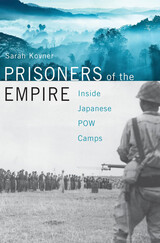
front cover of Prisoners of the Empire
Prisoners of the Empire
Inside Japanese POW Camps
Sarah Kovner
Harvard University Press, 2020

A pathbreaking account of World War II POW camps, challenging the longstanding belief that the Japanese Empire systematically mistreated Allied prisoners.

In only five months, from the attack on Pearl Harbor in December 1941 to the fall of Corregidor in May 1942, the Japanese Empire took prisoner more than 140,000 Allied servicemen and 130,000 civilians from a dozen different countries. From Manchuria to Java, Burma to New Guinea, the Japanese army hastily set up over seven hundred camps to imprison these unfortunates. In the chaos, 40 percent of American POWs did not survive. More Australians died in captivity than were killed in combat.

Sarah Kovner offers the first portrait of detention in the Pacific theater that explains why so many suffered. She follows Allied servicemen in Singapore and the Philippines transported to Japan on “hellships” and singled out for hard labor, but also describes the experience of guards and camp commanders, who were completely unprepared for the task. Much of the worst treatment resulted from a lack of planning, poor training, and bureaucratic incoherence rather than an established policy of debasing and tormenting prisoners. The struggle of POWs tended to be greatest where Tokyo exercised the least control, and many were killed by Allied bombs and torpedoes rather than deliberate mistreatment.

By going beyond the horrific accounts of captivity to actually explain why inmates were neglected and abused, Prisoners of the Empire contributes to ongoing debates over POW treatment across myriad war zones, even to the present day.
[more]

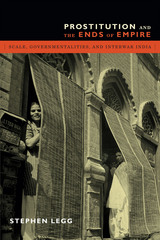
front cover of Prostitution and the Ends of Empire
Prostitution and the Ends of Empire
Scale, Governmentalities, and Interwar India
Stephen Legg
Duke University Press, 2014
Officially confined to red-light districts, brothels in British India were tolerated until the 1920s. Yet, by this time, prostitution reform campaigns led by Indian, imperial, and international bodies were combining the social scientific insights of sexology and hygiene with the moral condemnations of sexual slavery and human trafficking. These reformers identified the brothel as exacerbating rather than containing "corrupting prostitutes" and the threat of venereal diseases, and therefore encouraged the suppression of brothels rather than their urban segregation. In this book, Stephen Legg tracks the complex spatial politics surrounding brothels in the interwar period at multiple scales, including the local, regional, national, imperial, and global. Campaigns and state policies against brothels did not just operate at different scales but made scales themselves, forging new urban, provincial, colonial, and international formations. In so doing, they also remade the boundary between the state and the social, through which the prostitute was, Legg concludes, "civilly abandoned."
[more]

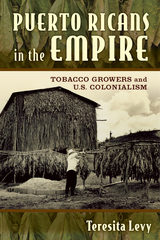
front cover of Puerto Ricans in the Empire
Puerto Ricans in the Empire
Tobacco Growers and U.S. Colonialism
Teresita A. Levy
Rutgers University Press, 2015
Most studies of Puerto Rico’s relations with the United States have focused on the sugar industry, recounting a tale of victimization and imperial abuse driven by the interests of U.S. sugar companies. But in Puerto Ricans in the Empire, Teresita A. Levy looks at a different agricultural sector, tobacco growing, and tells a story in which Puerto Ricans challenged U.S. officials and fought successfully for legislation that benefited the island.
 
Levy describes how small-scale, politically involved, independent landowners grew most of the tobacco in Puerto Rico. She shows how, to gain access to political power, tobacco farmers joined local agricultural leagues and the leading farmers’ association, the Asociación de Agricultores Puertorriqueños (AAP). Through their affiliation with the AAP, they successfully lobbied U.S. administrators in San Juan and Washington, participated in government-sponsored agricultural programs, solicited agricultural credit from governmental sources, and sought scientific education in a variety of public programs, all to boost their share of the tobacco-leaf market in the United States. By their own efforts, Levy argues, Puerto Ricans demanded and won inclusion in the empire, in terms that were defined not only by the colonial power, but also by the colonized.
 
The relationship between Puerto Rico and the United States was undoubtedly colonial in nature, but, as Puerto Ricans in the Empire shows, it was not unilateral. It was a dynamic, elastic, and ever-changing interaction, where Puerto Ricans actively participated in the economic and political processes of a negotiated empire.
 
[more]


Send via email Share on Facebook Share on Twitter