
 A SCHOLARLY BOOK REPOSITORY
32 start with P start with P
A generation of Italian authors dedicated their lives, their works, and their voices to the primary driving force behind twentieth-century narratives of World War II. Renata Viganò was an active member of the Italian Resistance during World War II, and, like many of her male counterparts, she depicted the actions of the brave people who contributed to and participated in the partisan movement. Unlike her counterparts, however, Viganò vividly portrayed the experiences of women, notably women on the front line, in her posthumously published Matrimonio in brigata, here translated for the first time in English as Partisan Wedding.
"If it had not been for them, the women . . . who got used to `men's business,' . . . the partisan army would have lost a vital, necessary force." The women in Partisan Wedding joined the struggle for many reasons; some for their husbands, others for their fathers, brothers, or sons; some for a sense of justice and the desire to do what was right. Whatever the cause, Viganò demonstrates that women maintained the ability to nurture and to care, to preserve their female qualities in the face of war.
Because of her own role as a partisan, the stories in Partisan Wedding are based on Viganò's personal experiences. Two stories in the collection are specifically autobiographical: "Acquitted" and "My Resistance." Relating her own plight to find her husband, a partisan commander, after his sudden arrest, "Acquitted" aptly conveys Viganò's struggle to maintain her strength in the face of complete helplessness. "My Resistance" is a personal account of her own experiences during the war and the women she met along the way.
Partisan Wedding is an invaluable contribution to the literature of the Second World War, completing the picture of those involved in the struggle for freedom. Viganò's remarkable prose, equally beautiful and terrible in its description of the minute details of human suffering and sacrifice, opens a window to a world that has rarely been seen, and a world not easily forgotten.
Based on extensive interviews with those who knew Pasolini, both friends and enemies, admirers and detractors, Pasolini Requiem chronicles his growth from poet in the provinces to Italy’s leading “civil poet”; his flight to Rome in 1950; the scandalous success of his two novels and political writing; and his transition to film, where he started as a contributor to the golden age of Italian cinema and ended with the shocking Salò, or the 120 Days of Sodom. Pasolini’s tragic and still unsolved murder has remained a subject of contentious debate for four decades. The enduring fascination with who committed the crime—and why—reflects his vital stature in Italy’s political and social history.
Updated throughout and with a new afterword covering the efforts to reopen the investigation—and the legal maelstrom surrounding Pasolini’s demise—this edition of Pasolini Requiem is a riveting account of one of the twentieth century’s most controversial, ever-present iconoclasts.
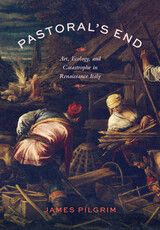
In the sixteenth century, Italian artist Jacopo Bassano painted pictures of herdsmen and animals moving through dark and muddy landscapes. But he also participated in the agricultural development of the region in which he lived, producing topographical maps of local mountains and forests, inventing new methods of drainage and irrigation, and studying the latest techniques of crop rotation and fertilization. The relationship between Bassano’s rustic art and his participation in environmental transformation has, however, never been explored.
One of the first studies of Italian Renaissance art to grapple with the connections between visual culture and the environment, Pastoral’s End explores this crucial, formative relationship. James Pilgrim looks at Bassano’s career holistically, demonstrating how his involvement in a world marked by agricultural expansion, industrialization, resource extraction, environmental degradation, social transformation, and radical philosophical development informed his paintings of country life. Introducing new archival and visual evidence of Bassano’s knowledge of hydrology, agronomy, husbandry, and architecture, Pastoral’s End argues that he transformed the more placid rustic imagery of previous Renaissance artists into visions of dangerous ecological instability.
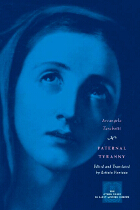
Paternal Tyranny, the first of these works, is a fiery but carefully argued manifesto against the oppression of women by the Venetian patriarchy. Denouncing key misogynist texts of the era, Tarabotti shows how despicable it was for Venice, a republic that prided itself on its political liberties, to deprive its women of rights accorded even to foreigners. She accuses parents of treating convents as dumping grounds for disabled, illegitimate, or otherwise unwanted daughters. Finally, through compelling feminist readings of the Bible and other religious works, Tarabotti demonstrates that women are clearly men's equals in God's eyes.
An avenging angel who dared to speak out for the rights of women nearly four centuries ago, Arcangela Tarabotti can now finally be heard.


"[A] long-awaited book. . . . [It is] the most complete survey of confraternities and charity, not only for Florence, but for any Italian city state to date. . . . This book recovers more vividly than other recent works what it meant to be a member of a confraternity in the late middle ages."—Samuel K. Cohn, Jr., Economic History Review
"Henderson offers new and fascinating information. . . . A stimulating and suggestive book that deserves a wide readership." —Gervase Rosser, Times Higher Education Supplement
Taking as her guiding metaphor the character of Pinocchio—a national icon made famous in 1881 by the eponymous children’s book—Susan Stewart-Steinberg argues that just like the renowned puppet, modern Italians were caught in a complex interplay between freely chosen submission and submission demanded by an outside force. In doing so, she explores all the ways that identity was constructed through newly formed attachments, voluntary and otherwise, to the young nation. Featuring deft readings of the period’s most important Italian cultural and social thinkers—including the theorist of mass psychology Scipio Sighele, the authors Matilde Serao and Edmondo De Amicis, the criminologist Cesare Lombroso, and the pedagogue Maria Montessori—Stewart-Steinberg’s richly multidisciplinary book will set a new standard in Italian studies.
For Agnew, place is not just a static backdrop against which events occur, but a dynamic component of social, economic, and political processes. He shows, for instance, how the lack of a common "landscape ideal" or physical image of Italy delayed the development of a sense of nationhood among Italians after unification. And Agnew uses the post-1992 victory of the Northern League over the Christian Democrats in many parts of northern Italy to explore how parties are replaced geographically during periods of intense political change.
Providing a fresh new approach to studying the role of space and place in social change, Place and Politics in Modern Italy will interest geographers, political scientists, and social theorists.

"Like many masterpieces, Lavin's book builds upon a simple idea . . . it is possible to do a computer analysis of . . . visual narratives. . . . This is the first computer-based study of the visual arts of which I am aware that illustrates how those technologies can utterly transform the study of old master art. An extremely important book, one likely to become the most influential recent study of art of this period, The Place of Narrative is also a beautiful artifact."—David Carrier, Leonardo
"Covering over a millennium and dealing with the whole of Italy, Lavin makes pioneering use of new methodology employing a computer database . . . [and] novel terminology to describe the disposition of scenes of church and chapel walls. . . . We should recognize this as a book of high seriousness which reaches out into new areas and which will fruitfully stimulate much thought on a neglected subject of very considerable significance."—Julian Gardner, Burlington Magazine
This volume is organized into ten sections, grouping the madrigals around themes such as the anguish of passion, the asymmetry of desire, the incursions of jealousy, and the possibility of mutual bliss. Nicholas R. Jones renders Guarini’s poetry into accessible contemporary English verse that nevertheless stays true to the substance and form of the original texts, reflecting their roots in the Petrarchan poetic tradition and displaying the emotion and musicality that made these lyrics so popular from the start. A substantive introduction provides cultural context for the madrigals and their musical settings; brief commentaries follow each translation to illuminate aspects of poetic and rhetorical craft. An extensive appendix lists the madrigal compositions that set these lyrics for vocal performance.
The book fills a major gap in the scholarship on Guarini’s literary legacy. It will appeal to scholars of literature, Renaissance studies, and musicology, early-music performers, and general readers interested in poetry and classical music.
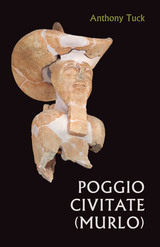
Poggio Civitate in Murlo, Tuscany, is home to one of the best-preserved Etruscan communities of the eighth through the sixth centuries BCE. In this book, Anthony Tuck, the director of excavations, provides a broad synthesis of decades of data from the site.
The results of many years of excavation at Poggio Civitate tell a story of growth, urbanization, ancient industrialization, and dissolution. The site preserves traces of aristocratic domestic buildings, including some of the most evocative and enigmatic architectural sculpture in the region, along with remnants of non-elite domestic spaces, enabling illuminating comparisons across social strata. The settlement also features evidence of large-scale production systems, including tools and other objects that reflect the daily experiences of laborers. Finally, the site contains the story of its own destruction. Tuck finds in the data clear indications that Poggio Civitate was methodically dismantled, and he posits hypotheses concerning the circumstances around this violent social and political act.
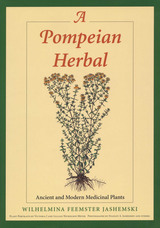
When workmen excavating the ruins of Pompeii eagerly gathered the native medicinal plants growing there, Wilhelmina Jashemski discovered that this was another example of the continuity of life in the shadow of Vesuvius. Many of the plants used for herbal medicine around Pompeii today are the same ones that ancient authorities such as Pliny the Elder and Dioscorides recommended for treating the same types of disorders.
In this book, Jashemski presents an herbal of thirty-six medicinal plants, most of them known to the ancients and still employed today. She describes each plant's contemporary medicinal uses and compares them to ancient practices as recorded in literary sources. Scientific, English, and Italian names and the plant's mythological associations complete the entries, while elegant, full-page portraits depict each plant visually.
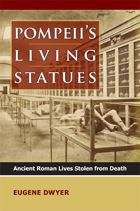
In AD 79, Mt. Vesuvius erupted in two stages. While the first stage was incredibly destructive, it was the second stage, a so-called pyroclastic flow, that inundated Pompeii with a combination of superheated gases, pumice, and rocks, killing tens of thousands of people and animals and burying them in ash and mud.
During excavations of the town in 1863, Giuseppe Fiorelli, the director of the dig, poured plaster of paris into a cavity under the soil revealed by a workman's pick. When the plaster set and the mound was uncovered, all were amazed to see the secret that the ground had held for 1,800 years: a detailed cast of an ancient Pompeian such as no one had seen before, frozen in the instant of dying and complete in every respect, including outlines of the clothes he was wearing at the time of the destruction. The bodies, photographed and exhibited in the specially built Pompeii Museum, completely changed the world's ideas of life in ancient Italy.
Pompeii's Living Statues is a narrative account, supported by contemporary documents, of the remarkable discovery of those ancient victims preserved in the volcanic mud of Vesuvius.
Eugene Dwyer examines these casts and related records, the originals of a number of which (along with their museum) were lost in World War II bombing. As he considers the casts as archaeological and cultural pieces, he also discusses Pompeii and its artifacts in the context of Italian unification and party politics, the development of modern excavation methods, and the challenges of maintaining a very large archaeological site. Dwyer's clear organization and writing style, combined with a collection of photographs and engravings, make for a fascinating exploration of Pompeii and its victims.

By collecting, sifting, and cross-referencing these varied documents, Franklin proves it possible to trace the major political alliances of the times, explore the remains of their houses, and find traces of their personalities. A few families, like the powerful Holconii, developers of the region's most famous grape vine, prove to have been steady players throughout Pompeii's history; but most families rose and fell within two generations at most. Chapters examine the men and families most prominent in each imperial period, including an analysis of their houses, and concludes with family trees. The documents themselves, elsewhere difficult to access, are prominently featured and translated in the text, making these discussions available and vivid to all readers.
This book is the first such attempt to cross-reference and animate all kinds of writing found at this legendary site. Outside of the city of Rome itself, this is the largest collection of writing from Roman antiquity, and it has lain mostly unexamined in the course of three centuries of excavations at Pompeii. This volume will interest not only students of Pompeii and classical scholars, but also historians, political scientists, sociologists, and enthusiasts of human behavior of all eras.
James L. Franklin is Professor of Classical Studies, Indiana University.
Rocco Rubini studies the motives and literary forms in the making of a “tradition,” not understood narrowly, as the conservative, stubborn preservation of received conventions, values, and institutions, but instead as the deliberate effort on the part of writers to transmit a reformulated past across generations. Leveraging Italian thinkers from Petrarch to Gramsci, with stops at prominent humanists in between—including Giambattista Vico, Carlo Goldoni, Francesco De Sanctis, and Benedetto Croce—Rubini gives us an innovative lens through which to view an Italian intellectual tradition that is at once premodern and modern, a legacy that does not depend on a date or a single masterpiece, but instead requires the reader to parse an expanse of writings to uncover deeper transhistorical continuities that span six hundred years. Whether reading work from the fourteenth century, or from the 1930s, Rubini elucidates the interplay of creation and the reception underlying the enactment of tradition, the practice of retrieving and conserving, and the revivification of shared themes and intentions that connect thinkers across time. Building on his award-winning book, The Other Renaissance, this will prove a valuable contribution for intellectual historians, literary scholars, and those invested in the continuing humanist legacy.
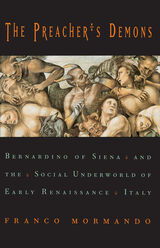
His story of the Parisian vigilante was a recommendation. Sexual deviants were the objects of relentless, unconditional persecution in Bernardino's sermons. Other targets of the preacher's venom were witches, Jews, and heretics. Mormando takes us into the social underworld of early Renaissance Italy to discover how one enormously influential figure helped to dramatically increase fear, hatred, and intolerance for those on society's margins.
This book is the first on Bernardino to appear in thirty-five years, and the first ever to consider the preacher's inflammatory role in Renaissance social issues.

The recent vast upsurge in social science scholarship on job precarity has generally little to say about earlier forms of this phenomenon. Eloisa Betti’s monograph convincingly demonstrates on the example of Italy that even in the post-war phase of Keynesian stability and welfare state, precarious labor was an underlying feature of economic development. She examines how in this short period exceptional politics of labor stability prevailed. The volume then presents the processes whereby labor precarity regained momentum— under the name of flexibility— in the post-Fordist phase from the early 1980s, taking on new forms in the Craxi and Berlusconi eras.
Multiple actors are addressed in the analysis. The book gives voice to intellectuals, scholars, politicians and trade unionists as they have framed the concept and debates on precarious work from the 1950s onwards. Views of labor law experts, politicians and public servants are investigated in regard to labor regulations. Positions of the very precarians are explored, ranging from rural women, industrial homeworkers and blue-collar workers to physicians, university researchers and trainees, unveiling the emergence of anti-precarity social movements. The continuous role of women’s associations and feminist groups in opposing labor precarity since the 1950s is prominently exposed.
With The Presence of Myth, Kolakowski demonstrates that no matter how hard man strives for purely rational thought, there has always been-and always will be-a reservoir of mythical images that lend "being" and "consciousness" a specifically human meaning.
"Kolakowski undertakes a philosophy of culture which extends to all realms of human intercourse—intellectual, artistic, scientific, and emotional. . . . [His] book has real significance for today, and may well become a classic in the philosophy of culture."—Anglican Theological Review

Tavuzzi shows that, aside from being Luther’s first opponent, Prierias played a key role in significant early-sixteenth-century controversies such as the cases of Reuchlin, Erasmus, and Pomponazzi. Drawing on previously untapped primary sources, Tavuzzi traces Prierias’s early career as preacher, professor, inquisitor, and administrator, and places him in the context of the struggles fought between unreformed and observant friars during the Renaissance. Prierias’s activities as Master of the Sacred Palace, his long-standing and bitter conflict with Cardinal Cajetan, and especially his forceful writings warning against the threat of witches and witchcraft are also described. Focusing closely on Prierias’s clash with Luther, Tavuzzi accounts for its development and illuminates the ecclesiological issues at stake. Prierias reveals the little-known world of the friars on the eve of the Reformation.
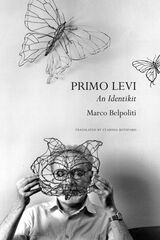
Over the last seventy years, Primo Levi (1919–87) has been recognized as the foremost literary witness of the extermination of the European Jews. In Primo Levi: An Identikit, a product of twenty years of research, Marco Belpoliti explores Levi’s tormented life, his trajectory as a writer and intellectual, and, above all, his multifaceted and complex oeuvre.
Organized in a mosaic format, this volume devotes a different chapter to each of Levi’s books. In addition to tracing the history of each book’s composition, publication, and literary influences, Belpoliti explores their contents across the many worlds of Primo Levi: from chemistry to anthropology, biology to ethology, space flights to linguistics. If This Is a Man, his initially rejected masterpiece, is also reread with a fresh perspective. We learn of dreams, animals, and travel; of literary writing, comedy, and tragedy; of shame, memory, and the relationship with other writers such as Franz Kafka and Georges Perec, Jean Améry and Varlam Shalamov. Fundamental themes such as Judaism, the camp, and testimony innervate the book, which is complemented by photographs and letters found by the author in hitherto unexplored archives.
This will be the definitive book on Primo Levi, a treasure trove of stories and reflections that paint a rich, nuanced composite portrait of one of the twentieth century’s most unique and urgent voices.
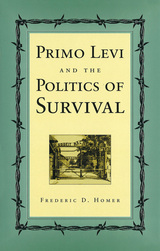
At the age of twenty-five, Primo Levi was sent to Hell. Levi, an Italian chemist from Turin, was one of many swept up in the Holocaust of World War II and sent to die in the German concentration camp in Auschwitz. Of the 650 people transported to the camp in his group, only 15 men and 9 women survived. After Soviet liberation of the camp in 1945, Levi wrote books, essays, short stories, poetry, and a novel, in which he painstakingly described the horrors of his experience at Auschwitz. He also spent the rest of his life struggling with the fact that he was not among those who were killed.
In Primo Levi and the Politics of Survival, Frederic D. Homer looks at Primo Levi's life but, more important, shows him to be a significant political philosopher. In the course of his writings, Levi asked and answered his most haunting question: can someone be brutalized by a terrifying experience and, upon return to "ordinary life," recover from the physical and moral destruction he has suffered? Levi used this question to develop a philosophy positing that although man is no match for life, he can become better prepared to contend with the tragedies in life.
According to Levi, the horrors of the world occur because of the strength of human tendencies, which make relationships between human beings exceedingly fragile. He believed that we are ill-constituted beings who have tendencies toward violence and domination, dividing ourselves into Us and Them, with very shallow loyalties. He also maintained that our only refuge is in education and responsibility, which may counter these tendencies. Homer calls Levi's philosophy "optimistic pessimism."
As Homer demonstrates, Levi took his past experiences into account to determine that goodwill and democratic institutions do not come easily to people. Liberal society is to be earned through discipline and responsibility toward our weaknesses. Levi's answer is "civilized liberalism." To achieve this we must counter some of our most stubborn tendencies.
Homer also explores the impact of Levi's death, an apparent suicide, on the way in which his work and theories have been perceived. While several critics discount Levi's work because of the nature of his death, Homer argues that his death is consistent with his philosophy. A book rich in brutally honest philosophy, Primo Levi and the Politics of Survival compels one to look at serious questions about life, tragedy, optimism, solidarity, violence, and human nature.

Lessons from Bologna on how ordinary people take charge of urban spaces and make their cities more democratic
Proprietors for a Democratic City examines how nonelite individuals politically engage with urban spaces—even when they do not formally own them. Drawing on more than a decade of fieldwork throughout Bologna, Italy, Robin M. LeBlanc presents valuable models of democratic community-making through imaginative occupation, curation, and coalition-building projects, with critical implications for the study of cities and democracy.
Once a standard-bearer of progressive governance, contemporary Bologna now faces globally emergent challenges to its democratic functioning, from a lack of affordable housing to the rise of an authoritarian and xenophobic Far Right. But amid this precarity, everyday citizens employ the spaces around them to influence the political life of the city. Through interviews with a wide range of Bolognese, from urban planners and real estate developers to housing office staff, retirees in public gardening plots, and members of immigrant and youth squatter collectives, LeBlanc illuminates the humble origins of coalitional work that can meaningfully address today’s urban economic, environmental, and demographic crises.
Challenging both capitalistic and Marxist conventional wisdom, Proprietors for a Democratic City is a vivid portrait of the urban landscape and an inspiring call to empower regular people to create vibrant democratic spaces.
Retail e-book files for this title are screen-reader friendly with images accompanied by short alt text and/or extended descriptions.
Explores the way Italian women writers craft identities through writing.
In this important volume, Graziella Parati examines the ways in which Italian women writers articulate their identities through autobiography—a public act that is also the creation of a private life. Considering autobiographical writings by five women writers from the seventeenth century to the present, Parati draws important connections between self-writing and the debate over women’s roles, both traditional and transgressive.
Parati considers the first prose autobiography written by an Italian woman -Camilla Faà Gonzaga’s 1622 memoir—as her beginning point, citing it as a central “pre-text.” In her memoir, Gonzaga makes explicit her conflict over the public silence imposed on her, yet succeeds in writing herself into history through self-narrative. Parati then examines Enif Robert’s autobiography, in which Robert strives to enter the public sphere of the post-World War I futurist movement by writing about her fight to overcome cancer of the uterus. Next, Parati considers Fausta Cialente’s life story, an account of her family's life in Trieste from World War I through the fascist era, as well as the narrative in which Rita Levi Montalcini describes her life as a woman, a Nobel-Prize winning scientist, and a Jew who lived under fascism in the thirties and forties. Finally, Parati analyzes Luisa Passerini's look back on her involvement with the student movement of 1968. Through her discussion of these women’s writings, Parati demonstrates the complex negotiations over identity contained within them, negotiations that challenge dichotomies between male and female, maternal and paternal, and private and public. Public History, Private Stories is a compelling exploration of the disparate identities created by these women through the act of writing autobiography.
buildings, commercial graphics, signs, epitaphs on tombstones,
graffiti—is a fixture of urban life. In Public
Lettering, Armando Petrucci reconstructs the history of
public writing in the West and traces its social functions
from the eleventh century through the modern period.
Taking the city of Rome as a case study, Petrucci begins
with a consideration of the first civic inscriptions after
ancient times. Substantial chapters on the uses of public
writing in the industrial revolution and the early twentieth
century prepare the way for his provocative discussions of
public lettering in the the contexts of fascism, post-war
radicalism, and the student revolutions of 1968 and 1977.
Throughout, Petrucci is concerned with the relations
between the functions and styles of letters and the places
where they appear. Writing, he argues, is one of the
instruments of public power; display lettering is often the
image and mirror of power itself, making the social use of
written forms a type of conquest. Because of Rome's role as
a “World-City,” Petrucci's interdisciplinary study has
wide-ranging implications for our understanding of the social
function of graphic design.
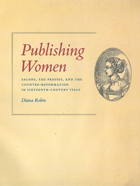
Even the most comprehensive Renaissance histories have neglected the vibrant groups of women writers that emerged in cities across Italy during the mid-1500s—and the thriving network of printers, publishers, and agents that specialized in producing and selling their books. In Publishing Women, Diana Robin finally brings to life this story of women’s cultural and intellectual leadership in early modern Italy, illuminating the factors behind—and the significance of—their sudden dominance.
Focusing on the collective publication process, Robin portrays communities in Naples, Venice, Rome, Siena, and Florence, where women engaged in activities that ranged from establishing literary salons to promoting religious reform. Her innovative cultural history considers the significant roles these women played in tandem with men, rather than separated from them. In doing so, it collapses the borders between women’s history, Renaissance and Reformation studies, and book history to evoke a historical moment that catapulted women’s writings and women-sponsored books into the public sphere for the first time anywhere in Europe.
READERS
Browse our collection.
PUBLISHERS
See BiblioVault's publisher services.
STUDENT SERVICES
Files for college accessibility offices.
RECENTLY PUBLISHED



UChicago Accessibility Resources
home | accessibility | search | about | contact us
BiblioVault ® 2001 - 2026
The University of Chicago Press