
 A SCHOLARLY BOOK REPOSITORY
270 start with S start with S
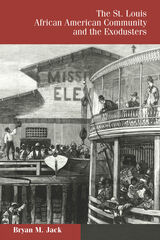
In the aftermath of the Civil War, thousands of former slaves made their way from the South to the Kansas plains. Called “Exodusters,” they were searching for their own promised land. Bryan Jack now tells the story of this American exodus as it played out in St. Louis, a key stop in the journey west.
Many of the Exodusters landed on the St. Louis levee destitute, appearing more as refugees than as homesteaders, and city officials refused aid for fear of encouraging more migrants. To the stranded Exodusters, St. Louis became a barrier as formidable as the Red Sea, and Jack tells how the city’s African American community organized relief in response to this crisis and provided the migrants with funds to continue their journey.
The St. Louis African American Community and the Exodusters tells of former slaves such as George Rogers and Jacob Stevens, who fled violence and intimidation in Louisiana and Mississippi. It documents the efforts of individuals in St. Louis, such as Charlton Tandy, Moses Dickson, and Rev. John Turner, who reached out to help them. But it also shows that black aid to the Exodusters was more than charity. Jack argues that community support was a form of collective resistance to white supremacy and segregation as well as a statement for freedom and self-direction—reflecting an understanding that if the Exodusters’ right to freedom of movement was limited, so would be the rights of all African Americans. He also discusses divisions within the African American community and among its leaders regarding the nature of aid and even whether it should be provided.
In telling of the community’s efforts—a commitment to civil rights that had started well before the Civil War—Jack provides a more complete picture of St. Louis as a city, of Missouri as a state, and of African American life in an era of dramatic change. Blending African American, southern, western, and labor history, The St. Louis African American Community and the Exodusters offers an important new lens for exploring the complex racial relationships that existed within post-Reconstruction America.
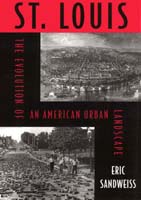
In this book, Eric Sandweiss scrutinizes the everyday landscape -- streets, houses, neighborhoods, and public buildings -- as it evolved in a classic American city. Bringing to life the spaces that most of us pass without noticing, he reveals how the processes of dividing, trading, improving, and dwelling upon land are acts that reflect and shape social relations. From its origins as a French colonial settlement in the eighteenth century to the present day, St. Louis offers a story not just about how our past is diagrammed in brick and asphalt, but also about the American city's continuing viability as a place where the balance of individual rights and collective responsibilities can be debated, demonstrated and adjusted for generations to come.
Through a comprehensive study of changing pottery attributes, Saunders documents the clash of Spanish and Native American cultures in the 16th-century southeastern United States.
By studying the ceramic traditions of the Guale Indians, Rebecca Saunders provides evidence of change in Native American lifeways from prehistory through European contact and the end of the Mission period. The Guale were among the first southeastern groups to come into contact with Spanish and French colonists, and they adapted various strategies in order to ensure their own social survival. That adaptation is reflected, Saunders shows, in the changing attributes of pottery recovered on archaeological sites on the coasts of Georgia and Florida.
Saunders traces the evolution of Guale pottery from the late prehistoric Irene phase through the Mission period at the three archaeological sites. She uses both technological and stylistic attributes to monitor change, paying particular attention to changes in execution and frequency of the filfot cross—a stylized cross that is a symbol of Guale cosmology. The frequency of this symbol in different ceramic components, according to Saunders, is a measure of change in the worldview of the missionized Guale. Although the symbol abruptly changed after the first Spanish contact, it showed remarkable stability through the Mission period, suggesting that traditional craft training and production remained strong despite high mortality rates and frequent relocation.
Only after 1684, when the Guale were relocated to Amelia Island in present-day Florida, did the use of the cross motif decline, suggesting that the Guale who remained in Spanish territory may have conceived of their place in the cosmos differently from their forebears or their contemporaries who fled to the interior.
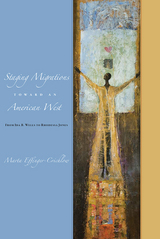
Four case studies consider how the featured women—activist Ida B. Wells, singer Sissieretta "Black Patti” Jones, World War II black female defense-industry workers, and performance artist Rhodessa Jones—imagined and experienced the American West geographically and symbolically at different historical moments. Dissecting the varied ways they used migration to survive in the world from the viewpoint of theater and performance theory, Effinger-Crichlow reconceptualizes the migration histories of black women in nineteenth- and twentieth-century America.
This interdisciplinary study expands the understanding of the African American struggle for unconstrained movement and full citizenship in the United States and will interest students and scholars of American and African American history, women and gender studies, theater, and performance theory.
Winner of the 2020 Robert E. Park Award for Best Book from the Community and Urban Sociology Section of the American Sociological Association
Winner of the 2020 Distinguished Contribution to Research Award from the Latino/a Section of the American Sociological Association
Honorable Mention for the 2020 Thomas and Znaniecki Award from the International Migration Section of the American Sociological Association
A quarter of young adults in the U.S. today are the children of immigrants, and Latinos are the largest minority group. In Stagnant Dreamers, sociologist and social policy expert María Rendón follows 42 young men from two high-poverty Los Angeles neighborhoods as they transition into adulthood. Based on in-depth interviews and ethnographic observations with them and their immigrant parents, Stagnant Dreamers describes the challenges they face coming of age in the inner city and accessing higher education and good jobs, and demonstrates how family-based social ties and community institutions can serve as buffers against neighborhood violence, chronic poverty, incarceration, and other negative outcomes.
Neighborhoods in East and South Central Los Angeles were sites of acute gang violence that peaked in the 1990s, shattering any romantic notions of American life held by the immigrant parents. Yet, Rendón finds that their children are generally optimistic about their life chances and determined to make good on their parents’ sacrifices. Most are strongly oriented towards work. But despite high rates of employment, most earn modest wages and rely on kinship networks for labor market connections. Those who made social connections outside of their family and neighborhood contexts, more often found higher quality jobs. However, a middle-class lifestyle remains elusive for most, even for college graduates.
Rendón debunks fears of downward assimilation among second-generation Latinos, noting that most of her subjects were employed and many had gone on to college. She questions the ability of institutions of higher education to fully integrate low-income students of color. She shares the story of one Ivy League college graduate who finds himself working in the same low-wage jobs as his parents and peers who did not attend college. Ironically, students who leave their neighborhoods to pursue higher education are often the most exposed to racism, discrimination, and classism.
Rendón demonstrates the importance of social supports in helping second-generation immigrant youth succeed. To further the integration of second-generation Latinos, she suggests investing in community organizations, combating criminalization of Latino youth, and fully integrating them into higher education institutions. Stagnant Dreamers presents a realistic yet hopeful account of how the Latino second generation is attempting to realize its vision of the American dream.
Author Judy Rohrer brings together an analysis of racial formation and colonization in the islands through a study of legal cases, contemporary public discourse (local media and literature), and Hawai‘i scholarship. Her analysis exposes how racialization works to obscure—with the ultimate goal of eliminating—native Hawaiian indigeneity, homeland, nation, and sovereignty.
Staking Claim argues that the dual settler colonial processes of racializing native Hawaiians (erasing their indigeneity), and indigenizing non-Hawaiians, enable the staking of non-Hawaiian claims to Hawai‘i. It encourages us to think beyond a settler-native binary by analyzing the ways racializations of Hawaiians and various non-Hawaiian settlers and arrivants bolster settler colonial claims, structures, and white supremacist ideologies.

Looking back at what might have happened in 1976, the author discovers a Bicentennial year steeped in recession, racism, and unrelenting violence. It was also a time of flourishing second-wave feminism, when young women were encouraged to do anything, if only they knew how. Stamford was in the midst of urban renewal, destroying historically black neighborhoods to create space for corporations escaping a bankrupt and dangerous New York City, just forty miles away. Organized crime followed the money, infiltrating Stamford at all levels. The author reveals how racism, misogyny, the economy, and corruption affected the young people’s daily lives, and helped lead Margo and Howie to their deaths.
Standing in the Need presents an intimate account of an African American family’s ordeal after Hurricane Katrina. Before the storm struck, this family of one hundred fifty members lived in the bayou communities of St. Bernard Parish just outside New Orleans. Rooted there like the wild red iris of the coastal wetlands, the family had gathered for generations to cook and share homemade seafood meals, savor conversation, and refresh their interconnected lives.
In this lively narrative, Katherine Browne weaves together voices and experiences from eight years of post-Katrina research. Her story documents the heartbreaking struggles to remake life after everyone in the family faced ruin. Cast against a recovery landscape managed by outsiders, the efforts of family members to help themselves could get no traction; outsiders undermined any sense of their control over the process. In the end, the insights of the story offer hope. Written for a broad audience and supported by an array of photographs and graphics, Standing in the Need offers readers an inside view of life at its most vulnerable.

That long-standing dichotomy is challenged in this new ethnography by anthropologist José Kelly. Kelly places the study of culture and cosmology squarely within the context of the modern nation-state and its institutions. He explores Indian-white relations as seen through the operation of a state-run health system among the indigenous Yanomami of southern Venezuela.
With theoretical foundations in the fields of medical and Amazonian anthropology, Kelly sheds light on how Amerindian cosmology shapes concepts of the state at the community level. The result is a symmetrical anthropology that treats white and Amerindian perceptions of each other within a single theoretical framework, thus expanding our understanding of each group and its influences on the other. This book will be valuable to those studying Amazonian peoples, medical anthropology, development studies, and Latin America. Its new takes on theory and methodology make it ideal for classroom use.
The circumstances affecting many African American males in schools and society remain complex and problematic. In spite of modest gains in school achievement and graduation rates, conditions that impede the progress of African American males persist: high rates of school violence and suspensions, overrepresentation in special education classes, poor access to higher education, high incidence of crime and incarceration, gender and masculine identity issues, and HIV/AIDS and other health crises.
The essays gathered here focus on these issues as they exist for males in grades K-12 and postsecondary education in Michigan. However, the authors intend their analyses and policy recommendations to apply to African American males nationally.
Although it recognizes the current difficulties of this population overall, this is an optimistic volume, with a goal of creating policies and norms that help African American males achieve their educational and social potential. In this era of widespread change for all members of American society-regardless of race-this book is a must-read for educators and policymakers alike.
That was over twenty years ago. Since then, the United States has experienced unprecedented wealth, more youth enrolling in higher education than ever before, and technology advancements far beyond what many in the 1980s dreamed possible. And yet, the state of the American mind seems to have deteriorated further. Benjamin Franklin’s “self-made man” has become a man dependent on the state. Independence has turned into self-absorption. Liberty has been curtailed in the defense of multiculturalism.
In order to fully grasp the underpinnings of this shift away from the self-reliant, well-informed American, editors Mark Bauerlein and Adam Bellow have brought together a group of cultural and educational experts to discuss the root causes of the decline of the American mind. The writers of these fifteen original essays include E. D. Hirsch, Nicholas Eberstadt, and Dennis Prager, as well as Daniel Dreisbach, Gerald Graff, Richard Arum, Robert Whitaker, David T. Z. Mindich, Maggie Jackson, Jean Twenge, Jonathan Kay, Ilya Somin, Steve Wasserman, Greg Lukianoff, and R. R. Reno. Their essays are compiled into three main categories:
- States of Mind: Indicators of Intellectual and Cognitive Decline
- These essays broach specific mental deficiencies among the population, including lagging cultural IQ, low Biblical literacy, poor writing skills, and over-medication.
- Personal and Cognitive Habits/Interests
- These essays turn to specific mental behaviors and interests, including avoidance of the news, short attention spans, narcissism, and conspiracy obsessions.
- National Consequences
- These essays examine broader trends affecting populations and institutions, including rates of entitlement claims, voting habits, and a low-performing higher education system.

Never before have Americans been so anxious about the future of their society. But rarely has anyone offered a clear statement about why, in a nation so prosperous, free, and stable, we tend to assume that the country is in dire straits and that the government can do little to help. This book is just such a statement, an eloquent assessment of where America stands, how our society has changed in the past half-century, and who or what is responsible for our current frustrations.
Derek Bok examines the nation's progress in five areas that Americans generally consider to be of paramount importance: economic prosperity, quality of life, opportunity, personal security, and societal values. He shows that although we are better off today in most areas than we were in 1960, we have performed poorly overall compared with other leading industrial nations. And when it comes to providing adequate health care at a reasonable cost, educating our young people for high-skilled jobs, alleviating poverty and urban blight, and reducing crime, our record has been dismal. Comparing the United States with other leading industrial nations on more than sixty key indicators, Bok shows that we rank below average in more than two-thirds of the cases and at the bottom in more than half.
What has caused this decline, and what can be done about it? In virtually all important areas of American life, Bok concludes, government policies have played a significant, often decisive role in accounting for our successes as well as our failures. But whereas others call for downsizing the federal government, Bok argues that government is essential to achieving America's goals. In short, Ronald Reagan was only half right. Government is the problem. But it is also the most important part of the solution. By assessing the state of the nation and identifying the reasons for its current condition, this book helps set the agenda for improving America's performance in the future.
Winner: 2005 Book Award from the Society for the Study of Early Modern Women; Selected by the German Studies Association as one of the top five books of 2004 in early modern history
"A fresh, original study of gender roles and religious ideology in the early modern Catholic state. . . . Using a rich array of archival sources, Strasser explores ways in which an increasingly centralized Bavarian government in Munich inaugurated marriage and convent reforms and a civil religion based on the veneration of the Virgin Mary. Her carefully selected case studies show how church and state collaborated to produce a shared discourse and consistent policies proscribing extramarital sex, and excluding those without property from marriage. "
Ulrike Strasser is Associate Professor of History, Affiliate Faculty in Women's Studies, and Core Faculty in Religious Studies at the University of California, Irvine.
The State You See uncovers a racial gap in the way the American government appears in people’s lives. It makes it clear that public policy changes over the last fifty years have driven all Americans to distrust the government that they see in their lives, even though Americans of different races are not seeing the same kind of government.
For white people, these policy changes have involved a rising number of generous benefits submerged within America’s tax code, which taken together cost the government more than Social Security and Medicare combined. Political attention focused on this has helped make welfare and taxes more visible representations of government for white Americans. As a result, white people are left with the misperception that government does nothing for them, apart from take their tax money to spend on welfare. Distrust of government is the result. For people of color, distrust is also rampant but for different reasons. Over the last fifty years, America has witnessed increasingly overbearing policing and swelling incarceration numbers. These changes have disproportionately impacted communities of color, helping to make the criminal legal system a unique visible manifestation of government in these communities.
While distrust of government emerges in both cases, these different roots lead to different consequences. White people are mobilized into politics by their distrust, feeling that they must speak up in order to reclaim their misspent tax dollars. In contrast, people of color are pushed away from government due to a belief that engaging in American elections will yield the same kind of unresponsiveness and violence that comes from interactions with the police. The result is a perpetuation of the same kind of racial inequality that has always been present in American democracy. The State You See is essential reading for anyone interested in understanding how the American government engages in subtle forms of discrimination and how it continues to uphold racial inequality in the present day.

States of Grace was first published in 1997. Minnesota Archive Editions uses digital technology to make long-unavailable books once again accessible, and are published unaltered from the original University of Minnesota Press editions.
Leaving their depleted fields for better prospects, Senegalese immigrants have made their way to Italy in significant numbers. What this migration means, in the context of both the migratory traditions and conditions of Africa and the history and future of the European nation-state, is the subject of this timely and ambitious book.
Focusing on Turin, the northern Italian point of entry for so many Senegalese, States of Grace chronicles the arrival and formation of a transnational African Islamic community in a largely Catholic Western European country, one that did not have immigrant legislation until 1991. With no colonial relation to Italy, the Senegalese represent the vanguard of population movements expanding outside of the arch of former colonial powers.
Donald Martin Carter locates the Senegalese migration in the context of past African internal and international migration and of present crises in West African agriculture. He also shows how the Senegalese migration, constituting a "phenomenon" and catalyzing new immigration restrictions among European states, calls into question the European interstate system, the future of the nation-state, and the nature of its relationship with non-European states.
Throughout Europe, protectionist immigration policies are often crafted in chauvinist and racist tones in which "migrants" is a euphemism for blacks, Arabs, and Asians. States of Grace uses Senegalese migration to demonstrate that racial conceptions are crucial to understanding the classifications of non-national "outside" and internal "other." The book is a bracing encounter with the ever-increasing cultural and ethnic heterogeneity that is the new and pressing reality of European society.
Donald Martin Carter is visiting assistant professor of anthropology at Johns Hopkins University.
Referring discreetly to her own experience, Woodward examines the interpenetration of social structures and subjectivity, considering how psychological emotions are social phenomena, with feminist anger, racial shame, old-age depression, and sympathy for non-human cyborgs (including robots) as key cases in point. She discusses how emerging institutional and discursive structures engender “new” affects that in turn can help us understand our changing world if we are attentive to them—the “statistical panic” produced by the risk society, with its numerical portents of disease and mortality; the rage prompted by impenetrable and bloated bureaucracies; the brutal shame experienced by those caught in the crossfire of the media; and the conservative compassion that is not an emotion at all, only an empty political slogan.
The orbit of Statistical Panic is wide, drawing in feminist theory, critical phenomenology, and recent theories of the emotions. But at its heart are stories. As an antidote to the vacuous dramas of media culture, with its mock emotions and scattershot sensations, Woodward turns to the autobiographical narrative. Stories of illness—by Joan Didion, Yvonne Rainer, Paul Monette, and Alice Wexler, among others—receive special attention, with the inexhaustible emotion of grief framing the book as a whole.

What led to the breakdown of the Soviet Union? Steven Solnick argues, contrary to most current literature, that the Soviet system did not fall victim to stalemate at the top or to a revolution from below, but rather to opportunism from within. In three case studies--on the Communist Youth League, the system of job assignments for university graduates, and military conscription--Solnick makes use of rich archival sources and interviews to tell the story from a new perspective, and to employ and test Western theories of the firm in the Soviet environment. He finds that even before Gorbachev, mechanisms for controlling bureaucrats in Soviet organizations were weak, allowing these individuals great latitude in their actions. Once reforms began, they translated this latitude into open insubordination by seizing the very organizational assets they were supposed to be managing. Thus, the Soviet system, Solnick argues, suffered the organizational equivalent of a colossal bank run. When the servants of the state stopped obeying orders from above, the state's fate was sealed.
By incorporating economic theories of institutions into a political theory of Soviet breakdown and collapse, Stealing the State offers a powerful and dynamic account of the most important international political event of the later twentieth century.
A unique and important study, Stepping Forward examines the experiences of nineteenth- and twentieth-century black women in Africa and African diaspora communities from a variety of perspectives in a number of different settings.
This wide-ranging collection designed for classroom use explores the broad themes that have shaped black women’s goals, options, and responses: religion, education, political activism, migration, and cultural transformation. Essays by leading scholars in the field examine the lives of black women in the United States and the Caribbean Basin; in the white settler societies of Kenya, Zimbabwe, and South Africa; and in the black settler societies of Liberia and Sierra Leone.
Among the contributors to this volume are historians, political scientists, and scholars of literature, music, and law. What emerges from their work is an image of black women’s agency, self-reliance, and resiliency. Despite cultural differences and geographical variations, black women have provided foundations on which black communities have not only survived, but also thrived. Stepping Forward is a valuable addition to our understanding of women’s roles in these diverse communities.
Matory describes the competitive process that hierarchically structures their self-definition as ethnic groups and the similar process by which middle-class African Americans seek distinction from their impoverished compatriots. Drawing on research at universities such as Howard, Harvard, and Duke and among their alumni networks, he details how university life—while facilitating individual upward mobility, touting human equality, and regaling cultural diversity—also perpetuates the cultural standards that historically justified the dominance of some groups over others. Combining his ethnographic findings with classic theoretical insights from Frantz Fanon, Fredrik Barth, Erving Goffman, Pierre Bourdieu and others—alongside stories from his own life in academia—Matory sketches the university as an institution that, particularly through the anthropological vocabulary of culture, encourages the stigmatized to stratify their own.
Blauner launched his concept of internal colonialism in the turbulent 1960's, a period in which many Americans worried that racial conflicts would propel the country into another civil war. The notion that the systematic oppression of people of color in the United States resembles the situation of colonized populations in Third World countries still informs much of the academic research on race as well as public discourse. Indeed, today's critical race and whiteness studies are deeply indebted to Blauner's work on internal colonialism and the pervasiveness of white privilege. Offering a radical perspective on the United States' racial landscape, Bob Blauner forcefully argues that we ignore the persistence of oppression and our continuing failure to achieve equality at our own peril.
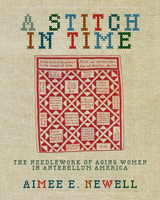
Drawing from 167 examples of decorative needlework—primarily samplers and quilts from 114 collections across the United States—made by individual women aged forty years and over between 1820 and 1860, this exquisitely illustrated book explores how women experienced social and cultural change in antebellum America.
The book is filled with individual examples, stories, and over eighty fine color photographs that illuminate the role that samplers and needlework played in the culture of the time. For example, in October 1852, Amy Fiske (1785–1859) of Sturbridge, Massachusetts, stitched a sampler. But she was not a schoolgirl making a sampler to learn her letters. Instead, as she explained, “The above is what I have taken from my sampler that I wrought when I was nine years old. It was w[rough]t on fine cloth [and] it tattered to pieces. My age at this time is 66 years.”
Situated at the intersection of women’s history, material culture study, and the history of aging, this book brings together objects, diaries, letters, portraits, and prescriptive literature to consider how middle-class American women experienced the aging process. Chapters explore the physical and mental effects of “old age” on antebellum women and their needlework, technological developments related to needlework during the antebellum period and the tensions that arose from the increased mechanization of textile production, and how gift needlework functioned among friends and family members. Far from being solely decorative ornaments or functional household textiles, these samplers and quilts served their own ends. They offered aging women a means of coping, of sharing and of expressing themselves. These “threads of time” provide a valuable and revealing source for the lives of mature antebellum women.
Publication of this book was made possible in part through generous funding from the Coby Foundation, Ltd and from the Quilters Guild of Dallas, Helena Hibbs Endowment Fund.
Stories of Freedom in Black New York recreates the experience of black New Yorkers as they moved from slavery to freedom. In the early decades of the nineteenth century, New York City's black community strove to realize what freedom meant, to find a new sense of itself, and, in the process, created a vibrant urban culture. Through exhaustive research, Shane White imaginatively recovers the raucous world of the street, the elegance of the city's African American balls, and the grubbiness of the Police Office. It allows us to observe the style of black men and women, to watch their public behavior, and to hear the cries of black hawkers, the strident music of black parades, and the sly stories of black conmen.
Taking center stage in this story is the African Company, a black theater troupe that exemplified the new spirit of experimentation that accompanied slavery's demise. For a few short years in the 1820s, a group of black New Yorkers, many of them ex-slaves, challenged pervasive prejudice and performed plays, including Shakespearean productions, before mixed race audiences. Their audacity provoked feelings of excitement and hope among blacks, but often of disgust by many whites for whom the theater's existence epitomized the horrors of emancipation.
Stories of Freedom in Black New York brilliantly intertwines black theater and urban life into a powerful interpretation of what the end of slavery meant for blacks, whites, and New York City itself. White's story of the emergence of free black culture offers a unique understanding of emancipation's impact on everyday life, and on the many forms freedom can take.
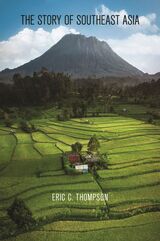
The oldest figurative cave paintings in the world are found on the island of Sulawesi in Indonesia. Hand stencils and animals painted some 45,000 years ago attest to a long history of human creativity. The Story of Southeast Asia tells how the peoples of the region have crafted their diverse societies and cultures over thousands of years. Southeast Asia has been a remarkable crossroads of global connections for millennia. Whereas other regions have been defined by centralizing forces, Southeast Asia’s story is one of complex networks of trade, ideas, and social relationships. Southeast Asians have created, localized, and remade their own cultural values by drawing on influences from around the world.
Marshalling the latest literature from anthropology, archaeology, history, and other disciplines, Eric C. Thompson highlights broad themes that cut across history: including the making—and evasion—of states, adoption of diverse religious practices, tolerance and flexibility regarding gender, processes of forging modern identities, struggles over sovereignty, and the making of modern nations in a postcolonial world. This readable, single-volume history reckons with the narrative pull of familiar colonial and national perspectives but maintains a regional and deep-historical focus. It will be a stimulating read for scholars as well as students and newcomers to Southeast Asian history.
By the mid-1980s, Korea's economic and political situation was becoming volatile. Labor relations were especially contentious. The Strains of Economic Growth, a collaborative research project between the Harvard Institute for International Development and the Korea Development Institute provides an analytic history of the economic causes of the labor unrest and popular discontent of the late 1980s. Set against rapid increases in wages and employment, worker dissatisfaction is traced to patterns of income inequality and to non-pecuniary dimensions of working life, including the suppression of labor organizations. The desire for greater political freedom also played an important role in the unprecedented unrest of this period.
The conclusions of this volume are essential for understanding the labor struggles that continue in Korea today and are highly relevant for policy makers from other emerging economies that wish to benefit from both the successes and failures of Korea's experience.
Song considers works that address the riots and often the traumatic place of the Korean American community within them: the independent documentary Sa-I-Gu (Korean for April 29, the date the riots began), Chang-rae Lee’s novel Native Speaker, the commercial film Strange Days, and the experimental drama of Anna Deavere Smith, among many others. He describes how cultural producers have used the riots to examine the narrative of national decline, manipulating language and visual elements, borrowing and refashioning familiar tropes, and, perhaps most significantly, repeatedly turning to metaphors of bodily suffering to convey a sense of an unraveling social fabric. Song argues that these aesthetic experiments offer ways of revisiting the traumas of the past in order to imagine more survivable futures.
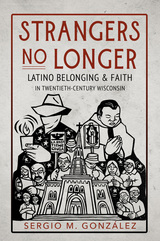
Hospitality practices grounded in religious belief have long exercised a profound influence on Wisconsin’s Latino communities. Sergio M. González examines the power relations at work behind the types of hospitality--welcoming and otherwise--practiced on newcomers in both Milwaukee and rural areas of the Badger State. González’s analysis addresses central issues like the foundational role played by religion and sacred spaces in shaping experiences and facilitating collaboration among disparate Latino groups and across ethnic lines; the connections between sacred spaces and the moral justification for social justice movements; and the ways sacred spaces evolved into places for mitigating prejudice and social alienation, providing sanctuary from nativism and repression, and fostering local and transnational community building.
Perceptive and original, Strangers No Longer reframes the history of Latinos in Wisconsin by revealing religion’s central role in the settlement experience of immigrants, migrants, and refugees.
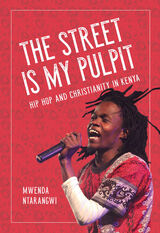
Mwenda Ntarangwi explores the Kenyan hip hop scene through the lens of Juliani's life and career. A born-again Christian, Juliani produces work highlighting the tensions between hip hop's forceful self-expression and a pious approach to public life, even while contesting the basic presumptions of both. In The Street Is My Pulpit, Ntarangwi forges an uncommon collaboration with his subject that offers insights into Juliani's art and goals even as Ntarangwi explores his own religious experience and subjective identity as an ethnographer. What emerges is an original contribution to the scholarship on hip hop's global impact and a passionate study of the music's role in shaping new ways of being Christian in Africa.
Winner, Warren Dean Memorial Prize, Conference on Latin American History (CLAH), 2018
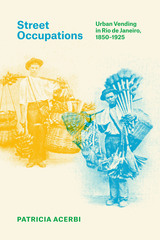
Street vending has supplied the inhabitants of Rio de Janeiro with basic goods for several centuries. Once the province of African slaves and free blacks, street commerce became a site of expanded (mostly European) immigrant participation and shifting state regulations during the transition from enslaved to free labor and into the early post-abolition period. Street Occupations investigates how street vendors and state authorities negotiated this transition, during which vendors sought greater freedom to engage in commerce and authorities imposed new regulations in the name of modernity and progress.
Examining ganhador (street worker) licenses, newspaper reports, and detention and court records, and considering the emergence of a protective association for vendors, Patricia Acerbi reveals that street sellers were not marginal urban dwellers in Rio but active participants in a debate over citizenship. In their struggles to sell freely throughout the Brazilian capital, vendors asserted their citizenship as urban participants with rights to the city and to the freedom of commerce. In tracing how vendors resisted efforts to police and repress their activities, Acerbi demonstrates the persistence of street commerce and vendors’ tireless activity in the city, which the law eventually accommodated through municipal street commerce regulation passed in 1924.
A focused history of a crucial era of transition in Brazil, Street Occupations offers important new perspectives on patron-client relations, slavery and abolition, policing, the use of public space, the practice of free labor, the meaning of citizenship, and the formality and informality of work.

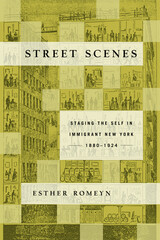
Street Scenes focuses on the intersection of modern city life and stage performance. From street life and slumming to vaudeville and early cinema, to Yiddish theater and blackface comedy, Esther Romeyn discloses racial comedy, passing, and masquerade as gestures of cultural translation. In these performances she detects an obsession with the idea of the city as theater and the self as actor, which was fueled by the challenges that consumer capitalism presented to notions of an “authentic” self.
It was exactly this idea of “authentic” immigrant selfhood that was at stake in many performances on the popular stage, and Romeyn ultimately demonstrates how these diverse and potent immigrant works influenced the emergence of a modern metropolitan culture.
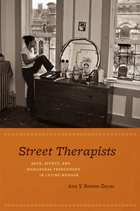
Drawing from almost a decade of ethnographic research in largely Brazilian and Puerto Rican neighborhoods in Newark, New Jersey, Ana Y. Ramos-Zayas, in Street Therapists,examines how affect, emotion, and sentiment serve as waypoints for the navigation of interracial relationships among US-born Latinos, Latin American migrants, blacks, and white ethnics. Tackling a rarely studied dynamic approach to affect, Ramos-Zayas offers a thorough—and sometimes paradoxical—new articulation of race, space, and neoliberalism in US urban communities.
After looking at the historical, political, and economic contexts in which an intensified connection between affect and race has emerged in Newark, New Jersey, Street Therapists engages in detailed examinations of various community sites—including high schools, workplaces, beauty salons, and funeral homes, among others—and secondary sites in Belo Horizonte, Brazil and San Juan to uncover the ways US-born Latinos and Latin American migrants interpret and analyze everyday racial encounters through a language of psychology and emotions. As Ramos-Zayas notes, this emotive approach to race resurrects Latin American and Caribbean ideologies of “racial democracy” in an urban US context—and often leads to new psychological stereotypes and forms of social exclusion. Extensively researched and thoughtfully argued, Street Therapists theorizes the conflictive connection between race, affect, and urban neoliberalism.
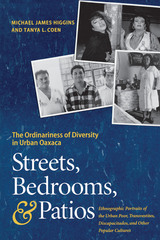
Diversity characterizes the people of Oaxaca, Mexico. Within this city of half a million, residents are rising against traditional barriers of race and class, defining new gender roles, and expanding access for the disabled. In this rich ethnography of the city, Michael Higgins and Tanya Coen explore how these activities fit into the ordinary daily lives of the people of Oaxaca.
Higgins and Coen focus their attention on groups that are often marginalized—the urban poor, transvestite and female prostitutes, discapacitados (the physically challenged), gays and lesbians, and artists and intellectuals. Blending portraits of and comments by group members with their own ethnographic observations, the authors reveal how such issues as racism, sexism, sexuality, spirituality, and class struggle play out in the people's daily lives and in grassroots political activism. By doing so, they translate the abstract concepts of social action and identity formation into the actual lived experiences of real people.
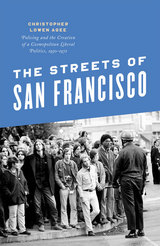
The Streets of San Francisco uncovers the seldom reported, street-level interactions between police officers and San Francisco residents and finds that police discretion was the defining feature of mid-century law enforcement. Postwar police officers enjoyed great autonomy when dealing with North Beach beats, African American gang leaders, gay and lesbian bar owners, Haight-Ashbury hippies, artists who created sexually explicit works, Chinese American entrepreneurs, and a wide range of other San Franciscans. Unexpectedly, this police independence grew into a source of both concern and inspiration for the thousands of young professionals streaming into the city's growing financial district. These young professionals ultimately used the issue of police discretion to forge a new cosmopolitan liberal coalition that incorporated both marginalized San Franciscans and rank-and-file police officers. The success of this model in San Francisco resulted in the rise of cosmopolitan liberal coalitions throughout the country, and today, liberal cities across America ground themselves in similar understandings of democracy, emphasizing both broad diversity and strong policing.
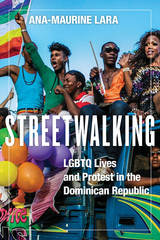
Streetwalking: LGBTQ Lives and Protest in the Dominican Republic is an exploration of the ways that lesbian, gay, bisexual, trans and queer persons exercise power in a Catholic Hispanic heteropatriarchal nation-state, namely the Dominican Republic. Lara presents the specific strategies employed by LGBTQ community leaders in the Dominican Republic in their struggle for subjectivity, recognition, and rights. Drawing on ethnographic encounters, film and video, and interviews, LGBTQ community leaders teach readers about streetwalking, confrontación, flipping the script, cuentos, and the use of strategic universalisms in the exercise of power and agency. Rooted in Maria Lugones's theorization of streetwalker strategies and Audre Lorde's theorization of silence and action, this text re-imagines the exercise and locus of power in examples provided by the living, thriving LGBTQ community of the Dominican Republic.
Sonja Mackenzie elegantly argues that structural vulnerability is felt—quite literally—in the blood, in the possibilities and constraints on sexual lives, and in the rhetorics of their telling. The circulation of structural intimacies in daily life and in the political domain reflects possibilities for seeking what Mackenzie calls intimate justice at the nexus of cultural, economic, political, and moral spheres. Structural Intimacies presents a compelling case: in an era of deepening medicalization of HIV/AIDS, public health must move beyond individual-level interventions to community-level health equity frames and policy changes

Rejecting the cliché about “weak identity and underdeveloped nationalism,” Bekus argues for the co-existence of two parallel concepts of Belarusianness—the official and the alternative one—which mirrors the current state of the Belarusian people more accurately and allows for a different interpretation of the interconnection between the democratization and nationalization of Belarusian society.
The book describes how the ethno-symbolic nation of the Belarusian nationalists, based on the cultural capital of the Golden Age of the Belarusian past (17th century) competes with the “nation” institutionalized and reified by the numerous civic rituals and social practices under the auspices of the actual Belarusian state.
Comparing the two concepts not only provides understanding of the logic that dominates Belarusian society’s self-description models, but also enables us to evaluate the chances of alternative Belarusianness to win this unequal struggle over identity.
In the 1960s, many believed that the civil rights movement’s successes would foster a new era of racial equality in America. Four decades later, the degree of racial inequality has barely changed. To understand what went wrong, Patrick Sharkey argues that we have to understand what has happened to African American communities over the last several decades. In Stuck in Place, Sharkey describes how political decisions and social policies have led to severe disinvestment from black neighborhoods, persistent segregation, declining economic opportunities, and a growing link between African American communities and the criminal justice system.
For decades, Marietta High was the flagship public school of a largely white suburban community in Cobb County, Georgia, just northwest of Atlanta. Today, as the school’s majority black and Latino students struggle with high rates of poverty and low rates of graduation, Marietta High has become a symbol of the wave of resegregation that is sweeping white students and students of color into separate schools across the American South.
Students of the Dream begins with the first generations of Marietta High desegregators authorized by the landmark Brown v. Board of Education ruling and follows the experiences of later generations who saw the dream of integration fall apart. Grounded in over one hundred interviews with current and former Marietta High students, parents, teachers, community leaders, and politicians, this innovative ethnographic history invites readers onto the key battlegrounds—varsity sports, school choice, academic tracking, and social activism—of Marietta’s struggle against resegregation. Well-intentioned calls for diversity and colorblindness, Ruth Carbonette Yow shows, have transformed local understandings of the purpose and value of school integration, and not always for the better.
The failure of local, state, or national policies to stem the tide of resegregation is leading activists—students, parents, and teachers—to reject traditional integration models and look for other ways to improve educational outcomes among African American and Latino students. Yow argues for a revitalized commitment to integration, but one that challenges many of the orthodoxies—including colorblindness—inherited from the mid-twentieth-century civil rights struggle.
This is a fascinating, lively, and well-written book. The author has a clear message which she states at the beginning, namely, that health is primarily an economic, not a medical problem, and she follows that to the end.Keith Griffin, University of California, Riverside
Houses made of rags and flattened soda cans, filthy water that breeds disease, counterfeit medicines, no access to decent medical care how can children growing up in such an environment become productive workers contributing to a developing economy?
Stunted Lives, Stagnant Economies describes in vivid detail the living conditions of the poor in developing countries and the diseases and injuries that result from this environment of need. Most of the diseases that affect the poor cholera, summer diarrhea, tuberculosis, lice, worms, leprosy result from the poverty of their environment. Poverty also determines the availability and effectiveness of the medical response. Using Argentina as a case study, Eileen Stillwaggon argues that making good health available to everyone is not a scientific problem but an economic one.
The debt crisis of the 1980s and the subsequent structural adjustment policies adopted by most developing countries exacerbated the problems faced by the poor. What kind of future can a nation build when the health of the majority of the population its workforceÑis at risk or compromised because social services have been reduced? Without adequate health care and social services, people cannot live up to their potential, and the spiral of poverty continues. But there are ways to fight this cycle of poverty.
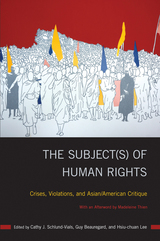
Human rights violations have always been part of Asian American studies. From Chinese immigration restrictions, the incarceration of Japanese Americans, yellow peril characterizations, and recent acts of deportation and Islamophobia, Asian Americans have consistently functioned as subordinated “subjects” of human rights violations. The Subject(s) of Human Rights brings together scholars from North America and Asia to recalibrate these human rights concerns from both sides of the Pacific.
The essays in this collection provide a sharper understanding of how Asian/Americans have been subjected to human rights violations, how they act as subjects of history and agents of change, and how they produce knowledge around such subjects. The editors of and contributors to The Subject(s) of Human Rights examine refugee narratives, human trafficking, and citizenship issues in twentieth- and twenty-first century literature. These themes further refract issues of American war-making, settler colonialism, military occupation, collateral damage, and displacement that relocate the imagined geographies of Asian America from the periphery to the center of human rights critique.
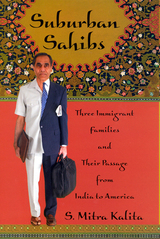
In this updated edition, journalist S. Mitra Kalita shows that although the reception from long-time residents has not been entirely welcoming, Indians have come to achieve economic success and their desire for political and social parity continues to grow stronger. She traces the evolution of the suburb from a destination for new arrivals to a launching pad for them.
In the late nineteenth century, tourists descended upon Edison to gawk at its Christmas lights displays. Today, thousands of Indians from all over the United States arrive in the same bedroom community to celebrate their own festivals of lights and colors. Suburban Sahibs attempts to answer the question of how and why they arrived, and offers a window into what America has become: a nation of suburbs as well as a nation of immigrants.
Will southern Africa explode? Are there alternatives to violent revolution? Can other countries assist South Africa, Namibia, and Zimbabwe in achieving majority rule? Or can the problems be solved only by the peoples of each nation? And what should be done by the West to aid development, encourage racial harmony, and promote the general welfare?
For more than a generation Robert Rotberg has visited and written about southern Africa. He has not only studied the history and politics of the area but also has steeped himself in the economic, environmental, and geographic factors that have helped create conflict there. Rotberg has blended sophisticated political knowledge with personal experience to recount the past and make possible an understanding of the future. The result is a timely, wise, and lucid portrait of three nations in search of a destiny. Suffer the Future is a balanced account aimed at making general readers, as well as students of international problems, aware of the realistic alternatives for policy in and toward southern Africa.
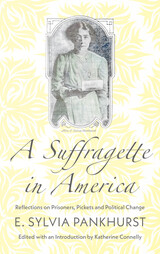
This book gathers Pankhurst’s writings from the year-long visit, in which she reveals her shock at the darkness hidden in American life, and draws parallels to her experiences of imprisonment and misogyny in her own country. Never before published, these writings mark an important stage in the development of the suffragette's thought, which she brought back to Britain to inform the burgeoning suffrage campaign there.
In this wide-ranging study, Sucheta Mazumdar offers a new answer to the fundamental question of why China, universally acknowledged as one of the most developed economies in the world through the mid-eighteenth century, paused in this development process in the nineteenth.
Focusing on cane-sugar production, domestic and international trade, technology, and the history of consumption for over a thousand years as a means of framing the larger questions, the author shows that the economy of late imperial China was not stagnant, nor was the state suppressing trade; indeed, China was integrated into the world market well before the Opium War. But clearly the trajectory of development did not transform the social organization of production or set in motion sustained economic growth.
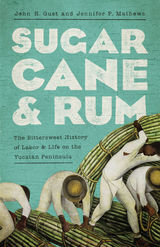
While the Yucatán Peninsula of Mexico may conjure up images of vacation getaways and cocktails by the sea, these easy stereotypes hide a story filled with sweat and toil. The story of sugarcane and rum production in the Caribbean has been told many times. But few know the bittersweet story of sugar and rum in the jungles of the Yucatán Peninsula during the nineteenth century. This is much more than a history of coveted commodities. The unique story that unfolds in John R. Gust and Jennifer P. Mathews’s new history Sugarcane and Rum is told through the lens of Maya laborers who worked under brutal conditions on small haciendas to harvest sugarcane and produce rum.
Gust and Mathews weave together ethnographic interviews and historical archives with archaeological evidence to bring the daily lives of Maya workers into focus. They lived in a cycle of debt, forced to buy all of their supplies from the company store and take loans from the hacienda owners. And yet they had a certain autonomy because the owners were so dependent on their labor at harvest time. We also see how the rise of cantinas and distilled alcohol in the nineteenth century affected traditional Maya culture and that the economies of Cancún and the Mérida area are predicated on the rum-influenced local social systems of the past. Sugarcane and Rum brings this bittersweet story to the present and explains how rum continues to impact the Yucatán and the people who have lived there for millennia.

All her life, Sugar Turner has had to hustle to survive. An African American woman living in the inner city, she has been a single mother juggling welfare checks, food stamps, boyfriends and husbands, illegal jobs, and home businesses to make ends meet for herself and her five children. Her life's path has also wandered through the wilderness of crack addiction and prostitution, but her strong faith in God and her willingness to work hard for a better life pulled her through. Today, Turner is off welfare and is completing her education. She is computer literate, holds a job in the local school system, has sent three of her children to college, and is happily married.
In this engrossing book, Sugar Turner collaborates with anthropologist Tracy Bachrach Ehlers in telling her story. Through conversations with Ehlers, diary entries, and letters, Turner vividly and openly describes all aspects of her life, including motherhood, relationships with men, welfare and work, and her attachment to her friends, family, and life in the "hood." Ehlers also gives her reactions to Turner's story, discussing not only how it belies the "welfare queen" stereotype, but also how it forced her to confront her own lingering confusions about race, her own bigotry.
What emerges from this book is a fascinating story of two women from radically different backgrounds becoming equal witnesses to each other's lives. By allowing us into the real world of an inner-city African American mother, they replace with compassion and insight the stereotypes, half-truths, and scorn that too often dominate public discourse.
In the U.S., discussions of race generally center on matters of black and white; Asian Americans usually figure in conversations about race as an undifferentiated ethnic group or as exotic Eurasians. The contributors to this book disrupt the standard discussions by considering people of mixed Asian ethnicities. They also pay particular attention to non-white multiracial identities to decenter whiteness and reflect the experience of individuals or communities who are considered a minority within a minority. With an entire section devoted to the Asian diaspora, The Sum of Our Parts suggests that questions of multiracial and multiethnic identity are surfacing around the globe. This timely and provocative collection articulates them for social scientists and students.

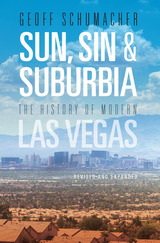
Schumacher’s history also profiles the Las Vegas where more than two million people live. He explores the neighborhoods sprawling beyond the Strip’s neon gleam and uncovers a diverse community offering much more than table games, lounge acts, and organized crime. Schumacher discusses contemporary Las Vegas, charting its course from the nation’s fastest-growing metropolis to one of the Great Recession’s most battered victims.
Sun, Sin & Suburbia will appeal to tourists looking to understand more than the glitz and glitter of Las Vegas and to newcomers who want to learn about their new hometown. It will also be an essential addition to any longtime Nevadan’s library of local history.
First published in 2012 by Stephens Press, this paperback edition is now available from the University of Nevada Press.
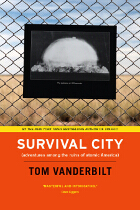
On the road to Survival City, Tom Vanderbilt maps the visible and invisible legacies of the cold war, exhuming the blueprints for the apocalypse we once envisioned and chronicling a time when we all lived at ground zero. In this road trip among ruined missile silos, atomic storage bunkers, and secret test sites, a lost battleground emerges amid the architecture of the 1950s, accompanied by Walter Cotten’s stunning photographs. Survival City looks deep into the national soul, unearthing the dreams and fears that drove us during the latter half of the twentieth century.
“A crucial and dazzling book, masterful, and for me at least, intoxicating.”—Dave Eggers
“A genuinely engaging book, perhaps because [Vanderbilt] is skillful at conveying his own sense of engagement to the reader.”—Los Angeles Times
“A retracing of Dr. Strangelove as ordinary life.”—Greil Marcus, Bookforum
In Surviving the Americas, Serena Cosgrove, José Idiáquez, Leonard Joseph Bent, and Andrew Gorvetzian shed light on what it means to be Garifuna today, particularly in Nicaragua. Their research includes over nine months of fieldwork in Garifuna communities in the Pearl Lagoon on the southern Caribbean coast of Nicaragua and in New York City. The resulting ethnography illustrates the unique social issues of the Nicaraguan Garifuna and how their culture, traditions, and reverence for their ancestors continues to persist.
Dreby shows that a restrictive approach to immigration creates problems over time and across generations. These issues occur regardless of one’s citizenship status and go beyond deportations. Despite having pride in their heritage, her interviewees did not talk much about immigration. She refers to this unwillingness—and at times, inability—to speak about immigration as silencing. Silencing in a community or family is often intended to protect children, but this can leave them with little information about their backgrounds and status, leading to fear and anxiety instead. Self-silencing often resulted from traumatic experiences tied to enforcement episodes, which sometimes took the form of memory loss or emotional withholding. Dreby finds that experiences with the immigration system that disrupted relationships in a child’s household arising from family separations, moves, or changing roles in the family had especially long-term effects, causing, at times, ongoing mental health issues. Even the risk of immigration involvement left some young adults feeling vulnerable and undermined their sense of safety and security as U.S. citizens.
Dreby also highlights stories that offer hope. Young adults developed strategies to persevere, and children who grew up in communities and families that openly talked about migration felt empowered and fared much better, especially when they had access to resources, such as adequate food and shelter, mental health services, and community support. Dreby calls for policies and practices to mitigate the harms of restrictive migratory control on children’s wellbeing, such avoiding the arrest of parents in front of children and ensuring that U.S. citizen children’s interests are considered in immigration court without their direct involvement.
Surviving the ICE Age details the generational harms caused by U.S. immigration policy and offers suggestions for a better way forward.

Essential reading for students of the former Yugoslavia and anyone interested in postwar or post-genocide studies, Surviving the Peace is an instant classic of long-form reporting, an impossible accomplishment without a lifetime of dedication to a place and people.
Peter Lippman's website is http://survivingthepeace.org/.
Unparalleled in scope, Survivors begins with the Cambodians' experiences under the brutal Khmer Rouge regime, following them through escape to refugee camps in Thailand and finally to the United States, where they try to build new lives in the wake of massive trauma. Their struggle becomes primarily economic as they continue to negotiate new cultures and deal with rapidly changing gender and intergenerational relations within their own families. Poverty, crime, and racial discrimination all have an impact on their experiences in America, and each is examined in depth.
Although written as a history, this is a thoroughly multidisciplinary study, and Chan makes use of research from anthropology, sociology, psychology, medicine, social work, linguistics and education. She also captures the perspective of individual Cambodians. Drawing on interviews with more than fifty community leaders, a hundred government officials, and staff members in volunteer agencies, Survivors synthesizes the literature on Cambodian refugees, many of whom come from varying socioeconomic backgrounds.
A major scholarly achievement, Survivors is unique in the Asian American canon for its memorable presentation of cutting-edge research and its interpretation of both sides of the immigration process.
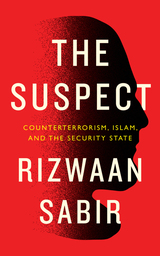
What impact has two decades' worth of policing and counterterrorism had on the state of mind of Muslims in Britain? The Suspect draws on the author's lived experiences of being suspected of terrorism to take the reader on a journey through British counterterrorism practices and the policing of Muslims.
Rizwaan Sabir describes what led to his arrest for suspected terrorism, his time in detention, and the surveillance he was subjected to on release from custody, including stop and frisk on the roadside, detentions at the border, and monitoring by police and government departments throughout his research.
Writing publicly for the first time about the traumatizing mental health effects of these experiences, he argues that these harmful outcomes are not the result of errors in government planning, but the consequences of using a counterinsurgency warfare approach to surveillance. If we are to break this injustice, we need to resist counterterrorism policy and practice.
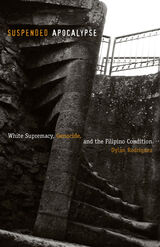
Suspended Apocalypse is a rich and provocative meditation on the emergence of the Filipino American as a subject of history. Culling from historical, popular, and ethnographic archives, Dylan Rodríguez provides a sophisticated analysis of the Filipino presence in the American imaginary. Radically critiquing current conceptions of Filipino American identity, community, and history, he puts forth a genealogy of Filipino genocide, rooted in the early twentieth-century military, political, and cultural subjugation of the Philippines by the United States.
Suspended Apocalypse critically addresses what Rodríguez calls "Filipino American communion," interrogating redemptive and romantic notions of Filipino migration and settlement in the United States in relation to larger histories of race, colonial conquest, and white supremacy. Contemporary popular and scholarly discussions of the Filipino American are, he asserts, inseparable from their origins in the violent racist regimes of the United States and its historical successor, liberal multiculturalism.
Rodríguez deftly contrasts the colonization of the Philippines with present-day disasters such as Hurricane Katrina and Mount Pinatubo to show how the global subjection of Philippine, black, and indigenous peoples create a linked history of genocide. But in these juxtapositions, Rodríguez finds moments and spaces of radical opportunity. Engaging the violence and disruption of the Filipino condition sets the stage, he argues, for the possibility of a transformation of the political lens through which contemporary empire might be analyzed, understood, and perhaps even overcome.

Today, the many visions of the Everglades—protectionist, ecological, commercial, historical—have become a tangled web of contradictory practices and politics for conservation and for development. Yet within this entanglement, the place of people remains highly ambivalent. It is the role of people in the Everglades that interests Ogden, as she seeks to reclaim the landscape’s long history as a place of human activity and, in doing so, discover what it means to be human through changing relations with other animals and plant life.
Ogden tells this story through the lives of poor rural whites, gladesmen, epitomized in tales of the Everglades’ most famous outlaws, the Ashley Gang. With such legends and lore on one side, and outsized efforts at drainage and development on the other, Swamplife strikes a rare balance, offering a unique insight into the hidden life of the Everglades—and into how an appreciation of oppositional culture and social class operates in our understanding of wilderness in the United States.
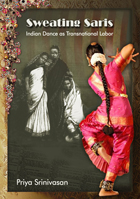
A groundbreaking book that seeks to understand dance as labor, Sweating Saris examines dancers not just as aesthetic bodies but as transnational migrant workers and wage earners who negotiate citizenship and gender issues.
Srinivasan merges ethnography, history, critical race theory, performance and post-colonial studies among other disciplines to investigate the embodied experience of Indian dance. The dancers’ sweat stained and soaked saris, the aching limbs are emblematic of global circulations of labor, bodies, capital, and industrial goods. Thus the sweating sari of the dancer stands in for her unrecognized labor.
Srinivasan shifts away from the usual emphasis on Indian women dancers as culture bearers of the Indian nation. She asks us to reframe the movements of late nineteenth century transnational Nautch Indian dancers to the foremother of modern dance Ruth St. Denis in the early twentieth century to contemporary teenage dancers in Southern California, proposing a transformative theory of dance, gendered-labor, and citizenship that is far-reaching.
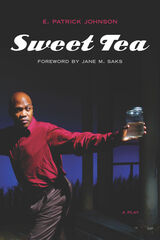
Based on several tours and individual stagings, Sweet Tea: A Play invites readers, students, theater practitioners, and audiences from different backgrounds to engage with the lives of eleven men and one gender-nonconforming person—incredible characters all originally played by the author in a one-man show.
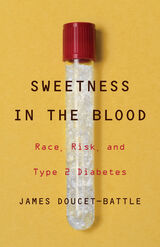
A bold new indictment of the racialization of science
Decades of data cannot be ignored: African American adults are far more likely to develop Type 2 diabetes than white adults. But has science gone so far in racializing diabetes as to undermine the search for solutions? In a rousing indictment of the idea that notions of biological race should drive scientific inquiry, Sweetness in the Blood provides an ethnographic picture of biotechnology’s framings of Type 2 diabetes risk and race and, importantly, offers a critical examination of the assumptions behind the recruitment of African American and African-descent populations for Type 2 diabetes research.
James Doucet-Battle begins with a historical overview of how diabetes has been researched and framed racially over the past century, chronicling one company’s efforts to recruit African Americans to test their new diabetes risk-score algorithm with the aim of increasing the clinical and market value of the firm’s technology. He considers African American reticence about participation in biomedical research and examines race and health disparities in light of advances in genomic sequencing technology. Doucet-Battle concludes by emphasizing that genomic research into sub-Saharan ancestry in fact underlines the importance of analyzing gender before attempting to understand the notion of race. No disease reveals this more than Type 2 diabetes.
Sweetness in the Blood challenges the notion that the best approach to understanding, managing, and curing Type 2 diabetes is through the lens of race. It also transforms how we think about sugar, filling a neglected gap between the sugar- and molasses-sweetened past of the enslaved African laborer and the high-fructose corn syrup- and corporate-fed body of the contemporary consumer-laborer.
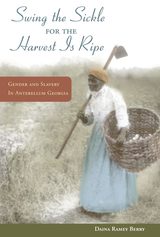
"Swing the Sickle for the Harvest Is Ripe" compares the work, family, and economic experiences of enslaved women and men in upcountry and lowland Georgia during the nineteenth century. Mining planters' daybooks, plantation records, and a wealth of other sources, Daina Ramey Berry shows how slaves' experiences on large plantations, which were essentially self-contained, closed communities, contrasted with those on small plantations, where planters' interests in sharing their workforce allowed slaves more open, fluid communications. By inviting readers into slaves' internal lives through her detailed examination of domestic violence, separation and sale, and forced breeding, Berry also reveals important new ways of understanding what it meant to be a female or male slave, as well as how public and private aspects of slave life influenced each other on the plantation.
A volume in the series Women in American History, edited by Anne Firor Scott, Susan Armitage, Susan K. Cahn, and Deborah Gray White

In this concise introduction to the state’s Swiss settlers, Frederick Hale traces the catalysts for Swiss emigration, their difficult journeys, and their adjustments to life on Wisconsin soil. Updates for this expanded edition include additional historic photographs and the selected writings of John Luchsinger, who settled at the Swiss colony at New Glarus, in 1856.

Of the many state-enacted cruelties to which refugees and asylum seekers are subjected, detention and deportation loom largest in popular consciousness. But there is a third practice, perpetrating a slower violence, that remains hidden: dispersal.
Jonathan Darling provides the first detailed account of how dispersal - the system of accommodation and support for asylum seekers and refugees in Britain - both sustains and produces patterns of violence, suffering and social abjection. He explores the evolution of dispersal as a privatized process, from the first outsourced asylum accommodation contracts in 2012 to the renewed wave of outsourcing pursued by the Home Office today.
Drawing on six years of research into Britain's dispersal system, and foregrounding the voices and experiences of refugees and asylum seekers, Darling argues that dispersal has played a central role in the erasure of asylum from public concern. Systems of Suffering is a vital tool in the arsenal of those fighting to hold the government to account for the violence of its asylum policy and practice.
READERS
Browse our collection.
PUBLISHERS
See BiblioVault's publisher services.
STUDENT SERVICES
Files for college accessibility offices.
RECENTLY PUBLISHED


UChicago Accessibility Resources
home | accessibility | search | about | contact us
BiblioVault ® 2001 - 2026
The University of Chicago Press