
 A SCHOLARLY BOOK REPOSITORY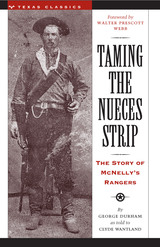
Only an extraordinary Texas Ranger could have cleaned up bandit-plagued Southwest Texas, between the Nueces River and the Rio Grande, in the years following the Civil War. Thousands of raiders on horseback, some of them Anglo-Americans, regularly crossed the river from Mexico to pillage, murder, and rape. Their main objective? To steal cattle, which they herded back across the Rio Grande to sell. Honest citizens found it almost impossible to live in the Nueces Strip.
In desperation, the governor of Texas called on an extraordinary man, Captain Leander M. McNelly, to take command of a Ranger company and stop these border bandits. One of McNelly's recruits for this task was George Durham, a Georgia farmboy in his teens when he joined the "Little McNellys," as the Captain's band called themselves. More than half a century later, it was George Durham, the last surviving "McNelly Ranger," who recounted the exciting tale of taming the Nueces Strip to San Antonio writer Clyde Wantland.
In Durham's account, those long-ago days are brought vividly back to life. Once again the daring McNelly leads his courageous band across Southwest Texas to victories against incredible odds. With a boldness that overcame their dismayingly small number, the McNellys succeeded in bringing law and order to the untamed Nueces Strip—succeeded so well that they antagonized certain "upright" citizens who had been pocketing surreptitious dollars from the bandits' operations.
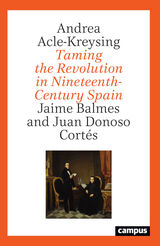
Jaime Balmes and Juan Donoso Cortés–the two most important conservative thinkers in nineteenth-century Spain–actively sought to preserve the centrality of church and monarchy in the wake of the rise of liberalism, while at the same time discrediting the stereotypical view of Spain as a backward and isolated country. Although they pursued a similar goal, their positions differed: while Balmes’ works anticipated a socially oriented Catholicism, Donoso presented Christianity as the supreme social good, incompatible with modern liberalism. In Taming the Revolution, Andrea Acle-Kreysing highlights the unresolved tensions in their works, escaping the dualistic interpretations of this period that defines tradition from modernity. This work endeavors to show how Spanish political thought was a compelling variation–rather than an aberration–of contemporary European debates.

When our children act up--whether they're just moody and rebellious or taking drugs and committing crimes--our solution, so often now, is to send them to a psychiatrist or developmental psychologist for help. What makes us think this will work? How did we come to rely on psychological explanations--and corrections--for juvenile misconduct?
In Taming the Troublesome Child, these questions lead to the complex history of "child guidance," a specialized psychological service developed early in the twentieth century. Kathleen Jones puts this professional history into the context of the larger culture of age, class, and gender conflict. Using the records of Boston's Judge Baker Guidance Center from 1920 to 1945, she looks at the relationships among the social activists, doctors, psychologists, social workers, parents, and young people who met in the child guidance clinic, then follows the clinicians as they adapt delinquency work to the problems of nondelinquent children--an adaptation that often entailed a harsh critique of American mothers. Her book reveals the uses to which professionals and patients have put this interpretation of juvenile misbehavior, and the conditions that mother-blaming has imposed on social policy and private child rearing to this day.
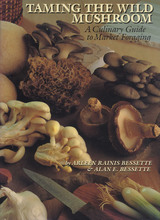
Many mushroom hunters prefer to do their foraging in the marketplace, where all the mushrooms are clearly labeled and safely edible. With this fact in mind, Arleen and Alan Bessette have written Taming the Wild Mushroom, one of the first cooking guides devoted exclusively to choosing and preparing the mushroom species now available in many grocery stores, supermarkets, and natural and whole foods markets.
A dozen wild and cultivated species are covered in the book, including White Button, King Bolete, Oyster, Chanterelle, Morel, Paddy Straw, Wood Ear, Shiitake, Enokitake, White Matsutake, Black Truffle, and Wine-cap Stropharia. Easy-to-understand descriptions and excellent color photographs of each species help market foragers choose mushrooms in peak condition. Fifty-seven original, species-specific recipes, from appetizers, soups, and salads to meat and vegetarian entrees to sauces and accompaniments, offer dozens of ways to savor the familiar and exotic flavors of these mushrooms. A mouth-watering photograph accompanies each recipe.
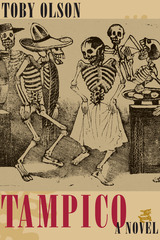
Four old men—John, Gino, Larry, and Frank—have been warehoused at "the Manor," a long-eroded home for the forgotten. The men take turns telling stories, stalling death as they relive pivotal parts of their pasts. Outside, the cliff crumbles and a lighthouse slips toward the sea.
John, in particular, enthralls the others with his tale of Tampico, Mexico, where he met an Indian woman named Chepa who owned a house at the edge of a mountain wilderness. She was his first love—and his first lesson in the dangers of foreign intrigue. But his is not the only memory haunted by mysteries born in Mexico. Sick of waiting for death, stirred by the shifting ground beneath their feet, the Manor's residents finally resolve to quit that place and head out for Tampico.
With inexorable pull, and exquisite scenes that could only come from Toby Olson, Tampico celebrates a sublime band of calaveras, "those skeleton messengers of mortality," who seek self-discovery even as their lives are ending.
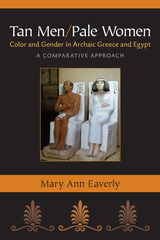
One of the most obvious stylistic features of Athenian black-figure vase painting is the use of color to differentiate women from men. By comparing ancient art in Egypt and Greece, Tan Men/Pale Women uncovers the complex history behind the use of color to distinguish between genders, without focusing on race. Author Mary Ann Eaverly considers the significance of this overlooked aspect of ancient art as an indicator of underlying societal ideals about the role and status of women. Such a commonplace method of gender differentiation proved to be a complex and multivalent method for expressing ideas about the relationship between men and women, a method flexible enough to encompass differing worldviews of Pharaonic Egypt and Archaic Greece. Does the standard indoor/outdoor explanation—women are light because they stay indoors—hold true everywhere, or even, in fact, in Greece? How “natural” is color-based gender differentiation, and, more critically, what relationship does color-based gender differentiation have to views about women and the construction of gender identity in the ancient societies that use it?
The depiction of dark men and light women can, as in Egypt, symbolize reconcilable opposites and, as in Greece, seemingly irreconcilable opposites where women are regarded as a distinct species from men. Eaverly challenges traditional ideas about color and gender in ancient Greek painting, reveals an important strategy used by Egyptian artists to support pharaonic ideology and the role of women as complementary opposites to men, and demonstrates that rather than representing an actual difference, skin color marks a society’s ideological view of the varied roles of male and female.
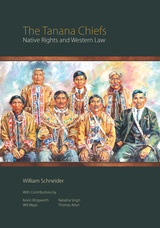
This is the story of a historic meeting between Native Athabascan leaders and government officials, held in Fairbanks, Alaska in 1915. It was one of the first times that Native voices were part of the official record. They sought education and medical assistance, and they wanted to know what they could expect from the federal government. They hoped for a balance between preserving their way of life with seeking new opportunities under the law.
The Tanana Chiefs chronicles the efforts by Alaska Natives to gain recognition for rights under Western law and the struggles to negotiate government-to-government relationships with the federal government. It contains the first full transcript of the historic meeting as well as essays that connect that first gathering with the continued efforts of the Tanana Chiefs Conference, which continues to meet and fight for Native rights.



This is the most comprehensive study of pien-wen (“transformation texts” i.e., tales of metamorphosis) in any language since the manuscripts were discovered at the beginning of this century in a remote cave complex in northwest China. They are the earliest written vernacular narratives in China and are thus extremely important in the history of Chinese language and literature.
Numerous scholarly controversies have surrounded the study of the texts in the last three quarters of a century; this volume seeks to resolve some of them—the extent, origins, and formal characteristics of the texts, the meaning of pien wen, the identity of the authors who composed these popular narratives and the scribes who copied them, the relationship of the texts to oral performance, and the reasons for the apparently sudden demise of the genre around the beginning of the Sung dynasty.
This is a multi-disciplinary study that integrates findings from religious, literary, linguistic, sociological, and historical materials, carried out with intellectual rigor. It includes an extensive bibliography of relevant sources in many languages.

Blood Meridian’s emergent geoaesthetics reveals forces operating according to other-than-human principles, as literary desert terrains retain a passive resistance, or weak agency, which presents a radical disturbance of anthropocentrism, mirrored in the novel’s style. Though the mediated unstable deserts in Blood Meridian defy appropriation, they are neither untouched nor untouchable: the borderlands bear the wounds and “blood meridians” of a non-chronological history of violence, tangential to the massacres of Native American and Mexican peoples depicted in the novel.
Stefanie Heine’s reading of Blood Meridian offers a crucial contribution to and intervention in contemporary ecocriticism, Anthropocene criticism, and New Materialist theories, encouraging readers to critically rethink customary notions of entanglement, kinship, and agency.
Robert Michael Pyle’s popular “Tangled Bank” column appeared in fifty-two consecutive issues of Orion and Orion Afield magazines over eleven years. Each essay collected in The Tangled Bank explores Charles Darwin’s contention that the elements of such a bank, and by extension all the living world, are endlessly interesting and ever evolving.
Pyle’s thoughtful and concise narratives range in subject from hops and those who love them to independent bookstores to the monarchs of Mexico. In each piece, Pyle refutes “the idea that the world is a boring place,” sharing his meticulous observations of the endless and fascinating details of the living earth.

Tangled Diagnoses examines the multiple consequences of the widespread diffusion of this medical innovation. Prenatal testing, Ilana Löwy argues, has become mainly a risk-management technology—the goal of which is to prevent inborn impairments, ideally through the development of efficient therapies but in practice mainly through the prevention of the birth of children with such impairments. Using scholarship, interviews, and direct observation in France and Brazil of two groups of professionals who play an especially important role in the production of knowledge about fetal development—fetopathologists and clinical geneticists—to expose the real-life dilemmas prenatal testing creates, this book will be of interest to anyone concerned with the sociopolitical conditions of biomedical innovation, the politics of women’s bodies, disability, and the ethics of modern medicine.
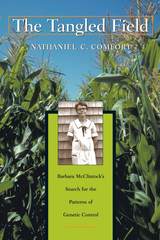
This biographical study illuminates one of the most important yet misunderstood figures in the history of science. Barbara McClintock (1902-1992), a geneticist who integrated classical genetics with microscopic observations of the behavior of chromosomes, was regarded as a genius and as an unorthodox, nearly incomprehensible thinker. In 1946, she discovered mobile genetic elements, which she called "controlling elements." Thirty-seven years later, she won a Nobel Prize for this work, becoming the third woman to receive an unshared Nobel in science. Since then, McClintock has become an emblem of feminine scientific thinking and the tragedy of narrow-mindedness and bias in science.
Using McClintock's research notes, newly available correspondence, and dozens of interviews with McClintock and others, Comfort argues that McClintock's work was neither ignored in the 1950s nor wholly accepted two decades later. Nor was McClintock marginalized by scientists; throughout the decades of her alleged rejection, she remained a distinguished figure in her field. Comfort replaces the "McClintock myth" with a new story, rich with implications for our understanding of women in science and scientific creativity.

The Tangled Fire of William Faulkner was first published in 1953. Minnesota Archive Editions uses digital technology to make long-unavailable books once again accessible, and are published unaltered from the original University of Minnesota Press editions.
Out of the tangled fire that is the genius of William Faulkner's fiction, this critical study draws as coherent and highly original view of the writer's achievement. By placing Faulkner in his Mississippi background and analyzing his novels and short stories in chronological sequence, O'Conner demonstrates a major thesis that sets this apart from other studies. It is his interpretation that Faulkner's fiction is not all of a piece, does not merely develop the conviction of the legend of the Old South, but is, rather, marked by diversity of theme.
The advertising industry may seem like one of the most craven manifestations of capitalism, turning consumption into a virtue. In Tangled Goods, authors Iddo Tavory, Sonia Prelat, and Shelly Ronen consider an important dimension of the advertising industry that appears to depart from the industry’s consumerist foundations: pro bono ad campaigns. Why is an industry known for biting cynicism and cutthroat competition also an industry in which people dedicate time and effort to “doing good”?
Interviewing over seventy advertising professionals and managers, the authors trace the complicated meanings of the good in these pro bono projects. Doing something altruistic, they show, often helps employees feel more at ease working for big pharma or corporate banks. Often these projects afford them greater creative leeway than they normally have, as well as the potential for greater recognition. While the authors uncover different motivations behind pro bono work, they are more interested in considering how various notions of the good shift, with different motivations and benefits rising to the surface at different moments. This book sheds new light on how goodness and prestige interact with personal and altruistic motivations to produce value for individuals and institutions and produces a novel theory of the relationship among goods: one of the most fraught questions in sociological theory.
This unique, empirical study examines the actual attitudes and perceptions of legal practitioners. The author discusses the realities of the profession--what lawyers face day to day, how they deal with conflicts of interest, and how those experiences vary from LaSalle Street to Wall Street to Main Street, from megafirms to solo practices. In describing how conflicts arise in their daily work, Shapiro sheds light on the nature of legal work--on clients, colleagues, law firm power and politics, economics, markets, malpractice insurance, careers, ethics, values, business judgments, and lawyers' most anguishing moments. In short, we learn what it means to be a lawyer at the end of the twentieth century.
Tangled Loyalties also looks at how these conflicts in law affect other fiduciaries--accountants, doctors, psychotherapists, journalists, and academics--and the way in which they respond to competing interests and the honoring of those interests.
Tangled Loyalties will appeal to readers interested in the legal and other professions, social institutions and relations, and issues of trust, ethics, social control and regulation.
Susan P. Shapiro is Senior Research Fellow, American Bar Foundation.

Contemporaries were shocked when author Mary Noailles Murfree revealed she was a woman, but modern readers may be more surprised by her cogent discussion of community responses to unwanted development. Effie Waller Smith, an African American woman writing of her love for the Appalachian mountains, wove discussions of women's rights, racial tension, and cultural difference into her Appalachian poetry. Grace MacGowan Cooke participated in avant-garde writers' colonies with the era's literary lights and applied their progressive ideals to her fiction about the Appalachia of her youth. Emma Bell Miles, witness to poverty, industrialization, and violence against women, wrote poignant and insightful critiques of her Appalachian home.
In The Tangled Roots of Feminism, Environmentalism, and Appalachian Literature Elizabeth Engelhardt finds in all four women's writings the origins of what we recognize today as ecological feminism—a wide-reaching philosophy that values the connections between humans and nonhumans and works for social and environmental justice.
People and the land in Appalachia were also the subject of women authors with radically different approaches to mountains and their residents. Authors with progressive ideas about women's rights did not always respect the Appalachian places they were writing about or apply their ideas to all of the women in those places—but they did create hundreds of short stories, novels, letters, diaries, photographs, sketches, and poems about the mountains.
While The Tangled Roots of Feminism, Environmentalism, and Appalachian Literature ascribes much that is noble to the beginnings of the ecological feminism movement as it developed in Appalachia, it is also unyielding in its assessment of the literatures of the voyeur, tourist, and social crusader who supported status quo systems of oppression in Appalachia.
A new interpretation of the roots of Israeli culture
In Tangled Roots: The Emergence of Israeli Culture, Israel Bartal traces the history of modern Hebrew culture prior to the emergence of political Zionism. Bartal examines how traditional and modernist ideals and Western and non-European Jewish cultures merged in an unprecedented encounter between an ancient land (Israel) and a multigenerational people (the Jews). Premodern Jewish traditionalists, Palestinian locals, foreign imperial forces, and Jewish intellectuals, writers, journalists, and party functionaries each affected the Israeli culture that emerged. As this new Hebrew culture was taking shape, the memory of the recent European past played a highly influential role in shaping the image of the New Hebrew, that mythological hero who was meant to supplant the East European exilic Jew.
Features
- A critical revision of most contemporary politicized histories of Jewish nationalism
- An examination of the history of modern Hebrew culture prior to political Zionism
Contributors:
Sarah Al-Tamimi, Michael A. Charleston, Dale H. Clayton, James W. Demastes, Russell D. Gray, Mark S. Hafner, John P. Huelsenbeck, J.-P. Hugot, Kevin P. Johnson, Peter Kabat, Bret Larget, Joanne Martin, Yannis Michalakis, Roderic D. M. Page, Ricardo L. Palma, Adrian M. Paterson, Susan L. Perkins, Andy Purvis, Bruce Rannala, David L. Reed, Fredrik Ronquist, Theresa A. Spradling, Jason Taylor, Michael Tristem
Contributors. Esteban Buch, Oscar Conde, Antonio Gómez, Morgan James Luker, Carolyn Merritt, Marilyn G. Miller, Fernando Rosenberg, Alejandro Susti
Luker traces the diverse and often contradictory ways tango is used in Argentina in activities ranging from state cultural policy-making to its export abroad as a cultural emblem, from the expanding nonprofit arts sector to tango-themed urban renewal projects. He shows how projects such as these are not peripheral to an otherwise “real” tango—they are the absolutely central means by which the values of this musical culture are cultivated. By richly detailing the interdependence of aesthetic value and the regimes of cultural management, this book sheds light on core conceptual challenges facing critical music scholarship today.
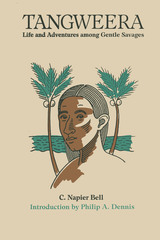
In the 1980s, conflicts between the Miskito people of Nicaragua's eastern coast and the Sandinistas drew international attention. Indeed, the Miskitos' struggle to defend their cultural autonomy and land rights points out a curious historical anomaly. This native group has long had closer ties to British and American culture than to Hispanic Nicaraguan culture. C. Napier Bell, son of a British trader, grew up on the Miskito Coast in the nineteenth century and spoke the Miskito language fluently.
Tangweera, first published in 1899, is Bell's autobiographical account of his boyhood experiences. Rich in ethnographic detail, the book records an idyllic life of hunting, fishing, and trading. Bell describes the social customs and beliefs of the various Indian peoples he knew, as well as the relations among the coastal Miskito, the black creole population, and the tribes of the interior—the latter a subject of continuing importance. Although Bell shared common nineteenth-century ideas about the inferiority of “savage” races, his affection for the Miskito people and his love of their land fill Tangweera. Anthropologists, historians, naturalists, and travelers in the region will find this fascinating reading.
The introduction by Philip A. Dennis, Professor of Anthropology at Texas Tech University, provides a modern observer's view of Miskito culture and discusses important changes and continuities since Bell's time.
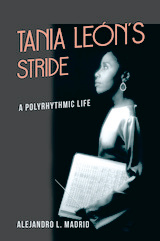
Nuanced and multifaceted, Tania León's Stride looks at the life, legacy, and milieu that created and sustained one of the most important figures in American classical music.
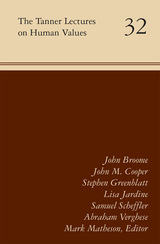
John Broome, “The Public and Private Morality of Climate Change”
John Broome is the Whites Professor of Moral Philosophy at the University of Oxford and a fellow of Corpus Christi College in Oxford. He has written six books.
John M. Cooper, “Ancient Philosophies as Ways of Life”
John Cooper is the Henry Putnam University Professor of Philosophy at Princeton University. His books include Pursuits of Wisdom: Six Ways of Ancient Philosophy from Socrates to Plotinus and Panentheism: The Other God of the Philosophers.
Stephen Greenblatt, “Shakespeare and the End of Life History”
Stephen Greenblatt is the John Cogan University Professor of the Humanities at Harvard University. He is the author of several books, including the 2012 Pulitzer Prize–winning The Swerve: How the World Became Modern and Will in the World: How Shakespeare Became Shakespeare.
Lisa Jardine, “The Sorcerer’s Apprentice: C. P. Snow and J. Bronowski” and “Science and Government: C. P. Snow and the Corridors of Power”
Lisa Jardine is a professor of Renaissance studies at University College London, where she is the director of the Interdisciplinary Centre for Research in the Humanities and the Centre for Editing Lives and Letters. She has published more than fifty scholarly articles and seventeen books, including Going Dutch: How England Plundered Holland’s Glory.
Samuel Scheffler, “The Afterlife”
Samuel Scheffler is University Professor and a professor of philosophy and law at New York University. He has published four books in the areas of moral and political philosophy, including Equality and Tradition.
Abraham Verghese, “Two Souls Intertwined”
Abraham Verghese is a professor of medicine and senior associate chair for the Theory and Practice of Medicine at Stanford University. He has published widely across disciplines, including My Own Country: A Doctor’s Story and the novel Cutting for Stone. He is perhaps best known for his deep interest in bedside medicine and work in the medical humanities.
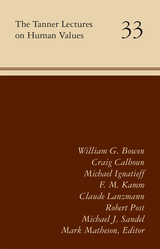
William G. Bowen, “Costs and Productivity in Higher Education” and “Prospects for an Online Fix: Can We Harness Technology in the Service of Our Aspirations?”
Craig Calhoun, “The Problematic Public: Revisiting Dewey, Arendt, and Habermas”
Michael Ignatieff, “Representation and Responsibility: Ethics and Public Office”
F. M. Kamm, “Who Turned the Trolley?” and “How Was the Trolley Turned?”
Claude Lanzmann, “Resurrection”
Robert Post, “Representative Democracy: The Constitutional Theory of Campaign Finance Reform” and “Campaign Finance Reform and the First Amendment”
Michael J. Sandal, “The Moral Economy of Speculation: Gambling, Finance, and the Common Good”
The Tanner Lectures on Human Values, founded July 1, 1978, at Clare Hall, Cambridge University, was established by the American scholar, industrialist, and philanthropist Obert Clark Tanner. Lectureships are awarded to outstanding scholars or leaders in broadly defined fields of human values and transcend ethnic, national, religious, or ideological distinctions. Volume 34 features lectures given during the academic year 2013 to 2014 at the University of Oxford; Stanford University; the University of Utah; and Yale University.
Shami Chakrabarti, Liberty Organization (formerly National Council for Civil Liberties)
“Human Rights as Human Values”
Paul Gilroy, King’s College London
“The Black Atlantic and Re-enchantment of Humanism”
Bruno Latour, Institut d’etudes politiques (Sciences Po) Paris “How Better to Register the Agency of Things”
Nicholas Lemann, Columbia University School of Journalism “The Turn Against Institutions” and “What Transactions Can’t Do”
Andrew Solomon, Author
“Love, Acceptance, Celebration: How Parents Make Their Children”
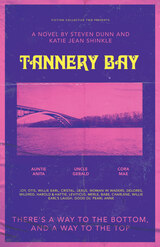
In a town trapped in endless July, love, resistance, and imagination break the loop.
Enter a world where time stands still and summer never ends. In the enchanted town of Tannery Bay, it’s July 37, and then July 2 again, but the year is a mystery. Trapped in an eternal loop, the residents embark on an extraordinary journey of self-discovery, unity, and defiance against the forces that seek to divide them.
Otis and Joy, intrepid siblings, work with their family and friends to oppose a formidable adversary: The Owners. These cunning and ruthless old men, driven by insatiable greed, hold the town hostage, exploiting its resources and dividing its people. In this powerful #OwnVoices narrative, Tannery Bay is a captivating tale of Black Joy and Queer Joy and the ways in which family is both biological and chosen, where love transcends boundaries, and where art is a vehicle for change.


Zhang's book brings together philosophy and literature, theory and practical criticism, the Western and the non-Western in defining common ground on which East and West may come to a mutual understanding. He provides commentary on the rich traditions of poetry and poetics in ancient China; equally illuminating are Zhang's astute analyses of Western poets such as Rilke, Shakespeare, and Mallarmé and his critical engagement with the work of Foucault, Derrida, and de Man, among others.
Wide-ranging and learned, this definitive work in East-West comparative poetics and the hermeneutic tradition will be of interest to specialists in comparative literature, philosophy, literary theory, poetry and poetics, and Chinese literature and history.
The vast literature of the Taoist canon, or Daozang, survives in a Ming Dynasty edition of some fifteen hundred different texts. Compiled under imperial auspices and completed in 1445—with a supplement added in 1607—many of the books in the Daozang concern the history, organization, and liturgy of China's indigenous religion. A large number of works deal with medicine, alchemy, and divination.
If scholars have long neglected this unique storehouse of China's religious traditions, it is largely because it was so difficult to find one's way within it. Not only was the rationale of its medieval classification system inoperable for the many new texts that later entered the Daozang, but the system itself was no longer understood by the Ming editors; hence the haphazard arrangement of the canon as it has come down to us.
This new work sets out the contents of the Daozang chronologically, allowing the reader to follow the long evolution of Taoist literature. Lavishly illustrated, the first volume ranges from antiquity through the Middle Ages, while the second spans the modern period. Within this frame, texts are grouped by theme and subject. Each one is the subject of a historical abstract that identifies the text's contents, date of origin, and author. Throughout the first two volumes, introductions outline the evolution of Taoism and its spiritual heritage. A third volume offering biographical sketches of frequently mentioned Taoists, multiple indexes, and an extensive bibliography provides critical tools for navigating this guide to one of the fundamental aspects of Chinese culture.

The vast literature of the Taoist canon, or Daozang, survives in a Ming Dynasty edition of some fifteen hundred different texts. Compiled under imperial auspices and completed in 1445—with a supplement added in 1607—many of the books in the Daozang concern the history, organization, and liturgy of China's indigenous religion. A large number of works deal with medicine, alchemy, and divination.
If scholars have long neglected this unique storehouse of China's religious traditions, it is largely because it was so difficult to find one's way within it. Not only was the rationale of its medieval classification system inoperable for the many new texts that later entered the Daozang, but the system itself was no longer understood by the Ming editors; hence the haphazard arrangement of the canon as it has come down to us.
This new work sets out the contents of the Daozang chronologically, allowing the reader to follow the long evolution of Taoist literature. Lavishly illustrated, the first volume ranges from antiquity through the Middle Ages, while the second spans the modern period. Within this frame, texts are grouped by theme and subject. Each one is the subject of a historical abstract that identifies the text's contents, date of origin, and author. Throughout the first two volumes, introductions outline the evolution of Taoism and its spiritual heritage. A third volume offering biographical sketches of frequently mentioned Taoists, multiple indexes, and an extensive bibliography provides critical tools for navigating this guide to one of the fundamental aspects of Chinese culture.
The vast literature of the Taoist canon, or Daozang, survives in a Ming Dynasty edition of some fifteen hundred different texts. Compiled under imperial auspices and completed in 1445—with a supplement added in 1607—many of the books in the Daozang concern the history, organization, and liturgy of China's indigenous religion. A large number of works deal with medicine, alchemy, and divination.
If scholars have long neglected this unique storehouse of China's religious traditions, it is largely because it was so difficult to find one's way within it. Not only was the rationale of its medieval classification system inoperable for the many new texts that later entered the Daozang, but the system itself was no longer understood by the Ming editors; hence the haphazard arrangement of the canon as it has come down to us.
This new work sets out the contents of the Daozang chronologically, allowing the reader to follow the long evolution of Taoist literature. Lavishly illustrated, the first volume ranges from antiquity through the Middle Ages, while the second spans the modern period. Within this frame, texts are grouped by theme and subject. Each one is the subject of a historical abstract that identifies the text's contents, date of origin, and author. Throughout the first two volumes, introductions outline the evolution of Taoism and its spiritual heritage. A third volume offering biographical sketches of frequently mentioned Taoists, multiple indexes, and an extensive bibliography provides critical tools for navigating this guide to one of the fundamental aspects of Chinese culture.
The vast literature of the Taoist canon, or Daozang, survives in a Ming Dynasty edition of some fifteen hundred different texts. Compiled under imperial auspices and completed in 1445—with a supplement added in 1607—many of the books in the Daozang concern the history, organization, and liturgy of China's indigenous religion. A large number of works deal with medicine, alchemy, and divination.
If scholars have long neglected this unique storehouse of China's religious traditions, it is largely because it was so difficult to find one's way within it. Not only was the rationale of its medieval classification system inoperable for the many new texts that later entered the Daozang, but the system itself was no longer understood by the Ming editors; hence the haphazard arrangement of the canon as it has come down to us.
This new work sets out the contents of the Daozang chronologically, allowing the reader to follow the long evolution of Taoist literature. Lavishly illustrated, the first volume ranges from antiquity through the Middle Ages, while the second spans the modern period. Within this frame, texts are grouped by theme and subject. Each one is the subject of a historical abstract that identifies the text's contents, date of origin, and author. Throughout the first two volumes, introductions outline the evolution of Taoism and its spiritual heritage. A third volume offering biographical sketches of frequently mentioned Taoists, multiple indexes, and an extensive bibliography provides critical tools for navigating this guide to one of the fundamental aspects of Chinese culture.
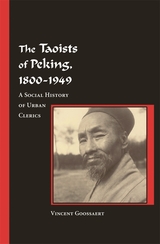
By looking at the activities of Taoist clerics in Peking, this book explores the workings of religion as a profession in one Chinese city during a period of dramatic modernization. The author focuses on ordinary religious professionals, most of whom remained obscure temple employees. Although almost forgotten, they were all major actors in urban religious and cultural life.
The clerics at the heart of this study spent their time training disciples, practicing and teaching self-cultivation, performing rituals, and managing temples. Vincent Goossaert shows that these Taoists were neither the socially despised illiterates dismissed in so many studies, nor otherworldly ascetics, but active participants in the religious economy of the city. In exploring exactly what their crucial role was, he addresses the day-to-day life of modern Chinese religion from the perspective of ordinary religious specialists. This approach highlights the social processes, institutions, and networks that transmit religious knowledge and mediate between prestigious religious traditions and the people in the street. In modern Chinese religion, the Taoists are such key actors. Without them, "Taoist ritual" and "Taoist self-cultivation" are just empty words.

The harsh realities of being migrant and immigrant, being birthright and oppressed, are as hard-pressed as the plancha move to the body. Each poem in Tapping Out is a “freestyle movement” of language and complexity put on full display, under the bright lights and roars of survival. Comer’s splendid and barbed, Detroit style of language melts the masks with searing words.
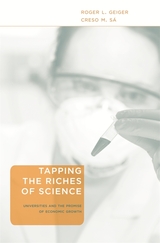
Can university-based scientific research contribute to the economic development of a region? Can it generate wealth for the university? American universities are under increasing pressure to maximize their economic contributions. Tapping the Riches of Science offers a rigorous and far-sighted explanation of this controversial and little-understood movement.
Just how do universities contribute to innovation in industry? How have state legislatures promoted local university commitments to economic relevance? And how has the pressure to be economically productive affected the core academic missions of teaching and research? Drawing from a range of social science analyses, campus interviews, and examples of university-industry partnerships, Roger Geiger and Creso Sá reveal the ways that economic development has been incorporated into university commitments.
Noting enduring cultural differences between the academic and business worlds, Geiger and Sá deflate both suspicious and overconfident views. They show how elusive success can be for embryonic discoveries with as-yet-unclear applications. Warning against promising—and expecting—too much, Tapping the Riches of Science nonetheless makes a strong case for the long-term promise of practical uses for academic research.

In Arab culture, at the ineffable point where music meets emotion, lies ṭarab. Often glossed as the ecstasy experienced and expressed when performing or listening to singing, instrumental works, and recitations of poetry, ṭarab is both a practice and an orienting concept central to musical aesthetics and spirituality characteristic of Middle Eastern cultures.
Gathering fifteen essays by scholars of music, affect, literature, religion, and education, Ṭarab extends the study of ṭarab historically, geographically, and sociologically. Historical essays explore ṭarab’s role in the medieval Middle East and the Ottoman Empire. Turning to the modern era, authors examine ṭarab and related concepts in Egypt, Albania, and Iraq, and among Turkish Roma and Lebanese Maronite Christians. The contributors also address contemporary practitioners and the intersections of ṭarab and maqām, belly dancing, music streaming, and university music ensembles. Situating this unique cultural concept in a global context, these studies enrich the story of ṭarab and provide new insight into music’s powerful emotional appeal.
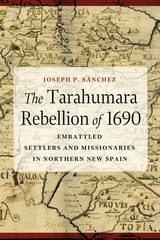
Previous histories have interpreted this revolt, and other borderlands uprisings, as localized and spontaneous events aimed at rectifying specific grievances. Historian Joseph P. Sánchez argues that the revolts of the Tepehuanes and the Tarahumaras in northern New Spain, or Nueva Vizcaya, were well-planned, inspired by outside events, and drew in multiple communities and ethnicities. Drawing on a wealth of primary sources, including Jesuit accounts and archival documents, Sánchez offers a comprehensive narrative that challenges conventional interpretations of colonial Mexican uprisings.
Far from localized, the Indigenous rebellions in the northern Mexican borderlands during the colonial period were part of the overall Indigenous struggle for defense of homeland throughout the Americas. The Tarahumara Rebellion of 1690 brings together a rich history of localized events and broader historical trends and offers a compelling narrative that enriches our understanding of the colonial experience in northern New Spain.
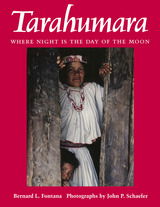
The subtitle of the book derives from the Tarahumara's belief that the soul works at night while the body sleeps and that during this "day of the moon" both the spirits of the dead and the souls of the living move about in their mysterious ways.
As the authors observe, the fact that "so many men, women, and children persist in distinctive, centuries-old cultural traditions in spite of their nearness to all the complexities and attractions of modern industrial society is an importatn part of the story." Their book tells that story and brings readers closer to understanding the Tarahumara world and way of life.
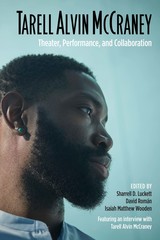
Contributors consider McCraney’s innovations as a playwright, adapter, director, performer, teacher, and collaborator, bringing fresh and diverse perspectives to their observations and analyses. In so doing, they expand and enrich the conversations on his much-celebrated and deeply resonant body of work, which includes the plays Choir Boy, Head of Passes, Ms. Blakk for President, The Breach, Wig Out!, and the critically acclaimed trilogy The Brother/Sister Plays: In the Red and Brown Water, The Brothers Size, and Marcus; Or the Secret of Sweet, as well as the Oscar Award–winning film Moonlight, which was based on his play In Moonlight Black Boys Look Blue.


A substantial number of American children experience poverty: about 17 percent of those under the age of eighteen meet the government’s definition, and the proportion is even greater within minority groups. Childhood poverty can have lifelong effects, resulting in poor educational, labor market, and physical and mental health outcomes for adults. These problems have long been recognized, and there are numerous programs designed to alleviate or even eliminate poverty; as these programs compete for scarce resources, it is important to develop a clear view of their impact as tools for poverty alleviation.
Targeting Investments in Children tackles the problem of evaluating these programs by examining them using a common metric: their impact on earnings in adulthood. The volume’s contributors explore a variety of issues, such as the effect of interventions targeted at children of different ages, and study a range of programs, including child care, after-school care, and drug prevention. The results will be invaluable to educational leaders and researchers as well as policy makers.

The spreading of democracy caused by the tariff evoked bitter sectional controversy among Americans. Northerners claimed they needed a tariff to protect their industries and also their wages. Southerners alleged the tariff forced them to buy goods at increased prices. Having lost the argument against the tariff on its merits, in the 1820s, southerners began to argue the Constitution did not allow Congress to enact a protective tariff. In this fight, we see increased tensions between northerners and southerners in the decades before the Civil War began.
As Tariff Wars reveals, this struggle spawned a controversy that placed the nation on a path that would lead to the early morning hours of Charleston Harbor in April of 1861.
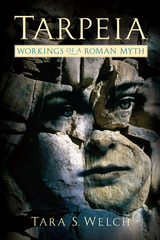
Welch demonstrates how ancient thinkers used Tarpeia’s myth to highlight matters of ethics, gender, ethnicity, political authority, language, conquest, and tradition. This cluster of themes reveals that Tarpeia’s myth is not primarily about what it means to be human, but rather what it means to be Roman. Thus Tarpeia’s story spans centuries, distances, genres, and modes of communication—Rome itself did. No Greek city-state could admit such continuity, and Greece was never so constant. In this way, though Tarpeia has a dozen Greek cousins whose stories are similar to hers, hers is a powerfully Roman myth, even for the Greeks who told her tale. She is token, totem, and symbol of Rome.
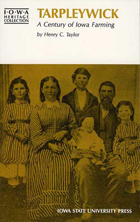
(Tarpleywick description) “When Tarpley Early Taylor came of age on August 2, 1858, his father gave him a horse, a saddle, and a bridle and wished him well…His first independent move was to go on horseback to Louisiana, Missouri, to visit his maternal grandparents, the Zumwalts. He stayed with them for some time, probably through the winter…We do not know what he did from the spring of 1859 to the spring of 1860 except that he had been earning money and saving it. We do know that he had returned to Van Buren County by Juy 24, 1860, because on that date he paid $800 for sixty acres of land a mile south of his father’s house…This was the beginning of Tarpleywick.” Born in Iowa in 1873, he was 96 years old when he died in May 1969. Taylor received his undergraduate training from Drake University and Iowa State University, his M.S. degree from Iowa State, and his Ph.D. degree from the University of Wisconsin. He was the first professor of agricultural economics in a land grant institution, the author of the first American textbook dealing with the principles of agricultural economics, the organizer and first Chief of the Bureau of Agricultural Economics in the USDA, and the first Managing Director of the Farm Foundation.
In Tarrying with the Negative, Žižek challenges the contemporary critique of ideology, and in doing so opens the way for a new understanding of social conflict, particularly the recent outbursts of nationalism and ethnic struggle. Are we, Žižek asks, confined to a postmodern universe in which truth is reduced to the contingent effect of various discursive practices and where our subjectivity is dispersed through a multitude of ideological positions? No is his answer, and the way out is a return to philosophy. This revisit to German Idealism allows Žižek to recast the critique of ideology as a tool for disclosing the dynamic of our society, a crucial aspect of which is the debate over nationalism, particularly as it has developed in the Balkans—Žižek's home. He brings the debate over nationalism into the sphere of contemporary cultural politics, breaking the impasse centered on nationalisms simultaneously fascistic and anticolonial aspirations. Provocatively, Žižek argues that what drives nationalistic and ethnic antagonism is a collectively driven refusal of our own enjoyment.
Using examples from popular culture and high theory to illuminate each other—opera, film noir, capitalist universalism, religious and ethnic fundamentalism—this work testifies to the fact that, far more radically than the postmodern sophists, Kant and Hegel are our contemporaries.
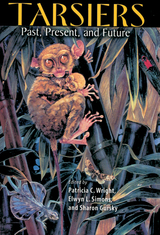
Tarsiiformes, or tarsiers for short, are a group of living species of special interest to primatologists because their combination of derived and ancient characters make them pivotal to understanding the roots of primate evolution. These small-bodied, nocturnal, solitary creatures resemble lower primates in their behavior but genetically, DNA evidence aligns them more closely with higher primates, such as monkeys, apes, and humans. These astounding creatures exhibit an ability found in no other living mammal¾they can turn their heads 180 degrees in either direction to see both prey and predators. The world’s only exclusive carnivorous primate, they eat live food (primarily insects, but the occasional vertebrate, such as lizards, snakes, or frogs will also do). This unique combination of behavior and anatomy makes the tarsier an especially interesting and controversial animal for study among primate behaviorists, evolutionists, and taxonomists, who view the tarsiers as “living fossils” that link past and present, lower and higher, primates in the long chain of evolutionary history.
This new volume presents alternative and contrasting perspectives on the most debated questions that have arisen in tarsier studies. Top researchers bring together perspectives from anatomical, behavioral, genetic, and conservation studies in this new and exciting addition to the understanding of primate evolution.
This book is a volume in the Rutgers Series on Human Evolution, edited by Robert Trivers, Lee Cronk, Helen Fischer, and Lionel Tiger.

A brand new feature in this revised and expanded edition is student access to Grade Grinder, an innovative Internet-based grading service that provides accurate and timely feedback to students whenever they need it. Students can submit solutions for the program’s more than 100 exercises to the Grade Grinder for assessment, and the results are returned quickly to the students and optionally to the teacher as well. A web-based interface also allows instructors to manage assignments and grades for their classes.
Intended as a supplement to a standard logic text, Tarski’s World is an essential tool for helping students learn the language of logic.
Through groundbreaking analyses of cultural texts, Ebert questions the contemporary Derridian dogma that asserts "the future belongs to ghosts." Events-to-come are not spectral, she contends, but the material outcome of global class struggles. Not "hauntology" but history produces cultural practices and their conflictive representations--from sexuality, war, and consumption to democracy, torture, globalization, and absolute otherness. With close readings of texts from Proust and Balzac to "Chick Lit," from Lukács, de Man, Deleuze, and Marx to Derrida, Žižek, Butler, Kollontai, and Agamben, the book opens up new directions for cultural critique today.

Task-based language instruction has proven to be highly effective, but surprisingly underutilized. Theory can only go so far and hands-on experience can greatly speed and enhance the learning of a second language. Nineteen talented instructors who have successfully implemented task-based programs explain the principles behind the programs, discuss how problems were resolved, and share details on class activities and program design. Each chapter takes the reader through the different stages in designing and setting up such programs, adjusting them, and appraising and testing them in normal classroom conditions. This book covers TBI syllabus and program design and is based on actual classroom experience. Any one of the courses or programs discussed can serve as models for others. Many of the contributors are highly respected practitioners who are presenting their programs for the first time, while others are regular participants in today's ongoing dialogue about teaching methods.
Full of concrete, adaptable models of task-based language teaching drawn from a number of countries and eleven different languages—including Arabic, Chinese, Czech, English, French, German, Korean, Spanish, and Ukrainian—Task-Based Instruction in Foreign Language Education presents proven, real-world, practical courses and programs; and includes web-based activities. It demonstrates useful and practical ways to engage students far beyond what can be learned from reading textbook dialogue. TBI involves the student directly with the language being taught via cognitively engaging activities that reflect authentic and purposeful use of language, resulting in language-learning experiences that are pleasurable and effective.
For all instructors seeking to help their learners enhance their understanding and grasp of the foreign language they are learning, Task-Based Instruction in Foreign Language Education is a rich and rewarding hands-on guide to effective and transformative learning.

Taste, Agamben argues, is a category that has much to reveal to the contemporary world. Taking a step into the history of philosophy and reaching to the very origins of aesthetics, Agamben critically recovers the roots of one of Western culture’s cardinal concepts. Agamben is the rare writer whose ideas and works have a broad appeal across many fields, and with Taste he turns his critical eye to the realm of Western art and aesthetic practice. This volume will not only engage the author’s devoted fans in philosophy, sociology, and literary criticism but also his growing audience among art theorists and historians.

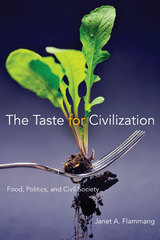
This book explores the idea that table activities--the mealtime rituals of food preparation, serving, and dining--lay the foundation for a proper education on the value of civility, the importance of the common good, and what it means to be a good citizen. The arts of conversation and diplomatic speech are learned and practiced at tables, and a political history of food practices recasts thoughtfulness and generosity as virtues that enhance civil society and democracy. In our industrialized and profit-centered culture, however, foodwork is devalued and civility is eroding.
Looking at the field of American civility, Janet A. Flammang addresses the gendered responsibilities for foodwork's civilizing functions and argues that any formulation of "civil society" must consider food practices and the household. To allow space for practicing civility, generosity, and thoughtfulness through everyday foodwork, Americans must challenge the norms of unbridled consumerism, work-life balance, and domesticity and caregiving. Connecting political theory with the quotidian activities of the dinner table, Flammang discusses practical ideas from the "delicious revolution" and Slow Food movement to illustrate how civic activities are linked to foodwork, and she points to farmers' markets and gardens in communities, schools, and jails as sites for strengthening civil society and degendering foodwork.

“This is a book about the American Dream as it has become embodied in the university in general and in the English department in particular,” writes James Ray Watkins at the start of A Taste for Language: Literacy, Class, and English Studies. In it, Watkins argues that contemporary economic and political challenges require a clear understanding of the identity of English studies, making elementary questions about literacy, language, literature, education, and class once again imperative.
A personal history of university-level English studies in the twentieth century, A Taste for Language combines biography, autobiography, and critical analysis to explore the central role of freshman English and literary studies in the creation and maintenance of the middle class. It tells a multi-generational story of the author and his father, intertwined with close reading of texts and historical analysis. The story moves from depression-era Mississippi, where the author's father was born, to a contemporary English department, where the author now teaches.
Watkins looks at not only textbooks, scholars, and the academy but also at families and other social institutions. A rich combination of biography, autobiography, and critical analysis, A Taste for Language questions what purpose an education in English language and literature serves in the lives of the educated in a class-based society and whether English studies has become wholly irrelevant in the twenty-first century.
The Taste for Nothingness traces Lucan's own analytical method by showing how virtus and related concepts operate--or rather, fail to operate--in Lucan's appropriations and distortions of the traditional epic-battle narrative; in the philosophical commitment of Cato the Younger; and in the personalities of the two antagonists, Pompey and Caesar. Much recent scholarship has reached a consensus that Lucan's literary method is mimetic, that his belief in a chaotic cosmos produces a poetics of chaos. While accepting many of the recent findings about Lucan's view of language and the universe, The Taste for Nothingness also allows an even bolder Lucan to emerge: a committed aesthete who regards art as the only realm in which order is possible.
Robert Sklenár is Visiting Assistant Professor of Classical Studies, Tulane University.
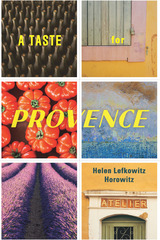
In A Taste for Provence, historian Helen Lefkowitz Horowitz digs into this question and spins a wonderfully appealing tale of how Provence became Provence. The region had previously been regarded as a backwater and known only for its Roman ruins, but in the postwar era authors, chefs, food writers, visual artists, purveyors of goods, and travel magazines crafted a new, alluring image for Provence. Soon, the travel industry learned that there were many ways to roam—and some even involved sitting still. The promise of longer stays where one cooked fresh food from storied outdoor markets became desirable as American travelers sought new tastes and unadulterated ingredients.
Even as she revels in its atmospheric, cultural, and culinary attractions, Horowitz demystifies Provence and the perpetuation of its image today. Guiding readers through books, magazines, and cookbooks, she takes us on a tour of Provence pitched as a new Eden, and she dives into the records of a wide range of visual media—paintings, photographs, television, and film—demonstrating what fueled American enthusiasm for the region. Beginning in the 1970s, Provence—for a summer, a month, or even just a week or two—became a dream for many Americans. Even today as a road well traveled, Provence continues to enchant travelers, armchair and actual alike.
A Taste for the Foreign examines foreignness as a crucial aesthetic category for the development of prose fiction from Jacques Amyot’s 1547 translation of The Ethiopian Story to Antoine Galland’s early eighteenth-century version of The Thousand and One Nights. While fantastic storylines and elements of magic were increasingly shunned by a neo-classicist literary culture that valued verisimilitude above all else, writers and critics surmised that the depiction of exotic lands could offer a superior source for the novelty, variety, and marvelousness that constituted fiction’s appeal. In this sense, early modern fiction presents itself as privileged site for thinking through the literary and cultural stakes of exoticism, or the taste for the foreign. Long before the term exoticism came into common parlance in France, fiction writers thus demonstrated their understanding of the special kinds of aesthetic pleasure produced by evocations of foreignness, developing techniques to simulate those delights through imitations of the exotic. As early modern readers eagerly consumed travel narratives, maps, and international newsletters, novelists discovered ways to blur the distinction between true and imaginary representations of the foreign, tantalizing readers with an illusion of learning about the faraway lands that captured their imaginations.
This book analyzes the creative appropriations of those scientific or documentary forms of writing that claimed to inform the French public about exotic places. Concentrating on the most successful examples of some of the most important sub-genres of prose fiction in the long seventeenth century—heroic romances, shorter urban novels, fictional memoirs, and extraordinary voyages—the book examines how these types of fiction creatively appropriate the scientific or documentary forms of writing that claimed to inform the French public about exotic places.
Published by University of Delaware Press. Distributed worldwide by Rutgers University Press.
The Taste of America provoked the cooking experts of the 1970s into spitting rage by pointing out in embarrassing detail that most of them lacked an essential ingredient: expertise. Now "Kool-Aid like Mother used to make" has become "Kool-Aid like Grandmother used to make," and a new generation has been weaned on synthetic food, pathetic snobbery, neurotic health advice, and reconstituted history.
This much-needed new edition chars Julia Child ("She's not a cook, but she plays one on TV"), chides food maven Ruth Reichl, and marvels at a convention of food technologists (whose program bore the slogan "Eat your heart out, Mother Nature"). Delectable reading for consumers, reformers, and scholars, this twenty-fifth anniversary reissue of The Taste of America will serve well into the new millennium.
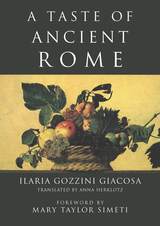
The Taste of Art offers a sample of scholarly essays that examine the role of food in Western contemporary art practices. The contributors are scholars from a range of disciplines, including art history, philosophy, film studies, and history. As a whole, the volume illustrates how artists engage with food as matter and process in order to explore alternative aesthetic strategies and indicate countercultural shifts in society.
The collection opens by exploring the theoretical intersections of art and food, food art’s historical root in Futurism, and the ways in which food carries gendered meaning in popular film. Subsequent sections analyze the ways in which artists challenge mainstream ideas through food in a variety of scenarios. Beginning from a focus on the body and subjectivity, the authors zoom out to look at the domestic sphere, and finally the public sphere.
Here are essays that study a range of artists including, among others, Filippo Tommaso Marinetti, Daniel Spoerri, Dieter Roth, Joseph Beuys, Al Ruppersberg, Alison Knowles, Martha Rosler, Robin Weltsch, Vicki Hodgetts, Paul McCarthy, Luciano Fabro, Carries Mae Weems, Peter Fischli and David Weiss, Janine Antoni, Elżbieta Jabłońska, Liza Lou, Tom Marioni, Rirkrit Tiravanija, Michael Rakowitz, and Natalie Jeremijenko.
Winner of the 2021 Gourmand Awards, Asian Section & Culinary History Section
Filipino cuisine is a delicious fusion of foreign influences, adopted and transformed into its own unique flavor. But to the Americans who came to colonize the islands in the 1890s, it was considered inferior and lacking in nutrition. Changing the food of the Philippines was part of a war on culture led by Americans as they attempted to shape the islands into a reflection of their home country.
Taste of Control tells what happened when American colonizers began to influence what Filipinos ate, how they cooked, and how they perceived their national cuisine. Food historian René Alexander D. Orquiza, Jr. turns to a variety of rare archival sources to track these changing attitudes, including the letters written by American soldiers, the cosmopolitan menus prepared by Manila restaurants, and the textbooks used in local home economics classes. He also uncovers pockets of resistance to the colonial project, as Filipino cookbooks provided a defense of the nation’s traditional cuisine and culture.
Through the topic of food, Taste of Control explores how, despite lasting less than fifty years, the American colonial occupation of the Philippines left psychological scars that have not yet completely healed, leading many Filipinos to believe that their traditional cooking practices, crops, and tastes were inferior. We are what we eat, and this book reveals how food culture served as a battleground over Filipino identity.
An exploration of gender, race, and food in Peru in the 1950s and 1960s and today.
From the late 1940s to the mid 1960s, Peru’s rapid industrialization and anti-communist authoritarianism coincided with the rise of mass-produced cookbooks, the first televised cooking shows, glossy lifestyle magazines, and imported domestic appliances and foodstuffs. Amy Cox Hall’s The Taste of Nostalgia uses taste as a thematic and analytic thread to examine the ways that women, race, and the kitchen were foundational to Peruvian longings for modernity, both during the Cold War and today.
Drawing on interviews, personal stories, media images, and archival and ethnographic research, Cox Hall considers how elite, European-descended women and the urban home were central to Peru’s modernizing project and finds that all women who labored within the deeply racialized and gendered world of food helped set the stage for a Peruvian food nationalism that is now global in the twenty-first century. Cox Hall skillfully connects how the sometimes-unsavory tastes of the past are served again in today’s profitable and pervasive gastronostalgia that helps sell Peru and its cuisine both at home and abroad.
When chef Matt Rapposelli left the National Park Service to attend culinary school in New England, he was moving from one passion to another. What later brought those passions together was a job in the Hocking Hills, southeast Ohio’s stunning, wild landscape, where the restaurants he helmed—at Hocking Hills Lodge and Lake Hope Lodge—gained a resounding reputation for classic dishes that, driven by the regional vernacular and the natural seasonal abundance of Appalachia, were impeccably fresh and flavorful.
A Taste of the Hocking Hills intermingles delicious recipes with striking photographs of a region to which thousands trek each year. Rapposelli presents dishes by the season, noting the specialties that appear on his menus in a given time of year. Whether enjoying a winter evening or a summer morning, cooks will be able to bring a bit of the Hocking Hills home.
Camille Begin shapes a cultural and sensory history of New Deal-era eating from the FWP archives. From "ravioli, the diminutive derbies of pastries, the crowns stuffed with a well-seasoned paste" to barbeque seasoning that integrated "salt, black pepper, dried red chili powder, garlic, oregano, cumin seed, and cayenne pepper" while "tomatoes, green chili peppers, onions, and olive oil made up the sauce", Begin describes in mouth-watering detail how Americans tasted their food. They did so in ways that varied, and varied widely, depending on race, ethnicity, class, and region. Begin explores how likes and dislikes, cravings and disgust operated within local sensory economies that she culls from the FWP’s vivid descriptions, visual cues, culinary expectations, recipes and accounts of restaurant meals. She illustrates how nostalgia, prescriptive gender ideals, and racial stereotypes shaped how the FWP was able to frame regional food cultures as "American."
A Choice 2025 Outstanding Academic Title
Honorable Mention, 2023-2024 Research Society of American Periodicals Book Prize
In its February 1926 issue, Good Housekeeping magazine introduced a column for its approximately one million subscribers called “Tasting and Testing Books.” The column’s author, Emily Newell Blair, would go on to produce ninety-one reading advice columns for the magazine between 1926 and 1934. During this period, Good Housekeeping became the most widely circulated periodical in the United States, doubling its circulation to over two million copies. Much of its popularity stemmed from its intensive promotion of its Seal of Approval for a variety of products, which brought consumers to it for utilitarian purposes. With her focus on regular books, Blair distinguished herself from highbrow literary critics, many of whom have been objects of study as High Modernists. She offered advice to help middle-class women readers make their own choices about the best books in which to invest time and money, rather than dictating what they should or should not read. She aligns herself with the average subscriber, outside the book publishing and reviewer industries, focusing on books that would now be termed middlebrow reading.
Blair’s time at Good Housekeeping covers the era from the heights of the “Roaring Twenties” to the depths of the Great Depression, and her recommendations offer a window into the uses of middlebrow reading during this period of dramatic economic and social shifts. Tasting and Testing Books argues that the consumer-first message of Good Housekeeping infused Blair’s advice column and validated a new attitude of proudly middlebrow pleasure reading in the mid-twentieth century. These columns shed new light on the reading lives of too-often overlooked women, often living outside of urban centers and away from elite literary circles, and present Emily Newell Blair, who strongly identified with her readers as a truly democratic tastemaker.
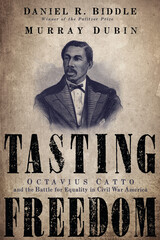
Octavius Valentine Catto was an orator who shared stages with Frederick Douglass, a second baseman on Philadelphia’s best black baseball team, a teacher at the city’s finest black school and an activist who fought in the state capital and on the streets for equal rights. With his racially-charged murder, the nation lost a civil rights pioneer—one who risked his life a century before Selma and Birmingham.
In Tasting Freedom Murray Dubin and Pulitzer Prize winner Dan Biddle painstakingly chronicle the life of this charismatic black leader—a “free” black whose freedom was in name only. Born in the American south, where slavery permeated everyday life, he moved north where he joined the fight to be truly free—free to vote, go to school, ride on streetcars, play baseball and even participate in July 4th celebrations.
Catto electrified a biracial audience in 1864 when he proclaimed, “There must come a change,” calling on free men and women to act and educate the newly freed slaves. With a group of other African Americans who called themselves a “band of brothers,” they challenged one injustice after another. Tasting Freedom presents the little-known stories of Catto and the men and women who struggled to change America.
H. M. van den Brink paints an evocative scene of everyday life in Spain. Readers see the urban shop windows displaying famous serrano ham and Spanish sweet cakes, taste crispy pigs’ ears along with rich chickpea soup, and smell the strong coffee and steaming tortillas often enjoyed while breakfasting outdoors. An appealing blend of historical background and personal recollections, Tasting Spain shapes a lively account of the country and its culture, both in the city and out in the countryside. From exquisite restaurants to private settings, this is a book about eating—meals that Van den Brink has enjoyed solo or with friends—and about the vivid and sustaining memories such meals can create.
“I am not a cook, nor a historian, nor a critic,” writes Van den Brink. “I am just an eater.” With Tasting Spain, he opens new vistas on Spanish cuisine that will tickle the taste buds of readers and leave them hungry for more of this beautiful land.
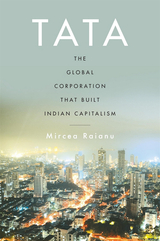
An eye-opening portrait of global capitalism spanning 150 years, told through the history of the Tata corporation.
Nearly a century old, the grand façade of Bombay House is hard to miss in the historic business district of Mumbai. This is the iconic global headquarters of the Tata Group, a multinational corporation that produces everything from salt to software. After getting their start in the cotton and opium trades, the Tatas, a Parsi family from Navsari, Gujarat, ascended to commanding heights in the Indian economy by the time of independence in 1947. Over the course of its 150-year history Tata spun textiles, forged steel, generated hydroelectric power, and took to the skies. It also faced challenges from restive workers fighting for their rights and political leaders who sought to curb its power.
In this sweeping history, Mircea Raianu tracks the fortunes of a family-run business that was born during the high noon of the British Empire and went on to capture the world’s attention with the headline-making acquisition of luxury car manufacturer Jaguar Land Rover. The growth of Tata was a complex process shaped by world historical forces: the eclipse of imperial free trade, the intertwined rise of nationalism and the developmental state, and finally the return of globalization and market liberalization. Today Tata is the leading light of one of the world’s major economies, selling steel, chemicals, food, financial services, and nearly everything else, while operating philanthropic institutions that channel expert knowledge in fields such as engineering and medicine.
Based on painstaking research in the company’s archive, Tata elucidates how a titan of industry was created and what lessons its story may hold for the future of global capitalism.

Contributors to this volume—almost half of whom are Tatars—discuss the problematic results of the partial Tatar return to Crimea that began in the 1980s. This incomplete migration has left the group geographically split and has complicated their desire for stability as a people, whether in their own homeland or in the Central Asian diaspora. Those who have returned to the region on the Black Sea in Ukrayina (formerly Ukraine) have found themselves engulfed in a hostile political environment dominated by Russian residents attempting to stifle the resurgence of Crimean Tatar life. Specific essays address the current political situation in and around Crimea, recent elections, and promising developments in the culture, leadership, and movement toward unity among Crimean Tatars.
Beyond demonstrating the problems of one nationality caught in a fierce power struggle, The Tatars of Crimea offers an example of the challenges faced by all nationalities of the former Soviet Union who now contend with deteriorating economic and political conditions, flagrant discrimination against ethnic minorities, and the denial of civil and human rights common in many of the newly independent states.
Contributors. Ludmilla Alexeyeva, Edward A. Allworth, Mübeyyin Batu Altan, Nermin Eren, Alan W. Fisher, Riza Gülüm, Seyit Ahmet Kirimca, Edward Lazzerini, Peter Reddaway, Ayshe Seytmuratova, Andrew Wilson

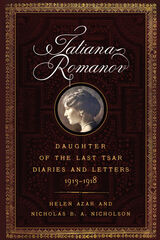
Grand Duchess Tatiana Nikolaevna of Russia was the second of the four daughters of Tsar Nicholas II and his wife, the Empress Alexandra Feodorovna. Long recognized by historians as the undisputed “beauty” of the family, Tatiana was acknowledged for her poise, her elegance, and her innate dignity within her own family. Helen Azar, translator of the diaries of Olga Romanov, and Nicholas B. A. Nicholson, Russian Imperial historian, have joined together to present a truly comprehensive picture of this extraordinarily gifted, complex, and intelligent woman in her own words. Tatiana Romanov, Daughter of the Last Tsar: Diaries and Letters, 1913–1918, presents translations of material never before published in Russian or in English, as well as materials never published in their entirety in the West.
The brisk, modern prose of Tatiana’s diary entries reveals the character of a young woman who was far more than the sheltered imperial beauty as she previously has been portrayed. While many historians and writers describe her as a cold, haughty, and distant aristocrat, this book shows instead a remarkably down-to-earth and humorous young woman, full of life and compassion. A detail-oriented and observant participant in some of the most important historical events of the early twentieth century, she left firsthand descriptions of the tercentenary celebrations of the House of Romanov, the early years of Russia’s involvement in World War I, and the road to her family’s final days in Siberian exile. Her writings reveal extraordinary details previously unknown or unacknowledged. Lavishly annotated for the benefit of the nonspecialist reader, this book is not only a reevaluation of Tatiana’s role as more than just one of four sisters, but also a valuable reference on Russia, the First World War, the Russian Revolution, and the people closest to the Grand Duchess and her family.
Since John Hersey’s Hiroshima—the classic account, published in 1946, of the aftermath of the atomic bombing of that city—very few books have examined the meaning and impact of World War II through the eyes of Japanese men and women who survived that conflict. Tattered Kimonos in Japan does just that: It is an intimate journey into contemporary Japan from the perspective of the generation of Japanese soldiers and civilians who survived World War II, by a writer whose American father and Japanese father-in-law fought on opposite sides of the conflict.
The author, a former NPR senior editor, is Jewish, and he approaches the subject with the sensibilities of having grown up in a community of Holocaust survivors. Mindful of the power of victimhood, memory, and shared suffering, he travels across Japan, including Hiroshima and Nagasaki, meeting a compelling group of men and women whose lives, even now, are defined by the trauma of war, and by lingering questions of responsibility and repentance for Japan’s wartime aggression.
The image of a tattered kimono from Hiroshima is the thread that drives the narrative arc of this emotional story about a writer’s encounter with history, inside the Japan of his father’s generation, on the other side of his father’s war. This is a book about history with elements of family memoir. It offers a fresh and truly unique perspective for readers interested in World War II, Japan, or Judaica; readers seeking cross-cultural journeys; and readers intrigued by Japanese culture, particularly the kimono.
The contributors examine the contexts in which Pacific tattoos were “discovered” by Europeans, track the history of the tattooing of Europeans visiting the region, and look at how Pacific tattooing was absorbed, revalued, and often suppressed by agents of European colonization. They consider how European art has incorporated tattooing, and they explore contemporary manifestations of Pacific tattoo art, paying particular attention to the different trajectories of Samoan, Tahitian, and Maori tattooing and to the meaning of present-day appropriations of tribal tattoos. New research has uncovered a fascinating visual archive of centuries-old tattoo images, and this richly illustrated volume includes a number of those—many published here for the first time—alongside images of contemporary tattooing in Polynesia and Europe. Tattoo offers a tantalizing glimpse into the plethora of stories and cross-cultural encounters that lie between the blood on a sailor’s backside in the eighteenth century and the hammering of a Samoan tattoo tool in the twenty-first.
Contributors. Peter Brunt, Anna Cole, Anne D’Alleva, Bronwen Douglas, Elena Govor, Makiko Kuwahara, Sean Mallon, Linda Waimarie Nikora, Mohi Rua, Cyril Siorat, Ngahuia Te Awekotuku, Nicholas Thomas, Joanna White

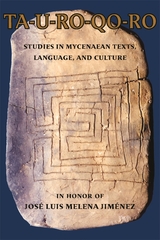
José Luis Melena Jiménez is a peerless scholar of editing the texts written in the Mycenaean writing system of the late second millennium BCE and explicating their linguistic and “historical” contents.
This volume takes up problems of script and language representation and textual interpretation, ranging from the use of punctuation markers and numbers in the Linear B tablets and the values of specific signs, to personal names and place names reflecting the ethnic composition of Mycenaean society and the dialects spoken during the proto-Homeric period of the late Bronze Age. New insights are offered into Mycenaean furniture, war chariots, pictorial vases, land cultivation, arboriculture, and shrine areas. Other papers discuss wealth finance, prestige goods, the ideology of obligatory payment, long-puzzling tax impositions, and the inevitable collapse of the palatial economic and political systems.
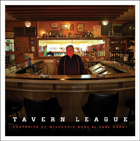
In Tavern League, photographer Carl Corey documents a unique and important segment of the Wisconsin community. Our bars are unique micro-communities, offering patrons a sense of belonging. Many of these bars are the only public gathering place in the rural communities they serve. These simple taverns offer the individual the valuable opportunity for face to face conversation and camaraderie, particularly as people become more physically isolated through the accelerated use of the internet’s social networking, mobile texting, gaming, and the rapid-fire of email.
This collection of 60 pictures captures the Wisconsin tavern as it is today. Carl Corey’s view is both familiar and undeniably unique, his pictures resonant with anyone who has set foot in a Wisconsin tavern. As the Milwaukee Journal Sentinel’s Mary Louise Schumacher has written, “Carl Corey’s photographs . . . document iconic American places that are taken for granted. . . . They are comforting images, places we know, but also eerie and remote, presented with a sense of romance and nostalgia that suggests they are already past.”
Through these essays—which deal with Bowles’s published as well as her unpublished work—Skerl seeks to generate serious critical attention for an important but neglected female experimental writer of the mid-twentieth century and to celebrate her originality, power, and craft.
Based in disciplines and theoretical approaches that range from feminist criticism to Middle Eastern studies, from postmodernism to queer theory, and from Victorianism to the Beat Generation, the essayists naturally approach Bowles’s fiction and drama from a wide variety of critical perspectives. All of these essays are unpublished and written for this volume.
When Daniel Webster commented that the two certainties were death and taxes, he could not have imagined all the ingenious ways governments could tax and spend, though leaving this earth has changed not at all.
The tax expenditure concept is one of the newer methods of tax policy analysis that has been reshaping fiscal and monetary plans of governments. A tax expenditure is a financial benefit provided through the tax system. Whether for obsolete machinery in a factory, payment of real estate taxes, or childcare for a working mother, a special tax break is a tax expenditure. The tax expenditure concept was introduced to the Treasury Department in 1968 under the direction of Stanley Surrey and was described in his landmark book Pathways to Tax Reform. In this new book, the authors analyze the development of the concept since 1973, during which time applications of tax expenditures have expanded rapidly and new dimensions have emerged for even wider usage.
The United States prepared special analyses of tax expenditures in 1975 and Congress made the tax expenditure budget a part of the Tax Reform Act of 1981. Other countries now use the tool for analysis and budgeting, and a tax expenditure budget seems to be a permanent fixture in government planning. Recent U.S. tax expenditure budgets have increased by as much as 179 percent, while taxes collected through direct legislation have risen only 14 percent. Surrey and McDaniel focus on the impact of the tax expenditure notion on budget policy and tax policy and administration, and on how governments can decide between tax expenditures or direct spending to implement programs.

This is a comprehensive book on the tax benefits of the charitable contribution, or bargain sale, of a conservation easement. It provides a detailed explanation of the complex and extensive requirements of the federal tax code and related concepts, including the rules governing the operation of tax-exempt organizations such as land trusts. Clearly written, systematic in its coverage, it is intended to be of value for anyone who deals with land trust issues, including land trust staff and trustees, landowners, lawyers, accountants, government officials, and interested lay people. Structured for easy reference, A Tax Guide to Conservation Easements is designed to be used as a resource tool. Related topics are cross-referenced throughout. All principles in the book are illustrated with one or more useful examples.
The tax benefits of contributing a conservation easement are unquestionably the heart of voluntary land conservation today. Knowledge of the tax law relating to land trusts and conservation easements is vital to properly establishing and managing land trusts and to insuring the tax deductibility of conservation easements. The future of voluntary land conservation is dependent on a clear understanding of tax policy. Complete, meticulous, and up to date, A Tax Guide to Conservation Easements is an essential handbook.
READERS
Browse our collection.
PUBLISHERS
See BiblioVault's publisher services.
STUDENT SERVICES
Files for college accessibility offices.
RECENTLY PUBLISHED


UChicago Accessibility Resources
home | accessibility | search | about | contact us
BiblioVault ® 2001 - 2025
The University of Chicago Press