

To show how early modern naturalists conceived of the interplay between sensory experience and the production of knowledge, Aesthetic Science explores natural-historical and anatomical works of the Royal Society through the lens of the aesthetic. By underscoring the importance of subjective experience to the communication of knowledge about nature, Wragge-Morley offers a groundbreaking reconsideration of scientific representation in the early modern period and brings to light the hitherto overlooked role of aesthetic experience in the history of the empirical sciences.
Powerful financial forces have supported the neoliberal project since the 1980s to advance their interests, but there are now signs that these forces have a new face and a new strategy.
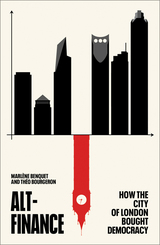
The majority of the British finance sector threw its support behind Britain leaving the European Union, a flagship institution of neoliberalism. Beyond this counterintuitive move, what was really happening and why? Alt-Finance examines a new authoritarian turn in financialised democracies, focusing on the City of London, revealing a dangerous alternative political project in the making.
In a clash with traditional finance, the new behemoths of financial capital - hedge funds, private equity firms, and real estate funds - have started to cohere around a set of political beliefs, promoting libertarian, authoritarian, climate-denying, and Eurosceptic views. Protecting investments, suppressing social dissent, and reducing state interference is at the core of their mission for a new world order.
By following the money, the authors provide indisputable evidence of these worrying developments. Through a clear analysis of the international dealings of this new authoritarian-libertarian regime, not just in Britain but in the US and Brazil, we can understand how our world is being shaped against our will by struggles between dominant groups.
‘Am I Less British?’ focuses on the children of refugees and immigrants from Turkey in North London. Providing a rich ethnography of the lives of the children, the book studies their sense of identity and belonging, and their transnational experiences. It aims to understand how the children position themselves within a range of locations (London, North London, and Turkey), where they face class hierarchy, racism, and discrimination. Dogus Simsek explores how these children think about their sense of belonging within the contemporary political context in Britain and Turkey. De-identifying themselves from national identities and holding onto their oppressed identities appear as new forms of resistance in response to racism and exclusion.
The experiences of the young people reflect the complexity of their lives in changing political and social circumstances across the borders of nation-states, as well as the importance of other categories of identity, including local identities. Overall, the book argues that the intersections of local, national, and transnational approaches, the political context through which the lives of young people are framed, and their sophisticated engagement with ideas of race, class, ethnicity, and gender, are crucial to understanding their identity formation.
Amy Levy has risen to prominence in recent years as one of the most innovative and perplexing writers of her generation. Embraced by feminist scholars for her radical experimentation with queer poetic voice and her witty journalistic pieces on female independence, she remains controversial for her representations of London Jewry that draw unmistakably on contemporary antisemitic discourse.
Amy Levy: Critical Essays brings together scholars working in the fields of Victorian cultural history, women’s poetry and fiction, and the history of Anglo-Jewry. The essays trace the social, intellectual, and political contexts of Levy’s writing and its contemporary reception. Working from close analyses of Levy’s texts, the collection aims to rethink her engagement with Jewish identity, to consider her literary and political identifications, to assess her representations of modern consumer society and popular culture, and to place her life and work within late-Victorian cultural debate.
This book is essential reading for undergraduate and postgraduate students offering both a comprehensive literature review of scholarship-to-date and a range of new critical perspectives.
Contributors:
Susan David Bernstein,University of Wisconsin-Madison
Gail Cunningham,Kingston University
Elizabeth F. Evans,Pennslyvania State University–DuBois
Emma Francis,Warwick University
Alex Goody,Oxford Brookes University
T. D. Olverson,University of Newcastle upon Tyne
Lyssa Randolph,University of Wales, Newport
Meri-Jane Rochelson,Florida International University
Flandreau argues that finance and science were at the heart of a new brand of imperialism born during Benjamin Disraeli’s first term as Britain’s prime minister in the 1860s. As anthropologists advocated the study of Miskito Indians or stated their views on a Jamaican rebellion, they were in fact catering to the impulses of the stock exchange—for their own benefit. In this way the very development of the field of anthropology was deeply tied to issues relevant to the financial market—from trust to corruption. Moreover, this book shows how the interplay between anthropology and finance formed the foundational structures of late nineteenth-century British imperialism and helped produce essential technologies of globalization as we know it today.
A monumental account of one migrant community’s everyday lives, struggles, and aspirations
Forty years of continuous war and conflict have made Afghans the largest refugee group in the world. In this first full-scale ethnography of Afghan migrants in England, Nichola Khan examines the imprint of violence, displacement, kinship obligations, and mobility on the lives and work of Pashtun journeyman taxi drivers in Britain. Khan’s analysis is centered in the county of Sussex, site of Brighton’s orientalist Royal Pavilion and the former home of colonial propagandist Rudyard Kipling. Her nearly two decades of relationships and fieldwork have given Khan a deep understanding of the everyday lives of Afghan migrants, who face unrelenting pressures to remit money to their struggling relatives in Pakistan and Afghanistan, adhere to traditional values, and resettle the wives and children they have left behind.
This kaleidoscopic narrative is enriched by the migrants’ own stories and dreams, which take on extra significance among sleep-deprived taxi drivers. Khan chronicles the way these men rely on Pashto poems and aphorisms to make sense of what is strange or difficult to bear. She also attests to the pleasures of local family and friends who are less demanding than kin back home—sharing connection and moments of joy in dance, excursions, picnics, and humorous banter. Khan views these men’s lives through the lenses of movement—the arrival of friends and family, return visits to Pakistan, driving customers, even the journey to remit money overseas—and immobility, describing the migrants who experience “stuckness” caused by unresponsive bureaucracies, chronic insecurity, or struggles with depression and other mental health conditions.
Arc of the Journeyman is a deeply humane portrayal that expands and complicates current perceptions of Afghan migrants, offering a finely analyzed description of their lives and communities as a moving, contingent, and fully contemporary force.
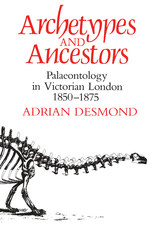
"A sophisticated study of the colonization of scientific territory—specifically of rival attempts to design the dinosaur—and of the constructive (not just obstructive) role of social pressures in the making of 'lasting contributions' to science. Not least it is a joy to read, perkily irreverent at times and full of nice vignettes and memorable turns of phrase."—Roy Porter, Times Higher Education Supplement
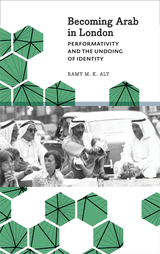
Drawing on the work of Judith Butler, Aly emphasizes the need to move away from the concept of identity and toward the idea of race, gender, and class as performance. Based on seven years of fieldwork, during which time the author immersed himself in London’s Arab community, Becoming Arab in London is an innovative and necessary contribution to the study of diaspora and difference in contemporary Britain.

What does it mean to exist outside the normative temporality of life, of housed living, and, ultimately, of selfhood? Becoming Somebody Else takes up this question, offering a window into the fragmented and chaotic lives of people experiencing homelessness in urban London as they drink and drug themselves into blackout in post-austerity Britain. A state of being where time, body, agency, and self collapse into a memoryless abyss, the blackout is a prism into how human beings make and unmake their selfhood in the wake of social suffering and personal trauma. Attending to the words and histories of several individuals, Joshua Burraway knits together structural, psychological, and phenomenological approaches to understand the ways in which memory, agency, and selfhood are sites of struggle and belonging, and in doing so, suggests new ways of thinking about addiction, homelessness, and therapeutic possibility.

Tobe completed in 12volumes, this monumental work here begins publication with the first two volumes—Abaco to Bertie and Bertin to Byzard. When completed, it is expected that the biographical dictionary will include information on more than 8,500 individuals.
Hundreds of printed sources have been searched for this project, and dozens of repositories combed, and the names of personnel listed have been filtered through parish registers whenever possible. From published and unpublished sources, from wills, archives of professional societies and guilds, from records of colleges, universities, and clubs, and from the contributions of selfless scholars, the authors have here assembled material which illuminates theatrical and musical activity in London in the 1660–1800 period.
The information here amassed will doubtless be augmented by other specialists in Restoration and eighteenth-century theatre and drama, but it is not likely that the number of persons now known surely or conjectured finally to have been connected with theatrical enterprise in this period will ever be increased considerably. Certainly, the contributions made here add immeasurably to existing knowledge, and in a number of instances correct standard histories or reference works.
The accompanying illustrations, estimated to be some 1,400 likenesses—at least one picture of each subject for whom a portrait exists—may prove to be a useful feature of the Work. The authors have gone beyond embellishment of the text, and have attempted to list all original portraits any knowledge of which is now recoverable, and have tried to ascertain the present location of portraits in every medium.
—Margaret J. M. Ezell
Distinguished Professor of English and John and Sara Lindsay Chair of Liberal Arts
Texas A&M University

The result is a complex and informative study on a missing chapter in the history of the Dominican Republic and, more broadly, a contribution to the often forgotten history of the cold war in the Caribbean.
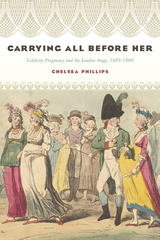
The rise of celebrity stage actresses in the long eighteenth century created a class of women who worked in the public sphere while facing considerable scrutiny about their offstage lives. Such powerful celebrity women used the cultural and affective significance of their reproductive bodies to leverage audience support and interest to advance their careers, and eighteenth-century London patent theatres even capitalized on their pregnancies. Carrying All Before Her uses the reproductive histories of six celebrity women (Susanna Mountfort Verbruggen, Anne Oldfield, Susannah Cibber, George Anne Bellamy, Sarah Siddons, and Dorothy Jordan) to demonstrate that pregnancy affected celebrity identity, impacted audience reception and interpretation of performance, changed company repertory and altered company hierarchy, influenced the development and performance of new plays, and had substantial economic consequences for both women and the companies for which they worked. Deepening the fields of celebrity, theatre, and women's studies, as well as social and medical histories, Phillips reveals an untapped history whose relevance and impact persists today.
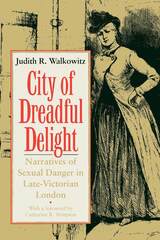
Victorian London was a world where long-standing traditions of class and gender were challenged by a range of public spectacles, mass media scandals, new commercial spaces, and a proliferation of new sexual categories and identities. In the midst of this changing culture, women of many classes challenged the traditional privileges of elite males and
asserted their presence in the public domain.
An important catalyst in this conflict, argues Walkowitz, was W. T. Stead's widely read 1885 article about child prostitution. Capitalizing on the uproar caused by the piece and the volatile political climate of the time, women spoke of sexual danger, articulating their own grievances against men, inserting themselves into the public discussion of sex to an unprecedented extent, and gaining new entree to public spaces and journalistic practices. The ultimate manifestation of class anxiety and gender antagonism came in 1888 with the tabloid tales of Jack the Ripper. In between, there were quotidien stories of sexual possibility and urban adventure, and Walkowitz examines them all, showing how women were not simply figures in the imaginary landscape of male spectators, but also central actors in the stories of metropolotin life that reverberated in courtrooms, learned journals, drawing rooms, street corners, and in the letters columns of the daily press.
A model of cultural history, this ambitious book will stimulate and enlighten readers across a broad range of interests.
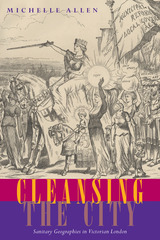
From the novels of Charles Dickens and George Gissing to anonymous magazine articles and pamphlets, resistance to reform found expression in the nostalgic appreciation of a threatened urban landscape and anxiety about domestic autonomy in an era of networked sanitary services. Cleansing the City emphasizes the disruptions and disorientation occasioned by purification—a process we are generally inclined to see as positive. By recovering these sometimes oppositional, sometimes ambivalent responses, Michelle Allen elevates a significant undercurrent of Victorian thought into the mainstream and thus provides insight into the contested nature of sanitary modernization.

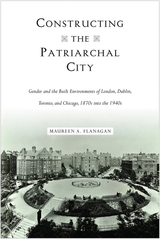
In the Anglo-Atlantic world of the late nineteenth century, groups of urban residents struggled to reconstruct their cities in the wake of industrialization and to create the modern city. New professional men wanted an orderly city that functioned for economic development. Women’s vision challenged the men’s right to reconstruct the city and resisted the prevailing male idea that women in public caused the city’s disorder.
Constructing the Patriarchal City compares the ideas and activities of men and women in four English-speaking cities that shared similar ideological, professional, and political contexts. Historian Maureen Flanagan investigates how ideas about gender shaped the patriarchal city as men used their expertise in architecture, engineering, and planning to fashion a built environment for male economic enterprise and to confine women in the private home. Women consistently challenged men to produce a more equitable social infrastructure that included housing that would keep people inside the city, public toilets for women as well as men, housing for single, working women, and public spaces that were open and safe for all residents.

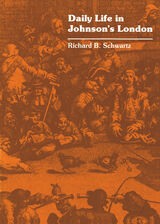
"Outstanding. . . . The author packs a remarkable quantity of detail into a small space, even including a discussion of price and wage figures that will be intelligible to Americans [today]. . . . His prose is lucid, graceful, lively. Generously illustrated, the book also includes an extensive bibliography."—Choice
"An excellent source for English Literature and history students studying this period or Samuel Johnson."—Booklist
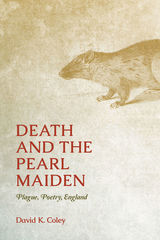
Death and the Pearl Maiden: Plague, Poetry, England asks why one of the singular historical traumas of the later Middle Ages appears to be evoked so fleetingly in fourteenth-century Middle English poetry, a body of work as daring and socially engaged as any in English literary history. By focusing on under-recognized pestilential discourses in Pearl, Cleanness, Patience, and Sir Gawain and the Green Knight—the four poems uniquely preserved British Library MS Cotton Nero A.x —this study resists the idea that the Black Death had only a slight impact on medieval English literature, and it strives to account for the understated shape of England’s literary response to the plague and our contemporary understandings of it.

“A welcome addition to the field of urban tourism research... its content could prove useful not only to students and academic, but also to policymakers interested in better understanding the implications of tourism development and the expansion of the visitor economy in large cities.” - https://www.sciencedirect.com/science/article/abs/pii/S0261517719301785
London is one of the world’s most popular destinations and visitors contribute approximately £14.9 billion of expenditure to the city every year. Its tourism and events sectors are growing and over the last few years London has received more visitors than ever before. However, detailed accounts of the city’s visitor economy are conspicuously absent.
This book analyses how the capital is developing as a destination through the expansion of tourism and events into new urban spaces. The book outlines how parts of London not previously regarded as tourist territory are now subject to the visitor gaze with tourism spreading beyond established central zones into peripheral, suburban and residential areas – in part propelled by a big rise in peer to peer accommodation use. Simultaneously, London’s airports and sports stadiums and their surrounds are becoming destinations in their own right. New vantage points have been created, allowing tourists to explore the city: from above, at night-time or through tours given by the homeless; via the opening up of the River Thames; or through the transformation of local parks into eventscapes.
The book explores these trends and shows how urban destinations expand. In doing so, it enhances our understanding of London and highlights the growing significance of tourism and events in global cities.
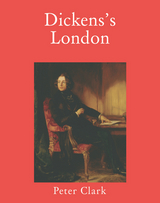
In five walks through central London, Peter Clark explores “The First Suburbs”—Camden Town, Chelsea, Greenwich, Hampstead, Highgate and Limehouse—as they feature in Dickens’s writing and illuminates the settings of Dickens’s life and his greatest works of journalism and fiction. Describing these storied spaces of today’s central London in intimate detail, Clark invites us to experience the city as it was known to Dickens and his characters. These walks take us through the locations and buildings that he interacted with and wrote about, creating an imaginative reconstruction of the Dickensian world that has been lost to time.

Disrupting the Speculative City tells the story of how the Haringey Development Vehicle community coalition, defeated one of the most ambitious programs of state-led gentrification in London. Drawing on the accounts of those at the heart of local statecraft and grassroots organizations, and analyzing crucial developments in property investment, this book explores a significant and inspirational success for campaigners in London, where social cleansing has become the default outcome of redevelopment.
This edition preserves the appearance, spelling, and punctuation of the original manuscript while expanding antiquated contractions to provide an easily readable text. Textual notes appear on the page, and in-depth contextual notes and word glosses are provided in the commentary section. The analyses add to our knowledge of early modern manuscript culture and literary manuscript transmission, and a substantial introduction provides context for the compilation of the anthology.
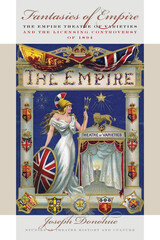
Fantasies of Empire is the first book to recount in full the story of the Empire licensing controversy in all its captivating detail. Contemporaneous accounts are interwoven with Donohue’s identification and analysis of the larger issues raised: What the controversy reveals about contemporary sexual and social relations, what light it sheds on opposing views regarding the place of art and entertainment in modern society, and what it says about the pervasive effect of British imperialism on society’s behavior in the later years of Queen Victoria’s reign. Donohue connects the controversy to one of the most interesting developments in the history of modern theatre, the simultaneous emergence of a more sophisticated, varied, and moneyed audience and a municipal government insistent on its right to control and regulate that audience’s social and cultural character and even its moral behavior.
Rich in illustrations and entertainingly written, Fantasies of Empire will appeal to theatre, dance, and social historians and to students of popular entertainment, the Victorian period, urban studies, gender studies, leisure studies, and the social history of architecture.


The Victorian era was the high point of literary tourism. Writers such as Charles Dickens, George Eliot, and Sir Walter Scott became celebrities, and readers trekked far and wide for a glimpse of the places where their heroes wrote and thought, walked and talked. Even Shakespeare was roped in, as Victorian entrepreneurs transformed quiet Stratford-upon-Avon into a combination shrine and tourist trap.
Stratford continues to lure the tourists today, as do many other sites of literary pilgrimage throughout Britain. And our modern age could have no better guide to such places than Simon Goldhill. In Freud's Couch, Scott’s Buttocks, Brontë's Grave, Goldhill makes a pilgrimage to Sir Walter Scott's baronial mansion, Wordsworth's cottage in the Lake District, the Bront ë parsonage, Shakespeare's birthplace, and Freud's office in Hampstead. Traveling, as much as possible, by methods available to Victorians—and gamely negotiating distractions ranging from broken bicycles to a flock of giggling Japanese schoolgirls—he tries to discern what our forebears were looking for at these sites, as well as what they have to say to the modern mind. What does it matter that Emily Brontë’s hidden passions burned in this specific room? What does it mean, especially now that his fame has faded, that Scott self-consciously built an extravagant castle suitable for Ivanhoe—and star-struck tourists visited it while he was still living there? Or that Freud's meticulous recreation of his Vienna office is now a meticulously preserved museum of itself? Or that Shakespeare’s birthplace features student actors declaiming snippets of his plays . . . in the garden of a house where he almost certainly never wrote a single line?
Goldhill brings to these inquiries his trademark wry humor and a lifetime's engagement with literature. The result is a travel book like no other, a reminder that even today, the writing life still has the power to inspire.
Gaming the Stage also introduces a new archive for game studies: scenes of onstage gaming, which appear at climactic moments in dramatic literature. Bloom reveals plays to be systems of information for theater spectators: games of withholding, divulging, speculating, and wagering on knowledge. Her book breaks new ground through examinations of plays such as The Tempest, Arden of Faversham, A Woman Killed with Kindness, and A Game at Chess; the histories of familiar games such as cards, backgammon, and chess; less familiar ones, like Game of the Goose; and even a mixed-reality theater videogame.

Looking at a heretofore overlooked set of archival records of London in the late 17th and early 18th centuries, Hurl-Eamon reassesses the impact of gender on petty crime and its prosecution during the period. This book offers a new approach to the growing body of work on the history of violence in past societies. By focusing upon low-cost prosecutions in minor courts, Hurl-Eamon uncovers thousands of assaults on the streets of early modern London. Previous histories stressing the masculine nature of past violence are questioned here: women perpetrated one-third of all assaults. In looking at more mundane altercations rather than the homicidal attacks studied in previous histories, the book investigates violence as a physical language, with some forms that were subject to gender constraints, but many of which were available to both men and women. Quantitative analyses of various circumstances surrounding the assaults—including initial causes, weapons used, and injuries sustained—outline the patterns of violence as a language.
Hurl-Eamon also stresses the importance of focusing on the prosecutorial voice. In bringing the court’s attention to petty attacks, thousands of early modern men and women should be seen as agents rather than victims. This view is especially interesting in the context of domestic violence, where hundreds of wives and servants prosecuted patriarchs for assault, and in the Mohock Scare of 1712, where London’s populace rose up in opposition to aristocratic violence. The discussion is informed by a detailed knowledge of assault laws and the rules governing justices of the peace.
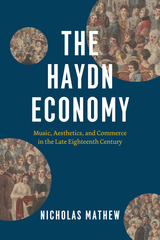
In this far-reaching work of music history and criticism, Nicholas Mathew reimagines the world of Joseph Haydn and his contemporaries, with its catastrophic upheavals and thrilling sense of potential. In the process, Mathew tackles critical questions of particular moment: how we tell the history of the European Enlightenment and Romanticism; the relation of late eighteenth-century culture to incipient capitalism and European colonialism; and how the modern market and modern aesthetic values were—and remain—inextricably entwined.
The Haydn Economy weaves a vibrant material history of Haydn’s career, extending from the sphere of the ancient Esterházy court to his frenetic years as an entrepreneur plying between London and Vienna to his final decade as a venerable musical celebrity, during which he witnessed the transformation of his legacy by a new generation of students and acolytes, Beethoven foremost among them. Ultimately, Mathew asserts, Haydn’s historical trajectory compels us to ask what we might retain from the cultural and political practices of European modernity—whether we can extract and preserve its moral promise from its moral failures. And it demands that we confront the deep histories of capitalism that continue to shape our beliefs about music, sound, and material culture.
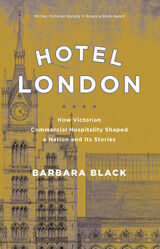
Incorporating the works of Oscar Wilde, Henry James, Wilkie Collins, Arnold Bennett, Florence Marryat, and Marie Belloc Lowndes, as well as contemporary depictions of the hotels in Mad Men,American Horror Story, and The Grand Budapest Hotel, Black examines how the hotel supported a corporate identity that would ultimately assist in the rise of modern capitalist structures and the middle class. In this way, Hotel London exposes the aggravations of class stratifications through the operations of status inside hotel life, giving a unique perspective on Victorian London that could only come from the stories of a hotel.
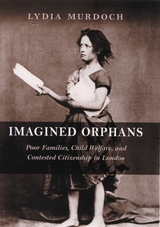
With his dirty, tattered clothes and hollowed-out face, Oliver Twist is the enduring symbol of the young indigent spilling out of orphanages and haunting the streets of late-nineteenth-century London. Although poor children were often portrayed as real-life Oliver Twists—either orphaned or abandoned by unworthy parents—they in fact frequently maintained contact and were eventually reunited with their families.
In Imagined Orphans, Lydia Murdoch focuses on this discrepancy between the representation and the reality of children’s experiences within welfare institutions—a discrepancy that she argues stems from conflicts over middle- and working-class notions of citizenship that arose in the 1870s and persisted until the First World War. Reformers’ efforts to depict poor children as either orphaned or endangered by abusive or “no-good” parents fed upon the poor’s increasing exclusion from the Victorian social body. Reformers used the public’s growing distrust and pitiless attitude toward poor adults to increase charity and state aid to the children.
With a critical eye to social issues of the period, Murdoch urges readers to reconsider the complex situations of families living in poverty. While reformers’ motivations seem well intentioned, she shows how their methods solidified the public’s antipoor sentiment and justified a minimalist welfare state that engendered a cycle of poverty. As they worked to fashion model citizens, reformers’ efforts to protect and care for children took on an increasingly imperial cast that would continue into the twentieth century.

The Last Asylum is Taylor’s breathtakingly blunt and brave account of those years. In it, Taylor draws not only on her experience as a historian, but also, more importantly, on her own lived history at Friern— once known as the Colney Hatch Lunatic Asylum and today the site of a luxury apartment complex. Taylor was admitted to Friern in July 1988, not long before England’s asylum system began to undergo dramatic change: in a development that was mirrored in America, the 1990s saw the old asylums shuttered, their patients left to plot courses through a perpetually overcrowded and underfunded system of community care. But Taylor contends that the emptying of the asylums also marked a bigger loss, a loss of community. She credits her own recovery to the help of a steadfast psychoanalyst and a loyal circle of friends— from Magda, Taylor’s manic-depressive roommate, to Fiona, who shares tips for navigating the system and stories of her boyfriend, the “Spaceman,” and his regular journeys to Saturn. The forging of that network of support and trust was crucial to Taylor’s recovery, offering a respite from the “stranded, homeless feelings” she and others found in the outside world.
A vivid picture of mental health treatment at a moment of epochal change, The Last Asylum is also a moving meditation on Taylor’s own experience, as well as that of millions of others who struggle with mental illness.
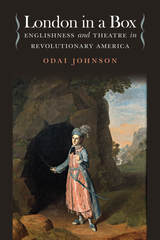
If one went looking for the tipping point in the prelude to the American Revolution, it would not be the destruction of the tea in Boston Harbor, or the blockade of Boston by British warships, or even the gathering of the first Continental Congress; rather, it was the Congress’s decision in late October of 1774 to close the theatres. In this remarkable feat of historical research, Odai Johnson pieces together the surviving fragments of the story of the first professional theatre troupe based in the British North American colonies. In doing so, he tells the story of how colonial elites came to decide they would no longer style themselves British gentlemen, but instead American citizens.
London in a Box chronicles the enterprise of David Douglass, founder and manager of the American Theatre, from the 1750s to the climactic 1770s. The ambitious Scotsman’s business was teaching provincial colonials to dress and behave as genteel British subjects. Through the plays he staged, the scenery and costumes, and the bearing of his actors, he displayed London fashion and London manners. He counted among his patrons the most influential men in America, from British generals and governors to local leaders, including the avid theatre-goers George Washington and Thomas Jefferson. By 1774, Douglass operated a monopoly of theatres in six colonies and the Anglophone Caribbean, from Jamaica to Charleston and northward to New York City. (Boston remained an impregnable redoubt against theatre.)
How he built this network of patrons and theatres and how it all went up in flames as the revolution began is the subject of this witty history. A treat for anyone interested in the world of the American Revolution and an important study for historians of the period.
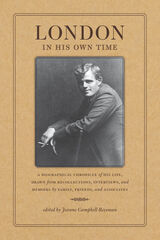
Everyone knows Jack London for his tales of adventure in Alaska and the Canadian Yukon. With his work translated into more than 100 languages, London is one of the most popular American writers in the world, alongside Mark Twain. Yet for the reader tackling The Call of the Wild or White Fang, or perhaps his most often-anthologized short story “To Build a Fire,” many misconceptions about his life confuse his legacy.
London in His Own Time is based on Jeanne Reesman’s nearly thirty-five years of archival research. The book offers surprising perspectives on Jack London’s many sides by family, friends, fellow struggling young writers, business associates, high school and college classmates, interviewers, editors, coauthors, visitors to his Sonoma Valley Beauty Ranch in Glen Ellen, California, and more.
People who have commented on and discussed the mercurial genius include Joseph Conrad, Theodore Dreiser, Upton Sinclair, Sinclair Lewis, Ambrose Bierce, and Mary Austin, as well as his half-sister, Eliza London Shepard, and his first wife, Elizabeth Bess “Bessie” Maddern London. There are a few Klondike pals he kept in touch with, and some fellow writers such as Cloudesley Johns, but many of those closest to him truly demonstrate his wide range of friends: barman Johnny Heinold; his second wife, Charmian, whom he called “Mate Woman”; his daughters, Joan and Becky; his lover, Anna Strunsky; his closest friends, especially the poet George Sterling; his former crewmate on the Snark, Martin Johnson; and his valet/memoirist, Yoshimatsu Nakata. Reesman also includes dozens of entries from Bay-area socialists, friends in Hawai’i and the South Seas, fellow war correspondents, neighbors like Luther Burbank, and his long-time editor at Macmillan, George Brett.
“When a man is tired of London, he is tired of life; for there is in London all that life can afford.” Samuel Johnson spoke highly of London in Boswell’s famous biography, but not all have shared his enthusiasm. Since, the capital has been characterized as a “riddle,” a “cesspool,” and a “modern Babylon”—the last by none other than Prime Minister Benjamin Disraeli. No tribute to the city would be complete without reference to the notoriously inclement weather, which caused Jane Austen to complain that, “in London it is always a sickly season.”
For fans, foes, and those planning a trip to the city in the hopes of forming an opinion, this collection will be welcomed.
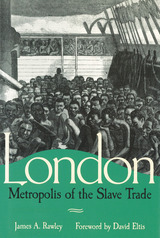
"The recognition that ordinary people could and did trade in slaves, as well as the fact that ordinary people became slaves, is, indeed, the beginning of comprehending the enormity of the forced migration of eleven million people and the attendant deaths of many more."
Rawley draws on material from the year 1700 to the American Civil War as he explores the role of London in the trade. He covers its activity as a port of departure for ships bound for Africa; its continuing large volume after the trade extended to Bristol and Liverpool; and the controversy between London’s parliamentary representatives, who defended the trade, and the abolitionist movement that was quartered there.
Sweeping in scope and thorough in its analysis, this collection of essays from a seasoned scholar will be welcomed by historians concerned with slavery and the slave trade, as well as by students just beginning their exploration of this subject.
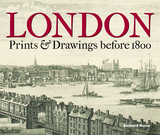
This book presents more than a hundred images of Greater London from before 1800, all from the Gough Collection of the Bodleian Library. We see prints of London before and after the Great Fire, images of the 1780 tornado, panoramas of the Thames, depictions of the building and destruction of landmark bridges, and much more. Making brilliant use of the most extensive collection of London images amassed by any private collector of the period, the book will be essential to anyone delving into the history of the city.
It is the London of this period that editors Roger Parker and Susan Rutherford pinpoint in this book, which chooses one broad musical category—voice—and engages with it through essays on music of the streets, theaters, opera houses, and concert halls; on the raising of voices in religious and sociopolitical contexts; and on the perception of voice in literary works and scientific experiments with acoustics. Emphasizing human subjects, this focus on voice allows the authors to explore the multifaceted issues that shaped London, from the anxiety surrounding the city’s importance in the musical world at large to the changing vocal imaginations that permeated the epoch. Capturing the breadth of sonic stimulations and cultures available—and sometimes unavoidable—to residents at the time, London Voices, 1820–1840 sheds new light on music in Britain and the richness of London culture during this period.
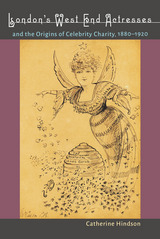
In the late nineteenth century, theatre’s fundraising for charitable causes shifted from male-dominated and private to female-directed and public. Although elite women had long been involved in such enterprises, they took on more authority in this period. At the same time, regular, high-profile public charity events became more important and much more visible than private philanthropy. Actresses became key figures in making the growing number of large and heavily publicized fundraisers successful. By 1920, the attitude was “Get an actress first. If you can’t get an actress, then get a duchess.” Actresses’ star power, their ability to orchestrate large events quickly, and their skill at performing a kind of genteel extortion made them essential to this model of charity. Actresses also benefited from this new role. Taking a prominent, public, offstage position was crucial in making them, individually and collectively, respectable professionals.
Author Catherine Hindson reveals this history by examining the major types of charity events at the turn of the twentieth century, including fundraising matinees, charity bazaars and costume parties, theatrical tea and garden parties, and benefit performances. Her study concludes with a look at the involvement of actresses in raising funds for British soldiers serving in the Anglo-Boer War and the First World War.
Today's successful plays and playwrights achieve their prominence not simply because of their intrinsic merit but because of the work of mediators, who influence the whole trajectory of a playwright's or a theatre company's career. Critics and academic writers are primarily considered the makers of reputations, but funding organizations and various media agents as well as artistic directors, producers, and directors also pursue separate agendas in shaping the reputations of theatrical works. In The Making of Theatrical Reputations Yael Zarhy-Levo demonstrates the processes through which these mediatory practices by key authority figures situate theatrical companies and playwrights within cultural and historical memory.
To reveal how these authorizing powers-that-be promote theatrical events, companies, and playwrights, Zarhy-Levo presents four detailed case studies that reflect various angles of the modern London theatre. In the case of the English Stage Company's production of John Osborne's Look Back in Anger, she centers on a specific event. She then focuses on the trajectory of a single company, the Theatre Workshop, particularly through its first decade at the Theatre Royal, Stratford East, London. Next, she explores the career of the dramatist John Arden, especially its first ten years, in part drawing upon an interview with Arden and his wife, actress and playwright Margaretta D'Arcy, before turning to her fourth study: the playwright Harold Pinter's shifting reputation throughout the different phases of his career.
Zarhy-Levo's accounts of these theatrical events, companies, and playwrights through the prism of mediation bring fresh insights to these landmark productions and their creators.

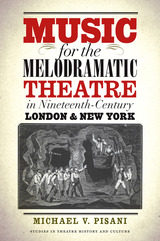
Mining old manuscripts and newspapers, he finds that starting in the 1790s, theatrical managers in Britain and the United States began to rely on music to play an interpretive role in melodramatic productions. During the nineteenth century, instrumental music—in addition to song—was a common feature in the production of stage plays.
The music played by instrumental ensembles not only enlivened performances but also served other important functions. Many actors and actresses found that accompanimental music helped them sustain the emotional pitch of a monologue or dialogue sequence. Music also helped audiences to identify the motivations of characters. Playwrights used music to hold together the hybrid elements of melodrama, heighten the build toward sensation, and dignify the tragic pathos of villains and other characters. Music also aided manager-directors by providing cues for lighting and other stage effects. Moreover, in a century of seismic social and economic changes, music could provide a moral compass in an uncertain moral universe.
Featuring dozens of musical examples and images of the old theatres, Music for the Melodramatic Theatre charts the progress of the genre from its earliest use in the eighteenth century to the elaborate stage productions of the very early twentieth century.
The late-Victorian discovery of the music hall by English intellectuals marks a crucial moment in the history of popular culture. Music Hall and Modernity demonstrates how such pioneering cultural critics as Arthur Symons and Elizabeth Robins Pennell used the music hall to secure and promote their professional identity as guardians of taste and national welfare. These social arbiters were, at the same time, devotees of the spontaneous culture of “the people.”
In examining fiction from Walter Besant, Hall Caine, and Henry Nevinson, performance criticism from William Archer and Max Beerbohm, and late-Victorian controversies over philanthropy and moral reform, scholar Barry Faulk argues that discourse on music-hall entertainment helped consolidate the identity and tastes of an emergent professional class. Critics and writers legitimized and cleaned up the music hall, at the same time allowing issues of class, respect, and empowerment to be negotiated.
Music Hall and Modernity offers a complex view of the new middle-class, middlebrow mass culture of late-Victorian London and contributes to a body of scholarship on nineteenth-century urbanism. The book will also interest scholars concerned with the emergence of a professional managerial class and the genealogy of cultural studies.
The Muslim population globally is comprised of hundreds of ethnic, linguistic, and religious sub-communities. Yet, more often than not, the public conflates these diverse and unrelated communities, branding Muslim immigrants as a single, suspicious, and culturally antagonistic group of people. Generalizations like these have compromised many Muslim immigrants' sense of belonging and acceptance in places where they have lived, in some cases, for three or four generations.
In Muslims of Metropolis, Kavitha Rajagopalan takes a much needed step in personalizing and humanizing our understanding of the Muslim diaspora. Tracing the stories of three very different families-a Palestinian family moving to London, a Kurdish family moving to Berlin, and a Bangladeshi family moving to New York-she reveals a level of complexity and nuance that is seldom considered. Through their voices and in their words, Rajagopalan describes what prompted these families to leave home, what challenges they faced in adjusting to their new lives, and how they came to view their place in society. Interviews with community leaders, social justice organizations, and with academics and political experts in each of the countries add additional layers of insight to how broad political issues, like nationalist conflict, immigration reform, and antiterrorism strategies affect the lives of Muslims who have migrated in search of economic stability and personal happiness.
Although recent thinking about immigration policy in the United States and Europe emphasizes the importance of long-term integration, a global attitude that continues to sensationalize divisions between Muslim and other communities thwarts this possibility. Integration cannot occur with policy solutions alone-people must feel that they belong to a larger society. Whether read as simple stories or broader narratives, the voices in this revealing book are among the many speaking against generalization, prejudice, and fear that has so far surrounded Muslims living in the West.
Examines the political and literary uses of the Trojan legend in the medieval period
England in the late fourteenth century witnessed a large-scale social revolt, a lingering and seemingly hopeless war with France, and fierce factional conflicts in royal politics and London civic government—struggles in which all parties sought to justify their actions by claiming historical precedent. How the Trojan legend figured in these claims—and in competing assertions of authorial legitimacy, nationhood, and rule in the later Middle Ages—is the complex nexus of history, myth, literature, and identity that Sylvia Federico explores in this ambitious book.
During the late medieval period, many European political and social groups took great pains to associate themselves with the ancient city; the claim on Troy, Federico asserts, was crucial to nationhood and was always a political act. Her book examines the poetry and prose of several late medieval authors, focusing particularly on how Chaucer’s use of the Trojan legend helped to set the terms by which the Ricardian and Lancastrian periods were distinguished, and further helped to establish English literary history as a noble precedent in its own right. Federico’s book affords remarkable insight into the workings of the medieval historical imagination.
Although he received no formal medical education, Forman built a thriving practice. His success rankled the College of Physicians of London, who hounded Forman with fines and jail terms for nearly two decades. In addition to detailing case histories of his medical practice—the first such records known from London—as well as his run-ins with the College, Forman's manuscripts cover a wide variety of other matters, from astrology and alchemy to gardening and the theater. His autobiographical writings are among the earliest English examples of their genre and display an abiding passion for reworking his personal history in the best possible light, even though they show little evidence that Forman ever intended to publish them.
Fantastic as many of Forman's manuscripts are, it is their more mundane aspects that make them such a priceless record of what daily life was like for ordinary inhabitants of Shakespeare's London. Forman's descriptions of the stench of a privy, the paralyzed limbs of a child, a lost bitch dog with a velvet collar all offer tantalizing glimpses of a world that seems at once very far away and intimately familiar. Anyone who wants to reclaim that world will enjoy this book.

An exploration of the fundamental relationship between opera and urban modernity in three iconic cities: London, Paris, and New York.
At the end of the nineteenth century, London, Paris, and New York were quintessential modern metropolises and vital centers for opera. In Operatic Infrastructures, Flora Willson examines opera’s roots in the material worlds of these cities. Reaching beyond histories of opera as spectacle, she investigates the physical underpinnings of opera at the century’s end as an inter-urban, multimedia network.
Operatic Infrastructures considers emergent technologies such as the telephone and the subway, but it also retrieves the hidden, forgotten, and otherwise effaced traces of systems such as storage facilities and colonial trade routes. It takes seriously the mundane aspects of materiality, from the blandest clichés of newspaper columns to the fine print of insurance certificates. In doing so, the book reveals just how far these interfaces with modern urban life reached into opera’s own systems of meaning-making and performance in the 1890s—making it impossible to demarcate neatly between “opera” and its “context.” Without such operatic infrastructures, Willson shows, there would be no opera at all.
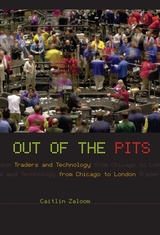
From New York to Singapore, from Chicago to London, the trading floors of the world’s financial markets are icons of global capitalism. Images of them are used on the news all the time—traders burying their heads in their hands when the market is down, their arms flailing in a frenzy when fortunes are rising—to convey the current state of the economy. But these marketplaces, and the cultural life that sustains them, are dissolving into the ether of the digital age: powerful financial institutions are shutting down the trading pits, replacing face-to-face exchanges with an electronic network where traders sit, face to screen, finger to mouse, and compete in a global arena made up of digits and charts.
Out of the Pits considers the implications of this sea change for everyone involved, from the traders and brokers to the market as a whole. Caitlin Zaloom takes us down to the floor at the Chicago Board of Trade and into a digital dealing room in the City of London. Drawing on her own firsthand experiences as a clerk and a trader and on her unusual access to these key sites of global finance, she explainshow changes at the world’s leading financial exchanges have transformed economic cultures and the craft of speculation; how people and places are responding to the digital transition; how traders are remaking themselves to compete in the contemporary marketplace; and how brokers, business managers, and software designers are collaborating to build new financial markets.
A penetrating and richly detailed account of how cities, culture, and technology shape everyday life in the new global economy, Out of the Pits will be must reading for business buffs or anyone who has ever wondered how financial markets work.
Tracing the long arc of chemically produced and reproduced art from the 1670s through the 1860s, the book reconsiders early photography by situating it in relationship to Reynolds’s replicated paintings and the literal engines of British industry. By following the chemicals, Painting with Fire remaps familiar stories about academic painting and pictorial experiment amid the industrialization of chemical knowledge.
Since World War II London has become a significantly multiracial city. Some of the earliest agents of its transformation were young men and women recruited in the late 1950s from Barbados, then a British colony, to work in the metropolis’s nationalized public transportation system and in its hospitals. These Barbadians met, married, settled in London, and raised Londoner children. In 1987-88 John Western conducted a series of interviews with twelve such families--both parents and children. Their vivid words fill A Passage to England with insight, human, and, often, poignancy. Here is a rich perspective on thirty years or more of London social history.
Western structured the interviews to allow the Barbadians a lot of freedom to discuss whatever came to mind concerning either their own life histories and achievements, or wider themes of culture, politics, and society. Topics covered range from matters of “race” to Margaret Thatcher and the change her decade in power has wrought in Britain. One development, for example, is the strikingly entrepreneurial spirit now embraced by some of the young British blacks, veritably “Mrs. Thatcher’s Children.” Ultimately, many of the interviewees focused on the changes they see in their ancestral island in the Caribbean, to which all of them have returned for visits. For this migrant generation especially, as the prospect of retirement begins to grow increasingly important, inevitable questions regard the definitions of “home” and “belonging” must be confronted: Does one stay in London--with one’s children and grandchildren--or does one return to Barbados, which for many seems no longer the same island as the one they left a working lifetime ago? Within the context of an ever-increasing complement of geographically mobile people worldwide, Western’s study provides unique insights into the particular ambiguities a particular set of person have wrestled with at a particular moment in history...but the import of the Barbadian Londoners’ story is universal.
As well as being a literary masterpiece, The People of the Abyss stands as a major sociological study. While other American writers were blindly celebrating the glories of the British Empire at its peak, Jack London was asking why such misery was to be found in the heart of a capital city of immense wealth.
This is a work of reportage - London lets his observations speak for themselves. A precursor to the writings of George Orwell, this book remains a standard-bearer critique of capitalism, as powerful today as it was then.

"The Politics of Evolution is intellectual dynamite, and certainly one of the most important books in the history of science published during the past decade."—Jim Secord, Times Literary Supplement
"One of those rare books that not only stakes out new territory but demands a radical overhaul of conventional wisdom."—John Hedley Brooke, Times Higher Education Supplement
Iván Mándy (1918–1995) has been called “the prose poet of Budapest,” and this volume of short stories presents the first comprehensive collection of his work in English. His early oeuvre created an urban mythology full of picaresque characters inhabiting the seedier neighborhoods of the city: its flea-market stalls, second-run cinemas, and old-fashioned coffeehouses. The stories from the later decades of Mándy’s life, often bordering on the absurd, introduce many autobiographical elements spun around the author’s alter-ego, János Zsámboky, whose hapless adventures on a rare trip abroad constitute this group of stories, including “Postcard from London.” Mándy’s unique style at times borrows techniques from films and radio plays, his quirky cuts creating a flicker of images seen in the mind’s eye. Memory and perception, time and place spin in narrative legerdemain that invites and rewards the reader’s active participation.

Precarious Motherhood is a deeply human investigation of the lives of racially minoritized mothers as they navigate the intersecting challenges of financial hardship and the UK’s hostile immigration policies. Based on thorough ethnographic research, Rachel Benchekroun examines how these mothers forge relationships to access support, maintain their children’s well-being, and carve out spaces of belonging in an often unwelcoming system. The book captures the resilience and the relentless precarity of motherhood in migration, where every relationship shapes social barriers and everyday survival.
Through the voices of over twenty migrant mothers, this work sheds light on the personal and political dimensions of motherhood. It provides critical insights into state policies and social infrastructures that shape migrant lives, making it a valuable resource for scholars of migration and social justice.
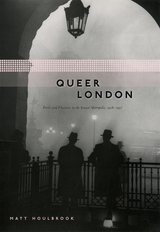
Cyril's story is Matt Houlbrook's point of entry into the queer worlds of early twentieth-century London. Drawing on previously unknown sources, from police reports and newspaper exposés to personal letters, diaries, and the first queer guidebook ever written, Houlbrook here explores the relationship between queer sexualities and modern urban culture that we take for granted today. He revisits the diverse queer lives that took hold in London's parks and streets; its restaurants, pubs, and dancehalls; and its Turkish bathhouses and hotels—as well as attempts by municipal authorities to control and crack down on those worlds. He also describes how London shaped the culture and politics of queer life—and how London was in turn shaped by the lives of queer men. Ultimately, Houlbrook unveils the complex ways in which men made sense of their desires and who they were. In so doing, he mounts a sustained challenge to conventional understandings of the city as a place of sexual liberation and a unified queer culture.
A history remarkable in its complexity yet intimate in its portraiture, Queer London is a landmark work that redefines queer urban life in England and beyond.
Winner of History Today’s Book of the Year Award, 2006
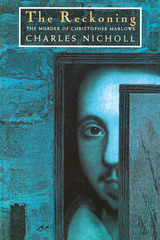
Here, in a tour de force of scholarship and ingenuity, Charles Nicholl penetrates four centuries of obscurity to reveal not only a complex and unsettling story of entrapment and betrayal, chimerical plot and sordid felonies, but also a fascinating vision of the underside of the Elizabethan world.
"Provides the sheer enjoyment of fiction, and might just be true."—Michael Kenney, Boston Globe
"Mr. Nicholl's glittering reconstruction of Marlowe's murder is only one of the many fascinating aspects of this book. Indeed, The Reckoning is equally compelling for its masterly evocation of a vanished world, a world of Elizabethan scholars, poets, con men, alchemists and spies, a world of Machiavellian malice, intrigue and dissent."—Michiko Kakutani, New York Times
"The rich substance of the book is his detail, the thick texture of betrayal and evasion which was Marlowe's life."—Thomas Flanagan, Washington Post Book World
Winner of the Crime Writer's Gold Dagger Award for Nonfiction Thriller
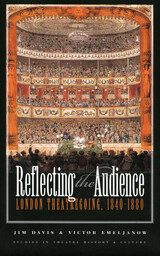
Davis and Emeljanow thoroughly examine the composition of these theatres' audiences, their behavior, and their attendance patterns by looking at topography, social demography, police reports, playbills, autobiographies and diaries, newspaper accounts, economic and social factors as seen in census returns, maps and transportation data, and the managerial policies of each theatre.

In January 2003, the British media splashed the news that anti-terror police had disrupted an Al-Qaeda cell, poised to unleash the deadly poison ricin on the capital. Police had reportedly found traces of ricin, as well as a panoply of bomb and poison-making equipment in the cell’s ‘factory of death’ – a shabby flat in north London. ‘This danger is present and real, and with us now’ announced prime minister Tony Blair.
But, when the ‘ricin plot’ came to trial at the Old Bailey, a very different story emerged: there was no ricin and no sophisticated plot. Rarely has a legal case been so shamelessly distorted by government, media and security forces to push their own ‘tough on terror’ agendas. In this meticulously researched and compellingly written book, Lawrence Archer, the jury foreman at the trial, and journalist Fiona Bawdon, give the definitive story of the ricin plot, the trial and its aftermath.
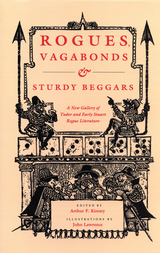
In his introduction, Arthur F. Kinney discusses the significance of these works as protonovels and their influence on such writers as Shakespeare. He also explores the social, political, and economic conditions of a time that spawned a community of renegades who conned their way to fame, fortune, and, occasionally, the rope at Tyburn.
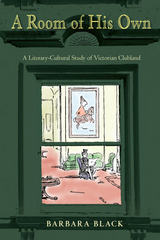
In nineteenth-century London, a clubbable man was a fortunate man, indeed. The Reform, the Athenaeum, the Travellers, the Carlton, the United Service are just a few of the gentlemen’s clubs that formed the exclusive preserve known as “clubland” in Victorian London—the City of Clubs that arose during the Golden Age of Clubs. Why were these associations for men only such a powerful emergent institution in nineteenth-century London? Distinctly British, how did these single-sex clubs help fashion men, foster a culture of manliness, and assist in the project of nation building? What can elite male affiliative culture tell us about nineteenth-century Britishness?
A Room of His Own sheds light on the mysterious ways of male associational culture as it examines such topics as fraternity, sophistication, nostalgia, social capital, celebrity, gossip, and male professionalism. The story of clubland (and the literature it generated) begins with Britain’s military heroes home from the Napoleonic campaign and quickly turns to Dickens’s and Thackeray’s acrimonious Garrick Club Affair. It takes us to Richard Burton’s curious Cannibal Club and Winston Churchill’s The Other Club; it goes underground to consider Uranian desire and Oscar Wilde’s clubbing and resurfaces to examine the problematics of belonging in Trollope’s novels. The trespass of French socialist Flora Tristan, who cross-dressed her way into the clubs of Pall Mall, provides a brief interlude. London’s clubland—this all-important room of his own—comes to life as Barbara Black explores the literary representations of clubland and the important social and cultural work that this urban site enacts. Our present-day culture of connectivity owes much to nineteenth-century sociability and Victorian networks; clubland reveals to us our own enduring desire to belong, to construct imagined communities, and to affiliate with like-minded comrades.
In Sex and the Gender Revolution, Randolph Trumbach reconstructs the worlds of eighteenth-century prostitution, illegitimacy, sexual violence, and adultery. In those worlds the majority of men became heterosexuals by avoiding sodomy and sodomite behavior.
As men defined themselves more and more as heterosexuals, women generally experienced the new male heterosexuality as its victims. But women—as prostitutes, seduced servants, remarrying widows, and adulterous wives— also pursued passion. The seamy sexual underworld of extramarital behavior was central not only to the sexual lives of men and women, but to the very existence of marriage, the family, domesticity, and romantic love. London emerges as not only a geographical site but as an actor in its own right, mapping out domains where patriarchy, heterosexuality, domesticity, and female resistance take vivid form in our imaginations and senses.
As comprehensive and authoritative as it is eloquent and provocative, this book will become an indispensable study for social and cultural historians and delightful reading for anyone interested in taking a close look at sex and gender in eighteenth-century London.
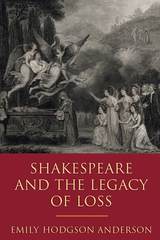
How do we recapture, or hold on to, the live performances we most love, and the talented artists and performers we most revere? Shakespeare and the Legacy of Loss tells the story of how 18th-century actors, novelists, and artists, key among them David Garrick, struggled with these questions through their reenactments of Shakespearean plays. For these artists, the resurgence of Shakespeare, a playwright whose works just decades earlier had nearly been erased, represented their own chance for eternal life. Despite the ephemeral nature of performance, Garrick and company would find a way to make Shakespeare, and through him the actor, rise again.
In chapters featuring Othello, Richard III, Hamlet, The Winter’s Tale, and The Merchant of Venice, Emily Hodgson Anderson illuminates how Garrick’s performances of Shakespeare came to offer his contemporaries an alternative and even an antidote to the commemoration associated with the monument, the portrait, and the printed text. The first account to read 18th-century visual and textual references to Shakespeare alongside the performance history of his plays, this innovative study sheds new light on how we experience performance, and why we gravitate toward an art, and artists, we know will disappear.
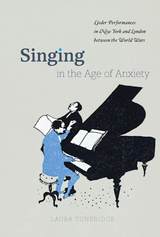
Laura Tunbridge explores the renewed vitality of this refugee musical form between the world wars, offering a fresh perspective on a period that was pervaded by anxieties of displacement. Through richly varied case studies, Singing in the Age of Anxiety traces how lieder were circulated, presented, and consumed in metropolitan contexts, shedding new light on how music facilitated unlikely crossings of nationalist and internationalist ideologies during the interwar period.
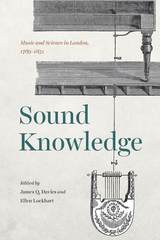
Sound Knowledge examines how scientific truth was accrued by means of visual and aural experience, and, in turn, how musical knowledge was located in relation to empirical scientific practice. James Q. Davies and Ellen Lockhart gather work by leading scholars to explore a crucial sixty-year period, beginning with Charles Burney’s ambitious General History of Music, a four-volume study of music around the globe, and extending to the Great Exhibition of 1851, where musical instruments were assembled alongside the technologies of science and industry in the immense glass-encased collections of the Crystal Palace. Importantly, as the contributions show, both the power of science and the power of music relied on performance, spectacle, and experiment. Ultimately, this volume sets the stage for a new picture of modern disciplinarity, shining light on an era before the division of aural and visual knowledge.
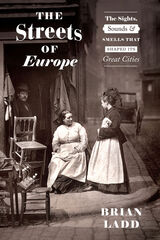
Merchants’ shouts, jostling strangers, aromas of fresh fish and flowers, plodding horses, and friendly chatter long filled the narrow, crowded streets of the European city. As they developed over many centuries, these spaces of commerce, communion, and commuting framed daily life. At its heyday in the 1800s, the European street was the place where social worlds connected and collided.
Brian Ladd recounts a rich social and cultural history of the European city street, tracing its transformation from a lively scene of trade and crowds into a thoroughfare for high-speed transportation. Looking closely at four major cities—London, Paris, Berlin, and Vienna—Ladd uncovers both the joys and the struggles of a past world. The story takes us up to the twentieth century, when the life of the street was transformed as wealthier citizens withdrew from the crowds to seek refuge in suburbs and automobiles. As demographics and technologies changed, so did the structure of cities and the design of streets, significantly shifting our relationships to them. In today’s world of high-speed transportation and impersonal marketplaces, Ladd leads us to consider how we might draw on our history to once again build streets that encourage us to linger.
By unearthing the vivid descriptions recorded by amused and outraged contemporaries, Ladd reveals the changing nature of city life, showing why streets matter and how they can contribute to public life.
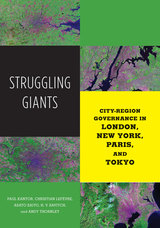
Throughout the past thirty years a small number of city-regions have achieved unprecedented global status in the world economy while undergoing radical changes. Struggling Giants examines the transformation of four of the most significant metropolises: London, New York, Paris, and Tokyo. This volume analyzes the thorniest issues these sprawling city-regions have faced, including ameliorating social problems through public policies, the effect of globalization on local governance, and the relationships between local, regional, and national institutions.
Three critical themes frame Struggling Giants. The first is the continuing struggle for governability in the midst of regional governmental fragmentation. The second theme is how the city-regions fight to manage powerful political biases. Policy-making is often selective, the authors find, and governments are more responsive to economic exigencies than to social or environmental needs. Finally, these city-regions are shown to be strong economic leaders in part because they are able to change—although the authors reveal that pragmatism and piecemeal policy solutions can still prevail.
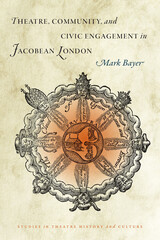
Taking to heart Thomas Heywood’s claim that plays “persuade men to humanity and good life, instruct them in civility and good manners, showing them the fruits of honesty, and the end of villainy,” Mark Bayer’s captivating new study argues that the early modern London theatre was an important community institution whose influence extended far beyond its economic, religious, educational, and entertainment contributions. Bayer concentrates not on the theatres where Shakespeare’s plays were performed but on two important amphitheatres, the Fortune and the Red Bull, that offer a more nuanced picture of the Jacobean playgoing industry. By looking at these playhouses, the plays they staged, their audiences, and the communities they served, he explores the local dimensions of playgoing.


Exiled, displaced, tortured, and grieving—each of the five Iraqi women whose lives and losses come to us through Haifa Zangana's skillfully wrought novel is searching in her own way for peace with a past that continually threatens to swallow up the present.
Majda, the widow of a former Ba'ath party official who was killed by the government he served. Adiba, a political dissident tortured under Saddam Hussein's regime. Um Mohammed, a Kurdish refugee who fled her home for political asylum. Iqbal, a divorced mother whose family in Iraq is suffering the effects of Western economic sanctions. And Sahira, the wife of a Communist politician, struggling with his disillusionment and her own isolation. Bound to one another by a common Iraqi identity and a common location in 1990s London, these women come together across differences in politics, ethnic and class background, age, and even language. In narrating the friendship that develops among them, Zangana captures their warmth and humor as well as their sadness, their feelings of despair along with their search for hope, their sense of uprootedness, and their yearnings for home.
Weaving between the women's memories of Iraq—nostalgic and nightmarish—and their lives as exiles in London, Zangana's novel gives voice to the richness and complexity of Iraqi women's experiences. Through their stories, the novel represents a powerful critique of the violence done to ordinary people by those who hold power both in Iraq and in the West.

An exciting and visually focused tour of the diverse range of films shot on location in London, World Film Locations: London presents contributions spanning the Victorian era, the swinging ’60s, and the politically charged atmosphere following the 2005 subway bombings. Essays exploring key directors, themes, and historical periods are complemented by reviews of important scenes that offer particular insight into London's relationship to cinema. The book is illustrated throughout with full-color film stills and photographs of cinematic landmarks as they appear now—as well as city maps to aid those keen to investigate them.
From Terror on the Underground to Thames Tales to Richard Curtis's affectionate portrayal of the city in Love Actually, this user-friendly guide explores the diversity and distinctiveness of films shot in location in London.
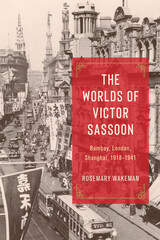
In this book, historian Rosemary Wakeman brings to life the frenzied, crowded streets, markets, ports, and banks of Bombay, London, and Shanghai. In the early twentieth century, these cities were at the forefront of the sweeping changes taking the world by storm as it entered an era of globalized commerce and the unprecedented circulation of goods, people, and ideas. Wakeman explores these cities and the world they helped transform through the life of Victor Sassoon, who in 1924 gained control of his powerful family’s trading and banking empire. She tracks his movements between these three cities as he grows his family’s fortune and transforms its holdings into a global juggernaut. Using his life as its point of entry, The Worlds of Victor Sassoon paints a broad portrait not just of wealth, cosmopolitanism, and leisure but also of the discrimination, exploitation, and violence wreaked by a world increasingly driven by the demands of capital.
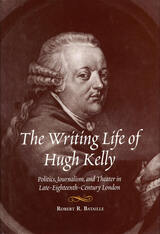
Robert R. Bataille demonstrates convincingly that between 1767 and 1777, Anglo-Irish writer Hugh Kelly made major contributions in three areas of British culture: politics, journalism, and theater. Bataille shows how all three activities were integrated in Kelly’s life, suggesting that such interrelationships often existed in the rough and ready London culture during the early reign of King George III.
When he discovered several newspaper campaigns that Kelly orchestrated as a paid political propagandist for George III and his ministers, Bataille understood in part how important Kelly was to his era. In his capacity as propagandist, Kelly defended Hanoverian colonial policies on the eve of the American Revolution, served as a key opponent of the radical Wilkites, and promoted the acceptance of the 1774 Quebec Bill, which established, among other things, the right of the recently defeated French citizens of Quebec to maintain the French language.
A belletristic journalist, Kelly published theater reviews and essays that played a major role in shaping the taste of his era. He wrote in defense of the controversial sentimental drama, and whenever he could, he promoted the major theatrical figure of the age, David Garrick. Under his editorship, the newspaper Public Ledger became a leading source of theater information. Seeking to raise the status of the profession of journalism, he wrote essays and articles that provided his middle-class readers with an insider’s view of the operations of the journalist.
Assessing Kelly’s contributions to the novel and drama, Bataille argues that this powerful journalist stands in the vanguard in the larger struggle against traditional attitudes supporting male superiority and aristocratic privilege. Kelly wrote in favor of gender equality and middle-class respectability, striving to inculcate what modern scholars refer to as the values of sensibility. Bataille also argues, however, that Kelly knew his audience. Instrumental in the rise of professional writing and popular culture, he understood that he had to observe the needs of his audience, detecting cultural trends and using the skills of the rhetorician.
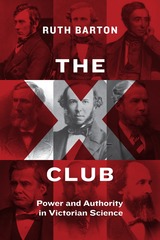
These six ambitious professionals and three wealthy amateurs—J. D. Hooker, T. H. Huxley, John Tyndall, John Lubbock, William Spottiswoode, Edward Frankland, George Busk, T. A. Hirst, and Herbert Spencer—wanted to guide the development of science and public opinion on issues where science impinged on daily life, religious belief, and politics. They formed a private dining club, which they named the X Club, to discuss and further their plans. As Ruth Barton shows, they had a clear objective: they wanted to promote “scientific habits of mind,” which they sought to do through lectures, journalism, and science education. They devoted enormous effort to the expansion of science education, with real, but mixed, success.
For twenty years, the X Club was the most powerful network in Victorian science—the men succeeded each other in the presidency of the Royal Society for a dozen years. Barton’s group biography traces the roots of their success and the lasting effects of their championing of science against those who attempted to limit or control it, along the way shedding light on the social organization of science, the interactions of science and the state, and the places of science and scientific men in elite culture in the Victorian era.
READERS
Browse our collection.
PUBLISHERS
See BiblioVault's publisher services.
STUDENT SERVICES
Files for college accessibility offices.
RECENTLY PUBLISHED





UChicago Accessibility Resources
home | accessibility | search | about | contact us
BiblioVault ® 2001 - 2026
The University of Chicago Press