
 A SCHOLARLY BOOK REPOSITORY
107 start with A start with A










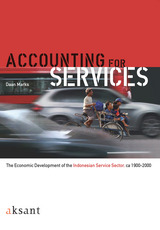
The most intriguing question about Indonesia’s economic development during the twentieth century is why the country’s growth performance has been so erratic and displayed such a high degree of discontinuity. This is connected with the fundamental question about the nature of long-run economic development in Indonesia.
So far the economic historiography of Indonesia has been less systematic than what the available source material would permit. Indonesia is exceptionally well endowed with rich statistical sources, which carry the potential of supporting a rigorous and systematic quantitative approach to vital questions concerning the economic growth performance in the long run.
This book takes such an approach and presents new estimates for the long-run growth of the Indonesian service sector, and analyses the role of the various service sectors in economic development. Linking empirical and theoretical analysis in a creative fashion, Daan Marks provides a rich and original contribution to our understanding of the economic history of Indonesia. He shows that the service sector has played a crucial role in Indonesia’s economic development. Or in other words, to fully understand Indonesia’s economic development path sevices need to be accounted for.




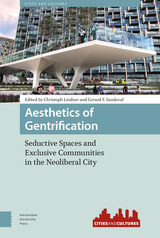
In this context, how do contemporary creative practices in art, architecture, and related fields help to produce or resist gentrification? What does gentrification look and feel like in specific sites and communities around the globe, and how is that appearance or feeling implicated in promoting stylized renewal to a privileged public? In what ways do the aesthetics of gentrification express contested conditions of migration and mobility? Addressing these questions, this book examines the relationship between aesthetics and gentrification in contemporary cities from multiple, comparative, global, and transnational perspectives.
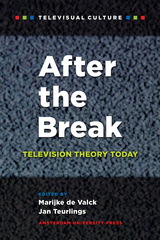
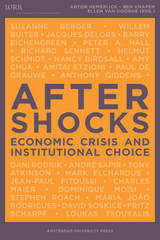
Although it would be premature to presume to identify the exact repercussions of the current economic crisis, it is clear that it will have profound effects in the political, economic, and social spheres. Written in the midst of the deepest economic crisis since the Great Depression, Aftershocks contains twenty-four essays—based on interviews with scholars, prominent European politicians, and leading figures from business and banking—that reflect on the origins of the crisis as well as the possible social, economic, and political transformations it may engender. Among the many contributors are Barry Eichengreen, Tony Atkinson, David Soskice, Nancy Birdsall, Amitai Etzioni, Helmut Schmidt, and Jacques Delors.



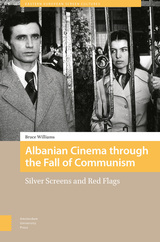




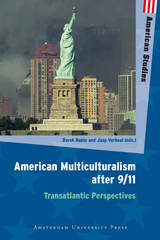
This groundbreaking volume explores the multicultural debate that has evolved in the United States and Europe since the cataclysmic events of 9/11. Instead of suggesting closure by presenting a unified narrative about cultural diversity, national identity, and social stratification, the essays in this well-balanced collection present a variety of perspectives, each highlighting the undiminished relevance of key issues such as immigration, assimilation, and citizenship, while also pointing to unresolved conflicts over universalism, religion, and tolerance. Most importantly, this volume shows that the struggle over multiculturalism is not limited to the political domain, but also has profound cultural implications. American Multiculturalism after 9/11: Transatlantic Perspectives is an invaluable, thought-provoking addition to the debate about multiculturalism as central to the study of the United States in a global context.























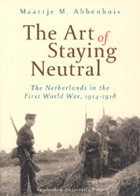
This book is a major contribution both to the study of neutrality and the domestic history of the Netherlands.




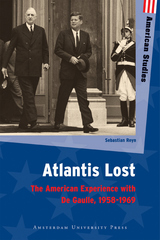
During the 1960s, Charles de Gaulle’s greatest quarrel was with the Americans. The American attitude towards this forceful European leader was, however, an equally defining part of the dispute. In this riveting study of transatlantic international relations, Sebastian Reyn traces American responses to de Gaulle’s foreign policy from 1958 to 1969, concluding that how Americans judged de Gaulle depended largely on whether their politics leaned to the left or the right.
READERS
Browse our collection.
PUBLISHERS
See BiblioVault's publisher services.
STUDENT SERVICES
Files for college accessibility offices.
RECENTLY PUBLISHED





UChicago Accessibility Resources
home | accessibility | search | about | contact us
BiblioVault ® 2001 - 2024
The University of Chicago Press