
 A SCHOLARLY BOOK REPOSITORY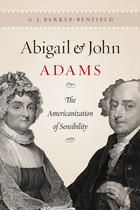
During the many years that they were separated by the perils of the American Revolution, John and Abigail Adams exchanged hundreds of letters. Writing to each other of public events and private feelings, loyalty and love, revolution and parenting, they wove a tapestry of correspondence that has become a cherished part of American history and literature.
With Abigail and John Adams, historian G. J. Barker-Benfield mines those familiar letters to a new purpose: teasing out the ways in which they reflected—and helped transform—a language of sensibility, inherited from Britain but, amid the revolutionary fervor, becoming Americanized. Sensibility—a heightened moral consciousness of feeling, rooted in the theories of such thinkers as Descartes, Locke, and Adam Smith and including a “moral sense” akin to the physical senses—threads throughout these letters. As Barker-Benfield makes clear, sensibility was the fertile, humanizing ground on which the Adamses not only founded their marriage, but also the “abhorrence of injustice and inhumanity” they and their contemporaries hoped to plant at the heart of the new nation. Bringing together their correspondence with a wealth of fascinating detail about life and thought, courtship and sex, gender and parenting, and class and politics in the revolutionary generation and beyond, Abigail and John Adams draws a lively, convincing portrait of a marriage endangered by separation, yet surviving by the same ideas and idealism that drove the revolution itself.
A feast of ideas that never neglects the real lives of the man and woman at its center, Abigail and John Adams takes readers into the heart of an unforgettable union in order to illuminate the first days of our nation—and explore our earliest understandings of what it might mean to be an American.
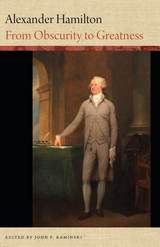
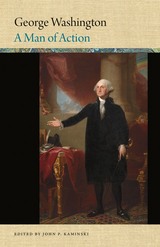
Editor John P. Kaminski has gathered a remarkable collection of quotations by and about Alexander Hamilton that paint for us a nuanced portrait of a complex man. Through his own words and the words of his contemporaries -- including the man who killed him in a duel, Aaron Burr -- we can gain a better understanding of this fascinating man who rose from anonymity on a small Caribbean island to the corridors of power.
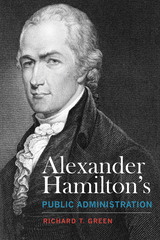
American public administration inherited from Alexander Hamilton a distinct republican framework through which we derive many of our modern governing standards and practices. His administrative theory flowed from his republican vision, prescribing not only the how of administration but also what should be done and why. Administration and policy merged seamlessly in his mind, each conditioning the other. His Anti-Federalist detractors clearly saw this and fought his vision tooth and nail.
That conflict endures to this day because Americans still have not settled on just one vision of the American republic. That is why, Richard Green argues, Hamilton is a pivotal figure in our current reckoning. If we want to more fully understand ourselves and our ways of governing today, we must start by understanding Hamilton, and we cannot do that without exploring his administrative theory and practice in depth.
Alexander Hamilton’s Public Administration considers Hamilton both as a founder of the American republic, steeped in the currents of political philosophy and science of his day, and as its chief administrative theorist and craftsman, deeply involved in establishing the early institutions and policies that would bring his interpretation of the written Constitution to life. Accordingly, this book addresses the complex mix of classical and modern ideas that informed his vision of a modern commercial and administrative republic; the administrative ideas, institutions, and practices that flowed from that vision; and the substantive policies he deemed essential to its realization. Green’s analysis grows out of an immersion in Hamilton’s extant papers, including reports, letters, pamphlets, and essays. Readers will find a comprehensive explanation of his theoretical contributions and a richly detailed account of his ideas and practices in historical context.
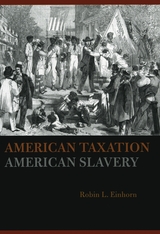
For all the recent attention to the slaveholding of the founding fathers, we still know remarkably little about the influence of slavery on American politics. American Taxation, American Slavery tackles this problem in a new way. Rather than parsing the ideological pronouncements of charismatic slaveholders, it examines the concrete policy decisions that slaveholders and non-slaveholders made in the critical realm of taxation. The result is surprising—that the enduring power of antigovernment rhetoric in the United States stems from the nation’s history of slavery rather than its history of liberty.
We are all familiar with the states’ rights arguments of proslavery politicians who wanted to keep the federal government weak and decentralized. But here Robin Einhorn shows the deep, broad, and continuous influence of slavery on this idea in American politics. From the earliest colonial times right up to the Civil War, slaveholding elites feared strong democratic government as a threat to the institution of slavery. American Taxation, American Slavery shows how their heated battles over taxation, the power to tax, and the distribution of tax burdens were rooted not in debates over personal liberty but rather in the rights of slaveholders to hold human beings as property. Along the way, Einhorn exposes the antidemocratic origins of the popular Jeffersonian rhetoric about weak government by showing that governments were actually more democratic—and stronger—where most people were free.
A strikingly original look at the role of slavery in the making of the United States, American Taxation, American Slavery will prove essential to anyone interested in the history of American government and politics.
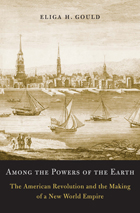
For most Americans, the Revolution’s main achievement is summed up by the phrase “life, liberty, and the pursuit of happiness.” Yet far from a straightforward attempt to be free of Old World laws and customs, the American founding was also a bid for inclusion in the community of nations as it existed in 1776. America aspired to diplomatic recognition under international law and the authority to become a colonizing power itself.
As Eliga Gould shows in this reappraisal of American history, the Revolution was an international transformation of the first importance. To conform to the public law of Europe’s imperial powers, Americans crafted a union nearly as centralized as the one they had overthrown, endured taxes heavier than any they had faced as British colonists, and remained entangled with European Atlantic empires long after the Revolution ended.
No factor weighed more heavily on Americans than the legally plural Atlantic where they hoped to build their empire. Gould follows the region’s transfiguration from a fluid periphery with its own rules and norms to a place where people of all descriptions were expected to abide by the laws of Western Europe—“civilized” laws that precluded neither slavery nor the dispossession of Native Americans.

The dramatic account of a Revolutionary-era conspiracy in which a band of farmers opposed to military conscription and fearful of religious persecution plotted to kill the governor of North Carolina.
Less than a year into the American Revolution, a group of North Carolina farmers hatched a plot to assassinate the colony’s leading patriots, including the governor. The scheme became known as the Gourd Patch or Lewellen Conspiracy. The men called themselves the Brethren.
The Brethren opposed patriot leaders’ demand for militia volunteers and worried that “enlightened” deist principles would be enshrined in the state constitution, displacing their Protestant faith. The patriots’ attempts to ally with Catholic France only exacerbated the Brethren’s fears of looming heresy. Brendan McConville follows the Brethren as they draw up plans for violent action. After patriot militiamen threatened to arrest the Brethren as British sympathizers in the summer of 1777, the group tried to spread false rumors of a slave insurrection in hopes of winning loyalist support. But a disaffected insider denounced the movement to the authorities, and many members were put on trial. Drawing on contemporary depositions and legal petitions, McConville gives voice to the conspirators’ motivations, which make clear that the Brethren did not back the Crown but saw the patriots as a grave threat to their religion.
Part of a broader Southern movement of conscription resistance, the conspiracy compels us to appreciate the full complexity of public opinion surrounding the Revolution. Many colonists were neither loyalists nor patriots and came to see the Revolutionary government as coercive. The Brethren tells the dramatic story of ordinary people who came to fear that their Revolutionary leaders were trying to undermine religious freedom and individual liberty—the very causes now ascribed to the Founding generation.

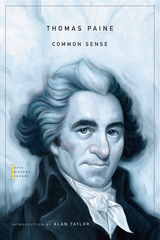
Common sense has always been a cornerstone of American politics. In 1776, Tom Paine’s vital pamphlet with that title sparked the American Revolution. And today, common sense—the wisdom of ordinary people, knowledge so self-evident that it is beyond debate—remains a powerful political ideal, utilized alike by George W. Bush’s aw-shucks articulations and Barack Obama’s down-to-earth reasonableness. But far from self-evident is where our faith in common sense comes from and how its populist logic has shaped modern democracy. Common Sense: A Political History is the first book to explore this essential political phenomenon.
The story begins in the aftermath of England’s Glorious Revolution, when common sense first became a political ideal worth struggling over. Sophia Rosenfeld’s accessible and insightful account then wends its way across two continents and multiple centuries, revealing the remarkable individuals who appropriated the old, seemingly universal idea of common sense and the new strategic uses they made of it. Paine may have boasted that common sense is always on the side of the people and opposed to the rule of kings, but Rosenfeld demonstrates that common sense has been used to foster demagoguery and exclusivity as well as popular sovereignty. She provides a new account of the transatlantic Enlightenment and the Age of Revolutions, and offers a fresh reading on what the eighteenth century bequeathed to the political ferment of our own time. Far from commonsensical, the history of common sense turns out to be rife with paradox and surprise.
Designed for use in courses, this abridged edition of the four-volume Constitutional History of the American Revolution demonstrates how significant constitutional disputes were in instigating the American Revolution. John Phillip Reid addresses the central constitutional issues that divided the American colonists from their English legislators: the authority to tax, the authority to legislate, the security of rights, the nature of law, the foundation of constitutional government in custom and contractarian theory, and the search for a constitutional settlement. Reid's distinctive analysis discusses the irreconcilable nature of this conflict—irreconcilable not because leaders in politics on both sides did not desire a solution, but because the dynamics of constitutional law impeded a solution that permitted the colonies to remain part of the dominions of George III.
Constitutional History of the American Revolution
Volume I: The Authority of Rights
Volume II: The Authority to Tax
Volume III: The Authority to Legislate
Volume IV: The Authority of Law
John Phillip Reid addresses the central constitutional issues that divided the American colonists from their English legislators: the authority to tax, the authority to legislate, the security of rights, the nature of law, the foundation of constitutional government in custom and contractarian theory, and the search for a constitutional settlement.
John Phillip Reid addresses the central constitutional issues that divided the American colonists from their English legislators: the authority to tax, the authority to legislate, the security of rights, the nature of law, the foundation of constitutional government in custom and contractarian theory, and the search for a constitutional settlement.
This is the first comprehensive study of the constitutionality of the Parliamentary legislation cited by the American Continental Congress as a justification for its rebellion against Great Britain in 1776. The content and purpose of that legislation is well known to historians, but here Reid places it in the context of eighteenth-century constitutional doctrine and discusses its legality in terms of the intellectual premises of eighteenth-century Anglo-American legal values.
The third installment in a planned four-volume work, The Authority to Legislate follows The Authority to Tax and The Authority of Rights. In this volume, Reid shows that the inflexibility of British constitutional principle left no room for settlement or change; Parliament became entrapped by the imperatives of the constitution it was struggling to preserve. He analyzes the legal theories put forward in support of Parliament’s authority to legislate and the specific precedents cited as evidence of that authority.
Reid’s examination of both the debate over the authority to legislate and the constitutional theory underlying the debate shows the extent to which the American Revolution and the Declaration of Independence were actions taken in defense of the rule of law. Considered as a whole, Reid’s Constitutional History of the American Revolution contributes to an understanding of the central role of legal and constitutional standards, especially concern for rule by law, in the development of the American nation.
This is the first comprehensive study of the constitutionality of the Parliamentary legislation cited by the American Continental Congress as a justification for its rebellion against Great Britain in 1776. The content and purpose of that legislation is well known to historians, but here John Phillip Reid places it in the context of eighteenth-century constitutional doctrine and discusses its legality in terms of the intellectual premises of eighteenth-century Anglo-American legal values.
The Authority of Law is the last of a four-volume work, preceded by The Authority to Tax, The Authority of Rights, and The Authority to Legislate. In these previous volumes, Reid argued that there would have been no rebellion had taxation been the only constitutional topic of controversy, that issues of rights actually played a larger role in the drafting of state and federal constitutions than they did in instigating a rebellion, and that the American colonists finally took to the battlefield against the British because of statutes that forced Americans to either concede the authority to legislate or leave the empire.
Expanding on the evidence presented in the first three volumes, The Authority of Law determines the constitutional issues dividing American whigs from British imperialists. Reid summarizes these issues as “the supremacy issue,” “the Glorious Revolution issue,” “the liberty issue,” and the “representation issue.” He then raises a compelling question: why, with so many outstanding lawyers participating in the debate, did no one devise a constitutionally legal way out of the standoff? Reid makes an original suggestion. No constitutional solution was found because the British were more threatened by American legal theory than the Americans were by British theory. British lawyers saw the future of liberty in Great Britain endangered by the American version of constitutional law.
Considered as a whole, Reid’s Constitutional History of the American Revolution contributes to an understanding of the central role of legal and constitutional standards, especially concern for rule by law, in the development of the American nation.
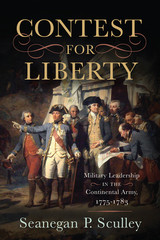
How American Colonial Ideals Shaped Command, Discipline, and Honor in the U.S. Armed Forces
In the summer of 1775, a Virginia gentleman-planter was given command of a New England army laying siege to British-occupied Boston. With his appointment, the Continental Army was born. Yet the cultural differences between those serving in the army and their new commander-in-chief led to conflicts from the very beginning that threatened to end the Revolution before it could start. The key challenge for General George Washington was establishing the standards by which the soldiers would be led by their officers. What kind of man deserved to be an officer? Under what conditions would soldiers agree to serve? And how far could the army and its leaders go to discipline soldiers who violated those enlistment conditions? As historian Seanegan P. Sculley reveals in Contest for Liberty: Military Leadership in the Continental Army, 1775–1783, these questions could not be determined by Washington alone. His junior officers and soldiers believed that they too had a part to play in determining how and to what degree their superior officers exercised military authority and how the army would operate during the war. A cultural negotiation concerning the use of and limits to military authority was worked out between the officers and soldiers of the Continental Army; although an unknown concept at the time, it is what we call leadership today. How this army was led and how the interactions between officers and soldiers from the various states of the new nation changed their understandings of the proper exercise of military authority was finally codified in General Friedrich Wilhelm von Steuben’s The Regulations for the Order and Discipline of the Troops of the United States, first published in 1779. The result was a form of military leadership that recognized the autonomy of the individual soldiers, a changing concept of honor, and a new American tradition of military service.
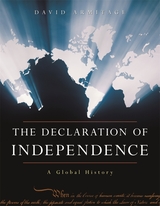
In a stunningly original look at the American Declaration of Independence, David Armitage reveals the document in a new light: through the eyes of the rest of the world. Not only did the Declaration announce the entry of the United States onto the world stage, it became the model for other countries to follow.
Armitage examines the Declaration as a political, legal, and intellectual document, and is the first to treat it entirely within a broad international framework. He shows how the Declaration arose within a global moment in the late eighteenth century similar to our own. He uses over one hundred declarations of independence written since 1776 to show the influence and role the U.S. Declaration has played in creating a world of states out of a world of empires. He discusses why the framers’ language of natural rights did not resonate in Britain, how the document was interpreted in the rest of the world, whether the Declaration established a new nation or a collection of states, and where and how the Declaration has had an overt influence on independence movements—from Haiti to Vietnam, and from Venezuela to Rhodesia.
Included is the text of the U.S. Declaration of Independence and sample declarations from around the world. An eye-opening list of declarations of independence since 1776 is compiled here for the first time. This unique global perspective demonstrates the singular role of the United States document as a founding statement of our modern world.
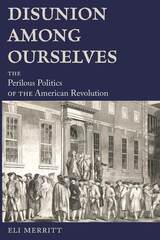
In this eye-opening account, Eli Merritt reveals the deep political divisions that almost tore the Union apart during the American Revolution. So fractious were the founders’ political fights that they feared the War of Independence might end in disunion and civil war.
Instead of disbanding into separate regional confederacies, the founders managed to unite for the sake of liberty and self-preservation. In so doing, they succeeded in holding the young nation together. To achieve this, they forged grueling compromises, including Declaration of Independence in 1776, the Mississippi-Fisheries Compromise of 1779, and the ratification of the Articles of Confederation in 1781.
In addition to bringing new insights to the history of the American Revolution, Disunion Among Ourselves has inevitable resonances with our present era of political hyperpolarization and serves as a touchstone for contemporary politics, reminding us that the founders overcame far tougher times than our own through commitment to ethical constitutional democracy and compromise.
Founding Fictions develops the concept of a “political fiction,” or a narrative that people tell about their own political theories, and analyzes how republican and democratic fictions positioned American citizens as either romantic heroes, tragic victims, or ironic partisans. By re-telling the stories that Americans have told themselves about citizenship, Mercieca highlights an important contradiction in American political theory and practice: that national stability and active citizen participation are perceived as fundamentally at odds.
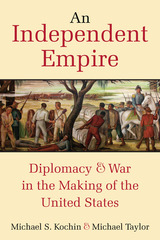
Foreign policies and diplomatic missions, combined with military action, were the driving forces behind the growth of the early United States. In an era when the Old and New Worlds were subject to British, French, and Spanish imperial ambitions, the new republic had limited diplomatic presence and minimal public credit. It was vulnerable to hostile forces in every direction. The United States could not have survived, grown, or flourished without the adoption of prescient foreign policies, or without skillful diplomatic operations.
An Independent Empire shows how foreign policy and diplomacy constitute a truly national story, necessary for understanding the history of the United States. In this lively and well-written book, episodes in American history—such as the writing and ratification of the Constitution, Henry Clay’s advocacy of an American System, Pinckney’s Treaty with Spain, and the visionary but absurd Congress of Panama—are recast as elemental aspects of United States foreign and security policy.
An Independent Empire tells the stories of the people who defined the early history of America’s international relationships. Throughout the book are brief, entertaining vignettes of often-overlooked intellectuals, spies, diplomats, and statesmen whose actions and decisions shaped the first fifty years of the United States. More than a dozen bespoke maps illustrate that the growth of the early United States was as much a geographical as a political or military phenomenon.
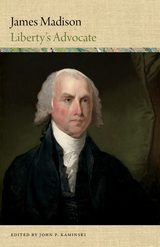
America has had few political thinkers who have rivalled James Madison. The son of a wealthy planter, Madison was an unhealthy child and was beset by physical infirmities throughout his long life, and grew into a cerebral man. Madison left Virginia to attend the College of New Jersey, but returned to his native state after completing his studies. Though he aspired to be a college professor, Madison instead went into public service and became one of the most influential, guiding voices of the Founding Era. Madison’s Virginia Plan would be used as a blueprint for the Constitutional Convention, where the Articles of Confederation would be replaced with a new Constitution that bore traces of Madison’s influence throughout.
Editor John Kaminski has gathered a remarkable collection of quotations by and about James Madison for the third installment of his Word Portraits of America’s Founders series. Through these words by and about Madison, we learn more about one of the country’s most influential Founding Fathers, who held a lifelong commitment to liberty and opposed oppression.

Letters from an American Farmer was published in London in 1782, just as the idea of an “American” was becoming a reality. Those epistolary essays introduced the European public to America’s landscape and customs and have since served as the iconic description of a then-new people. Dennis D. Moore’s convenient, up-to-date reader’s edition situates those twelve pieces from the 1782 Letters in the context of thirteen other essays representative of Crèvecoeur’s writings in English.
The “American Farmer” of the title is Crèvecoeur’s fictional persona Farmer James, a bumpkin from rural Pennsylvania. In his Introduction to this edition, Moore places this self-effacing pose in perspective and charts Crèvecoeur’s enterprising approach to self-promotion, which involved repackaging and adapting his writings for French and English audiences.
Born in Normandy, Crèvecoeur came to New York in the 1750s by way of England and then Canada, traveled throughout the colonies as a surveyor and trader, and was naturalized in 1765. The pieces he included in the 1782 Letters map a shift from hopefulness to disillusionment: its opening selections offer America as a utopian haven from European restrictions on personal liberty and material advancement but give way to portrayals of a land plagued by the horrors of slavery, the threat of Indian raids, and revolutionary unrest. This new edition opens up a broader perspective on this artful, ambitious writer and cosmopolitan thinker who coined America’s most enduring metaphor: a place where “individuals of all nations are melted into a new race of men.”
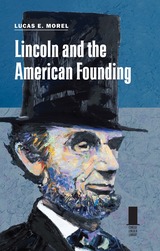
With each chapter describing a particular influence, Morel leads readers from the Founding Father, George Washington; to the founding documents, the Declaration of Independence and Constitution; to the founding compromise over slavery; and finally to a consideration of how the original intentions of the Founding Fathers should be respected in light of experience, progress, and improvements over time. Within these key discussions, Morel shows that without the ideals of the American Revolution, Lincoln’s most famous speeches would be unrecognizable, and the character of the nation would have lost its foundation on the universal principles of human equality, individual liberty, and government by the consent of the governed.
Lincoln thought that the principles of human equality and individual rights could provide common ground for a diverse people to live as one nation and that some old things, such as the political ideals of the American founding, were worth preserving. He urged Americans to be vigilant in maintaining the institutions of self-government and to exercise and safeguard the benefits of freedom for future generations. Morel posits that adopting the way of thinking and speaking Lincoln advocated, based on the country’s founding, could help mend our current polarized discourse and direct the American people to employ their common government on behalf of a truly common good.
Volume 18 is the final volume of the Papers of John Adams wholly devoted to Adams’ diplomatic career. It chronicles fourteen months of his tenure as minister to Great Britain and his joint commission, with Thomas Jefferson, to negotiate treaties with Europe and North Africa. With respect to Britain, Adams found it impossible to do “any Thing Satisfactory, with this Nation,” and the volume ends with his decision to resign his posts. His diplomatic efforts, Adams thought, were too much akin to “making brick without straw.”
John Adams’ ministerial efforts in London were disappointing, but other aspects of his life were not. He and Jefferson failed to finalize treaties with Portugal and Great Britain, but they did, through agent Thomas Barclay, conclude a treaty with Morocco. Barclay’s letters are the earliest and most evocative American accounts of that region. Adams witnessed the marriage of his daughter, Abigail 2d, to William Stephens Smith, promoted the ordination of American Episcopal bishops, and toured the English countryside, first with Thomas Jefferson and then with his family. Most significant perhaps was the publication of the first volume of Adams’ Defence of the Constitutions of Government of the United States of America. This work is often attributed to concern over Shays’ Rebellion, of which Adams knew little when he began drafting. In fact, it was Adams’ summer 1786 visit to the Netherlands that provoked his work. There, Dutch Patriot friends, involved in their own revolution, expressed interest in seeing “upon paper” his remarks “respecting Government.”
In mid-March 1781, John Adams received his commission and instructions as minister to the Netherlands and embarked on the boldest initiative of his diplomatic career. Disappointed by the lack of interest shown by Dutch investors in his efforts to raise a loan for the United States, Adams changed his tactics, and in a memorial made a forthright appeal to the States General of the Netherlands for immediate recognition of the United States. Published in Dutch, English, and French, it offered all of Europe a radical vision of the ordinary citizen’s role in determining political events. In this volume, for the first time, the circumstances and reasoning behind Adams’s bold moves in the spring of 1781 are presented in full.
In July the French court summoned Adams, the only American in Europe empowered to negotiate an Anglo–American peace, to Paris for consultations regarding an offer made by Austria and Russia to mediate the Anglo–French war. In his correspondence with France’s foreign minister, the Comte de Vergennes, Adams passionately insisted that the United States was fully and unambiguously independent and sovereign and must be recognized as such by Great Britain before any negotiations took place. This volume shows John Adams to be a determined and resourceful diplomat, unafraid to go beyond the bounds of traditional diplomacy to implement his vision of American foreign policy.
No family in three generations has contributed so much to American history as the Adamses. John Adams, John Quincy Adams, and Charles Francis Adams, despite periods of doubt, knew that history, if not their contemporaries, would recognize their accomplishments. When the Adams Papers series is complete, the writings of these three statesmen will have been examined thoroughly.
Aside from the Legal Papers of John Adams, published in 1965, these two volumes are the first in Series III: General Correspondence and Other Papers of the Adams Statesmen. Volumes 1 and 2 of the Papers of John Adams include letters to and from friends and colleagues, reports of committees on which he served, his polemical writings, published and unpublished, and state papers to which he made a contribution.
All of Adams’s newspaper writings, including “A Dissertation on the Canon and the Feudal Law,” are in these two volumes. In addition to being a condemnation of the Stamp Act, the “Dissertation” is shown to be one of the building blocks of the theory of a commonwealth of independent states under the king, which reaches complete statement in the Novanglus letters. For the first time, all thirteen of these letters appear in full with annotation.
The period September 1755 to April 1775 covers Adams’s public service in Braintree and Boston town meetings, the Massachusetts House of Representatives, the First Continental Congress, and the First Provincial Congress of Massachusetts. During this time his political future was being shaped by circumstances not always of his choosing. He hesitated at first at the threshold of a public career, political ambition in conflict with concern for his family’s well-being. But as the confrontation with Great Britain sharpened, the crisis became acute; no choice remained. For Adams there was no shirking the path of duty.
On the last day of December 1780, John Adams wrote that he had just spent “the most anxious and mortifying Year of my whole Life.” He had resided first at Paris, then at Amsterdam, attempting, without success, to open Anglo–American peace negotiations and to raise a Dutch loan. In volumes 9 and 10 of the Papers of John Adams, over 600 letters and documents that Adams sent to and received from numerous correspondents in Europe and America provide an unparalleled view of Adams’s diplomacy and a wealth of detail on the world in which he lived.
These volumes chronicle Adams’s efforts to convince the British people and their leaders that Britain’s economic survival demanded an immediate peace; his “snarling growling” debate with the French foreign minister, the Comte de Vergennes, over the proper Franco–American relationship; and his struggle to obtain a loan in the Netherlands, where policies were dictated by Mammon rather than republican virtue. Adams’s writings, diplomatic dispatches, and personal correspondence all make clear the scope of his intelligence gathering and his propaganda efforts in the British, French, and Dutch press. The letters reflect his interest in Bordeaux wines, the fate of Massachusetts Constitution that he had drafted in 1779, and political developments in Philadelphia, Boston, London, and St. Petersburg. The volumes leave no doubt as to John Adams’s unwavering commitment to the American cause. Even in this most difficult year, he believed the revolution in America to be “the greatest that ever took Place among Men.” He felt honored to serve a new nation where “the Wisdom and not the Man is attended to,” whose citizens were fighting a “People’s War” from which the United States would inevitably emerge victorious to take its rightful place on the world stage.
The American victory at Yorktown in October 1781 and the fall of Lord North’s ministry in March 1782 opened the possibility that John Adams might soon be involved in negotiations to end the war for American independence. To prepare for the occasion, Adams and Benjamin Franklin discussed in their letters the fundamentals for peace. Adams made it clear to the British government that there would be no negotiations without British recognition of the United States as independent and sovereign.
This volume chronicles Adams’s efforts, against great odds, to achieve formal recognition of the new United States. The documents include his vigorous response to criticism of his seemingly unorthodox methods by those who would have preferred that he pursue a different course, including Congress’s newly appointed secretary for foreign affairs, Robert R. Livingston.
In April 1782 the Netherlands recognized the United States and admitted John Adams as its minister. For Adams it was “the most Signal Epocha, in the History of a Century,” and he would forever see it as the foremost achievement of his diplomatic career. The volume ends with Adams, at long last a full-fledged member of the diplomatic corps, describing his reception by the States General and his audiences with the Prince and Princess of Orange.
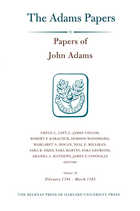
“Once more after an Interruption of ten Years, I pronounce myself a happy Man, and pray Heaven to continue me so.” Thus wrote John Adams in late August 1784 after the arrival in Europe of his wife Abigail and daughter Nabby. Adams and his family were living together in the pleasant Paris suburb of Auteuil. There Adams, with Benjamin Franklin and Thomas Jefferson, formed a joint commission to conclude commercial treaties with the nations of Europe and North Africa. For the first time since he had left America in 1778 on his first diplomatic mission, Adams was no longer engaged in “militia diplomacy.”
Volume 16 of the Papers of John Adams chronicles fourteen months of Adams’ diplomatic career. As minister to the Netherlands he raised a new Dutch loan to save America from financial ruin. As joint commissioner he negotiated a commercial treaty with Prussia, proposed similar treaties with other European nations, and prepared to negotiate with the Barbary states. The commissioners also sought to resolve Anglo-American differences left over from the peace negotiations and arising from the two nations’ burgeoning trade. Volume 16 thus forms a prelude to the next phase of John Adams’ diplomatic career, for his February 1785 appointment as minister to the Court of St. James meant that the management of Anglo-American relations would be his responsibility alone.
“Huzza for the new World and farewell to the Old One,” John Adams wrote in late 1787, wrapping up a decade’s worth of diplomatic service in Europe. Volume 19 of the Papers of John Adams chronicles Adams’s last duties in London and The Hague. In the twenty-eight months documented here, he petitioned the British ministry to halt impressment of American sailors, toured the English countryside, and observed parliamentary politics. Adams salvaged U.S. credit by contracting two new Dutch loans amid the political chaos triggered by William V’s resurgence. Correspondents like Thomas Jefferson and the Marquis de Lafayette mulled over the Anglo–American trade war that followed the Revolution and reported on the French Assembly of Notables—topics that Adams commented on with trademark candor. He wrote the final two volumes of his work, A Defence of the Constitutions of Government of the United States of America.
Adams yearned to return home and see the American republic take shape. “For a Man who has been thirty Years rolling like a stone,” Adams wrote, the choice was whether to “set down in private Life to his Plough; or push into turbulent scenes of Sedition and Tumult; whether be sent to Congress, or a Convention or God knows what.” Back on his native soil of Massachusetts in June 1788, Adams settled into rural retirement with wife Abigail and watched the U.S. Constitution’s ratification evolve. By volume’s end, John Adams again resumes public life, ready to serve as America’s first vice president.
"You may well Suppose that I was the Focus of all Eyes," John Adams wrote on 2 June 1785 of his first audience with George III, which formally inaugurated the post of American minister to Great Britain. Eager to restore "the old good Nature and the old good Humour" between the two nations, Adams spent the following months establishing the U.S. legation at No. 8 Grosvenor Square. For Adams, it was a period of multiple responsibilities and mixed success. He remained minister to the Netherlands and one of the joint commissioners charged with negotiating commercial treaties with the nations of Europe and North Africa--sensitive duties that occasionally called for Adams to encode his correspondence with the aid of his new secretary and future son-in-law, Col. William Stephens Smith.
Rebuffed by the British ministry in his mission to enforce the peace treaty of 1783 and renew Anglo-American commerce, Adams identified and achieved other goals. He preserved American credit despite the bankruptcy of a Dutch banking house that handled U.S. loans, petitioned for the release of impressed sailors, marked the ratification of the Prussian-American treaty, championed the needs of the American Episcopal Church, and laid the groundwork for negotiations with the Barbary States. His attention was not confined solely to foreign affairs. John Adams's letters from London, laced with his trademark candor, demonstrate his ripening Federalist view of the new American government's vulnerability and promise.
On September 3, 1783, John Adams, Benjamin Franklin, and John Jay signed the definitive Anglo-American peace treaty. Adams and his colleagues strived to establish a viable relationship between the new nation and its largest trading partner but were stymied by rising British anti-Americanism.
Adams’ diplomatic efforts were also complicated by domestic turmoil. Americans, in a rehearsal for the later Federalist-Antifederalist conflict over the United States Constitution, were debating the proper relationship between the central government and the states. Adams, a Federalist as early as 1783, argued persuasively for a government that honored its treaties and paid its foreign debts. But when bills far exceeding the funds available for their redemption were sent to Europe, he was forced to undertake a dangerous winter journey to the Netherlands to raise a new loan and save the United States from financial disaster.
None of the founding fathers equals the candor of John Adams’ observations of his eighteenth-century world. His letters, always interesting, reveal with absolute clarity Adams’ positions on the personalities and issues of his times.
John Adams reached Paris on October 26, 1782, for the final act of the American Revolution: the peace treaty. This volume chronicles his role in the negotiations and the decision to conclude a peace separate from France. Determined that the United States pursue an independent foreign policy, Adams's letters criticized Congress's naive confidence in France. But in April 1783, frustrated at delays over the final treaty and at real and imagined slights from Congress and Benjamin Franklin, Adams believed the crux of the problem was Franklin's moral bankruptcy and servile Francophilia in the service of a duplicitous Comte de Vergennes.
Volume 14 covers more than just the peace negotiations. As American minister to the Netherlands, Adams managed the distribution of funds from the Dutch-American loan. Always an astute observer, he commented on the fall of the Shelburne ministry and its replacement by the Fox-North coalition, the future of the Anglo-American relationship, and the prospects for the United States in the post-revolutionary world. But he was also an anxious father, craving news of John Quincy Adams's slow journey from St. Petersburg to The Hague. By May 1783, Adams was tired of Europe, but resigned to remaining until his work was done.
A new chapter in John Adams's diplomatic career opened when the Dutch recognized the United States in April 1782. Operating from the recently purchased American legation at The Hague, Adams focused his energies on raising a much needed loan from Dutch bankers and negotiating a Dutch-American commercial treaty. This volume chronicles Adams's efforts to achieve these objectives, but it also provides an unparalleled view of eighteenth-century American diplomacy on the eve of a peace settlement ending the eight-year war of the American Revolution.
John Adams was a shrewd observer of the political and diplomatic world in which he functioned and his comments on events and personalities remain the most candid and revealing of any American in Europe. His correspondence traces the complex negotiations necessary to raise a Dutch loan and throws new light on his conclusion of a treaty of amity and commerce with the Netherlands, achievements of which he was most proud. Events in England and elsewhere in Europe also provided grist for his pen. Would the establishment in July of a new ministry under the earl of Shelburne hinder or advance the cause of peace? That question bedeviled Adams and his correspondents for the fate of the new nation literally rode on its answer. The volume ends with Adams's triumphal departure from The Hague to face new challenges at Paris as one of the American commissioners to negotiate an Anglo-American peace treaty.
These volumes provide an unparalleled account of the conduct of American diplomacy in the early years of the republic, while the war with Britain continued and after the treaty of alliance with France was signed. John Adams served for ten months as a commissioner to France. Though he was the newest member of the three-man commission, he was its chief administrator, handling most of its correspondence, and his papers are the first full documentary record of the commission ever published. They provide a wealth of detail on every aspect of diplomacy, from negotiations with ministers of state to the arranging of prisoner exchanges.
The documents throw new light on Adams’s relations with his fellow commissioners, Benjamin Franklin and Arthur Lee. Historians have depicted Adams as hostile to Franklin and supportive of Lee, but the record shows that he found himself increasingly in disagreement with Lee, while working harmoniously with Franklin from the outset. Moreover, after the commission was disbanded in February 1779 and Franklin was appointed Minister to France—a move Adams had advocated—he undertook an important mission at Franklin’s behest. It is now clear that the rift that developed between the two statesmen did not begin until after Adams’s return to Paris in 1780.
Legal and constitutional scholars will find Volume 8 of particular interest. The Massachusetts Constitution of 1780, drafted by John Adams in 1779, served as a crucial source for the Constitution of the United States; today it is the oldest written constitution in the world still in effect. The earliest surviving version of Adams’s text, the Report of a Constitution for the Commonwealth of Massachusetts, is here published with full annotation for the first time. It is John Adams’s most enduring constitutional work.
These volumes document John Adams’s thinking and actions during the final years of his congressional service and take him through his first five months as a Commissioner in France in association with Benjamin Franklin and Arthur Lee.
While Adams was still in Philadelphia, military matters continued to he his major concern. Most demanding was his presidency of the Board of War, which took up his “whole Time, every Morning and Evening.” In general, though, the documents and reports of his conduct reveal a commitment to a national outlook. Congress should be a national legislature, and personal, state, and regional rivalries should give way to concern for the greater good—these were his deeply held convictions.
When chosen a Commissioner to France, Adams was reluctant to go. But duty and the honor of the position, along with the encouragement of an understanding and self-sacrificing wife, persuaded him to accept. With son John Quincy for a companion, he crossed the Atlantic to a new career. His initiation into the complexities of diplomacy brought a growing awareness of European affairs and the problems facing the new nation in the diplomatic arena. Letters deal with such varied topics as the supervision of American commercial agents in French ports, regulation of privateers, settlement of disputes between crews and officers, negotiation of loans, and help for American prisoners in England. Personal letters run the gamut from Adams’s views on the proper conduct of American diplomacy to strangers’ pleas for aid in locating relatives in America. Contrary to the usual impression of Adams as little more than a clerk for the Commission, evidence shows that he was its chief administrator.
Acclimation to living abroad among diplomats did not stifle Adams’s yearning for the simplicities of private life in the midst of his family. Yet as the important and interesting documents of this volume show, the groundwork was being laid for his even more significant role in diplomacy.
As the American colonies grew more restive, and a break with the mother country ceased to be unthinkable, John Adams was forced to spend less and less time with his beloved family. Although burdened by ever-expanding responsibilities in the Second Continental Congress, he found time for an amazing amount of correspondence. The majority of his letters were written to secure the facts that would enable this duty-ridden man to decide and act effectively on the issues being debated. Military affairs, a source of never-ending concern, provide some of the most fascinating subjects, including several accounts of the Battle of Bunker Hill, assessments of various high-ranking officers, and complaints about the behavior of the riflemen sent from three states southward to aid the Massachusetts troops.
The heated question of pay for soldiers and officers strained relations between New England and southern colonies early. By refusing to confront the issue of slavery when it was raised by several correspondents, Adams sought to avoid exacerbating regional sensitivities further. When the question of independent governments for former colonies arose, at the request of several colleagues Adams sketched a model, Thoughts on Government, three versions of which are included here.
His optimistic republicanism, however, was balanced by fear that a “Spirit of Commerce” would undermine the virtue requisite for republican institutions. Adams' important committee work included his draft in 1775 of rules for regulation of the Continental Navy, which have remained the basis for the governance of the United States Navy down into our own time, and his plan of treaties, which would guide American diplomats up to World War II. Both were derivative, but he skillfully adapted his materials to American needs and circumstances. These volumes reflect the spirit of those tumultuous years when the leaders emerging in America confronted each other, and exciting new ideas, as they tried to resolve the issues of a revolutionary period.
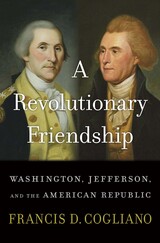
The first full account of the relationship between George Washington and Thomas Jefferson, countering the legend of their enmity while drawing vital historical lessons from the differences that arose between them.
Martha Washington’s worst memory was the death of her husband. Her second worst was Thomas Jefferson’s awkward visit to pay his respects subsequently. Indeed, by the time George Washington had died in 1799, the two founders were estranged. But that estrangement has obscured the fact that for most of their thirty-year acquaintance they enjoyed a productive relationship. Precisely because they shared so much, their disagreements have something important to teach us.
In constitutional design, for instance: Whereas Washington believed in the rule of traditional elites like the Virginia gentry, Jefferson preferred what we would call a meritocratic approach, by which elites would be elected on the basis of education and skills. And while Washington emphasized a need for strong central government, Jefferson favored diffusion of power across the states. Still, as Francis Cogliano argues, common convictions equally defined their relationship: a passion for American independence and republican government, as well as a commitment to westward expansion and the power of commerce. They also both evolved a skeptical view of slavery, eventually growing to question the institution, even as they took only limited steps to abolish it.
What remains fascinating is that the differences between the two statesmen mirrored key political fissures of the early United States, as the unity of revolutionary zeal gave way to competing visions for the new nation. A Revolutionary Friendship brilliantly captures the dramatic, challenging, and poignant reality that there was no single founding ideal—only compromise between friends and sometime rivals.

In a new work anticipating the bicentennial of the French Revolution, Patrice Higonnet demonstrates why the American and French Revolutions, although roughly contemporaneous and inspired by many of the same ideals, followed utterly different trajectories: the Americans proceeded to stabilize and build upon their revolution, while the French stumbled from bloodbath to republic to empire to monarchy again.
Eighteenth-century American society, individualistic to a degree, nevertheless managed to ground its politics in communitarian philosophy and to deny the existence of social cleavages, thus creating a pluralist ideology that successfully balanced the two strains. In contrast, argues Higonnet, individualistic politics in France collapsed in 1791 for lack of a foundation, and French society drifted toward terrorism as the rival claims of libertarian and communitarian principles struggled on the national scene. Higonnet works out these ideas in a learned and persuasive new perspective on the two major democratic revolutions of the eighteenth century.
This is a book for serious readers of history that can also refresh college courses in American history, French history, the history of revolutions, comparative studies, intellectual history, and the history of the eighteenth century in the Western world.
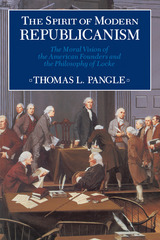
"A work of extraordinary ambition, written with great intensity. . . . [Pangle offers] a trenchant analysis of Locke's writings, designed to demonstrate their remarkable originality and to clarify by doing so as much as the objective predicament as the conscious intentions of the Founding Fathers themselves."—John Dunn, Times Higher Education Supplement
"A forcefully argued study of the Founding Fathers' debt to Locke. . . . What distinguishes Pangle's study from the dozens of books which have challenged or elaborated upon the republican revision is the sharpness with which he exposes the errors of the revisionists while at the same time leaving something of substantive value for the reader to consider."—Joyce Appleby, Canadian Journal of History
"Breathtaking in its daring and novelty. . . . Pangle's book is tense and tenacious, a stunning meditation on America's political culture."—John Patrick Diggins, Transactions of the C. S. Peirce Society
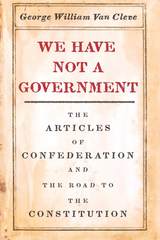
In George William Van Cleve’s book, we encounter a sharply divided America. The Confederation faced massive war debts with virtually no authority to compel its members to pay them. It experienced punishing trade restrictions and strong resistance to American territorial expansion from powerful European governments. Bitter sectional divisions that deadlocked the Continental Congress arose from exploding western settlement. And a deep, long-lasting recession led to sharp controversies and social unrest across the country amid roiling debates over greatly increased taxes, debt relief, and paper money. Van Cleve shows how these remarkable stresses transformed the Confederation into a stalemate government and eventually led previously conflicting states, sections, and interest groups to advocate for a union powerful enough to govern a continental empire.
Touching on the stories of a wide-ranging cast of characters—including John Adams, Patrick Henry, Daniel Shays, George Washington, and Thayendanegea—Van Cleve makes clear that it was the Confederation’s failures that created a political crisis and led to the 1787 Constitution. Clearly argued and superbly written, We Have Not a Government is a must-read history of this crucial period in our nation’s early life.
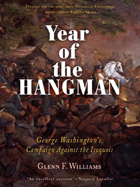
Winner of the 2005 Thomas Fleming Award for the Best Book in American Revolutionary War History
Finalist for the Army Historical Foundation Distinguished Writing Award
After two years of fighting, Great Britain felt confident that the American rebellion would be crushed in 1777, the "Year of the Hangman." Britain devised a bold new strategy. Turning its attention to the colonial frontiers, especially those of western New York, Pennsylvania, and Virginia, Britain enlisted its provincial rangers, Tories, and allied warriors, principally from the Iroquois Confederacy, to wage a brutal backwoods war in support of General John Burgoyne's offensive as it swept southward from Canada in an attempt to cut the colonies in half, divert the Continental Army, and weaken its presence around British-occupied New York City and Philadelphia.
Burgoyne's defeat at Saratoga sent shock waves through the British command. But the efforts along the frontier under the direction of Sir John Johnson, Colonel John Butler, and the charismatic Mohawk leader, Joseph Brant, appeared to be impairing the American ability to conduct the war. Destroying Patriot settlements and farms across hundreds of miles of frontier, the British and Indian forces threatened to reduce Continental army enlistment, and more importantly, precious food supplies. Following the massacres at the well-established colonial settlements of Wyoming, Pennsylvania, and Cherry Valley, New York, the Continental Congress persuaded General George Washington to conduct a decisive offensive to end the threat once and for all. Brewing for years, the conflict between the Iroquois and colonists would now reach its deadly climax.
Charging his troops "to not merely overrun, but destroy," Washington devised a two-prong attack to exact American revenge. The largest coordinated American military action against American Indians in the war, the campaign shifted the power in the east, ending the political and military influence of the Iroquois, forcing large numbers of loyalist to flee to Canada, and sealing Britain's fateful decision to seek victory in the south. In Year of the Hangman: George Washington's Campaign Against the Iroquois, historian Glenn F. Williams recreates the riveting events surrounding the action, including the checkered story of European and Indian alliances, the bitter frontier wars, and the bloody battles of Oriskany and Newtown.
READERS
Browse our collection.
PUBLISHERS
See BiblioVault's publisher services.
STUDENT SERVICES
Files for college accessibility offices.
RECENTLY PUBLISHED


UChicago Accessibility Resources
home | accessibility | search | about | contact us
BiblioVault ® 2001 - 2024
The University of Chicago Press