
 A SCHOLARLY BOOK REPOSITORY

A civil rights attorney’s unflinching memoir about the fight against segregation and systemic racism through landmark legal battles in Alabama
Be Not Afraid: A Southern Journey Through Law, Liberty, and Civil Rights is a timely and unflinching memoir from civil rights attorney Jack Drake, who has spent decades on the front lines of Alabama’s legal battles for racial justice. Raised in a segregated community in Gardendale, Alabama, Drake came of age during the civil rights movement and became a pivotal figure in cases that reshaped the state’s legal and moral landscape.
Drake helped reform Alabama’s grossly inadequate mental health system and supported voting rights efforts throughout Alabama. His career underscores the crucial role private attorneys and grassroots advocates played in enforcing civil rights laws long after their passage.
Through vivid recollections of courtroom battles, civil rights alliances, and personal transformation, Be Not Afraid offers an intimate view into the persistence and courage required to challenge systemic injustice. At a time when debates over equity and democracy remain pressing, Drake’s story is both a powerful reflection on the past and a call to action for the present. It speaks to the enduring importance of legal advocacy and community solidarity in the fight for a more just society, making it essential reading for those engaged in civil rights history, law, or social change.
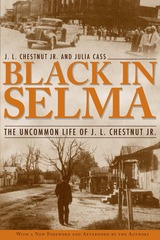
One man’s fight for justice. One town’s reckoning with history.
Born in Selma in 1930, J. L. Chestnut left home to study law at Howard University in Washington, DC. Returning to Selma, Chestnut was the town’s first and only African American attorney in the late 1950s. As the turbulent struggle for civil rights spread across the South, Chestnut became an active and ardent promoter of social and legal equality in his hometown. A key player on the local and state fronts, Chestnut accrued deep insights into the racial tensions in his community and deftly opened paths toward a more equitable future.
Though intimately involved in many events that took place in Selma, Chestnut was nevertheless often identified in history books simply as “a local attorney.” Black in Selma reveals his powerful yet little-known story.
In the 2014 film Selma, director Ava DuVernay takes audiences to the climactic confrontation between civil rights advocates and the state’s security forces of March 1965. Readers looking for a deeper understanding of the events that preceded that epic moment, as well as how racial integration unfolded in Selma in the decades that followed, will find Chestnut’s story and memories both a vital primary source and an inspiration.
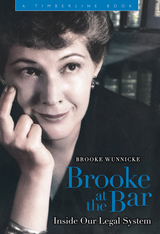
Brooke shares vignettes of her early life—California in the Great Depression, college at Stanford, law school in Colorado during World War II, and the 1946 opening of her Cheyenne law office, a precedent for women in law. She vividly describes memorable and amusing experiences with clients, witnesses, lawyers, juries, and judges and explains some significant cases. She recounts important and dynamic events from her twelve years as Denver’s chief appellate deputy district attorney, an era during which she was an inestimable mentor to many young lawyers who became prominent in the private and public sectors.
Brooke passionately believed “the law has been and will continue to be civilization’s hope.” In her book’s final part, she demystifies many legal terms and procedures and describes the parts of a civil jury trial—including information for jurors and witnesses—and provides an enthusiastic and clear refresher on the US Constitution and Bill of Rights.
Brooke at the Bar is a unique and historically important contribution that will be of interest to general readers, scholars, and students interested in US law, political science, government, women’s history, twentieth-century western history, civil rights, and legal communities, including those in Wyoming and Colorado, where Brooke was “at the Bar.”
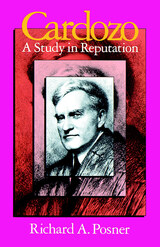
"The present compact and unflaggingly interesting volume . . . is a full-bodied scholarly biography. . . .It is illuminating in itself, and will serve as a significant contribution."—Paul A. Freund, New York Times Book Review

Clarence Darrow, son of a village undertaker and coffinmaker, rose to become one of America’s greatest attorneys—and surely its most famous. The Ohio native gained renown for his central role in momentous trials, including his 1924 defense of Leopold and Loeb and his defense of Darwinian principles in the 1925 Scopes “Monkey Trial.” Some have traced Darrow’s lifelong campaign against capital punishment to his boyhood terror at seeing a Civil War soldier buried—and no client of Darrow’s was ever executed, not even black men who were accused of murder for killing members of a white mob.
Closing Arguments: Clarence Darrow on Religion, Law, and Society collects, for the first time, Darrow’s thoughts on his three main preoccupations, revealing a carefully conceived philosophy expressed with delightful pungency and clarity. His thoughts on social issues, especially on the dangers of religious fundamentalism, are uncannily prescient. A dry humor infuses his essays, and his reflections on himself and his philosophy reveal a quiet dignity at the core of a man better known for provoking Americans during an era of unprecedented tumult. From the wry “Is the Human Race Getting Anywhere?” to the scornful “Patriotism” and his elegiac summing up, “At Seventy-two,” Darrow’s writing still stimulates, pleases and challenges.
A rebel who always sided intellectually and emotionally with the minority, Darrow remains a figure to contend with sixty-seven years after his death. “Inside every lawyer is the wreck of a poet,” Darrow once said. Closing Arguments demonstrates that, in his case, that statement is true.
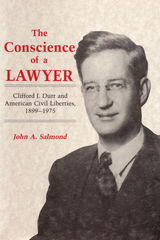
A powerful portrait of principle and protest in the life of a Southern lawyer who stood for civil liberties.
Clifford Judkins Durr was an Alabama lawyer who played an important role in defending activists and other accused of disloyalty during the New Deal and McCarthy eras. His uncompromising commitment to civil liberties and civic decency caused him to often take unpopular positions.
In 1933, Durr moved to Washington to work as a lawyer for the Reconstruction Finance Corporation, a creation of Roosevelt’s new Democratic administration, becoming a dedicated New Dealer in the process. He was then appointed by President Franklin D. Roosevelt to the Federal Communications Commission (FCC), a politically sensitive position as FDR sought to counter the increasing power and concentration of broadcasters, many of whom were opponents of the New Deal. Durr resigned from the FCC in 1948 and after brief employment with the National Farmers Union in Colorado, the Durrs eventually returned to Montgomery, Alabama in the hope of returning to a more prosperous, less controversial life.
Durr continued to practice in Montgomery as counsel for black citizens whose rights had been violated and ultimately, in December, 1955, when police arrested Rosa Parks for refusing to give her bus seat to a white man he stepped in and lent his extensive legal prowess to her case and the continuing quest for civil rights. Closing his firm in 1964 Durr began to lecture in the United States and abroad. He died at his grandfather's farm in 1975.
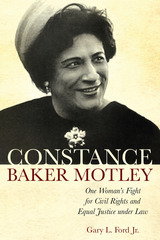
The story of NAACP’s sole female attorney. She shaped civil rights history as lead strategist and litigator from 1946–1964, arguing landmark desegregation cases and defending Martin Luther King Jr. and countless freedom fighters.
Constance Baker Motley was an African American woman; the daughter of immigrants from Nevis, British West Indies; a wife; and a mother who became a pioneer and trailblazer in the legal profession. She broke down barriers, overcame gender constraints, and operated outside the boundaries placed on black women by society and the civil rights movement. In Constance Baker Motley: One Woman’s Fight for Civil Rights and Equal Justice under Law, Gary L. Ford Jr. explores the key role Motley played in the legal fight to desegregate public schools as well as colleges, universities, housing, transportation, lunch counters, museums, libraries, parks, and other public accommodations.
The only female attorney at the NAACP Legal Defense and Educational Fund, Inc., Motley was also the only woman who argued desegregation cases in court during much of the civil rights movement. From 1946 through 1964, she was a key litigator and legal strategist for landmark civil rights cases including the Montgomery Bus Boycott and represented Martin Luther King Jr. as well as other protesters arrested and jailed as a result of their participation in sit-ins, marches, and freedom rides.
Motley was a leader who exhibited a leadership style that reflected her personality traits, skills, and strengths. She was a visionary who formed alliances and inspired local counsel to work with her to achieve the goals of the civil rights movement. As a leader and agent of change, she was committed to the cause of justice and she performed important work in the trenches in the South and behind the scene in courts that helped make the civil rights movement successful.
"Highly recommended."
—CHOICE

A Supreme Court historian’s memoir places court events in the larger context of American history.
Legal scholar James F. Simon has written many acclaimed books on the history of the US Supreme Court, but in this memoir, he turns his attention to a more personal subject: himself. Simon, a native of Fort Worth, details what it was like growing up in segregated Texas. He left home for college and law school at Yale, interspersed with travels abroad to build a schoolhouse in Ghana, work at an Israeli kibbutz, and spend a year on a fellowship in India.
Simon worked as a legal journalist for Time magazine before embarking on a career as a Supreme Court historian. He later was appointed professor of constitutional law and served as dean of New York Law School. Meanwhile, he continued his work on what became his specialty, well-researched books on the history of the Supreme Court that place events at the court in the larger context of American history. Much of this research is included in his papers, which are now housed at the Briscoe Center for American History.
In this engaging memoir, Simon describes the challenges of interviewing Supreme Court justices and researching constitutional history for his books and juggling his law school and family responsibilities, all the while reflecting on changing American perspectives on civil rights and liberties.
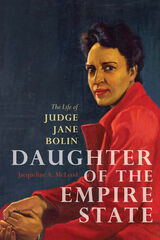
Bolin was appointed to New York City's domestic relations court in 1939 for the first of four ten-year terms. When she retired in 1978, her career had extended well beyond the courtroom. Drawing on archival materials as well as a meeting with Bolin in 2002, historian Jacqueline A. McLeod reveals how Bolin parlayed her judicial position to impact significant reforms of the legal and social service system in New York.
Beginning with Bolin's childhood and educational experiences at Wellesley and Yale, Daughter of the Empire State chronicles Bolin's relatively quick rise through the ranks of a profession that routinely excluded both women and African Americans. Deftly situating Bolin's experiences within the history of black women lawyers and the historical context of high-achieving black New Englanders, McLeod offers a multi-layered analysis of black women's professionalization in a segregated America.
Linking Bolin's activist leanings and integrationist zeal to her involvement in the NAACP, McLeod analyzes Bolin's involvement at the local level as well as her tenure on the organization's national board of directors. An outspoken critic of the discriminatory practices of New York City's probation department and juvenile placement facilities, Bolin also co-founded, with Eleanor Roosevelt, the Wiltwyck School for boys in upstate New York and campaigned to transform the Domestic Relations Court with her judicial colleagues. McLeod's careful and highly readable account of these accomplishments inscribes Bolin onto the roster of important social reformers and early civil rights trailblazers.

One of Abraham Lincoln’s staunchest and most effective allies, Judge David Davis masterminded the floor fight that gave Lincoln the presidential nomination at the 1860 Republican National Convention. This history-changing event emerged from a long friendship between the two men. It also altered the course of Davis’s career, as Lincoln named him to the U.S. Supreme Court in 1862.
Raymond J. McKoski offers a biography of Davis’s public life, his impact on the presidency and judiciary, and his personal, professional, and political relationships with Lincoln. Davis lent his vast network of connections, organizational and leadership abilities, and personal persuasiveness to help Lincoln’s political rise. When Davis became a judge, he honed an ability to hear each case with complete impartiality, a practice that endeared him to Lincoln but one day put him at odds with the president over important Civil War–era rulings. McKoski details these cases while providing an in-depth account of Davis’s role in Lincoln’s two unsuccessful campaigns for U.S. Senate and the fateful run for the presidency.
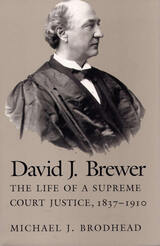
This is the first biography of David J. Brewer, an Associate Justice of the United States Supreme Court from 1889 to 1910.
Prior to rising to the nation’s highest tribunal, Brewer served as a county probate judge, a state district judge, a Kansas State Supreme Court justice, and a federal circuit court judge. He was known not only for his long tenure on the Supreme Court but also for his numerous off-the-bench statements as an orator and writer.
Many of Brewer’s judicial opinions and nonjudicial utterances created controversy, particularly when he confronted the reform issues of his day. The court, then presided over by Chief Justice Melville W. Fuller, has been seen as reactionary, determined to infuse the law with social Darwinism and laissez-faire ideology. Yet, contrary to this assessment of the Fuller Court as a whole, Brewer accepted most of his generation’s reform goals. He championed many forms of social legislation, the regulation of business, the rights of women and minorities, the support of charities, educational reform, and world peace.
Michael J. Brodhead contends that until recently historians have carelessly and inaccurately created a false image of Brewer, partly by citing a small sample of his opinions and public statements as representative of his alleged conservatism. They have also assumed that the disputable decisions of Brewer and his contemporaries were based on ideological predilections and that precedent and recognized legal principles played no role.
During his term, Brewer was the author of such notable court opinions as In re Debs, Muller v. Oregon, and Kansas v. Colorado. He supported property rights, admired honest entrepreneurial activity, and opposed the concentration of power in any form. Brewer favored the individual in all instances, whether that individual was the initiator of a great economic enterprise or a farmer struggling to extend agriculture into the western plains.
In 1820 the Missouri controversy erupted over the issue of slavery in the newly acquired lands of the Louisiana Purchase. It fell to Jesse Burgess Thomas (1777–1853), a junior U.S. senator from the new state of Illinois, to handle the delicate negotiations that led to the Missouri Compromise. Thomas’s maturity, good judgment, and restraint helped pull the country back from the brink of disunion and created a compromise that held for thirty-four years. In Dividing the Union, Matthew W. Hall examines the legal issues underlying the controversy and the legislative history of the Missouri Compromise while focusing on the aspects of Thomas’s life and character that gave him such influence. The first in-depth biography of Thomas, Hall’s work demonstrates how the legislative battle over the Compromise reflected the underlying nuances of the larger struggle over slavery.
The text of the Missouri Compromise originated from the Northwest Ordinance. Article VI of the Ordinance purported to prohibit slavery in the Northwest Territory, but paradoxically, a provision that assured property rights in another article was used to protect slavery. People in some parts of the Northwest sought to circumvent Article VI by formulating indenture laws and various state constitutional provisions addressing slavery. Pro- and antislavery activists eventually developed quite different interpretations of the relevant language in these documents, making negotiations over slavery in the new territory extremely complicated.
As Hall demonstrates, Thomas was perfectly situated geographically, politically, and ideologically to navigate the Missouri controversy. He was the first speaker of the Indiana Territorial General Assembly, one of the first territorial judges in the Illinois Territory, and the president of the Illinois State Constitutional Convention in 1818. Because the drive for statehood in Illinois was strong, the convention managed to skirt the divisive issue of slavery, due in large part to Thomas’s efforts. That he was never required to clearly articulate his own views on slavery allowed Thomas to maintain a degree of neutrality, and his varied political career gave him the experience necessary to craft a compromise.
Thomas’s final version of the Compromise included shrewdly worded ambiguities that supported opposing interests in the matter of slavery. These ambiguities secured the passage of the Compromise and its endurance until the Kansas-Nebraska Act of 1854. By weaving Thomas’s life story into the history of the Missouri Compromise, Hall offers new insight into both a pivotal piece of legislation and an important, previously overlooked figure in nineteenth-century American politics.
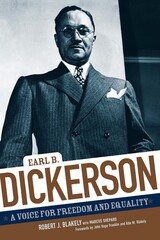
At fifteen, Earl Burrus Dickerson stowed away on a train in Canton, Mississippi, fleeing the racial oppression of his native South. But Chicago, the boy's destination, was no haven of racial fairness and equality. His flight north was in fact the beginning of a journey that would last a lifetime--and would forever pit Dickerson against the forces of racial injustice. Earl B. Dickerson's story, told here for the first time, is one of courage and character, of remarkable accomplishment in the face of terrible odds; it is also emblematic of the twentieth-century struggle for civil rights--a crucial chapter of African American history as it was lived by one uncompromising individual.
In this book, Robert J. Blakely tells how Dickerson (1891-1986) worked his way through preparatory schools and college, a segregated officer's training school, and law school at the University of Chicago. The story follows Dickerson's career as general counsel to the first insurance company owned and operated by African Americans; the first African American Democratic alderman elected to the Chicago City Council; a member of FDR's first Fair Employment Practices Committee; leader of the movement that broke the color barrier to membership in the Illinois Bar Association; and, perhaps most famously, the power behind Hansberry v. Lee, the U.S. Supreme Court case that marked the beginning of the end of restrictive real estate covenants--one of the most pernicious legal tools of segregation in the North. Blakely gives us a sense of the man behind the achievements, the life that defied conventions and statistics, and the world in which "the dean of Chicago's black lawyers" became a pioneering architect for equal opportunity in American life.
"A first-rate prose stylist, [Holmes] was perhaps the most quotable of all judges, as this ably edited volume shows."—Washington Post Book World
"Brilliantly edited, lucidly organized, and equipped with a compelling introduction by Judge Posner, [this book] is one of the finest single-volume samplers of any author's work I have seen. . . . Posner has fully captured the acrid tang of him in this masterly anthology."—Terry Teachout, National Review
"Excellent. . . . A worthwhile contribution to current American political/legal discussions."—Library Journal
"The best source for the reader who wants a first serious acquaintance with Holmes."—Thomas C. Grey, New York Review of Books
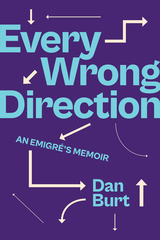
Every Wrong Direction recreates and dissects the bitter education of Dan Burt, an American émigré who never found a home in America. It begins in the row homes of Jewish immigrants and working-class Italians on the mean streets of 1950s South Philadelphia. Every Wrong Direction follows the author from the rough, working-class childhood that groomed him to be a butcher or charter boat captain, through America, Britain and Saudi Arabia as student, lawyer, spy, culture warrior, and expatriate, ending with a photo of his college rooms at St John’s College, Cambridge. Between this beginning and end, through a Philadelphia commuter college, to Cambridge, then Yale Law School, across the working to upper classes, three countries, and seven cities over 43 years, it maps his pursuit of, realization, disillusionment with and abandonment of America and the American Dream.
Praise for Dan Burt's previous memoir, You Think It Strange:
“Burt’s early life was indeed a triumph of wit and will. He managed to escape a world filled with violence and a culture that valued street smarts over book smarts, all the while knowing that just about everyone around him thought little of his prospects. That he made it out at all is extraordinary. That he became a successful lawyer and writer is virtually unimaginable.” —Commonweal
“Dan Burt is a fine poet, and this memoir has all the sensitivity and vigilance you might expect from a writer with such a background. But his prose also has a robustness and documentary power that continually startles and engages. As it combines these things, You Think It Strange catches the strangeness of the world and makes it familiar.”
—Sir Andrew Motion, Poet Laureate of the United Kingdom, 1999-2009
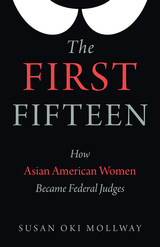
This book tells the stories of the first fifteen. In the process, it recounts remarkable tales of Asian women overcoming adversity and achieving the American dream, despite being the daughters of a Chinese garment worker, Japanese Americans held in internment camps during World War II, Vietnamese refugees, and penniless Indian immigrants. Yet The First Fifteen also explores how far Asian Americans and women still have to go before the federal judiciary reflects America as a whole.
In a candid series of interviews, these judges reflect upon the personal and professional experiences that led them to this distinguished position, as well as the nerve-wracking political process of being nominated and confirmed for an Article III judgeship. By sharing their diverse stories, The First Fifteen paints a nuanced portrait of how Asian American women are beginning to have a voice in determining American justice.
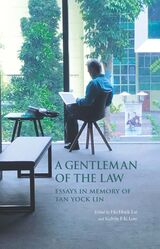
Singaporean legal scholar Tan Yock Lin (1953–2023) was a distinguished figure in Singapore’s legal community and an emeritus professor at the Faculty of Law, National University of Singapore. Known for his unparalleled knowledge of Singaporean law, intellectual rigor, and deep personal integrity, Tan’s scholarship helped define and advance the study of law in Singapore. This volume brings together twelve essays by eminent legal scholars addressing the wide-ranging fields in which Tan made lasting scholarly contributions: equity and trusts, personal property, international law, and the law of evidence and criminal justice. Alongside these are personal tributes that offer glimpses into the ways Tan touched the lives of those around him as a student, teacher, mentor, and colleague.
At once an academic contribution and a work of remembrance, A Gentleman of the Law honours the legacy of a scholar whose impact will long continue to shape the legal landscape in Singapore and beyond. This volume is an essential addition to any collection on Singapore law.
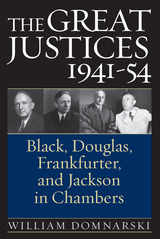
This is rare and little-examined territory: in the public consciousness the Supreme Court is usually seen as an establishment whose main actors, the justices, remain above emotion, vitriol, and gossip, the better to interpret our nation of laws. Yet the Court's work is always an interchange of ideas and individuals, and the men and women who make up the Court, despite or because of their best intentions, are as human as the rest of us. Appreciating that human dimension helps us to discover some of the Court's secrets, and a new way to understand the Court and its role.
Comparing four brilliant but very different jurists of the Roosevelt Court-Hugo Black, William O. Douglas, Felix Frankfurter, and Robert Jackson-William Domnarski paints a startling picture of the often deeply ambiguous relationship between ideas and reality, between the law and the justices who interpret and create it. By pulling aside the veil of decorous tradition, Domnarski brings to light the personalities that shaped one of the greatest Courts of our time-one whose decisions continue to affect judicial thinking today.
William Domnarski is the author of In the Opinion of the Court (1996), a study of the history and nature of federal court judicial opinions. He holds a J.D. from the University of Connecticut and a Ph.D. in English from the University of California. Domnarski currently practices law in California, where he is also working on a forthcoming biography of legendary Hollywood lawyer Bert Fields.
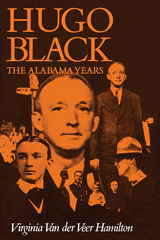
Almost any Alabamian, white or black, unsophisticated or meagerly educated, can name one man who was a justice of the United States Supreme Court. That name may be spoken with praise or, more often, profanity, but Hugo La Fayette Black, who left Alabama for Washington in 1927, remained a presence of major, almost legendary, proportions in his native state of Alabama. He was an associate justice of the Supreme Court for so many years that most Alabamians were vague as to what he did before and how he got the job. But any gray-haired man of seventy or eighty on Twentieth Street in Birmingham will tell you quickly enough that Hugo Black, beginning in the now-dim era of the Coolidge administration,. was once United States senator.
In 1969, citizen gadfly Sherman Skolnick accused two Illinois Supreme Court justices of accepting valuable bank stock from an influential Chicago lawyer in exchange for deciding an important case in the lawyer’s favor. The resulting feverish media coverage prompted the state supreme court to appoint a special commission to investigate. Within six weeks and on a shoestring budget, the commission mobilized a small volunteer staff to reveal the facts. Stevens, then a relatively unknown Chicago lawyer, served as chief counsel. His work on this investigation would launch him into the public spotlight and onto the bench.
Manaster, who served on the commission, tells the real story of the investigation, detailing the dead ends, tactics, and triumphs. Manaster expertly traces Stevens’s masterful courtroom strategies and vividly portrays the high-profile personalities involved, as well as the subtleties of judicial corruption. A reflective foreword by Justice Stevens himself looks back at the case and how it influenced his career.
Now the subject of the documentary Unexpected Justice: The Rise of John Paul Stevens, Manaster’s book is both a fascinating chapter of political history and a revealing portrait of the early career of a Supreme Court justice.
In 1969, citizen gadfly Sherman Skolnick accused two Illinois Supreme Court justices of accepting valuable bank stock from an influential Chicago lawyer in exchange for deciding an important case in the lawyer’s favor. The resulting feverish media coverage prompted the state supreme court to appoint a special commission to investigate. Within six weeks and on a shoestring budget, the commission mobilized a small volunteer staff to reveal the facts. Stevens, then a relatively unknown Chicago lawyer, served as chief counsel. His work on this investigation would launch him into the public spotlight and onto the bench.
Manaster, who served on the commission, tells the real story of the investigation, detailing the dead ends, tactics, and triumphs. Manaster expertly traces Stevens’s masterful courtroom strategies and vividly portrays the high-profile personalities involved, as well as the subtleties of judicial corruption. A reflective foreword by Justice Stevens himself looks back at the case and how it influenced his career.
Now the subject of the documentary Unexpected Justice: The Rise of John Paul Stevens, Manaster’s book is both a fascinating chapter of political history and a revealing portrait of the early career of a Supreme Court justice.
As political attacks on judges increase, Schudson calls for reforms to protect judicial independence and for vigilance to ensure justice for all. Independence Corrupted is invaluable for students and scholars, lawyers and judges, and all citizens concerned about the future of America's courts.
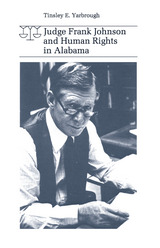
Where courage meets the gavel: One judge’s relentless fight for justice and human rights in Alabama.
Judge Frank M. Johnson, Jr., Chief Judge of the United States District Court for the Middle District of Alabama until his elevation to the Court of Appeals for the Fifth Circuit in 1979, was perhaps President Dwight D. Eisenhower’s most significant appointment to a lower court. His selection to the bench in 1955 followed by only a few months the Supreme Court’s historic decision in Brown vs. Board of Education.
During Judge Johnson’s tenure, his court invalidated segregation and other forms of racial discrimination in Alabama’s transportation facilities, voter registration processes, school and colleges, administrative agencies, system of jury selection, prisons, mental institutions, political parties, and government grant programs. In fact, most of the state’s major racial crises were resolved in his courtroom. However, his impact on human rights policy in Alabama was not confined to a racial context. Among other significant developments, the Middle District Court ordered reapportionment of the state’s governing bodies and invalidated its grossly inequitable property tax systems.
Judge Johnson’s decisions made him one of the most widely respected and controversial trial judges in the country. Until recently, however, his name was anathema to many white Alabamians, and he and his family were subject to ostracism, threats, violence, and verbal abuse.
Yarbrough examines Judge Johnson’s life through the end of the Wallace era and the Judge’s appointment to the Fifth Circuit Court. More broadly, the book is a history of modern human rights reform in Alabama, cast in the biographical idiom. For, in a real sense, the history of the reform and of Judge Johnson’s judicial career have been synonymous.
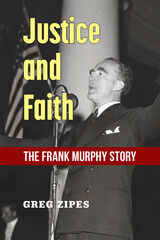
Murphy is best remembered for his immense legal contributions supporting individual liberty and fighting discrimination, particularly discrimination against the most vulnerable. Despite being a loyal ally of Franklin Delano Roosevelt, when FDR ordered the removal of Japanese Americans during World War II, Supreme Court Justice Murphy condemned the policy as “racist” in a scathing dissent to the Korematsu v. United States decision—the first use of the word in a Supreme Court opinion. Every American, whether arriving by first class or in chains in the galley of a slave ship, fell under Murphy’s definition of those entitled to the full benefits of the American dream.
Justice and Faith explores Murphy’s life and times by incorporating troves of archive materials not available to previous biographers, including local newspaper records from across the country. Frank Murphy is proof that even in dark times, the United States has extraordinary resilience and an ability to produce leaders of morality and courage.
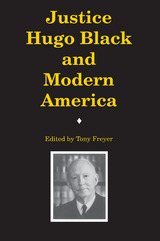
The struggle to accommodate both individual freedom and community welfare shaped modern America. American have disagreed about whether federal protection of national welfare could be reconciled with defense of individual rights; however, no public figure worked longer or more consistently to meet this challenge than Alabama’s Hugo L. Black
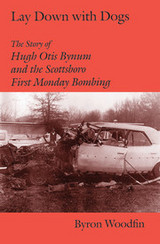
The gripping story of the attempted murder of Scottsboro attorney and state legislator Loy Campbell
“As with any good book about a great event, this one has a little of everything—suspense, humor, pathos, melodrama.” —Journal of Southern History
On a quiet December morning in 1972, Scottsboro attorney and former state legislator Loy Campbell started his car and detonated a bomb hidden beneath the hood. The explosion tore through the vehicle, cost him both legs, and nearly killed him, shattering the calm of the northeast Alabama town. Lay Down with Dogs reconstructs the attempted assassination of Campbell and subsequent trial. As Alabama’s young and ambitious attorney general, Bill Baxley took personal charge of the case. He led the state’s investigation and prosecution against those accused of planning and financing the assassination attempt, most notably Hugh Otis Bynum Jr., one of the most powerful local figures in Scottsboro. More than a crime story, it is a gripping account of violence, power, and survival at a volatile moment in modern Southern history.
Drawing on court records, investigative files, contemporary journalism, and firsthand testimony, Byron Woodfin offers the most comprehensive account of the bombing and its aftermath. With the skill of an experienced historian and storyteller, the narrative follows both the painstaking investigation and the dramatic prosecution that ultimately exposed the forces behind the attack. The author’s deep familiarity with Alabama history and legal culture lends authority and insight, while a clear, compelling prose style keeps the story moving with the momentum of a true‑crime classic.
Lay Down with Dogs will appeal to readers of Southern history, legal history, and true crime, as well as anyone interested in justice, civic life, and unsolved tensions in twentieth‑century America. It is ideal for scholars, students, and general readers seeking a powerful, unsettling, and unforgettable story rooted in real events.
Despite historians' focus on the man as president and politician, Abraham Lincoln lived most of his adult life as a practicing lawyer. It was as a lawyer that he fed his family, made his reputation, bonded with Illinois, and began his political career. Lawyering was also how Lincoln learned to become an expert mediator between angry antagonists, as he applied his knowledge of the law and of human nature to settle one dispute after another. Frontier lawyers worked hard to establish respect for the law and encourage people to resolve their differences without intimidation or violence. These were the very skills Lincoln used so deftly to hold a crumbling nation together during his presidency.
The growth of Lincoln's practice attests to the trust he was able to inspire, and his travels from court to court taught him much about the people and land of Illinois. Lincoln the Lawyer explores the origins of Lincoln's desire to practice law, his legal education, his partnerships with John Stuart, Stephen Logan, and William Herndon, and the maturation of his far-flung practice in the 1840s and 1850s. Brian Dirck provides a context for law as it was practiced in mid-century Illinois and evaluates Lincoln's merits as an attorney by comparison with his peers. He examines Lincoln's clientele, his circuit practice, his views on legal ethics, and the supposition that he never defended a client he knew to be guilty. This approach allows readers not only to consider Lincoln as he lived his life--it also shows them how the law was used and developed in Lincoln's lifetime, how Lincoln charged his clients, how he was paid, and how he addressed judge and jury.
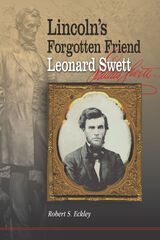
In 1849, while traveling as an attorney on the Eighth Judicial Circuit in Illinois, Abraham Lincoln befriended Leonard Swett (1825–89), a fellow attorney sixteen years his junior. Despite this age difference, the two men built an enduring friendship that continued until Lincoln’s assassination in 1865. Until now, no historian has explored Swett’s life or his remarkable relationship with the sixteenth president. In this welcome volume, Robert S. Eckley provides the first biography of Swett, crafting an intimate portrait of his experiences as a loyal member of Lincoln’s inner circle.
Eckley chronicles Swett’s early life and the part he played in Lincoln’s political campaigns, including his role as an essential member of the team behind Lincoln’s two nominations and elections for the presidency. Swett counseled Lincoln during the formation of his cabinet and served as an unofficial advisor and sounding board during Lincoln’s time in office. Throughout his life, Swett wrote a great deal on Lincoln, and planned to write a biography about him, but Swett’s death preempted the project. His eloquent and interesting writings about Lincoln are described and reproduced in this volume, some for the first time.
With Lincoln’s Forgotten Friend, Eckley removes Swett from the shadows of history and sheds new light on Lincoln’s personal relationships and their valuable contributions to his career.
Superior Achievement from the Illinois State Historical Society, 2013

A revealing portrait of Judge James E. Horton Jr., whose quiet moral courage reshaped one of the most explosive legal battles in American history.
A Man Visited by History illuminates what author Steven P. Brown calls the “last major Scottsboro trials–related subject to have eluded careful study”: the life of Judge James E. Horton Jr., the white Alabama Eighth Circuit judge who set aside an all-white jury’s guilty verdict and death sentence in the second trial of African American defendant Haywood Patterson. Of the three trial judges and more than one hundred jurors who considered the cases of the Scottsboro defendants, Horton was the only one to find that the evidence against them was virtually nonexistent. Horton was then removed from further involvement with the cases and, despite being on the fast track to political prominence before the 1933 retrial of the Scottsboro defendants, was defeated for reelection as circuit judge in 1934. His ruling in the Patterson case impacted the Scottsboro defendants’ lives and continues to affect their legacies today.
Brown researched largely untapped resources that, for the first time, illuminate who Horton was before the Scottsboro trials, what he faced presiding over Patterson’s case, the factors that led him to overturn the jury’s verdict, and his later life raising award-winning cattle. What emerges is a remarkably consistent picture of a man who, Brown argues, for more than ninety years, sought nothing more than to do what he thought was right. Historians of the South, the early twentieth century, the law, and race relations as well as general readers will find this intimate account of the judge in the infamous trials to be riveting and instructive.
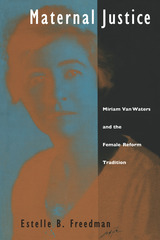
Estelle B. Freedman draws from Van Waters's diaries, letters, and personal papers to recreate her complex personal life, unveiling the disparity between Van Waters's public persona and her agonized private soul. With the power and elegance of a novel, Maternal Justice illuminates this historical context, casting light on the social welfare tradition, on women's history, on the American feminist movement, and on the history of sexuality.
"Maternal Justice is as much a work of history as it is biography, bringing to life not only a remarkable woman but also the complex political and social milieu within which she worked and lived."—Kelleher Jewett, The Nation
"This sympathetic biography reclaims Van Waters for history."—Publishers Weekly
"The Van Waters legacy, as Freedman gracefully presents, is that she cared about the lives of women behind bars. It is a strikingly unfashionable sentiment today."—Jane Meredith Adams, San Francisco Chronicle Book Review, Editor's Recommended Selection
"This finely crafted biography is both an engrossing read and a richly complicated account of a reformer whose work . . . bridged the eras of voluntarist charitable activism and professional social service."—Sherri Broder, Women's Review of Books
"This is a sympathetic, highly personal biography, revealing of both the author's responses to her subject's life and, in considerable detail, Van Waters's family traumas, illnesses, and love affairs."—Elizabeth Israels Perry, Journal of American History

The life of a crusading federal judge who stood up and fought for “the little guy”
This is the story of Miles Lord (1919–2016), who rose from humble beginnings on Minnesota’s Iron Range to become one of the most colorful and powerful judges in the country, described as “an unabashed Prairie populist” and “a live-wire slayer of corporate behemoths.” He cut a wide swath through history on his path to the bench: coming of age alongside a cadre of young Midwestern social-gospel progressives, including Hubert H. Humphrey, Eugene McCarthy, and Walter Mondale, in the days before they reached national fame; teaming with Bobby Kennedy as a hotshot prosecutor in pursuit of Jimmy Hoffa; and serving as the secret envoy between his friends Hubert and Eugene in their battle for the soul of the Democratic party in the historic 1968 presidential campaign. Later, after donning his black robe, he reshaped jurisprudence with precedent-breaking rulings—on issues ranging from women’s rights to consumer protection to education reform—and breaking trail when he ordered the shutdown of the Reserve Mining Company in northern Minnesota, which was spewing its waste into Lake Superior, in the most sensational trial of the early environmental era.
One of Judge Lord’s landmark cases—and interlaced as a centerpiece narrative of this book—involved the Dalkon Shield intrauterine device, which caused horrific infections in thousands of women, resulting in infertility and sometimes death. Author Roberta Walburn served as the judge’s law clerk during that litigation in 1983–84, and she provides a page-turning account (both an insider’s view and an in-depth chronicle) of what was called “one of the most disastrous episodes of American corporate misconduct.” In the end, more than 200,000 women received nearly $3 billion in compensation, and the Fortune 500 defendant was left in ruins. But Judge Lord was hauled up on judicial misconduct charges for his no-holds-barred actions that were certainly provocative but also stand as a timely reminder, even (or especially) today, of the challenges in balancing the scales of justice for a legal system that too often skews to the rich and powerful.
The author deftly weaves the Dalkon Shield drama into the larger story of the life of a one-of-a-kind man, crafting a sweeping and spirited true-life tale with not only her first-hand experiences as the judge’s law clerk but also with unrestricted access to the judge’s personal files. This is a rare and compelling portrait of a remarkable man and his place in both Minnesota and U.S. history.
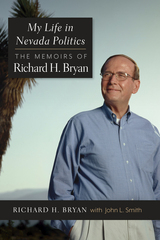
Born in Washington, D.C. in 1937, Bryan grew up in Las Vegas. His interest in politics started early, winning school-class elections and expressing a personal goal of one day becoming Governor of Nevada. He was elected student body president at the University of Nevada.
His career in public service began as a deputy district attorney in Clark County. In 1966, he became the first county public defender in state history. Bryan served in the Nevada Legislature in both the Assembly and Senate before winning the statewide office of Attorney General in 1978. He was elected Nevada Governor in 1982, winning re-election in 1986. Bryan was elected to the U.S. Senate in 1988, reelected in 1994, and served on the committees on Commerce, Banking, Taxation, and Intelligence, and chaired the Ethics Committee. He retired from the Senate in 2001 and returned to Nevada.
Bryan’s list of accomplishments is extensive. He was largely responsible for the early call-to-arms in the fight against the Department of Energy’s attempt to create a nuclear waste repository at Yucca Mountain. As governor, he reorganized state economic development programs, improved environmental protections for Lake Tahoe and other threatened areas, and made unprecedented appointments of women. In the Senate, Bryan authored the Southern Nevada Public Lands Management Act and the National Conservation Area for the High Rock Desert country. He had a front-row seat to the historic buildup to the Iraq War and the impeachment of President Bill Clinton. In retirement, Bryan continues to serve the state through his participation on a wide range of committees.
Throughout his political career, Bryan, with wife Bonnie at his side, traversed Nevada from its tiniest hamlets to the metro areas of Reno and Las Vegas with unrivaled zeal in his efforts to represent the state’s citizens. He is famous for knowing thousands of his constituents not only by their first names, but also recalling details of their lives. The simple fact is, while in service to Nevada, Bryan was in his element in the place he loves best.
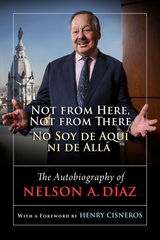
Raised in the squalor of a New York tenement until he was 10 years old, Nelson Díaz saw his life change when his family moved to a brand-new high-rise project in West Harlem in the 1950s. That experience, along with lessons learned as the only Latino law student at Temple University, would drive him throughout his life as a lawyer and activist, fighting for the expansion of rights for all Americans.
“No soy de aquí ni de allá” is a mantra for Puerto Ricans who feel like foreigners wherever they are and who seek a place for themselves. In his inspiring autobiography, Not from Here, Not from There, Díaz tells the story of his struggles and triumphs as his perspective widened from the New York streets and law school classrooms to the halls of power in Philadelphia and Washington, DC. Whether as a leader in economic development, a pioneer in court reform, or a champion of fair housing, Díaz has never stopped advocating for others. Díaz was happy to be the first Latino to “do something,” but he never wanted to be the last. This story of an outsider who worked his way to the inside offers powerful lessons on finding a place in the world by creating spaces where everyone is welcome.
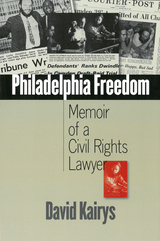
"David Kairys is one of the grand long-distance runners in the struggle for justice in America. His brilliant legal mind and superb lawyerly skills are legendary. This marvelous book is his gift to us!"
---Cornel West, Professor of Religion and African American Studies, Princeton University, and award-winning author of Race Matters
Philadelphia Freedom is the spellbinding tale of an idealistic young lawyer coming of age in the political cauldron of the 1960s and 1970s. From his immersion in the civil rights movement to his determined court battles to quell criminal violence by Philadelphia police, Kairys recounts how he helped make history in the city of brotherly love."
---William K. Marimow, Editor and Executive Vice President, Philadelphia Inquirer, and recipient of two Pulitzer Prizes
"In the current climate of political deception and the trampling of our civil rights, Kairys's compelling book is a clenched fist, a prayer for social justice and a call to conscience."
---Steve Lopez, Los Angeles Times columnist and former Philadelphia Inquirer columnist
"With engaging, insider stories of innovative legal strategies of a truly creative lawyer, this book evokes the ebullient spirit of progressive social change launched in the 1960s and should be read by aspiring and practicing lawyers as well as anyone interested in American social history. Philadelphia Freedom reads like a suspense novel and reveals how novel legal and political thinking can and does make a real difference to individuals and to the quality of justice."
---Martha L. Minow, Jeremiah Smith, Jr. Professor of Law, Harvard University
"David Kairys's compelling book properly explains the vital role that civil rights attorneys play in our system of justice."
---Judge John E. Jones III, United States District Court for the Middle District of Pennsylvania, and presiding judge in the landmark Kitzmiller v. Dover Area School District case
A memoir that is also a compelling page-turner, Philadelphia Freedom is the poignant, informative, often inspiring account of renowned civil-rights lawyer David Kairys's personal quest for achieving social justice during the turbulent 1960s and 70s.
Philadelphia Freedom brings us intimately and directly into Kairys's burgeoning law career and the struggles of the 60s as his professional and private life navigated the turmoil and promise of the civil rights and antiwar movements.
Many of the cases Kairys took on involved discrimination and equal protection, freedom of speech, and government malfeasance. Kairys is perhaps most well known for his victory in the Camden 28 draft board case, in which the FBI set up a sting of the Catholic anti-war left at the behest of the highest levels of government.
The stories and cases range from nationally important and recognizable---the family of the scientist the CIA unwittingly gave LSD in the 1950s; the leading race discrimination case against the FBI; Dr. Benjamin Spock's First Amendment case before the Supreme Court; the city handgun lawsuits Kairys conceived---to those he encountered in his early work as a public defender. The characters include public figures such as FBI Directors J. Edgar Hoover and Louis Freeh; CIA Director William Colby; Pennsylvania Senator Arlen Specter; New York Attorney General Eliot Spitzer; U.S. Attorneys General Edward Levi and John Mitchell; Georgia Governor Lester Maddox; Pennsylvania Governor, former Philadelphia Mayor, and Democratic National Committee chair Ed Rendell; Philadelphia Mayor and Police Commissioner Frank Rizzo. But some of the most memorable are not well known, involving regular people caught up in the often heartless machinery of the courts and legal system.
Though it reads like a novel, with all the elements of character, plot, and suspense, Philadelphia Freedom also has historical significance as a firsthand account of the 1960s and 70s and contains social commentary about race as well as insights and major perspectives on the nature and social role of law.
David Kairys is Professor of Law at Beasley School of Law, Temple University. He was a full-time civil rights lawyer from 1968 to 1990.
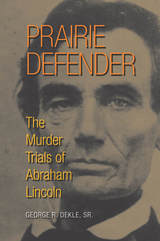
2018 ISHS Annual Award Winner for a Scholarly Publication
According to conventional wisdom, Abraham Lincoln spent most of his law career collecting debt and representing railroads, and this focus made him inept at defending clients in homicide cases. In this unprecedented study of Lincoln’s criminal cases, George Dekle disproves these popular notions, showing that Lincoln was first and foremost a trial lawyer. Through careful examination of Lincoln’s homicide cases and evaluation of his legal skills, Dekle demonstrates that criminal law was an important part of Lincoln's practice, and that he was quite capable of defending people accused of murder, trying approximately one such case per year.
Dekle begins by presenting the viewpoints of not only those who see Lincoln as a perfect lawyer whose only flaw was his inability to represent the wrong side of a case but also those who believe Lincoln was a less-than-honest legal hack. The author invites readers to compare these wildly different stereotypes with the flesh-and-blood Lincoln revealed in each case described in the book, including an axe murder suit in which Lincoln assisted the prosecution, a poisoning case he refused to prosecute for $200 but defended for $75, and a case he won by proving that a supposed murder victim was actually still alive.
For each case Dekle covers, he first tells the stories of the feuds, arguments, and insults that led to murder and other criminal activity, giving a gripping view of the seamy side of life in nineteenth-century Illinois. Then he traces the course of the pretrial litigation, describes the trials and the various tactics employed in the prosecution and defense, and critiques the performance of both Lincoln and his adversaries.
Dekle concludes that Lincoln was a competent, diligent criminal trial lawyer who knew the law, could argue it effectively to both judge and jury, and would use all lawful means to defend clients whether he believed them to be innocent or guilty. His trial record shows Lincoln to have been a formidable defense lawyer who won many seemingly hopeless cases through his skill as a courtroom tactician, cross-examiner, and orator. Criminal defendants who could retain Lincoln as a defense attorney were well represented, and criminal defense attorneys who sought him as co-counsel were well served. Providing insight into both Lincoln’s legal career and the culture in which he practiced law, Prairie Defender resolves a major misconception concerning one of our most important historical figures.
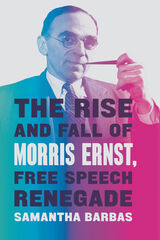
In the 1930s and ’40s, Morris Ernst was one of America’s best-known liberal lawyers. The ACLU’s general counsel for decades, Ernst was renowned for his audacious fights against artistic censorship. He successfully defended Ulysses against obscenity charges, litigated groundbreaking reproductive rights cases, and supported the widespread expansion of protections for sexual expression, union organizing, and public speech. Yet Ernst was also a man of stark contradictions, waging a personal battle against Communism, defending an autocrat, and aligning himself with J. Edgar Hoover’s inflammatory crusades.
Arriving at a moment when issues of privacy, artistic freedom, and personal expression are freshly relevant, The Rise and Fall of Morris Ernst, Free Speech Renegade brings this singularly complex figure into a timely new light. As Samantha Barbas’s eloquent and compelling biography makes ironically clear, Ernst both transformed free speech in America and inflicted damage to the cause of civil liberties. Drawing on Ernst’s voluminous cache of publications and papers, Barbas follows the life of this singular idealist from his pugnacious early career to his legal triumphs of the 1930s and ’40s and his later idiosyncratic zealotry. As she shows, today’s challenges to free speech and the exercise of political power make Morris Ernst’s battles as pertinent as ever.
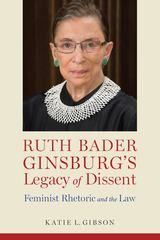
A rhetorical analysis of Justice Ruth Bader Ginsburg’s feminist jurisprudence.
Ruth Bader Ginsburg’s lifelong effort to reshape the language of American law has had profound consequences: she has shifted the rhetorical boundaries of jurisprudence on a wide range of fundamental issues from equal protection to reproductive rights. Beginning in the early 1970s, Ginsburg led a consequential attack on sexist law in the United States. By directly confronting the patriarchal voice of the law, she pointedly challenged an entrenched genre of legal language that silenced the voices and experiences of American women and undermined their status as equal citizens. On the United States Supreme Court, Justice Ginsburg continues to challenge the traditional scripts of legal discourse to insist on a progressive vision of the Constitution and to demand a more inclusive and democratic body of law.
This illuminating work examines Justice Ruth Bader Ginsburg’s contributions in reshaping the rhetoric of the law (specifically through the lens of watershed cases in women’s rights) and describes her rhetorical contributions—beginning with her work in the 1970s as a lawyer and an advocate for the ACLU’s Women’s Rights Project through her tenure as a Supreme Court justice. Katie L. Gibson examines Ginsburg’s rhetoric to argue that she has dramatically shifted the boundaries of legal language. Gibson draws from rhetorical theory, critical legal theory, and feminist theory to describe the law as a rhetorical genre, arguing that Ginsburg’s jurisprudence can appropriately be understood as a direct challenge to the traditional rhetoric of the law.
Ruth Bader Ginsburg stands as an incredibly important figure in late twentieth- and early twenty-first-century feminism. While a growing number of admirers celebrate Justice Ginsburg’s voice of dissent today, Ginsburg’s rhetorical legacy reveals that she has long articulated a sharp and strategic voice of judicial dissent. This study contributes to a more complete understanding of her feminist legacy by detailing the unique contributions of her legal rhetoric.
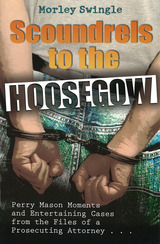
I closed my direct examination of narcotics officer Bill Bohnert by asking, "Detective Bohnert, do you see in the courtroom today the man we just saw on the tape, selling the crack cocaine to Darren Bullard?"
Bohnert pointed to Robert Funt.
"He's right there. . . ."
I heard laughter in the courtroom. I glanced at the defendant, who had dutifully raised his hand.
The prisoners seated behind him were laughing. They recognized a Perry Mason moment when they saw one.
Bohnert continued, "He's the one with his hand raised in the air."
It has been said that the public prosecutor has more power over life, liberty, and reputation than any other person—a daunting proposition, but perhaps less intimidating when that official’s perspective is tempered by humor and compassion.
In Scoundrels to the Hoosegow, a veteran prosecutor who is also a consummate storyteller shares more than thirty entertaining legal stories drawn from real life, re-creating, with verve and wit, villains, heroes, and ordinary citizens. In cases both tragic and hilarious, Morley Swingle offers a behind-the-scenes look at the justice system, taking readers from the scene of the crime to the courtroom as he explores the worlds of judges, attorneys, police officers, and criminals.
Informed by a deep appreciation of Mark Twain, Swingle aims to do for his profession what Clemens did for riverboat piloting. He leads readers on an enjoyable romp through crime and punishment, while offering a clear exposition of legal points—from the subtleties of cross-examination to the role of plea bargaining.
In cases ranging from indecent exposure to conspiracy to commit murder, Swingle considers the fine line between pornography and obscenity and discusses sensitive issues surrounding first-degree murder and the death penalty. Whether describing a drunken but well-meaning probationer who frees the dogs on “death row” or the woman who tries to hire a reluctant hit man to dispose of her husband, he combines true crime and legal analysis with a healthy dose of humor—and shares the occasional “Perry Mason moment” in which a trial dramatically shifts direction.
Not since the author of Anatomy of a Murder, Robert Traver, wrote Small Town D.A. fifty years ago has an American prosecutor penned such a candid, revealing, and funny account of the job—an altogether satisfying book that sentences the reader to many hours of enjoyment.
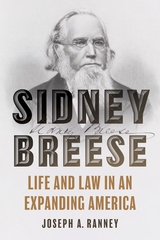
Born in New York, Breese moved to Illinois in 1818. An ambitious personality combined with acumen in law, politics, and business boosted Breese into the state’s frontier elite and involved him in the political controversies that roiled the Jacksonian Era. First a circuit court judge, Breese rose to the state Supreme Court before his election to the US Senate in 1842. Breese focused his senatorial energies on westward expansion and transforming the nation into a world power—ambitions symbolized by his pivotal role in the creation of the Illinois Central Railroad. After returning to the state Supreme Court, Breese ruled on essential cases that enshrined expansionist jurisprudence in American law and regulated the growing power of corporations in post–Civil War America.
A first full-length biography, Sidney Breese places the life of an overlooked figure within legal and Illinois history.
In Strong Advocate, Thomas Strong, one of the most successful trial lawyers in Missouri’s history, chronicles his adventures as a contemporary personal injury attorney. Though the profession is held in low esteem by the general public, Strong entered the field with the right motives: to help victims who have been injured by defective products or the negligence of others.
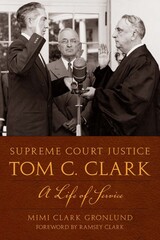
An associate justice on the renowned Warren Court whose landmark ruling in Brown v. Board of Education overturned racial segregation in schools and other public facilities, Tom C. Clark was a crusader for justice throughout his long legal career. Among many tributes Clark received, Supreme Court Chief Justice Warren Burger opined that "no man in the past thirty years has contributed more to the improvement of justice than Tom Clark."
Supreme Court Justice Tom C. Clark is the first biography of this important American jurist. Written by his daughter, Mimi Clark Gronlund, and based on interviews with many of Clark's judicial associates, friends, and family, as well as archival research, it offers a well-rounded portrait of a lawyer and judge who dealt with issues that remain in contention today—civil rights, the rights of the accused, school prayer, and censorship/pornography, among them. Gronlund explores the factors in her father's upbringing and education that helped form his judicial philosophy, then describes how that philosophy shaped his decisions on key issues and cases, including the internment of Japanese Americans during World War II, the investigation of war fraud, the Truman administration's loyalty program (an anti-communist effort), the Brown decision, Mapp v. Ohio (protections against unreasonable search and seizure), and Abington v. Schempp (which overturned a state law that required reading from the Bible each day in public schools).
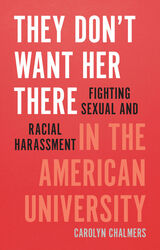
As Jew gained accolades and advanced through the ranks at Iowa, she was met with increasingly vicious attacks on her character by her white male colleagues—implying that her sexuality had opened doors for her. After years of being subjected to demoralizing sexual, racial, and ethnic discrimination, finding herself without any higher-up departmental support, and noting her professional progression beginning to suffer by the hands of hate, Jean Jew decided to fight back. Carolyn Chalmers was her lawyer.
This book tells the inside story of pioneering litigation unfolding during the eight years of a university investigation, a watershed federal trial, and a state court jury trial. In the face of a university determined to defeat them and maintain the status quo, Jew and Chalmers forged an exceptional relationship between a lawyer and a client, each at the top of their game and part of the first generation of women in their fields. They Don’t Want Her There is a brilliant, original work of legal history that is deeply personal and shows today’s professional women just how recently some of our rights have been won—and at what cost.
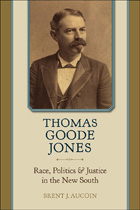
Thomas Goode Jones of Alabama is the first comprehensive biography of a key Alabama politician and federal jurist whose life and times embody the conflicts and transformations in the Deep South between the Civil War and World War I.
A man who both represented and differed from his class, Thomas Goode Jones offers contemporary readers and scholars an ideal subject of study to understand a period of southern history that still shapes American life today. Often overshadowed by the pharaonic antebellum period, the Civil War, and the luminous heights of the civil rights movement, the deceptively placid decades at the turn of the century were, in fact, a period when southerners fiercely debated the course of the South’s future. In tracing Jones’s career, Brent J. Aucoin offers vivid accounts of the great events and trends of that pivotal period: Reconstruction, the birth of the “Solid South,” the Populist Revolt, and the establishment of racial disenfranchisement and segregation.
Born in 1844, Jones served in the Confederate army and after the war identified as a conservative “Bourbon” Democrat. He served as Alabama's governor from 1890 to 1894 and as a federal judge from 1901 until his death in 1914. As a veteran, politician, and judge, Jones embodied numerous roles in the shifting political landscape of the South.
Jones was not, however, a reflexive conformist and sometimes pursued policies at odds with his party. Jones’s rhetoric and support of African American civil rights were exceptional and earned him truculent criticism from unrepentant racist factions in his party. His support was so fearless that it inspired Booker T. Washington to recommend Jones to Republican president Theodore Roosevelt as a federal judge. On the bench, Jones garnered national attention for his efforts to end peonage and lynching, and yet he also enabled the establishment of legalized segregation in Alabama, confounding attempts easily to categorize him as an odious reactionary or fearless progressive.
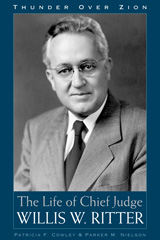
Ritter was clearly ahead of his time, for his opinions on criminal justice, police interrogation, and the rights to counsel have now become accepted standards in jurisprudence. They are, indeed, so universally accepted that few if any viewers of televised police court dramas would even question them. In his personal life he was a man flawed on a grand scale and he lived a life fraught with contradictions. This is his compelling story, compellingly recounted.
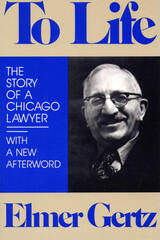
Elmer Gertz has defended famous people—including Henry Miller, Nathan Leopold, and Jack Ruby—and he has become famous in his own right through his struggle for civil liberties and personal rights.
Gertz has taken on a lengthy list of cases and causes over the six decades of his legal career. He fought successfully against the censorship of Henry Miller’s book Tropic of Cancer,which had been banned in Chicago for obscenity. He got Nathan Leopold released from prison after Leopold had served 34 years for his part in the death of 14-year-old Bobby Franks. An ardent foe of the death penalty, Gertz labored for years as part of a national team of lawyers that was finally able to overturn Jack Ruby’s death sentence for the murder of Lee Harvey Oswald. Gertz’s cases have helped make libel law in the nation.
For this edition, Gertz adds an afterword that covers the 15 years since the book’s first publication. Gertz talks of Henry Miller’s last days and his travels to the USSR on behalf of the Refuseniks.

The Trials of Richard Goldstone tells the story of this extraordinary individual and the price he paid for his convictions. It describes how Goldstone, working as a judge in apartheid South Africa, helped to undermine this unjust system and later, at Nelson Mandela’s request, led a commission that investigated cases of racial violence and intimidation. It also considers the international renown he received as the chief United Nations prosecutor for war crimes committed in Rwanda and the former Yugoslavia, the first tribunals to try political and military leaders on charges of genocide. Finally, it explores how Goldstone became a controversial figure in the wake of the Jewish jurist’s powerful, but flawed, investigation of Israel for alleged war crimes in Gaza.
Richard Goldstone’s dramatic life story reveals that even in a world rife with prejudice, nationalism, and contempt for human rights, one courageous man can advance the cause of justice.
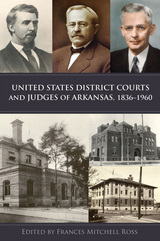
The book begins with statehood and continues with Congress’s decision to expand jurisdiction of the original 1836 District Court of Arkansas to include the vast Indian Territory to the west. The territory’s formidable size and rampant lawlessness brought in an overwhelming number of cases. The situation was only somewhat mitigated in 1851, when Congress split the state into eastern and western districts, which were still served by just one judge who travelled between the two courts.
A new judgeship for the Western District was created in 1871, and new seats for that court were established, but it wasn’t until 1896 that Congress finally ended all jurisdiction of Arkansas’s Western District Court over the Indian Territory.
Contributors to this collection include judges, practicing attorneys, academics, and thoughtful and informed family members who reveal how the judges made decisions on issues involving election laws, taxes, civil rights, railroads, liquor and prohibition, quack medicine, gangsters, bankruptcy, personal injury, the draft and Selective Service, school desegregation, prisons, and more. United States District Courts and Judges of Arkansas, 1836–1960 will be of value to anyone interested in Arkansas history—particularly Arkansas legal and judicial history as it relates to the local and national issues that came before these judges.
This project was supported in part by the United States District Court for the Eastern District of Arkansas and the United States District Court for the Western District of Arkansas.
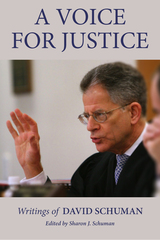
His friends and associates knew that Oregon Supreme Court Justice Hans Linde convinced Schuman to turn to the Oregon Constitution rather than the federal one to protect individual rights. But even some of Schuman’s closest friends were unaware of his fiction, which provides a window into his deep capacity for empathy and casts new light on his ability to write elegant, sometimes funny, judicial opinions. His legal thinking also had deep roots in literature and political theory.
Schuman’s 672 judicial opinions are not just brilliant, but written so that anyone can understand them. Like Ruth Bader Ginsburg, he knew there was nothing to gain by communicating only to specialists. He wanted citizens to be able to make up their own minds about important issues.
A Voice for Justice brings together for the first time writings that span over fifty years. Lawyers and laypeople alike will appreciate Schuman’s lucid, engaging observations, which are highly relevant to our current anxieties about institutional racism and democracy under stress. The short stories, speeches, op-eds, articles, legal opinions, and dissents selected for this volume constitute a call to action for everyone to become voices for justice.
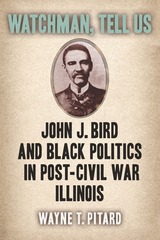
The most influential Black leader in 19th century southern Illinois
This key biography of John J. Bird unveils the forgotten story of a remarkable Black political figure in post-Civil War Illinois. Emerging as a leader in Cairo, the city with Illinois’ second-largest Black community, Bird played a pivotal role in advancing civil rights within the state, also becoming Illinois’ first Black elected judge and first Black trustee of the University of Illinois. Watchman, Tell Us deftly examines Bird’s lifetime of service and advocacy for a vulnerable community and the ways in which he successfully advocated for and protected voting rights, educational opportunity, and public access for the Black residents of southern Illinois.
Bird arrived in Cairo at age twenty during the Civil War to aid the 2,000 Black refugees from the South living there. By 1870, he had established the city’s substantial Black Republican wing, providing the Black community with unprecedented political influence in this hostile, majority white, Democratic town. Under Bird’s leadership, the Black Republicans pressed for policies that improved the well-being of the African American population, including the early establishment of a Black public school, the rise of an integrated judicial system, and the ability to access public and private businesses. Bird became influential across Illinois as a judge and university trustee, a leader in the Black convention movement, and a significant newspaper editor in Cairo and Springfield. When Bird died in 1912, the nation he loved had once again betrayed its Black citizens, and it appeared that most of the achievements he had fought for had collapsed. But the work of Bird and the other civil rights workers of the nineteenth century created the foundation upon which the movements of the twentieth century could stand.
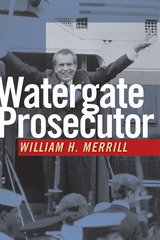
DC. Both of these crimes were eventually traced back to the "plumbers unit," which was directed by John Ehrlichman, President Nixon's top domestic aide. As he convincingly recounts, Merrill sought the job as Assistant Special Prosecutor for one reason: to bring these criminals to justice. In addition, as this revelatory account makes clear, he pursued that goal tenaciously.
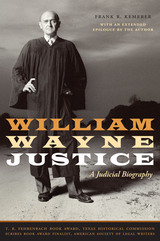
In his forty years on the federal bench in Texas, William Wayne Justice has been a formidable force for change. His rulings have prompted significant institutional reforms in education, prisons, and racial relations, to name only a few areas of society in Texas and beyond that have been affected by Justice's work. For his labors, Judge Justice has received numerous awards, including the Outstanding Federal Trial Judge Award, the Thurgood Marshall Award from the Section on Individual Rights and Responsibilities of the American Bar Association, and the Morris Dees Justice Award from the University of Alabama School of Law.
This paperback reprint of William Wayne Justice chronicles his judicial career and the decisions he reached. It includes a new epilogue that describes Justice's move to Austin as a judge on senior status yet with a full caseload, tracks the long-running institutional reform cases to their conclusion, and examines the legacy of this remarkable and controversial jurist.
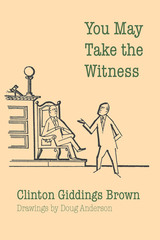
When Clinton Giddings Brown (1882–1964) retired from a long and successful career as a trial lawyer in San Antonio, Texas, fishing on the Gulf Coast was out—by doctor’s orders. So he sat on the front gallery of his house in San Antonio and fished with a lead pencil in the richly stocked memories of his professional life. “Some days I didn’t get a nibble, but some mornings they were biting fine.”
The resultant and delightful catch is the story of a full, merry, and successful life. From the day in 1906 when “Mr. Clint” hung out his shingle in a little office over his father’s bank, through the long succession of “fine scraps, rough and tumble, no holds barred,” which were the jury cases he tried for defendant corporations in personal-injury damage suits, there was not much about the law and about human nature that he did not have the opportunity to learn.
The first client in the little office was Charlie Ross, a Pullman porter who wanted to make sure that the title on his new house was clear. The fee was $15, and Charlie was his friend for life. In the pages that follow the reader will meet many other unforgettable characters, including Dr. John Brinkley, the man who made a million dollars a year from his goat-gland operation until Dr. Morris Fishbein called him a “quack”; old Jim Wheat, who killed a white man, and Jim’s little grandson Lige, who knew what God would do to him if he told lies in court; Bosco, who forgot his complete paralysis when the lady lure came into the picture; and pretty little Mary, whom the jury loved.
Brown was elected district attorney for Bexar County, Texas, in 1913 and became mayor of San Antonio the following year; in the latter office he served two terms, resigning to join the Army in the First World War. On his return from France he was invited to work with a law firm that represented many large corporations, among them the Public Service Company, which ran San Antonio’s streetcar and bus lines, and the Southern Pacific Railroad. Soon made a partner, he remained with the firm until his retirement, and through a quarter of a century tried about as many jury cases as any other attorney in the city.
You May Take the Witness is a book for anyone who has ever felt the fascination of courtrooms and trials, and who has not? It is also a book in which lawyers will find an excellent refresher course for both mind and spirit. Here are invaluable tips on all the ins-and-outs of jury trial, not from the flat dimensions of a law-school text but from the full, real world of actual trials and the men and women involved. Brown tells how to handle witnesses and to pick juries, when to object and when not to object. The most important lesson of all, he says, is to value the jury and be an honest person before them. “The jury is decent, so you be decent, and ‘be yourself.’”
It is clear that Clinton Giddings Brown succeeded as a lawyer because he succeeded as a human being, just as it is clear that he knows how to tell story after fine story because he enjoyed living each episode of his life to its fullest.
READERS
Browse our collection.
PUBLISHERS
See BiblioVault's publisher services.
STUDENT SERVICES
Files for college accessibility offices.
RECENTLY PUBLISHED



UChicago Accessibility Resources
home | accessibility | search | about | contact us
BiblioVault ® 2001 - 2026
The University of Chicago Press