
 A SCHOLARLY BOOK REPOSITORY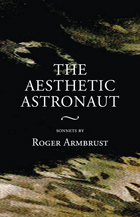
One hundred twenty-two sonnets that touch on contemporary American popular culture, social trends, and personalities. Poet Roger Armbrust is described by some as a mystic, by others as a spiritualist, and by yet others as a guy who toys with really big thoughts, making them objects both of serious study and of humor. His sonnets will push you to laughter and meditation: a satisfying literary ride.
In The Aesthetic Astronaut, Roger Armbrust escorts readers on an insightful journey throughout Earth and beyond. We experience the loneliness and instpiration of "the Aesthetic Astronaut"; cold-blooded calculations of "The Armchair Assassin"; passion and sense of the romantic lover; reflective memories of a gentle heart growing older; ironic vision of an observer to history, and subtle--and sometimes not so subtle--humor of a fellow human involved in our day-to-day challenge of living a worthwhile life. The poet's imagery and attitude. . . may fascinate, thrill, sadden, anger, or push you to laughter or meditation. But you'll find the trip a fascinating literary ride.
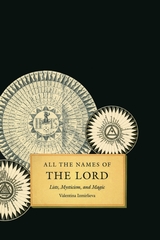
This unexpected juxtaposition of a theological treatise and a magical amulet allows Izmirlieva to reveal lists’ rhetorical potential to create order and to function as both tools of knowledge and of power. Despite the two different visions of order represented by each list, Izmirlieva finds that their uses in Christian practice point to a complementary relationship between the existential need for God’s protection and the metaphysical desire to submit to his infinite majesty—a compelling claim sure to provoke discussion among scholars in many fields.
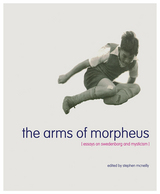
This volume, the fifth in the Journal of the Swedenborg Society series, contains the following seven essays:
• Czeslaw Milosz, “Swedenborg the Mystic”
• Ariel Hessayon, “Jacob Boehme, Swedenborg and Their Readers”
• Gary Lachman, “Swedenborg, Rudolf Steiner and the Hypnagogic State”
• Richard Lines, “The Feminine Mysticism of Madame Guyon”
• Reuben Bell, “Swedenborg and the Kabbalah”
• James Wilson, “Swedenborg and Paracelsus”
• José Antonio Antón-Pacheco, “Ibn ‘Arabi and Swedenborg”
Also included are a preface by Stephen McNeilly, a chronology of Swedenborg, biographies of the subjects of the essays, and an index.
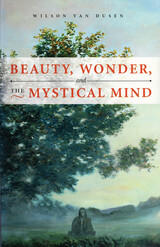
Beauty, Wonder, and the Mystical Mind spreads before the reader a rich word picture of the spiritual realm. Wilson Van Dusen describes the mature mystic, enumerating the characteristics of those whose lives are shaped by the experience of God. He explains how religion fits within the context of culture and how mysticism fits -- or does not -- within the context of religion. He also compares the mystical to the aesthetic, noting the similar ways in which art and epiphany move and elevate the experiencer.
Believing that all have the potential to experience God, Van Dusen opens the mystical realm to the reader with his warm and accessible style. Writing from lifelong personal experience in the spiritual dimension, he offers a singular interpretation of the history of major religions and their regard for mysticism.
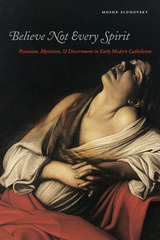
From 1400 through 1700, the number of reports of demonic possessions among European women was extraordinarily high. During the same period, a new type of mysticism—popular with women—emerged that greatly affected the risk of possession and, as a result, the practice of exorcism. Many feared that in moments of rapture, women, who had surrendered their souls to divine love, were not experiencing the work of angels, but rather the ravages of demons in disguise. So how then, asks Moshe Sluhovsky, were practitioners of exorcism to distinguish demonic from divine possessions?
Drawing on unexplored accounts of mystical schools and spiritual techniques, testimonies of the possessed, and exorcism manuals, Believe Not Every Spirit examines how early modern Europeans dealt with this dilemma. The personal experiences of practitioners, Sluhovsky shows, trumped theological knowledge. Worried that this could lead to a rejection of Catholic rituals, the church reshaped the meaning and practices of exorcism, transforming this healing rite into a means of spiritual interrogation. In its efforts to distinguish between good and evil, the church developed important new explanatory frameworks for the relations between body and soul, interiority and exteriority, and the natural and supernatural.
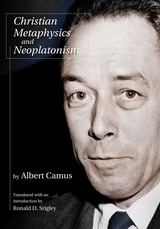
Contemporary scholarship tends to view Albert Camus as a modern, but he himself was conscious of the past and called the transition from Hellenism to Christianity “the true and only turning point in history.” For Camus, modernity was not fully comprehensible without an examination of the aspirations that were first articulated in antiquity and that later received their clearest expression in Christianity. These aspirations amounted to a fundamental reorientation of human life in politics, religion, science, and philosophy.
Understanding the nature and achievement of that reorientation became the central task of Christian Metaphysics and Neoplatonism. Primarily known through its inclusion in a French omnibus edition, ithas remained one of Camus’ least-read works, yet it marks his first attempt to understand the relationship between Greek philosophy and Christianity as he charted the movement from the Gospels through Gnosticism and Plotinus to what he calls Augustine’s “second revelation” of the Christian faith.
Ronald Srigley’s translation of this seminal document helps illuminate these aspects of Camus’ work. His freestanding English edition exposes readers to an important part of Camus’ thought that is often overlooked by those concerned primarily with the book’s literary value and supersedes the extant McBride translation by retaining a greater degree of literalness.
Srigley has fully annotated Christian Metaphysics to include nearly all of Camus’ original citations and has tracked down many poorly identified sources. When Camus cites an ancient primary source, whether in French translation or in the original language, Srigley substitutes a standard English translation in the interest of making his edition accessible to a wider range of readers. His introduction places the text in the context of Camus’ better-known later work, explicating its relationship to those mature writings and exploring how its themes were reworked in subsequent books.
Arguing that Camus was one of the great critics of modernity through his attempt to disentangle the Greeks from the Christians, Srigley clearly demonstrates the place of Christian Metaphysics in Camus’ oeuvre. As the only stand-alone English version of this important work—and a long-overdue critical edition—his fluent translation is an essential benchmark in our understanding of Camus and his place in modern thought.
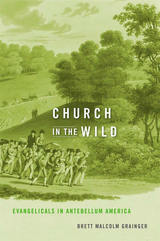
A religious studies scholar argues that in antebellum America, evangelicals, not Transcendentalists, connected ordinary Americans with their spiritual roots in the natural world.
We have long credited Emerson and his fellow Transcendentalists with revolutionizing religious life in America and introducing a new appreciation of nature. Breaking with Protestant orthodoxy, these New Englanders claimed that God could be found not in church but in forest, fields, and streams. Their spiritual nonconformity had thrilling implications but never traveled far beyond their circle. In this essential reconsideration of American faith in the years leading up to the Civil War, Brett Malcolm Grainger argues that it was not the Transcendentalists but the evangelical revivalists who transformed the everyday religious life of Americans and spiritualized the natural environment.
Evangelical Christianity won believers from the rural South to the industrial North: this was the true popular religion of the antebellum years. Revivalists went to the woods not to free themselves from the constraints of Christianity but to renew their ties to God. Evangelical Christianity provided a sense of enchantment for those alienated by a rapidly industrializing world. In forested camp meetings and riverside baptisms, in private contemplation and public water cures, in electrotherapy and mesmerism, American evangelicals communed with nature, God, and one another. A distinctive spirituality emerged pairing personal piety with a mystical relation to nature.
As Church in the Wild reveals, the revivalist attitude toward nature and the material world, which echoed that of Catholicism, spread like wildfire among Christians of all backgrounds during the years leading up to the Civil War.
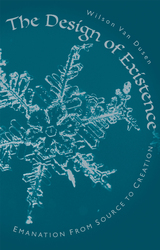
In The Design of Existence, Wilson Van Dusen offers spiritual explorers a guidebook for mystical experience, describing the inner landscape in detail. Though considering himself a scientist, Van Dusen approaches reality as a mystic, using the writings of 18th-century visionary Emanuel Swedenborg as a lens. For Swedenborg and Van Dusen, our interior realm reflects the external cosmos, which makes a mystical sense of oneness possible: "We are in a massive order, far greater than we can see. Yet we are not alien to this order. We are created out of it."
For Van Dusen's mysticism, Swedenborg is the exemplar of universality. A scientist who mastered fields as varied as chemistry, physiology, optics, and metallurgy, Swedenborg turned inward to investigate the psychological and the spiritual. He affirmed the value of other religious cultures and even wrote in gender-inclusive Latin. He had startlingly contemporary insights: he saw that the spiritual must inform everyday experience, that feelings must aid the intellect in seeking the spiritual, that the quest for the soul leads to understanding the cosmos and vice versa.
Van Dusen uses Swedenborg's ideas as the basis for a true universal mysticism. In The Design of Existence, he invites each of us to confront mystical experience as proof that we and the cosmos share a spiritual design, which orders our lives as surely as it orders the universe itself.
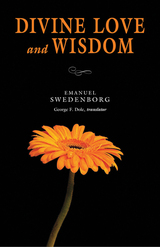
Divine Love and Wisdom has been called the most profound work of the Enlightenment scientist and seer Emanuel Swedenborg. It demonstrates how God’s love, wisdom, and humanity are reflected in creation and in ourselves, and suggests that the act of Creation is not a mystery of the past, but a miracle ongoing in every instant of the present. Like a blueprint of things unseen, Divine Love and Wisdom makes visible the hidden design of the universe, as well as the qualities of its Architect. Its vivid depiction of the spiritual mechanism of the world has impressed thinkers such as William Blake, Samuel Taylor Coleridge, Ralph Waldo Emerson, and Henry James, Sr.
The New Century Edition of the Works of Emanuel Swedenborg is a modern-language, scholarly translation of Swedenborg’s theological works. The series’ easy-to-read style retains the dignity, variety, clarity, and gender-inclusive language of Swedenborg’s original Latin, bringing his thought to life.
This portable edition contains the text of the New Century Edition translation, but not the introduction, annotations, or other supplementary materials found in the deluxe edition.
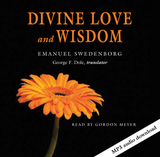
Divine Love and Wisdom has been called the most profound work of the Enlightenment scientist and seer Emanuel Swedenborg. It demonstrates how God’s love, wisdom, and humanity are reflected in creation and in ourselves, and suggests that the act of Creation is not a mystery of the past, but a miracle ongoing in every instant of the present. Like a blueprint of things unseen, Divine Love and Wisdom makes visible the hidden design of the universe, as well as the qualities of its Architect. Its vivid depiction of the spiritual mechanism of the world has impressed thinkers such as William Blake, Samuel Taylor Coleridge, Ralph Waldo Emerson, and Henry James, Sr.
The New Century Edition of the Works of Emanuel Swedenborg is a modern-language, scholarly translation of Swedenborg’s theological works. The series’ easy-to-read style retains the dignity, variety, clarity, and gender-inclusive language of Swedenborg’s original Latin, bringing his thought to life.
This portable edition contains the text of the New Century Edition translation, but not the introduction, annotations, or other supplementary materials found in the deluxe edition.
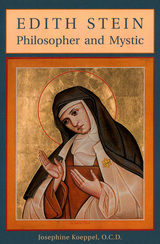
The twentieth anniversary of the beatification of Edith Stein (1891–1942), the accomplished Jewish philosopher who made a spiritual journey from atheism to agnosticism before eventually converting to Catholicism, will be celebrated in 2007. In Edith Stein: Philosopher and Mystic, Josephine Koeppel chronicles the life of this influential saint from her secular youth and entrance into a German monastery to her tragic death at Auschwitz. This accessible work will reward readers of all faiths interested in the life of a remarkable woman who changed the modern conception of sainthood.
“Expecting Teryk is a rich and sumptuous work that speaks to the deeper realities and represents a unique viewpoint of experiences shared by all individuals who choose the path to parenthood.”—Disability, Pregnancy, and Parenthood
The period just prior to the birth of a child is a time of profound personal transformation for expectant parents. Expecting Teryk: An Exceptional Path to Parenthood is an intimate exploration, written in the form of a letter from a parent to her future son, that reclaims a rite of passage that modern society would strip of its magic.
Dawn Prince-Hughes, renowned author of Songs of the Gorilla Nation: My Journey through Autism, considers the ways being autistic might inform her parenting. She also candidly narrates her experience of becoming a parent as part of a lesbian couple—from meeting her partner to the questions they ask about their readiness to become parents and the practical considerations of choosing a sperm donor.
Expecting Teryk is viewed through the lens of autism as Prince-Hughes shares the unique way she sees and experiences the world—as well as her aching will to be fully present for her son. Contemplating the evolutionary traditions of parenting from both animal and human perspectives and the reassurances that nature offers, Expecting Teryk is a work of sensuous wonder that speaks to the deeper realities and archetypal experiences shared by all who embark on the journey of parenthood.

Over the course of his life, Frank Waters amassed a body of work that has few equals in the literature of the American West. Because his was a writing that touched every facet of the Western experience, his voice still echoes throughout that region’s literary world.
Swallow Press is especially proud to present this generous sampling of Frank Waters’s writings. A Frank Waters Reader encompasses the full range of his work and draws from both his nonfiction and his many novels. It stands as a testament to his singular achievement and proof of the talent that established him as the foremost writer in the Southwest.
This collection spanning forty years of writing provides an excellent introduction for the uninitiated as well as a retrospective for those already familiar with this giant talent. His gift for achieving a delicate balance among the many contrary forces at work in the land and the people who inhabit it is as true and enduring as the region that inspired him.
Over the course of his life, Frank Waters amassed a body of work that has few equals in the literature of the American West. Because his was a writing that touched every facet of the Western experience, his voice still echoes throughout that region’s literary world.
Swallow Press is especially proud to present this generous sampling of Frank Waters’s writings. A Frank Waters Reader encompasses the full range of his work and draws from both his nonfiction and his many novels. It stands as a testament to his singular achievement and proof of the talent that established him as the foremost writer in the Southwest.
This collection spanning forty years of writing provides an excellent introduction for the uninitiated as well as a retrospective for those already familiar with this giant talent. His gift for achieving a delicate balance among the many contrary forces at work in the land and the people who inhabit it is as true and enduring as the region that inspired him.
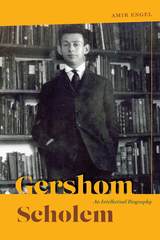
As Engel shows, in his search for the truth of Jewish mysticism Scholem molded the vast literature of Jewish mystical lore into a rich assortment of stories that unveiled new truths about the modern condition. Positioning Scholem’s work and life within early twentieth-century Germany, Palestine, and later the state of Israel, Engel intertwines Scholem’s biography with his historiographical work, which stretches back to the Spanish expulsion of Jews in 1492, through the lives of Rabbi Isaac Luria and Sabbatai Zevi, and up to Hasidism and the dawn of the Zionist movement. Through parallel narratives, Engel touches on a wide array of important topics including immigration, exile, Zionism, World War One, and the creation of the state of Israel, ultimately telling the story of the realizations—and failures—of a dream for a modern Jewish existence.
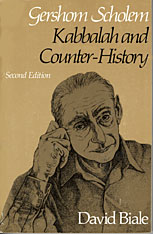
Through a lifetime of passionate scholarship, Gershom Scholem (1897–1982) uncovered the “domains of tradition hidden under the debris of centuries” and made the history of Jewish mysticism and messianism comprehensible and relevant to current Jewish thought.
In this paperback edition of his definitive book on Scholem’s work, David Biale has shortened and rearranged his study for the benefit of the general reader and the student. A new introduction and new passages in the main text highlight the pluralistic character of Jewish theology as seen by Scholem, the place of the Kabbalah in debates over Zionism versus assimilation, and the interpretation of Kafka as a Jewish writer.
Winner of the Global Humanities Translation Prize
Hallaj is the first authoritative translation of the Arabic poetry of Husayn ibn Mansur al-Hallaj, an early Sufi mystic. Despite his execution in Baghdad in 922 and the subsequent suppression of his work, Hallaj left an enduring literary and spiritual legacy that continues to inspire readers around the world. In Hallaj, Carl W. Ernst offers a definitive collection of 117 of Hallaj’s poems expertly translated for contemporary readers interested in Middle Eastern and Sufi poetry and spirituality.
Ernst’s fresh and direct translations reveal Hallaj’s wide range of themes and genres, from courtly love poems to metaphysical reflections on union with God. In a fascinating introduction, Ernst traces Hallaj’s dramatic story within classical Islamic civilization and early Arabic Sufi poetry. Setting himself apart by revealing Sufi secrets to the world, Hallaj was both celebrated and condemned for declaring: “I am the Truth.”
Expressing lyrics and ideas still heard in popular songs, the works of Hallaj remain vital and fresh even a thousand years after their composition. They reveal him as a master of spiritual poetry centuries before Rumi, who regarded Hallaj as a model. This unique collection makes it possible to appreciate the poems on their own, as part of the tragic legend of Hallaj, and as a formidable legacy of Middle Eastern culture.
The Global Humanities Translation Prize is awarded annually to a previously unpublished translation that strikes the delicate balance between scholarly rigor, aesthetic grace, and general readability, as judged by a rotating committee of Northwestern faculty, distinguished international scholars, writers, and public intellectuals. The Prize is organized by the Global Humanities Initiative, which is jointly supported by Northwestern University’s Buffett Institute for Global Studies and Kaplan Institute for the Humanities.
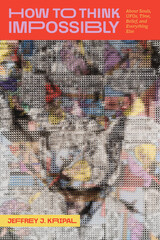
From precognitive dreams and telepathic visions to near-death experiences, UFO encounters, and beyond, so-called impossible phenomena are not supposed to happen. But they do happen—all the time. Jeffrey J. Kripal asserts that the impossible is a function not of reality but of our everchanging assumptions about what is real. How to Think Impossibly invites us to think about these fantastic (yet commonplace) experiences as an essential part of being human, expressive of a deeply shared reality that is neither mental nor material but gives rise to both. Thinking with specific individuals and their extraordinary experiences in vulnerable, open, and often humorous ways, Kripal interweaves humanistic and scientific inquiry to foster an awareness that the fantastic is real, the supernatural is super natural, and the impossible is possible.

The inspiring letters of philosopher, mystic, and freedom fighter Simone Weil to her family, presented for the first time in English.
Now in the pantheon of great thinkers, Simone Weil (1909–1943) lived largely in the shadows, searching for her spiritual home while bearing witness to the violence that devastated Europe twice in her brief lifetime. The letters she wrote to her parents and brother from childhood onward chart her intellectual range as well as her itinerancy and ever-shifting preoccupations, revealing the singular personality at the heart of her brilliant essays.
The first complete collection of Weil’s missives to her family, A Life in Letters offers new insight into her personal relationships and experiences. The letters abound with vivid illustrations of a life marked by wisdom as much as seeking. The daughter of a bourgeois Parisian Jewish family, Weil was a troublemaking idealist who preferred the company of miners and Russian exiles to that of her peers. An extraordinary scholar of history and politics, she ultimately found a home in Christian mysticism. Weil paired teaching with poetry and even dabbled in mathematics, as evidenced by her correspondence with her brother, André, who won the Kyoto Prize in 1994 for the famed Weil Conjectures.
A Life in Letters depicts Simone Weil’s thought taking shape amid political turmoil, as she describes her participation in the Spanish struggle against fascism and in the transatlantic resistance to the Nazis. An introduction and notes by Robert Chenavier contextualize the letters historically and intellectually, relating Weil’s letters to her general body of writing. This book is an ideal entryway into Weil’s philosophical insights, one for both neophytes and acolytes to treasure.

Lives of the Psychics, a journey through the terrain of psychic phenomena, tries to answer these questions through interviews with practicing psychics, a survey of the heroic attempts of researchers to test psychic abilities in controlled experiments, and an exploration of out-of-body, near-death, and mystical experiences. Fred M. Frohock brings together a wide variety of psychic claims and examines them with a rich set of materials—interviews, critical anecdotes, history, multiple theories of the paranormal—that allows him to use whatever tools are necessary to illuminate beliefs in the supernatural. He relates real-life events to scientific studies, so the reader is a party not only to fantastic experiences and first-hand stories of the paranormal but also to the rationales for these experiences proposed by scientists. There is no more rewarding guide to the limits and powers of science in explaining psychic phenomena.
To a field filled with uncertainty and suspicion, Frohock brings a discerning eye, a critical sensibility, and a fundamental sense of curiosity about the role of mysticism in science. Even skeptics will be intrigued.
We experience art with our whole bodies, yet traditional approaches to Persian literature overemphasize the mind—the political, allegorical, or didactic—and ignore the feelings that uniquely characterize aesthetics. Losing Our Minds, Coming to Our Senses rediscovers the sensuality of Persian art across period, genre, and artist. Through readings of such well-known writers as Rumi and lesser-known artists as Hossein Abkenar, the authors demonstrate the significance of sensoria to the rich history of Persian letters.
Though his work was little known outside Italian intellectual circles for most of the twentieth century, anthropologist and historian of religions Ernesto de Martino is now recognized as one of the most original thinkers in the field. This book is testament to de Martino’s innovation and engagement with Hegelian historicism and phenomenology—a work of ethnographic theory way ahead of its time.
This new translation of Sud e Magia, his 1959 study of ceremonial magic and witchcraft in southern Italy, shows how De Martino is not interested in the question of whether magic is rational or irrational but rather in why it came to be perceived as a problem of knowledge in the first place. Setting his exploration within his wider, pathbreaking theorization of ritual, as well as in the context of his politically sensitive analysis of the global south’s historical encounters with Western science, he presents the development of magic and ritual in Enlightenment Naples as a paradigmatic example of the complex dynamics between dominant and subaltern cultures. Far ahead of its time, Magic is still relevant as anthropologists continue to wrestle with modernity’s relationship with magical thinking.
“This book is nothing less than the definitive study of a text long considered central to understanding the Renaissance and its place in Western culture.”
—James Hankins, Harvard University
Pico della Mirandola died in 1494 at the age of thirty-one. During his brief and extraordinary life, he invented Christian Kabbalah in a book that was banned by the Catholic Church after he offered to debate his ideas on religion and philosophy with anyone who challenged him. Today he is best known for a short speech, the Oration on the Dignity of Man, written in 1486 but never delivered. Sometimes called a “Manifesto of the Renaissance,” this text has been regarded as the foundation of humanism and a triumph of secular rationality over medieval mysticism.
Brian Copenhaver upends our understanding of Pico’s masterwork by re-examining this key document of modernity. An eminent historian of philosophy, Copenhaver shows that the Oration is not about human dignity. In fact, Pico never wrote an Oration on the Dignity of Man and never heard of that title. Instead he promoted ascetic mysticism, insisting that Christians need help from Jews to find the path to heaven—a journey whose final stages are magic and Kabbalah. Through a rigorous philological reading of this much-studied text, Copenhaver transforms the history of the idea of dignity and reveals how Pico came to be misunderstood over the course of five centuries. Magic and the Dignity of Man is a seismic shift in the study of one of the most remarkable thinkers of the Renaissance.
Subsequent chapters go on to explore Wilkinson’s early role in publishing the poetry of William Blake; his dealings with Thomas Carlyle and Ralph Waldo Emerson; his lifelong friendship with Henry James, Sr; his association with Daniel Dunglas Home, Thomas Lake Harris, and Andrew Jackson Davis; his homeopathic practice and its influence on James Tyler Kent; and his engagement with such causes as utopian socialism, environmentalism, women’s suffrage, antivivisectionism, and the deregulation of medicine. The book concludes with a broader study of Wilkinson’s interest in mythology, psychology, and Christian spiritualism.
Though the second volume remained in fragments at the time of his death, Michel de Certeau had the foresight to leave his literary executor detailed instructions for its completion, which formed the basis for the present work. Together, both volumes solidify Certeau’s place as a touchstone of twentieth-century literature and philosophy, and continue his exploration of the paradoxes of historiography; the construction of social reality through practice, testimony, and belief; the theorization of speech in angelology and glossolalia; and the interplay of prose and poetry in discourses of the ineffable. This book will be of vital interest to scholars in religious studies, theology, philosophy, history, and literature.
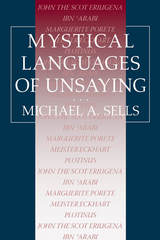
This book includes readings of the most rigorously apophatic texts of Plotinus, John the Scot Eriugena, Ibn Arabi, Marguerite Porete, and Meister Eckhart, with comparative reference to important apophatic writers in the Jewish tradition, such as Abraham Abulafia and Moses de Leon. Sells reveals essential common features in the writings of these authors, despite their
wide-ranging differences in era, tradition, and theology.
By showing how apophasis works as a mode of discourse rather than as a negative theology, this work opens a rich heritage to reevaluation. Sells demonstrates that the more radical claims of apophatic writers—claims that critics have often dismissed as hyperbolic or condemned as pantheistic or nihilistic—are vital to an adequate account of the mystical languages of unsaying. This work also has important implications for the relationship of classical apophasis to contemporary languages of the unsayable. Sells challenges many widely circulated characterizations of apophasis among deconstructionists as well as a number of common notions about medieval thought and gender relations in medieval mysticism.
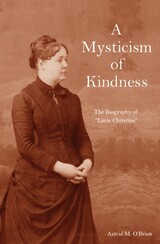
On the surface, Lucie Christine—the pseudonym given to a nineteenth-century Frenchwoman named Mathilde Boutle—was a very ordinary upper-middle-class woman, fulfilling her daily responsibilities to her husband and children. But underneath, Lucie Christine was an extraordinary human being. In A Mysticism of Kindness, Astrid M. O’Brien tells the life story of this remarkable woman, revealing how her experiences as a mystic allowed her to persevere as a wife and mother in the midst of constant verbal and physical abuse from her alcoholic husband. Her story will inspire all those who struggle to find a way to live a strong spiritual life in an often difficult and troubling world.
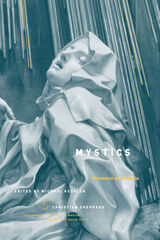
Mystics presents a collection of previously unpublished essays by prominent scholars that consider both the idea of mystics and mysticism. The contributors offer detailed discussions of a variety of mystics from history, including Dionysius the Areopagite, Thomas Aquinas, Joan of Arc, Nicholas of Cusa, Saint Teresa of Avila, Martin Luther, and George Herbert. Essays on mysticism in George Bataille, Maurice Blanchot, and contemporary technology bring the volume into the twenty-first century.
For anyone interested in the state of current thinking about mysticism, this collection will be an essential touchstone.
Contributors:
Thomas A. Carlson, Alexander Golitzin, Kevin Hart, Amy Hollywood, Michael Kessler, Jean-Luc Marion, Bernard McGinn, Françoise Meltzer, Susan Schreiner, Regina M. Schwartz, Christian Sheppard, David Tracy
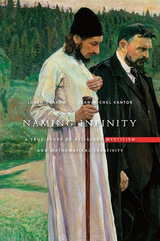
In 1913, Russian imperial marines stormed an Orthodox monastery at Mt. Athos, Greece, to haul off monks engaged in a dangerously heretical practice known as Name Worshipping. Exiled to remote Russian outposts, the monks and their mystical movement went underground. Ultimately, they came across Russian intellectuals who embraced Name Worshipping—and who would achieve one of the biggest mathematical breakthroughs of the twentieth century, going beyond recent French achievements.
Loren Graham and Jean-Michel Kantor take us on an exciting mathematical mystery tour as they unravel a bizarre tale of political struggles, psychological crises, sexual complexities, and ethical dilemmas. At the core of this book is the contest between French and Russian mathematicians who sought new answers to one of the oldest puzzles in math: the nature of infinity. The French school chased rationalist solutions. The Russian mathematicians, notably Dmitri Egorov and Nikolai Luzin—who founded the famous Moscow School of Mathematics—were inspired by mystical insights attained during Name Worshipping. Their religious practice appears to have opened to them visions into the infinite—and led to the founding of descriptive set theory.
The men and women of the leading French and Russian mathematical schools are central characters in this absorbing tale that could not be told until now. Naming Infinity is a poignant human interest story that raises provocative questions about science and religion, intuition and creativity.

What if you were to discover that you were not entirely you, but rather one half of a whole, that you had, in other words, a divine double? In the second and third centuries CE, this idea gripped the religious imagination of the Eastern Mediterranean, providing a distinctive understanding of the self that has survived in various forms throughout the centuries, down to the present. Our Divine Double traces the rise of this ancient idea that each person has a divine counterpart, twin, or alter-ego, and the eventual eclipse of this idea with the rise of Christian conciliar orthodoxy.
Charles Stang marshals an array of ancient sources: from early Christianity, especially texts associated with the apostle Thomas “the twin”; from Manichaeism, a missionary religion based on the teachings of the “apostle of light” that had spread from Mesopotamia to the Mediterranean; and from Neoplatonism, a name given to the renaissance of Platonism associated with the third-century philosopher Plotinus. Each of these traditions offers an understanding of the self as an irreducible unity-in-duality. To encounter one’s divine double is to embark on a path of deification that closes the gap between image and archetype, human and divine.
While the figure of the divine double receded from the history of Christianity with the rise of conciliar orthodoxy, it survives in two important discourses from late antiquity: theodicy, or the problem of evil; and Christology, the exploration of how the Incarnate Christ is both human and divine.
"This is a magnificent book—painstakingly researched and gracefully written. . . . Professor Dimock's book is one of the most rewarding and stimulating studies to appear in recent years."—G. Richard Weldon, Journal of Asian Studies
The essays in this volume make an important contribution to religious studies by proposing that it is misleading to conceive of religious experience in terms of an irreconcilable dichotomy between universality and cultural construction. An esteemed group of contributors, representing the study of Asian and Western religious traditions from a range of disciplinary perspectives, suggests that attention to various forms of divine radiance shows that there is indeed a range of principles that, if not universal, are nevertheless very widely occurring and amenable to fruitful comparative inquiry. What results is a work of enormous scope, demonstrating compelling cross-connections that will be of value to scholars of comparative religions, mysticism, and the relationship between art and the sacred.
Contributors:
* Catherine B. Asher
* Raoul Birnbaum
* Sarah Iles Johnston
* Matthew T. Kapstein
* Andrew Louth
* Paul E. Muller-Ortega
* Elliot R. Wolfson
* Mimi Hall Yiengpruksawan
* Hossein Ziai
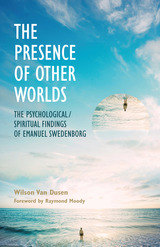
In 1974, Wilson Van Dusen published a groundbreaking study on the findings of Emanuel Swedenborg, a book that has inspired thousands to look more closely into Swedenborg's works and to consider the implications of living a useful and thoughtfully directed life. This updated second edition, published on the thirtieth anniversary of the book's original publication, includes a new introduction to this bestselling work.
An account of the monumental journey of an eighteenth-century scientist and philosopher into the depths of his own mind and to spiritual worlds beyond, The Presence of Other Worlds shows how Swedenborg's personal experiences radiate with insights about psychological and spiritual develpments that are relevant to modern-day seekers. It has been hailed since its first publication as a passport for all spiritual voyagers into the human psyche and the innter sanctum of the afterlife.
Dr. Raymond Moody, author of Life After Life, provides a foreword that explains the importance of Swedenborg's mystical experiences in connection with the near-death experience. Dr. James Lawrence presents a tribute to Wilson Van Dusen and his enduring legacy in an afterword.
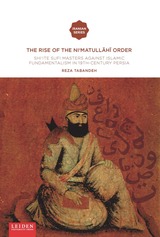
Islamic mysticism experienced a remarkable revival in nineteenth-century fundamentalist Persia. Sparked by the return of the Sufi master Ma‘um Ali Shah from India, the Ni‘matullāhī Order rapidly spread throughout the region amid fierce opposition from Shi‘te clerics. Rise of the Ni‘matullāhī Order charts the movement’s unlikely rise across three generations of Sufi masters. Reza Tabandeh demonstrates how Ma‘um Ali Shah, Majdhub Ali Shah, and Mast Ali Shah sustained the revival by reinterpreting classical Sufi teachings for a Shi‘ite context.
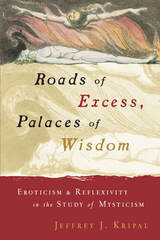
In his new book, Kripal addresses the twentieth-century study of mysticism as a kind of mystical tradition in its own right, with its own unique histories, discourses, sociological dynamics, and rhetorics of secrecy. Fluidly combining autobiography and biography with scholarly exploration, Kripal takes us on a tour of comparative mystical thought by examining the lives and works of five major historians of mysticism—Evelyn Underhill, Louis Massignon, R. C. Zaehner, Agehananda Bharati, and Elliot Wolfson—as well as relating his own mystical experiences. The result, Kripal finds, is seven "palaces of wisdom": the religious power of excess, the necessity of distance in the study of mysticism, the relationship between the mystical and art, the dilemmas of male subjectivity and modern heterosexuality, a call for ethical criticism, the paradox of the insider-outsider problem in the study of religion, and the magical power of texts and their interpretation.
An original and penetrating analysis of modern scholarship and scholars of mysticism, Roads of Excess, Palaces of Wisdom is also a persuasive demonstration of the way this scholarly activity is itself a mystical phenomenon.
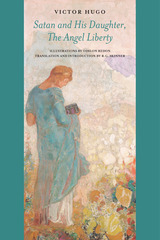
Satan and his Daughter, the Angel Liberty, drawn from this larger poem, tells the story of Satan and his daughter, the angel created by God from a feather left behind following his banishment. Hugo details Satan’s fall, and through a despairing soliloquy, reveals him intent on revenge, yet desiring God’s forgiveness. The angel Liberty, meanwhile, is presented by Hugo as the embodiment of good, working to convince her father to return to Heaven.
This new translation by Richard Skinner presents Hugo’s verse in a unique prose approach to the poet’s poignant work, and is accompanied by the Symbolist artist Odilon Redon’s haunting illustrations. No adventurous reader will want to miss this beautiful mingling of the epic and familial, religious and political.
What is particular to these thinkers, Hollywood reveals, is their attention to forms of mysticism associated with women. They regard mystics such as Angela of Foligno, Hadewijch, and Teresa of Avila not as emotionally excessive or escapist, but as unique in their ability to think outside of the restrictive oppositions that continue to afflict our understanding of subjectivity, the body, and sexual difference. Mystics such as these, like their twentieth-century descendants, bridge the gaps between action and contemplation, emotion and reason, and body and soul, offering new ways of thinking about language and the limits of representation.
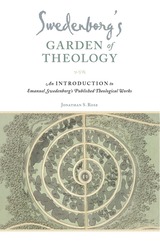
When he entered the visionary phase of his life, Swedish theologian Emanuel Swedenborg (1688-1772) set out on a journey to document all that he had seen, heard, and learned while in contact with the spirits of heaven and hell. Before his death, he wrote eighteen different works published in twenty-five volumes, totaling about three and a half million words.
Navigating that rich garden of thought has been a challenge even for scholars of Swedenborg, let alone those new to his work. In this compact guide, Jonathan S. Rose introduces readers to the basic concepts of Swedenborg’s thought, including Swedenborg’s view of God and the afterlife and his description of humanity’s spiritual history. Rose also examines how Swedenborg’s theology relates to other Christian denominations, both in his time and ours, and takes a side trip into some of Swedenborg’s more unusual ideas.
Swedenborg’s Garden of Theology provides an ideal introduction for anyone seeking a starting point to delve into Swedenborg’s religious thought.
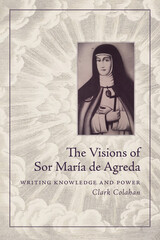
Clark Colahan now offers the first major study of Sor María's writings, including translations of two previously unpublished works: Face of the Earth and Map of the Spheres and the first half of her Report to Father Manero, in which she reflects on her bilocation.
READERS
Browse our collection.
PUBLISHERS
See BiblioVault's publisher services.
STUDENT SERVICES
Files for college accessibility offices.
RECENTLY PUBLISHED





UChicago Accessibility Resources
home | accessibility | search | about | contact us
BiblioVault ® 2001 - 2024
The University of Chicago Press