
 A SCHOLARLY BOOK REPOSITORY
So begins Lawrence Lessig's sweeping indictment of contemporary American institutions and the corruption that besets them. We can all see it—from the selling of Congress to special interests to the corporate capture of the academy. Something is wrong. It’s getting worse.
And it’s our fault. What Lessig shows, brilliantly and persuasively, is that we can’t blame the problems of contemporary American life on bad people, as our discourse all too often tends to do. Rather, he explains, “We have allowed core institutions of America’s economic, social, and political life to become corrupted. Not by evil souls, but by good souls. Not through crime, but through compromise.” Every one of us, every day, making the modest compromises that seem necessary to keep moving along, is contributing to the rot at the core of American civic life. Through case studies of Congress, finance, the academy, the media, and the law, Lessig shows how institutions are drawn away from higher purposes and toward money, power, quick rewards—the first steps to corruption.
Lessig knows that a charge so broad should not be levied lightly, and that our instinct will be to resist it. So he brings copious, damning detail gleaned from years of research, building a case that is all but incontrovertible: America is on the wrong path. If we don’t acknowledge our own part in that, and act now to change it, we will hand our children a less perfect union than we were given. It will be a long struggle. This book represents the first steps.
When Deng Xiaoping launched China on the path to economic reform in the late 1970s, he vowed to build “socialism with Chinese characteristics.” More than three decades later, China’s efforts to modernize have yielded something very different from the working people’s paradise Deng envisioned: an incipient kleptocracy, characterized by endemic corruption, soaring income inequality, and growing social tensions. China’s Crony Capitalism traces the origins of China’s present-day troubles to the series of incomplete reforms from the post-Tiananmen era that decentralized the control of public property without clarifying its ownership.
Beginning in the 1990s, changes in the control and ownership rights of state-owned assets allowed well-connected government officials and businessmen to amass huge fortunes through the systematic looting of state-owned property—in particular land, natural resources, and assets in state-run enterprises. Mustering compelling evidence from over two hundred corruption cases involving government and law enforcement officials, private businessmen, and organized crime members, Minxin Pei shows how collusion among elites has spawned an illicit market for power inside the party-state, in which bribes and official appointments are surreptitiously but routinely traded. This system of crony capitalism has created a legacy of criminality and entrenched privilege that will make any movement toward democracy difficult and disorderly.
Rejecting conventional platitudes about the resilience of Chinese Communist Party rule, Pei gathers unambiguous evidence that beneath China’s facade of ever-expanding prosperity and power lies a Leninist state in an advanced stage of decay.

The Clinton scandal consumed the better part of a year of American public life, bitterly dividing the nation and culminating in a constitutional crisis. In this book, thoughtful, nonpartisan essays provide an insightful and lasting analysis of one of the major political events of our time.
Here leading scholars explore the long-reaching constitutional and political implications of the scandal: how it will affect the presidency, the law, and the political process. A first group of chapters considers effects of the scandal on institutions: the presidency, Congress, the courts, the independent counsel statute, executive privilege, and the impeachment process itself. A second section addresses political factors: public opinion, the media, and presidential character and personality. A concluding essay broadly examines the implications of the scandal for governance.
These far-reaching essays address such issues as risks posed to Congressional political careers, the prospect of future presidents being subject to civil suits, the pros and cons of Kenneth Starr's investigation, the role of the media in breaking and then shaping the story, and ways of reforming the system to handle the unacceptable private behavior of future presidents.
A provocative book for readers concerned with how our government copes with such a challenge, and an essential reader for courses on the presidency or American government, this collection will stand the tests of both time and rigorous analysis.
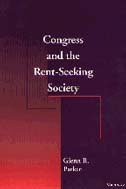
Skillfully blending historical data with microeconomic theory, Glenn Parker argues that the incentives for congressional service have declined over the years, and that with that decline has come a change in the kind of person who seeks to enter Congress. The decline in the attractiveness of Congress is a consequence of congressional careerists and of the growth in the rent-seeking society, a term which describes the efforts of special interests to obtain preferential treatment by using the machinery of government--legislation and regulations.
Parker provides a fresh and controversial perspective to the debate surrounding the relative merits of career or amateur politicians. He argues that driving career politicians from office can have pernicious effects on the political system: it places the running of Congress in the hands of amateur politicians, who stand to lose little if they are found engaging in illegal or quasi-legal practices. On the other hand, career legislators risk all they have invested in their long careers in public service if they engage in unsavory practices. As Parker develops this controversial argument, he provides a fresh perspective on the debate surrounding the value of career versus amateur politicians.
Little attention has been given to the long-term impact of a rent-seeking society on the evolution of political institutions. Parker examines empirically and finds support for hypotheses that reflect potential symptoms of adverse selection in the composition of Congress: (1) rent-seeking politicians are more inclined than others to manipulate institutional arrangements for financial gain; (2) the rent-seeking milieu of legislators are more likely to engage in rent-seeking activity than earlier generations; (3) and the growth of rent-seeking activity has hastened the departure of career legislators.
Glenn R. Parker is Distinguished Research Professor, Florida State University.
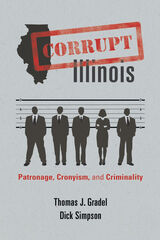
In Corrupt Illinois, veteran political observers Thomas J. Gradel and Dick Simpson take aim at business-as-usual. Naming names, the authors lead readers through a gallery of rogues and rotten apples to illustrate how generations of chicanery have undermined faith in, and hope for, honest government. From there, they lay out how to implement institutional reforms that provide accountability and eradicate the favoritism, sweetheart deals, and conflicts of interest corroding our civic life.
Corrupt Illinois lays out a blueprint to transform our politics from a pay-to-play–driven marketplace into what it should be: an instrument of public good.
Corruption has blurred, and in some cases blinded, the vision of democracy in many Latin American nations. Weakened institutions and policies have facilitated the rise of corrupt leadership, election fraud, bribery, and clientelism. Corruption and Democracy in Latin America presents a groundbreaking national and regional study that provides policy analysis and prescription through a wide-ranging methodological, empirical, and theoretical survey.
The contributors offer analysis of key topics, including: factors that differentiate Latin American corruption from that of other regions; the relationship of public policy to corruption in regional perspective; patterns and types of corruption; public opinion and its impact; and corruption's critical links to democracy and governance.
Additional chapters present case studies on specific instances of corruption: diverted funds from a social program in Peru; Chilean citizens' attitudes toward corruption; the effects of interparty competition on vote buying in local Brazilian elections; and the determinants of state-level corruption in Mexico under Vicente Fox.
The volume concludes with a comparison of the lessons drawn from these essays to the evolution of anticorruption policy in Latin America over the past two decades. It also applies these lessons to the broader study of corruption globally to provide a framework for future research in this crucial area.
Contributors to this volume address the measurement and consequences of fraud and corruption and the forces that ultimately led to their decline within the United States. They show that various approaches to reducing corruption have met with success, such as deregulation, particularly “free banking,” in the 1830s. In the 1930s, corruption was kept in check when new federal bureaucracies replaced local administrations in doling out relief. Another deterrent to corruption was the independent press, which kept a watchful eye over government and business. These and other facets of American history analyzed in this volume make it indispensable as background for anyone interested in corruption today.

Taking a more grounded, empirical and holistic perspective, this text reveals how corruption operates through informal rules, personal connections and the wider social contexts that govern everyday practices. It looks at corruption in transitional societies such as post-Soviet Russia, and also explores efforts to reform or regulate institutions that are perceived to have a potential for corruption, such as the European Commission. The book also covers the Enron and WorldCom scandals.
This book contrasts experiences of mainland China and Hong Kong to explore the pressing question of how governments can transform a culture of widespread corruption to one of clean government. Melanie Manion examines Hong Kong as the best example of the possibility of reform. Within a few years it achieved a spectacularly successful conversion to clean government. Mainland China illustrates the difficulty of reform. Despite more than two decades of anticorruption reform, corruption in China continues to spread essentially unabated.
The book argues that where corruption is already commonplace, the context in which officials and ordinary citizens make choices to transact corruptly (or not) is crucially different from that in which corrupt practices are uncommon. A central feature of this difference is the role of beliefs about the prevalence of corruption and the reliability of government as an enforcer of rules ostensibly constraining official venality. Anticorruption reform in a setting of widespread corruption is a problem not only of reducing corrupt payoffs, but also of changing broadly shared expectations of venality. The book explores differences in institutional design choices about anticorruption agencies, appropriate incentive structures, and underlying constitutional designs that contribute to the disparate outcomes in Hong Kong and mainland China.
When Louis XVI presented Benjamin Franklin with a snuff box encrusted with diamonds and inset with the King’s portrait, the gift troubled Americans: it threatened to “corrupt” Franklin by clouding his judgment or altering his attitude toward the French in subtle psychological ways. This broad understanding of political corruption—rooted in ideals of civic virtue—was a driving force at the Constitutional Convention.
For two centuries the framers’ ideas about corruption flourished in the courts, even in the absence of clear rules governing voters, civil officers, and elected officials. Should a law that was passed by a state legislature be overturned because half of its members were bribed? What kinds of lobbying activity were corrupt, and what kinds were legal? When does an implicit promise count as bribery? In the 1970s the U.S. Supreme Court began to narrow the definition of corruption, and the meaning has since changed dramatically. No case makes that clearer than Citizens United.
In 2010, one of the most consequential Court decisions in American political history gave wealthy corporations the right to spend unlimited money to influence elections. Justice Anthony Kennedy's majority opinion treated corruption as nothing more than explicit bribery, a narrow conception later echoed by Chief Justice Roberts in deciding McCutcheon v. FEC in 2014. With unlimited spending transforming American politics for the worse, warns Zephyr Teachout, Citizens United and McCutcheon were not just bad law but bad history. If the American experiment in self-government is to have a future, then we must revive the traditional meaning of corruption and embrace an old ideal.
While Fidel Castro maintained his longtime grip on Cuba, revolutionary scholars and policy analysts turned their attention from how Castro succeeded (and failed), to how Castro himself would be succeeded—by a new government. Among the many questions to be answered was how the new government would deal with the corruption that has become endemic in Cuba. Even though combating corruption cannot be the central aim of post-Castro policy, Sergio Díaz-Briquets and Jorge Pérez-López suggest that, without a strong plan to thwart it, corruption will undermine the new economy, erode support for the new government, and encourage organized crime. In short, unless measures are taken to stem corruption, the new Cuba could be as messy as the old Cuba.
Fidel Castro did not bring corruption to Cuba; he merely institutionalized it. Official corruption has crippled Cuba since the colonial period, but Castro's state-run monopolies, cronyism, and lack of accountability have made Cuba one of the world's most corrupt states. The former communist countries in Eastern Europe were also extremely corrupt, and analyses of their transitional periods suggest that those who have taken measures to control corruption have had more successful transitions, regardless of whether the leadership tilted toward socialism or democracy. To that end, Díaz-Briquets and Pérez-López, both Cuban Americans, do not advocate any particular system for Cuba's next government, but instead prescribe uniquely Cuban policies to minimize corruption whatever direction the country takes after Castro. As their work makes clear, averting corruption may be the most critical obstacle in creating a healthy new Cuba.
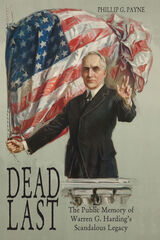
If George Washington and Abraham Lincoln are the saints in America’s civil religion, then the twenty-ninth president, Warren G. Harding, is our sinner. Prior to the Nixon administration, the Harding scandals were the most infamous of the twentieth century. Harding is consistently judged a failure, ranking dead last among his peers.
By examining the public memory of Harding, Phillip G. Payne offers the first significant reinterpretation of his presidency in a generation. Rather than repeating the old stories, Payne examines the contexts and continued meaning of the Harding scandals for various constituencies. Payne explores such topics as Harding’s importance as a midwestern small-town booster, his rumored black ancestry, the role of various biographers in shaping his early image, the tension between public memory and academic history, and, finally, his status as an icon of presidential failure in contemporary political debates. Harding was a popular president and was widely mourned when he died in office in 1923; but with his death began the construction of his public memory and his fall from political grace.
In Dead Last, Payne explores how Harding’s name became synonymous with corruption, cronyism, and incompetence and how it is used to this day as an example of what a president should not be.
In 1987, the city of Chicago hired a former radical college chaplain to clean up rampant corruption on the waterfront. R. J. Nelson thought he was used to the darker side of the law—he had been followed by federal agents and wiretapped due to his antiwar stances in the sixties—but nothing could prepare him for the wretched bog that constituted the world of a Harbor Boss. Dirty Waters is the wry, no-holds-barred memoir of Nelson’s time controlling some of the city’s most beautiful spots while facing some of its ugliest traditions. Nelson takes us through Chicago's beloved “blue spaces” and deep into the city’s political morass, revealing the different moralities underlining three mayoral administrations and navigating the gritty mechanisms of the city’s political machine. Ultimately, Dirty Waters is a tale of morality, of what it takes to be a force for good in the world and what struggles come from trying to stay ethically afloat in a sea of corruption.

What are states, and how are they made? Scholars of European history assert that war makes states, just as states make war. This study finds that in China, the challenges of governing produced a trajectory of state-building in which the processes of moral regulation and social control were at least as central to state-making as the exercise of coercive power.
State-making is, in China as elsewhere, a profoundly normative and normalizing process. This study maps the complex processes of state-making, moral regulation, and social control during three critical reform periods: the Yongzheng reign (1723-1735), the Guomindang's Nanjing decade (1927-1937), and the Communist Party's Socialist Education Campaign (1962-1966). During each period, central authorities introduced—not without resistance—institutional change designed to extend the reach of central control over local political life. The successes and failures of state-building in each case rested largely upon the ability of each regime to construct itself as an autonomous moral agent both separate from and embedded in an imagined political community. Thornton offers a historical reading of the state-making process as a contest between central and local regimes of bureaucratic and discursive practice.

While pursuing a race for district prosecutor in the 1970s, Glasgow had run afoul of the local political machine. The machine later decided to teach Glasgow a lesson even though he’d lost the race. Down and Dirty Down South is Glasgow’s story of how he attempted to clear his name and also track down the people who had set him up for charges of smuggling illegal drugs into the United States.
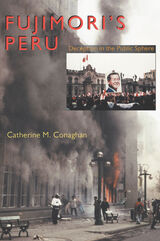
Alberto Fujimori ascended to the presidency of Peru in 1990, boldly promising to remake the country. Ten years later, he hastily sent his resignation from exile in Japan, leaving behind a trail of lies, deceit, and corruption. While piecing together the shards of Fujimori’s presidency, prosecutors uncovered a vast criminal conspiracy fueled by political ambition and personal greed.
The Fujimori regime managed to maintain a facade of democracy while systematically eviscerating democratic institutions and the rule of law through legal subterfuge, intimidation, and outright bribery. The architect of this strategy was Fujimori’s notorious intelligence advisor, Vladimiro Montesinos. With great skill, Fujimori and Montesinos created the appearance of a democratic public sphere but ensured it would work only to suit their personal motives. The press was allowed to operate, but information exchange was under strict control. The more government officials tampered with the free flow of ideas, the more they inadvertently exposed the ills they were trying to cover up. And that proved to be their downfall.
Merging penetrating analysis and a journalist’s flair for narrative, Catherine Conaghan reveals the thin line between democracy and dictatorship, and shows how public institutions can both empower dictators and bring them down.
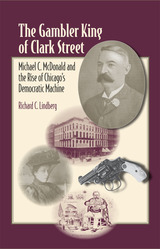
The Gambler King of Clark Street tells the story of a larger-than-life figure who fused Chicago’s criminal underworld with the city’s political and commercial spheres to create an urban machine built on graft, bribery, and intimidation. Lindberg vividly paints the life of the Democratic kingmaker against the wider backdrop of nineteenth-century Chicago crime and politics.
McDonald has long been cited in the published work of city historians, members of academia, and the press as the principal architect of a unified criminal enterprise that reached into the corridors of power in Chicago, Cook County, the state of Illinois, and ultimately the Oval Office. The Gambler King of Clark Street is both a major addition to Chicago’s historical literature and a revealing biography of a powerful and troubled man.
Illinois State Historical Society Scholarly Award, Certificate of Excellence, 2009
Society of Midland Authors Biography Award, 2009
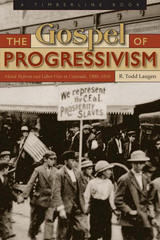
Sharing enemies like the party boss and corporate lobbyist who undermined honest and responsive government, Progressive leaders were determined to root out selfish political action with public exposure. Labor unions defied bosses and rallied for government protection of workers. Women's clubs appealed to other women as mothers, calling for social welfare, economic justice, and government responsiveness. Protestant church congregations formed a core of support for moral reform. Labor relations experts struggled to prevent the outbreak of violence through mediation between corporate employers and organized labor. Persevering through World War I, Colorado reformers faced their greatest challenge in the 1920s, when leaders of the Ku Klux Klan drew upon the rhetoric of Protestant Progressives and manipulated reform tools to strengthen their own political machine. Once in power, Klan legislators turned on Progressive leaders in the state government.
A story of promising alliances never fully realized, zealous crusaders who resisted compromise, and reforms with unexpected consequences, The Gospel of Progressivism will appeal to those interested in Progressive Era reform, Colorado history, labor relations, and women's activism.
Government of the Shadows analyses the concept of clandestine government. It explores how covert political activity and transnational organised crime are linked -- and how they ultimately work to the advantage of state and corporate power.
The book shows that legitimate government is now routinely accompanied by extra-governmental covert operations. Using a variety of case studies, from the mafia in Italy to programmes for food and reconstruction in Iraq, the contributors illustrate that para-political structures are not 'deviant', but central to the operation of global governments.
The creation of this truly parallel world-economy, the source of huge political and economic potential, entices states to undertake new forms of regulation, either through their own intelligence agencies, or through the more shadowy world of criminal cartels.
In many countries, public sector institutions impose heavy burdens on economic life: heavy and arbitrary taxes retard investment, regulations enrich corrupt bureaucrats, state firms consume national wealth, and the most talented people turn to rent-seeking rather than productive activities. As a consequence of such predatory policies--described in this book as the grabbing hand of the state--entrepreneurship lingers and economies stagnate.
The authors of this collection of essays describe many of these pathologies of a grabbing hand government, and examine their consequences for growth. The essays share a common viewpoint that political control of economic life is central to the many government failures that we observe. Fortunately, a correct diagnosis suggests the cures, including the best strategies of fighting corruption, privatization of state firms, and institutional building in the former socialist economies. Depoliticization of economic life emerges as the crucial theme of the appropriate reforms. The book describes the experiences with the grabbing hand government and its reform in medieval Europe, developing countries, transition economies, as well as today's United States.
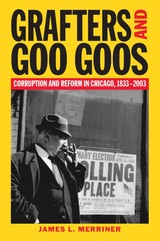
Chicago’s reputation for corruption is the basis of local and national folklore and humor. Grafters and Goo Goos: Corruption and Reform in Chicago, 1833–2003 unfolds the city’s notorious history of corruption and the countervailing reform struggles that largely failed to clean it up. More than a regional history of crime in politics, this wide-ranging account of governmental malfeasances traces ongoing public corruption and reform to its nineteenth-century democratic roots. Former Chicago journalist James L. Merriner reveals the battles between corrupt politicos and ardent reformers to be expressions of conflicting class, ethnic, and religious values.
From Chicago’s earliest years in the 1830s, the city welcomed dollar-chasing businessmen and politicians, swiftly followed by reformers who strived to clean up the attendant corruption. Reformers in Chicago were called “goo goos,” a derisive epithet short for “good-government types.” Grafters and Goo Goos contends a certain synergy defined the relationship between corruption and reform. Politicians and reformers often behaved similarly, their separate ambitions merging into a conjoined politics of interdependency wherein the line between heroes and villains grew increasingly faint. The real story, asserts Merriner, has less to do with right against wrong than it does with the ways the cultural backgrounds of politicians and reformers steered their own agendas, animating and defining each other by their opposition.
Drawing on original and archival research, Merriner identifies constants in the struggle between corruption and reform amid a welter of changing social circumstances and customs—decades of alternating war and peace, hardships and prosperity. Three areas of reform and resistance are identified: structural reform of the political system to promote honesty and efficiency, social reform to provide justice to the lower classes, and moral reform to combat vice. “In the matter of corruption and reform, the constants might be stronger than the variables,” writes Merriner in the Preface. “The players, rules, and scorekeepers change, but not the essential game.”
Complemented by eighteen illustrations, Grafters and Goo Goos is rife with shocking and amusing anecdotes and peppered with the personalities of famous muckrakers, bootleggers, mayors, and mobsters. While other studies have profiled infamous Chicago corruption cases and figures such as Al Capone and Richard J. Daley, this is the first to provide an overview appropriate for historians and general readers alike. In examining Chicago’s notorious saga of corruption and reform against a backdrop of social history, Merriner calls attention to our constant problems of both civic and national corruption and contributes to larger discussions about the American experiment of democratic self-government.
David Whyte brings together a wide range of leading commentators and campaigners, offering a series of troubling answers. Unflinchingly facing the corruption in British public life, they show that it is no longer tenable to assume that corruption is something that happens elsewhere; corrupt practices are revealed across a wide range of venerated institutions, from local government to big business. These powerful, punchy essays aim to shine a light on the corruption fundamentally embedded in UK politics, police, and finance.
--William S. Laufer, Professor, The Wharton School of Business
"This delightful and serious book involves a matter I have long felt of first importance. That is our tendency to make social truth and acceptance conform to personal or larger corporate interests. On this I have written , but gladly yield to this persuasive parallel. No one concerned with literate, informed, and relevant---as distinct from self-serving---truth should miss It's Legal but It Ain't Right."
--John Kenneth Galbraith
"This absorbing and well-written book of essays on the harmful consequences of legal industries skillfully illuminates the ways in which some corporate harms fail to be transformed into criminal law-making and enforcement, and offers cogent suggestions for better regulation in the public interest."
--Dr. Michael Levi, Professor of Criminology, Cardiff University
Many U.S. corporations and the goods they produce negatively impact our society without breaking any laws. We are all too familiar with the tobacco industry's effect on public health and health care costs for smokers and nonsmokers, as well as the role of profit in the pharmaceutical industry's research priorities. It's Legal but It Ain't Right tackles these issues, plus the ethical ambiguities of legalized gambling, the firearms trade, the fast food industry, the pesticide industry, private security companies, and more. Aiming to identify industries and goods that undermine our societal values and to hold them accountable for their actions, this collection makes a valuable contribution to the ongoing discussion of ethics in our time.
This accessible exploration of corporate legitimacy and crime will be important reading for advocates, journalists, students, and anyone interested in the dichotomy between law and legitimacy.
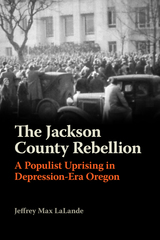
The Jackson County Rebellion explores a dramatic if little-known populist insurgency in the American West. Author Jeff LaLande takes a deep dive into a tumultuous uprising that captured national attention as it played out in rural Oregon. First tracing its roots back to the area’s tradition of protest, including the Ku Klux Klan of the 1920s, he focuses on Jackson County’s politics of upheaval during the worst days of the Great Depression. The broad strokes of the episode may be familiar to contemporary readers: Demagogues fanning rage — relentlessly accusing an elite of corruption and conspiracy. The strife-torn episode featured nativist and anti-Semitic elements.
The local press played a key role in the events. Two inflammatory newspapers, one owned by wealthy orchardist Llewellyn Banks and the other by politician Earl Fehl, became the vehicles by which these men won the loyalty of rural and working-class residents. Partners in demagoguery, Banks and Fehl created a movement — dubbed the “Good Government Congress” that very nearly took over county government through direct action, ballot theft, and threats of violence. Among those opposing the two men was Harvard-educated Robert Ruhl, owner/editor of the Medford Mail-Tribune, who faced off against Banks and Fehl. Despite boycotts and threats of sabotage. Ruhl ran a resolute editorial campaign against the populist threat in his Mail-Tribune, which won a Pulitzer Prize for its reporting on the uprising.
The rebellion blazed hotly but not for long. Its end was marked by the arrest of its leaders after the fiercely contested 1932 election and by Banks’s murder of the police officer sent to arrest him. Placing the Jackson County Rebellion squarely within America’s long tradition of populist uprisings against the perceived sins of an allegedly corrupt, affluent local elite, LaLande argues that this little-remembered episode is part of a long history of violent conflict in the West that continues today.
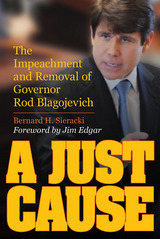
During the predawn hours of December 9, 2008, an FBI team swarmed the home of Illinois governor Rod Blagojevich and took him away in handcuffs. The shocking arrest, based on allegations of corruption and extortion, launched a chain of political events never before seen in Illinois. In A Just Cause, Bernard H. Sieracki delivers a dynamic firsthand account of this eight-week political crisis, beginning with Blagojevich’s arrest, continuing through his impeachment and trial, and culminating in his conviction and removal from office. Drawing on his own eyewitness observations of the hearings and trial, the comments of interviewees, trial transcripts, and knowledge gained from decades of work with the Illinois legislature, Sieracki tells the compelling story of the first impeachment and removal from office of an Illinois governor, while providing a close look at the people involved.
A Just Cause depicts Blagojevich as a master of political gamesmanship, a circus ringmaster driven by personal ambition and obsessed with private gain. Sieracki examines in depth the governor’s unethical behavior while in office, detailing a litany of partisan and personal hostilities that spanned years. He thoroughly covers the events leading to Blagojevich’s downfall and the reactions of the governor’s cohorts. The author discusses the numerous allegations against Blagojevich, including attempts to “sell” appointments, jobs, and contracts in exchange for financial contributions. Sieracki then exhaustively recounts Blagojevich’s senate trial and the governor’s removal from office.
This engrossing volume is both a richly detailed case study of the American checks-and-balances system and an eyewitness account of unprecedented events. It will appeal to anyone interested in the stunning, true tale of a state upholding the maxim “The welfare of the people is the supreme law.”
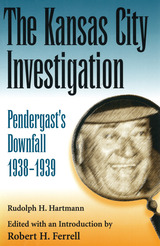
The long reign of Kansas City political boss Thomas J. Pendergast came to an end in 1939, after an investigation led by Special Agent Rudolph Hartmann of the U.S. Department of the Treasury resulted in Pendergast's conviction for income tax evasion. In 1942, Hartmann's account was submitted to Secretary of the Treasury Henry Morgenthau, Jr., in whose papers it remained for the past fifty-six years unbeknownst to historians. While researching the relations between Pendergast and Franklin D. Roosevelt, Robert H. Ferrell came across Hartmann's landmark report—the only firsthand account of the investigation that brought down the greatest political machine of its time, possibly one of the greatest in all of American history.
Reading like a "whodunit," The Kansas City Investigation traces Pendergast's political career from its beginnings to its end. As one of America's major city bosses, Pendergast was at the height of his influence in 1935-1936 when his power reached not merely to every ward and precinct in Kansas City but also to the statehouse in Jefferson City and Capitol Hill in Washington, D.C. It was during this time that the boss took a massive bribe—$315,000—from 137 national fire insurance companies operating within Missouri, opening him to attack by his enemies.
Early in 1938, an official in the Washington headquarters of the Bureau of Internal Revenue, a former Missourian, quit his job to accept private employment, but not without first tipping off a reporter from the Kansas City Star about Pendergast's bribe. The reporter immediately phoned Lloyd C. Stark, the governor of Missouri and a known enemy of Pendergast. Stark then went to Washington to inform President Roosevelt. Although the president had been a supporter of Pendergast, he now considered Stark a more important political ally. Roosevelt asked the Treasury Department to investigate Pendergast's income taxes. The intelligence unit of the Treasury Department put Hartmann, its best operative, on the case. Within a year, after the most minute of inquiries into checkbooks, serial numbers on currency, a safe-deposit box, and a telegraphed transfer of $10,000, Hartmann and his agents found enough evidence to convict Boss Tom.
More than a simple account of what the Roosevelt administration did to cause the collapse of the Pendergast machine, The Kansas City Investigation takes the reader through the ups and downs, twists and turns, of this intriguing investigation, all from an insider's perspective. More important, Hartmann's report provides historians and readers alike the opportunity to evaluate the machine era in American political history—an era that, according to the investigation, "proved the old axiom that `truth is stranger than fiction.'"
Inthis original study,Luc Duhamel examines the KGB at its pinnacle of power. The appointment of former KGB director Yuri Andropov as general secretary of the Communist Party in 1982 marked the height of KGB influence. For the first time since Stalin, Beria, and the NKVD, there was now an unquestioned authority to pursue violators of Soviet law, including members of the Communist Party. Duhamel focuses on the KGB’s investigation into Moscow’s two largest trade organizations: the Chief Administration of Trade and the Administration of the Moscow Fruit and Vegetable Office. Like many of their Soviet counterparts, these state-controlled institutions were built on a foundation of bribery and favoritism among Communist Party members, workers, and their bosses. This book analyzes the multifarious networks of influence peddling, appointments, and clientelism that pervaded these trade organizations and maintained their ties to party officials.
Through firsthand research into the archives of the Andropov-era KGB and the prosecutor general’s office, Duhamel uncovers the indictment of thousands of trade organization employees, the reprimand of Communist Party members, and the radical change in political ideology manifested by these proceedings. He further reveals that despite aggressive prosecutions, the KGB’s power would soon wither, as the agency came under intense scrutiny because of its violent methods and the ghosts of the NKVD. The reinstatement of Moscow city government control over the trade organizations, the death of Andropov, and the rising tide of democratic reform would effectively end the reign of the KGB and its anticorruption campaigns.

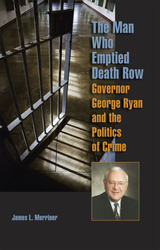
George H. Ryan, Illinois governor from 1999 to 2003, became nationally known for two significant and very different reasons. The first governor in the United States to clear out his state’s death row and put a moratorium on the death penalty, he was also convicted and sent to prison on corruption charges. The Man Who Emptied Death Row: Governor George Ryan and the Politics of Crime details the career of a man who both enhanced and tarnished the image of the highest office in Illinois and examines the political history and culture that shaped him.
Author James L. Merriner explores the two very different stories of George Ryan: the brave crusader against the death penalty and the petty crook. An extensive analysis of the official record, exclusive interviews, and previously undisclosed incidents in Ryan’s career expose why the governor pardoned or commuted the sentences of all 171 prisoners on Illinois’s death row before leaving office and how he later was convicted of eighteen counts of official corruption.
This biography traces Ryan’s family history and the Illinois political climate that influenced his development as a politician. Although Ryan championed “good-government” initiatives—organ donations, tougher drunken-driving and lobbyist disclosure laws—he never overcame a reputation as a wheeler-dealer, notes Merriner.
Merriner goes beyond Ryan’s life and career to explore the politics of crime, highlighting the successes and failures of the criminal justice system and suggesting how both white-collar fraud and violent crime shape politics. A fascinating story that reveals much about the way Illinois politics works, The Man Who Emptied Death Row will help determine how history will judge Illinois governor George Ryan.
Surveys reveal that a majority of Americans believe government is run for special interests, not public interest. The increased presence and power of lobbyists in Washington and the excesses of PAC and campaign contributions, in-kind benefits, and other favors would seem to indicate a government of weak public servants corrupted by big private-interest groups.
But as Fred McChesney shows, this perspective affords only a partial understanding of why private interests are paying, and what they are paying for. Consider, for example, Citicorp, the nation's largest banking company, whose registered lobbyists spend most of their time blocking legislation that could hurt any one of the company's credit-card, loan, or financial-service operations. What this scenario suggests, the author argues, is that payments to politicians are often made not for political favors, but to avoid political disfavor, that is, as part of a system of political extortion or "rent extraction."
The basic notion of rent extraction is simple: because the state can legally take wealth from its citizens, politicians can extort from private parties payments not to expropriate private wealth. In that sense, rent (that is, wealth) extraction is "money for nothing"--money paid in exchange for politicians' inaction. After constructing this model of wealth extraction, McChesney tests it with many examples, including several involving routine proposals of tax legislation, followed by withdrawal for a price. He also shows how the model applies more generally to regulation. Finally, he examines how binding contracts are written between private interests and politicians not to extract wealth.
This book, standing squarely at the intersection of law, political science, and economics, vividly illustrates the patterns of legal extortion underlying the current fabric of interest-group politics.

From 1902, when it latched onto such mass circulation magazines as Collier's and McClure's, until it merged into the Progressive movement in 1912, muckraking relentlessly pricked the nation's social conscience by exposing the abuses of industry and politics. Ranging in tone from the scholarly to the sensational, muckraking articles attacked food adulteration, unscrupulous insurance practices, fraudulent claims for patent medicines, and links between government and vice. When muckrakers raised their voices against child labor, graft, monopoly, unsafe mill conditions, and the white slave trade of poor immigrant girls, they found a receptive audience. "I aimed at the public's heart," wrote Upton Sinclair about The Jungle, "and by accident I hit it in the stomach."
Gathering the most significant pieces published during the heyday of the muckraking movement, The Muckrakers brings vividly to life this unique era of exposure and self-examination. For each article, Arthur and Lila Weinberg provide concise commentary on the background of its subject and the specific and long-range repercussions of its publication. The volume features the work of both journalists and fiction writers, including Ida Tarbell, Lincoln Steffens, Upton Sinclair, Ray Stannard Baker, Samuel Hopkins Adams, Thomas W. Lawson, Charles Edward Russell, and Mark Sullivan.
Eloquent and uncompromising, the muckrakers shocked America from a state of lethargy into Progressive reform. This generous volume vividly captures the urgency of their quest.

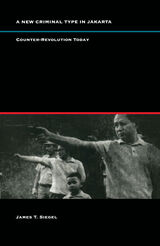
Examining the links between the concept of criminality and scandal, rumor, fear, and the state, Siegel analyzes daily life in Jakarta through the seemingly disparate but strongly connected elements of family life, gossip, and sensationalist journalism. He offers close analysis of the preoccupation with crime in Pos Kota (a newspaper directed toward the lower classes) and the middle-class magazine Tempo. Because criminal activity has been a sensationalized preoccupation in Jakarta’s news venues and among its people, criminality, according to Siegel, has pervaded the identities of its ordinary citizens. Siegel examines how and why the government, fearing revolution and in an attempt to assert power, has made criminality itself a disturbing rationalization for the spectacular massacre of the people it calls criminals—many of whom were never accused of particular crimes. A New Criminal Type in Jakarta reveals that Indonesians—once united by Sukarno’s revolutionary proclamations in the name of “the people”—are now, lacking any other unifying element, united through their identification with the criminal and through a “nationalization of death” that has emerged with Suharto’s strong counter-revolutionary measures.
A provocative introduction to contemporary Indonesia, this book will engage those interested in Southeast Asian studies, anthropology, history, political science, postcolonial studies, public culture, and cultural studies generally.
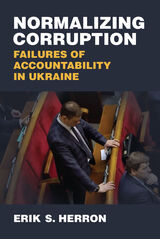
Normalizing Corruption addresses several interconnected questions: Under what circumstances do incumbents lose elections? How well do party organizations encourage cohesive behavior? Is executive authority responsive to inquiries from public organizations and other government institutions? How can citizens influence government actions? Do civil servants conduct their duties as impartial professionals, or are they beholden to other interests? The research builds upon extensive fieldwork, data collection, and data analysis that Erik S. Herron has conducted since 1999.

In 1754, Charles de Raymond, chevalier of the Royal and Military Order of Saint Louis and a captain in the Troupes de la Marine wrote a bold, candid, and revealing expose; on the French colonial posts and settlements of New France. On the Eve of the Conquest, more than an annotated translation, includes a discussion on the historical background of the start of the French and Indian War, as well as a concise biography of Raymond and Michel Le Courtois de Surlaville, the army colonel at the French court to whom the report was sent. The events surrounding Raymond's controversial year as commandant of the post (now Fort Wayne, Indiana) in 1749-50, his disputed recall by Governor General Jacques-Pierre de Taffanel de La Jonquier, and the subsequent friction between La Jonquiere's successor, Ange de Menneville Duqesne, and Raymond are presented in detail and illustrated by translations of their correspondence.
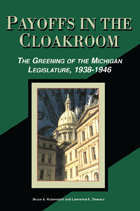
Payoffs in the Cloakroom is a spellbinding follow-up to Rubenstein and Ziewacz's critically acclaimed Three Bullets Sealed His Lips. Three Bullets brought to life new evidence on the 1945 murder of Michigan Senator Warren Hooper. Payoffs in the Cloakroom takes up where Three Bullets left off, unraveling a complex web of political corruption and dirty state politics. In the process, the authors demonstrate that Senator Hooper was murdered to prevent his grand jury testimony against republican boss Frank McKay, who was facing bribery charges.
Making use of actual court proceeding, personal interviews, and newspaper accounts, and even a re-evaluation of police evidence, Rubenstein and Ziewacz tell a story that contains all the ingredients of first-class detective fiction—only in this instance, the story is based on fact. With chapter titles such as "Charlie and His Little Black Book," "I Never Dreamed Murder," and "Them Bones, Them Bones," the authors have, once again, provided a stimulating and absorbing account of one of the darker chapters of Michigan's political history.
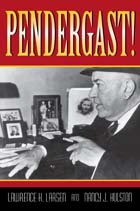
Born in St. Joseph, Missouri, in 1872, Tom Pendergast moved to Kansas City around 1890 to work for his brother James, founder of the Pendergast "Goat" faction in Kansas City Democratic politics. In 1911, Pendergast became head of the Goats, and over the next fifteen years he created a powerful political machine that used illegal voting and criminal enforcers to gain power. Following a change in the city charter in 1925, Pendergast took control of Kansas City and ran it as his own personal business. In the 1930s, he received over $30 million annually from gambling, prostitution, and narcotics, putting him in the big leagues of American civic corruption. He also wielded great power in the National Democratic Party and started Harry S. Truman on the road to the presidency.
In this well-balanced biography, the authors examine Pendergast's rise to power, his successes as a political leader, his compassion for the destitute, and his reputation for keeping his word. They also examine Pendergast's character development and how his methods became more and more ruthless. Pendergast had no use for ideology in his "invisible government"—only votes counted.
In 1937 and 1938 the federal government broke the back of Pendergast's machine, convicting 259 of his campaign aides for vote fraud. In 1939 Pendergast, who was believed to be the largest bettor on horse racing in the United States, was jailed for income tax evasion, and he died in disgrace in 1945.
An insightful and comprehensive biography, Pendergast! will surely serve for years to come as the most thorough investigation of the life and infamous career of Tom Pendergast.
He examines the costs of corruption, both financial and nonpecuniary, and considers the opportunity cost that corruption imposes. Mandel explores the nature and development of Philadelphia’s unique culture of corruption, emphasizing how machine politics and self-dealing are entwined with city history, creating a culture that allows corruption to thrive. In addition, he provides practical, achievable policies and actions that can produce positive change in Philadelphia and elsewhere.
Mandel seeks to provide insight into how our collective actions or inattention give consent to the corruption, as well as its roots and effects, and the reasons for its persistence. Philadelphia, Corrupt and Consenting is a critique, but above all, it is a call to action.
Situating her in-depth studies of Chicago and San Jose in the broad context of data drawn from more than 240 cities over the course of a century, she finds that the answer—a resounding yes—illuminates the nature of political power. Both political machines and reform governments, she reveals, bias the system in favor of incumbents, effectively establishing monopolies that free governing coalitions from dependence on the support of their broader communities. Ironically, Trounstine goes on to show, the resulting loss of democratic responsiveness eventually mobilizes residents to vote monopolistic regimes out of office. Envisioning an alternative future for American cities, Trounstine concludes by suggesting solutions designed to free urban politics from this damaging cycle.
The Qing dynasty office purchase system (juanna), which allowed individuals to pay for appointments in the government, was regarded in traditional Chinese historiography as an inherently corrupt and anti-meritocratic practice. It enabled participants to become civil and military officials while avoiding the competitive government-run examination systems.
Lawrence Zhang’s groundbreaking study of a broad selection of new archival and other printed evidence—including a list of over 10,900 purchasers of offices from 1798 and narratives of purchase—contradicts this widely held assessment and investigates how observers and critics of the system, past and present, have informed this questionable negative view. The author argues that, rather than seeing office purchase as a last resort for those who failed to obtain official appointments via other means, it was a preferred method for wealthy and well-connected individuals to leverage their social capital to the fullest extent. Office purchase was thus not only a useful device that raised funds for the state, but also a political tool that, through literal investments in their positions and their potential to secure status and power, tied the interests of official elites ever more closely to those of the state.
The Qing dynasty office purchase system (juanna), which allowed individuals to pay for appointments in the government, was regarded in traditional Chinese historiography as an inherently corrupt and anti-meritocratic practice. It enabled participants to become civil and military officials while avoiding the competitive government-run examination systems.
Lawrence Zhang’s groundbreaking study of a broad selection of new archival and other printed evidence—including a list of over 10,900 purchasers of offices from 1798 and narratives of purchase—contradicts this widely held assessment and investigates how observers and critics of the system, past and present, have informed this questionable negative view. The author argues that, rather than seeing office purchase as a last resort for those who failed to obtain official appointments via other means, it was a preferred method for wealthy and well-connected individuals to leverage their social capital to the fullest extent. Office purchase was thus not only a useful device that raised funds for the state, but also a political tool that, through literal investments in their positions and their potential to secure status and power, tied the interests of official elites ever more closely to those of the state.
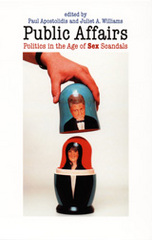
The essays in Public Affairs reflect on a number of sex scandals while emphasizing the Clinton/Lewinsky affair, certainly the most avidly followed and momentous sex scandal in American political history. Leading scholars situate contemporary public affairs in the context not only of earlier sex scandals in American politics (such as Thomas Jefferson’s and Sally Hemings’s affair), but also of more purely political scandals (including Teapot Dome and Watergate) and sex scandals centered around public figures other than politicians (such as the actor Hugh Grant and the minister Jimmy Swaggart). Some essays consider the Clinton affair in light of feminist and anti-racist politics, while others discuss the dynamics of scandals as major media events. By charting a critical path through the muck of scandal rather than around it, Public Affairs illuminates why sex scandals have become such a prominent feature of American public life.
Contributors. Paul Apostolidis, Jodi Dean, Joshua Gamson, Theodore J. Lowi, Joshua D. Rothman, George Shulman, Anna Marie Smith, Jeremy Varon, Juliet A. Williams
"Anechiarico and Jacobs . . . have pushed aside the claims and posturing by officials and reformers and revealed a critical need to reevaluate just what we have and are doing to public servants, and to the public, in the name of anti-corruption."—Citylaw
"A timely and very useful addition to the new debate over corruption and reform."—Michael Johnston, American Political Science Review

Gupta conducted ethnographic research among officials charged with coordinating development programs in rural Uttar Pradesh. Drawing on that research, he offers insightful analyses of corruption; the significance of writing and written records; and governmentality, or the expansion of bureaucracies. Those analyses underlie his argument that care is arbitrary in its consequences, and that arbitrariness is systematically produced by the very mechanisms that are meant to ameliorate social suffering. What must be explained is not only why government programs aimed at providing nutrition, employment, housing, healthcare, and education to poor people do not succeed in their objectives, but also why, when they do succeed, they do so unevenly and erratically.
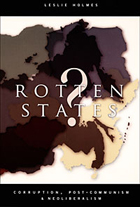
Drawing on data including surveys commissioned especially for this study, Holmes examines the causes and consequences of official corruption as well as ways of combating it. He focuses particular attention on the timing of the recent increase in reports of corruption, the relationship between post-communism and corruption, and the interplay between corruption and the delegitimation and weakening of the state. Holmes argues that the global turn toward neoliberalism—with its focus on ends over means, flexibility, and a reduced role for the state—has generated much of the corruption in post-communist states. At the same time, he points out that neoliberalism is perhaps the single most powerful tool for overcoming the communist legacy, which is an even more significant cause of corruption. Among the conclusions that Holmes draws is that a strong democratic state is needed in the early stages of the transition from communism in order to prevent corruption from taking hold.
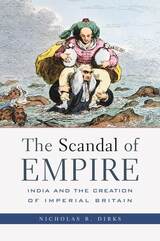
Many have told of the East India Company’s extraordinary excesses in eighteenth-century India, of the plunder that made its directors fabulously wealthy and able to buy British land and titles, but this is only a fraction of the story. When one of these men—Warren Hastings—was put on trial by Edmund Burke, it brought the Company’s exploits to the attention of the public. Through the trial and after, the British government transformed public understanding of the Company’s corrupt actions by creating an image of a vulnerable India that needed British assistance. Intrusive behavior was recast as a civilizing mission. In this fascinating, and devastating, account of the scandal that laid the foundation of the British Empire, Nicholas Dirks explains how this substitution of imperial authority for Company rule helped erase the dirty origins of empire and justify the British presence in India.
The Scandal of Empire reveals that the conquests and exploitations of the East India Company were critical to England’s development in the eighteenth century and beyond. We see how mercantile trade was inextricably linked with imperial venture and scandalous excess and how these three things provided the ideological basis for far-flung British expansion. In this powerfully written and trenchant critique, Dirks shows how the empire projected its own scandalous behavior onto India itself. By returning to the moment when the scandal of empire became acceptable we gain a new understanding of the modern culture of the colonizer and the colonized and the manifold implications for Britain, India, and the world.
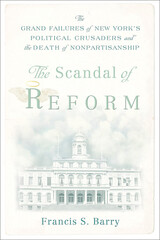
The Scandal of Reform pulls the curtain back on New York's reformers past and present, revealing the bonds they have always shared with the bosses they disdain, the policy failures they still refuse to recognize, and the transition they have made from nonpartisan outsiders to ideological insiders.
Francis S. Barry examines the evolution of political reform from the frontlines of New York City's recent reform wars. He offers an insider's account and analysis of the controversial 2003 referendum debate on nonpartisan elections, and he challenges reformersùand members of both partiesùto reconsider their faith in reforms that are no longer serving the public interest.
*Winner of the European Award for Investigative And Judicial Journalism 2021*
*Winner of the Premio Alessandro Leogrande Award for Investigative Journalism 2022*
*Winner of the Premio Angelo Vassallo Award 2022*
'I want to live in a society where secret power is accountable to the law and to public opinion for its atrocities, where it is the war criminals who go to jail, not those who have the conscience and courage to expose them.'
It is 2008, and Stefania Maurizi, an investigative journalist with a growing interest in cryptography, starts looking into the little-known organisation WikiLeaks. Through hushed meetings, encrypted files and explosive documents, what she discovers sets her on a life-long journey that takes her deep into the realm of secret power.
Working closely with WikiLeaks' founder Julian Assange and his organisation for her newspaper, Maurizi has spent over a decade investigating state criminality protected by thick layers of secrecy, while also embarking on a solitary trench warfare to unearth the facts underpinning the cruel persecution of Assange and WikiLeaks.
With complex and disturbing insights, Maurizi’s tireless journalism exposes atrocities, the shameful treatment of Chelsea Manning and Edward Snowden, on up to the present persecution of WikiLeaks: a terrifying web of impunity and cover-ups.
At the heart of the book is the brutality of secret power and the unbearable price paid by Julian Assange, WikiLeaks and truthtellers.
In this searing personal narrative, the former state senator recounts his fight to expose and reform these acts of government misconduct. Not afraid to cite specific cases of soft corruption in New Jersey politics, he paints a vivid portrait of public servants who care more about political power and personal gain than the public good. By recounting events that he witnessed firsthand in the Garden State, he provides dramatic illustrations of ills that afflict American politics nationwide.
As he identifies five main forms of soft corruption, Schluter diagnoses the state government’s ethical malaise, and offers concrete policy suggestions for how it might be cured. Not simply a dive through the muck of New Jersey politics, Soft Corruption is an important first step to reforming our nation’s political system, a book that will inspire readers to demand that our elected officials can and must do better.
Visit: www.softcorruption.com (http://www.softcorruption.com)
Despite growing attention to crimes by those in positions of trust, however, violations in business and similar wrongdoing in government are still often treated as fundamentally separate problems. In State-Corporate Crime, Raymond J. Michalowski and Ronald C. Kramer bring together fifteen essays to show that those in positions of political and economic power frequently operate in collaboration, and are often all too willing to sacrifice the well-being of the many for the private profit and political advantage of the few.
Drawing on case studies including the explosion of the space shuttle Challenger, Ford Explorer rollovers, the crash of Valujet flight 592, nuclear weapons production, and war profiteering, the essays bear frank witness to those who have suffered, those who have died, and those who have contributed to the greatest human and environmental devastations of our time. This book is a much needed reminder that the most serious threats to public health, security, and safety are not those petty crimes that appear nightly on local news broadcasts, but rather are those that result from corruption among the wealthiest and most powerful members of society.
The Truman Scandals and the Politics of Morality is a thoroughly researched effort offering an excellent historical narrative of the scandals and accusations of scandal that bedeviled Harry Truman throughout his political career. The book is particularly significant in light of the connections the author establishes between Truman's early political experiences and his subsequent difficulties as president.
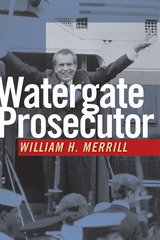
DC. Both of these crimes were eventually traced back to the "plumbers unit," which was directed by John Ehrlichman, President Nixon's top domestic aide. As he convincingly recounts, Merrill sought the job as Assistant Special Prosecutor for one reason: to bring these criminals to justice. In addition, as this revelatory account makes clear, he pursued that goal tenaciously.
READERS
Browse our collection.
PUBLISHERS
See BiblioVault's publisher services.
STUDENT SERVICES
Files for college accessibility offices.
RECENTLY PUBLISHED



UChicago Accessibility Resources
home | accessibility | search | about | contact us
BiblioVault ® 2001 - 2024
The University of Chicago Press