
 A SCHOLARLY BOOK REPOSITORY
12 start with C start with C
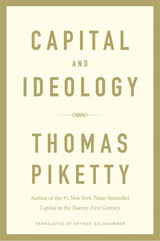
A New York Times Bestseller
An NPR Best Book of the Year
The epic successor to one of the most important books of the century: at once a retelling of global history, a scathing critique of contemporary politics, and a bold proposal for a new and fairer economic system.
Thomas Piketty’s bestselling Capital in the Twenty-First Century galvanized global debate about inequality. In this audacious follow-up, Piketty challenges us to revolutionize how we think about politics, ideology, and history. He exposes the ideas that have sustained inequality for the past millennium, reveals why the shallow politics of right and left are failing us today, and outlines the structure of a fairer economic system.
Our economy, Piketty observes, is not a natural fact. Markets, profits, and capital are all historical constructs that depend on choices. Piketty explores the material and ideological interactions of conflicting social groups that have given us slavery, serfdom, colonialism, communism, and hypercapitalism, shaping the lives of billions. He concludes that the great driver of human progress over the centuries has been the struggle for equality and education and not, as often argued, the assertion of property rights or the pursuit of stability. The new era of extreme inequality that has derailed that progress since the 1980s, he shows, is partly a reaction against communism, but it is also the fruit of ignorance, intellectual specialization, and our drift toward the dead-end politics of identity.
Once we understand this, we can begin to envision a more balanced approach to economics and politics. Piketty argues for a new “participatory” socialism, a system founded on an ideology of equality, social property, education, and the sharing of knowledge and power. Capital and Ideology is destined to be one of the indispensable books of our time, a work that will not only help us understand the world, but that will change it.
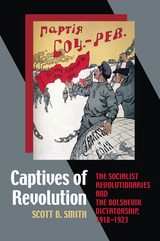
The Socialist Revolutionaries (SRs) were the largest political party in Russia in the crucial revolutionary year of 1917. Heirs to the legacy of the People’s Will movement, the SRs were unabashed proponents of peasant rebellion and revolutionary terror, emphasizing the socialist transformation of the countryside and a democratic system of government as their political goals. They offered a compelling, but still socialist, alternative to the Bolsheviks, yet by the early 1920s their party was shattered and its members were branded as enemies of the revolution. In 1922, the SR leaders became the first fellow socialists to be condemned by the Bolsheviks as “counter-revolutionaries” in the prototypical Soviet show trial.
In Captives of the Revolution, Scott B. Smith presents both a convincing account of the defeat of the SRs and a deeper analysis of the significance of the political dynamics of the Civil War for subsequent Soviet history. Once the SRs decided to openly fight the Bolsheviks in 1918, they faced a series of nearly impossible political dilemmas. At the same time, the Bolsheviks fatally undermined the revolutionary credentials of the SRs by successfully appropriating the rhetoric of class struggle, painting a simplistic picture of Reds versus Whites in the Civil War, a rhetorical dominance that they converted into victory over the SRs and any left-wing alternative to Bolshevik dictatorship. In this narrative, the SRs became a bona fide threat to national security and enemies of the people—a characterization that proved so successful that it became an archetype to be used repeatedly by the Soviet leadership against any political opponents, even those from within the Bolshevik party itself.
In this groundbreaking study, Smith reveals a more complex and nuanced picture of the postrevolutionary struggle for power in Russia than we have ever seen before and demonstrates that the Civil War—and in particular the struggle with the SRs—was the formative experience of the Bolshevik party and the Soviet state.
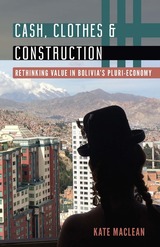
A groundbreaking feminist perspective on Movimiento al Socialismo (MAS) rule in Bolivia and the country’s radical transformation under Evo Morales
The presidency of Evo Morales in Bolivia (2006–2019) has produced considerable academic scholarship, much of it focused on indigenous social movements or extractivism, and often triumphalist about the successes of Morales’s Movimiento al Socialismo (MAS). Turning a new lens on the movement, Cash, Clothes, and Construction presents the first gender-based analysis of “pluri-economy,” a central pillar of Bolivia’s program under Morales, evaluating the potential of this vision of “an economy where all economies fit” to embrace feminist critiques of capitalism and economic diversity.
Based on more than twelve years of empirical research exploring the remarkable transformations in Bolivia since 2006, this book focuses on three sectors—finance, clothing, and construction—in which indigenous women have defied gendered expectations. Kate Maclean presents detailed case studies of women selling secondhand high street clothes from the United States in the vast, peri-urban markets of Bolivian cities; Aymaran designers of new pollera (traditional Andean dress) fashions, one of whom exhibited her collection in New York City; and the powerful and rich chola paceña, whose real estate investments have transformed the cultural maps of La Paz and El Alto.
Cash, Clothes, and Construction offers a gendered analysis of the mission of MAS to dismantle neoliberalism and decolonize politics and economy from the perspective of the Indigenous women who have radically transformed Bolivia’s economy from the ground up.

Confronting Leviathan describes Mozambique’s attempt to construct a socialist society in one African country on the back of an anti-colonial struggle for national independence. In explaining the failure of this effort the authors suggest reasons why the socialist vision of the ruling party, Frelimo, lacked resonance with Mozambican society. They also document in detail South Africa’s attempts to destabilize the country, even to the extent of sponsoring the Renamo insurgents. The dynamics of that insurgency and its roots in Mozambican society are examined as well as the process of negotiation that brought it to a close. Finally the authors analyze the more recent attempt to construct a liberal capitalist society in Mozambique. From their findings it appears that this may prove no easier than the construction of socialism.
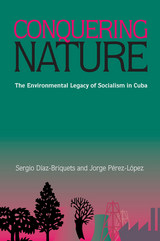
Conquering Nature provides the only book-length analysis of the environmental situation in Cuba after four decades of socialist rule, based on extensive examination of secondary sources, informed by the study of development and environmental trends in former socialist countries as well as in the developing world. It approaches the issue comprehensively and from interdisciplinary, comparative, and historical perspectives. Based on the Cuban example, Díaz-Briquets and Pérez-López challenge the concept that environmental disruption was not supposed to occur under socialism since it was alleged that guided by scientific policies, socialism could only beget environmentally benign economic development. In reality, the socialist environmental record proved to be far different from the utopian view.
Between the early 1960s and the late 1980s the environmental situation worsened despite Cuba’s achieving one of the lowest population growth rates in the world and having eliminated extreme living standard differentials in rural areas, two of the primary reasons often blamed for environmental deterioration in developing countries. The government’s approach was to “conquer nature” and under its central planning approach, it did not take local circumstances into consideration. This disregard for the environmental consequences of development projects continues to this day despite official allegations to the contrary—as the country pursues an economic survival strategy based on the crash development of the tourist sector and exploitation of natural resources. An underlying conclusion of the book is that the environmental legacy of socialism will present serious challenges to future Cuban generations.
Conquering Nature provides, for the first time, a relevant analysis of socialist environmental policies of a developing country. It will be of interest to students and scholars of Cuba and those interested in environmental issues in developing countries.

The collection begins with an historical overview of socialism in Western Europe and moves toward the suggestion of a framework for a post-socialist discourse. Among the topics covered are: the birth and death of communism and a regime type in Eastern Europe; how different forms of national communism were smothered by Sovietization in the postwar period; the origins of revolutions in Eastern Europe; the potential for social democracy in Hungary; the role of the Left in a reunified German; and directions for the Left in general.
Contributors. Geoff Eley, Konrad Jarausch, Herbert Kitschelt, Christiane Lemke, Andrei Markovits, Gary Marks, Wolfgang Merkel, Norman Naimark, Iván and Szonja Szelénya, Sharon Wolchik

Critical Theories of the State is a clear and accessible survey of radical perspectives on the modern state. By focusing on Marxist theory and its variations, particularly as applied to advanced industrial societies and contemporary welfare states, Clyde W. Barrow provides a more extensive and thorough treatment than is available in any other work.
Barrow divides the methodological assumptions and key hypotheses of Marxist, Neo-Marxist, and Post-Marxist theories into five distinct approaches: instrumentalist, structuralist, derivationist, systems-analytic, and organizational realist. He categorizes the many theorists discussed in the book, including such thinkers as Elmer Altvater, G. William Domhoff, Fred Block, Claus Offe, and Theda Skocpol according to their concepts of the state’s relationship to capital and their methodological approach to the state. Based on this survey, Barrow elaborates a compelling typology of radical state theories that identifies with remarkable clarity crucial points of overlap and divergence among the various theories.
Scholars conducting research within the rubric of state theory, political development, and policy history will find Critical Theories of the State an immensely valuable review of the literature. Moreover, Barrow’s work will make an excellent textbook for undergraduate and graduate courses in political science and sociology, and can also be used by those teaching theory courses in international relations, history, and political economy.

Limited to neither a single discipline nor a particular intellectual figure, this book comprehensively views British cultural Marxism in terms of the dialogue between historians and the originators of cultural studies and in its relationship to the new left and feminist movements. From the contributions of Eric Hobsbawm, Christopher Hill, Rodney Hilton, Sheila Rowbotham, Catherine Hall, and E. P. Thompson to those of Perry Anderson, Barbara Taylor, Raymond Williams, Dick Hebdige, and Stuart Hall, Dworkin examines the debates over issues of culture and society, structure and agency, experience and ideology, and theory and practice. The rise, demise, and reorganization of journals such as The Reasoner, The New Reasoner, Universities and Left Review, New Left Review, Past and Present, are also part of the history told in this volume. In every instance, the focus of Dworkin’s attention is the intellectual work seen in its political context. Cultural Marxism in Postwar Britain captures the excitement and commitment that more than one generation of historians, literary critics, art historians, philosophers, and cultural theorists have felt about an unorthodox and critical tradition of Marxist theory.
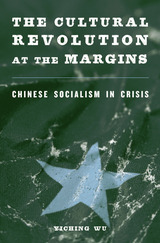
Mao Zedong envisioned a great struggle to "wreak havoc under the heaven" when he launched the Cultural Revolution in 1966. But as radicalized Chinese youth rose up against Party officials, events quickly slipped from the government's grasp, and rebellion took on a life of its own. Turmoil became a reality in a way the Great Leader had not foreseen. The Cultural Revolution at the Margins recaptures these formative moments from the perspective of the disenfranchised and disobedient rebels Mao unleashed and later betrayed.
The Cultural Revolution began as a "revolution from above," and Mao had only a tenuous relationship with the Red Guard students and workers who responded to his call. Yet it was these young rebels at the grassroots who advanced the Cultural Revolution's more radical possibilities, Yiching Wu argues, and who not only acted for themselves but also transgressed Maoism by critically reflecting on broader issues concerning Chinese socialism. As China's state machinery broke down and the institutional foundations of the PRC were threatened, Mao resolved to suppress the crisis. Leaving out in the cold the very activists who had taken its transformative promise seriously, the Cultural Revolution devoured its children and exhausted its political energy.
The mass demobilizations of 1968-69, Wu shows, were the starting point of a series of crisis-coping maneuvers to contain and neutralize dissent, producing immense changes in Chinese society a decade later.
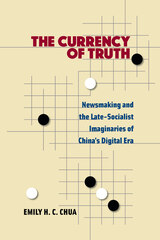
In The Currency of Truth, Emily H. C. Chua argues that news in China works less as a medium of mass communication than as a kind of currency as industry players make and use news articles to create agreements, build connections, and protect and advance their positions against one another. Looking at the ethical and professional principles that well-intentioned and civically minded journalists strive to uphold, and the challenges and doubts that they grapple with in the process, Chua brings her findings into conversation around “post-truth” news and the “crisis” of professional journalism in the West. The book encourages readers to rethink contemporary news, arguing that rather than setting out from the assumption that news works either to inform or deceive its publics, we should explore the “post-public” social and political imaginaries emerging among today’s newsmakers and remaking the terms of their practice.

Dyer-Witheford maps the dynamics of modern capitalism, showing how capital depends for its operations not just on exploitation in the immediate workplace, but on the continuous integration of a whole series of social sites and activities, from public health and maternity to natural resource allocation and the geographical reorganization of labor power. He also shows how these sites and activities may become focal points of subversion and insurgency, as new means of communication vital for the smooth flow of capital also permit otherwise isolated and dispersed points of resistance to connect and combine with one another.
Cutting through the smokescreen of high-tech propaganda, Dyer-Witheford predicts the advent of a reinvented, "autonomist" Marxism that will rediscover the possibility of a collective, communist transformation of society. Refuting the utopian promises of the information revolution, he discloses the real potentialities for a new social order in the form of a twenty-first-century communism based on the common sharing of wealth.
READERS
Browse our collection.
PUBLISHERS
See BiblioVault's publisher services.
STUDENT SERVICES
Files for college accessibility offices.
RECENTLY PUBLISHED






UChicago Accessibility Resources
home | accessibility | search | about | contact us
BiblioVault ® 2001 - 2024
The University of Chicago Press