
 A SCHOLARLY BOOK REPOSITORY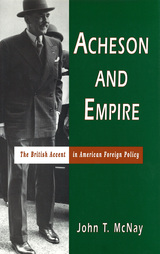
Acheson and Empire offers a compelling reassessment of Dean Acheson's policies toward the former colonial world during his period as secretary of state from 1949 to 1953. John T. McNay argues that Acheson inherited through his own personal history a way of understanding the world that encouraged imperial-style international relationships. This worldview represented a well-developed belief system rooted in his Ulster Protestant heritage that remained consistent throughout his life.
By exploring relationships of the United States with Britain and countries formerly or then controlled by Britain, such as India, Ireland, Iran, and Egypt, McNay shows the significance of Acheson's beliefs. McNay argues that Acheson's support of existing imperial relationships was so steadfast that it often led other nations to perceive that the United States was nothing more than a front for British interests. He believes this approach to foreign policy damaged American relations with emerging countries and misled the British regarding possibilities of an Anglo-American partnership.
Acheson and Empire contends that the widely accepted view of Acheson as a foreign policy realist is misleading and that historians should acknowledge that his affinity for the British Empire went beyond his clothing and mannerisms. McNay maintains that the widely accepted view of Acheson as one of a group of "wise men" who shaped the Cold War world by basing their decisions on cold calculation of American interests should be reconsidered.
Drawing from extensive research in archival sources, including the Truman Library, the National Archives, the Public Record Office in London, and Acheson's personal papers at Yale, Acheson and Empire offers a fresh look at Dean Acheson that runs counter to previous biographies and many histories of the Cold War.
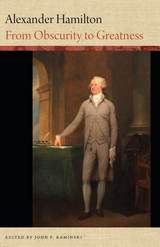
Editor John P. Kaminski has gathered a remarkable collection of quotations by and about Alexander Hamilton that paint for us a nuanced portrait of a complex man. Through his own words and the words of his contemporaries -- including the man who killed him in a duel, Aaron Burr -- we can gain a better understanding of this fascinating man who rose from anonymity on a small Caribbean island to the corridors of power.
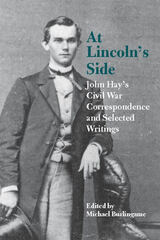
John Hay believed that “real history is told in private letters,” and the more than 220 surviving letters and telegrams from his Civil War days prove that to be true, showing Abraham Lincoln in action: “The Tycoon is in fine whack. I have rarely seen him more serene & busy. He is managing this war, the draft, foreign relations, and planning a reconstruction of the Union, all at once. I never knew with what tyrannous authority he rules the Cabinet, till now. The most important things he decides & there is no cavil.”
Along with Hay’s personal correspondence, Burlingame includes his surviving official letters. Though lacking the “literary brilliance of [Hay’s] personal letters,” Burlingame explains, “they help flesh out the historical record.” Burlingame also includes some of the letters Hay composed for Lincoln’s signature, including the celebrated letter of condolence to the Widow Bixby.
More than an inside glimpse of the Civil War White House, Hay’s surviving correspondence provides a window on the world of nineteenth-century Washington, D.C.

the towering figure--and mind--of Benjamin Franklin. A Renaissance man
in a Revolutionary time, Franklin had interests and knowledge not only
in religion but in literature, philosophy, politics, publishing, history,
and scientific inquiry, among many other disciplines.
Kerry S. Walters examines Franklin's search for the Divine using a similar,
multifaceted approach--and in so doing has created the first extended
treatment of Franklin's religious thought in thirty years. Walters brings
the same intellectual range and depth to the understanding of Franklin's
beliefs that Franklin brought to his own quest. What emerges from this
pilgrimage into the soul of one of America's greatest figures is a very
human Benjamin Franklin who grew with the accumulation of knowledge to
arrive at a "theistic perspectivism," which provided him with
a philosophical explanation for the diversity of religious faiths--and
a justification for the liberty of conscience he advocated throughout
his life.
Benjamin Franklin and His Gods is an original and beautifully
challenging spiritual and intellectual biography. Destined to be a classic.

A new account of the life and policies of the first German chancellor, Otto von Bismarck, this concise historical-biography reflects, for the first time in English, the historical shift in emphasis from the traditional political-economic approach to the more complex social-economic one of post—World War II scholarship.
Since the middle of the 1950s, much new material on Bismarck and nineteenth-century Germany and new interpretations of existing material have been published in Germany, Great Britain, and the United States. Professor George O. Kent’s brilliant synthesis, drawing on this mass of material, examines changes in emphasis in post—World War II scholarship. The book, particularly in the historiographical notes and bibliographical essay, provides the serious student with an invaluable guide to the intricacies of recent Bismarckian scholarship. For the general reader, the main text presents a picture of the man, the issues, and the age in the light of modern scholarship.
The major shift in historical emphasis described in this new account is the importance scholars give to the period 1877–79, the years of change from free trade to protectionism, rather than to 1870–71 the founding of the Reich. Bismarck’s political machinations, particularly his willingness to explore the possibilities of a coup d’état, are more fully discussed here than in any other book.
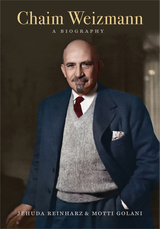
In Chaim Weizmann: A Biography, Jehuda Reinharz and Motti Golani show how Weizmann, a leader of the World Zionist Organization who became the first president of Israel, advocated for a Jewish state by gaining the support of influential politicians and statesmen as well as Jews around the world. Beginning with his childhood in Belorussia and concluding with his tenure as president, Reinharz and Golani describe how a Russian Jew, who immigrated to the United Kingdom in the early twentieth century, was able to advance the goals of Theodor Herzl, the founder of the Zionist Organization. Weizmann is also shown as a man of human foibles—his infatuations, political machinations, and elitism—as well as a man of admirable qualities—intelligence, wit, charisma, and dedication.
Weizmann, who came to the UK to work as a biochemist, was in regular communication with British political figures, including prime ministers Arthur James Balfour, David Lloyd George, Winston Churchill, and Ramsay MacDonald. He also met presidents of the United States from Woodrow Wilson to Harry Truman. His success in earning the support of British political figures helped lead to the Balfour Declaration, which advocated for a “national home” for the Jewish people in Palestine.
As the authors show in this authoritative account of Weizmann’s life, Weizmann was guided by the belief that “Zion shall be redeemed in justice,” a phrase that recurs often in his writings.
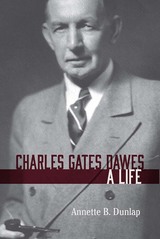
Charles Gates Dawes: A Life is the first comprehensive biography of an American in whose fascinating story contemporary readers can follow the struggles and triumphs of early twentieth-century America and Europe.
Dawes is most known today as vice president of the United States under Calvin Coolidge, but he also distinguished himself and his hometown of Evanston, Illinois, on the world stage with the 1925 Nobel Peace Prize. This engrossing biography traces how, when the punitive armistice that ended the First World War resulted in a disabled, restive Germany, Dawes’s diplomatic legerdemain averted war through a renegotiation of Germany’s debt repayments.
Dawes’s diplomatic and political achievements, however, were only the illustrious capstones to a multifaceted career that included military service, law, finance, and business on the local, state, national, and global stages. In every arena of his life, he combined the social graces of the Gilded Age with the spirit of service of the Progressive Era.
Despite his life of disciplined service, Dawes was an ebullient and irrepressible figure. Dawes’s salty language was often colorful fodder for tabloid and magazine writers of his era. In this captivating biography, Annette B. Dunlap recounts the story of an original American who enlightened and enlivened his world.
This book was published in cooperation with the Evanston History Center and with generous support from the Tawani Foundation.
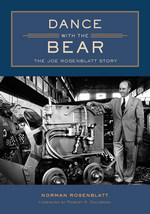
The “Little Hoover Commission” was modeled after the 1947 initiative of President Harry Truman, who created the Commission on Organization of the Executive Branch of Government to recommend administrative changes and appointed former president Herbert Hoover to chair it. Rosenblatt, a perceptive and outspoken figure, brought a much-needed dose of urgency and pragmatism to the Utah process and formulated a number of far-reaching suggestions to the legislature—many of which were adopted and still exist to this day. His work with the commission coupled with his later role on the San Francisco Federal Reserve Board did much to modernize Utah. Rosenblatt’s legacy as a perpetual champion of the community is further exemplified by his role as cultural conduit between Salt Lake’s Jewish community and the leaders of the Church of Jesus Christ of Latter-day Saints.
This readable work will serve as an integral addition to Utah business and political history, enriching the library of anyone looking for an engaging story of a remarkable and transformative figure.
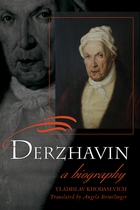
“Khodasevich’s light narrative touch (as translated by Brintlinger) lends a novelistic quality to the biography, making it a genuine tour de force. All students and scholars – of history, literature, poetry, biography – will find something of interest here.”—Choice
Third and last of the Adams dynasty of statesmen, Charles Francis Adams followed in his grandfather's and father's footsteps by keeping a diary from youth to old age. With only a few gaps in the earliest years, Charles Francis Adams' diary extends from 1820 to 1880, furnishing a massively detailed and intensely personal record of the writer's life as an undergraduate at Harvard, manager of the Adams family's business affairs, historian and biographer, Free Soil political leader and Republican Congressman, United States minister in London during the Civil War, arbitrator of the Alabama claims at the Geneva Tribunal, and father of a whole constellation of gifted sons.
The Diary of Charles Francis Adams, which is expected to run to at least eighteen volumes under the editorship of Professor and Mrs. Donald, is the second to appear in the Diaries Series of the Belknap Press edition of The Adams Papers. Unlike John Adams' Diary and Autobiography (4 volumes, 1961) and John Quincy Adams' Diary (in preparation), that of Charles Francis Adams has never before been even selectively published. This is partly because the protracted efforts of the family to prepare a satisfactory edition after the writer's death finally broke down under the sheer bulk of the material.
The present two volumes reveal Charles Francis Adams as a sensitive and self-critical young man during his college years, in the social whirl of Washington while his father was Secretary of State and President, during his training as a lawyer in Daniel Webster's Boston law office, and throughout his proonged courtship of Abigail B. Brooks, a New England heiress. A central theme of these volumes is the struggle which raged within young Adams' mind and heart between the warm, poetic heritage of his Southern-born mother and the cold, political, New England legacy of his Adams forebears. The defeat of his father in the 1828 ejection, the tragic death of his older brother, and his marriage to Abigail in 1829, with which the volumes end, were way stations in his course toward making himself a 'New England man." This complex struggle in a young man's mind is one of the most fully chronicled and dramatic episodes in the entire body of the Adams family archives at the Massachusetts Historical Society, tinder whose supervision The Adams Papers are being edited.
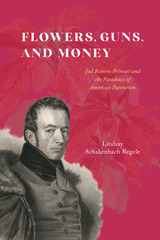
Joel Roberts Poinsett’s (1779–1851) brand of self-interested patriotism illuminates the paradoxes of the antebellum United States. He was a South Carolina investor and enslaver, a confidant of Andrew Jackson, and a secret agent in South America who fought surreptitiously in Chile’s War for Independence. He was an ambitious Congressman and Secretary of War who oversaw the ignominy of the Trail of Tears and orchestrated America’s longest and costliest war against Native Americans, yet also helped found the Smithsonian. In addition, he was a naturalist, after whom the poinsettia—which he appropriated while he was serving as the first US ambassador to Mexico—is now named.
As Lindsay Schakenbach Regele shows in Flowers, Guns, and Money, Poinsett personified a type of patriotism that emerged following the American Revolution, one in which statesmen served the nation by serving themselves, securing economic prosperity and military security while often prioritizing their own ambitions and financial interests. Whether waging war, opposing states’ rights yet supporting slavery, or pushing for agricultural and infrastructural improvements in his native South Carolina, Poinsett consistently acted in his own self-interest. By examining the man and his actions, Schakenbach Regele reveals an America defined by opportunity and violence, freedom and slavery, and nationalism and self-interest.
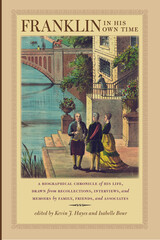
The most original and most delightful of the Founding Fathers, Benjamin Franklin was publisher and printer, essayist and author, businessman and “general,” scientist and philologist, politician and diplomat, moralist and sage—and a thoroughly rational patriot who was a major force in winning his country’s independence and securing its life in the Constitution. Born poor in Cotton Mather’s Boston, he was soon at ease in Quaker Philadelphia, and later in royal London, and in elegant Paris. Born with no advantages, he died wealthy and esteemed. He was the quintessential American, almost totally free of the limits of his environment, ready to accept any challenge, to speculate, experiment, and question.
Esmond Wright, the distinguished English scholar of America, sees Franklin as an Old England Man and a reluctant revolutionary; civilized, urbane, devious, and on occasion just a little unscrupulous. For, despite his charm and genius, Franklin was not admired by everybody. His contemporary John Adams thought little of his political abilities, and the Federalist pamphleteer William Cobbett called him a “crafty and lecherous old hypocrite.” In the next century, Mark Twain, Hawthorne, and Melville did not value him; still later, D. H. Lawrence despised the middle-class morality he promoted. Many today deplore his lack of interest in the arts or metaphysics, his lack of passionate commitment, his opportunism, his occasional coarseness. Yet his success in business, his many-faceted public career, his ingenious inventions and world-renowned scientific genius, his splendid prose style, his worldly wisdom, and the attractive personality that shines through his remarks and writings, made Benjamin Franklin the “new man” of the eighteenth-century dream and also vastly appealing to the modern temper. Wright’s new biography presents a fully rounded portrait of this remarkable man for all ages.
This first comprehensive biography of Franklin in fifty years has taken advantage of Yale’s massive edition-in-progress of Franklin’s papers and of the many specialized studies inspired by the correspondence. Franklin of Philadelphia, designed for the general reader, is also a work for scholars, for the author appends a thorough analysis of other interpretations of Franklin’s career and personality.
From his birth in the lowest stratum of the samurai class to his assassination at the hands of right-wing militarists, Takahashi Korekiyo (1854-1936) lived through tumultuous times that shaped the course of modern Japanese history. Takahashi is considered "Japan's Keynes" in many circles because of the forward-thinking (and controversial) fiscal and monetary policies--including deficit financing, currency devaluation, and lower interest rates--that he implemented to help Japan rebound from the Great Depression and move toward a modern economy.
Richard J. Smethurst's engaging biography underscores the profound influence of the seven-time finance minister on the political and economic development of Japan by casting new light on Takahashi's unusual background, unique talents, and singular experiences as a charismatic and cosmopolitan financial statesman.
Along with the many fascinating personal episodes--such as working as a houseboy in California and running a silver mine in the Andes--that molded Takahashi and his thinking, the book also highlights four major aspects of Takahashi's life: his unorthodox self-education, his two decades of service at the highest levels of government, his pathbreaking economic and political policies before and during the Depression, and his efforts to stem the rising tide of militarism in the 1930s. Deftly weaving together archival sources, personal correspondence, and historical analysis, Smethurst's study paints an intimate portrait of a key figure in the history of modern Japan.
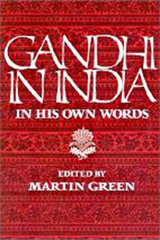
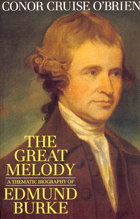
"In bringing Burke to our attention, Mr. O'Brien has brought back a lost treasure. The Great Melody is a brilliant work of narrative sweep and analytical depth. Conor Cruise O'Brien on Edmund Burke is a literary gift to political thought."—John Patrick Diggins, New York Times Book Review
"Serious readers of history are in for a treat: a book by the greatest living Irishman on the greatest Irishman who ever lived. . . . O'Brien's study is not merely a reconstruction of a fascinating man and period. It is also a tract for the times. . . . I cannot remember another time when I finished a book of more than 600 pages wishing it were longer."—Paul Johnson, The Independent
"The Great Melody combines superb biography and fascinating history with a profound understanding of political philosophy."—Former President Richard Nixon
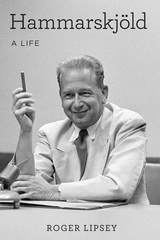
After his mysterious death, Dag Hammarskjöld was described by John F. Kennedy as the "greatest statesman of our century." Second secretary-general of the United Nations (1953 - 61), he is the only person to have been awarded the Nobel Peace Prize posthumously. Through extensive research in little explored archives and personal correspondence, Roger Lipsey has produced the definitive biography of Dag Hammarskjöld. Hammarskjöld: A Life provides vivid new insights into the life and mind of a truly great individual. Hammarskjöld the statesman and Hammarskjöld the author of the classic spiritual journal Markings meet in this new biography - and the reader will meet them both in these pages. A towering mid-twentieth-century figure, Hammarskjöld speaks directly to our time.
Very little has been written about Harold Ickes, one of the most important, complex, and colorful figures of the New Deal. By any standards his public career was remarkable. For thirteen turbulent years as Interior Secretary and as head of the Public Works Administration he was an uncommonly effective official and a widely acknowledged leader of liberal reform. As the foremost conservationist of his time, he saved millions of acres of land from decimation. He was matchless, too, as a fighter for just causes, and used his formidable talent for invective and his inexhaustible supply of moral fervor to flay representatives of prejudice and self-interest, whether in the cause of Negro rights or that of the common man against economic royalists.
Despite a long and distinguished public life, Ickes is an enigma because of his inability to control his rage, to temper his public criticism, to respond objectively to situations. At the heart of his public and private life was constant moral outrage. This astute study by a historian and a psychologist probes the sources and consequences of Ickes' abnormal combativeness.
White and Maze uncover the psychological imperatives and conscious ideals of Ickes' unknown private life that illuminate his public career. Some of the episodes include sadistic attacks by an elder brother; young Harold contemplating shooting his father; bitter and physical brawls with his imperious, wealthy, and previously married socialite wife, Anna Wilmarth Thompson of Chicago; and thoughts of suicide.
Richard Polenberg calls this book "Superb [and] one of the most informative and interesting I have read on the New Deal. The story shows Ickes' weaknesses and flaws, but it puts them in context. The authors have not tried to explain everything Ickes ever did wholly in psychological terms, but the particular insights they bring to bear help present a rounded view of the man. The book is beautifully written."
During America's longest crisis—the Great Depression and the Second World War—one man stood nearest to the president, almost as a partner: Harry Hopkins, trusted and loyal lieutenant and best friend of Franklin D. Roosevelt. From his work on the New Deal through his assignments during the war, Hopkins was the grand planner, expediter, adviser, and negotiator. Here is the first complete modern biography of this remarkable man, based on prodigious primary sources and written with the benefit of historical perspective.
George McJimsey fully records Hopkins's meteoric public career and probes the sources of his creativity and talent. Reared in Iowa with missionary values, he became a professional social worker in New York, pioneering strategies for several health and social service agencies. His special talent for persuasion and conciliation brought him into the New Deal, where as head of the Federal Emergency Relief Agency and the Public Works Administration he led Roosevelt's recovery programs—helping to pump billions of dollars into large projects and into tens of thousands of jobs without any political scandal or great conflict with conservative adversaries or competitors such as Harold Ickes. Later, as Secretary of Commerce, he continued to lead the country out of depression.
The coming of war tested Hopkins in new and unexpected ways. From being democracy's great bureaucrat he became the grand vizier of the arsenal of democracy. Living in the White House (in the Lincoln Room), Hopkins organized Lend-Lease, built the Anglo-American alliance, coordinated military supplies with strategic objectives, negotiated with Stalin, and helped to plan FDR's meetings with Churchill, Stalin, De Gaulle, and Chiang Kai-shek. Intelligent, humane, imaginative yet practical, always loyal to Roosevelt yet operating with his own creative independence, Hopkins played a role in winning the war and shaping the peace that provides an inspiring example of devoted public service. General readers and historians, journalists, and everyone interested in how government works will value and enjoy this book.
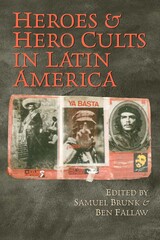
Latin American history traditionally has been defined by larger-than-life heroes such as Símon Bolívar, Emiliano Zapata, and Evita Perón. Recent scholarship, however, tends to emphasize social and cultural factors rather than great leaders. In this new collection, Samuel Brunk and Ben Fallaw bring heroes back to the center of the debate, arguing that heroes not only shape history, they also "tell us a great deal about the places from which they come."
The original essays in this collection examine ten modern Latin American heroes whose charisma derived from the quality of their relationships with admirers, rather than their innate personal qualities. The rise of mass media, for instance, helped pave the way for populists such as radio actress-turned-hero Evita Perón. On the other hand, heroes who become president often watch their images crumble, as policies replace personality in the eyes of citizens. In the end, the editors argue, there is no formula for Latin American heroes, who both forge, and are forged by, unique national events. The conclusion points toward Mexico, where the peasant revolutions that elevated Miguel Hidalgo and, later, Emiliano Zapata are so revered that today's would-be heroes, such as the EZLN's Subcomandante Marcos, must link themselves to peasant mythology even when their personal roots are far from native ground. The enduring (or, in some cases, fading) influence of those discussed in this volume validates the central placement of heroes in Latin American history.
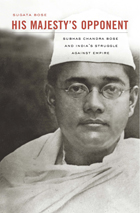
The man whom Indian nationalists perceived as the “George Washington of India” and who was President of the Indian National Congress in 1938–1939 is a legendary figure. Called Netaji (“leader”) by his countrymen, Subhas Chandra Bose struggled all his life to liberate his people from British rule and, in pursuit of that goal, raised and led the Indian National Army against Allied Forces during World War II. His patriotism, as Gandhi asserted, was second to none, but his actions aroused controversy in India and condemnation in the West.
Now, in a definitive biography of the revered Indian nationalist, Sugata Bose deftly explores a charismatic personality whose public and private life encapsulated the contradictions of world history in the first half of the twentieth century. He brilliantly evokes Netaji’s formation in the intellectual milieu of Calcutta and Cambridge, probes his thoughts and relations during years of exile, and analyzes his ascent to the peak of nationalist politics. Amidst riveting accounts of imprisonment and travels, we glimpse the profundity of his struggle: to unite Hindu and Muslim, men and women, and diverse linguistic groups within a single independent Indian nation. Finally, an authoritative account of his untimely death in a plane crash will put to rest rumors about the fate of this “deathless hero.”
This epic of a life larger than its legend is both intimate, based on family archives, and global in significance. His Majesty’s Opponent establishes Bose among the giants of Indian and world history.
The Impossible Indian offers a rare, fresh view of Gandhi as a hard-hitting political thinker willing to countenance the greatest violence in pursuit of a global vision that went far beyond a nationalist agenda. Revising the conventional view of the Mahatma as an isolated Indian moralist detached from the mainstream of twentieth-century politics, Faisal Devji offers a provocative new genealogy of Gandhian thought, one that is not rooted in a clichéd alternative history of spiritual India but arises from a tradition of conquest and violence in the battlefields of 1857.
Focusing on his unsentimental engagement with the hard facts of imperial domination, Fascism, and civil war, Devji recasts Gandhi as a man at the center of modern history. Rejecting Western notions of the rights of man, rights which can only be bestowed by a state, Gandhi turned instead to the idea of dharma, or ethical duty, as the true source of the self’s sovereignty, independent of the state. Devji demonstrates that Gandhi’s dealings with violence, guided by his idea of ethical duty, were more radical than those of contemporary revolutionists.
To make sense of this seemingly incongruous relationship with violence, Devji returns to Gandhi’s writings and explores his engagement with issues beyond India’s struggle for home rule. Devji reintroduces Gandhi to a global audience in search of leadership at a time of extraordinary strife as a thinker who understood how life’s quotidian reality could be revolutionized to extraordinary effect.
"Colbert has long been celebrated as Louis XIV's minister of finance, trade, and industry. More recently, he has been viewed as his minister of culture and propaganda. In this lively and persuasive book, Jake Soll has given us a third Colbert, the information manager."
---Peter Burke, University of Cambridge
"Jacob Soll gives us a road map drawn from the French state under Colbert. With a stunning attention to detail Colbert used knowledge in the service of enhancing
royal power. Jacob Soll's scholarship is impeccable and his story long
overdue and compelling."
---Margaret Jacob, University of California, Los Angeles
"Nowadays we all know that information is the key to power, and that the masters of information rule the world. Jacob Soll teaches us that Jean-Baptiste Colbert had grasped this principle three and a half centuries ago, and used it to construct a new kind of state. This imaginative, erudite, and powerfully written book re-creates the history of libraries and archives in early modern Europe, and ties them in a novel and convincing way to the new statecraft of Europe's absolute monarchs."
---Anthony Grafton, Princeton University
"Brilliantly researched, superbly told, and timely, Soll's story is crucial for the history of the modern state."
---Keith Baker, Stanford University
When Louis XIV asked his minister Jean-Baptiste Colbert---the man who was to oversee the building of Versailles and the Royal Academy of Sciences, as well as the navy, the Paris police force, and French industry---to build a large-scale administrative government, Colbert created an unprecedented information system for political power. In The Information Master, Jacob Soll shows how the legacy of Colbert's encyclopedic tradition lies at the very center of the rise of the modern state and was a precursor to industrial intelligence and Internet search engines.
Soll's innovative look at Colbert's rise to power argues that his practice of collecting knowledge originated from techniques of church scholarship and from Renaissance Italy, where merchants recognized the power to be gained from merging scholarship, finance, and library science. With his connection of interdisciplinary approaches---regarding accounting, state administration, archives, libraries, merchant techniques, ecclesiastical culture, policing, and humanist pedagogy---Soll has written an innovative book that will redefine not only the history of the reign of Louis XIV and information science but also the study of political and economic history.
On 18 April 1861, assistant presidential secretary John Hay recorded in his diary the report of several women that "some young Virginian long haired swaggering chivalrous of course. . . and half a dozen others including a daredevil guerrilla from Richmond named Ficklin would do a thing within forty eight hours that would ring through the world."
The women feared that the Virginian planned either to assassinate or to capture the president. Calling this a "harrowing communication," Hay continued his entry: "They went away and I went to the bedside of the Chief couché. I told him the yarn; he quietly grinned."
This is but one of the dramatic entries in Hay’s Civil War diary, presented here in a definitive edition by Michael Burlingame and John R. Turner Ettlinger. Justly deemed the most intimate record we will ever have of Abraham Lincoln in the White House, the Hay diary is, according to Burlingame and Ettlinger, "one of the richest deposits of high-grade ore for the smelters of Lincoln biographers and Civil War historians." While the Cabinet diaries of Salmon P. Chase, Edward Bates, and Gideon Welles also shed much light on Lincoln’s presidency, as does the diary of Senator Orville Hickman Browning, none of these diaries has the literary flair of Hay’s, which is, as Lincoln’s friend Horace White noted, as "breezy and sparkling as champagne." An aspiring poet, Hay recorded events in a scintillating style that the lawyer-politician diarists conspicuously lacked.
Burlingame and Ettlinger’s edition of the diary is the first to publish the complete text of all of Hay’s entries from 1861 through 1864. In 1939 Tyler Dennett published Lincoln and the Civil War in the Diaries and Letters of John Hay, which, as Civil War historian Allan Nevins observed, was "rather casually edited." This new edition is essential in part because Dennett omitted approximately 10 percent of Hay’s 1861–64 entries.
Not only did the Dennett edition omit important parts of the diaries, it also introduced some glaring errors. More than three decades ago, John R. Turner Ettlinger, then in charge of Special Collections at the Brown University Library, made a careful and literal transcript of the text of the diary, which involved deciphering Hay’s difficult and occasionally obscure writing. In particular, passages were restored that had been canceled, sometimes heavily, by the first editors for reasons of confidentiality and propriety. Ettlinger’s text forms the basis for the present edition, which also incorporates, with many additions and much updating by Burlingame, a body of notes providing a critical apparatus to the diary, identifying historical events and persons.
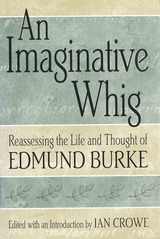
David Bromwich’s portrait of statesman Edmund Burke (1730–1797) is the first biography to attend to the complexity of Burke’s thought as it emerges in both the major writings and private correspondence. The public and private writings cannot be easily dissociated, nor should they be. For Burke—a thinker, writer, and politician—the principles of politics were merely those of morality enlarged. Bromwich reads Burke’s career as an imperfect attempt to organize an honorable life in the dense medium he knew politics to be.
This intellectual biography examines the first three decades of Burke’s professional life. His protest against the cruelties of English society and his criticism of all unchecked power laid the groundwork for his later attacks on abuses of government in India, Ireland, and France. Bromwich allows us to see the youthful skeptic, wary of a social contract based on “nature”; the theorist of love and fear in relation to “the sublime and beautiful”; the advocate of civil liberty, even in the face of civil disorder; the architect of economic reform; and the agitator for peace with America. However multiple and various Burke’s campaigns, a single-mindedness of commitment always drove him.
Burke is commonly seen as the father of modern conservatism. Bromwich reveals the matter to be far more subtle and interesting. Burke was a defender of the rights of disfranchised minorities and an opponent of militarism. His politics diverge from those of any modern party, but all parties would be wiser for acquaintance with his writing and thoughts.
Barbour, a Virginia contemporary of Thomas Jefferson and James Madison, during a long public career spanning the years 1798-1842, exerted a constructive influence on the nation’s history. Active in state and national politics during the formative decades of the republic, Barbour was a political nationalist who grafted to the dominant political philosophy of the day those elements of the Hamiltonian Federalist creed necessary for governing a dynamic, changing nation.
James Madison: Philosopher, Founder, and Statesman presents fresh scholarship on the nation’s fourth president, who is often called both the father of the U.S. Constitution and the father of the Bill of Rights. These essays by historians and political scientists from the United States and abroad focus on six distinct aspects of Madison’s life and work: his personality and development as a statesman; his work at the Constitutional Convention of 1787 and contributions to larger constitutional design; his advocacy for the adoption of the Bill of Rights; his controversial role as a party leader; his presidency; and his life after leaving office.
James Madison continues to be regarded as one of America’s great political theorists, a man who devoted his life to, and who found fulfillment in, public service. His philosophical contributions remain vital to any understanding of the modern American polity. This book will be of great interest to political scientists and theorists, as well as to historians of early American history and politics.
Preeminent Civil War historian Frank Vandiver always longed to see an interpretive biography of Jefferson Davis. Finally, more than twenty years after Vandiver expressed that wish, publication of Jefferson Davis, Unconquerable Heart makes such an interpretive biography available.
Felicity Allen begins this monumental work with Davis's political imprisonment at the end of the Civil War and masterfully flashes back to his earlier life, interweaving Davis's private life as a schoolboy, a Mississippi planter, a husband, a father, and a political leader. She follows him from West Point through army service on the frontier, his election to the U.S. House of Representatives, his regimental command in the Mexican War, his service as U.S. secretary of war and senator, and his term as president of the Confederate States of America.
Although Davis's family is the nexus of this biography, friends and enemies also play major roles. Among his friends intimately met in this book are such stellar figures as Andrew Jackson, John C. Calhoun, Zachary Taylor, Franklin Pierce, Albert Sidney Johnston, and Robert E. Lee.
With the use of contemporary accounts and Davis's own correspondence, Jefferson Davis, Unconquerable Heart casts new light upon this remarkable man, thawing the icy image of Davis in many previous accounts. Felicity Allen shows a strong, yet gentle man; a stern soldier who loved horses, guns, poetry, and children; a master of the English language, with a dry wit; a man of powerful feelings who held them in such tight control that he was considered cold; and a home-loving Mississippian who was drawn into a vortex of national events and eventual catastrophe. At all times, "duty, honor, country" ruled his mind. Davis's Christian view of life runs like a thread throughout the book, binding together his devotion to God, his family, and the land.
Jefferson Davis, Unconquerable Heart brings Davis to life in a way that has never been done before. The variety of his experience, the breadth of his learning, and the consistency of his beliefs make this historical figure eminently worth knowing.
José Martí (1853–1895) was the founding hero of Cuban independence. In all of modern Latin American history, arguably only the “Great Liberator” Simón Bolívar rivals Martí in stature and legacy. Beyond his accomplishments as a revolutionary and political thinker, Martí was a giant of Latin American letters, whose poetry, essays, and journalism still rank among the most important works of the region. Today he is revered by both the Castro regime and the Cuban exile community, whose shared veneration of the “apostle” of freedom has led to his virtual apotheosis as a national saint.
In José Martí: A Revolutionary Life, Alfred J. López presents the definitive biography of the Cuban patriot and martyr. Writing from a nonpartisan perspective and drawing on years of research using original Cuban and U.S. sources, including materials never before used in a Martí biography, López strips away generations of mythmaking and portrays Martí as Cuba’s greatest founding father and one of Latin America’s literary and political giants, without suppressing his public missteps and personal flaws. In a lively account that engrosses like a novel, López traces the full arc of Martí’s eventful life, from his childhood and adolescence in Cuba, to his first exile and subsequent life in Spain, Mexico City, and Guatemala, through his mature revolutionary period in New York City and much-mythologized death in Cuba on the battlefield at Dos Ríos. The first major biography of Martí in over half a century and the first ever in English, José Martí is the most substantial examination of Martí’s life and work ever published.
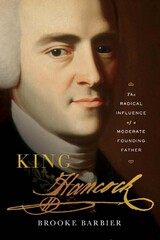
A rollicking portrait of the paradoxical patriot, whose measured pragmatism helped make American independence a reality.
Americans are surprisingly more familiar with his famous signature than with the man himself. In this spirited account of John Hancock’s life, Brooke Barbier depicts a patriot of fascinating contradictions—a child of enormous privilege who would nevertheless become a voice of the common folk; a pillar of society uncomfortable with radicalism who yet was crucial to independence. About two-fifths of the American population held neutral or ambivalent views about the Revolution, and Hancock spoke for them and to them, bringing them along.
Orphaned young, Hancock was raised by his merchant uncle, whose business and vast wealth he inherited—including household slaves, whom Hancock later freed. By his early thirties, he was one of New England’s most prominent politicians, earning a place on Britain’s most-wanted list and the derisive nickname King Hancock. While he eventually joined the revolution against England, his ever moderate—and moderating—disposition would prove an asset after 1776. Barbier shows Hancock appealing to southerners and northerners, Federalists and Anti-Federalists. He was a famously steadying force as president of the fractious Second Continental Congress. He parlayed with French military officials, strengthening a key alliance with his hospitable diplomacy. As governor of Massachusetts, Hancock convinced its delegates to vote for the federal Constitution and calmed the fallout from the shocking Shays’s Rebellion.
An insightful study of leadership in the revolutionary era, King Hancock traces a moment when passion was on the side of compromise and accommodation proved the basis of profound social and political change.
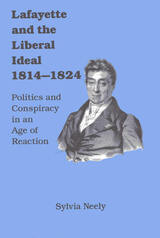
Sylvia Neely provides both the first scholarly study of Lafayette’s life after the French Revolution and a detailed analysis of French politics during the early Restoration.
Lafayette, advocating a liberalism based on the American example, used both legal and illegal means to overturn a conservative government. The personification of liberalism for many of his contemporaries, he and his friends Benjamin Constant, Voyer d’Argenson, and Charles Goyet saw themselves as fighters in an international struggle that set liberalism against the forces of reaction and obscurantism. Although he ultimately failed, Lafayette was convinced that the liberal ideals derived from the Enlightenment and from his personal mentor, George Washington, would prevail.
Neely makes Lafayette’s actions clear by considering seriously the principles that guided his life and by describing the political climate of the early nineteenth century. She discloses previously overlooked features of the revolutions of the 1820s which account for the divisions among the revolutionary groups. She also examines relationships between Lafayette and the prominent writers and thinkers of the period, among them Augustin Thierry, Jeremy Bentham, Lady Morgan, and Frances Wright.
The private correspondence of Rome’s most prolific public figure.
To his dear friend Atticus, Cicero reveals himself as to no other of his correspondents except perhaps his brother. In Cicero's Letters to Atticus we get an intimate look at his motivations and convictions and his reactions to what is happening in Rome. These letters also provide a vivid picture of a momentous period in Roman history, years marked by the rise of Julius Caesar and the downfall of the Republic.
When the correspondence begins in November 68 BC, the 38-year-old Cicero is a notable figure in Rome: a brilliant lawyer and orator, he has achieved primacy at the Roman bar and a political career that would culminate in the consulship in 63. Over the next twenty-four years—until November 44, a year before he was put to death by the forces of Octavian and Mark Antony—Cicero wrote frequently to his friend and confidant, sharing news and views and discussing affairs of business and state. It is to this corpus of over 400 letters that we owe most of our information about Cicero's literary activity. Here too is a revealing picture of the staunch republican's changing attitude toward Caesar. And taken as a whole the letters provide a first-hand account of social and political life in Rome.
D. R. Shackleton Bailey's authoritative edition and translation of the Letters to Atticus is a revised version of his Cambridge Classical Texts and Commentaries edition, with full explanatory notes.
The private correspondence of Rome’s most prolific public figure.
To his dear friend Atticus, Cicero reveals himself as to no other of his correspondents except perhaps his brother. In Cicero's Letters to Atticus we get an intimate look at his motivations and convictions and his reactions to what is happening in Rome. These letters also provide a vivid picture of a momentous period in Roman history, years marked by the rise of Julius Caesar and the downfall of the Republic.
When the correspondence begins in November 68 BC, the 38-year-old Cicero is a notable figure in Rome: a brilliant lawyer and orator, he has achieved primacy at the Roman bar and a political career that would culminate in the consulship in 63. Over the next twenty-four years—until November 44, a year before he was put to death by the forces of Octavian and Mark Antony—Cicero wrote frequently to his friend and confidant, sharing news and views and discussing affairs of business and state. It is to this corpus of over 400 letters that we owe most of our information about Cicero's literary activity. Here too is a revealing picture of the staunch republican's changing attitude toward Caesar. And taken as a whole the letters provide a first-hand account of social and political life in Rome.
D. R. Shackleton Bailey's authoritative edition and translation of the Letters to Atticus is a revised version of his Cambridge Classical Texts and Commentaries edition, with full explanatory notes.
The private correspondence of Rome’s most prolific public figure.
To his dear friend Atticus, Cicero reveals himself as to no other of his correspondents except perhaps his brother. In Cicero's Letters to Atticus we get an intimate look at his motivations and convictions and his reactions to what is happening in Rome. These letters also provide a vivid picture of a momentous period in Roman history, years marked by the rise of Julius Caesar and the downfall of the Republic.
When the correspondence begins in November 68 BC, the 38-year-old Cicero is a notable figure in Rome: a brilliant lawyer and orator, he has achieved primacy at the Roman bar and a political career that would culminate in the consulship in 63. Over the next twenty-four years—until November 44, a year before he was put to death by the forces of Octavian and Mark Antony—Cicero wrote frequently to his friend and confidant, sharing news and views and discussing affairs of business and state. It is to this corpus of over 400 letters that we owe most of our information about Cicero's literary activity. Here too is a revealing picture of the staunch republican's changing attitude toward Caesar. And taken as a whole the letters provide a first-hand account of social and political life in Rome.
D. R. Shackleton Bailey's authoritative edition and translation of the Letters to Atticus is a revised version of his Cambridge Classical Texts and Commentaries edition, with full explanatory notes.
The private correspondence of Rome’s most prolific public figure.
To his dear friend Atticus, Cicero reveals himself as to no other of his correspondents except perhaps his brother. In Cicero's Letters to Atticus we get an intimate look at his motivations and convictions and his reactions to what is happening in Rome. These letters also provide a vivid picture of a momentous period in Roman history, years marked by the rise of Julius Caesar and the downfall of the Republic.
When the correspondence begins in November 68 BC, the 38-year-old Cicero is a notable figure in Rome: a brilliant lawyer and orator, he has achieved primacy at the Roman bar and a political career that would culminate in the consulship in 63. Over the next twenty-four years—until November 44, a year before he was put to death by the forces of Octavian and Mark Antony—Cicero wrote frequently to his friend and confidant, sharing news and views and discussing affairs of business and state. It is to this corpus of over 400 letters that we owe most of our information about Cicero's literary activity. Here too is a revealing picture of the staunch republican's changing attitude toward Caesar. And taken as a whole the letters provide a first-hand account of social and political life in Rome.
D. R. Shackleton Bailey's authoritative edition and translation of the Letters to Atticus is a revised version of his Cambridge Classical Texts and Commentaries edition, with full explanatory notes.
The private correspondence of Rome’s most prolific public figure.
Cicero (Marcus Tullius, 106–43 BC), Roman lawyer, orator, politician and philosopher, of whom we know more than of any other Roman, lived through the stirring era that saw the rise, dictatorship, and death of Julius Caesar in a tottering republic. In his political speeches especially and in his correspondence we see the excitement, tension and intrigue of politics and the part he played in the turmoil of the time. Of about 106 speeches, delivered before the Roman people or the Senate if they were political, before jurors if judicial, fifty-eight survive (a few of them incompletely). In the fourteenth century Petrarch and other Italian humanists discovered manuscripts containing more than 900 letters of which more than 800 were written by Cicero and nearly 100 by others to him. These afford a revelation of the man all the more striking because most were not written for publication. Six rhetorical works survive and another in fragments. Philosophical works include seven extant major compositions and a number of others; and some lost. There is also poetry, some original, some as translations from the Greek.
The Loeb Classical Library edition of Cicero is in twenty-nine volumes.
The private correspondence of Rome’s most prolific public figure.
Cicero (Marcus Tullius, 106–43 BC), Roman lawyer, orator, politician and philosopher, of whom we know more than of any other Roman, lived through the stirring era that saw the rise, dictatorship, and death of Julius Caesar in a tottering republic. In his political speeches especially and in his correspondence we see the excitement, tension and intrigue of politics and the part he played in the turmoil of the time. Of about 106 speeches, delivered before the Roman people or the Senate if they were political, before jurors if judicial, fifty-eight survive (a few of them incompletely). In the fourteenth century Petrarch and other Italian humanists discovered manuscripts containing more than 900 letters of which more than 800 were written by Cicero and nearly 100 by others to him. These afford a revelation of the man all the more striking because most were not written for publication. Six rhetorical works survive and another in fragments. Philosophical works include seven extant major compositions and a number of others; and some lost. There is also poetry, some original, some as translations from the Greek.
The Loeb Classical Library edition of Cicero is in twenty-nine volumes.
The private correspondence of Rome’s most prolific public figure.
Cicero (Marcus Tullius, 106–43 BC), Roman lawyer, orator, politician and philosopher, of whom we know more than of any other Roman, lived through the stirring era that saw the rise, dictatorship, and death of Julius Caesar in a tottering republic. In his political speeches especially and in his correspondence we see the excitement, tension and intrigue of politics and the part he played in the turmoil of the time. Of about 106 speeches, delivered before the Roman people or the Senate if they were political, before jurors if judicial, fifty-eight survive (a few of them incompletely). In the fourteenth century Petrarch and other Italian humanists discovered manuscripts containing more than 900 letters of which more than 800 were written by Cicero and nearly 100 by others to him. These afford a revelation of the man all the more striking because most were not written for publication. Six rhetorical works survive and another in fragments. Philosophical works include seven extant major compositions and a number of others; and some lost. There is also poetry, some original, some as translations from the Greek.
The Loeb Classical Library edition of Cicero is in twenty-nine volumes.
Private correspondence and dubious disquisitions.
Cicero had an affectionate relationship with his only brother, Quintus, down to the closing years of their lives. The letters from Cicero to him in this collection offer an intimate look at their world. Cicero’s close friendship with the intensely intellectual Brutus was signalized by Cicero’s dedication of his prized Orator to Brutus. The correspondence between the two collected here dates from the spring and summer of 43 BC, and it conveys some of the drama of the period following the assassination of Julius Caesar.
Shackleton Bailey also provides in this volume a new text and translation of two invective speeches purportedly delivered in the Senate: Sallust attacking Cicero and Cicero attacking Sallust. These are probably anonymous ancient schoolbook exercises, but have come down to us with the works of Sallust and Cicero. Another work in the same category, the Letter to Octavian ostensibly by Cicero but probably dating from the third or fourth century AD, is included as well. Here too (with text by Shackleton Bailey and revised introduction and translation by M. I. Henderson) is the Handbook of Electioneering, a guide said to be written by Quintus to his brother, advising him on campaigning for the consulship of 63 BC. Whether or not this is genuinely the work of Quintus, it remains an interesting treatise on Roman elections. Letter fragments complete the volume; these were not previously available in the Loeb Classical Library.
On the 150th anniversary of the death of the English historian and politician Thomas Babington Macaulay, Robert Sullivan offers a portrait of a Victorian life that probes the cost of power, the practice of empire, and the impact of ideas.
His Macaulay is a Janus-faced master of the universe: a prominent spokesman for abolishing slavery in the British Empire who cared little for the cause, a forceful advocate for reforming Whig politics but a Machiavellian realist, a soaring parliamentary orator who avoided debate, a self-declared Christian, yet a skeptic and a secularizer of English history and culture, and a stern public moralist who was in love with his two youngest sisters.
Perhaps best known in the West for his classic History of England, Macaulay left his most permanent mark on South Asia, where his penal code remains the law. His father ensured that ancient Greek and Latin literature shaped Macaulay’s mind, but he crippled his heir emotionally. Self-defense taught Macaulay that power, calculation, and duplicity rule politics and human relations. In Macaulay’s writings, Sullivan unearths a sinister vision of progress that prophesied twentieth-century genocide. That the reverent portrait fashioned by Macaulay’s distinguished extended family eclipsed his insistent rhetoric about race, subjugation, and civilizing slaughter testifies to the grip of moral obliviousness.
Devoting his huge talents to gaining power—above all for England and its empire—made Macaulay’s life a tragedy. Sullivan offers an unsurpassed study of an afflicted genius and a thoughtful meditation on the modern ethics of power.
“Machiavellian”—used to describe the ruthless cunning of the power-obsessed and the pitiless—is never meant as a compliment. But the man whose name became shorthand for all that is ugly in politics was more engaging and nuanced than his reputation suggests. Christopher S. Celenza’s Machiavelli: A Portrait removes the varnish of centuries to reveal not only the hardnosed political philosopher but the skilled diplomat, learned commentator on ancient history, comic playwright, tireless letter writer, and thwarted lover.
Machiavelli’s hometown was the epicenter of the Italian Renaissance in the fifteenth century, a place of unparalleled artistic and intellectual attainments. But Florence was also riven by extraordinary violence. War and public executions were commonplace—Machiavelli himself was imprisoned and brutally tortured at the behest of his own government. These experiences left a deep impression on this keen observer of power politics, whose two masterpieces—The Prince and The Discourses—draw everywhere on the hard-won wisdom gained from navigating a treacherous world. But like many of Machiavelli’s fellow Florentines, he also immersed himself in the Latin language and wisdom of authors from the classical past. And for all of Machiavelli’s indifference to religion, vestiges of Christianity remained in his thought, especially the hope for a redeemer—a prince who would provide the stability so rare in Machiavelli’s worldly experience.
John Churchill, the Duke of Marlborough (1644-1722), was one of the greatest military commanders and statesmen in the history of England. Victorious in the Battles of Blenheim (1704), Ramillies (1706), and countless other campaigns, Marlborough, whose political intrigues were almost as legendary as his military skill, never fought a battle he didn't win. Although he helped James II crush the rebellion of the Duke of Monmouth, Marlborough later supported William of Orange against James II in the Glorious Revolution of 1688 and brilliantly managed England's diplomatic triumphs during the War of the Spanish Succession. Marlborough also bequeathed the world another great British military strategist and diplomat—his descendant, Winston S. Churchill, who wrote this book to redeem Marlborough's reputation from Macaulay's smears.
One million words long and ten years in the making, Churchill's Marlborough stands as both a literary and historical masterpiece, giving us unique insights into the Churchill of World War II, for just as Churchill's literary skill helps us understand the complexities of Marlborough's life, so too did his writing of Marlborough help Churchill master the arts of military strategy and diplomacy. This two-volume edition includes the entire text and almost all the original maps.
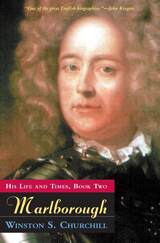
John Churchill, the Duke of Marlborough (1644-1722), was one of the greatest military commanders and statesmen in the history of England. Victorious in the Battles of Blenheim (1704), Ramillies (1706), and countless other campaigns, Marlborough, whose political intrigues were almost as legendary as his military skill, never fought a battle he didn't win. Although he helped James II crush the rebellion of the Duke of Monmouth, Marlborough later supported William of Orange against James II in the Glorious Revolution of 1688 and brilliantly managed England's diplomatic triumphs during the War of the Spanish Succession. Marlborough also bequeathed the world another great British military strategist and diplomat—his descendant, Winston S. Churchill, who wrote this book to redeem Marlborough's reputation from Macaulay's smears.
One million words long and ten years in the making, Churchill's Marlborough stands as both a literary and historical masterpiece, giving us unique insights into the Churchill of World War II, for just as Churchill's literary skill helps us understand the complexities of Marlborough's life, so too did his writing of Marlborough help Churchill master the arts of military strategy and diplomacy. This two-volume edition includes the entire text and almost all the original maps.
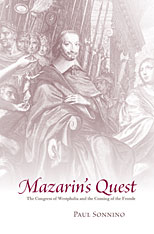
In a provocative study, Paul Sonnino examines the diplomatic negotiations that took place in Westphalia from 1643 to 1648, which brought an end to the agonizing civil and religious conflict of the Thirty Years’ War.
Sonnino steps back from myriad historical readings of Westphalia to take the diplomats’ intentions and interactions strictly on their own terms. He places the reader alongside the pivotal figure of French minister Jules Cardinal Mazarin as he maneuvers for gain. The narrative thus offers a firsthand experience of the negotiations as they played out, as well as a penetrating look into the character, personality, and ideas of the crafty cardinal. Although Mazarin acquired the province of Alsace—making him a hero to French nationalists—he had a much more successful peace within his grasp, but lost it when he insisted on annexing the Spanish Low Countries. Sonnino also offers a new interpretation of the origins of the Fronde, linking the French domestic revolt to foreign policy, in Mazarin’s failure to secure peace with Spain.
Based on unprecedented archival documentation, Mazarin’s Quest provides an original and illuminating look at one of the most complicated diplomatic gatherings of all time.
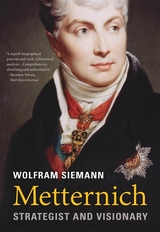
A compelling new biography that recasts the most important European statesman of the first half of the nineteenth century, famous for his alleged archconservatism, as a friend of realpolitik and reform, pursuing international peace.
Metternich has a reputation as the epitome of reactionary conservatism. Historians treat him as the archenemy of progress, a ruthless aristocrat who used his power as the dominant European statesman of the first half of the nineteenth century to stifle liberalism, suppress national independence, and oppose the dreams of social change that inspired the revolutionaries of 1848. Wolfram Siemann paints a fundamentally new image of the man who shaped Europe for over four decades. He reveals Metternich as more modern and his career much more forward-looking than we have ever recognized.
Clemens von Metternich emerged from the horrors of the Revolutionary and Napoleonic wars, Siemann shows, committed above all to the preservation of peace. That often required him, as the Austrian Empire’s foreign minister and chancellor, to back authority. He was, as Henry Kissinger has observed, the father of realpolitik. But short of compromising on his overarching goal Metternich aimed to accommodate liberalism and nationalism as much as possible. Siemann draws on previously unexamined archives to bring this multilayered and dazzling man to life. We meet him as a tradition-conscious imperial count, an early industrial entrepreneur, an admirer of Britain’s liberal constitution, a failing reformer in a fragile multiethnic state, and a man prone to sometimes scandalous relations with glamorous women.
Hailed on its German publication as a masterpiece of historical writing, Metternich will endure as an essential guide to nineteenth-century Europe, indispensable for understanding the forces of revolution, reaction, and moderation that shaped the modern world.
Here is an authoritative reference work that makes biographies of prominent Mexican national politicians from the period 1884–1934 available in English. Like the author's biographical directory for the years 1935–2009, it draws on many years of research in Mexico and the United States and seeks not only to provide accurate biographical information about each entry but also, where possible and appropriate, to connect these politicians to more recent leadership generations. Thus, Mexican Political Biographies, 1884-1934 not only is a useful historical source but also provides additional information on the family backgrounds of many contemporary figures.
The work includes those figures who have held specific posts at the national level or who have served as state governors. Each biographical entry contains the following information: date of birth, birthplace, education, elective political office, political party positions, appointive governmental posts at all levels, group activities, nongovernmental positions and professions, relatives, mentors and important friends, military experience, unusual career activities, and published biographical sources.
Another unique feature of the directory is appendixes with complete lists of the names and dates of cabinet members, supreme court justices, senators, deputies, selected ambassadors, and party leaders.
This fourth edition of Roderic Camp's highly respected Mexican Political Biographies is an updated comprehensive biographical directory of leading state and national politicians in Mexico, covering the years 1935–2009. The original edition, published in 1976, was the first and only comprehensive biographical work on contemporary political figures in any language and served as the prototype for the Mexican government's brief foray into its own official biographical directory. The Mexican Supreme Court has cited every biography of justices in the third edition as the basis of its biographies in the late 1980s.
With updates of the existing biographies and appendices, plus almost 1,000 additional biographies, this fourth edition now features close to 3,000 entries and serves as a unique resource list of the chronological occupants of all leading national political posts. The need for such information has become even more pronounced since Mexico's political transformation from a semi-authoritarian to a democratic model.
This latest edition allows readers access to information about Mexican politicians into the new century, and like its earlier versions, will be a valuable tool for government officials, journalists, historians, social scientists, the business community, and students.
Finally, it includes a detailed bibliographic essay that identifies and explains the significance of biographical sources and has been enhanced by numerous up-to-date Internet sources. An added convenience is an accompanying CD that allows readers to search the biographies and appendices, enhancing the longevity, usefulness, and uniqueness of this edition.
This biography examines his campaigns from South Africa to India to evaluate the successes and failures of non-violent resistance. Seventy years after his death, his legacy remains contested: was he a saint, revolutionary, class conciliator, or self-obsessed spiritual zealot?
The contradictions of Gandhi’s politics are unpicked through an analysis of the social forces at play in the mass movement around him. Entrusted to liberate the oppressed of India, his key support base were industrialists, landlords and the rich peasantry. Gandhi’s moral imperatives often clashed with these vested material interests, as well as with more radical currents to his left.
Today, our world is scarred by permanent wars, racism and violence, environmental destruction and economic crisis. Can non-violent resistance win against state and corporate power? This book explores Gandhi’s experiments in civil disobedience to assess their relevance for struggles today.
An Australian Book Review Best Book of the Year
One of France’s most famous historians compares two exemplars of political and military leadership to make the unfashionable case that individuals, for better and worse, matter in history.
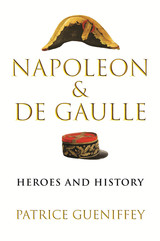
Historians have taught us that the past is not just a tale of heroes and wars. The anonymous millions matter and are active agents of change. But in democratizing history, we have lost track of the outsized role that individual will and charisma can play in shaping the world, especially in moments of extreme tumult. Patrice Gueniffey provides a compelling reminder in this powerful dual biography of two transformative leaders, Napoleon Bonaparte and Charles de Gaulle.
Both became national figures at times of crisis and war. They were hailed as saviors and were eager to embrace the label. They were also animated by quests for personal and national greatness, by the desire to raise France above itself and lead it on a mission to enlighten the world. Both united an embattled nation, returned it to dignity, and left a permanent political legacy—in Napoleon’s case, a form of administration and a body of civil law; in de Gaulle’s case, new political institutions. Gueniffey compares Napoleon’s and de Gaulle’s journeys to power; their methods; their ideas and writings, notably about war; and their postmortem reputations. He also contrasts their weaknesses: Napoleon’s limitless ambitions and appetite for war and de Gaulle’s capacity for cruelty, manifested most clearly in Algeria.
They were men of genuine talent and achievement, with flaws almost as pronounced as their strengths. As many nations, not least France, struggle to find their soul in a rapidly changing world, Gueniffey shows us what a difference an extraordinary leader can make.
Coedited by noted Masters scholar, Jason Stacy, and his class, “Editing History,” this annotated edition of Edgar Lee Masters’s The New Star Chamber and Other Essays reappears at a perilous time in US history, when large corporations and overseas conflicts once again threaten the integrity of American rights and liberties, and the United States still finds itself beholden to corporate power and the legacy of imperial hubris. In speaking to his times, Masters also speaks to ours.
These thirteen essays lay bare the political ideology that informed Spoon River Anthology. Masters argues that the dangerous imperialism championed by then-President Theodore Roosevelt was rooted in the Constitution itself. By debating the ethics of the Philippine-American War, criticizing Hamiltonian centralization of government, and extolling the virtues of Jeffersonian individualism, Masters elucidates the ways in which America had strayed from its constitutional morals and from democracy itself. The result is a compelling critique of corporate capitalism and burgeoning American imperialism, as well as an exemplary source for understanding its complicated author in the midst of his transformation from urban lawyer to poet of rural America.
In print again for the first time since 1904, this edition includes an introduction and historical annotations throughout. Edited and annotated by students at Southern Illinois University Edwardsville, and designed and illustrated by students at Southern Illinois University Carbondale, this volume traces economic and political pathologies to the origins of the American republic. The New Star Chamber and Other Essays is as vital now as it was over 100 years ago.
Invectives against Antony.
Cicero (Marcus Tullius, 106–43 BC), Roman advocate, orator, politician, poet, and philosopher, about whom we know more than we do of any other Roman, lived through the stirring era that saw the rise, dictatorship, and death of Julius Caesar in a tottering republic. In Cicero’s political speeches and in his correspondence we see the excitement, tension, and intrigue of politics and the part he played in the turmoil of the time. Of about 106 speeches, 58 survive (a few incompletely), 29 of which are addressed to the Roman people or Senate, the rest to jurors. In the fourteenth century Petrarch and other Italian humanists discovered manuscripts containing more than 900 letters, of which more than 800 were written by Cicero, and nearly 100 by others to him. This correspondence affords a revelation of the man, all the more striking because most of the letters were not intended for publication. Six works on rhetorical subjects survive intact and another in fragments. Seven major philosophical works are extant in part or in whole, and there are a number of shorter compositions either preserved or known by title or fragments.
The Loeb Classical Library edition of Cicero is in twenty-nine volumes.
Invectives against Antony.
Cicero (Marcus Tullius, 106–43 BC), Roman advocate, orator, politician, poet, and philosopher, about whom we know more than we do of any other Roman, lived through the stirring era that saw the rise, dictatorship, and death of Julius Caesar in a tottering republic. In Cicero’s political speeches and in his correspondence we see the excitement, tension, and intrigue of politics and the part he played in the turmoil of the time. Of about 106 speeches, 58 survive (a few incompletely), 29 of which are addressed to the Roman people or Senate, the rest to jurors. In the fourteenth century Petrarch and other Italian humanists discovered manuscripts containing more than 900 letters, of which more than 800 were written by Cicero, and nearly 100 by others to him. This correspondence affords a revelation of the man, all the more striking because most of the letters were not intended for publication. Six works on rhetorical subjects survive intact and another in fragments. Seven major philosophical works are extant in part or in whole, and there are a number of shorter compositions either preserved or known by title or fragments.
The Loeb Classical Library edition of Cicero is in twenty-nine volumes.
Zanzibar has had the most turbulent postcolonial history of any part of the United Republic of Tanzania, yet few sources explain the reasons why. The current political impasse in the islands is a contest over the question of whether to revere and sustain the Zanzibari Revolution of 1964, in which thousands of islanders, mostly Arab, lost their lives. It is also about whether Zanzibar’s union with the Tanzanian mainland—cemented only a few months after the revolution—should be strengthened, reformed, or dissolved. Defenders of the revolution claim it was necessary to right a century of wrongs. They speak the language of African nationalism and aspire to unify the majority of Zanzibaris through the politics of race. Their opponents instead deplore the violence of the revolution, espouse the language of human rights, and claim the revolution reversed a century of social and economic development. They reject the politics of race, regarding Islam as a more worthy basis for cultural and political unity.
From a series of personal interviews conducted over several years, Thomas Burgess has produced two highly readable first-person narratives in which two nationalists in Africa describe their conflicts, achievements, failures, and tragedies. Their life stories represent two opposing arguments, for and against the revolution. Ali Sultan Issa traveled widely in the 1950s and helped introduce socialism into the islands. As a minister in the first revolutionary government he became one of Zanzibar’s most controversial figures, responsible for some of the government’s most radical policies. After years of imprisonment, he reemerged in the 1990s as one of Zanzibar’s most successful hotel entrepreneurs. Seif Sharif Hamad came of age during the revolution and became disenchanted with its broken promises and excesses. In the 1980s he emerged as a reformist minister, seeking to roll back socialism and authoritarian rule. After his imprisonment he has ever since served as a leading figure in what has become Tanzania’s largest opposition party
As Burgess demonstrates in his introduction, both memoirs trace Zanzibar’s postindependence trajectory and reveal how Zanzibaris continue to dispute their revolutionary heritage and remain divided over issues of memory, identity, and whether to remain a part of Tanzania. The memoirs explain how conflicts in the islands have become issues of national importance in Tanzania, testing that state’s commitment to democratic pluralism. They engage our most basic assumptions about social justice and human rights and shed light on a host of themes key to understanding Zanzibari history that are also of universal relevance, including the legacies of slavery and colonialism and the origins of racial violence, poverty, and underdevelopment. They also show how a cosmopolitan island society negotiates cultural influences from Africa, the Middle East, Asia, and Europe.
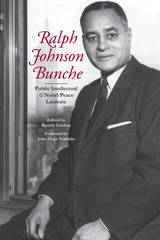
Nobel Peace Prize winner Ralph Johnson Bunche (1904-71) was one of the twentieth century’s foremost diplomats and intellectuals. In the wake of centennial celebrations of his birth, leading scholars and diplomats assess Bunche’s historical importance and enduring impact on higher education, public policy, and international politics. Their essays reveal not only the breadth of Bunche’s influence, such as his United Nations work to broker peace during times of civil war in Africa, the Middle East, and Asia, but also the depth of his intellectual perspectives on race, civil rights, higher education, and international law. Probing his publications, speeches, and public policy initiatives, the volume offers telling insights into the critical roles of universities, public intellectuals, and diplomats in working together to find solutions to domestic and international problems through public and scholarly engagement. In this way, the volume highlights the very connections that Bunche exhibited as an academic, intellectual, and diplomat.
Contributors include Lorenzo DuBois Baber, John Hope Franklin, Jonathan Scott Holloway, Charles P. Henry, Ben Keppel, Beverly Lindsay, Princeton Lyman, Edwin Smith, and Hanes Walton Jr.
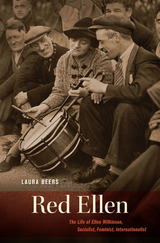
In 1908 Ellen Wilkinson, a fiery adolescent from a working-class family in Manchester, was “the only girl who talks in school debates.” By midcentury, Wilkinson had helped found Britain’s Communist Party, earned a seat in Parliament, and become a renowned advocate for the poor and dispossessed at home and abroad. She was one of the first female delegates to the United Nations, and she played a central role in Britain’s postwar Labour government. In Laura Beers’s account of Wilkinson’s remarkable life, we have a richly detailed portrait of a time when Left-leaning British men and women from a range of backgrounds sought to reshape domestic, imperial, and international affairs.
Wilkinson is best remembered as the leader of the Jarrow Crusade, the 300-mile march of two hundred unemployed shipwrights and steelworkers to petition the British government for assistance. But this was just one small part of Red Ellen’s larger transnational fight for social justice. She was involved in a range of campaigns, from the quest for official recognition of the Spanish Republican government, to the fight for Indian independence, to the effort to smuggle Jewish refugees out of Germany.
During Wilkinson’s lifetime, many British radicals viewed themselves as members of an international socialist community, and some, like her, became involved in socialist, feminist, and pacifist movements that spanned the globe. By focusing on the extent to which Wilkinson’s activism transcended Britain’s borders, Red Ellen adjusts our perception of the British Left in the early twentieth century.
Shen Gua (1031−1095) is a household name in China, known as a distinguished renaissance man and the author of Brush Talks from Dream Brook, an old text whose remarkable “scientific” discoveries make it appear curiously ahead of its time. In this first book-length study of Shen in English, Ya Zuo reveals the connection between Shen’s life as an active statesman and his ideas, specifically the empirical stance manifested through his wide-ranging inquiries. She places Shen on the broad horizon of premodern Chinese thought, and presents his empiricism within an extensive narrative of Chinese epistemology.
Relying on Shen as a searchlight, Zuo focuses in on how an individual thinker summoned conditions and concepts from the vast Chinese intellectual tradition to build a singular way of knowing. Moreover, her study of Shen provides insights into the complex dynamics in play at the dawn of the age of Neo-Confucianism and compels readers to achieve a deeper appreciation of the diversity in Chinese thinking.
Arai Hakuseki, advisor to the sixth and seventh Tokugawa shogun, played an important role in politics between 1709 and 1716, during an era of large changes in the bakufu. He participated in major policy decisions on currency, foreign trade, and local administration, while simultaneously trying to enhance the shogun's authority both within the bakufu and as a national ruler. The following shogun retained Hakuseki's fiscal and trade policies, but promptly reversed those measures designed to make the shogun a king-like figure.
Nakai examines these successes and failures against the background of the time, especially the bifurcated and ambiguous distribution of authority between the Tokugawa shogun and the tenno in Kyoto. She also traces the influence of Confucian political theory on Hakuseki's program and on his defense of that program in the face of criticism. Nakai draws upon Hakuseki's autobiography anddiary and the reportorial letters of a contemporary for Hakuseki's political activities, and on Hakuseki's historical works and memorials for the theoretical basis for his programs, rooted in Confucianism.
Illustrative and lively translations from Hakuseki enrich the book, helping to portray a multi-faceted personality who managed to blend practical politics and Confucian idealism within the complicated and dynamic environment of the early-eighteenth-century bakufu.
Perry begins with Bulgaria in the tumultuous years immediately following its founding in 1878. After the ousting of the country's first prince, Stambolov enters the stage as the fiery young lawyer who restored him to the throne. Although the prince promptly abdicated, Stambolov stepped into the breach and led the nation during the interregnum. Perry traces this patriotic politician's transformation into an authoritarian prime minister. He shows how Stambolov stabilized the Bulgarian economy and brought relative security to the land—but not without cost to himself and his regime. Perry depicts a man whose promotion of Bulgaria's independence exacted its price in individual rights, a ruler whose assassination in 1895 was the cause of both rejoicing and sorrow.
Stambolov thus emerges from these pages as a complex historical figure, an authoritarian ruler who protected his country's liberty at the cost of the people's freedom and whose dictatorial policies set Bulgaria upon a course of stability and modernization. An afterword compares the Bulgarian liberation era of Stambolov with the communist-era dictator, Todor Zhikov, analyzing similarities and differences.
Prime minister of Sweden and leader of the Social Democratic party from 1946-1969, Tage Erlander enjoyed a career that was remarkable both for its major accomplishments and longevity. Under his leadership, Sweden became an exemplary welfare state following World War II. Universal pensions, child support, health insurance, extended paid vacations, subsidized housing, and many other benefits made Sweden's standard of living the envy of the world.
This definitive political biography is both the study of an individual style of leadership and the role of the prime minister in a parliamentary state. It shows Erlander as a complex and engaging intellectual fiercely loyal to his party, agitative yet dedicated to cooperation between parties.
Olof Ruin analyzes Erlander's various roles as Riksdag caucus leader, cabinet organizer, party leader, promoter of domestic consensus, and foreign policy maker. Ruin is the first scholar to be given unrestricted access to Erlander's diaries.
Robert Service completes his masterful trilogy on the founding figures of the Soviet Union in an eagerly anticipated, authoritative biography of Leon Trotsky.
Trotsky is perhaps the most intriguing and, given his prominence, the most understudied of the Soviet revolutionaries. Using new archival sources including family letters, party and military correspondence, confidential speeches, and medical records, Service offers new insights into Trotsky. He discusses Trotsky’s fractious relations with the leaders he was trying to bring into a unified party before 1914; his attempt to disguise his political closeness to Stalin; and his role in the early 1920s as the progenitor of political and cultural Stalinism. Trotsky evinced a surprisingly glacial and schematic approach to making revolution. Service recounts Trotsky’s role in the botched German revolution of 1923; his willingness to subject Europe to a Red Army invasion in the 1920s; and his assumption that peasants could easily be pushed onto collective farms. Service also sheds light on Trotsky’s character and personality: his difficulties with his Jewish background, the development of his oratorical skills and his preference for writing over politicking, his inept handling of political factions and coldness toward associates, and his aversion to assuming personal power.
Although Trotsky’s followers clung to the stubborn view of him as a pure revolutionary and a powerful intellect unjustly hounded into exile by Stalin, the reality is very different. This illuminating portrait of the man and his legacy sets the record straight.
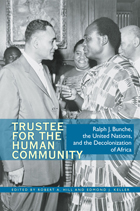
Ralph J. Bunche (1904–1971), winner of the Nobel Peace Prize in 1950, was a key U.S. diplomat in the planning and creation of the United Nations in 1945. In 1947 he was invited to join the permanent UN Secretariat as director of the new Trusteeship Department. In this position, Bunche played a key role in setting up the trusteeship system that provided important impetus for postwar decolonization ending European control of Africa as well as an international framework for the oversight of the decolonization process after the Second World War.
Trustee for the Human Community is the first volume to examine the totality of Bunche’s unrivalled role in the struggle for African independence both as a key intellectual and an international diplomat and to illuminate it from the broader African American perspective.
These commissioned essays examine the full range of Ralph Bunche’s involvement in Africa. The scholars explore sensitive political issues, such as Bunche’s role in the Congo and his views on the struggle in South Africa. Trustee for the Human Community stands as a monument to the profoundly important role of one of the greatest Americans in one of the greatest political movements in the history of the twentieth century.
Contributors: David Anthony, Ralph A. Austen, Abena P. A. Busia, Neta C. Crawford, Robert R. Edgar, Charles P. Henry, Robert A. Hill, Edmond J. Keller, Martin Kilson, Georges Nzongola-Ntalaja, Jon Olver, Pearl T. Robinson, Elliott P. Skinner, Crawford Young
"The experience of reading one of his novels is . . . comparable to one's first reaction to the great Russian novels: the fresh realization of the common humanity of all peoples, underlain by a simultaneous sense of strangeness—like one's own reflection seen in a green twilight."—Margaret Parton, New Herald Tribune Book Review
"The hardest of all things for a novelist to communicate is the extraordinary ordinariness of most human happiness. . . . Jane Austen, Soseki, Chekhov: a few bring it off. Narayan is one of them."—Francis King, Spectator
"The novels of R.K. Narayan are the best I have read in any language for a long time."—Amit Roy, Daily Telegraph

Colonial expert and pamphleteer William Knox has received attention in virtually every major study of the American Revolution, yet this is the first biography of Knox ever written.
Knox is best known as undersecretary of state in the American Department of the British government from 1770 to 1782. A prolific and candid commentator, he also made a reputation as a pamphleteer, defending the imperial cause during the decade preceding the Revolution. It had been his experience as provost marshal in Georgia from 1757 to 1762 that convinced Knox of the danger to the empire of the growing "democratic" forces in the American colonies.
While numerous historical works have focused on this or that aspect of Knox's career and thought, such treatment has produced at best a jigsaw portrait. Bellot's comprehensive narrative reveals Knox as a person—one whose Calvinist heritage and Scots-Irish upbringing profoundly influenced his view of empire—and as a historical actor and witness. Here is a look at the events of the revolutionary period through the eyes of a British bureaucrat who had a significant role in both the formation and the execution of British policy. This perspective also provides an excellent case study of the operation of the eighteenth-century British bureaucracy.
Beginning in 1975 with the Ford administration, in a job procured for him by friend and tennis partner George H. W. Bush, Baker was in the thick of American politics. He recounts the inside story of Ford’s rejection of Reagan as a running mate in 1976 with the same insight he has into Reagan’s rejection of Ford four years later. When the White House was plunged into turmoil after the Reagan assassination attempt, he was there, and his stories take readers deeper into those chaotic days. Baker was on hand for the George H. W. Bush campaign’s battle over running mate Dan Quayle and, more recently, he was again on the front row as George W. Bush fought it out in Florida. Spellbinding and frank, his stories are the ones between the lines of our history books.
In this new edition, Baker also responds for the first time in print to the George W. Bush administration’s reaction to the Iraq Study Group Report, written with his input. Baker is very qualified to comment on the political operation of the current administration, and his new writing for this paperback brings the full weight of his experience to bear.
As National Security Adviser to President Jimmy Carter, Zbigniew Brzezinski (1928–2017) guided U.S. foreign policy at a critical juncture of the Cold War. But his impact on America’s role in the world extends far beyond his years in the White House, and reverberates to this day. His geopolitical vision, scholarly writings, frequent media appearances, and policy advice to decades of presidents from Lyndon Johnson to Barack Obama made him America’s grand strategist, a mantle only Henry Kissinger could also claim.
Both men emigrated from turbulent Europe in 1938 and got their Ph.D.s in the 1950s from Harvard, then the epitome of the Cold War university. With its rise to global responsibilities, the United States needed professionals. Ambitious academics like Brzezinski soon replaced the old establishment figures who had mired the country in Vietnam, and they transformed the way America conducted foreign policy.
Justin Vaïsse offers the first biography of the successful immigrant who completed a remarkable journey from his native Poland to the White House, interacting with influential world leaders from Gloria Steinem to Deng Xiaoping to John Paul II. This complex intellectual portrait reveals a man who weighed in on all major foreign policy debates since the 1950s, from his hawkish stance on the USSR to his advocacy for the Middle East peace process and his support for a U.S.-China global partnership. Through its examination of Brzezinski’s statesmanship and comprehensive vision, Zbigniew Brzezinski raises important questions about the respective roles of ideas and identity in foreign policy.
READERS
Browse our collection.
PUBLISHERS
See BiblioVault's publisher services.
STUDENT SERVICES
Files for college accessibility offices.
RECENTLY PUBLISHED



UChicago Accessibility Resources
home | accessibility | search | about | contact us
BiblioVault ® 2001 - 2024
The University of Chicago Press