
 A SCHOLARLY BOOK REPOSITORY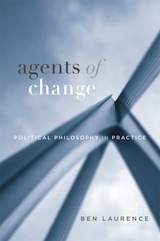
An incisive argument for the relevance of political philosophy and its possibility of effecting change.
The appeal of political philosophy is that it will answer questions about justice for the sake of political action. But contemporary political philosophy struggles to live up to this promise. Since the death of John Rawls, political philosophers have become absorbed in methodological debates, leading to an impasse between two unattractive tendencies: utopians argue that philosophy should focus uncompromisingly on abstract questions of justice, while pragmatists argue that we should concern ourselves only with local efforts to ameliorate injustice. Agents of Change shows a way forward.
Ben Laurence argues that we can combine utopian justice and the pragmatic response to injustice in a political philosophy that unifies theory and practice in pursuit of change. Political philosophy, on this view, is not a purely normative theory disconnected from practice. Rather, political philosophy is itself a practice—an exercise of practical reason issuing in action. Laurence contends that this exercise begins in ordinary life with the confrontation with injustice. Philosophy draws ideas about justice from this encounter to be pursued through political action. Laurence shows that the task of political philosophy is not complete until it asks the question “What is to be done?” and deliberates actionable answers.

Through vivid and searching portraits of these three redoubtable journalists, prize-winning historian John L. Thomas traces for the first time the evolving ideologies of the most significant reformers of their age.
Henry George’s Progress and Poverty, Edward Bellamy’s Looking Backward, and Henry Lloyd’s Wealth against Commonwealth each in its turn became an international bestseller, championing a course of national policy and social reform that owed allegiance neither to the large-scale capitalist model then emerging, nor to the bureaucratic socialism espoused on the left. Also common to the vast writings of all three were a deep distrust of partisan machine politics and a mounting sense of social crisis which neither spoilsmanship nor materialism seemed able to address.
Seeking instead diversity and cooperation within society, small economic units, and simplicity in government, the authors of these works were moved to defend strikes during the heyday of industrial capitalism. They spoke out for international peace when imperialism was rampant. They called for the preservation of community values in the face of urban sprawl. And they urged the goals of brotherhood and interdependence in an age when survival of the fittest was seen as holy writ.
They failed magnificently as apostles of a radical culture based on the ideal of a community, yet their intellectual legacy was not lost: their heirs include the broad movement that took the name Progressive, the New Deal, and the hopeful crusades of the 1960s. This magnificent book is their memorial and their history.
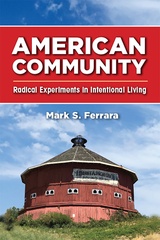
American Community takes us inside forty of the most interesting intentional communities in the nation’s history, from the colonial era to the present day. You will learn about such little-known experiments in cooperative living as the Icarian communities, which took the utopian ideas expounded in a 1840 French novel and put them into practice, ultimately spreading to five states over fifty years. Plus, it covers more recent communities such as Arizona’s Arcosanti, designed by architect Paolo Soleri as a model for ecologically sustainable living.
In this provocative and engaging book, Mark Ferrara guides readers through an array of intentional communities that boldly challenged capitalist economic arrangements in order to attain ideals of harmony, equality, and social justice. By shining a light on these forgotten histories, it shows that far from being foreign concepts, communitarianism and socialism have always been vital parts of the American experience.

Automating technologies threaten to usher in a workless future. But this can be a good thing—if we play our cards right.
Human obsolescence is imminent. The factories of the future will be dark, staffed by armies of tireless robots. The hospitals of the future will have fewer doctors, depending instead on cloud-based AI to diagnose patients and recommend treatments. The homes of the future will anticipate our wants and needs and provide all the entertainment, food, and distraction we could ever desire.
To many, this is a depressing prognosis, an image of civilization replaced by its machines. But what if an automated future is something to be welcomed rather than feared? Work is a source of misery and oppression for most people, so shouldn’t we do what we can to hasten its demise? Automation and Utopia makes the case for a world in which, free from need or want, we can spend our time inventing and playing games and exploring virtual realities that are more deeply engaging and absorbing than any we have experienced before, allowing us to achieve idealized forms of human flourishing.
The idea that we should “give up” and retreat to the virtual may seem shocking, even distasteful. But John Danaher urges us to embrace the possibilities of this new existence. The rise of automating technologies presents a utopian moment for humankind, providing both the motive and the means to build a better future.
2023 Honorable Mention Best History Book, International Latino Book Awards
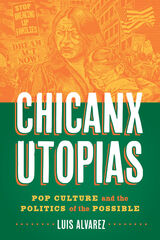
Broad and encompassing examination of Chicanx popular culture since World War II and the utopian visions it articulated
Amid the rise of neoliberalism, globalization, and movements for civil rights and global justice in the post–World War II era, Chicanxs in film, music, television, and art weaponized culture to combat often oppressive economic and political conditions. They envisioned utopias that, even if never fully realized, reimagined the world and linked seemingly disparate people and places. In the latter half of the twentieth century, Chicanx popular culture forged a politics of the possible and gave rise to utopian dreams that sprang from everyday experiences.
In Chicanx Utopias, Luis Alvarez offers a broad study of these utopian visions from the 1950s to the 2000s. Probing the film Salt of the Earth, brown-eyed soul music, sitcoms, poster art, and borderlands reggae music, he examines how Chicanx pop culture, capable of both liberation and exploitation, fostered interracial and transnational identities, engaged social movements, and produced varied utopian visions with divergent possibilities and limits. Grounded in the theoretical frameworks of Walter Benjamin, Stuart Hall, and the Zapatista movement, this book reveals how Chicanxs articulated pop cultural utopias to make sense of, challenge, and improve the worlds they inhabited.
A sweeping history of American cities and towns, and the utopian aspirations that shaped them, by one of America’s leading urban planners and scholars.
The first European settlers saw America as a paradise regained. The continent seemed to offer a God-given opportunity to start again and build the perfect community. Those messianic days are gone. But as Alex Krieger argues in City on a Hill, any attempt at deep understanding of how the country has developed must recognize the persistent and dramatic consequences of utopian dreaming. Even as ideals have changed, idealism itself has for better and worse shaped our world of bricks and mortar, macadam, parks, and farmland. As he traces this uniquely American story from the Pilgrims to the “smart city,” Krieger delivers a striking new history of our built environment.
The Puritans were the first utopians, seeking a New Jerusalem in the New England villages that still stand as models of small-town life. In the Age of Revolution, Thomas Jefferson dreamed of citizen farmers tending plots laid out across the continent in a grid of enlightened rationality. As industrialization brought urbanization, reformers answered emerging slums with a zealous crusade of grand civic architecture and designed the vast urban parks vital to so many cities today. The twentieth century brought cycles of suburban dreaming and urban renewal—one generation’s utopia forming the next one’s nightmare—and experiments as diverse as Walt Disney’s EPCOT, hippie communes, and Las Vegas.
Krieger’s compelling and richly illustrated narrative reminds us, as we formulate new ideals today, that we chase our visions surrounded by the glories and failures of dreams gone by.
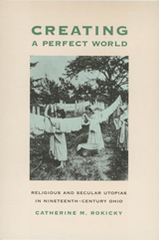
Powerful currents of religious revival and political and social reform swept nineteenth-century America. Many people expressed their radical religious and social ideals by creating or joining self-contained utopian communities. These utopianists challenged the existing social and economic order with alternative notions about religion, marriage, family, sexuality, property ownership, and wage labor.
Between 1787 and 1919, approximately 270 utopian communities existed in the United States. Due to its unique location on the young nation’s frontier, the state of Ohio was the site of much of this activity.
Creating a Perfect World examines Ohio’s utopian movements, both religious and secular. These include the United Society of Believers in Christ’s Second Coming, or Shakers; the Society of Separatists at Zoar; the Mormons, who stopped in the state for several years on their way west; and several societies based on the philosophies of European social reformers Robert Owen and Charles Fourier.
In this detailed account of a unique and fascinating chapter in Ohio’s history, Catherine M. Rokicky profiles these communities and explores their ideals, how and why they were established, their leaders, and their members’ reasons for joining and sometimes leaving. She also examines the roles men and women played, their approaches to communal living and community property, their economic activities, their relations with surrounding communities and the state, and the various reasons for their success or failure.
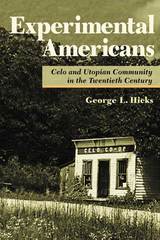
From colonial times to the present, the United States has been home to a steady stream of utopian experimental communities. In Experimental Americans, George L. Hicks takes us inside one of the longer-lived of such communities, Celo Community in western North Carolina, to explore the dynamics of intentional communities in America.
Founded in 1937 by Arthur Morgan, first chairman of the Tennessee Valley Authority, Celo (pronounced see-lo) established its own rules of land tenure and taxation, conducted its internal business by consensus, and did not require its members to accept any particular ideology or religious creed. Drawing on extensive fieldwork in Celo and among its local neighbors, consultation of Celo's documentary records, and interviews with ex-members, Hicks traces the Community's ups and downs. Attacked for its opposition to World War II, Celo was revived by pacifists released from prisons and Civilian Public Service camps after the war; debilitated in the 1950s by bitter feuds with ex-members, it was buoyed up in the 1960s by the radical enthusiasm of new currents in the nation.
Hicks assesses the Community's success in creating alternatives to mainstream social relations and examines the interactions between Celo and its neighboring community. He considers variations in paths taken by utopian communities, with a look at a close cousin of Celo, the Macedonia Community in Georgia. He also discusses the Community's "post-utopian" phase, marked by a shift in the late 1970s from social goals to straightforward land management.
While utopian communities might hope to secede from American society in varying degrees and to institute new and improved cultural models, nonetheless they express in many ways the attempt--characteristic of the nation itself--to balance individualism and egalitarianism. By providing the context, utopian and conventional, within which Celo and other experimental communities emerge and change, Experimental Americans illuminates an ongoing encounter with persistent tensions and contradictions in America's cultural postulates.

When capitalism is clearly catastrophically out of control and its excesses cannot be sustained socially or ecologically, the ideas of Herbert Marcuse become as relevant as they were in the 1960s. This is the first English introduction to Marcuse to be published for decades, and deals specifically with his aesthetic theories and their relation to a critical theory of society.
Although Marcuse is best known as a critic of consumer society, epitomised in the classic One-Dimensional Man, Malcolm Miles provides an insight into how Marcuse's aesthetic theories evolved within his broader attitudes, from his anxiety at the rise of fascism in the 1930s through heady optimism of the 1960s, to acceptance in the 1970s that radical art becomes an invaluable progressive force when political change has become deadlocked.
Marcuse's aesthetics of liberation, in which art assumes a primary role in interrupting the operation of capitalism, made him a key figure for the student movement in the 1960s. As diverse forms of resistance rise once more, a new generation of students, scholars and activists will find Marcuse’s radical theory essential to their struggle.

Drawing on the history of utopian thought, as well as on her own research on utopian communities, Kitch defines utopian thinking, explores the pitfalls of pursuing social change based on utopian ideas, and argues for a "higher ground" —a contrasting approach she calls realism. Replacing utopianism with realism helps to eliminate self-defeating notions in feminist theory, such as false generalization, idealization, and unnecessary dichotomies. Realistic thought, however, allows feminist theory to respond to changing circumstances, acknowledge sameness as well as difference, value the past and the present, and respect ideological give-and-take.
An important critique of feminist thought, Kitch concludes with a clear, exciting vision for a feminist future without utopia.
"A small masterwork . . . a stringent examination of some persistent and murky notions in human history. . . . It is best to read Cioran while sitting. The impact upon the intellect can be temporarily stunning, and motor systems may give way under the assault."—Joseph Patrick Kennedy, Houston Chronicle
"Cioran has a claim to be regarded as among the handful of original minds . . . writing today."—New York Times
"A sort of final philosopher of the Western world. [Cioran's] statements have the compression of poetry and the audacity of cosmic clowning."—Washington Post
E. M. Cioran (1911-1995) was born and educated in Romania and lived in Paris from 1937 until his death. He is the author of numerous works, including On the Heights of Despair, also available from the University of Chicago Press.
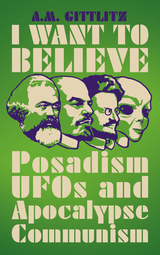
Advocating nuclear war, attempting communication with dolphins, and taking an interest in the paranormal and UFOs, there is perhaps no greater (or stranger) cautionary tale for the Left than that of Posadism. Named after the Argentine Trotskyist J. Posadas, the movement’s journey through the fractious and sectarian world of mid-20th century revolutionary socialism was unique. This book is a “dumpster dive” into the weird and wonderful world of the Posadists.
Although at times significant, Posadas' movement was ultimately a failure. As it disintegrated, it increasingly grew to resemble a bizarre cult, detached from the working class it sought to liberate. The renewed interest in Posadism today, especially for its more outlandish fixations, speaks to both a cynicism towards the past and nostalgia for the earnest belief that a better world is possible. Chapters include:
*Revolutionary Youth or Patriotic Youth
*The Death Throes of Capitalism
*The Origins of Posadism
*Flying Saucers, the Process of Matter and Energy, Science, the Revolutionary and Working-Class Stuggle, and the Socialist Future of Mankind
*What Exists Cannot be True
*Why Don’t Extraterrestrials Make Public Contact
*UFOs to the People
In the Introduction, A.M. Gittlitz writes, “Insurrection or first contact could come any day, Marxists and ufologists both tell us, but both are far more likely if we desire them, embracing a sentiment enigmatically expressed in a meme come before its time, a poster on the wall of rouge FBI agent Fox Mulder in the ‘90s sci-fi noir The X-Files: hovering alongside a granny image of a comically unconvincingly flying saucer and the words I WANT TO BELIEVE".
Drawing on considerable archival research, and numerous interviews with ex- and current Posadists, I Want to Believe tells the fascinating story of this most unusual socialist movement and considers why it continues to capture the imaginations of leftists today.
An appeal for the importance of theory, utopia, and close consideration of our contemporary dark times
What does any particular theory allow us to do? What is the value of doing so? And who benefits? In Invoking Hope, Phillip E. Wegner argues for the undiminished importance of the practices of theory, utopia, and a deep and critical reading of our current situation of what Bertolt Brecht refers to as finsteren Zeiten, or dark times.
Invoking Hope was written in response to three events that occurred in 2016: the five hundredth anniversary of the publication of Thomas More’s Utopia; the one hundredth anniversary of the founding text in theory, Ferdinand de Saussure’s Course in General Linguistics; and the rise of the right-wing populism that culminated in the election of Donald Trump. Wegner offers original readings of major interventions in theory alongside dazzling utopian imaginaries developed from classical Greece to our global present—from Theodor Adorno, Ernst Bloch, Alain Badiou, Jacques Derrida, Fredric Jameson, Sarah Ahmed, Susan Buck-Morss, and Jacques Lacan to such works as Plato’s Republic, W. E. B. Du Bois’s John Brown, Isak Dinesen’s “Babette’s Feast,” Kim Stanley Robinson’s 2312, and more. Wegner comments on an expansive array of modernist and contemporary literature, film, theory, and popular culture.
With Invoking Hope, Wegner provides an innovative lens for considering the rise of right-wing populism and the current crisis in democracy. He discusses challenges in the humanities and higher education and develops strategies of creative critical reading and hope against the grain of current trends in scholarship.
After communism collapsed in the former Soviet Union, capitalism seemed to many observers like the only game in town, and questioning it became taboo for academic economists. But the financial crisis, chronic unemployment, and the inexorable rise of inequality have resurrected the question of whether there is a feasible and desirable alternative to capitalism. Against this backdrop of growing disenchantment, Giacomo Corneo presents a refreshingly antidogmatic review of economic systems, taking as his launching point a fictional argument between a daughter indignant about economic injustice and her father, a professor of economics.
Is Capitalism Obsolete? begins when the daughter’s angry complaints prompt her father to reply that capitalism cannot responsibly be abolished without an alternative in mind. He invites her on a tour of tried and proposed economic systems in which production and consumption obey noncapitalistic rules. These range from Plato’s Republic to diverse modern models, including anarchic communism, central planning, and a stakeholder society. Some of these alternatives have considerable strengths. But daunting problems arise when the basic institutions of capitalism—markets and private property—are suppressed. Ultimately, the father argues, all serious counterproposals to capitalism fail to pass the test of economic feasibility. Then the story takes an unexpected turn. Father and daughter jointly come up with a proposal to gradually transform the current economic system so as to share prosperity and foster democratic participation.
An exceptional combination of creativity and rigor, Is Capitalism Obsolete? is a sorely needed work about one of the core questions of our times.
Utopian thinking is often dismissed as unrealistic, overly idealized, and flat-out impractical—in short, wholly divorced from the urgent conditions of daily life. This is perhaps especially true when the utopian ideal in question is reforming and repairing the United States’ bitter history of racial injustice. But as Victoria W. Wolcott provocatively argues, utopianism is actually the foundation of a rich and visionary worldview, one that specifically inspired the major figures of the Civil Rights Movement in ways that haven’t yet been fully understood or appreciated.
Wolcott makes clear that the idealism and pragmatism of the Civil Rights Movement were grounded in nothing less than an intensely utopian yearning. Key figures of the time, from Martin Luther King Jr. and Pauli Murray to Father Divine and Howard Thurman, all shared a belief in a radical pacificism that was both specifically utopian and deeply engaged in changing the current conditions of the existing world. Living in the Future recasts the various strains of mid-twentieth-century civil rights activism in a utopian light, revealing the power of dreaming in a profound and concrete fashion, one that can be emulated in other times that are desperate for change, like today.
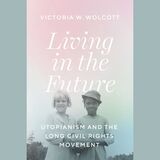
This is an auto-narrated audiobook edition of this book.
Living in the Future reveals the unexplored impact of utopian thought on the major figures of the Civil Rights Movement.
Utopian thinking is often dismissed as unrealistic, overly idealized, and flat-out impractical—in short, wholly divorced from the urgent conditions of daily life. This is perhaps especially true when the utopian ideal in question is reforming and repairing the United States’ bitter history of racial injustice. But as Victoria W. Wolcott provocatively argues, utopianism is actually the foundation of a rich and visionary worldview, one that specifically inspired the major figures of the Civil Rights Movement in ways that haven’t yet been fully understood or appreciated.
Wolcott makes clear that the idealism and pragmatism of the Civil Rights Movement were grounded in nothing less than an intensely utopian yearning. Key figures of the time, from Martin Luther King Jr. and Pauli Murray to Father Divine and Howard Thurman, all shared a belief in a radical pacificism that was both specifically utopian and deeply engaged in changing the current conditions of the existing world. Living in the Future recasts the various strains of mid-twentieth-century civil rights activism in a utopian light, revealing the power of dreaming in a profound and concrete fashion, one that can be emulated in other times that are desperate for change, like today.
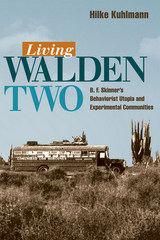
In the novel, behavioral engineers use positive reinforcement in organizing and "gently guiding" all aspects of society, leaving the rest of the citizens "free" to lead happy and carefree lives. Among the real-world communities, a recurrent problem in moving past the planning stages was the nearly ubiquitous desire among members to be gentle guides, coupled with strong resistance to being guided.
In an insightful and often hilarious narrative, Hilke Kuhlmann explores the dynamics of the communities, with an in-depth examination of the two surviving Skinnerian communities: Comunidad Los Horcones in Mexico, and Twin Oaks in Virginia. Drawing on extensive interviews with the founders and key players in the Walden Two communities, Kuhlmann redefines the criteria for their success by focusing on the tension between utopian blueprints for a new society and communal experiments' actual effects on individual lives.

The town boasts a saloon, general store, hitching posts, and rodeos. Yet, above all of this stands a little church—the heart of what Barker conceived as his Christian utopia. This unique combination has led to more than forty years of philanthropic ventures, controversial events such as the Love Valley Rock Festival, stories and legends, and political ambition. Love Valley: An American Utopia captures the history of this town in narrative form while arguing that Love Valley’s founders were motivated by utopian goals.

Naked in the Woods chronicles Grundstein’s shift from reluctant hippie to committed utopian—sacrificing phones, electricity, and running water to live on 160 acres of remote forest with nothing but a drafty cabin and each other. Grundstein, (whose husband left, seduced by “freer love”) faced tough choices. Could she make it as a single woman in man’s country? Did she still want to? How committed was she to her new life? Although she reveled in the shared transcendence of communal life deep in the natural world, disillusionment slowly eroded the dream. Brotherhood frayed when food became scarce. Rifts formed over land ownership. Dogma and reality clashed.
Many people, baby boomers and millennials alike, have romantic notions about the 1960s and 70s. Grundstein’s vivid account offers an unflinching, authentic portrait of this iconic and often misreported time in American history. Accompanied by a collection of distinctive photographs she took at the time, Naked in the Woods draws readers into a period of convulsive social change and raises timeless questions: how far must we venture to find the meaning we seek, and is it ever far out enough to escape our ingrained human nature?
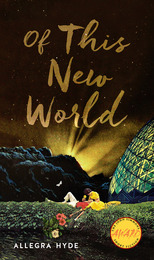
Over the course of twelve stories, Hyde writes with a mix of lyricism, humor, and masterful detail. A group of environmental missionaries seeks to start an ideal eco-society on an island in The Bahamas, only to unwittingly tyrannize the local inhabitants. The neglected daughter of a floundering hippie commune must adjust to conventional life with her un-groovy grandmother. Haunted by her years at a collegiate idyll, a young woman eulogizes a friendship. After indenturing his only son to the Shakers, an antebellum vegan turns to Louisa May Alcott’s famous family for help. And in the final story, a former drug addict chases a second chance at life in a government-sponsored space population program. An unmissable debut, the collection charts the worlds born in our dreams and bred in hope.
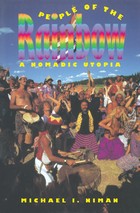
A fictional re-creation of a day in the life of a Rainbow character named Sunflower begins the book, illustrating events that might typically occur at an annual North American Rainbow Gathering. Using interviews with Rainbows, content analysis of media reports, participant observation, and scrutiny of government documents relating to the group, Niman presents a complex picture of the Family and its relationship to mainstream culture—called "Babylon" by the Rainbows. Niman also looks at internal contradictions within the Family and examines members' problematic relationship with Native Americans, whose culture and spiritual beliefs they have appropriated.
The nomadic nature of the Rainbow Family has long exasperated the U.S. government--especially the Forest Service--and has baffled the media. Niman places the Rainbow Family's gatherings in a historical context by framing the group's activities in terms of the long tradition of intentional communities and utopian experimentation within the United States. Concluding with reflections on the successes and limitations of the Rainbow movement, People of the Rainbow provides an extensive ethnography of this intriguing subculture and provides fresh insights into the ongoing legacy of utopian communalism.
The Author: Michael I. Niman is an adjunct assistant professor of American studies at the State University of New York at Buffalo and a lecturer in the communication department at Buffalo State College.
"Mr. Gilbert's splendid book opens the door on a conflicted past, and provides an indispensable perspective on the troubled and troubling struggle we face today between old and new, unity and diversity."—Alan Trachtenberg, New York Times
"Perfect Cities is a remarkable account of a struggle for cultural definition. Chronicling the byplay between cultural homogeneity and heterogeneity, unity and diversity, James Gilbert not only throws light on Chicago's past but also provides insight that can be applied to the cultural debates of our own time."—Adria Bernardi, Chicago Tribune
"What Gilbert has done is to enable the reader to experience the grand utopian visions of the times, yet at the same time see the cantankerous reality that made the visions impossible."—Henry Kisor, Chicago Sun-Times
What is the best possible society? How would its rulers govern and its citizens behave? Such questions are sometimes dismissed as distractions from genuine political problems, but in an era when political idealism seems a relic of the past, says Jonny Thakkar, they are more urgent than ever. A daring experiment in using ancient philosophy to breathe life into our political present, Plato as Critical Theorist takes seriously one of Plato’s central claims: that philosophers should rule. What many accounts miss is the intimate connection between Plato’s politics and his metaphysics, Thakkar argues. Philosophy is the activity of articulating how parts and wholes best fit together, while ruling is the activity that shapes the parts of society into a coherent whole conducive to the good life. Plato’s ideal society is thus one in which ideal theory itself plays a leading role.
Today’s liberal democracies require not philosopher-kings legislating from above but philosopher-citizens willing to work toward a vision of the best society in their daily lives. Against the claim that such idealism is inherently illiberal, Thakkar shows that it is fully compatible with the liberal theories of both Popper and Rawls while nevertheless pushing beyond them in providing a new vantage point for the Marxian critique of capitalism.
Contributors. Roland Boer, Frances Daly, Henk de Berg, Vincent Geoghegan, Wayne Hudson, Ruth Levitas, David Miller, Catherine Moir, Caitríona Ní Dhúill, Welf Schröter, Johan Siebers, Peter Thompson, Francesca Vidal, Rainer Ernst Zimmermann, Slavoj Žižek

Punk Identities, Punk Utopias unpacks punk and the factors that shape its increasingly complex and indefinable social, political, and economic setting. The third offering in Intellect’s Global Punk series, produced in collaboration with the Punk Scholars Network, this volume examines the broader social, political, and technological concerns that affect punk scenes around the world, from digital technology and new media to gender, ethnicity, identity, and representation.
Drawing on scholarship in cultural studies, musicology, and social sciences, this interdisciplinary collection will add to the academic discussion of contemporary popular culture, particularly in relation to punk and the critical understanding of transnational and cross-cultural dialogue.
Raymond Geuss is one of the most inventive and distinctive voices in contemporary political philosophy and a trenchant critic of the field’s dominant assumptions. In Reality and Its Dreams, he challenges the “normative turn” in political philosophy—the idea that the right approach to politics is to start from thinking abstractly about our own normative views and then, when they have been clarified and systematized, apply them to judging political structures, decisions, and events. Rather, the study of politics should be focused on the sphere of real politics, not least because normative judgments always arise from concrete historical configurations of power, including ideological power.
It is possible to do this without succumbing to a numbing or toxic form of relativism or abandoning utopianism, although utopianism needs to be reunderstood. The utopian impulse is not an attempt to describe a perfect society but an impulse to think the impossible in politics, to articulate deep-seated desires that cannot be realized under current conditions, and to imagine how conditions that seem invariant can be changed.
Geuss ranges widely across philosophy, literature, and art, exploring past and present ideas about such subjects as envy, love, satire, and evil and the work of figures as diverse as John Rawls, St. Augustine, Rabelais, and Russell Brand. His essays provide a bracing critique of ideas, too often unexamined, that shape and misshape our intellectual and political worlds.
Martínez Andrade focuses on the central role of religion in the region and how it influences people’s interaction with changes in modern economics. Capitalism in Latin America, Martínez Andrade argues, has taken on religious characteristics, with places of worship—shopping malls and department stores—as well as its own prophets. This form of cultural religion is often contradictory in surprising ways: not only does it legitimate oppression, it can also be a powerful source of rebellion, unveiling a subversive side to the status quo. Religion Without Redemption advances the ideas of liberation theory, and challenges the provincialism to which many Latin American thinkers are usually consigned.
The Platonic ideal of government.
Plato of Athens, who laid the foundations of the Western philosophical tradition and in range and depth ranks among its greatest practitioners, was born to a prosperous and politically active family ca. 427 BC. In early life an admirer of Socrates, Plato later founded the first institution of higher learning in the West, the Academy, among whose many notable alumni was Aristotle. Traditionally ascribed to Plato are thirty-six dialogues developing Socrates’ dialectic method and composed with great stylistic virtuosity, together with thirteen letters.
Republic, a masterpiece of philosophical and political thought, concerns righteousness both in individuals and in communities, and proposes an ideal state organized and governed on philosophical principles. This edition, which replaces the original Loeb edition by Paul Shorey, offers text, translation, and annotation that are fully current with modern scholarship. The Loeb Classical Library edition of Plato is in twelve volumes.
The Platonic ideal of government.
Plato of Athens, who laid the foundations of the Western philosophical tradition and in range and depth ranks among its greatest practitioners, was born to a prosperous and politically active family ca. 427 BC. In early life an admirer of Socrates, Plato later founded the first institution of higher learning in the West, the Academy, among whose many notable alumni was Aristotle. Traditionally ascribed to Plato are thirty-six dialogues developing Socrates’ dialectic method and composed with great stylistic virtuosity, together with thirteen letters.
Republic, a masterpiece of philosophical and political thought, concerns righteousness both in individuals and in communities, and proposes an ideal state organized and governed on philosophical principles. This edition, which replaces the original Loeb edition by Paul Shorey, offers text, translation, and annotation that are fully current with modern scholarship. The Loeb Classical Library edition of Plato is in twelve volumes.
In the years immediately following Napoleon’s defeat, French thinkers in all fields set their minds to the problem of how to recover from the long upheavals that had been set into motion by the French Revolution. Many challenged the Enlightenment’s emphasis on mechanics and questioned the rising power of machines, seeking a return to the organic unity of an earlier age and triggering the artistic and philosophical movement of romanticism. Previous scholars have viewed romanticism and industrialization in opposition, but in this groundbreaking volume John Tresch reveals how thoroughly entwined science and the arts were in early nineteenth-century France and how they worked together to unite a fractured society.
Focusing on a set of celebrated technologies, including steam engines, electromagnetic and geophysical instruments, early photography, and mass-scale printing, Tresch looks at how new conceptions of energy, instrumentality, and association fueled such diverse developments as fantastic literature, popular astronomy, grand opera, positivism, utopian socialism, and the Revolution of 1848. He shows that those who attempted to fuse organicism and mechanism in various ways, including Alexander von Humboldt and Auguste Comte, charted a road not taken that resonates today.
Essential reading for historians of science, intellectual and cultural historians of Europe, and literary and art historians, The Romantic Machine is poised to profoundly alter our understanding of the scientific and cultural landscape of the early nineteenth century.
How nineteenth-century social reformers devised a new set of radical blueprints for society
In the middle of the nineteenth century, a utopian impulse flourished in the United States through the circulation of architectural and urban plans predicated on geometrically distinct designs. Though the majority of such plans remained unrealized, The Shape of Utopia emphasizes the enduring importance of these radical propositions and their ability to visualize alternatives to what was then a newly emerging capitalist nation.
Drawing diagrammatic plans for structures such as octagonal houses, a hexagonal anarchist city, and circular centers of equitable commerce, these various architectural utopians applied geometric forms to envision a more just and harmonious society. Highlighting the inherent political capacity of architecture, Irene Cheng showcases how these visionary planners used their blueprints as persuasive visual rhetoric that could mobilize others to share in their aspirations for a better world.
Offering an extensive and uniquely focused view of mid-nineteenth-century America’s rapidly changing cultural landscape, this book examines these utopian plans within the context of significant economic and technological transformation, encompassing movements such as phrenology, anarchism, and spiritualism. Engaging equally with architectural history, visual culture studies, and U.S. history, The Shape of Utopia documents a pivotal moment in American history when ordinary people ardently believed in the potential to reshape society.

This first book-length study of the Ruskin colonies shows how several hundred utopian socialists gathered as a cooperative community in Tennessee and Georgia in the late nineteenth century. The communitarians' noble but fatally flawed act of social endeavor revealed the courage and desperation they felt as they searched for alternatives to the chaotic and competitive individualism of the age of robber barons and for a viable model for a just and humane society at a time of profound uncertainty about public life in the United States.
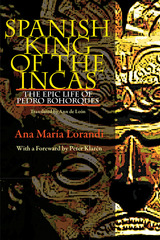
Described in his lifetime as “mad,” “a dreamer,” “quixotic,” and “a lunatic,” Pedro Bohorques is one of the most fascinating personalities of Spanish colonial America. A common man from an ordinary Andalusian family, he sought his fortune in the new world as a Renaissance adventurer.
Smitten with the idea of the mythical cities of gold, Bohorques led a series of expeditions into the jungles of Peru searching for the paradise of El Dorado. Having mastered the Quechua language of the countryside, he presented himself as a descendent of Inca royalty and quickly rose to power as a king among the Calchaquíes of Tucumán. He was later arrested and executed by the crown for his participation in a peasant revolt against Spanish rule.
In Spanish King of the Incas, Ana María Lorandi examines Bohorques as a character whose vision, triumphs, and struggles are a reflection of his seventeenth-century colonial world. In this thoroughly engaging ethnohistory, Lorandi brings to light the many political and cultural forces of the time. The status of the Inca high nobility changed dramatically after the Spanish conquest, as native populations were subjugated by the ruling class. Utopian ideals of new cities of riches such as El Dorado prevailed in the public imagination alongside a desire to restore an idealized historic past. As the Middle Ages gave way to the new belief systems of the Renaissance, ingenuousness about mythical creatures became strong, and personal success was measured by the performance of heroic deeds and the attainment of kingdoms. Charismatic and bold, Pedro Bohorques flourished in the ambiguous margins of this society full of transition and conflict.
Ann de León's artful translation preserves both the colorful details of the story and the clarity of expression in Lorandi's complex analyses.
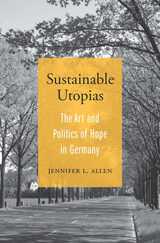
To reclaim a sense of hope for the future, German activists in the late twentieth century engaged ordinary citizens in innovative projects that resisted alienation and disenfranchisement.
By most accounts, the twentieth century was not kind to utopian thought. The violence of two world wars, Cold War anxieties, and a widespread sense of crisis after the 1973 global oil shock appeared to doom dreams of a better world. The eventual victory of capitalism and, seemingly, liberal democracy relieved some fears but exchanged them for complacency and cynicism.
Not, however, in West Germany. Jennifer Allen showcases grassroots activism of the 1980s and 1990s that envisioned a radically different society based on community-centered politics—a society in which the democratization of culture and power ameliorated alienation and resisted the impotence of end-of-history narratives. Berlin’s History Workshop liberated research from university confines by providing opportunities for ordinary people to write and debate the story of the nation. The Green Party made the politics of direct democracy central to its program. Artists changed the way people viewed and acted in public spaces by installing objects in unexpected environments, including the Stolpersteine: paving stones, embedded in residential sidewalks, bearing the names of Nazi victims. These activists went beyond just trafficking in ideas. They forged new infrastructures, spaces, and behaviors that gave everyday people real agency in their communities. Undergirding this activism was the environmentalist concept of sustainability, which demanded that any alternative to existing society be both enduring and adaptable.
A rigorous but inspiring tale of hope in action, Sustainable Utopias makes the case that it is still worth believing in human creativity and the labor of citizenship.
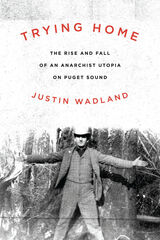
The true story of an anarchist colony on a remote Puget Sound peninsula, Trying Home traces the history of Home, Washington, from its founding in 1896 to its dissolution amid bitter infighting in 1921.
As a practical experiment in anarchism, Home offered its participants a rare degree of freedom and tolerance in the Gilded Age, but the community also became notorious to the outside world for its open rejection of contemporary values. Using a series of linked narratives, Trying Home reveals the stories of the iconoclastic individuals who lived in Home, among them Lois Waisbrooker, an advocate of women’s rights and free love, who was arrested for her writings after the assassination of President McKinley; Jay Fox, editor of The Agitator, who defended his right to free speech all the way to the Supreme Court; and Donald Vose, a young man who grew up in Home and turned spy for a detective agency.
Justin Wadland weaves his own discovery of Home—and his own reflections on the concept of home—into the story, setting the book apart from a conventional history. After discovering the newspapers published in the colony, Wadland ventures beyond the documents to explore the landscape, travelling by boat along the steamer route most visitors once took to the settlement. He visits Home to talk with people who live there now.
Meticulously researched and engagingly written, Trying Home will fascinate scholars and general readers alike, especially those interested in the history of the Pacific Northwest, utopian communities, and anarchism.
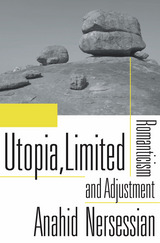
What is utopia if not a perfect world, impossible to achieve? Anahid Nersessian reveals a basic misunderstanding lurking behind that ideal. In Utopia, Limited she enlists William Blake, William Wordsworth, John Keats, and others to redefine utopianism as a positive investment in limitations. Linking the ecological imperative to live within our means to the aesthetic philosophy of the Romantic period, Nersessian’s theory of utopia promises not an unconditionally perfect world but a better world where we get less than we hoped, but more than we had.
For the Romantic writers, the project of utopia and the project of art were identical. Blake believed that without limits, a work of art would be no more than a set of squiggles on a page, or a string of nonsensical letters and sounds. And without boundaries, utopia is merely an extension of the world as we know it, but blighted by a hunger for having it all. Nersessian proposes that we think about utopia as the Romantics thought about aesthetics—as a way to bind and thereby emancipate human political potential within a finite space.
Grounded in an intellectual tradition that begins with Immanuel Kant and includes Theodor Adorno and Northrop Frye, Utopia, Limited lays out a program of “adjustment” that applies the lessons of art to the rigors of life on an imperiled planet. It is a sincere response to environmental devastation, offering us a road map through a restricted future.
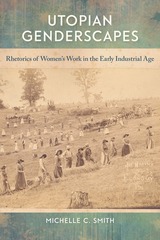
A necessary rhetorical history of women’s work in utopian communities
Utopian Genderscapes focuses on three prominent yet understudied intentional communities—Brook Farm, Harmony Society, and the Oneida Community—who in response to industrialization experimented with radical social reform in the antebellum United States. Foremost among the avenues of reform was the place and substance of women’s work. Author Michelle C. Smith seeks in the communities’ rhetorics of teleology, choice, and exceptionalism the lived consequences of the communities' lofty goals for women members.
This feminist history captures the utopian reconfiguration of women’s bodies, spaces, objects, and discourses and delivers a needed intervention into how rhetorical gendering interacts with other race and class identities. The attention to each community’s material practices reveals a gendered ecology, which in many ways squared unevenly with utopian claims. Nevertheless, this volume argues that this utopian moment inaugurated many of the norms and practices of labor that continue to structure women’s lives and opportunities today: the rise of the factory, the shift of labor from home spaces to workplaces, the invention of housework, the role of birth control and childcare, the question of wages, and the feminization of particular kinds of labor.
An impressive and diverse array of archival and material research grounds each chapter’s examination of women’s professional, domestic, or reproductive labor in a particular community. Fleeting though they may seem, the practices and lives of those intentional women, Smith argues, pattern contemporary divisions of work along the vibrant and contentious lines of gender, race, and class and stage the continued search for what is possible.
This masterly study has a grand sweep. It ranges over centuries, with a long look backward over several millennia. Yet the history it unfolds is primarily the story of individuals: thinkers and dreamers who envisaged an ideal social order and described it persuasively, leaving a mark on their own and later times.
The roster of utopians includes men of all stripes in different countries and eras--figures as disparate as More and Fourier, the Marquis de Sade and Edward Bellamy, Rousseau and Marx. Fascinating character studies of the major figures are among the delights of the book.
Utopian writings run the gamut from fictional narratives to theoretical treatises, from political manifestos to constitutions for a new society. The Manuels have structured five centuries of utopian invention by identifying successive constellations, groups of thinkers joined by common social and moral concerns. Within this framework they analyze individual writings, in the context of the author's life and of the socio-economic, religious, and political exigencies of his time. Concentrating on innovative works, they highlight disjunctures as well as continuities in utopian thought from the Renaissance through the twentieth century.
Witty and erudite, challenging in its interpretations and provocative in the questions it poses, the Manuels' anatomy of utopia is an adventure in ideas.
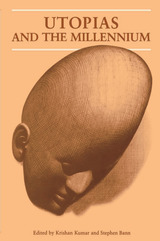
The essays in this book explore aspects of this relationship; some consider their role in the debate concerning human perfectibility, while others examine the rise of secularism. Further contributions reflect upon the apparent failure of the modern Communist utopia, note the recent reappearance of apocalyptic themes in fiction and social theory, or draw on the contributions of feminism and ecology. As our century ends, it seems that utopia and the millennium are once more locked in an uneasy embrace.
With essays by Louis Marin, J. C. Davis, Louis James, Gregory Claeys, Krishan Kumar, Vita Fortunati, David Ayers, Jan Relf and John O'Neill.
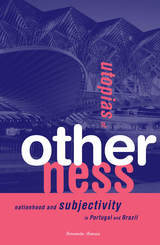
Forges a new understanding of how these two Lusophone nations are connected
The closely entwined histories of Portugal and Brazil remain key references for understanding developments—past and present—in either country. Accordingly, Fernando Arenas considers Portugal and Brazil in relation to one another in this exploration of changing definitions of nationhood, subjectivity, and utopias in both cultures. Examining the two nations’s shared language and histories as well as their cultural, social, and political points of divergence, Arenas pursues these definitive changes through the realms of literature, intellectual thought, popular culture, and political discourse.
Both Brazil and Portugal are subject to the economic, political, and cultural forces of postmodern globalization. Arenas analyzes responses to these trends in contemporary writers including José Saramago, Caio Fernando Abreu, Maria Isabel Barreno, Vergílio Ferreira, Clarice Lispector, and Maria Gabriela Llansol. Ultimately, Utopias of Otherness shows how these writers have redefined the concept of nationhood, not only through their investment in utopian or emancipatory causes such as Marxist revolution, women’s liberation, or sexual revolution, but also by shifting their attention to alternative modes of conceiving the ethical and political realms.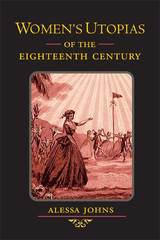
The most studied utopias have been proposed by men, but during the eighteenth century a group of reform-oriented female novelists put forth a series of work that expressed their views of, and their reservations about, ideal societies. In Women's Utopias of the Eighteenth Century, Alessa Johns examines the utopian communities envisaged by Mary Astell, Sarah Fielding, Mary Hamilton, Sarah Scott, and other writers from Britain and continental Europe, uncovering the ways in which they resembled--and departed from--traditional utopias.
Johns demonstrates that while traditional visions tended to look back to absolutist models, women's utopias quickly incorporated emerging liberal ideas that allowed far more room for personal initiative and gave agency to groups that were not culturally dominant, such as the female writers themselves. Women's utopias, Johns argues, were reproductive in nature. They had the potential to reimagine and perpetuate themselves.
READERS
Browse our collection.
PUBLISHERS
See BiblioVault's publisher services.
STUDENT SERVICES
Files for college accessibility offices.
RECENTLY PUBLISHED



UChicago Accessibility Resources
home | accessibility | search | about | contact us
BiblioVault ® 2001 - 2024
The University of Chicago Press