Results by title
2817 books match the query 'Nature' and 238 start with a

Across the Great Border Fault
The Naturalist Myth in AmericaDann, Kevin
Rutgers University Press, 2000
In recent years scholars have begun to question the cultural values underlying our view of Nature. Kevin Dann contributes to this debate by juxtaposing two radically different “Arcadian” experiments founded by Manhattanites seeking cultural renewal through contact with the natural world.
Dann focuses first on initiatives carried out by the American Museum of Natural History and the Eugenics Record Office from 1910 to 1940 within Harriman State Park in the Ramapo Mountains. He argues that these diverse expressions of the early “back-to-nature” movement are united by their biological materialism, or “Naturalism,” which became integral to the popular culture of educated metropolitan Americans in the early twentieth century.
He then compares this activity to the contemporary efforts at nearby Threefold Farm, where anthroposophists--followers of Rudolf Steiner's“spiritual science”--developed a program of natural scientific research and education that directly opposed Darwinian explanations of natural history, social Darwinian views of human society, and reductionist scientific methods. By challenging scientific “fact” with spiritual scientific descriptions of supersensible phenomena, the Threefold Farm initiative offered Americans a new gospel of nature.
Acting with the World
Agency in the AnthropoceneAndrew Pickering
Duke University Press, 2025

Adaptive Strategies and Population Ecology of Northern Grouse
Volume 1. Population StudiesArthur T. Bergerud and Michael W. Gratson, Editors
University of Minnesota Press, 1988
Adaptive Strategies and Population Ecology of Northern Grouse was first published in 1988. Minnesota Archive Editions uses digital technology to make long-unavailable books once again accessible, and are published unaltered from the original University of Minnesota Press editions.
This book is at once a major reference to the species of grouse that inhabit North America and the Holarctic and a synthesis of all the available data on their ecology, sociobiology, population dynamics, and management. The book undertakes to answer two long-standing questions in population ecology: what actually regulates the numbers within a population, and what are the breeding and survival strategies evolved in this northern environment? For Volume I, editors Arthur T. Bergerud and Michael W. Gratson have drawn together their own work and that of colleagues in North America, Iceland, and Norway—in all, eleven research studies, averaging six years' duration, on eight species of grouse. These studies deal with the blue and ruffed grouse of the forest habitat; the sharp-tailed grouse, prairie chicken, and sage grouse of the prairie or steppe; and the white-tailed, rick, and willow ptarmigan found in alpine and arctic tundras. The authors describe the rich repertoire of behavior patterns developed by the hen and the cock to achieve their two primary objectives—first, to stay alive, and then to breed. Volume II, primarily the work of Bergerud, synthesizes the evidence in Volume I and in the grouse research literature from a theoretical perspective. Several potentially controversial sociobiological hypotheses are advanced to account for flocking behavior, migration, dispersal, roosting and feeding behavior, mate choice and mating systems. The demographic analysis provides new insights into cycles of abundance, the limitation of numbers, and the demographic factors that determine densities. The contributors, besides Bergerud and Gratson: R.C. Davies, A. Gardarson, J.E. Hartzler, R.A. Huempfner, D.A. Jenni, D.H. Mossop, S. Myrberget, R.E. Page, R.K. Schmidt, W.D. Svedarsky, and J.R. Tester.
Adaptive Strategies and Population of Northern Grouse
Volume II. Theory and SynthesisArthur T. Bergerud and Michael W. Gratson, Editors
University of Minnesota Press, 1988
Adaptive Strategies and Population of Northern Grouse was first published in 1988. Minnesota Archive Editions uses digital technology to make long-unavailable books once again accessible, and are published unaltered from the original University of Minnesota Press editions.
The first volume contains eleven studies of eight grouse species; the second contains primarily the work of Bergerud, which utilizes the evidence in the first volume to advance theories of behavior and offer new demographic insights.
This second volume contains primarily the work of Bergerud, which utilizes the evidence in the first volume to advance theories of behavior and offer new demographic insights.
Adventures in the Wild
Tales from Biologists of the Natural StateJoy Trauth
University of Arkansas Press, 2008
Adventures with a Texas Naturalist
By Roy Bedichek
University of Texas Press, 1994
A classic since its first publication in 1947, Adventures with a Texas Naturalist distills a lifetime of patient observations of the natural world. This reprint contains a new introduction by noted nature writer Rick Bass.
Aerosol Effects on Climate
S. Gerard Jennings
University of Arizona Press, 1993
Aesop's Anthropology
A Multispecies ApproachJohn Hartigan Jr.
University of Minnesota Press, 0
Forerunners: Ideas First is a thought-in-process series of breakthrough digital publications. Written between fresh ideas and finished books, Forerunners draws on scholarly work initiated in notable blogs, social media, conference plenaries, journal articles, and the synergy of academic exchange. This is gray literature publishing: where intense thinking, change, and speculation take place in scholarship.
Aesthetics of the Natural Environment
Emily Brady
University of Alabama Press, 2003
Aesthetic experience is one of the fundamental ways that we develop a relationship to our natural surroundings. Emily Brady provides a comprehensive study of this type of experience and the central philosophical issues related to it, developing her own original theory of aesthetic appreciation of nature. She provides useful background to the current debate and an up-to-date critical appraisal of contemporary theories.
The context of the contemporary debate is laid out through a discussion of aesthetic experience and aesthetic qualities; early theories of aesthetic appreciation of nature, including the beautiful, the sublime, and the picturesque; and differences between artistic and environmental appreciation and interpretation. Brady situates her own approach in relation to a set of noncognitive accounts of appreciation. Her "integrated aesthetic" brings together various features of appreciation, including the senses, emotion, and imagination, with a reappraisal of the concept of disinterestedness. These ideas are further developed within the more practical domains of aesthetic judgment and education of the environment and through an examination of the role of aesthetic value in environmental conservation.
Arnold Berleant of Long Island University, a pioneer in this area of research, has declared Brady’s work, “admirably comprehensive coverage of the subject.” Julie C. Van Camp of California State University, Long Beach, has said, “The bibliography is priceless. . . . The discussions of such philosophers as Kant and Dewey seem plausible and understandable to an audience of students and the educated public.” This book will be valuable to readers interested in such wide-ranging subjects as philosophy, aesthetics, ethics, ecology, conservation, environmental policy-making, geography, and landscape architecture.
Affective Ecologies
Empathy, Emotion, and Environmental NarrativeAlexa Weik von Mossner
The Ohio State University Press, 2017
How do we experience the virtual environments we encounter in literature and film on the sensory and emotional level? How do environmental narratives invite us to care for human and nonhuman others who are put at risk? And how do we feel about the speculative futures presented to us in ecotopian and ecodystopian texts? Weik von Mossner explores these central questions that are important to anyone with an interest in the emotional appeal and persuasive power of environmental narratives.
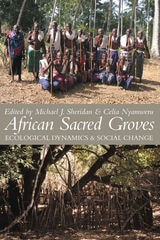
African Sacred Groves
Ecological Dynamics and Social ChangeMichael J. Sheridan
Ohio University Press, 2007
book by an international group of scholars and conservation practitioners provides a methodological framework for understanding these forests by examining their ecological characteristics, delineating how they relate to social dynamics and historical contexts, exploring their ideological aspects, and evaluating their strengths and weaknesses as sites for community-based resource management and the conservation of cultural and biological diversity.
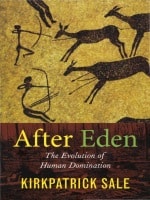
After Eden
The Evolution of Human DominationKirkpatrick Sale
Duke University Press, 2006
In After Eden, Kirkpatrick Sale answers these questions in a radically new way. Integrating research in paleontology, archaeology, and anthropology, he points to the beginning of big-game hunting as the origin of Homo sapiens’ estrangement from the natural world. Sale contends that a new, recognizably modern human culture based on the hunting of large animals developed in Africa some 70,000 years ago in response to a fierce plunge in worldwide temperature triggered by an enormous volcanic explosion in Asia. Tracing the migration of populations and the development of hunting thousands of years forward in time, he shows that hunting became increasingly adversarial in relation to the environment as people fought over scarce prey during Europe’s glacial period between 35,000 and 10,000 years ago. By the end of that era, humans’ idea that they were the superior species on the planet, free to exploit other species toward their own ends, was well established.
After Eden is a sobering tale, but not one without hope. Sale asserts that Homo erectus, the variation of the hominid species that preceded Homo sapiens and survived for nearly two million years, did not attempt to dominate the environment. He contends that vestiges of this more ecologically sound way of life exist today—in some tribal societies, in the central teachings of Hinduism and Buddhism, and in the core principles of the worldwide environmental movement—offering redemptive possibilities for ourselves and for the planet.
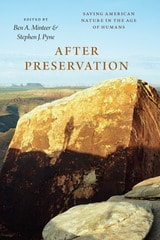
After Preservation
Saving American Nature in the Age of HumansEdited by Ben A. Minteer and Stephen J. Pyne
University of Chicago Press, 2015
Ben A. Minteer and Stephen J. Pyne bring together a stunning consortium of voices comprised of renowned scientists, historians, philosophers, environmental writers, activists, policy makers, and land managers to negotiate the incredible challenges that environmentalism faces. Some call for a new, post-preservationist model, one that is far more pragmatic, interventionist, and human-centered. Others push forcefully back, arguing for a more chastened and restrained vision of human action on the earth. Some try to establish a middle ground, while others ruminate more deeply on the meaning and value of wilderness. Some write on species lost, others on species saved, and yet others discuss the enduring practical challenges of managing our land, water, and air.
From spirited optimism to careful prudence to critical skepticism, the resulting range of approaches offers an inspiring contribution to the landscape of modern environmentalism, one driven by serious, sustained engagements with the critical problems we must solve if we—and the wild garden we may now keep—are going to survive the era we have ushered in.
Contributors include: Chelsea K. Batavia, F. Stuart (Terry) Chapin III, Norman L. Christensen, Jamie Rappaport Clark, William Wallace Covington, Erle C. Ellis, Mark Fiege, Dave Foreman, Harry W. Greene, Emma Marris, Michelle Marvier, Bill McKibben, J. R. McNeill, Curt Meine, Ben A. Minteer, Michael Paul Nelson, Bryan Norton, Stephen J. Pyne, Andrew C. Revkin, Holmes Rolston III, Amy Seidl, Jack Ward Thomas, Diane J. Vosick, John A. Vucetich, Hazel Wong, and Donald Worster.
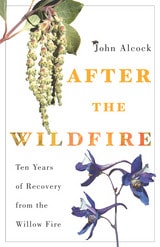
After the Wildfire
Ten Years of Recovery from the Willow FireJohn Alcock
University of Arizona Press, 2017
Swallowtail butterflies frolic on the wind. Vireos and rock wrens sing their hearts out by the recovering creek. Spiders and other predators chase their next meal. Through it all, John Alcock observes, records, and delights in what he sees. In a once-burnt area, life resurges. Plants whose seeds and roots withstood an intense fire become habitat for the returning creatures of the wild. After the Wildfire describes the remarkable recovery of wildlife in the Mazatzal Mountains in central Arizona.
It is the rare observer who has the dedication to revisit the site of a wildfire, especially over many years and seasons. But naturalist John Alcock returned again and again to the Mazatzals, where the disastrous Willow fire of 2004 burned 187 square miles. Documenting the fire’s aftermath over a decade, Alcock thrills at the renewal of the once-blackened region. Walking the South Fork of Deer Creek in all seasons as the years passed, he was rewarded by the sight of exuberant plant life that in turn fostered an equally satisfying return of animals ranging from small insects to large mammals.
Alcock clearly explains the response of chaparral plants to fire and the creatures that reinhabit these plants as they come back from a ferocious blaze: the great spreadwing damselfly, the western meadowlark, the elk, and birds and bugs of rich and colorful varieties. This book is at once a journey of biological discovery and a celebration of the ability of living things to reoccupy a devastated location. Alcock encourages others to engage the natural world—even one that has burnt to the ground.

Agricultural Biotechnology and the Environment
Science, Policy, and Social IssuesSheldon Krimsky and Roger Wrubel
University of Illinois Press, 1996
"Extraordinarily well documented . . . remarkably clear. This is
the most comprehensive coverage of these issues to date. It will be required
reading for some time." -- Lawrence Busch, Michigan State University
"Krimsky and Wrubel not only describe the components of agricultural
biotechnology, they address and analyze controversies involving the risks
and benefits of new technologies. Coverage of technical to social components
of agricultural biotechnology is unusually complete and thorough. Their
even-handed and comprehensive approach to these topics is rare and extremely
valuable." -- Richard Weinzierl, University of Illinois
Modern agriculture is being transformed by the genetic alteration of
seeds, animals, and microorganisms, a process that has produced such products
as flavor saver tomatoes and crops resistant to specific insects or herbicides.
Agricultural Biotechnology and the Environment is the first comprehensive
overview of the ongoing transformation of agriculture, exploring the impact
of genetic engineering from scientific, social, ethical, and ecological
perspectives.
Sheldon Krimsky and Roger Wrubel detail the impact the new generation
of products is expected to have on agricultural practice and the environment
and assess the degree to which current trends in biotechnology match earlier
expectations. They also analyze the social and political response to innovations
resulting from genetic technology.
Closely examined in each of three areas--transgenic plants, genetically
engineered microorganisms, and transgenic animals--are technical and scientific
problems, social controversies, and anticipated environmental impacts.
An objective, detailed look at a subject of interest to a broad spectrum
of readers, Agricultural Biotechnology and the Environment will
be of interest to researchers in the new biotechnology fields as well
as to educated general readers and policymakers.
A volume in the series The Environment and the Human Condition

Agricultural Development in Japan
The Land Improvement District in Concept and PracticeGil Latz
University of Chicago Press, 1989
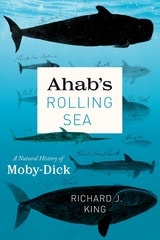
Ahab's Rolling Sea
A Natural History of "Moby-Dick"Richard J. King
University of Chicago Press, 2019
A revelation for Moby-Dick devotees and neophytes alike, Ahab’s Rolling Sea is a chronological journey through the natural history of Melville’s novel. From white whales to whale intelligence, giant squids, barnacles, albatross, and sharks, Richard J. King examines what Melville knew from his own experiences and the sources available to a reader in the mid-1800s, exploring how and why Melville might have twisted what was known to serve his fiction. King then climbs to the crow’s nest, setting Melville in the context of the American perception of the ocean in 1851—at the very start of the Industrial Revolution and just before the publication of On the Origin of Species. King compares Ahab’s and Ishmael’s worldviews to how we see the ocean today: an expanse still immortal and sublime, but also in crisis. And although the concept of stewardship of the sea would have been entirely foreign, if not absurd, to Melville, King argues that Melville’s narrator Ishmael reveals his own tendencies toward what we would now call environmentalism.
Featuring a coffer of illustrations and an array of interviews with contemporary scientists, fishers, and whale watch operators, Ahab’s Rolling Sea offers new insight not only into a cherished masterwork and its author but also into our evolving relationship with the briny deep—from whale hunters to climate refugees.

Ain't Love Grand!
Earthworms to Elephant SealsMarty Crump
University of Chicago Press, 2005
The natural world is filled with diverse—not to mention quirky and odd—animal behaviors. Consider the male praying mantis that continues to mate after being beheaded; the insects, insects, and birds that offer gifts of food in return for sex; the male hip-pocket frog that carries his own tadpoles; the baby spiders that dine on their mother; or the starfish that sheds an arm or two to escape a predator's grasp. In Ain’t Love Grand, Marty Crump—a tropical field biologist well known for her work with the reproductive behavior of amphibians—examines the bizarre conduct of animals as they mate, parent, feed, defend themselves, and communicate. More importantly, Crump points out that diverse and unrelated animals often share seemingly erratic behaviors—evidence, Crump argues, that these natural histories, though outwardly weird, are actually successful ways of living.
Aina Hanau / Birth Land
Brandy Nalani McDougall
University of Arizona Press, 2023
‘Āina Hānau / Birth Land is a powerful collection of new poems by Kanaka ʻŌiwi (Native Hawaiian) poet Brandy Nālani McDougall. ‘Āina hānau—or the land of one’s birth—signifies identity through intimate and familial connections to place and creates a profound bond between the people in a community. McDougall’s poems flow seamlessly between ‘Ōlelo Hawai‘i and English, forming rhythms and patterns that impress on the reader a deep understanding of the land. Tracing flows from the mountains to the ocean, from the sky to the earth, and from ancestor to mother to child, these poems are rooted in the rich ancestral and contemporary literature of Hawaiʻi —moʻolelo, moʻokūʻauhau, and mele —honoring Hawaiian ʻāina, culture, language, histories, aesthetics, and futures.
The poems in Āina Hānau / Birth Land cycle through sacred and personal narratives while exposing and fighting ongoing American imperialism, settler colonialism, militarism, and social and environmental injustice to protect the ʻāina and its people. The ongoing environmental crisis in Hawaiʻi, inextricably linked to colonialism and tourism, is captured with stark intensity as McDougall writes, Violence is what we settle for / because we’ve been led to believe / green paper can feed us / more than green land. The experiences of birth, motherhood, miscarriage, and the power of Native Hawaiian traditions and self-advocacy in an often dismissive medical system is powerfully narrated by the speaker of the titular poem, written for McDougall’s daughters.
‘Āina Hānau reflects on what it means to be from and belong to an ʻāina hānau, as well as what it means to be an ‘āina hānau, as all mothers serve as the first birth lands for their children.
Alabama Wildlife, Volume 5
Edited by Ericha Shelton-Nix
University of Alabama Press, 2017
Alabama Wildlife, Volume 5 offers a comprehensive update and provides a wealth of new information concerning changes and developments relative to the conservation status of wild animal populations of the state that have occurred in the decade since publication of the previous four volumes in 2004. Enhancements include the addition of any new or rediscovered taxon, species priority status changes, and taxonomic changes, plus the addition of the crayfishes, which were left out previously because so little was known about these understudied taxa.
A complete taxonomic checklist is included, which lists each imperiled taxon along with its priority designation followed by detailed species accounts. The eighty-four crayfish species accounts are comprised of a physical description (including a photograph, when available), distribution map, habitat summary, key life history, ecological information, basis for its status classification, and specific conservation and management recommendations. This revised expansion of the Alabama Wildlife set will be helpful to those seeking to broaden their knowledge of Alabama’s vast wildlife resources and will greatly influence future studies in the conservation of many of the imperiled species.
Alaska Halibut History
The Story of Alaska's Commercial Halibut FisheryJames Mackovjak
University of Alaska Press, 2027
Alaska Halibut History—the latest installment in James Mackovjak’s Alaska fisheries series—chronicles one of the grandest and most storied fisheries in the region. Author of Alaska Codfish Chronicle and Alaska Herring History, Mackovjak tells the story of the flatfish that has long been a favorite among chefs globally. A staple in the diet of many Native populations, the halibut has also played a key role in Indigenous mythology across the northern Pacific region. Tracing the evolution of Alaska’s halibut fishery over time, Mackovjak reveals the cultural, economic, and environmental impact of halibut fishing in Alaska and the fish’s vital role in commercial, sport, and subsistence fishing within the state.
Mackovjak considers the organization and chronology of halibut fishery as well as the various factors that have affected fishery management over the years, such as bycatch (the portion of commercial fishing catch that includes animals other than the target species), guided sportfishing, fishermen’s unionization, technological and environmental changes, and major world events. Through detailed analysis and exploration of government reports and fisheries publications, Alaska Halibut History offers a glimpse into the development of the modern-day halibut fishery and the nuances of and challenges behind providing the fish so often seen on a menu. It is an indispensable work for anyone interested in the halibut and fishing in the northern Pacific region.
Alaska Herring History
The Story of Alaska’s Herring Fisheries and Industryby James Mackovjak
University of Alaska Press, 2022
The book is divided into three parts based on the purposes for which herring have been harvested. Part I is a history of the reduction (fertilizer/fish meal/fish oil) and cured (salted) herring industries and the
bait-herring fisheries; part II is a history of the roe-herring fisheries in Southeast Alaska, Prince William Sound, Kodiak Island, lower Cook Inlet, Togiak, and Norton Sound; and part III is a history of the herring spawn-on-kelp industry. Historical and contemporary photos and illustrations—as well as graphs and charts that help summarize the development and, in some cases, the demise of the fisheries—augment this detailed look at the evolution of Alaska's herring fisheries.
Balancing scientific details, historical facts, and personal anecdotes from experts in the field, Alaska Herring History will be of interest to historians, social scientists, biologists, and fishery managers and makes an important contribution to Alaska fisheries literature.
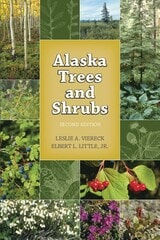
Alaska Trees and Shrubs
Les Viereck
University of Alaska Press, 2007
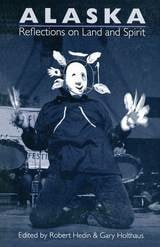
Alaska
Reflections on Land and SpiritEdited by Robert Hedin and Gary Holthaus
University of Arizona Press, 1989
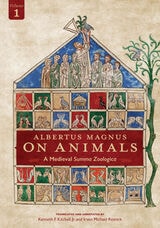
Albertus Magnus On Animals V1
A Medieval Summa Zoologica Revised EditionAlbertus Magnus, Edited by Kenneth F. Kitchell Jr.and Irven Michael Resnick
The Ohio State University Press, 2018
In his work De animalibus, Albert integrated the vast amount of information on nature that had come down to him in previous centuries: the exposition of Michael Scotus’s translation from the Arabic of Aristotle’s books on the natural world (Books 1–19), Albert’s own revisions to Aristotle’s teachings (Books 20–21), and a “dictionary” of animals appropriated largely from the De natura rerum of Thomas of Cantimpré (Books 22–26). Albert’s comprehensive treatise on living things was acknowledged as the reputable authority in biology for almost five hundred years.
In this translated and annotated edition, Kenneth F. Kitchell Jr. and Irven Michael Resnick illuminate the importance of this work, allowing Albert’s magnum opus to be better understood and more widely appreciated than ever before. Broken into two volumes (Books 1–10 and 11–26),Albertus Magnus On Animals is a veritable medieval scientific encyclopedia, ranging in topics from medicine, embryology, and comparative anatomy to women, hunting and everyday life, commerce, and much more—an essential work for historians, medievalists, scientists, and philosophers alike.
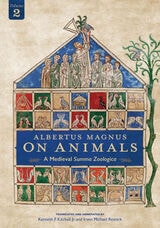
Albertus Magnus On Animals V2
A Medieval Summa Zoologica Revised EditionAlbertus Magnus, Edited by Kenneth F. Kitchell Jr.and Irven Michael Resnick
The Ohio State University Press, 2019
In his work De animalibus, Albert integrated the vast amount of information on nature that had come down to him in previous centuries: the exposition of Michael Scotus’s translation from the Arabic of Aristotle’s books on the natural world (Books 1–19), Albert’s own revisions to Aristotle’s teachings (Books 20–21), and a “dictionary” of animals appropriated largely from the De natura rerum of Thomas of Cantimpré (Books 22–26). Albert’s comprehensive treatise on living things was acknowledged as the reputable authority in biology for almost five hundred years.
In this translated and annotated edition, Kenneth F. Kitchell Jr. and Irven Michael Resnick illuminate the importance of this work, allowing Albert’s magnum opus to be better understood and more widely appreciated than ever before. Broken into two volumes (Books 1–10 and 11–26),Albertus Magnus On Animals is a veritable medieval scientific encyclopedia, ranging in topics from medicine, embryology, and comparative anatomy to women, hunting and everyday life, commerce, and much more—an essential work for historians, medievalists, scientists, and philosophers alike.
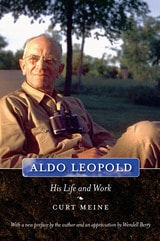
Aldo Leopold
His Life and WorkCurt D. Meine
University of Wisconsin Press, 2010
This biography of Aldo Leopold follows him from his childhood as a precocious naturalist to his profoundly influential role in the development of conservation and modern environmentalism in the United States. This edition includes a new preface by author Curt Meine and an appreciation by acclaimed Kentucky writer and farmer Wendell Berry.
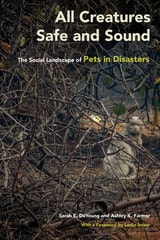
All Creatures Safe and Sound
The Social Landscape of Pets in DisastersSarah E. DeYoung and Ashley K. Farmer
Temple University Press, 2021
Some of the most striking news stories from natural disasters are of animals tied to trees or cats swimming through murky flood waters. Although the issue of evacuating pets has gained more attention in recent disasters, there are still many failures throughout local and national systems of managing pets and accommodating animals in emergencies.
All Creatures Safe and Sound is a comprehensive study of what goes wrong in our disaster response that shows how people can better manage pets in emergencies—from the household level to the large-scale, national level. Authors Sarah DeYoung and Ashley Farmer offer practical disaster preparedness tips while they address the social complexities that affect disaster management and animal rescue. They track the developments in the management of pets since Hurricane Katrina, including an analysis of the 2006 PETS Act, which dictates that animals should be included in hazard and disaster planning. Other chapters focus on policies in place for sheltering and evacuation, coalitions for animal welfare and the prevention of animal cruelty, organizational coordination, decision-making, preparedness, the role of social media in animal rescue and response, and how privilege and power shape disaster experiences and outcomes.
Using data they collected from seven major recent American disasters, ranging from Hurricanes Harvey, Irma, and Florence to the Camp, Tubbs, and Carr Fires in California and the Hawaii Lava Flow, the authors provide insights about the successes and failures of animal care. All Creatures Safe and Sound also outlines what still needs to change to best prepare for the safety and welfare of pets, livestock, and other companion animals in times of crisis.
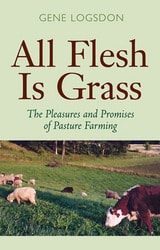
All Flesh Is Grass
The Pleasures and Promises of Pasture FarmingGene Logsdon
Ohio University Press, 2004
Amidst Mad Cow scares and consumer concerns about how farm animals are bred, fed, and raised, many farmers and homesteaders are rediscovering the traditional practice of pastoral farming. Grasses, clovers, and forbs are the natural diet of cattle, horses, and sheep, and are vital supplements for hogs, chickens, and turkeys. Consumers increasingly seek the health benefits of meat from animals raised in green paddocks instead of in muddy feedlots.
In All Flesh Is Grass: The Pleasures and Promises of Pasture Farming, Gene Logsdon explains that well-managed pastures are nutritious and palatable—virtual salads for livestock. Leafy pastures also hold the soil, foster biodiversity, and create lovely landscapes. Grass farming might be the solution for a stressed agricultural system based on an industrial model and propped up by federal subsidies.
In his clear and conversational style, Logsdon explains historically effective practices and new techniques. His warm, informative profiles of successful grass farmers offer inspiration and ideas. His narrative is enriched by his own experience as a “contrary farmer” on his artisan-scale farm near Upper Sandusky, Ohio.
All Flesh Is Grass will have broad appeal to the sustainable commercial farmer, the home-food producer, and all consumers who care about their food.
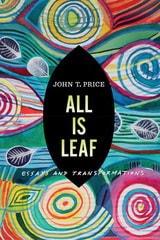
All Is Leaf
Essays and TransformationsJohn T Price
University of Iowa Press, 2022
He employs an array of forms and voices, whether penning a break-up letter to America or a literary rock-n-roll road song dedicated to prairie scientists, or giving pregame pep talks to his son’s losing football team. Here, too, are moving portrayals of his father’s last effort as a small-town lawyer to defend the rights of abused women, and his own efforts as a writing teacher to honor the personal stories of his students.
From his Iowa backyard to the edge of the Arctic Circle, from the forgotten recesses of the body to the far reaches of the solar system, this book demonstrates the ways imagination and informed compassion can, as Price describes it, expand thousandfold the boundaries of what we might “have naïvely considered an individual self.”
All the Boats on the Ocean
How Government Subsidies Led to Global OverfishingCarmel Finley
University of Chicago Press, 2017
In this transnational, interdisciplinary history, Carmel Finley answers these questions and more as she explores how government subsidies propelled the expansion of fishing from a coastal, in-shore activity into a global industry. While nation states struggling for ocean supremacy have long used fishing as an imperial strategy, the Cold War brought a new emphasis: fishing became a means for nations to make distinct territorial claims. A network of trade policies and tariffs allowed cod from Iceland and tuna canned in Japan into the American market, destabilizing fisheries in New England and Southern California. With the subsequent establishment of tuna canneries in American Samoa and Puerto Rico, Japanese and American tuna boats moved from the Pacific into the Atlantic and Indian Oceans after bluefin. At the same time, government subsidies in nations such as Spain and the Soviet Union fueled fishery expansion on an industrial scale, with the Soviet fleet utterly depleting the stock of rosefish (or Pacific ocean perch) and other groundfish from British Columbia to California. This massive global explosion in fishing power led nations to expand their territorial limits in the 1970s, forever changing the seas.
Looking across politics, economics, and biology, All the Boats on the Ocean casts a wide net to reveal how the subsidy-driven expansion of fisheries in the Pacific during the Cold War led to the growth of fisheries science and the creation of international fisheries management. Nevertheless, the seas are far from calm: in a world where this technologically advanced industry has enabled nations to colonize the oceans, fish literally have no place left to hide, and the future of the seas and their fish stocks is uncertain.
All the Fish in the Sea
Maximum Sustainable Yield and the Failure of Fisheries ManagementCarmel Finley
University of Chicago Press, 2011
Carmel Finley reveals that the fallibility of MSY lies at its very inception—as a tool of government rather than science. The foundational doctrine of MSY emerged at a time when the US government was using science to promote and transfer Western knowledge and technology, and to ensure that American ships and planes would have free passage through the world’s seas and skies. Finley charts the history of US fisheries science using MSY as her focus, and in particular its application to halibut, tuna, and salmon fisheries. Fish populations the world over are threatened, and All the Fish in the Sea helps to sound warnings of the effect of any management policies divested from science itself.
Almanac for the Anthropocene
A Compendium of Solarpunk FuturesPhoebe Wagner
West Virginia University Press, 2022
Original voices from across the solarpunk movement, which positions ingenuity, generativity, and community as ways to resist hopelessness in response to the climate crisis.
Almanac for the Anthropocene collects original voices from across the solarpunk movement, which positions ingenuity, generativity, and community as beacons of resistance to the hopelessness often inspired by the climate crisis. To point toward practical implementation of the movement’s ideas, it gathers usable blueprints that bring together theory and practice. The result is a collection of interviews, recipes, exercises, DIY instructions, and more—all of it amounting to a call to create hope through action.
Inspired by a commitment to the idea that there can be no environmental justice without decolonial and racial justice, Almanac for the Anthropocene unites in a single volume both academic and practical responses to environmental crisis.
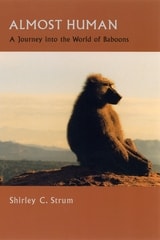
Almost Human
A Journey into the World of BaboonsShirley C. Strum
University of Chicago Press, 2001
Vividly written and filled with fascinating insights, Almost Human chronicles the first fifteen years of Strum's fieldwork with the Pumphouse Gang. From the first paragraph, the reader is drawn along with Strum into the world of the baboons, learning about the tragedies and triumphs of their daily lives—and the lives of the scientists studying them. This edition includes a new introduction and epilogue that place Strum's research in the context of the current global conservation crisis and tell us what has happened to the Pumphouse Gang since the book was first published.
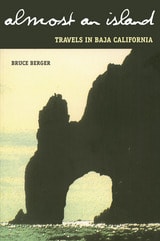
Almost an Island
Travels in Baja CaliforniaBruce Berger
University of Arizona Press, 1998
Eight hundred miles long, Baja California is the remotest region of the Sonoran desert, a land of volcanic cliffs, glistening beaches, fantastical boojum trees, and some of the greatest primitive murals in the Western Hemisphere. In Almost an Island, Berger recounts tales from his three decades in this extraordinary place, enriching his account with the peninsula's history, its politics, and its probable future—rendering a striking panorama of this land so close to the United States, so famous, and so little known.
Readers will meet a cast of characters as eccentric as the place itself: Brandy, who ranges the desert in a sand buggy while breathing from an oxygen tank; Katie, the chanteuse; nuns illegally raising pigs. They will encounter the tourist madness of a total eclipse, the story of the heir to an oasis, a musical Mata Hari, rare pronghorn antelope, and a pet tarantula. In prose as glittering as this desert engulfed by the sea, Almost an Island is a fascinating journey into the human heart of a spectacular land.
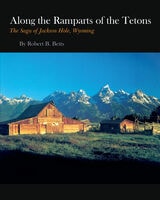
Along the Ramparts of the Tetons
The Saga of Jackson Hole, WyomingRobert B. Betts
University Press of Colorado, 1991
In these pages, the reader will witness the dramatic creation of the Tetons; the arrival of the first humans, bands of fur-clad Early Hunters who ventured into the valley some 10,000 years ago; the coming and going of the later Indian tribes; and the nearly incredible journey of John Colter, who back in 1807 is said to have been the first white man to have found his way through the wilderness and into Jackson Hole.
Here, too, the reader will meet the boisterous mountain men, trappers such as Jim Bridger and the former slave, Jim Beckwourth, who roamed the Rockies when St. Louis was still a frontier village; a little Mormon boy who ran away from home and lived with the Indians before becoming a Pony Express rider; a most unusual Englishman who describes a terrible tragedy that befell his Indian wife and half-breed children; a glory-seeking lieutenant who led six cavalrymen on a foolhardy expedition that almost cost them their lives; and a nineteenth-century president of the United States who took a pack trip through Jackson Hole, allegedly leaving a trail of empty bottles behind.
And there is more, much more--the story of the pioneers, those hardy few who dared to settle in this high and inhospitable land; the story of outlaws, a shoot-out, vigilance committees and an Indian "massacre" that embarrassed the New York Times; the story of the deliverance of the world's largest elk herd from the many perils that threatened it with extinction; and, finally, the story of the long and angry controversy over the preservation of the Tetons and Jackson Hole as a national park, a struggle called "one of the most remarkable conservation fights of the twentieth century."
All these and still other episodes in the long and colorful cavalcade of Jackson Hole are woven together to form a work of Western Americana rich in anecdotes and portraits of delightfully eccentric characters.
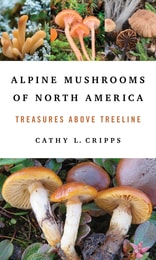
Alpine Mushrooms of North America
Treasures above TreelineCathy L. Cripps
University of Illinois Press, 2025
Features include:
- More than 200 color photographs
- Small size perfect for use in the field
- In-depth scientific information on 150 species, including some recently discovered and most not found outside alpine or Arctic habitats
- Division of species into ecological groups to aid with searching and identification
- Coverage of the Rocky Mountains of Montana, Wyoming, and Colorado, with extensions into British Columbia and Alaska, with many of the same mushrooms also found in the Arctic
- Tips on collecting for both professional researchers and amateur enthusiasts
- A conservation-based approach aimed at the general public, mycologists, researchers, naturalists, land managers, and others
Easy to use and charged with cutting-edge science, Alpine Mushrooms of North America is an expert guide to mycology’s final frontier.
Alterhumanism
Becoming Human on a Conservation FrontierPiergiorgio Di Giminiani
University of Arizona Press, 2025
Amazon Sweet Sea
Land, Life, and Water at the River's MouthBy Nigel J. H. Smith
University of Texas Press, 2002
Far into the Atlantic Ocean, the outflow from the Amazon River creates a "sweet sea" of fresh water. At the river's mouth, a vast delta of river channels and marshes, floodplain and upland forests, open and scrub savannas, floating meadows, and mangrove swamps hosts an astonishingly diverse assemblage of plant and animal life. So rich is this biological treasure house that early European explorers deemed it inexhaustible.
In this highly readable book, Nigel Smith explores how human use of the Amazon estuary's natural resources has been affected by technological change, rapid urban growth, and accelerated market integration. Avoiding alarmist rhetoric, he shows how human intervention in the estuary has actually diversified agriculture and helped save floodplain forests from wanton destruction. His findings underscore the importance of understanding the history of land use and the ecological knowledge of local people when formulating development and conservation policies. The book will be of interest to everyone concerned with the fate of tropical forests, conserving biodiversity, and developing natural resources in a sustainable manner.
Amazonia in the Anthropocene
People, Soils, Plants, ForestsBy Nicholas C. Kawa
University of Texas Press, 2016
Widespread human alteration of the planet has led many scholars to claim that we have entered a new epoch in geological time: the Anthropocene, an age dominated by humanity. This ethnography is the first to directly engage the Anthropocene, tackling its problems and paradoxes from the vantage point of the world’s largest tropical rainforest.
Drawing from extensive ethnographic research, Nicholas Kawa examines how pre-Columbian Amerindians and contemporary rural Amazonians have shaped their environment, describing in vivid detail their use and management of the region’s soils, plants, and forests. At the same time, he highlights the ways in which the Amazonian environment resists human manipulation and control—a vital reminder in this time of perceived human dominance. Written in engaging, accessible prose, Amazonia in the Anthropocene offers an innovative contribution to debates about humanity’s place on the planet, encouraging deeper ecocentric thinking and a more inclusive vision of ecology for the future.
Amber Waves
The Extraordinary Biography of Wheat, from Wild Grass to World MegacropCatherine Zabinski
University of Chicago Press, 2020
At breakfast tables and bakeries, we take for granted a grain that has made human civilization possible, a cereal whose humble origins belie its world-shaping power: wheat. Amber Waves tells the story of a group of grass species that first grew in scattered stands in the foothills of the Middle East until our ancestors discovered their value as a source of food. Over thousands of years, we moved their seeds to all but the polar regions of Earth, slowly cultivating what we now know as wheat, and in the process creating a world of cuisines that uses wheat seeds as a staple food. Wheat spread across the globe, but as ecologist Catherine Zabinski shows us, a biography of wheat is not only the story of how plants ensure their own success: from the earliest bread to the most mouthwatering pasta, it is also a story of human ingenuity in producing enough food for ourselves and our communities.
Since the first harvest of the ancient grain, we have perfected our farming systems to grow massive quantities of food, producing one of our species’ global mega crops—but at a great cost to ecological systems. And despite our vast capacity to grow food, we face problems with undernourishment both close to home and around the world. Weaving together history, evolution, and ecology, Zabinski’s tale explores much more than the wild roots and rise of a now-ubiquitous grain: it illuminates our complex relationship with our crops, both how we have transformed the plant species we use as food, and how our society—our culture—has changed in response to the need to secure food sources. From the origins of agriculture to gluten sensitivities, from our first selection of the largest seeds from wheat’s wild progenitors to the sequencing of the wheat genome and genetic engineering, Amber Waves sheds new light on how we grow the food that sustains so much human life.

America's Deadliest Twister
The Tri-State Tornado of 1925Geoff Partlow
Southern Illinois University Press, 2014
Winner, ISHS Certificate of Excellence, 2015
Disaster relief as we know it did not exist when the deadliest tornado in U.S. history gouged a path from southeast Missouri through southern Illinois and into southwestern Indiana. The tri-state tornado of 1925 hugged the ground for 219 miles, generated wind speeds in excess of 300 miles per hour, and killed 695 people. Drawing on survivor interviews, public records, and newspaper archives, America’s Deadliest Twister offers a detailed account of the storm, but more important, it describes life in the region at that time as well as the tornado’s lasting cultural impact, especially on southern Illinois.
Author Geoff Partlow follows the storm from town to town, introducing us to the people most affected by the tornado, including the African American population of southern Illinois. Their narratives, along with the stories of the heroes who led recovery efforts in the years following, add a hometown perspective to the account of the storm itself.
In the discussion of the aftermath of the tornado, Partlow examines the lasting social and economic scars in the area, but he also looks at some of the technological firsts associated with this devastating tragedy. Partlow shows how relief efforts in the region began to change the way people throughout the nation thought about disaster relief, which led to the unified responses we are familiar with today.
America's Neighborhood Bats
Understanding and Learning to Live in Harmony with ThemBy Merlin D. Tuttle
University of Texas Press, 2005
Since its first publication in 1988, America's Neighborhood Bats has changed the way we look at bats by underscoring their harmless and beneficial nature. In this second revised edition, Merlin Tuttle offers bat aficionados the most up-to-date bat facts, including a wealth of new information on bat house design and current threats to bat survival.
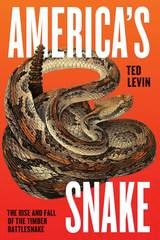
America's Snake
The Rise and Fall of the Timber RattlesnakeTed Levin
University of Chicago Press, 2016
Yet most of us have never seen a timber rattler. Though they’re found in thirty-one states, and near many major cities, in contemporary America timber rattlesnakes are creatures mostly of imagination and innate fear.
Ted Levin aims to change that with America’s Snake, a portrait of the timber rattlesnake, its place in America’s pantheon of creatures and in our own frontier history—and of the heroic efforts to protect it against habitat loss, climate change, and the human tendency to kill what we fear. Taking us from labs where the secrets of the snake’s evolutionary history are being unlocked to far-flung habitats whose locations are fiercely protected by biologists and dedicated amateur herpetologists alike, Levin paints a picture of a fascinating creature: peaceable, social, long-lived, and, despite our phobias, not inclined to bite. The timber rattler emerges here as emblematic of America and also, unfortunately, of the complicated, painful struggles involved in protecting and preserving the natural world.
A wonderful mix of natural history, travel writing, and exemplary journalism, America’s Snake is loaded with remarkable characters—none more so than the snake at its heart: frightening, perhaps; endangered, certainly; and unquestionably unforgettable.
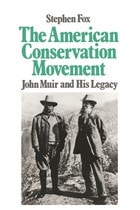
American Conservation Movement
John Muir And His LegacyStephen Fox
University of Wisconsin Press, 1986
John Muir and His Legacy is at once a biography of this remarkable man—the first work to make unrestricted use of all of Muir’s manuscripts and personal papers—and a history of the century-old fight to save the natural environment. Stephen Fox traces the conservation movement's diverse, colorful, and tumultuous history, from the successful campaign to establish Yosemite National Park in 1890 to the movement's present day concerns of nuclear waste and acid rain.
Conservation has run a cyclical course, Fox contends, from its origins in the 1890s when it was the province of amateurs, to its takeover by professionals with quasi-scientific notions, and back, in the 1960s to its original impetus. Since then man’s view of himself as “the last endangered species” has sparked an explosion of public interest in environmentalism.
First published in 1981 by Little, Brown, this book was warmly received as both a biography of Muir and a history of the American conservation movement. It is now available in this new Wisconsin paperback edition.

American Dunkirk
The Waterborne Evacuation of Manhattan on 9/11James M Kendra
Temple University Press, 2016
When the terrorist attacks struck New York City on September 11, 2001, boat operators and waterfront workers quickly realized that they had the skills, the equipment, and the opportunity to take definite, immediate action in responding to the most significant destructive event in the United States in decades. For many of them, they were “doing what needed to be done.”
American Dunkirk shows how people, many of whom were volunteers, mobilized rescue efforts in various improvised and spontaneous ways on that fateful date. Disaster experts James Kendra and Tricia Wachtendorf examine the efforts through fieldwork and interviews with many of the participants to understand the evacuation and its larger implications for the entire practice of disaster management.
The authors ultimately explore how people—as individuals, groups, and formal organizations—pull together to respond to and recover from startling, destructive events. American Dunkirk asks, What can these people and lessons teach us about not only surviving but thriving in the face of calamity?
American Fish and Wildlife Policy
The Human DimensionEdited by William R. Mangun
Southern Illinois University Press, 1992
These eleven original essays by leading wildlife management and public policy scholars deal with policy issues, management perspectives, and the public attitudes about wildlife that shape the world of the wildlife manager.
Part 1 contains William R. Mangun’s introductory essay "Fish and Wildlife Policy Issues" and Daniel J. Decker et al.’s "Toward a Comprehensive Paradigm of Wildlife."
Ann H. Harvey’s "Interagency Conflict and Coordination in Wildlife Management," Philip S. Cook and Ted T. Cable’s "Developing Policy for Public Access to Private Land," and Debra A. Rose’s "Implementing Endangered Species Policy" make up part 2.
Part 3 consists of Cliff Hamilton’s "Pursuing a New Paradigm in Funding State Fish and Wildlife Programs" and Trellis G. Green’s "Use of Economics in Federal and State Fishery Allocation Decisions."
The fourth part includes James J. Kennedy and Jack Ward Thomas’s "Exit, Voice, and Loyalty of Wildlife Biologists in Public Natural Resource/Environmental Agencies"; Jean C. Mangun et al.’s "Nonconsumptive Wildlife-Associated Recreation in the United States"; and Barbara A. Knuth’s "Natural Resource Hazards: Managing to Protect People from the Resource."
In part 5, Joseph F. Coates looks to the future in "Public Policy Actors and Futures."
American Indian Literature, Environmental Justice, and Ecocriticism
The Middle PlaceJoni Adamson
University of Arizona Press, 2001
This powerful book is one of the first to examine the intersections between literature and the environment from the perspective of the oppressions of race, class, gender, and nature, and the first to review American Indian literature from the standpoint of environmental justice and ecocriticism. By examining such texts as Sherman Alexie's short stories and Leslie Marmon Silko's novel Almanac of the Dead, Adamson contends that these works, in addition to being literary, are examples of ecological criticism that expand Euro-American concepts of nature and place.
Adamson shows that when we begin exploring the differences that shape diverse cultural and literary representations of nature, we discover the challenge they present to mainstream American culture, environmentalism, and literature. By comparing the work of Native authors such as Simon Ortiz with that of environmental writers such as Edward Abbey, she reveals opportunities for more multicultural conceptions of nature and the environment.
More than a work of literary criticism, this is a book about the search to find ways to understand our cultural and historical differences and similarities in order to arrive at a better agreement of what the human role in nature is and should be. It exposes the blind spots in early ecocriticism and shows the possibilities for building common ground— a middle place— where writers, scholars, teachers, and environmentalists might come together to work for social and environmental change.
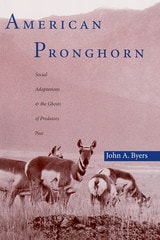
American Pronghorn
Social Adaptations and the Ghosts of Predators PastJohn A. Byers
University of Chicago Press, 1997
In this elegantly written book, John A. Byers argues that these mystifying behaviors evolved in response to the dangerous predators with whom pronghorn shared their grassland home for nearly four million years: among them fleet hyenas, lions, and cheetahs. Although these predators died out ten thousand years ago, pronghorn still behave as if they were present—as if they were living with the ghosts of predators past.
Byers's provocative hypothesis will stimulate behavioral ecologists and mammalogists to consider whether other species' adaptations are also haunted by selective pressures from predators past. The book will also find a ready audience among evolutionary biologists and paleontologists.
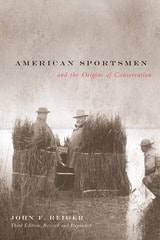
American Sportsmen and the Origins of Conservation, 3rd Ed
John F. Reiger
Oregon State University Press, 2001
Beginning in the 1870s, sportsmen across America formed hundreds of organizations that not only fostered responsibility for game habitats but also spearheaded the creation of national parks, forests, and wildlife refuges. Reiger tells how these "gentlemen" hunters and anglers, outdoor journals like Forest and Stream, and organizations such as the Boone and Crockett Club—founded by Theodore Roosevelt, George Bird Grinnell, and other prominent sportsmen—lobbied for laws regulating the taking of wildlife, and helped to arouse public interest in wilderness preservation.
In this new edition, Reiger traces the antecedents of the sportsmen's conservation movement to the years before the Civil War. He extends his coverage into the present by demonstrating how the nineteenth-century sportsman's code—with its demand for taking responsibility for the total environment—continues to be the cornerstone of the sporting ethic. A new Epilogue depicts leading environmental thinker Aldo Leopold as the best-known exponent of this hunter-conservationist ideal.
Praised as "one of the seminal works in conservation history" by historian Hal Rothman, Reiger's book continues to be essential reading for all concerned with how earlier Americans regarded the land, demonstrating even to those who oppose hunting that they share with sportsmen and sportswomen an awareness and appreciation of our fragile environment.