Results by title
18284 books match the query 'United States' and 1653 start with a

Are We the 99%?
The Occupy Movement, Feminism, and IntersectionalityHeather McKee Hurwitz
Temple University Press, 2021
The protestors that comprised the Occupy Wall Street movement came from diverse backgrounds. But how were these activists—who sought radical social change through many ideologies—able to break down oppressions and obstacles within the movement? And in what ways did the movement perpetuate status-quo structures of inequality?
Are We the 99%? is the first comprehensive feminist and intersectional analysis of the Occupy movement. Heather McKee Hurwitz considers how women, people of color, and genderqueer activists struggled to be heard and understood. Despite cries of “We are the 99%,” signaling solidarity, certain groups were unwelcome or unable to participate. Moreover, problems with racism, sexism, and discrimination due to sexuality and class persisted within the movement.
Using immersive first-hand accounts of activists’ experiences, online communications, and media coverage of the movement, Hurwitz reveals lessons gleaned from the conflicts within the Occupy movement. She compares her findings to those of other contemporary protest movements—nationally and globally—so that future movements can avoid infighting and deploy an “intersectional imperative” to embrace both diversity and inclusivity.
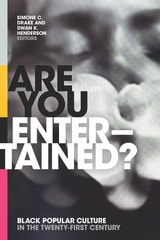
Are You Entertained?
Black Popular Culture in the Twenty-First CenturySimone C. Drake and Dwan Henderson Simmons, editors
Duke University Press, 2020
Contributors. Takiyah Nur Amin, Patricia Hill Collins, Kelly Jo Fulkerson-Dikuua, Simone C. Drake, Dwan K. Henderson, Imani Kai Johnson, Ralina L. Joseph, David J. Leonard, Emily J. Lordi, Nina Angela Mercer, Mark Anthony Neal, H. Ike Okafor-Newsum, Kinohi Nishikawa, Eric Darnell Pritchard, Richard Schur, Tracy Sharpley-Whiting, Vincent Stephens, Lisa B. Thompson, Sheneese Thompson

Are You Two Sisters?
The Journey of a Lesbian CoupleSusan Krieger
Temple University Press, 2022
Authored by one of the most respected figures in the field of personal ethnographic narrative, this book serves as both a memoir and a sociological study, telling the story of one lesbian couple’s lifelong journey together.
Are You Two Sisters? is Susan Krieger’s candid, revealing, and engrossing memoir about the intimacies of a lesbian couple. Krieger explores how she and her partner confront both the inner challenges of their relationship and the invisibility of lesbian identity in the larger world.
Using a lively novelistic and autoethnographic approach that toggles back and forth in time, Krieger reflects on the evolution of her forty-year relationship. She describes building a life together, from sharing pets and travels to getting married. Are You Two Sisters? addresses not only questions of gender and sexuality, but also of disability, as Krieger explores how the couple adapts to her increasing blindness.
Krieger’s title comes from a question asked by a stranger outside a remote desert bar as she and her partner traveled in the Southwest. Her apprehension about answering that question suggests how, even after the legalization of gay marriage, lesbianism often remains hidden—an observation that makes Krieger’s poignant narrative all the more moving.
Area and Administration
James W. Fesler
University of Alabama Press, 2008
A foundational classic on the organization and coordination of modern government.
This fresh publication of James W. Fesler’s classic, Area and Administration is a powerful work of intellectual history. Richly illustrating how the Great Depression and World War II shaped the thinking of scholars who helped build modern American government.
It is also an authoritative work of powerful insight. The challenges of linking the center with the front lines, or securing vertical and horizonal coordination, and of connecting area and function, have only become more important in twenty-first century government. Fesler’s path-breaking book provides an extraordinarily useful foundation for grappling with issues that have become even more important for governance.
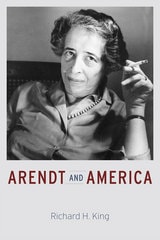
Arendt and America
Richard H. King
University of Chicago Press, 2015
Situating Arendt within the context of U.S. intellectual, political, and social history, King reveals how Arendt developed a fascination with the political thought of the Founding Fathers. King also re-creates her intellectual exchanges with American friends and colleagues, such as Dwight Macdonald and Mary McCarthy, and shows how her lively correspondence with sociologist David Riesman helped her understand modern American culture and society. In the last section of Arendt and America, King sets out the context in which the Eichmann controversy took place and follows the debate about “the banality of evil” that has continued ever since. As King shows, Arendt’s work, regardless of focus, was shaped by postwar American thought, culture, and politics, including the Civil Rights Movement and the Cold War.
For Arendt, the United States was much more than a refuge from Nazi Germany; it was a stimulus to rethink the political, ethical, and historical traditions of human culture. This authoritative combination of intellectual history and biography offers a unique approach for thinking about the influence of America on Arendt’s ideas and also the effect of her ideas on American thought.

Argentina, the United States, and the Anti-Communist Crusade in Central America, 1977–1984
Mis Lam#26Ariel Armony
Ohio University Press, 1997
Ariel Armony focuses, in this study, on the role played by Argentina in the anti–Communist crusade in Central America. This systematic examination of Argentina’s involvement in the Central American drama of the late 1970s and early 1980s fine–tunes our knowledge of a major episode of the Cold War era.
Basing his study on exhaustive research in the United States, Argentina, and Nicaragua, Armony adroitly demolishes several key assumptions that have shaped the work of scholars in U.S. foreign policy, Argentine military politics, and Central American affairs.
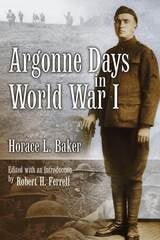
Argonne Days in World War I
Horace L. Baker, Edited & Intro by Robert H. Ferrell
University of Missouri Press, 2007
This poignant memoir recalls the great battle of the Meuse-Argonne, an epic conflict waged by well over a million men that saw casualties of 26,277 killed and 95,786 wounded. Many books have been written about General Pershing’s planning of the offensive; this one tells what happened to the soldiers who had to carry out his orders.
The Thirty-second was a shock division made up largely of National Guard units—farm boys from the Upper Midwest. But as casualties mounted, replacements were rushed into battle with little training—and devastating results. Baker knew friends and tent mates who were alive one day, dead the next, and he kept track of the battle in diary entries tucked into his Bible—and made evasively short in case of capture.
He shares his and his comrades’ thoughts about fighting in a harsh climate and terrain, relates their ongoing problems with short supplies, and tells how they managed to overcome their fears. It is a straightforward narrative that doesn’t glorify battle or appeal to patriotism yet conveys the horrors of warfare with striking accuracy. Historian Robert Ferrell’s new introduction puts Baker’s recollections in the context of the larger theater of war.
Baker fleshed out his diary in a book that saw limited publication in 1927 but has remained essentially unknown. Argonne Days in World War I is a masterpiece brimming with insight about the ordinary doughboys who fought in the European trenches. It conveys the spirit of a man who did his duty in a time of trouble—and is a testament to the spirit shared by thousands like him.
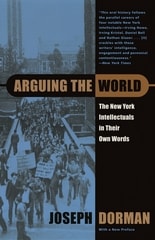
Arguing the World
The New York Intellectuals in their Own WordsJoseph Dorman
University of Chicago Press, 2001
Joseph Dorman's acclaimed documentary, Arguing the World, included stunning interviews with Irving Howe, Daniel Bell, Irving Kristol, and Nathan Glazer. Now with a new preface, Dorman converted the film into this book that includes an overview of the New York Intellectuals and a chapter on the future of the public intellectual. Expertly spliced together from the film and new material, this book gives the sense that these men are still engaged in their fiery debates that targeted everything from the Depression to McCarthyism to the rise of the New Left through the Age of Reagan.
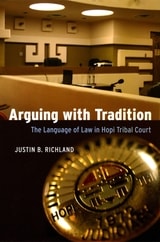
Arguing with Tradition
The Language of Law in Hopi Tribal CourtJustin B. Richland
University of Chicago Press, 2008
Like many indigenous legal institutions across North America, the Hopi Tribal Court was created in the image of Anglo-American-style law. But Richland shows that in recent years, Hopi jurists and litigants have called for their courts to develop a jurisprudence that better reflects Hopi culture and traditions. Providing unprecedented insights into the Hopi and English courtroom interactions through which this conflict plays out, Richland argues that tensions between the language of Anglo-style law and Hopi tradition both drive Hopi jurisprudence and make it unique. Ultimately, Richland’s analyses of the language of Hopi law offer a fresh approach to the cultural politics that influence indigenous legal and governmental practices worldwide.
Arguments for Learning
An Intellectual History of the College of Education at the University of IllinoisBill Cope and Walter Feinberg
University of Illinois Press, 2025
Cope and Feinberg draw on conversations, narratives, and archival research that reveal how different generations explored their role in defining and carrying out the College’s multifaceted mission. Their account raises critical questions about the character of learning, the aims of teaching, and the nature of teaching as a profession. At the same time, the authors address issues that range from the role of schools in fostering individual and collective identity to the introduction of computer-mediated and online learning. Cope and Feinberg examine changes in self-understanding about fundamental ideas and chart how the College evolved from its original narrow mission of training children’s schoolteachers to embracing global perspectives.
A wide-ranging portrait of an institution, Arguments for Learning uses the School of Education to tell the stories of thinkers dedicated to the idea that education can change the world for the better.

Ariel's Ecology
Plantations, Personhood, and Colonialism in the American TropicsMonique Allewaert
University of Minnesota Press, 2013
What happens if we abandon the assumption that a person is a discrete, world-making agent who acts on and creates place? This, Monique Allewaert contends, is precisely what occurred on eighteenth-century American plantations, where labor practices and ecological particularities threatened the literal and conceptual boundaries that separated persons from the natural world.
Integrating political philosophy and ecocriticism with literary analysis, Ariel’s Ecology explores the forms of personhood that developed out of New World plantations, from Georgia and Florida through Jamaica to Haiti and extending into colonial metropoles such as Philadelphia. Allewaert’s examination of the writings of naturalists, novelists, and poets; the oral stories of Africans in the diaspora; and Afro-American fetish artifacts shows that persons in American plantation spaces were pulled into a web of environmental stresses, ranging from humidity to the demand for sugar. This in turn gave rise to modes of personhood explicitly attuned to human beings’ interrelation with nonhuman forces in a process we might call ecological.
Certainly the possibility that colonial life revokes human agency haunts works from Shakespeare’s Tempest and Montesquieu’s Spirit of the Laws to Spivak’s theories of subalternity. In Allewaert’s interpretation, the transformation of colonial subjectivity into ecological personhood is not a nightmare; it is, rather, a mode of existence until now only glimmering in Che Guevara’s dictum that postcolonial resistance is synonymous with “perfect knowledge of the ground.”
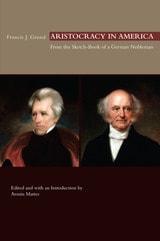
Aristocracy in America
From the Sketch-Book of a German NoblemanFrancis J. Grund, edited with an introduction by Armin Mattes
University of Missouri Press, 2018
Francis J. Grund, a German emigrant, was one of the most influential journalists in America in the three decades preceding the Civil War. He also wrote several books, including this fictional, satiric travel memoir in response to Alexis de Tocqueville’s famous Democracy in America. Armin Mattes provides a thorough account of Grund’s dynamic engagement in American political life, and brings to light many of Grund’s reflections on American social and political life previously published only in German. Mattes shows how Grund’s work can expand our understanding of the emerging democratic political culture and society in the antebellum United States.
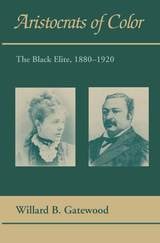
Aristocrats of Color
The Black Elite, 1880–1920Willard B. Gatewood
University of Arkansas Press, 2000
Every American city had a small, self-aware, and active black elite, who felt it was their duty to set the standard for the less fortunate members of their race and to lead their communities by example. Rank within this black upper class rested on such issues as the status of one’s forebears as either house servants or field hands, the darkness of one’s skin, and the level of one’s manners and education.
Professor Gatewood’s study examines this class of African Americans by looking at the genealogies and occupations of specific families and individuals throughout the United States and their roles in their various communities. The resulting narrative is a full and illuminating account of a most influential segment of the African-American population. It explores fully the distinctive background, prestige, attitudes, behavior, power, and culture of this class. The Black Community Studies series from the University of Arkansas Press, edited by Professor Gatewood, continues to examine many of the same themes first explored in this important study.
Aristotle's Voice
Rhetoric, Theory, and Writing in AmericaJasper Neel
Southern Illinois University Press, 1994
In this book, Jasper Neel’s sure-to-be-controversial resituating of Aristotle centers around three questions that have been constants in his twenty-two years of teaching experience: What does itmean to teach writing? What should one know before teaching writing? And, if there is such a thing as "research in the teaching of writing," what is it?
Believing that all composition teachers are situated politically and socially, both as part of the institution in which they teach and as beings with lived histories, Neel examines his own life and the life of composition studies as a discipline in the context of Aristotle. Neel first situates the Rhetoric as a political document; he then situates the Rhetoric in the Aristotelian system and describes how professional discourse came to know itself through Aristotle’s way of studying the world; finally, he examines the operation of the Rhetoric inside itself before arguing the need to turn to Aristotle’s notion of sophistry as a way of negating his system.
By pointing out the connections among Aristotelian rhetoric, the contemporary university, and the contemporary writing teacher, Neel shows that Aristotle’s frightening social theories are as alive today as are Aristotelian notions of discourse.
Neel explains that by their very nature teachers must speak with a professional voice. It is through showing how to "hear" one’s professional voice that Neel explores the notion of professional discourse that originates with Aristotle. In maintaining that one must pay a high price in order to speak through Aristotle’s theory or to assume the role of "professional," he argues that no neutral ground exists either for pedagogy or for the analysis of pedagogy. Neel concludes this discussion by proposing that Aristotelian sophistry is both an antidote to Aristotelian racism, sexism, and bigotry and a way of allowing Aristotelian categories of discourse to remain useful.
Finally, as an Aristotelian, a teacher, and a writer, Neel responds both to Aristotle and to professionalism by rethinking the influence of the past and reviving the voice of Aristotelian sophistry.

Arizona Friend Trips
Stories from the RoadLisa Schnebly Heidinger and Julie Morrison
University of Arizona Press, 2025
Southwest Books of the Year Pick
In Arizona Friend Trips, Lisa Schnebly Heidinger and Julie Morrison invite readers to explore the state’s most cherished places through a blend of poetry, prose, and photography. From the iconic landmarks to hidden gems, each chapter of this captivating travelogue provides a rich tapestry of historical insight, personal anecdotes, and emotional reflections, painting a vivid portrait of Arizona’s diverse landscapes and vibrant culture. Be part of this unique journey as Lisa and Julie embark on an unforgettable adventure, filled with laughter, nostalgia, and a deep appreciation for the beauty of the Grand Canyon State.
Arizona Friend Trips is a celebration of friendship, discovery, and the enduring spirit of exploration. As Lisa and Julie share their favorite trips and formative experiences, readers are treated to an intimate glimpse into their lives, making this book a joyous and uplifting read for travelers and armchair explorers alike. Whether you're planning your own Arizona adventure or simply yearning to wander from the comfort of home, Arizona Friend Trips promises to inspire, delight, and leave you longing for the open road.
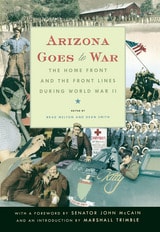
Arizona Goes to War
The Home Front and the Front Lines during World War IIBrad Melton
University of Arizona Press, 2003
Arizona Goes to War takes readers back to a time when military installations sprang up all over the state as thousands of airmen arrived to train in Arizona's clear desert skies, and when soldiers destined for North Africa came to get their first taste of desert sands. In its pages, readers will learn not only of the green recruits who passed through Arizona, but also of the state's Native Americans who registered for the draft in record numbers, of Japanese Americans unjustly incarcerated in desert detention centers, and of ordinary citizens who did their bit for the war effort. Included in the book are some of World War II's most incredible stories, such as the testing of tank engines in Arizona dust storms for the North Africa campaign, the interrogation of Japanese consular diplomats from Honolulu at the Triangle T Guest Ranch near Dragoon, and the escape of 25 German POWs from a detention camp outside of Phoenix—called the greatest escape by Axis prisoners from a U.S. compound during the war. A separate chapter pays tribute to Arizona's war heroes: not only Silvestre Herrera, but also fighter ace Grant Turley, Midway hero John C. Butler, and Pima Indian Ira Hayes, who helped raise the flag on Iwo Jima. A host of profiles and sidebars bring people and events of the wartime era to life, and a useful appendix provides a traveler's guide to Arizona's World War II sites.
World War II may have transformed Arizona more than it did any other state; not only did Arizona's industry blossom, its population did as well when servicemen who had been stationed there returned to put down stakes. Arizona Goes to War recaptures the glory and spirit of that era and reminds us that the people who lived through those years are well worth commemorating.

Arizona Place Names
Will Croft Barnes
University of Arizona Press, 1988
For this first toponymic encyclopedia of Arizona, Barnes compiled information from published histories, federal and state government documents, and reminiscences of "old timers, Indians, Mexicans, cowboys, sheep-herders, historians, any and everybody who had a story to tell as to the origin and meaning of Arizona names." The result is a book chock full of oddments, humor, and now-forgotten lore, which belongs on the night table as well as in the glove compartment.
Barnes' original Arizona Place Names has become a booklover's favorite and is much in demand. The University of Arizona Press is pleased to reissue this classic of Arizoniana, which remains as useful and timeless as it was more than half a century ago.
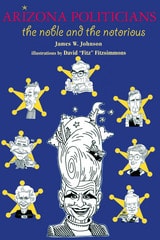
Arizona Politicians
The Noble and the NotoriousJames W. Johnson; Illustrations by David "Fitz" Fitzsimmons
University of Arizona Press, 2002
—A car dealer who propelled himself to the governor's mansion with the help of public recognition of his TV commercials
—An Arizonan who served not only as governor and chief justice of the Arizona Supreme Court, but also as the Majority Leader of the U.S. Senate and chief sponsor of the GI Bill
—A cowboy who delivered speeches to ranchhands and went on to become a U.S. senator known as one of the great orators of the twentieth century
—One of four Arizonans who lost a bid for the presidency yet made the Gallup Poll as one of the ten most admired men in the world
—A secretary who became the first woman in the nation to sit on a state supreme court
Journalist James Johnson has written profiles of 21 men and women from Arizona who have made their mark in the political arena. Chosen for their contributions to the state, their national prominence, their colorful personalities, and in some cases their notoriety, these prominent public servants—from first governor George W. P. Hunt to current senior senator McCain—all have been major participants in state or national affairs. Congressman Mo Udall once commented on Arizona's "civilized brand of politics," in which Republicans and Democrats, conservatives and liberals, treated one another with mutual respect. Johnson conveys both the spirit and spiritedness of Arizona politics and reveals how in many cases these politicians and their family members found their lives and careers overlapping. He tells their stories with humor and objectivity, while political cartoonist David Fitzsimmons captures their trademark styles in original drawings.
Although the individuals may speak from different platforms, all have been proud to call themselves Arizonans and proud to serve their state. This book shares their accomplishments and shows how, for better or worse, they've helped put Arizona in the spotlight.
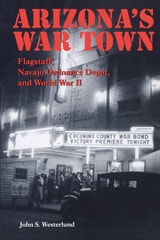
Arizona's War Town
Flagstaff, Navajo Ordnance Depot, and World War IIJohn S. Westerlund
University of Arizona Press, 2003
A clearing in the ponderosa pine forest called Volunteer Prairie met the military's criteria for a munitions depot—open terrain, a cool climate, plentiful water, and proximity to a railroad—and it was also sufficiently inland to be safe from the threat of coastal invasion. Constructing a depot of 800 ammunition bunkers, each the size of a 2,000-square-foot home, called for a force of 8,000 laborers, and Flagstaff became a boom town overnight as construction workers and their families poured in from nearby Indian reservations and as far away as the Midwest and South. More than 2,000 were retained as permanent employees—a larger workforce than Flagstaff's total pre-war employment roster.
As Westerlund's portrait of wartime Flagstaff shows, prosperity brought unanticipated consequences: racism simmered beneath the surface of the town as ethnic groups were thrown together for the first time; merchants called a city-wide strike to protest emerging union activity; juvenile delinquency rose dramatically; Flagstaff women entered the workforce in unprecedented numbers, altering local mores along with their own plans for the future; meanwhile, hundreds of sailors and marines arrived at Arizona State Teachers College to participate in the Navy's "V-12" program. Whether recounting the difficulty of 3,500 Navajo and Hopi employees adjusting to life off the reservation or the complaints of townspeople that Austrian POWs-transferred to the depot to ease the labor shortage-were treated too well, Westerlund shows that the construction and maintenance of the facility was far more than a military matter.
Navajo Ordnance Depot remained operational to support wars in Korea, Vietnam, and the Persian Gulf, and today Camp Navajo provides storage for thousands of deactivated ICBM motors. But in recounting its early days, Westerlund has skillfully blended social and military history to vividly portray not only a city's transitional years but also the impact of military expansion on economic and community development in the American West.

Arizona
A History, Revised EditionThomas E. Sheridan
University of Arizona Press, 2012
Hailed as a model state history thanks to Thomas E. Sheridan's thoughtful analysis and lively interpretation of the people and events shaping the Grand Canyon State, Arizona has become a standard in the field. Now, just in time for Arizona's centennial, Sheridan has revised and expanded this already top-tier state history to incorporate events and changes that have taken place in recent years. Addressing contemporary issues like land use, water rights, dramatic population increases, suburban sprawl, and the US-Mexico border, the new material makes the book more essential than ever. It successfully places the forty-eighth state's history within the context of national and global events. No other book on Arizona history is as integrative or comprehensive.
From stone spear points more than 10,000 years old to the boom and bust of the housing market in the first decade of this century, Arizona: A History explores the ways in which Native Americans, Hispanics, African Americans, Asians, and Anglos have inhabited and exploited Arizona. Sheridan, a life-long resident of the state, puts forth new ideas about what a history should be, embracing a holistic view of the region and shattering the artificial line between prehistory and history. Other works on Arizona's history focus on government, business, or natural resources, but this is the only book to meld the ethnic and cultural complexities of the state's history into the main flow of the story.
A must read for anyone interested in Arizona's past or present, this extensive revision of the classic work will appeal to students, scholars, and general readers alike.
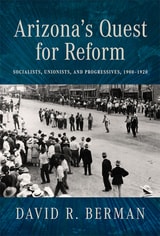
Arizona’s Quest for Reform
Socialists, Unionists, and Progressives, 1900–1920David R. Berman
University of Arizona Press, 2026
In Arizona’s Quest for Reform, David R. Berman traces the rise and fall of a dynamic coalition of socialists, labor activists, and progressive Democrats led by the influential Governor George Hunt as they pursued sweeping reforms in a rapidly changing state. From the fight for workers’ rights and women’s suffrage to the use of the initiative process and the role of radical newspapers, Berman brings to life the people and movements that shaped Arizona’s early political identity.
Drawing on extensive primary sources and organized in a clear chronological structure, Berman’s study reveals the tensions, alliances, and dramatic events that defined Arizona’s reform efforts between 1900 and 1920. The book explores the impact of powerful mining interests, railroad companies, and labor unions, while also examining the racialization of Mexican miners and their evolving role in the labor movement. Through vivid storytelling and rigorous scholarship, Berman uncovers the complexities of political change in a state straddling the transition from territory to statehood.
This landmark work will appeal to scholars of western history, labor studies, and political science, as well as general readers interested in Arizona’s unique place in the national Progressive movement. Arizona’s Quest for Reform not only deepens our understanding of the past but also offers timely insights into the enduring challenges of coalition building, grassroots activism, and political reform. It is a vital contribution to the study of Arizona and the American West.
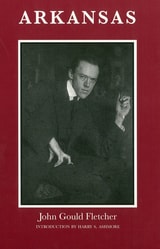
Arkansas
John Gould Fletcher
University of Arkansas Press, 1995
Like a well-planned time capsule, Arkansas is a fascinating picture of the state’s evolution: from a wilderness explored by Hernando de Soto to a rowdy and often lawless frontier, a partner in the shameful dislocation of Native Americans, a state in the Confederacy, a source of homegrown populists, and always a land of opportunity.
As Harry S. Ashmore states in his introduction to this third volume of the John Gould Fletcher Series, “Arkansas still stands up as its author intended, a poet’s imaginative treatment of a ‘history both tragic and comic—with its deep legendary roots going far back into the remote prehistoric past.’ It has earned a permanent place among the books that must be read by those who seek to understand the matrix in which new forces of economic and social change are reshaping Arkansas’s traditional society.”
Arkansas Archaeology
Essays in Honor of Dan and Phyllis MorseRobert C. Mainfort
University of Arkansas Press, 1999

Arkansas Biography
A Collection of Notable LivesNancy Williams
University of Arkansas Press, 2000
Arkansas Godfather
The Story of Owney Madden and How He Hijacked Middle AmericaGraham Nown
Butler Center for Arkansas Studies, 2013
Arkansas Travelers
Geographies of Exploration and Perception, 1804-1834Andrew J. Milson
University of Arkansas Press, 2023
“I reckon stranger you have not been used much to traveling in the woods,” a hunter remarked to Henry Rowe Schoolcraft as he trekked through the Ozark backcountry in late 1818. The ensuing exchange is one of many compelling encounters between Arkansas travelers and settlers depicted in Arkansas Travelers: Geographies of Exploration and Perception, 1804–1834. This book is the first to integrate the stories of four travelers who explored Arkansas during the transformative period between the Louisiana Purchase of 1803 and statehood in 1836: William Dunbar, Thomas Nuttall, Henry Rowe Schoolcraft, and George William Featherstonhaugh.
In addition to gathering their tales of treacherous rivers, drunken scoundrels, and repulsive food, historian and geographer Andrew J. Milson explores the impact such travel narratives have had on geographical understandings of Arkansas places. Using the language in each traveler’s narrative, Milson suggests, and the book includes, new maps that trace these perceptions, illustrating not just the lands traversed, but the way travelers experienced and perceived place. By taking a geographical approach to the history of these spaces, Arkansas Travelers offers a deeper understanding—a deeper map—of Arkansas.

Arkansas Wildlife
A HistoryKeith B. Sutton
University of Arkansas Press, 1998
Arkansas Women and the Right to Vote
The Little Rock Campaigns: 1868-1920Bernadette Cahill
Butler Center for Arkansas Studies, 2015
Arkansas and the New South, 1874–1929
Carl Moneyhon
University of Arkansas Press, 1997
This study is the first published in the Histories of Arkansas, a new series that will build a complete chronological history of the state from the colonial period through modern times. Under the general editorship of noted historian Elliott West, this series will include various thematic histories as well as the chronologically arranged core volumes.
In Arkansas and the New South, 1874–1929 Carl Moneyhon examines the struggle of Arkansas’s people to enter the economic and social mainstreams of the nation in the years from the end of Reconstruction to the beginning of the Great Depression. Economic changes brought about by development of the timber industry, exploitation of the rich coal fields in the western part of the state, discovery of petroleum, and building of manufacturing industries transformed social institutions and fostered a demographic shift from rural to urban settings.
Arkansans were notably successful in bringing the New South to their state, relying on individual enterprise and activist government as they integrated more fully into the national economy and society. But by 1929 persistent problems in the still dominant agricultural sector, the onset of the depression, and heightening social tensions arrested progress and dealt the state a major economic setback that would only be overcome in the years following World War II.
Expanding upon scholarly articles that merely touch on this era in Arkansas history and delving into pertinent primary sources, Moneyhon offers not only an overall look at the state but also an explanation for the singular path it took during these momentous years.
Arkansas in Ink
Gunslingers, Ghosts, and Other Graphic TalesGuy Lancaster
Butler Center for Arkansas Studies, 2014
Arkansas in Modern America since 1930
Ben F. Johnson III
University of Arkansas Press, 2019
Particularly impressive for the breadth of its scope, Arkansas in Modern America since 1930 offers an overview of the factors that moved Arkansas from a primarily rural society to one more in step with the modern economy and perspectives of the nation as a whole. The narrative covers the roles of Daisy Bates, Sam Walton, Don Tyson, Bill Clinton, and other influential figures in the state’s history to reveal a state shaped by global as much as by local forces. The second edition of this important book will continue to set the standard for analysis and interpretation of Arkansas’s place in the contemporary world.
Arkansas in Modern America, 1930–1999
Ben F. Johnson III
University of Arkansas Press, 2000
Arkansas, 1800-1860
Remote and RestlessS. Charles Bolton
University of Arkansas Press, 1998
Often thought of as a primitive backwoods peopled by rough hunters and unsavory characters, early Arkansas was actually productive and dynamic in the same manner as other American territories and states. In this, the second volume in the Histories of Arkansas, S. Charles Bolton describes the emigration, mostly from other southern states, that carried Americans into Arkansas; the growth of an agricultural economy based on cotton, corn, and pork; the dominance of evangelical religion; and the way in which women coped with the frontier and made their own contributions toward its improvement. He closely compares the actual lifestyles of the settlers with the popularly held, uncomplimentary image.
Separate chapters deal with slavery and the lives of the slaves and with Indian affairs, particularly the dispossession of the native Quapaws and the later-arriving Cherokees. Political chapters explore opportunism in Arkansas Territory, the rise of the Democratic Party under the control of the Sevier-Johnson group known as the Dynasty, and the forces that led Arkansas to secede from the Union. In addition, Arkansas’s role in the Mexican War and the California gold rush is treated in detail.
In truth, geographic isolation and a rugged terrain did keep Arkansas underpopulated, and political violence and a disastrous experience in state banking tarnished its reputation, but the state still developed rapidly and successfully in this period, playing an important role on the southwestern frontier.
Winner of the 1999 Booker Worthen Literary Prize

Arkansas/Arkansaw
How Bear Hunters, Hillbillies, and Good Ol' Boys Defined a StateBrooks Blevins
University of Arkansas Press, 2009
Winner, 2011 Ragsdale Award

Arkansas
A Concise HistoryJeannie M. Whayne
University of Arkansas Press, 2019
Distilled from Arkansas: A Narrative History, the definitive work on the subject since its original publication in 2002, Arkansas: A Concise History is a succinct one-volume history of the state from the prehistory period to the present. Featuring four historians, each bringing his or her expertise to a range of topics, this volume introduces readers to the major issues that have confronted the state and traces the evolution of those issues across time.
After a brief review of Arkansas’s natural history, readers will learn about the state’s native populations before exploring the colonial and plantation eras, early statehood, Arkansas’s entry into and role in the Civil War, and significant moments in national and global history, including Reconstruction, the Gilded Age, the Progressive Era, the Elaine race massacre, the Great Depression, both world wars, and the Civil Rights Movement. Linking these events together, Arkansas: A Concise History offers both an understanding of the state’s history and a perspective on that history’s implications for the political, economic, and social realities of today.
Arkansas
A Narrative HistoryJeannie M. Whayne
University of Arkansas Press, 2013
Arkansas: A Narrative History is a comprehensive history of the state that has been invaluable to students and the general public since its original publication. Four distinguished scholars cover prehistoric Arkansas, the colonial period, and the nineteenth and twentieth centuries and incorporate the newest historiography to bring the book up to date for 2012.
A new chapter on Arkansas geography, new material on the civil rights movement and the struggle over integration, and an examination of the state’s transition from a colonial economic model to participation in the global political economy are included. Maps are also dramatically enhanced, and supplemental teaching materials are available.
“No less than the first edition, this revision of Arkansas: A Narrative History is a compelling introduction for those who know little about the state and an insightful survey for others who wish to enrich their acquaintance with the Arkansas past.”
—Ben Johnson, from the Foreword
Arkansas’s Gilded Age
The Rise, Decline, and Legacy of Populism and Working-Class ProtestMatthew Hild
University of Missouri Press, 2018
The story of farmer and labor protest in Arkansas during the late nineteenth century offers lessons relevant to contemporary
working-class Americans in what some observers have called the “new Gilded Age.”

Armageddon in Waco
Critical Perspectives on the Branch Davidian ConflictEdited by Stuart A. Wright
University of Chicago Press, 1996
Could the tragedy have been prevented? Was it necesary for the BATF agents to do what they did? What could have been done differently? Armageddon in Waco offers the most detailed, wide-ranging analysis of events surrounding Waco. Leading scholars in sociology, history, law, and religion explore all facets of the confrontation in an attempt to understand one of the most confusing government actions in American history.
The book begins with the history of the Branch Davidians and the story of its leader, David Koresh. Chapters show how the Davidians came to trouble authorities, why the group was labeled a "cult," and how authorities used unsubstantiated allegations of child abuse to strengthen their case against the sect.
The media's role is examined next in essays that considering the effect on coverage of lack of time and resources, the orchestration of public relations by government officials, the restricted access to the site or to countervailing evidence, and the ideologies of the journalists themselves. Several contributors then explore the relation of violence to religion, comparing Waco to Jonestown.
Finally, the role played by "experts" and "consultants" in defining such conflicts is explored by two contributors who had active roles as scholarly experts during and after the siege The legal and consitutional implications of the government's actions are also analyzed in balanced, clearly written detail.
Armed Forces
Masculinity and Sexuality in the American War FilmEberwein, Robert
Rutgers University Press, 2007
In war films, the portrayal of deep friendships between men is commonplace. Given the sexually anxious nature of the American imagination, such bonds are often interpreted as carrying a homoerotic subtext. In Armed Forces , Robert Eberwein argues that an expanded conception of masculinity and sexuality is necessary in order to understand more fully the intricacy of these intense and emotional human relationships. Drawing on a range of examples from silent films such as What Price Glory and Wings to sound era works like The Deer Hunter, Platoon, Three Kings, and Pearl Harbor , he shows how close readings of war films, particularly in relation to their cultural contexts, demonstrate that depictions of heterosexual love, including those in romantic triangles, actually help to define and clarify the nonsexual nature of male love. The book also explores the problematic aspects of masculinity and sexuality when threatened by wounds, as in The Best Years of Our Lives, and considers the complex and persistent analogy between weapons and the male body, as in Full Metal Jacket and Saving Private Ryan .
Armed with the Constitution
Jehovah's Witnesses in Alabama and the U.S Supreme Court, 1939-1946Merlin Owen Newton
University of Alabama Press, 1995
Armed with the Constitution stresses the courage of a black man, Rosco Jones, and a white woman, Grace Marsh, who dared to challenge the status quo in Alabama in the early 1940s. These two Jehovah’s Witnesses helped to lay a foundation for testing the constitutionality of state and local laws, establishing precedents that the Civil Rights movement, the feminist movement, and similar forces could follow. Newton has prepared a finely woven tale of oral, legal, and social history that opens a window on the world of the Jehovah’s Witnesses in Alabama.
More than a legal study, this book is also a dramatic history of two powerful personalities whose total commitment to their faith enabled them to carry the Jehovah’s Witnesses’ battle from rural Alabama to the halls of the U.S. Supreme Court.
Arms And The Enlisted Woman
Judith Hicks Stiehm
Temple University Press, 1989
Arms and Innovation
Entrepreneurship and Alliances in the Twenty-First Century Defense IndustryJames Hasik
University of Chicago Press, 2008
For all their advantages, small firms also face significant challenges in access to capital and customers. To overcome such problems, they can form alliances either with each other or with larger companies. Hasik traces the trade-offs of such alliances and provides crucial insight into their promises and pitfalls.
This ground-breaking study is a significant contribution to understanding both entrepreneurship and alliances, two crucial factors in business generally. It will be of interest to readers in the defense sector as well as the wider business community.
Arms and Men
A Study in American Military HistoryMillis, Walter
Rutgers University Press, 1981
--Richard H. Kohn
"In my opinion Arms and Men is a splendid piece of work, clearly organized, well argued and beautifully written. We have long needed an informed and intelligent commentary on the evolution of American military policy; and in Mr. Millis' book we have it. I think that his book will awaken great interest and be widely used. I am sure also that professional students of the subject will find it possible, after reading this book, to see the course of American military affairs with a new perspective. That is one of the great services performed by Mr. Millis. He has covered the whole subject with authority, but - thank heaven - in a short book, in which the arguments are not blunted by unnecessary detail."
--Gordon A. Craig
"This author knows weapons, politics and human nature. His perceptive grasp of these complexes shines in the writing."
--The New York Times
Army Life of an Illinois Soldier
Including a Day-by-Day Record of Sherman's March to the SeaCharles W. Wills. Foreword by John Y. Simon
Southern Illinois University Press, 1996
A high-spirited idealist who craved excitement when he enlisted in the Eighth Illinois Volunteers for three months and reenlisted for three years, Charles W. Wills of Canton, Illinois, wrote frequently to his sister Mary Emily Wills and kept a diary of General William T. Sherman’s campaigns during the last year of the war. In the beginning of his service, Wills could boast that his company refused to enlist "roughs." He reported that he and his comrades "drink no liquors and keep ourselves as cleanly as possible.... Almost all are reading or writing, and I defy anyone to find 75 men without any restraint, paying more attention to the Sabbath. . . . Health generally excellent in our company, because we are all careful."
A student and store clerk before enlisting, Wills found that army life "beats clerking." He enlisted as a private at the age of twenty-one and by twenty-four was a major. He had thought he might receive an infantry commission eventually, but when the opportunity arose for promotion to first lieutenant in the Seventh Illinois Cavalry, "cupidity and ambition" caused him to abandon the Eighth, enabling him to hold rank "without so much walking." For a while, though, he seriously rued his lack of action. "Haven’t I a brilliant record," he wrote. "Thirty-three months in service and not a battle." As Simon points out, however, "in the year ahead, Wills would have more than his fill of battles." Battle starved once, his enthusiasm for carnage waned as he marched with Sherman to the sea. Yet Major Wills was impressed by his troops’ "endurance, spirit and recklessness."
Wills matured in the army. He joined solely to preserve the Union, and his early comments on slaves "lacked sympathy, even decency," according to Simon. Later he came to the point where he would arm blacks—in part, with an eye toward gaining rank by leading the new regiments. Yet he was not blind to the anomalies of a slave society.
Wills died in 1883. To preserve his memory, his sister (now Mary Kellogg) printed his diary in 1904. Two years later, Kellogg combined the diary with the letters Wills had written to her earlier in the war. Simon renders this assessment: "Wills had a sparkling, witty style that contrasted sharply with that of both his contemporaries in the field and the seven regimental veterans who compiled their diaries. In assembling this book, Mary E. Kellogg wisely allowed her brother to speak for himself; rarely intruding a comment of her own, excising from his letters home inevitable expressions of concern for his sister and her welfare but leaving intact the sparkling flow of camp gossip and military speculation."
Army Life
From a Soldier's JournalA. O. Marshall
University of Arkansas Press, 2009
Army Of Israel
David Bigler
Utah State University Press, 2000
Army of Hope, Army of Alienation
Culture and Contradiction in the American Army Communities of Cold War GermanyJohn P. Hawkins
University of Alabama Press, 2004
An inside look at the promises, pressures, and paradoxes of American military life in Cold War Germany.
Army life has always been known as a life of sacrifice, challenge, and frustration, yet one filled also with deep satisfactions. This is so for the soldiers’ families as much as for the soldiers themselves. Over the years, military and civilian leaders of the US Army have tried to reduce the hardships of military life by creating an array of community services designed to provide social support for soldiers and families and help them live satisfying lives in military communities.
Unfortunately, this effort has not been particularly successful, and frustration, dissatisfaction, and alienation persist among soldiers and family member in the US Army communities in Germany. Discontent continues because the underlying sources of alienation in the Army and among its families are highly complex, poorly understood, and therefore hardly addressed by the Army’s quality-of-life programs that are intended to make soldier and family life more bearable.
In Army of Hope, Army of Alienation: Culture and Contradiction in the American Army Communities of Cold War Germany, the author seeks to penetrate the logic, social structure, and daily practice of life in the American military communities that lay scattered along the frontier between East and West Germany during the final years of the Cold War. In coming to understand the life and thought of these American soldiers and families, ordinary American citizens can learn much about their military forces and about their own society and culture. In addition, a greater understanding about how people work and live around an institution that is at once so important and yet tasked with a mission so different from that of ordinary pursuits can stimulate social scientists and concerned citizens to think differently about culture, society, and behavior in general.
Around Quitting Time
Work and Middle-Class Fantasy in American FictionRobert Seguin
Duke University Press, 2001
Tracing connections between the reconstruction of the labor process and the aesthetic dilemmas of modernism, between the emergence of the modern state and the structure of narrative, Seguin analyzes the work of Nathanael West, Ernest Hemingway, Willa Cather, John Barth, and others. These fictional narratives serve to demonstrate for Seguin the pattern of social sites and cultural phenomenon that have emerged where work and leisure, production and consumption, and activity and passivity coincide. He reveals how, by creating pathways between these seemingly opposed domains, the middle-class imaginary at once captures and suspends the dynamics of social class and opens out onto a political and cultural terrain where class is both omnipresent and invisible.
Around Quitting Time will interest critics and historians of modern U.S. culture, literary scholars, and those who explore the interaction between economic and cultural forms.
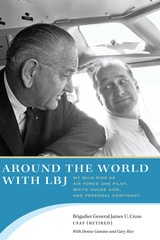
Around the World with LBJ
My Wild Ride as Air Force One Pilot, White House Aide, and Personal ConfidantBy Brigadier General James U. Cross, USAF (retired), with Denise Gamino and Gary Rice
University of Texas Press, 2008
When Lyndon Baines Johnson wanted to go somewhere, there was no stopping him. This dynamic president called for Air Force One as others summon a taxi—at a moment's notice, whatever the hour or the weather. And the man who made sure that LBJ got his ride was General James U. Cross, the president's hand-picked pilot, top military assistant, and personal confidante. One of the few Air Force One pilots to have a position, simultaneously, in the White House, General Cross is also the only member of LBJ's inner circle who has not publicly offered his recollections of the president. In this book, he goes on the record, creating a fascinating, behind-the-scenes portrait of America's complex, often contradictory, always larger-than-life thirty-sixth president.
General Cross tells an engrossing story. In addition to piloting Air Force One around the globe, he served President Johnson in multiple capacities, including directing the Military Office in the White House; managing a secret two-million-dollar presidential emergency fund; supervising the presidential retreat at Camp David, the president's entire transportation fleet, and the presidential bomb shelters; running the White House Mess; hiring White House social aides, including the president's future son-in-law, Charles Robb; and writing condolence letters to the families of soldiers killed in Vietnam. This wide-ranging, around-the-clock access to President Johnson allowed Cross to witness events and share moments that add color and depth to our understanding of America's arguably most demanding and unpredictable president.

Arranging Marriage
Conjugal Agency in the South Asian DiasporaMarian Aguiar
University of Minnesota Press, 2018
The first critical analysis of contemporary arranged marriage among South Asians in a global context
Arranged marriage is an institution of global fascination—an object of curiosity, revulsion, outrage, and even envy. Marian Aguiar provides the first sustained analysis of arranged marriage as a transnational cultural phenomenon, revealing how its meaning has been continuously reinvented within the South Asian diaspora of Britain, the United States, and Canada. Aguiar identifies and analyzes representations of arranged marriage in an interdisciplinary set of texts—from literary fiction and Bollywood films, to digital and print media, to contemporary law and policy on forced marriage.
Aguiar interprets depictions of South Asian arranged marriage to show we are in a moment of conjugal globalization, identifying how narratives about arranged marriage bear upon questions of consent, agency, state power, and national belonging. Aguiar argues that these discourses illuminate deep divisions in the processes of globalization constructed on a fault line between individualist and collectivist agency and in the process, critiques neoliberal celebrations of “culture as choice” that attempt to bridge that separation. Aguiar advocates situating arranged marriage discourses within their social and material contexts so as to see past reductive notions of culture and grasp the global forces mediating increasingly polarized visions of agency.