28167 books match the query 'History' and 2536 start with a
cover of An Armchair Traveller's History of Istanbul: City of Remembering and Forgetting

An Armchair Traveller's History of Istanbul

City of Remembering and Forgetting

Richard Tillinghast

Haus Publishing, 2013

The author is an old Istanbul hand who has seen it change over the years from a provincial backwater to today's vibrant metropolis. With Tillinghast as a guide through Istanbul's cafés, mosques and palaces, and along its streets and waterways, readers will feel at home both in the Constantinople of bygone days and on the streets of the modern town.
[more]
cover of An Armchair Traveller's History of Tokyo

An Armchair Traveller's History of Tokyo

Jonathan Clements

Haus Publishing, 2018

With almost 13 million residents, Tokyo is now as much an icon of modernity as it is a city, with its neon-lit billboards, futuristic technology, and avant-garde fashion scene. But the long and fascinating history of Japan’s modern capital encompasses much, much more, and in An Armchair Traveller’s History of Tokyo, Jonathan Clements sketches the city’s amazing trajectory from its humble beginnings as a group of clearings in a forest on the Kanto plain all the way to its upcoming role as host of the 2020 Olympic Games.

Tokyo, meaning “Eastern Capital,” has only enjoyed that name and status for 150 years. Before that, it was a medieval outpost designed to keep watch over rich farmlands. But this seemingly unassuming geographical location ultimately led to its status as a supercity. Though the imperial court ruled Japan from the sleepy city of Kyoto, the landowners of the Kanto plain where Tokyo lies held the true wealth and power in Japan, which they eventually asserted in a series of bloody civil wars. The Tokyo region became the administrative center of Japan’s Shogun overlords and the site of a vibrant urban culture home to theaters, taverns, and brothels. After the Meiji Restoration in 1868, it became Japan’s true capital, home to the emperors, the seat of government, and a site of rapid urban growth.

Anyone who’s ever longed to look upon Mount Fuji, embody the bravery of the Samurai, or savor the world’s finest sushi will find themselves transported from the comfort of their armchair while reading Clements’s account of Tokyo.
[more]
cover of An Army of Ex-Lovers: My life at the Gay Community News

An Army of Ex-Lovers

My life at the Gay Community News

Amy Hoffman

University of Massachusetts Press, 2007

Boston's weekly Gay Community News was “the center of the universe” during the late 1970s, writes Amy Hoffman in this memoir of gay liberation before AIDS, before gay weddings, and before The L Word. Provocative, informative, inspiring, and absurd, with a small circulation but a huge influence, Gay Community News produced a generation of leaders, writers, and friends. In addition to capturing the heady atmosphere of the times—the victories, controversies, and tragedies—Hoffman's memoir is also her personal story, written with wit and insight, of growing up in a political movement; of her deepening relationships with charismatic, talented, and sometimes utterly weird coworkers; and of trying to explain it all to her large Jewish family.
[more]
cover of An Artificial History of Natural Intelligence: Thinking with Machines from Descartes to the Digital Age

An Artificial History of Natural Intelligence

Thinking with Machines from Descartes to the Digital Age

David W. Bates

University of Chicago Press, 2024

A new history of human intelligence that argues that humans know themselves by knowing their machines.

We imagine that we are both in control of and controlled by our bodies—autonomous and yet automatic. This entanglement, according to David W. Bates, emerged in the seventeenth century when humans first built and compared themselves with machines. Reading varied thinkers from Descartes to Kant to Turing, Bates reveals how time and time again technological developments offered new ways to imagine how the body’s automaticity worked alongside the mind’s autonomy. Tracing these evolving lines of thought, An Artificial History of Natural Intelligence offers a new theorization of the human as a being that is dependent on technology and produces itself as an artificial automaton without a natural, outside origin.

[more]
cover of An Athletic Director’s Story and the Future of College Sports in America

An Athletic Director’s Story and the Future of College Sports in America

Robert E. Mulcahy

Rutgers University Press, 2020

Robert Mulcahy’s chronicle of his decade leading Rutgers University athletics is an intriguing story about fulfilling a vision.  The goal was to expand pride in intercollegiate athletics.  Redirecting a program with clearer direction and strategic purpose brought encouraging results.  Advocating for finer coaching and improved facilities, he and Rutgers achieved national honors in Division I sports.  Unprecedented alumni interest and support for athletics swelled across the Rutgers community.
His words and actions were prominent during a nationally-reported incident involving student athletes.  When the Rutgers Women’s Basketball team players were slandered by racist remarks from a popular radio talk show host, Mulcahy met it head on.  With the coach and players, he set an inspiring example for defending character and values.
Though Mr. Mulcahy left Rutgers in 2009, his memoir reflects continued devotion to intercollegiate athletics and student athletes.  His insights for addressing several leading issues confronting Division I sports today offer guidelines for present and future athletic directors to follow.
 
[more]
cover of An Atlantic City Reader: The Rise and Decline of an American Resort

An Atlantic City Reader

The Rise and Decline of an American Resort

Louis J. Parascandola

Rutgers University Press, 2026

As Atlantic City grew to become one of the largest tourist destinations on the East Coast, it loomed ever larger in the imaginations of American writers. Generation upon generation of novelists, journalists, musicians, and poets visited Atlantic City and left with vivid impressions of its kaleidoscopic delights and its seedy underbelly.

This new reader collects all of these diverse perspectives on the city in one place, including accounts of Atlantic City by such famous visitors as Walt Whitman, William Carlos Williams, Fanny Hurst, Arthur Conan Doyle, Damon Runyon, Langston Hughes, Elmore Leonard, and Bruce Springsteen. Arranged chronologically, the anthology traces the city’s history from its humble beginnings as a quiet health resort to its rapid ascent to the world’s playground, its gradual decline, and its hopeful if tenuous future. Together, the pieces in this collection take us inside the city’s glitz, glamor, and gambling palaces, but they also don’t shy away from its troubling histories of racial discrimination, political corruption, and urban decay. Compiling fiction, poetry, drama, memoirs, newspaper stories, and magazine reports, The Atlantic City Reader presents an engaging and multifaceted portrait of this iconic resort town. 
[more]
cover of An Atlas of Illinois Fishes: 150 Years of Change

An Atlas of Illinois Fishes

150 Years of Change

Brian A. Metzke, Brooks M. Burr, Leon C. Hinz Jr., Lawrence M. Page, and Christopher A. Taylor

University of Illinois Press, 2022

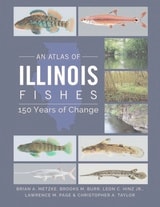
Lake Michigan, winding creeks, sprawling swamps, and one of the world’s great rivers--Illinois’s variety of aquatic habitats makes the Prairie State home to a diverse array of fishes. The first book of its kind in over forty years, An Atlas of Illinois Fishes is a combination of nature guide and natural history. It provides readers with an authoritative resource based on the extensive biological data collected by scientists since the mid-1850s. Each of the entries on Illinois’s 217 current and extirpated fish species offers one or more color photographs; maps depicting distributions at three time periods; descriptions of identifying features; notes on habitat preference; and comments on distribution. In addition, the authors provide a pictorial key for identifying Illinois fishes.

Scientifically up-to-date and illustrated with over 240 color photos, An Atlas of Illinois Fishes is a benchmark in the study of Illinois’s ever-changing fish communities and the habitats that support them.
[more]
cover of An Audience of Artists: Dada, Neo-Dada, and the Emergence of Abstract Expressionism

An Audience of Artists

Dada, Neo-Dada, and the Emergence of Abstract Expressionism

Catherine Craft

University of Chicago Press, 2012

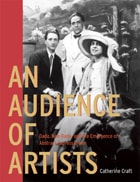
The term Neo-Dada surfaced in New York in the late 1950s and was used to characterize young artists like Robert Rauschenberg and Jasper Johns whose art appeared at odds with the serious emotional and painterly interests of the then-dominant movement, Abstract Expressionism. Neo-Dada quickly became the word of choice in the early 1960s to designate experimental art, including assemblage, performance, Pop art, and nascent forms of minimal and conceptual art.
An Audience of Artists turns this time line for the postwar New York art world on its head, presenting a new pedigree for these artistic movements. Drawing on an array of previously unpublished material, Catherine A. Craft reveals that Neo-Dada, far from being a reaction to Abstract Expressionism, actually originated at the heart of that movement’s concerns about viewers, originality, and artists’ debts to the past and one another. Furthermore, she argues, the original Dada movement was not incompatible with Abstract Expressionism. In fact, Dada provided a vital historical reference for artists and critics seeking to come to terms with the radical departure from tradition that Abstract Expressionism seemed to represent. Tracing the activities of artists such as Robert Motherwell, Barnett Newman, and Jackson Pollock alongside Marcel Duchamp’s renewed embrace of Dada in the late 1940s, Craft composes a subtle exploration of the challenges facing artists trying to work in the wake of a destructive world war and the paintings, objects, writings, and installations that resulted from their efforts.
 
Providing the first examination of the roots of the Neo-Dada phenomenon, this groundbreaking study significantly reassesses the histories of these three movements and offers new ways of understanding the broader issues related to the development of modern art.
[more]
cover of An Awesome Universe: From the First Stargazers to Modern Cosmology

An Awesome Universe

From the First Stargazers to Modern Cosmology

William Sheehan and Christopher J. Conselice

University of Arizona Press, 2027

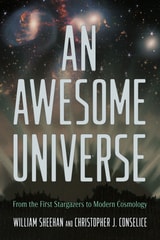
This groundbreaking exploration of humanity’s quest to understand the cosmos spans the earliest observations of the night sky to the latest revelations from advanced space telescopes. It is about humans as much as stars, galaxies, black holes, dark matter, and dark energy. It is a book about the awe we experience in the presence of the awesome universe.

Written by an award-winning historian of astronomy and a professional astronomer specializing in galaxy formation in the early universe, this book provides a comprehensive narrative of cosmic discovery. It examines the evolution of our understanding of the universe—from the first glimpses of the stars to the recognition of the Milky Way as a spiral galaxy and the realization that our universe is filled with countless other galaxies. The book also explores the revolutionary advancements in astrophysics that have shaped our knowledge, including quantum mechanics, nuclear physics, and the study of the still mysterious dark matter and dark energy. 

Richly illustrated with remarkable images that show the scale of the universe—from the ancient sky to the ten trillion galaxies now known to exist—An Awesome Universe also addresses some of the most profound questions in science: the nature of life beyond Earth, the fate of the universe, and whether we will ever fully understand the mysteries of space-time, the Big Bang, and the possibility of a multiverse. 

This authoritative and visually captivating work offers readers a glimpse into the “Big Picture” of the cosmos, framed by the contributions of pioneering astronomers and driven by our ongoing quest for knowledge about our place in the universe. 

[more]
cover of An Early Encounter with Tomorrow: Europeans, Chicago's Loop, and the World's Columbian Exposition

An Early Encounter with Tomorrow

Europeans, Chicago's Loop, and the World's Columbian Exposition

Arnold Lewis

University of Illinois Press, 1997

Winner of the Jacques Barzun Prize in Cultural History given by the Council of the American Philosophical Society
 
Extravagantly illustrated with over seventy photographs, drawings, paintings, and contemporary cartoons, An Early Encounter with Tomorrow documents the mixture of amazement and alarm with which European visitors greeted 1890s Chicago: as a futuristic city animated by a crass, frenetic mercantile class. This volume also contains an extensive bibliography, arranged by country, and profiles of the foreign observers who sought the implications for European culture in what Asa Briggs called the "shock city" of the western world.

 
 
[more]
cover of An Early Woodland Community at the Schultz Site 20SA2 in the Saginaw Valley and the Nature of the Early Woodland Adaptation in the Great Lakes Region

An Early Woodland Community at the Schultz Site 20SA2 in the Saginaw Valley and the Nature of the Early Woodland Adaptation in the Great Lakes Region

Doreen Ozker

University of Michigan Press, 1982
The Schultz site is an Early Woodland site on the Tittabawassee River in Saginaw County, Michigan. In this volume, author Doreen Ozker describes the site: its stratigraphy and plant and faunal remains, as well as ceramics and lithics. She also situates the site in the context of the Early Woodland community. She distinguishes Late Archaic and Early Woodland from each other, and as a result, redefines Early Woodland culture.
[more]
cover of An Ecology of Knowledges: Fear, Love, and Technoscience in Guatemalan Forest Conservation

An Ecology of Knowledges

Fear, Love, and Technoscience in Guatemalan Forest Conservation

Micha Rahder

Duke University Press, 2020
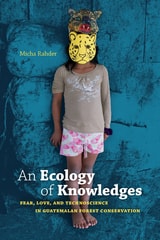
Guatemala's Maya Biosphere Reserve (MBR), the largest protected area in Central America, is characterized by rampant violence, social and ethnic inequality, and rapid deforestation. Faced with these threats, local residents, conservationists, scientists, and NGOs in the region work within what Micha Rahder calls “an ecology of knowledges,” in which interventions on the MBR landscape are tied to differing and sometimes competing forms of knowing. In this book, Rahder examines how technoscience, endemic violence, and an embodied love of wild species and places shape conservation practices in Guatemala. Rahder highlights how different forms of environmental knowledge emerge from encounters and relations between humans and nonhumans, institutions and local actors, and how situated ways of knowing impact conservation practices and natural places, often in unexpected and unintended ways. In so doing, she opens up new ways of thinking about the complexities of environmental knowledge and conservation in the context of instability, inequality, and violence around the world.
[more]
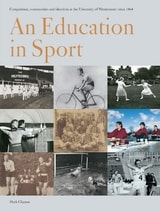
cover of An Education in Sport: Competition, communities and identities at the University of Westminster since 1864

An Education in Sport

Competition, communities and identities at the University of Westminster since 1864

Mark Clapson

University of Westminster Press, 2013

The story of sporting communities and individuals at the University of Westminster over 150 years is the second book to explore the institution's diverse history including its role as a pioneer of women's sports. Drawing upon the University's extensive archives this richly illustrated book celebrates its unique, ground-breaking sports heritage.

[more]
cover of An Efficient Womanhood: Women and the Making of the Universal Negro Improvement Association

An Efficient Womanhood

Women and the Making of the Universal Negro Improvement Association

Natanya Duncan

University of Illinois Press, 2023

Black women and a far-reaching strategy for activism and action

Founded in 1914 by Amy Ashwood and Marcus Garvey, the Universal Negro Improvement Association and African Communities League (commonly called the UNIA) grew into one of the largest social justice organizations of the twentieth century. Natanya Duncan’s collective biography explores women’s role in building the UNIA and how Ashwood’s strategy of efficient womanhood equipped them to confront political and social issues--even when it meant defying gender norms. Efficient womanhood took a three-tiered approach that asked UNIA women to seek equitable partners, take on roles as mentors, and connect resources and people to their communities and Black people at large. Strong believers in the necessity of their presence and voices, UNIA women developed leadership skills within and beyond the organization and used these skills in service to their communities.

Enlightening and in-depth, An Efficient Womanhood tells the story of the women who shaped a framework for leadership and engagement that remains a blueprint for activists today.
[more]
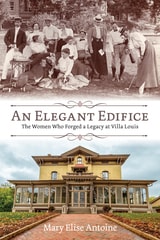
cover of An Elegant Edifice: The Women Who Forged a Legacy at Villa Louis

An Elegant Edifice

The Women Who Forged a Legacy at Villa Louis

Mary Elise Antoine

Wisconsin Historical Society Press, 2026

Discover the three generations of Dousman women who breathed life into a grand Gilded Age estate. 

On the banks of the upper Mississippi River at Prairie du Chien, Wisconsin, stands Villa Louis, the majestic Italianate-style mansion and estate built by the prosperous Dousman family in 1871. An Elegant Edifice tells the stories of the women of the Dousman residence. Jane, who outlived her husband by fourteen years, oversaw the estate and maintained the family’s presence in Prairie du Chien. Jane’s daughter-in-law, Nina, managed the property and assumed the role of head of the family following her husband’s death, ensuring stability for her children during times of tragedy. Finally, Nina’s daughters Violet and Virginia helped to restore the family home in the 1930s, secure its future as a historic site, and record the Dousmans’ history for posterity.

An Elegant Edifice illustrates the broad strokes of American expansionism through the backgrounds and activities of these influential women, complete with marriages and separations, births and deaths, business disputes, lawsuits, and reconciliations. With stories of St. Louis and St. Paul society, the stylish shops of New York City, and the prominence of Prairie du Chien in the nineteenth century, this book reveals the leisure activities and extravagant lifestyle afforded to the family by their wealth—Tiffany jewelry and housewares, William Morris wallpaper and fabrics, Jaccard silver, and a fine art collection to rival the public museums of the era.

Thanks to the women’s fortitude and shared conviction in the importance of family, Villa Louis has been preserved and restored to its 1890s splendor and is today considered one of the most authentically restored Italianate villas in the United States. While previous histories have focused on the Dousman patriarchs, public historian Mary Elise Antoine offers a new perspective on the Dousman family history by bringing into focus Jane, Nina, Violet, and Virginia. These women’s lives—historically less well-documented than the lives of their husbands, fathers, and sons—contributed greatly to the preservation of Villa Louis and to our understanding of an important chapter in American history.
[more]
cover of An Elusive Science: The Troubling History of Education Research

An Elusive Science

The Troubling History of Education Research

Ellen Condliffe Lagemann

University of Chicago Press, 2000

Since its beginnings at the start of the 20th century, educational scholarship has been a marginal field, criticized by public policy makers and relegated to the fringes of academe. An Elusive Science explains why, providing a critical history of the traditions, conflicts, and institutions that have shaped the study of education over the past century.

"[C]andid and incisive. . . . A stark yet enlightening look at American education."—Library Journal

"[A]n account of the search, over the past hundred or so years, to try and discover how educational research might provide reliable prescriptions for the improvement of education. Through extensive use of contemporary reference material, [Lagemann] shows that the search for ways of producing high-quality research has been, in effect, a search for secure disciplinary foundations."—Dylan William, Times Higher Education Supplement
[more]
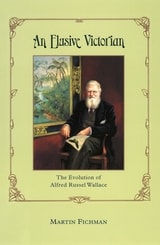
cover of An Elusive Victorian: The Evolution of Alfred Russel Wallace

An Elusive Victorian

The Evolution of Alfred Russel Wallace

Martin Fichman

University of Chicago Press, 2003

Codiscoverer of the theory of evolution by natural selection, Alfred Russel Wallace should be recognized as one of the titans of Victorian science. Instead he has long been relegated to a secondary place behind Darwin. Worse, many scholars have overlooked or even mocked his significant contributions to other aspects of Victorian culture. With An Elusive Victorian, Martin Fichman provides the first comprehensive analytical study of Wallace's life and controversial intellectual career.

Fichman examines not only Wallace's scientific work as an evolutionary theorist and field naturalist but also his philosophical concerns, his involvement with theism, and his commitment to land nationalization and other sociopolitical reforms such as women's rights. As Fichman shows, Wallace worked throughout his life to integrate these humanistic and scientific interests. His goal: the development of an evolutionary cosmology, a unified vision of humanity's place in nature and society that he hoped would ensure the dignity of all individuals.

To reveal the many aspects of this compelling figure, Fichman not only reexamines Wallace's published works, but also probes the contents of his lesser known writings, unpublished correspondence, and copious annotations in books from his personal library. Rather than consider Wallace's science as distinct from his sociopolitical commitments, An Elusive Victorian assumes a mutually beneficial relationship between the two, one which shaped Wallace into one of the most memorable characters of his time. Fully situating Wallace's wide-ranging work in its historical and cultural context, Fichman's innovative and insightful account will interest historians of science, religion, and Victorian culture as well as biologists.
[more]
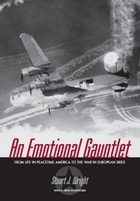
cover of An Emotional Gauntlet: From Life in Peacetime America to the War in European Skies

An Emotional Gauntlet

From Life in Peacetime America to the War in European Skies

Stuart J. Wright

University of Wisconsin Press, 2008

    Stuart J. Wright tells the gripping story of a World War II American aircrew flying missions from England in a B-24 Liberator bomber they nicknamed Corky. This is a true account based on years of research and correspondence with crewmembers and their families. Wright adds a dimension rarely explored in other World War II memoirs and narratives, beginning the chronicle during peacetime when the men of the aircrew are introduced as civilians-kids during the 1920s. As they mature through the years of the Great Depression to face a world at war, questions are raised about "just" and "unjust" wars, imperialism, and patriotism. Jingoistic sentimentality is resisted in favor of objectivity, as the feelings and motivations of the crewmembers are explored: the Chinese American air gunner had hoped to serve in the U.S. Army Air Force to fight against the Japanese invaders of his homeland; the Jewish navigator felt compelled to join the battle against Nazi Germany.
    In recounting the harrowing conditions and horrors of bombing missions over Europe, An Emotional Gauntlet emphasizes the interpersonal relationships within the crew and the spirit these men shared. Corky's crew served under Operations Officer Major James Stewart (the Hollywood movie star.) They often returned from arduous bombing missions to sleep in half-empty huts—their friends in other planes had not been so lucky. Pilot Jack Nortridge regularly assured his crew, "If you fly with me, I'm going to bring you home." This book is a testament to their strength and determination.
[more]
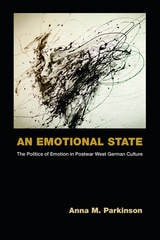
cover of An Emotional State: The Politics of Emotion in Postwar West German Culture

An Emotional State

The Politics of Emotion in Postwar West German Culture

Anna M. Parkinson

University of Michigan Press, 2015

This literary-historical study seeks to dismantle the prevailing notion that Germany, in the period following the Second World War, exhibited an “inability to mourn,” arguing that in fact this period experienced a surge of affect. Anna Parkinson examines the emotions explicitly manifested or addressed in a variety of German cultural artifacts, while also identifying previously unacknowledged (and undertheorized) affective structures implicitly at work during the country’s national crisis. Much of the scholarship in the expanding field of affect theory distrusts Freudian psychoanalysis, which does not differentiate between emotion and affect.
 
One of the book’s major contributions is that it offers an analytical distinction between emotion and affect, finding a compelling way to talk about affect and emotion that is informed by affect theory but that integrates psychoanalysis. The study draws on the psychoanalytic writings of Freud, Margarete and Alexander Mitscherlich, and André Green, while engaging with interdisciplinary theorists of affect including Barbara Rosenwein, Lauren Berlant, Ann Cvetkovich, and Eve Kosofsky Sedgwick among many others. 

[more]
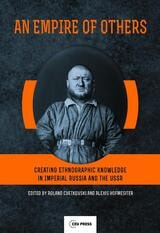
cover of An Empire of Others: Creating Ethnographic Knowledge in Imperial Russia and the USSR

An Empire of Others

Creating Ethnographic Knowledge in Imperial Russia and the USSR

Alexis Hofmeister

Central European University Press, 2014
Ethnographers helped to perceive, to understand and also to shape imperial as well as Soviet Russia's cultural diversity. This volume focuses on the contexts in which ethnographic knowledge was created. Usually, ethnographic findings were superseded by imperial discourse: Defining regions, connecting them with ethnic origins and conceiving national entities necessarily implied the mapping of political and historical hierarchies. But beyond these spatial conceptualizations the essays particularly address the specific conditions in which ethnographic knowledge appeared and changed. On the one hand, they turn to the several fields into which ethnographic knowledge poured and materialized, i.e., history, historiography, anthropology or ideology. On the other, they equally consider the impact of the specific formats, i.e., pictures, maps, atlases, lectures, songs, museums, and exhibitions, on academic as well as non-academic manifestations.
[more]
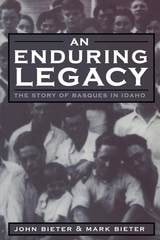
cover of An Enduring Legacy: The Story Of Basques In Idaho

An Enduring Legacy

The Story Of Basques In Idaho

Mark Bieter

University of Nevada Press, 2003

In this volume, brothers Mark and John Bieter chronicle three generations of Basque presence in Idaho from 1890 to the present, resulting in an engaging story that begins with a few solitary sheepherders and follows their evolution into the prominent ethnic community of today.
[more]
cover of An Entangled Bank: The Origins of Ecosystem Ecology

An Entangled Bank

The Origins of Ecosystem Ecology

Joel B. Hagen

Rutgers University Press, 1992

This book was a revelation. I was simply enthralled by Joel Hagen's brilliance in reviewing the emergence of the discipline of ecosystem ecology (the study of biotic-abiotic interaction and nutrient flows in ecological systems). He does a magnificent job of introducing the personalities that midwived the new science. He explains their intellectual struggles, philosophical cross-currents, and different academic milieux. He also expertly illuminates sociopolitical context. Through his in-depth research he is able to dispel some misconceptions and truismsm, arriving at the heart of what made each scientist tick. Even when exploring some of the arcane figures and dead-end developments, he is so compelling that they become integral to the story, not sidetracks.

His breadth of knowledge, his discerning inclusiveness, his clarity of thought, all make _An Entangled Bank_ a stimulating read. Very often in science courses we are presented only with the canonical "state of the science," having to swallow its agglomerated whole free of context. Hagen reveals the wisdom of understanding intellectual foundations. Through study of the origins and development of a science, we may better grasp the received tenets of current scientific understanding. As a young science, ecosystem ecology has a historical context that is relatively accessible to us, if less romantic than a tale of the origins of astronomy might be.

A peek into the labs and offices of botanists, limnologists, and biogeochemists might not seem like the acme of excitement. Hagen inspires us with his insights. He makes his subject meaningful to us. Though it is not pleasure reading by any stretch, its clear-sighted intellectual vigor makes _An Entangled Bank_ pure enjoyment.

[more]
cover of An Environmental History of Knowledge and Politics: Forestry in Nineteenth- and Twentieth-Century Hungary

An Environmental History of Knowledge and Politics

Forestry in Nineteenth- and Twentieth-Century Hungary

Robert Balogh

Central European University Press, 2026
In February 2024 the designated body of the geological sciences rejected the proposition that humans have entered the Anthropocene epoch. Historians are yet to tell history as the interaction with materials and living beings. The history of forestry is a particularly promising subject to study. Environmental concerns and the large-scale commodification of forests, often with state participation, have been walking hand-in-hand since at least the mid-eighteenth century. Moreover, the history of the development of forestry’s standardised methodology is a global history. This book describes the efforts and experiences of trained foresters driven by competing priorities, as well as their impact on the society, landscape and politics of Hungary between about 1860 and 1975.
[more]
cover of An Epistemology of the Concrete: Twentieth-Century Histories of Life

An Epistemology of the Concrete

Twentieth-Century Histories of Life

Hans-Jörg Rheinberger

Duke University Press, 2010
An Epistemology of the Concrete brings together case studies and theoretical reflections on the history and epistemology of the life sciences by Hans-Jörg Rheinberger, one of the world’s foremost philosophers of science. In these essays, he examines the history of experiments, concepts, model organisms, instruments, and the gamut of epistemological, institutional, political, and social factors that determine the actual course of the development of knowledge. Building on ideas from his influential book Toward a History of Epistemic Things, Rheinberger first considers ways of historicizing scientific knowledge, and then explores different configurations of genetic experimentation in the first half of the twentieth century and the interaction between apparatuses, experiments, and concept formation in molecular biology in the second half of the twentieth century. He delves into fundamental epistemological issues bearing on the relationship between instruments and objects of knowledge, laboratory preparations as a special class of epistemic objects, and the note-taking and write-up techniques used in research labs. He takes up topics ranging from the French “historical epistemologists” Gaston Bachelard and Georges Canguilhem to the liquid scintillation counter, a radioactivity measuring device that became a crucial tool for molecular biology and biomedicine in the 1960s and 1970s. Throughout An Epistemology of the Concrete, Rheinberger shows how assemblages—historical conjunctures—set the conditions for the emergence of epistemic novelty, and he conveys the fascination of scientific things: those organisms, spaces, apparatuses, and techniques that are transformed by research and that transform research in turn.
[more]
cover of An Epitaph for German Judaism: From Halle to Jerusalem

An Epitaph for German Judaism

From Halle to Jerusalem

Emil Fackenheim

University of Wisconsin Press, 2007

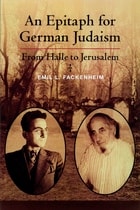
     Emil Fackenheim’s life work was to call upon the world at large—and on philosophers, Christians, Jews, and Germans in particular—to confront the Holocaust as an unprecedented assault on the Jewish people, Judaism, and all humanity. In this memoir, to which he was making final revisions at the time of his death, Fackenheim looks back on his life, at the profound and painful circumstances that shaped him as a philosopher and a committed Jewish thinker.
     Interned for three months in the Sachsenhausen concentration camp after Kristallnacht, Fackenheim was released and escaped to Scotland and then to Canada, where he lived in a refugee internment camp before eventually becoming a congregational rabbi and then, for thirty-five years, a professor of philosophy. He recalls here what it meant to be a German Jew in North America, the desperate need to respond to the crisis in Europe and to cope with its overwhelming implications for Jewish identity and community. His second great turning point came in 1967, as he saw Jews threatened with another Holocaust, this time in Israel. This crisis led him on a pilgrimage to Jerusalem and ultimately back to Germany, where he continued to grapple with the question, How can the Jewish faith—and the Christian faith—exist after the Holocaust?


“An ‘epoch-making’ autobiography.”—Arnold Ages, Jewish Tribune
 
[more]
cover of An Epitaph for Little Rock: A Fiftieth Anniversary Retrospective on the Central High Crisis

An Epitaph for Little Rock

A Fiftieth Anniversary Retrospective on the Central High Crisis

John A. Kirk

University of Arkansas Press, 2008
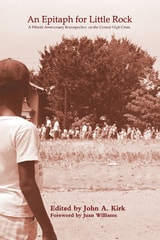
This collection of essays mines the Arkansas Historical Quarterly from the 1960s to the present to form a body of work that represents some of the finest scholarship on the crisis, from distinguished southern historians Numan V. Bartley, Neil R. McMillen, Tony A. Freyer, Roy Reed, David L. Chappell, Lorraine Gates Schuyler, John A. Kirk, Azza Salama Layton, and Ben F. Johnson III. A comprehensive array of topics are explored, including the state, regional, national, and international dimensions of the crisis as well as local white and black responses to events, gender issues, politics, and law. Introduced with an informative historiographical essay from John A. Kirk, An Epitaph for Little Rock is essential reading on this defining moment in America's civil rights struggle.
[more]
cover of An Equal Share of Freedom: American Jews, Zionism, and World War I

An Equal Share of Freedom

American Jews, Zionism, and World War I

Edited by Mark Raider, Zohar Segev, and Gary Phillip Zola

University of Minnesota Press, 2024

Essays illustrating the American Jewish experience during World War I.
 
An Equal Share of Freedom sheds new light on several important and interrelated dimensions of American, Jewish, and world history in the World War I era. Paying close attention to the Balfour Declaration as a hub around which to explore the period’s unfolding and turbulent social, cultural, and political developments, this collection of essays covers a diverse range of topics including Jewish doughboys, Zionist women authors, and political elites such as Golda Meir and Woodrow Wilson. The volume demonstrates the complex nature of Jewish ethnonational consciousness in the American setting and the impact of Zionism on US wartime and postwar activity.

The essays in this volume overturn timeworn assumptions that have long shaped the fields of American history and modern Jewish history. Taken as a whole, they demonstrate the war’s profound impact on American Jewish life and the transformation of American Jewry’s relationship with wider American society. These essays also illustrate the centrality of Zionism to the American Jewish experience and the extent to which American Jewry’s national consciousness and the future direction of the Zionist project were forged in the crucible of the Great War. An Equal Share of Freedom is the first volume in the Jacob Rader Marcus Series on the American Jewish Experience.  In this series, Raider, Segev, and Zola highlight the myriad possibilities for expanding and deepening scholarly understanding of American Jews and the shared history of American society and the Jewish people in the twentieth century, starting with a look at World War I.

[more]
cover of An Equation That Changed the World: Newton, Einstein, and the Theory of Relativity

An Equation That Changed the World

Newton, Einstein, and the Theory of Relativity

Harald Fritzsch

University of Chicago Press, 1994

Fritzsch offers readers the opportunity to listen in on a meeting of Isaac Newton, Albert Einstein, and a present-day physicist. While he introduces the theory of relativity, Fritzsch teaches its sources, its workings, and the ways it has revolutionized our view of the physical world. An Equation That Changed the World dramatizes the importance of relativity, for the human race, and the survival of our planet.

"Fritzsch could not give the modern reader a more memorable introduction to the personalities and science of Isaac Newton and Albert Einstein unless somehow he could find the keys to H. G. Wells' time machine. . . . Many readers will applaud Fritzsch for this lively but profoundly insightful book." —Booklist, starred review

"[Fritzsch] has dreamed up a dialogue between the two great physicists, helped along by a fictional modern physicist. . . . The conversation builds up to an explanation of E=mc2, and on the way illuminates the important points where Newtonian and Einsteinian theory diverge." —David Lindley, New York Times Book Review

[more]
cover of An Era of Disruption and Violence: The FBI and the Shattering of the Sixties New Left

An Era of Disruption and Violence

The FBI and the Shattering of the Sixties New Left

Aaron J. Leonard

Rutgers University Press, 2027

Throughout the decade of the sixties, the FBI and other elements of the government undertook a massive effort to contain the movement against the American apartheid system and the war in Vietnam. The prime focus of these increasingly repressive efforts was the young radicals of the New Left, residing in the Students for a Democratic Society. Utilizing thousands of pages of unexamined FBI files, voluminous reports from Congress, and the author’s files obtained through Freedom of Information filings, this book will tell the story of the massive repression set loose against SDS, the group’s breakup due to internecine factionalism, and how this was encouraged and amplified at every turn by secret measures deployed by the FBI.

[more]
cover of An Errant Eye: Poetry and Topography in Early Modern France

An Errant Eye

Poetry and Topography in Early Modern France

Tom Conley

University of Minnesota Press, 2010

An Errant Eye studies how topography, the art of describing local space and place, developed literary and visual form in early modern France. Arguing for a "new poetics of space" ranging throughout French Renaissance poetry, prose, and cartography, Tom Conley performs dazzling readings of maps, woodcuts, and poems to plot a topographical shift in the late Renaissance in which space, subjectivity, and politics fall into crisis. He charts the paradox of a period whose demarcation of national space through cartography is rendered unstable by an ambient world of printed writing.

This tension, Conley demonstrates, cuts through literature and graphic matter of various shapes and forms-hybrid genres that include the comic novel, the emblem-book, the eclogue, sonnets, and the personal essay. An Errant Eye differs from historical treatments of spatial invention through Conley's argument that the topographic sensibility is one in which the ocular faculty, vital to the description of locale, is endowed with tact and touch.

Detailed close readings of Apian, Rabelais, Montaigne, and others empower the reader with a lively sense of the topographical impulse, deriving from Conley's own "errant eye," which is singularly discerning in attentiveness to the ambiguities of charted territory, the contours of woodcut images, and the complex combinations of word and figure in French Renaissance poetry, emblem, and politics.
[more]
cover of An Ethics of Remembering: History, Heterology, and the Nameless Others

An Ethics of Remembering

History, Heterology, and the Nameless Others

Edith Wyschogrod

University of Chicago Press, 1998

What are the ethical responsibilities of the historian in an age of mass murder and hyperreality? Can one be postmodern and still write history? For whom should history be written?

Edith Wyschogrod animates such questions through the passionate figure of the "heterological historian." Realizing the philosophical impossibility of ever recovering "what really happened," this historian nevertheless acknowledges a moral imperative to speak for those who have been rendered voiceless, to give countenance to those who have become faceless, and hope to the desolate. Wyschogrod also weighs the impact of modern archival methods, such as photographs, film, and the Internet, which bring with them new constraints on the writing of history and which mandate a new vision of community. Drawing on the works of continental philosophers, historiographers, cognitive scientists, and filmmakers, Wyschogrod creates a powerful new framework for the understanding of history and the ethical duties of the historian.

[more]
cover of An Evangelical Adrift: The Making of John Henry Newman's Theology

An Evangelical Adrift

The Making of John Henry Newman's Theology

Geertjan Zuijdwegt

Catholic University of America Press, 2022
An Evangelical Adrift is a theological biography of John Henry Newman (1801-1890) that reconstructs the most formative period in his development: the years between his teenage conversion to evangelicalism in 1816 and the beginning of the Tractarian Movement in 1833. By the early 1830s, Newman had explicitly rejected much of the theology he espoused in the late 1810s and early 1820s, and developed a highly original, deeply personal, and quite radical alternative, whose fundamental notions continued to shape his thought in later life. To date, there is neither a historically accurate nor a theologically sophisticated account of this change: the period in which it occurred is neglected, its significance is overlooked, its nature and content are misrepresented, and its scope is narrowed. Besides being modelled on Newman’s own brief treatment of the period in his autobiographical Apologia pro vita sua (1864), later scholarly accounts are burdened by a persistent assumption that Newman’s catholic sensibility and anti-liberal convictions were constants throughout his life. This assumption was problematized by Frank Turner’s revisionist biography of the Anglican Newman (2002) and the ensuing debate about its reception. Zuijdwegt argues that Turner rightly identified evangelicalism as a key polemical target of the Anglican Newman, but stretched his argument too far by reducing Newman’s self-proclaimed lifelong battle against liberalism as a much later gloss on this earlier history. The present study offers a compelling alternative to both mainline and revisionist interpretations. Based on detailed historical and theological analysis of the whole range of primary sources (including much neglected published and unpublished material), it meticulously reconstructs Newman’s youthful adoption of, gradual departure from, and theological alternative to evangelicalism. Against most mainline studies, it argues that this was a fundamental transformation, affecting nearly every aspect of Newman’s theology. Against Turner and other revisionists, it argues that this change was the product of careful and consistent theological reasoning and reflection, and that anti-liberalism was just as integral to it as anti-evangelicalism.
[more]
cover of An Exaltation of Parks: John D. Rockefeller Jr.'s Crusade to Save America's Wonderlands

An Exaltation of Parks

John D. Rockefeller Jr.'s Crusade to Save America's Wonderlands

Steve Kemp

University of Utah Press, 2025

Uncovering the partnership that saved America’s natural treasures

America’s national parks are facing unprecedented challenges. With visitation pressures mounting and the National Park Service struggling to keep up, author and former park ranger Steve Kemp looks toward one exceptionally effective historical example of conservation philanthropy and park building—the collaboration between John D. Rockefeller Jr. and NPS legends Stephen Mather, Horace Albright, and Arno Cammerer.

An Exaltation of Parks reveals the inspiring story of this collaboration, showing how the partnership transformed some of America's most cherished national parks, including Acadia, Grand Teton, Great Smoky Mountains, Yellowstone, and Yosemite. It recounts Rockefeller’s lifelong dedication to conservation, digging into his own pockets and toiling as a volunteer to achieve his goals for converting private land into public use. Bringing to life the history and significance of America’s most magnificent landscapes, this volume is both a tribute to past conservation victories and a call to action for the future, emphasizing the need for continued vigilance to preserve these national treasures for generations to come.
[more]
cover of An Exemplar of the True: The Tabernacle and the Architecture of Medieval Theology

An Exemplar of the True

The Tabernacle and the Architecture of Medieval Theology

Allison Zbicz Michael

Catholic University of America Press, 2026
Scholarly academics, cloistered monks, and high-ranking prelates once found abundantly fertile material for theological reflection in the Exodus descriptions of Tabernacle and the Ark of the Covenant. Where traditional scholarly accounts of the rise of scholasticism tend to focus almost entirely on the incorporation of Aristotelian thought and the legacy of Peter Lombard’s sententiae, attention to these works illuminates some of the deeply biblical roots of scholastic patterns of thought. The Tabernacle often appealed to these early interpreters because it provided a valuable source for exploring the structural patterns embedded in creation. The first part of this book examines the works of four major twelfth-century figures on this popular interpretive theme. Richard of St. Victor, Stephen Langton, Peter of Poitiers, and Adam of Dryburgh each share the conviction that the details of the Tabernacle’s material structure reflect the structures of immaterial truths. The second part of the book shows the rich inheritance of this tradition, as received by Saint Bonaventure and Saint Thomas Aquinas. In the twelfth-century, the image of the Tabernacle, composed of diverse parts arranged in a coherent whole, provides a divinely-given source for theological method and a model for attempts to systematize and integrate various forms of knowledge. At times, the Tabernacle structure suggests for these interpreters certain correspondences with Aristotelian insights, while elsewhere, the edifice undergirds attempts to offer a rigorous counterbalance to perceived philosophical excesses. In both cases, the Tabernacle is taken as a biblical locus for working through methodological questions prompted by the increasing availability of Aristotle’s corpus. These biblical interpreters bequeathed to the thirteenth-century magistri a structural framework and a confidence that disparate forms of human knowing all fit together.
[more]
cover of An Expedition to the Ranquel Indians: Excursion a los indios ranqueles

An Expedition to the Ranquel Indians

Excursion a los indios ranqueles

By Lucio V. Mansilla

University of Texas Press, 1997

The encounter between Native American peoples and Europeans and their descendants has marked the history of every nation in the Americas, both North and South. Lucio Mansilla's Una excursión a los indios ranqueles, published in Argentina in 1870, is one of very few works in American letters that presents a vivid, firsthand account of a noncombative encounter between Native American and European civilizations.

This volume is the first English translation of Mansilla's classic work. Long noted for its humor, adventurousness, and narrative ingenuity, the book offers penetrating insights into fundamental issues of "civilization and barbarism," immigration, ethnic and racial diversity, and land ownership and tenancy.

Mansilla alone among his contemporaries espoused open dialogue as the best approach to the "Indian problem." Although the peace accord he sought to enact with the Ranquels was summarily disregarded by the Argentine government, which slowly gravitated towards a policy of ethnic cleansing and expropriation of Indian lands, the Expedition does narrate a rehearsal for a reconciliation that in the end never took place.
[more]
cover of An Historical Account of the Black Empire of Hayti

An Historical Account of the Black Empire of Hayti

Marcus Rainsford

Duke University Press, 2013
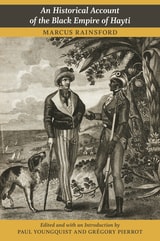
As the first complete narrative in English of the Haitian Revolution, Marcus Rainsford's An Historical Account of the Black Empire of Hayti was highly influential in establishing nineteenth-century world opinion of this momentous event. This new edition is the first to appear since the original publication in 1805. Rainsford, a career officer in the British army, went to Haiti to recruit black soldiers for the British. By publishing his observations of the prowess of black troops, and recounting his meetings with Toussaint Louverture, Rainsford offered eyewitness testimonial that acknowledged the intelligence and effectiveness of the Haitian rebels. Although not an abolitionist, Rainsford nonetheless was supportive of the independent state of Haiti, which he argued posed no threat to British colonial interests in the West Indies, an extremely unusual stance at the time. Rainsford's account made an immediate impact upon publication; it was widely reviewed, and translated twice in its first year. Paul Youngquist's and Grégory Pierrot's critical introduction to this new edition provides contextual and historical details, as well as new biographical information about Rainsford. Of particular interest is a newly discovered miniature painting of Louverture attributed to Rainsford, which is reproduced along with the twelve engravings that accompanied his original account.
[more]
cover of An Illini Place: Building the University of Illinois Campus

An Illini Place

Building the University of Illinois Campus

Incoronata Inserra

University of Illinois Press, 2017
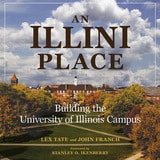
Why does the University of Illinois campus at Urbana-Champaign look as it does today? Drawing on a wealth of research and featuring more than one hundred color photographs, An Illini Place provides an engrossing and beautiful answer to that question. Lex Tate and John Franch trace the story of the university's evolution through its buildings. Oral histories, official reports, dedication programs, and developmental plans both practical and quixotic inform the story. The authors also provide special chapters on campus icons and on the buildings, arenas and other spaces made possible by donors and friends of the university. Adding to the experience is a web companion that includes profiles of the planners, architects, and presidents instrumental in the campus's growth, plus an illustrated inventory of current and former campus plans and buildings.
[more]
cover of An Illinois Sampler: Teaching and Research on the Prairie

An Illinois Sampler

Teaching and Research on the Prairie

Edited by Mary-Ann Winkelmes and Antoinette Burton with Kyle Mays

University of Illinois Press, 2014

An Illinois Sampler presents personal accounts from faculty members at the University of Illinois at Urbana-Champaign and other contributors about their research and how it enriches and energizes their teaching. Contributors from the humanities, engineering, social and natural sciences, and other disciplines explore how ideas, methods, and materials merge to lead their students down life-changing paths to creativity, discovery, and solutions. Faculty introduce their classes to work conducted from the Illinois prairie to Caribbean coral reefs to African farms, and from densely populated cities to dense computer coding. In so doing they generate an atmosphere where research, teaching, and learning thrive inside a feedback loop of education across disciplines.

Aimed at alumni and prospective students interested in the university's ongoing mission, as well as current faculty and students wishing to stay up to date on the work being done around them, An Illinois Sampler showcases the best, the most ambitious, and the most effective teaching practices developed and nurtured at one of the world's premier research universities.

Contributors are Nancy Abelmann, Flavia C. D. Andrade, Jayadev Athreya, Betty Jo Barrett, Thomas J. Bassett, Hugh Bishop, Antoinette Burton, Lauren A. Denofrio-Corrales, Lizanne DeStefano, Karen Flynn, Bruce W. Fouke, Rebecca Ginsburg, Julie Jordan Gunn, Geoffrey Herman, Laurie Johnson, Kyle T. Mays, Rebecca Nettl-Fiol, Audrey Petty, Anke Pinkert, Raymond Price, Luisa-Maria Rosu, D. Fairchild Ruggles, Carol Spindel, Mark D. Steinberg, William Sullivan, Richard I. Tapping, Bradley Tober, Agniezska Tuszynska, Bryan Wilcox, Kate Williams, Mary-Ann Winkelmes, and Yi Lu.
[more]
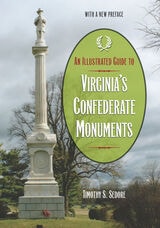
cover of An Illustrated Guide to Virginia's Confederate Monuments

An Illustrated Guide to Virginia's Confederate Monuments

Timothy S. Sedore

Southern Illinois University Press, 2011


From well-known battlefields, such as Manassas, Fredericksburg, and Appomattox, to lesser-known sites, such as Sinking Spring Cemetery and Rude’s Hill, Sedore leads readers on a vivid journey through Virginia’s Confederate history. Tablets, monoliths, courthouses, cemeteries, town squares, battlefields, and more are cataloged in detail and accompanied by photographs and meticulous commentary. Each entry contains descriptions, fascinating historical information, and location, providing a complete portrait of each site.

Much more than a visual tapestry or a tourist’s handbook, An Illustrated Guide to Virginia’s Confederate Monuments draws on scholarly and field research to reveal these sites as public efforts to reconcile mourning with Southern postwar ideologies. Sedore analyzes in depth the nature of these attempts to publicly explain Virginia’s sense of grief after the war, delving deep into the psychology of a traumatized area. From commemorations of famous generals to memories of unknown soldiers, the dead speak from the pages of this sweeping companion to history.
 
[more]
cover of An Image of God: The Catholic Struggle with Eugenics

An Image of God

The Catholic Struggle with Eugenics

Sharon M. Leon

University of Chicago Press, 2013
During the first half of the twentieth century, supporters of the eugenics movement offered an image of a racially transformed America by curtailing the reproduction of “unfit” members of society. Through institutionalization, compulsory sterilization, the restriction of immigration and marriages, and other methods, eugenicists promised to improve the population—a policy agenda that was embraced by many leading intellectuals and public figures. But Catholic activists and thinkers across the United States opposed many of these measures, asserting that “every man, even a lunatic, is an image of God, not a mere animal."

In An Image of God, Sharon Leon examines the efforts of American Catholics to thwart eugenic policies, illuminating the ways in which Catholic thought transformed the public conversation about individual rights, the role of the state, and the intersections of race, community, and family. Through an examination of the broader questions raised in this debate, Leon casts new light on major issues that remain central in American political life today: the institution of marriage, the role of government, and the separation of church and state. This is essential reading in the history of religion, science, politics, and human rights.

[more]
cover of An Imaginative Whig: Reassessing the Life and Thought of Edmund Burke

An Imaginative Whig

Reassessing the Life and Thought of Edmund Burke

Edited & Intro by Ian Crowe

University of Missouri Press, 2005
This collection of essays shifts the focus of scholarly debate away from the themes that have traditionally dominated the study of Edmund Burke. In the past, largely ideology-based or highly textual studies have tended to paint Burke as a “prophet” or “precursor” of movements as diverse as conservatism, political pragmatism, and romanticism. In contrast, these essays address prominent issues in contemporary society—multiculturalism, the impact of postmodern and relativist methodologies, the boundaries of state-church relationships, and religious tolerance in modern societies—by emphasizing Burke’s earlier career and writings and focusing on his position on historiography, moral philosophy, jurisprudence, aesthetics, and philosophical skepticism.
 
The essays in this collection, written by some of today’s most renowned Burke scholars, will radically challenge our deeply rooted assumptions about Burke, his thought, and his place in the history of Western political philosophy.
[more]
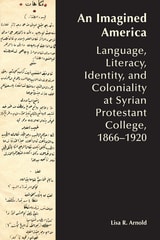
cover of An Imagined America: Language, Literacy, Identity, and Coloniality at Syrian Protestant College, 1866–1920

An Imagined America

Language, Literacy, Identity, and Coloniality at Syrian Protestant College, 1866–1920

Lisa Arnold

University Press of Colorado, 2026

An Imagined America presents a historical, transnational, translingual, and decolonial perspective on questions of identity, literacy, language, culture, and citizenship. In examining a variety of English- and Arabic-language archival documents from the founding of Syrian Protestant College in 1866 (today the American University of Beirut) until the fall of the Ottoman Empire in 1920, Lisa R. Arnold shows how transnational and translingual negotiations among faculty, students, and administrators, as well as the local and regional community, produced a tenuous and sometimes unsettling vision of America for foreigners and locals alike. As her account shows, transnational and translingual discourses provide the backdrop and motive for the assertion of coloniality in contexts of literacy education such as that of Syrian Protestant College. An Imagined America allows scholars and educators in rhetoric and writing studies, education, and related fields to consider how literacy education in English has, and often continues to, construct an imagined America that is both grounded on and reproduces colonial epistemology. Such constructions work to uphold exclusionary practices that are all too vivid in our world today.


[more]
cover of An Immigrant Bishop: John England's Adaptation of Irish Catholicism to American Republicanism, Second Edition

An Immigrant Bishop

John England's Adaptation of Irish Catholicism to American Republicanism, Second Edition

Patrick W. Carey

Catholic University of America Press, 2022

An Immigrant Bishop is a revised examination of the Irish intellectual roots of Bishop John England’s American pastoral works in the diocese of Charleston, South Carolina (1820-1842). The text focuses on his political philosophy and his theology of the Church, both of which were influenced by the Enlightenment and a theological, not a political, Gallicanism. As the study demonstrates, we now know more about England’s intellectual life prior to his immigration than we do about any other Catholic immigrant from Ireland. Neither Peter Guilday’s monumental two-volume biography (1927) of England nor any subsequent scholarly study of England has uncovered and analyzed, as this book does, England’s many unpublished and published writings in Ireland—his explicitly authored texts, his published speeches before the Cork Aggregate meetings, and his pseudonymous articles in the Cork Mercantile Chronicle between 1808, when he was ordained, and 1820, when he emigrated to the United States. John England (1786-1842), the first Catholic bishop of Charleston, was the foremost national spokesman for Catholicism in the United States during the years of his episcopacy and the primary apologist for the compatibility of Catholicism and American republicanism. He was also the first Catholic bishop to speak before the United States Congress and the first American to receive a papal appointment as an Apostolic Delegate to a foreign country (in this case to negotiate a concordat with President Jean Pierre Boyer of Haiti). He is considered the father of the Baltimore Provincial Councils and the nineteenth-century American Catholic conciliar tradition. He was also the only bishop in American history to develop a constitutional form of diocesan government and administration. Among other things he was the first cleric to establish a diocesan newspaper that had something of a national distribution. England’s contribution to the early formation of an American Catholicism has been told many times before, but he has the kind of creative mind and episcopal leadership that demands repeated re-considerations.
[more]
cover of An Immigrant Neighborhood: Interethnic and Interracial Encounters in New York before 1930

An Immigrant Neighborhood

Interethnic and Interracial Encounters in New York before 1930

Shirley Yee

Temple University Press, 2011

Examining race and ethnic relations through an intersectional lens, Shirley Yee's An Immigrant Neighborhoodinvestigates the ways that race, class, and gender together shaped concepts of integration and assimilation as well as whiteness and citizenship in lower Manhattan during the late nineteenth and early twentieth-centuries.

In contrast to accounts of insulated neighborhoods and ethnic enclaves, Yee unearths the story of working class urban dwellers of various ethnic groups—Chinese, Jews, Italians, and Irish—routinely interacting in social and economic settings.

Yee's numerous, fascinating anecdotes—such as one about an Irishman who served as the only funeral director for Chinese for many years—recount the lived experiences of these neighborhoods, detailing friendships, business relationships, and sexual relationships that vividly counter the prevailing idea that different ethnic groups did not mix except in ways marked by violence and hostility.
[more]
cover of An Imperfect Occupation: Enduring the South African War

An Imperfect Occupation

Enduring the South African War

John Boje

University of Illinois Press, 2015
The South African War (1899–1902), also called the Boer War and Anglo-Boer War, began as a conventional conflict. It escalated into a savage irregular war fought between the two Boer republics and a British imperial force that adopted a scorched-earth policy and used concentration camps to break the will of Afrikaner patriots and Boer guerrillas. In An Imperfect Occupation , John Boje delves into the agonizing choices faced by Winburg district residents during the British occupation. Afrikaner men fought or evaded combat or collaborated; Afrikaner women fled over the veld or submitted to life in the camps; and black Africans weighed the life or death consequences of taking sides. Boje's sensitive analysis showcases the motives, actions, and reactions of Boers and Africans alike as initial British accommodation gave way to ruthlessness. Challenging notions of Boer unity and homogeneity, Boje illustrates the precarious tightrope of resistance, neutrality, and collaboration walked by people on all sides. He also reveals how the repercussions of the war's transformative effect on Afrikaner identity plays out in today's South Africa. Readable and compassionate, An Imperfect Occupation provides a dramatic account of the often overlooked aspects of one of the first "modern" wars.
[more]
cover of An Improper Profession: Women, Gender, and Journalism in Late Imperial Russia

An Improper Profession

Women, Gender, and Journalism in Late Imperial Russia

Barbara T. Norton and Jehanne M Gheith, eds.

Duke University Press, 2001

Journalism has long been a major factor in defining the opinions of Russia’s literate classes. Although women participated in nearly every aspect of the journalistic process during the nineteenth and early twentieth centuries, female editors, publishers, and writers have been consistently omitted from the history of journalism in Imperial Russia. An Improper Profession offers a more complete and accurate picture of this history by examining the work of these under-appreciated professionals and showing how their involvement helped to formulate public opinion.

In this collection, contributors explore how early women journalists contributed to changing cultural understandings of women’s roles, as well as how class and gender politics meshed in the work of particular individuals. They also examine how female journalists adapted to—or challenged—censorship as political structures in Russia shifted. Over the course of this volume, contributors discuss the attitudes of female Russian journalists toward socialism, Russian nationalism, anti-Semitism, women’s rights, and suffrage. Covering the period from the early 1800s to 1917, this collection includes essays that draw from archival as well as published materials and that range from biography to literary and historical analysis of journalistic diaries.

By disrupting conventional ideas about journalism and gender in late Imperial Russia, An Improper Profession should be of vital interest to scholars of women’s history, journalism, and Russian history.

Contributors. Linda Harriet Edmondson, June Pachuta Farris, Jehanne M Gheith, Adele Lindenmeyr, Carolyn Marks, Barbara T. Norton, Miranda Beaven Remnek, Christine Ruane, Rochelle Ruthchild, Mary Zirin
[more]
cover of An Inca Account of the Conquest of Peru

An Inca Account of the Conquest of Peru

Titu Cusi Yupanqui

University Press of Colorado, 2005

Available in English for the first time, An Inca Account of the Conquest of Peru is a firsthand account of the Spanish invasion, narrated in 1570 by Diego de Castro Titu Cusi Yupanqui - the penultimate ruler of the Inca dynasty - to a Spanish missionary and transcribed by a mestizo assistant. The resulting hybrid document offers an Inca perspective on the Spanish conquest of Peru, filtered through the monk and his scribe.

Titu Cusi tells of his father's maltreatment at the hands of the conquerors; his father's ensuing military campaigns, withdrawal, and murder; and his own succession as ruler. Although he continued to resist Spanish attempts at "pacification," Titu Cusi entertained Spanish missionaries, converted to Christianity, and then, most importantly, narrated his story of the conquest to enlighten Emperor Phillip II about the behavior of the emperor's subjects in Peru. This vivid narrative illuminates the Incan view of the Spanish invaders and offers an important account of indigenous resistance, accommodation, change, and survival in the face of the European conquest.

Informed by literary, historical, and anthropological scholarship, Bauer's introduction points out the hybrid elements of Titu Cusi's account, revealing how it merges native Andean and Spanish rhetorical and cultural practices. Supported in part by the Colorado Endowment for the Humanities.
[more]
cover of An Independent Empire: Diplomacy & War in the Making of the United States

An Independent Empire

Diplomacy & War in the Making of the United States

Michael S. Kochin and Michael Taylor

University of Michigan Press, 2020

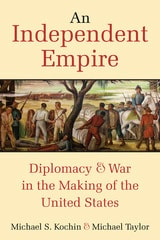
Foreign policies and diplomatic missions, combined with military action, were the driving forces behind the growth of the early United States. In an era when the Old and New Worlds were subject to British, French, and Spanish imperial ambitions, the new republic had limited diplomatic presence and minimal public credit. It was vulnerable to hostile forces in every direction. The United States could not have survived, grown, or flourished without the adoption of prescient foreign policies, or without skillful diplomatic operations.

An Independent Empire shows how foreign policy and diplomacy constitute a truly national story, necessary for understanding the history of the United States. In this lively and well-written book, episodes in American history—such as the writing and ratification of the Constitution, Henry Clay’s advocacy of an American System, Pinckney’s Treaty with Spain, and the visionary but absurd Congress of Panama—are recast as elemental aspects of United States foreign and security policy.

An Independent Empire tells the stories of the people who defined the early history of America’s international relationships. Throughout the book are brief, entertaining vignettes of often-overlooked intellectuals, spies, diplomats, and statesmen whose actions and decisions shaped the first fifty years of the United States. More than a dozen bespoke maps illustrate that the growth of the early United States was as much a geographical as a political or military phenomenon.
 

[more]
cover of An Indian in White America

An Indian in White America

Mark Monroe, edited by Carolyn Reyer, afterword by Kenneth Lincoln

Temple University Press, 1994
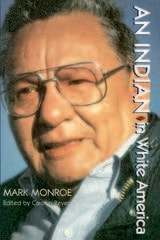
"At time when most Americans don't realize that over 66 percent of Indians live off the reservation, this book is a powerful witness ... it will reward the reader with an illuminating look into what it means to be a member of America's Native minority." --Kirkus Reviews Narrated with intense honesty, this autobiography of Mark Monroe, a Lakota Sioux Indian, is a story of courage, faith, and determination, and a rare opportunity to witness the life of a contemporary American Indian. Despite lifelong confrontations with violence, racism, and personal hardship--alcoholism, family deaths, illness, poverty, and unemployment--Mark Monroe has worked to instill ethnic pride in his fellow Indians. After an early idyllic childhood at the Rosebud South Dakota reservation, Monroe moved with his parents off-reservation to Alliance, Nebraska. There he first felt the sting of white America's racism from signs outside local businesses that read "No Indians or dogs allowed." As a young man, Monroe enlisted in the military, for the first time experiencing outside acceptance and learning vocational skills. Upon his return to the United States, he worked as a baker. At the same time, however, he was being sucked into a life of alcoholism, begun years earlier with social drinking. Eventually he was unable to eat or to work. After rehabilitation, he ran for Police Magistrate. Monroe was the first Indian ever to have filed for public office in Alliance, and his candidacy divided the town. Though he lost the election, he gained community support and a growing sense of dignity from the campaign. From the misery and hopelessness he suffered as an alcoholic, and the pains of recovery, Monroe became aware of the cultural difference between Indian alcoholism and white alcoholism. This understanding led to his work with Indian alcoholics at the Panhandle Mental Health Center in Scottsbluff, Nebraska--another first. No Indian had ever served on the Center's staff. Since his recovery, Monroe has been an active participant in his community and continues to fight for the legal rights of American Indians. In 1973 he founded the American Indian Council, which today offers a variety of health, educational, and social programs, including a nutrition program, a hospital busing program, and alcohol counseling. "[An] interesting representation of Lakota male experiences in the realities of present-day life in the Great Plains." --Wicazo Sa Review "Mark Monroe has broken out of society's cage and achieved outstanding things. We are all better off for it. His personality and stature--qualities of leadership, determination, and stamina--quickly override the poverty-stricken times and the tragic aspects that linger constantly at the edges of this Indian world, this seemingly desolate place. Compared with other Native American biographies, An Indian in White America stands near the top." --Charles Ballard, Institute of Ethnic Studies, University of Nebraska "I know of no other volume that deals so frankly with the familiar Indian problems of poverty, racism and alcoholism while offering, at the same time, the powerful example of one man's struggle out of those traps which still threaten Native people. Although Mark Monroe describes himself as 'just an ikee wicasa--a common man who's trying to provide for his family,' he provides us all with lessons for healing and survival. His autobiography is an uncommon gift." --Joseph Bruchac, Editor, Greenfield Press Review
[more]
cover of An Indispensable Liberty: The Fight for Free Speech in Nineteenth-Century America

An Indispensable Liberty

The Fight for Free Speech in Nineteenth-Century America

Edited by Mary M. Cronin

Southern Illinois University Press, 2016

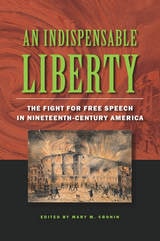
Most Americans today view freedom of speech as a bedrock of all other liberties, a defining feature of American citizenship. During the nineteenth century, the popular concept of American freedom of speech was still being formed. In An Indispensable Liberty: The Fight for Free Speech in Nineteenth-Century America, contributors examine attempts to restrict freedom of speech and the press during and after the Civil War.
 
The eleven essays that make up this collection show how, despite judicial, political, and public proclamations of support for freedom of expression, factors like tradition, gender stereotypes, religion, and fear of social unrest often led to narrow judicial and political protection for freedom of expression by people whose views upset the status quo. These views, expressed by abolitionists, suffragists, and labor leaders, challenged rigid cultural mores of the day, and many political and cultural leaders feared that extending freedom of expression to agitators would undermine society. The Civil War intensified questions about the duties and privileges of citizenship. After the war, key conflicts over freedom of expression were triggered by Reconstruction, suffrage, the Comstock Act, and questions about libel.
 
The volume’s contributors blend social, cultural, and intellectual history to untangle the complicated strands of nineteenth-century legal thought. By chronicling the development of modern-day notions of free speech, this timely collection offers both a valuable exploration of the First Amendment in nineteenth-century America and a useful perspective on the challenges we face today.
[more]