Results by title
4154 books match the query 'State & Local' and 398 start with a
Angel De Cora, Karen Thronson, and the Art of Place
How Two Midwestern Women Used Art to Negotiate Migration and DispossessionElizabeth Sutton
University of Iowa Press, 2020
Angel De Cora (c. 1870–1919) was a Native Ho-Chunk artist who received relative acclaim during her lifetime. Karen Thronson (1850–1929) was a Norwegian settler housewife who created crafts and folk art in obscurity along with the other women of her small immigrant community. The immigration of Thronson and her family literally maps over the De Cora family’s forced migration across Wisconsin, Iowa, and onto the plains of Nebraska and Kansas. Tracing the parallel lives of these two women artists at the turn of the twentieth century, art historian Elizabeth Sutton reveals how their stories intersected and diverged in the American Midwest.
By examining the creations of these two artists, Sutton shows how each woman produced art or handicrafts that linked her new home to her homeland. Both women had to navigate and negotiate between asserting their authentic self and the expectations placed on them by others in their new locations. The result is a fascinating story of two women that speaks to universal themes of Native displacement, settler conquest, and the connection between art and place.
Anglos and Mexicans in the Making of Texas, 1836-1986
By David Montejano
University of Texas Press, 1987
Winner, Frederick Jackson Turner Award, Organization Of American Historians, 1988
American Historical Association, Pacific Branch Book Award, 1989
Texas Institute of Letters Friends Of The Dallas Public Library Award, 1987
Texas Historical Commission T. R. Fehrenbach Award, Best Ethnic, Minority, And Women's History Publication, 1987

Ann Arbor Observed
Selections from Then and NowGrace Shackman
University of Michigan Press, 2010
Packed with photographs from Ann Arbor of yesteryear and the present day, Ann Arbor Observed compiles the best of Shackman’s articles in one book divided into eight sections: public buildings and institutions, the University of Michigan, transportation, industry, downtown Ann Arbor, recreation and culture, social fabric and communities, and architecture.
For long-time residents, Ann Arbor expatriates, University of Michigan alumni, and visitors alike, Ann Arbor Observed provides a rare glimpse of the bygone days of a town with a rich and varied history.
Grace Shackman is a history columnist for the Ann Arbor Observer, the Community Observer, and the Old West Side News, as well as a writer for University of Michigan publications. She is the author of two previous books: Ann Arbor in the 19th Century and Ann Arbor in the 20th Century.
Another City upon a Hill
A New England MemoirJoseph A. Conforti
Tagus Press, 2013

Another Road to Justice
Antonio Orendain and the Texas Farmworkers’ RevoltTimothy Paul Bowman
University of Texas Press, 0
A new perspective on the farmworker movement that recenters Texas and activist Antonio Orendain.
Another Road to Justice chronicles an important yet overlooked chapter in US labor history: the farmworker movement in Texas. Eclipsed by the activities of the United Farm Workers in California during the 1960s through ‘80s, Texas organizers were, nonetheless, diligent radicals, deeply engaged in consciousness raising, social reform, and labor action.
In this engrossing account, Timothy Paul Bowman explores the lives and impact of Texas activists, above all Antonio Orendain—a key figure in the struggle of Mexican and Mexican American workers along the international border in the Lower Rio Grande Valley. A formerly undocumented immigrant who became the leading organizer in the region, Orendain went from Cesar Chavez’s righthand man in the UFW to one of his biggest rivals by the middle of the 1970s. Through efforts like the Starr County Strike of 1966–1967 and the 1975 melon strike, Orendain and other workers achieved significant gains. At the same time, tensions between organizers splintered the UFW, leading Orendain to form the Texas Farm Workers Union. Bowman shines light on this history and the often-overlooked activists who earnestly fought to overcome oppression, often at great personal cost.
Another Way Home
The Tangled Roots of Race in One Chicago FamilyRonne Hartfield
University of Chicago Press, 2004
Hartfield begins with the early life of her mother, Day Shepherd. Born to a wealthy British plantation owner and the mixed-race daughter of a former slave, Day negotiates the complicated circumstances of plantation life in the border country of Louisiana and Mississippi and, as she enters womanhood, the quadroon and octoroon societies of New Orleans. Equally a tale of the Great Migration, Another Way Home traces Day's journey to Bronzeville, the epicenter of black Chicago during the first half of the twentieth century. Here, through the eyes of Day and, ultimately, her daughter, we witness the bustling city streets and vibrant middle-class culture of this iconic black neighborhood. We also relive crucial moments in African American history as they are experienced by the author's family and others in Chicago's South Side black community, from the race riots of 1919 and the Great Depression to the murder of Emmett Till and the dawn of the civil rights movement.
Throughout her book, Hartfield portrays mixed-race Americans navigating the challenges of their lives with resilience and grace, making Another Way Home an intimate and compelling encounter with one family's response to our racially charged culture.
Another's Country
Archaeological and Historical Perspectives on Cultural Interactions in the Southern ColoniesEdited by J.W. Joseph and Martha Zierden
University of Alabama Press, 2001
The 18th-century South was a true melting pot, bringing together colonists from England, France, Germany, Ireland, Switzerland, and other locations, in addition to African slaves—all of whom shared in the experiences of adapting to a new environment and interacting with American Indians. The shared process of immigration, adaptation, and creolization resulted in a rich and diverse historic mosaic of cultures.
The cultural encounters of these groups of settlers would ultimately define the meaning of life in the nineteenth-century South. The much-studied plantation society of that era and the Confederacy that sprang from it have become the enduring identities of the South. A full understanding of southern history is not possible, however, without first understanding the intermingling and interactions of the region’s eighteenth-century settlers. In the essays collected here, some of the South’s leading historical archaeologists examine various aspects of the colonial experience, attempting to understand how cultural identity was expressed, why cultural diversity was eventually replaced by a common identity, and how the various cultures intermeshed.
Written in accessible language, this book will be valuable to archaeologists and non-archaeologists alike. Cultural, architectural, and military historians, cultural anthropologists, geographers, genealogists, and others interested in the cultural legacy of the South will find much of value in this book.

Anson Jones
The Last President of TexasBy Herbert Gambrell
University of Texas Press, 1964
This is the story of a New Englander who came penniless to Mexican Texas in 1833 and within the next decade helped to bring his adopted country through the turbulent disorders of settlement, revolution, political experimentation, and statehood.
Within a year of his arrival, Anson Jones was successfully practicing medicine, acquiring land, and resolving to avoid politics; but then the Revolution erupted and Jones became a private in the Texas Army, doubling as surgeon at San Jacinto. Military duty done, he resumed medical practice but some acts of the First Congress so irked him that he became a member of the Second and began a political career that lasted from 1837 to 1846 during which he served successively as congressman, minister to the United States, Texas senator, secretary of state, and president of the Republic of Texas. Anson Jones took his own life on January 9, 1858.
Told with imagination and insight, Herbert Gambrell's account of the life of Anson Jones is also a colorful and concurrent biography of Texas and its people.
Ante-Bellum Alabama
Town and CountryWeymouth T. Jordan
University of Alabama Press, 1986
Ante-Bellum Alabama: Town and Country was written to give the reader insight into important facets of Alabama’s ante-bellum history. Presented in the form of case studies from the pre-Civil War period, the book deals with a city, a town, a planter’s family, rural social life, attitudes concerning race, and Alabama’s early agricultural and industrial development.
Ante-bellum Alabama’s primary interest was agriculture; the chief crop was King Cotton; and most of the people were agriculturalists. Towns and cities came into existence to supply the agricultural needs of the state and to process and distribute farm commodities. Similarly, Alabama’s industrial development began with the manufacture of implements for farm use, in response to the state’s agricultural needs. Rural-agriculture influences dominated the American scene; and in this respect Alabama was typical of her region as well as of most of the United States.
Anti-Catholicism in Arkansas
How Politicians, the Press, the Klan, and Religious Leaders Imagined an Enemy, 1910–1960Kenneth C. Barnes
University of Arkansas Press, 2016
Winner, 2017 Ragsdale Award
A timely study that puts current issues—religious intolerance, immigration, the separation of church and state, race relations, and politics—in historical context.
The masthead of the Liberator, an anti-Catholic newspaper published in Magnolia, Arkansas, displayed from 1912 to 1915 an image of the Whore of Babylon. She was an immoral woman sitting on a seven-headed beast, holding a golden cup “full of her abominations,” and intended to represent the Catholic Church.
Propaganda of this type was common during a nationwide surge in antipathy to Catholicism in the early twentieth century. This hostility was especially intense in largely Protestant Arkansas, where for example a 1915 law required the inspection of convents to ensure that priests could not keep nuns as sexual slaves.
Later in the decade, anti-Catholic prejudice attached itself to the campaign against liquor, and when the United States went to war in 1917, suspicion arose against German speakers—most of whom, in Arkansas, were Roman Catholics.
In the 1920s the Ku Klux Klan portrayed Catholics as “inauthentic” Americans and claimed that the Roman church was trying to take over the country’s public schools, institutions, and the government itself. In 1928 a Methodist senator from Arkansas, Joe T. Robinson, was chosen as the running mate to balance the ticket in the presidential campaign of Al Smith, a Catholic, which brought further attention.
Although public expressions of anti-Catholicism eventually lessened, prejudice was once again visible with the 1960 presidential campaign, won by John F. Kennedy.
Anti-Catholicism in Arkansas illustrates how the dominant Protestant majority portrayed Catholics as a feared or despised “other,” a phenomenon that was particularly strong in Arkansas.
Anti-Indianism in Modern America
A Voice from Tatekeya's EarthElizabeth Cook-Lynn
University of Illinois Press, 2000
Addressing Native American studies past, present, and future, the essays in New Indians, Old Wars tackle the discipline head-on, presenting a radical revision of the popular view of the American West in the process. Instead of luxuriating in the West's past glories or accepting the widespread historians' view of it as a shared place, Elizabeth Cook-Lynn argues that the American West should be fundamentally understood as stolen.
Cook-Lynn says that the Indian Wars of Resistance to the nineteenth- and twentieth-century colonial effort to seize native lands and resources must be given standing in the face of the ever-growing imperial narrative of America--because the terror the world is now witnessing may be the direct consequence of events which began in America's earliest dealings with the natives of this continent. Cook-Lynn's story examines the ongoing and perennial relationship of conflict between colonizers and indigenous people, and it is a story that every American must read.
Cook-Lynn understands that the story of the American West teaches the political language of land theft and tyranny. She argues that to remedy this situation, Native American studies must be considered and pursued as its own discipline, rather than as a subset of history or anthropology. She makes an impassioned claim that such a shift, not merely an institutional or theoretical change, could allow Native American studies to play an important role in defending the sovereignty of indigenous nations today.
Apache Gold and Yaqui Silver
By J. Frank Dobie
University of Texas Press, 1985
Buried vaults stacked with gold bars, secret caches of coins and jewels plundered from the Spaniards and the Church, exposed veins of ore with nuggets the size of turkey eggs. Guarded by the bones of dead men, the legendary treasures of the Southwest still wait for those foolhardy or desperate enough to seek them.
Death is the cure for gold fever, and the lucky few who saw the riches and lived to tell of them spent the rest of their lives searching, haunted by faulty memories, changed landscapes, and quirks of fate. It is the stories of these men and the wealth they pursued that J. Frank Dobie tells in Apache Gold and Yaqui Silver.
In this masterful collection of tales, Dobie introduces us to Pedro Loco, General Mexhuira's ghost, the German, and a colorful group of oddfellows driven to roam the hills in an eternal quest for the hidden entrance, the blazed tree, the box canyon, for fabulous wealth glimpsed, lost, and never forgotten.
Are treasures really there? Searchers still seek them. But for the reader, the treasure is here—Dobie's tales are pure gold.
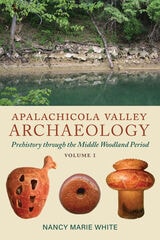
Apalachicola Valley Archaeology, Volume 1
Prehistory through the Middle Woodland PeriodNancy Marie White
University of Alabama Press, 2024
The definitive archaeological record and what is known or speculated about the ancient Apalachicola and lower Chattahoochee Valley region of northwest Florida, southeast Alabama, and southwest Georgia.
In this meticulously researched volume, Nancy Marie White provides a major holistic synthesis of the archaeological record and what is known or surmised about the peoples of the Apalachicola and lower Chattahoochee Valley region of northwest Florida, southeast Alabama, and southwest Georgia. White transforms a neglected research area into a lively saga that spans the time of the first human settlement, around 14,000 years ago, through the Middle Woodland period, ending about AD 700.
White reveals that Paleoindian habitation was more extensive than once surmised. Archaic sites were widespread, and those societies persisted when the Ice Age ended 10,000 years ago. Pottery appeared in the Late Archaic period (before 4000 BP), and Early Woodland–period burial mounds demonstrate a flowering of religious and ritual systems. Middle Woodland societies expanded this mortuary ceremony, and the complex pottery of the Swift Creek and the early Weeden Island ceramic series show an increased fascination with the ornate and unusual. Yet, basic Native American lifeways continued with gathering-fishing-hunting subsistence traditions similar to those of their ancestors.
This volume and its companion form the definitive work on the Apalachicola–lower Chattahoochee Valley region for both scholars and general readers interested in Native Americans of the Southeast.
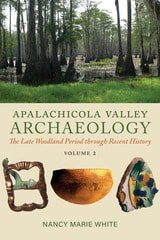
Apalachicola Valley Archaeology, Volume 2
The Late Woodland Period through Recent HistoryNancy Marie White
University of Alabama Press, 0
A comprehensive synthesis tracing 1,300 years of cultural transformation in the Apalachicola–lower Chattahoochee Valley, from Late Woodland societies to the modern era.
Apalachicola Valley Archaeology: The Late Woodland Period through Recent History, Volume 2, synthesizes the archaeology and history of the Native Americans, African Americans, and Euro-Americans of the Apalachicola–lower Chattahoochee Valley region of northwest Florida, southeast Alabama, and southwest Georgia from about 1300 years ago until the present. The region extends from Columbia, Alabama, to the Gulf of Mexico. It is culturally and environmentally distinct but little known archaeologically because it crosses historic political boundaries at the frontier.
Early chapters overview the environment and archaeology. Coverage then surveys time periods, from the Late Woodland to present. Topics include settlement, archaeological findings and material culture, subsistence and seasonality, history, sociopolitical systems, and peoples.
White’s prodigious work reveals that the prehistoric Late Woodland cultures who developed maize agriculture developed into Fort Walton chiefdoms. Post-invasion and Spanish and British colonization, these peoples were replaced by consolidated groups of Native American survivors and maroons moving around the region. These multiethnic societies with blended material cultures developed new identities, living at the edges of colonial territories. Creek societies, many becoming Seminoles, fought on all sides of European and American conflicts until most Indians were forcibly removed in the 1830s. Then the region became important for cotton, cattle, and timber, which were often produced by enslaved labor and transported by steamboat. Later expansion of agriculture and silviculture, as well as turpentine, tupelo honey, and other industries, left material evidence. The usefulness of the information to modern society is noted. Copious illustrations enhance the scientific analyses and the telling of the human stories.

Apocalyptic Anxiety
Religion, Science, and America's Obsession with the End of the WorldAnthony Aveni
University Press of Colorado, 2016
The book begins with the Millerites, the nineteenth-century religious sect of Pastor William Miller, who used biblical calculations to predict October 22, 1844 as the date for the Second Advent of Christ. Aveni also examines several other religious and philosophical movements that have centered on apocalyptic themes—Christian millennialism, the New Age movement and the Age of Aquarius, and various other nineteenth- and early twentieth-century religious sects, concluding with a focus on the Maya mystery of 2012 and the contemporary prophets who connected the end of the world as we know it with the overturning of the Maya calendar.
Apocalyptic Anxiety places these seemingly never-ending stories of the world’s end in the context of American history. This fascinating exploration of the deep historical and cultural roots of America’s voracious appetite for apocalypse will appeal to students of American history and the histories of religion and science, as well as lay readers interested in American culture and doomsday prophecies.
Appalachia North
A MemoirMatthew Ferrence
West Virginia University Press, 2018
Appalachia North is the first book-length treatment of the cultural position of northern Appalachia—roughly the portion of the official Appalachian Regional Commission zone that lies above the Mason-Dixon line. For Matthew Ferrence this region fits into a tight space of not-quite: not quite “regular” America and yet not quite Appalachia.
Ferrence’s sense of geographic ambiguity is compounded when he learns that his birthplace in western Pennsylvania is technically not a mountain but, instead, a dissected plateau shaped by the slow, deep cuts of erosion. That discovery is followed by the diagnosis of a brain tumor, setting Ferrence on a journey that is part memoir, part exploration of geology and place. Appalachia North is an investigation of how the labels of Appalachia have been drawn and written, and also a reckoning with how a body always in recovery can, like a region viewed always as a site of extraction, find new territories of growth.
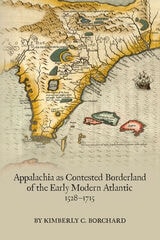
Appalachia as Contested Borderland of the Early Modern Atlantic, 1528-1715
Kimberly C. Borchard
Arizona Center for Medieval and Renaissance Studies, 2021
Appalachian Reckoning
A Region Responds to Hillbilly ElegyAnthony Harkins
West Virginia University Press, 2019
2020 American Book Award winner, Walter & Lillian Lowenfels Criticism Award
2019 Weatherford Award winner, nonfiction
With hundreds of thousands of copies sold, a Ron Howard movie in the works, and the rise of its author as a media personality, J. D. Vance’s Hillbilly Elegy: A Memoir of a Family and Culture in Crisis has defined Appalachia for much of the nation. What about Hillbilly Elegy accounts for this explosion of interest during this period of political turmoil? Why have its ideas raised so much controversy? And how can debates about the book catalyze new, more inclusive political agendas for the region’s future?
Appalachian Reckoning is a retort, at turns rigorous, critical, angry, and hopeful, to the long shadow Hillbilly Elegy has cast over the region and its imagining. But it also moves beyond Hillbilly Elegy to allow Appalachians from varied backgrounds to tell their own diverse and complex stories through an imaginative blend of scholarship, prose, poetry, and photography. The essays and creative work collected in Appalachian Reckoning provide a deeply personal portrait of a place that is at once culturally rich and economically distressed, unique and typically American. Complicating simplistic visions that associate the region almost exclusively with death and decay, Appalachian Reckoning makes clear Appalachia’s intellectual vitality, spiritual richness, and progressive possibilities.

Arab Americans in Michigan
Rosina J. Hassoun
Michigan State University Press, 2003
The state of Michigan hosts one of the largest and most diverse Arab American populations in the United States. As the third largest ethnic population in the state, Arab Americans are an economically important and politically influential group. It also reflects the diversity of national origins, religions, education levels, socioeconomic levels, and degrees of acculturation. Despite their considerable presence, Arab Americans have always been a misunderstood ethnic population in Michigan, even before September 11, 2001 imposed a cloud of suspicion, fear, and uncertainty over their ethnic enclaves and the larger community. In Arab Americans in Michigan Rosina J. Hassoun outlines the origins, culture, religions, and values of a people whose influence has often exceeded their visibility in the state.
Archaeological Explorations in Caves of the Point of Pines Region, Arizona
James C. Gifford
University of Arizona Press, 1980
Archaeological History Hocking Valley
James L. Murphy
Ohio University Press, 1989
Never before available in paperback, this new edition also reveals Murphy’s original findings during 15 years of archeological surveys and excavations. This book includes detailed reports on the excavation of three Adena mounds, two Fort Ancient village sites, and several multi-component rock shelters.
A deliberate effort to present archeological finds of interest to both the professional archeologist and the layman in terms understandable to both has been coupled with an attempt to distinguish clearly between the presentation of facts and the presentation of opinion. The book is enhanced by illustrations of much of the artifact material analyzed in the text, site diagrams, and a map locating all major known archeological sites in the Hocking Valley, and an appendix locating and describing all sites discussed in the text.
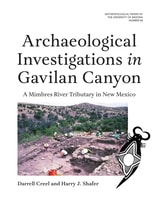
Archaeological Investigations in Gavilan Canyon
A Mimbres River Tributary in New MexicoDarrell Creel and Harry J. Shafer
University of Arizona Press, 2027
In the 1980s, Texas A&M University’s NAN Ranch Project included surveys and excavations in Gavilan Canyon, a major tributary of the Mimbres River. Uniquely, these excavations documented water control systems and their uses. Collected and now made available for the first time, Archaeological Investigations in Gavilan Canyon shares results from the excavations that were conducted primarily at Pueblo Vinegaroon, a Classic Period Mimbres pueblo of about twenty rooms, and at nearby Cholla Village.
During the NAN Ranch Project, researchers conducted extensive surveys of the canyon from its confluence with the Mimbres River and documented numerous sites dating to as early as Early Archaic through Classic Mimbres. The results also document pithouse sites as well as numerous small masonry pueblos. Analysis shows that the ebb and flow of late prehistoric occupation in Gavilan Canyon largely matches the occurrence of wet periods and prolonged droughts.
The book reveals that the changes in occupation in Gavilan Canyon help explain changes seen in the Mimbres River Valley, including the extensively excavated NAN Ranch and Swarts sites.
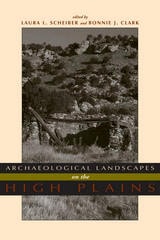
Archaeological Landscapes on the High Plains
Laura L. Scheiber
University Press of Colorado, 2008
Focusing on long-term change, this book considers ethnographic literature, archaeological evidence, and environmental data spanning thousands of years of human presence to understand human perception and construction of landscape. The contributors offer cohesive and synthetic studies emphasizing hunter-gatherers and subsistence farmers.
Using landscape as both reality and metaphor, Archaeological Landscapes on the High Plains explores the different and changing ways that people interacted with place in this transitional zone between the Rocky Mountains and the eastern prairies.
The contemporary archaeologists working in this small area have chosen diverse approaches to understand the past and its relationship to the present. Through these ten case studies, this variety is highlighted but leads to a common theme - that the High Plains contains important locales to which people, over generations or millennia, return. Providing both data and theory on a region that has not previously received much attention from archaeologists, especially compared with other regions in North America, this volume is a welcome addition to the literature. Contributors:
o Paul Burnett
o Oskar Burger
o Minette C. Church
o Philip Duke
o Kevin Gilmore
o Eileen Johnson
o Mark D. Mitchell
o Michael R. Peterson
o Lawrence Todd
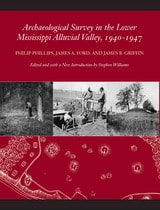
Archaeological Survey in the Lower Mississippi Alluvial Valley, 1940–1947
Philip Phillips, James A. Ford, and James B. Griffin; edited and with a new introduction by Stephen Williams
University of Alabama Press, 2003
A Dan Josselyn Memorial Publication
The Lower Mississippi Survey was initiated in 1939 as a joint undertaking of three institutions: the School of Geology at Louisiana State University, the Museum of Anthropology at the University of Michigan, and the Peabody Museum at Harvard. Fieldwork began in 1940 but was halted during the war years. When fieldwork resumed in 1946, James Ford had joined the American Museum of Natural History, which assumed co-sponsorship from LSU. The purpose of the Lower Mississippi Survey (LMS)—a term used to identify both the fieldwork and the resultant volume—was to investigate the northern two-thirds of the alluvial valley of the lower Mississippi River, roughly from the mouth of the Ohio River to Vicksburg. This area covers about 350 miles and had been long regarded as one of the principal hot spots in eastern North American archaeology.
Phillips, Ford, and Griffin surveyed over 12,000 square miles, identified 382 archaeological sites, and analyzed over 350,000 potsherds in order to define ceramic typologies and establish a number of cultural periods. The commitment of these scholars to developing a coherent understanding of the archaeology of the area, as well as their mutual respect for one another, enabled the publication of what is now commonly considered the bible of southeastern archaeology. Originally published in 1951 as volume 25 of the Papers of the Peabody Museum of American Archaeology and Ethnology, this work has been long out of print.
Because Stephen Williams served for 35 years as director of the LMS at Harvard, succeeding Phillips, and was closely associated with the authors during their lifetimes, his new introduction offers a broad overview of the work’s influence and value, placing it in a contemporary context.

Archaeology and Ceramics at the Marksville Site
Alan Toth
University of Michigan Press, 1974
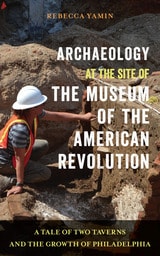
Archaeology at the Site of the Museum of the American Revolution
A Tale of Two Taverns and the Growth of PhiladelphiaRebecca Yamin
Temple University Press, 2019
When the Museum of the American Revolution acquired the land at Third and Chestnut streets in Olde City, Philadelphia, it came with the condition that an archaeological investigation be conducted. The excavation that began in the summer of 2014 yielded treasures in the trash: unearthed privy pits provided remarkable finds from a mid-eighteenth-century tavern to relics from a button factory dating to the early twentieth century. These artifacts are described and analyzed by urban archaeologist Rebecca Yamin in Archaeology at the Site of the Museum of the American Revolution.
Yamin, lead archaeologist on the dig, catalogues items—including earthenware plates and jugs, wig curlers, clay pipes, and liquor bottles—to tell the stories of their owners and their roles in Philadelphia history. As she uncovers the history of the people as well as their houses, taverns, and buildings that were once on the site, she explains that by looking at these remains, we see the story of the growth of Philadelphia from its colonial beginnings to the Second World War.
Archaeology at the Site of the Museum of the American Revolution is a perfect keepsake for armchair archaeologists, introductory students, and history buffs.
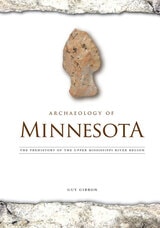
Archaeology of Minnesota
The Prehistory of the Upper Mississippi River RegionGuy Gibbon
University of Minnesota Press, 2012
Histories of Minnesota typically begin with seventeenth-century French fur traders exploring the western shores of Lake Superior. And yet, archaeology reveals that Native Americans lived in the region at least 13,000 years before such European incursions. Archaeology of Minnesota tells their story—or as much as the region’s wealth of artifacts, evidence of human activity, and animal and plant remains can convey.
From archaeological materials, Guy Gibbon reconstructs the social, economic, and political systems—the lifeways—of those who inhabited what we now call Minnesota for thousands of years before the first contact between native peoples and Europeans. From the boreal coniferous forests to the north, to the tall grass prairie to the west and southwest, to the deciduous forest to the east and southeast, the richly diverse land of the upper Mississippi River region, crossed and bordered by all manner of waterways, was a virtual melting pot of prehistoric cultures.
Demonstrating how native cultures adapted and evolved over time, Gibbon provides an explanation that is firmly rooted in the nature of local environments. In doing so, he shows how the study of Minnesota archaeology is relevant to a broader understanding of long-term patterns of change in human development throughout the world.
Archaeology of Southern Urban Landscapes
Amy L Young
University of Alabama Press, 2000
Groundbreaking essays in urban archaeology highlight the impact of towns and cities on the southern landscape.
The rapid growth and development of urban areas in the South have resulted in an increase in the number of urban archaeology projects required by federal and state agencies. These projects provide opportunities not only to investigate marginal areas between the town and countryside but also to recover information long buried beneath the earliest urban structures. Such projects have also created a need for a one-volume update on archaeology as it is practiced in the urban areas of the southeastern United States.
Archaeology of Southern Urban Landscapes will assist practitioners and scholars in the burgeoning fields of urban and landscape archaeology by treating the South as a distinctive social, geographic, and material entity and by focusing on the urban South rather than the stereotypical South of rural plantations. The case studies in this volume span the entire southeastern United States, from Annapolis to New Orleans and from colonial times to the 19th century. The authors address questions involving the function of cities, interregional diversity, the evolution of the urban landscape, and the impact of the urban landscape on southern culture. By identifying the relationship between southern culture and the South's urban landscapes, this book will help us understand the built landscape of the past and predict future growth in the region.

Archeology in the Adirondacks
The Last FrontierDavid R. Starbuck
University Press of New England, 2018
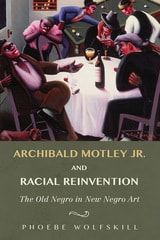
Archibald Motley Jr. and Racial Reinvention
The Old Negro in New Negro ArtPhoebe Wolfskill
University of Illinois Press, 2017
Phoebe Wolfskill demonstrates how Motley's art embodied the tenuous nature of the Black Renaissance and the wide range of ideas that structured it. Focusing on key works in Motley's oeuvre, Wolfskill reveals the artist's complexity and the variety of influences that informed his work. Motley’s paintings suggest that the racist, problematic image of the Old Negro was not a relic of the past but an influence that pervaded the Black Renaissance. Exploring Motley in relation to works by notable black and non-black contemporaries, Wolfskill reinterprets Motley's oeuvre as part of a broad effort to define American cultural identity through race, class, gender, religion, and regional affiliation.
Archipelagoes of My South
Episodes in the Shaping of a Region, 1830–1965J. Mills Thornton III
University of Alabama Press, 2016
A collection of essays representing forty-five years of reflection on the central problems of southern history bound together by a common concern with defining the crucial interaction of race and class in the formation of southern politics and life
“The tourist archipelagoes of my South / are prisons, too, corruptible” writes the poet Derek Walcott. While Walcott refers to the islands of the Caribbean, the analogous idea of a land made into solitary islands by an imprisoned and inherited corruption is historian J. Mills Thornton III’s American South. The captivating essays in Archipelagoes of My South: Episodes in the Shaping of a Region, 1830–1965 address this overarching and underlying narrative of Alabama politics and the history of the South.
Highlighting events as significant as the role of social and economic conflict in the southern secession movement, various aspects of Reconstruction, and the role of the Ku Klux Klan in the politics of the 1920s, Thornton draws from various points in the southern past in an effort to identify and understand the sources of the region’s power. Moreover, each essay investigates its subject matter and peels back layers with an aim to clarify why the enormous diversity of the southern experience makes that power so great, all the while allowing the reader to see connections that would not otherwise be apparent.
Archipelagoes of My South gathers previously uncollected essays into a single volume covering the entire length and breadth of Thornton’s career. The author’s principal concerns have always been the arc of regional evolution and the significance of the local. Thus, the mechanisms of political and social change and the interrelationships across eras and generations are recurring themes in many of these essays.
Even those who have spent their entire lives in the South may be unaware of the fractured layers of history that lie beneath the landscape they inhabit. For those southern residents who seek to comprehend more of their own past, this landmark compilation of essays on Alabama and southern history endeavors to provide illumination and enlightenment.

Architects of Little Rock
1833-1950Charles Witsell
University of Arkansas Press, 2014
Published in collaboration with the Fay Jones School of Architecture.

Architectural Missionary
D. Fred Charlton in Michigan's Upper Peninsula, 1887–1918Steven C. Brisson
Michigan State University Press, 2021
Architecture of Middle Tennessee
The Historic American Buildings SurveyThomas B. Brumbaugh
Vanderbilt University Press, 1974
Vanderbilt staffers discovered a treasure trove of photos and diagrams from the HABS survey that did not make the original edition in the Press archives. This new, expanded edition contains all of the original text and images from the first volume, plus many of the forgotten archived materials collected by HABS in the 1970s.
In her new introduction to this reissue, Aja Bain discusses why these buildings were saved and wonders about what lessons preservationists can learn now about how to preserve a wider swath of our shared history.

Are All Politics Nationalized?
Evidence from the 2020 Campaigns in PennsylvaniaEdited by Stephen K. Medvic, Matthew M. Schousen, and Berwood A. Yost
Temple University Press, 2023
Given the news media’s focus on national issues and debates, voters might be expected to make decisions about state and local candidates based on their views of the national parties and presidential candidates. However, nationalization as a concept, and the process by which politics becomes nationalized, are not fully understood. Are All Politics Nationalized? addresses this knowledge gap by looking at the behavior of candidates and the factors that influence voters’ electoral choices.
The editors and contributors examine the 2020 elections in six Pennsylvania districts to explore the level of nationalization in campaigns for Congress and state legislature. They also question if politicians are encouraging nationalized behavior and straight ticket voting—especially with down-ballot races.
Are All Politics Nationalized? concludes that issues specific to particular districts—such as fracking and local union politics—still matter, and candidates are eager to connect with voters by highlighting their ties to the local community. National politics do trickle down to local races, but races up and down the ballot are still heavily localized.

Arguing the World
The New York Intellectuals in their Own WordsJoseph Dorman
University of Chicago Press, 2001
Joseph Dorman's acclaimed documentary, Arguing the World, included stunning interviews with Irving Howe, Daniel Bell, Irving Kristol, and Nathan Glazer. Now with a new preface, Dorman converted the film into this book that includes an overview of the New York Intellectuals and a chapter on the future of the public intellectual. Expertly spliced together from the film and new material, this book gives the sense that these men are still engaged in their fiery debates that targeted everything from the Depression to McCarthyism to the rise of the New Left through the Age of Reagan.

Arguments for Learning
An Intellectual History of the College of Education at the University of IllinoisBill Cope and Walter Feinberg
University of Illinois Press, 2025
Cope and Feinberg draw on conversations, narratives, and archival research that reveal how different generations explored their role in defining and carrying out the College’s multifaceted mission. Their account raises critical questions about the character of learning, the aims of teaching, and the nature of teaching as a profession. At the same time, the authors address issues that range from the role of schools in fostering individual and collective identity to the introduction of computer-mediated and online learning. Cope and Feinberg examine changes in self-understanding about fundamental ideas and chart how the College evolved from its original narrow mission of training children’s schoolteachers to embracing global perspectives.
A wide-ranging portrait of an institution, Arguments for Learning uses the School of Education to tell the stories of thinkers dedicated to the idea that education can change the world for the better.

Aristocrats of Color
The Black Elite, 1880–1920Willard B. Gatewood
University of Arkansas Press, 2000
Every American city had a small, self-aware, and active black elite, who felt it was their duty to set the standard for the less fortunate members of their race and to lead their communities by example. Rank within this black upper class rested on such issues as the status of one’s forebears as either house servants or field hands, the darkness of one’s skin, and the level of one’s manners and education.
Professor Gatewood’s study examines this class of African Americans by looking at the genealogies and occupations of specific families and individuals throughout the United States and their roles in their various communities. The resulting narrative is a full and illuminating account of a most influential segment of the African-American population. It explores fully the distinctive background, prestige, attitudes, behavior, power, and culture of this class. The Black Community Studies series from the University of Arkansas Press, edited by Professor Gatewood, continues to examine many of the same themes first explored in this important study.

Arizona Goes to War
The Home Front and the Front Lines during World War IIBrad Melton
University of Arizona Press, 2003
Arizona Goes to War takes readers back to a time when military installations sprang up all over the state as thousands of airmen arrived to train in Arizona's clear desert skies, and when soldiers destined for North Africa came to get their first taste of desert sands. In its pages, readers will learn not only of the green recruits who passed through Arizona, but also of the state's Native Americans who registered for the draft in record numbers, of Japanese Americans unjustly incarcerated in desert detention centers, and of ordinary citizens who did their bit for the war effort. Included in the book are some of World War II's most incredible stories, such as the testing of tank engines in Arizona dust storms for the North Africa campaign, the interrogation of Japanese consular diplomats from Honolulu at the Triangle T Guest Ranch near Dragoon, and the escape of 25 German POWs from a detention camp outside of Phoenix—called the greatest escape by Axis prisoners from a U.S. compound during the war. A separate chapter pays tribute to Arizona's war heroes: not only Silvestre Herrera, but also fighter ace Grant Turley, Midway hero John C. Butler, and Pima Indian Ira Hayes, who helped raise the flag on Iwo Jima. A host of profiles and sidebars bring people and events of the wartime era to life, and a useful appendix provides a traveler's guide to Arizona's World War II sites.
World War II may have transformed Arizona more than it did any other state; not only did Arizona's industry blossom, its population did as well when servicemen who had been stationed there returned to put down stakes. Arizona Goes to War recaptures the glory and spirit of that era and reminds us that the people who lived through those years are well worth commemorating.

Arizona Politicians
The Noble and the NotoriousJames W. Johnson; Illustrations by David "Fitz" Fitzsimmons
University of Arizona Press, 2002
—A car dealer who propelled himself to the governor's mansion with the help of public recognition of his TV commercials
—An Arizonan who served not only as governor and chief justice of the Arizona Supreme Court, but also as the Majority Leader of the U.S. Senate and chief sponsor of the GI Bill
—A cowboy who delivered speeches to ranchhands and went on to become a U.S. senator known as one of the great orators of the twentieth century
—One of four Arizonans who lost a bid for the presidency yet made the Gallup Poll as one of the ten most admired men in the world
—A secretary who became the first woman in the nation to sit on a state supreme court
Journalist James Johnson has written profiles of 21 men and women from Arizona who have made their mark in the political arena. Chosen for their contributions to the state, their national prominence, their colorful personalities, and in some cases their notoriety, these prominent public servants—from first governor George W. P. Hunt to current senior senator McCain—all have been major participants in state or national affairs. Congressman Mo Udall once commented on Arizona's "civilized brand of politics," in which Republicans and Democrats, conservatives and liberals, treated one another with mutual respect. Johnson conveys both the spirit and spiritedness of Arizona politics and reveals how in many cases these politicians and their family members found their lives and careers overlapping. He tells their stories with humor and objectivity, while political cartoonist David Fitzsimmons captures their trademark styles in original drawings.
Although the individuals may speak from different platforms, all have been proud to call themselves Arizonans and proud to serve their state. This book shares their accomplishments and shows how, for better or worse, they've helped put Arizona in the spotlight.
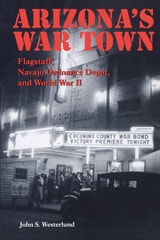
Arizona's War Town
Flagstaff, Navajo Ordnance Depot, and World War IIJohn S. Westerlund
University of Arizona Press, 2003
A clearing in the ponderosa pine forest called Volunteer Prairie met the military's criteria for a munitions depot—open terrain, a cool climate, plentiful water, and proximity to a railroad—and it was also sufficiently inland to be safe from the threat of coastal invasion. Constructing a depot of 800 ammunition bunkers, each the size of a 2,000-square-foot home, called for a force of 8,000 laborers, and Flagstaff became a boom town overnight as construction workers and their families poured in from nearby Indian reservations and as far away as the Midwest and South. More than 2,000 were retained as permanent employees—a larger workforce than Flagstaff's total pre-war employment roster.
As Westerlund's portrait of wartime Flagstaff shows, prosperity brought unanticipated consequences: racism simmered beneath the surface of the town as ethnic groups were thrown together for the first time; merchants called a city-wide strike to protest emerging union activity; juvenile delinquency rose dramatically; Flagstaff women entered the workforce in unprecedented numbers, altering local mores along with their own plans for the future; meanwhile, hundreds of sailors and marines arrived at Arizona State Teachers College to participate in the Navy's "V-12" program. Whether recounting the difficulty of 3,500 Navajo and Hopi employees adjusting to life off the reservation or the complaints of townspeople that Austrian POWs-transferred to the depot to ease the labor shortage-were treated too well, Westerlund shows that the construction and maintenance of the facility was far more than a military matter.
Navajo Ordnance Depot remained operational to support wars in Korea, Vietnam, and the Persian Gulf, and today Camp Navajo provides storage for thousands of deactivated ICBM motors. But in recounting its early days, Westerlund has skillfully blended social and military history to vividly portray not only a city's transitional years but also the impact of military expansion on economic and community development in the American West.

Arizona
A History, Revised EditionThomas E. Sheridan
University of Arizona Press, 2012
Hailed as a model state history thanks to Thomas E. Sheridan's thoughtful analysis and lively interpretation of the people and events shaping the Grand Canyon State, Arizona has become a standard in the field. Now, just in time for Arizona's centennial, Sheridan has revised and expanded this already top-tier state history to incorporate events and changes that have taken place in recent years. Addressing contemporary issues like land use, water rights, dramatic population increases, suburban sprawl, and the US-Mexico border, the new material makes the book more essential than ever. It successfully places the forty-eighth state's history within the context of national and global events. No other book on Arizona history is as integrative or comprehensive.
From stone spear points more than 10,000 years old to the boom and bust of the housing market in the first decade of this century, Arizona: A History explores the ways in which Native Americans, Hispanics, African Americans, Asians, and Anglos have inhabited and exploited Arizona. Sheridan, a life-long resident of the state, puts forth new ideas about what a history should be, embracing a holistic view of the region and shattering the artificial line between prehistory and history. Other works on Arizona's history focus on government, business, or natural resources, but this is the only book to meld the ethnic and cultural complexities of the state's history into the main flow of the story.
A must read for anyone interested in Arizona's past or present, this extensive revision of the classic work will appeal to students, scholars, and general readers alike.
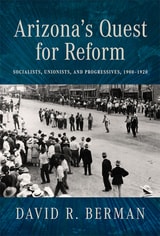
Arizona’s Quest for Reform
Socialists, Unionists, and Progressives, 1900–1920David R. Berman
University of Arizona Press, 2026
In Arizona’s Quest for Reform, David R. Berman traces the rise and fall of a dynamic coalition of socialists, labor activists, and progressive Democrats led by the influential Governor George Hunt as they pursued sweeping reforms in a rapidly changing state. From the fight for workers’ rights and women’s suffrage to the use of the initiative process and the role of radical newspapers, Berman brings to life the people and movements that shaped Arizona’s early political identity.
Drawing on extensive primary sources and organized in a clear chronological structure, Berman’s study reveals the tensions, alliances, and dramatic events that defined Arizona’s reform efforts between 1900 and 1920. The book explores the impact of powerful mining interests, railroad companies, and labor unions, while also examining the racialization of Mexican miners and their evolving role in the labor movement. Through vivid storytelling and rigorous scholarship, Berman uncovers the complexities of political change in a state straddling the transition from territory to statehood.
This landmark work will appeal to scholars of western history, labor studies, and political science, as well as general readers interested in Arizona’s unique place in the national Progressive movement. Arizona’s Quest for Reform not only deepens our understanding of the past but also offers timely insights into the enduring challenges of coalition building, grassroots activism, and political reform. It is a vital contribution to the study of Arizona and the American West.

Arkansas
John Gould Fletcher
University of Arkansas Press, 1995
Like a well-planned time capsule, Arkansas is a fascinating picture of the state’s evolution: from a wilderness explored by Hernando de Soto to a rowdy and often lawless frontier, a partner in the shameful dislocation of Native Americans, a state in the Confederacy, a source of homegrown populists, and always a land of opportunity.
As Harry S. Ashmore states in his introduction to this third volume of the John Gould Fletcher Series, “Arkansas still stands up as its author intended, a poet’s imaginative treatment of a ‘history both tragic and comic—with its deep legendary roots going far back into the remote prehistoric past.’ It has earned a permanent place among the books that must be read by those who seek to understand the matrix in which new forces of economic and social change are reshaping Arkansas’s traditional society.”
Arkansas Archaeology
Essays in Honor of Dan and Phyllis MorseRobert C. Mainfort
University of Arkansas Press, 1999

Arkansas Biography
A Collection of Notable LivesNancy Williams
University of Arkansas Press, 2000
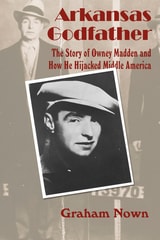
Arkansas Godfather
The Story of Owney Madden and How He Hijacked Middle AmericaGraham Nown
Butler Center for Arkansas Studies, 2013
Arkansas Travelers
Geographies of Exploration and Perception, 1804-1834Andrew J. Milson
University of Arkansas Press, 2023
“I reckon stranger you have not been used much to traveling in the woods,” a hunter remarked to Henry Rowe Schoolcraft as he trekked through the Ozark backcountry in late 1818. The ensuing exchange is one of many compelling encounters between Arkansas travelers and settlers depicted in Arkansas Travelers: Geographies of Exploration and Perception, 1804–1834. This book is the first to integrate the stories of four travelers who explored Arkansas during the transformative period between the Louisiana Purchase of 1803 and statehood in 1836: William Dunbar, Thomas Nuttall, Henry Rowe Schoolcraft, and George William Featherstonhaugh.
In addition to gathering their tales of treacherous rivers, drunken scoundrels, and repulsive food, historian and geographer Andrew J. Milson explores the impact such travel narratives have had on geographical understandings of Arkansas places. Using the language in each traveler’s narrative, Milson suggests, and the book includes, new maps that trace these perceptions, illustrating not just the lands traversed, but the way travelers experienced and perceived place. By taking a geographical approach to the history of these spaces, Arkansas Travelers offers a deeper understanding—a deeper map—of Arkansas.

Arkansas Wildlife
A HistoryKeith B. Sutton
University of Arkansas Press, 1998

Arkansas Women and the Right to Vote
The Little Rock Campaigns: 1868-1920Bernadette Cahill
Butler Center for Arkansas Studies, 2015