Results by title
2706 books match the query 'European' and 85 start with b

BASTARDS AND FOUNDLINGS
ILLEGITIMACY IN EIGHTEENTH-CENTURY ENGLANDLisa Zunshine
The Ohio State University Press, 2005

Backgrounds of English Literature, 1700-1760
Cecil Moore
University of Minnesota Press, 1953

Bad Books
Rétif de la Bretonne, Sexuality, and PornographyAmy S. Wyngaard
University of Delaware Press, 2013
Published by University of Delaware Press. Distributed worldwide by Rutgers University Press.
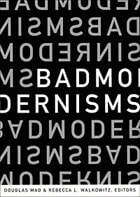
Bad Modernisms
Douglas Mao and Rebecca L. Walkowitz, eds.
Duke University Press, 2006
Bad Modernisms thus builds on and extends the “new modernist studies,” recent work marked by the application of diverse methods and attention to texts and artists not usually labeled as modernist. In this collection, these developments are exemplified by essays ranging from a reading of dandyism in 1920s Harlem as a performance of a “bad” black modernist imaginary to a consideration of Filipino American modernism in the context of anticolonialism. The contributors reconsider familiar figures—such as Virginia Woolf, D. H. Lawrence, Josef von Sternberg, Ludwig Wittgenstein, W. H. Auden, and Wyndham Lewis—and bring to light the work of lesser-known artists, including the writer Carlos Bulosan and the experimental filmmaker Len Lye. Examining cultural artifacts ranging from novels to manifestos, from philosophical treatises to movie musicals, and from anthropological essays to advertising campaigns, these essays signal the capaciousness and energy galvanizing the new modernist studies.
Contributors. Lisa Fluet, Laura Frost, Michael LeMahieu, Heather K. Love, Douglas Mao, Jesse Matz, Joshua L. Miller, Monica L. Miller, Sianne Ngai, Martin Puchner, Rebecca L. Walkowitz
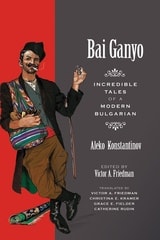
Bai Ganyo
Incredible Tales of a Modern BulgarianAleko Konstantinov
University of Wisconsin Press, 2010
Bai Ganyo has been translated into most European languages, but now Victor Friedman and his fellow translators have finally brought this Balkan masterpiece to English-speaking readers, accompanied by a helpful introduction, glossary, and notes.
Bait
David Albahari
Northwestern University Press, 2001
Bakhtin/ Bakhtin
The Archives and Beyond, Volume 97Peter Hitchcock
Duke University Press, 0
Exploring both the dynamism of Bakhtin versus “Bakhtin” and the dynamics of “possible Bakhtins,” the contributors tackle this theorist’s range of shifting shapes, from the carnival-messianistic and the chronotopic, through the philosophic and the ideologic, to the “applied Bakhtin” of the social sciences. Bakhtin’s texts are examined in the context of work by such disparate figures as Ernst Cassirer and Rudolph Rocker, while various aspects of the academic “Bakhtin industry” are examined, including the “will to mythology by anthology” and the inequities of a world market in ideas exemplified by the resource gap between Russian and Western scholarship. The “state of the archive” is assessed by both UK Bakhtin Centre Director David Shepherd and Russian Bakhtin Archivist Nikolai Pan’kov. Throughout the issue, which is framed by Peter Hitchcock’s introductory polemics and Michael Holquist’s afterword, author and archive are continually deconstructed and reconstructed.
Contributors. Robert Barsky, Rachel Falconer, Maroussia Hadjukowski-Ahmed, Ken Hirschkop, Peter Hitchcock, Michael Holquist, Vitaly Makhlin, Nikolai Pan’kov, Brian Poole, David Shepherd, Galin Tihanov, Anthony Wall
Balkan Blues
Writing Out of YugoslaviaJoanna Labon
Northwestern University Press, 1995
Contributors: Dubravka Ugrešić, Bogdan Bogdanović, Dragan Velikić, Danilo Kiš, Drago Jančar, Mirko Kovač, Goran Stefanovski, Dževad Karahasan, and Slobodan Blagojević.
Ballad of Descent
Martin Vopenka
Northwestern University Press, 1995

Bankruptcy and Debt Collection in Liberal Capitalism
Switzerland, 1800–1900Mischa Suter
University of Michigan Press, 2021
Drawing on perspectives from anthropology and social theory, this book explores the quotidian routines of debt collection in nineteenth-century capitalism. It focuses on Switzerland, an exemplary case of liberal rule. Debt collection and bankruptcy relied on received practices until they were standardized in a Swiss federal law in 1889. The vast array of these practices was summarized by the idiomatic Swiss legal term “Rechtstrieb” (literally, “law drive”). Analyzing these forms of summary justice opens a window to the makeshift economies and the contested political imaginaries of nineteenth-century everyday life. Ultimately, the book advances an empirically grounded and theoretically informed history of quotidian legal practices in the everyday economy; it is an argument for studying capitalism from the bottom up.
Barbarous Play
Race on the English Renaissance StageLara Bovilsky
University of Minnesota Press, 2008
Like our own, early modern beliefs about race depended on metaphorical, selective, and contradictory understandings of how membership in groups is determined. Although race took distinctive forms in the past, the fallacies that underlie early modern racial experience generally are precisely-and surprisingly-the same as those in contemporary culture.
Exploring the similar underpinnings of early modern and contemporary ideas of difference, Barbarous Play examines English Renaissance understandings of race as depicted in drama. Reading plays by Shakespeare, Marlowe, Webster, and Middleton, Bovilsky offers case studies of how racial meanings are generated by narratives of boundary crossing-especially miscegenation, religious conversion, class transgression, and moral and physical degeneracy. In the process, she reveals deep parallels between the period’s conceptions of race and gender.
Barbarous Play contests the widely held view that race and racism depend on modern science for their existence and argues that understanding just what is false and figurative in past depictions of race, such as those found in Othello, The Merchant of Venice, The White Devil, and The Changeling, can clarify the illogic of present-day racism.
Lara Bovilsky is assistant professor of English at Washington University in St. Louis.
Bard of Iceland
Jonas Hallgrimsson, Poet and ScientistRichard Ringler
University of Wisconsin Press, 2002
Bard of Iceland makes available for the first time in any language other than Icelandic an extensive selection of works by Jónas Hallgrímsson (1807–1845), the most important poet of modern Iceland. Jónas was also Iceland’s first professionally trained geologist and an active contributor in a number of other scientific fields: geography, botany, zoology, and archaeology. He played a key role as well in Iceland’s struggle to gain independence from Denmark. "Descriptive power and fullness of spirit were the hallmarks of his soul," wrote a contemporary admirer.
Dick Ringler, one of the premier scholars of Icelandic literature in the world, offers a substantial biography of Jónas, a representative selection of his most important poems, and some of his prose work in science and belles lettres. Ringler also provides extended commentaries and an essay on Icelandic prosody.
The poems are translated into English equivalents of their original complex meters in Icelandic and Danish. As a poet Jónas was intimately familiar with his nation’s medieval literary inheritance—the sagas and eddas—and also with the groundbreaking work of contemporary German and Danish Romanticism (Chamisso, Heine, Oehlenschläger). A master of poetic form, Jónas not only exploited and enlarged the possibilities of traditional eddic and skaldic meters, but introduced the sonnet, triolet stanza, terza and ottava rima, and blank verse into the Icelandic metrical repertory.
Bareface
A Guide to C.S. Lewis's Last NovelDoris T. Myers
University of Missouri Press, 2004

Battle Of Kosovo
John Matthias
Ohio University Press, 1987
The Battle of Kosovo cycle of heroic ballads is generally considered the finest work of Serbian folk poetry. Commemorating the Serbian Empire’s defeat at the hands of the Turks in the late fourteenth century, these poems and fragments have been known for centuries in Eastern Europe. With the appearance of the collections of Serbian folk poems by Vuk Stefanovic Karasdzic, the brilliance of the poetry in the Kosovo and related cycles of ballads was affirmed by poets and critics as deeply influential as Goethe, Jacob Brimm, Adam Mickiewicz, and Alexander Pushkin. Although translations into English have been attempted before, few of them, as Charles Simic notes in his preface, have been persuasive until now. Simic compares the movement of the verse in these translations to the “variable foot” effect of William Carlos Williams’s later poetry, and argues that John Matthias “grasps the poetic strategies of the anonymous Serbian poet as well as Pound did those of Chinese poetry.”
First published in 1987, the translation of the Battle of Kosovo is now reprinted both because of its intrinsic merits and because the recent crisis in Kosovo itself compels the entire world to understand the nature of the ancient conflicts and passions that fuel it. Although Matthias and Simic have elected to retain their original preface and introduction, Christopher Merrill, a scholar of the region and author of Only the Nails Remain, has contributed a brief afterword explaining the importance of this poetry in the context of NATO’s first military action ever against a sovereign nation.

Baudelaire and the Poetics of Modernity
Patricia A. Ward
Vanderbilt University Press, 2000
Charles Baudelaire, possibly the most influential author of nineteenth-century France, created a poetics of modernity and a thematics of the city; he transcended genre by moving between poetry and prose. He is also the most accessible of modern French poets to an American readership. These essays examine Baudelaire's poetics and the complex relationship between the poet and his twentieth-century literary heirs, including Rene Char, Yves Bonnefoy, and Michel Deguy.
The contributors, who include Deguy and Bonnefoy, are all distinguished writers or critics noted for their own poetry or for their scholarship on Baudelaire and in French studies. Their essays go to the heart of what makes Baudelaire so important: his modernity and his influence from the very beginning on other poets, including those outside of France. The essays are written in English, with citations from Baudelaire and other sources in both French and English.
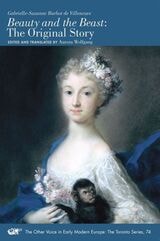
Beauty and the Beast
The Original StoryGabrielle-Suzanne Barbot de Villeneuve
Iter Press, 2020
The Other Voice in Early Modern Europe: The Toronto Series volume 74
Beckett after Wittgenstein
Andre Furlani
Northwestern University Press, 2015
Among the best-represented authors in Samuel Beckett’s library was Ludwig Wittgenstein, yet the philosopher’s relevance to the Nobel laureate’s work is scarcely acknowledged and seldom elucidated. Beckett after Wittgenstein is the first book to examine Beckett’s formative encounters with, and profound affinities to, Wittgenstein’s thought, style, and character.
While a number of influential critics, including the philosopher Alain Badiou, have discerned a transition in Beckett’s work beginning in the late 1950s, Furlani is the first to identify and clarify how this change occurs in conjunction with the writer’s sustained engagement with Wittgenstein’s thought on, for example, language, cognition, subjectivity, alterity, temporality, belief, hermeneutics, logic, and perception. Drawing on a wealth of Beckett’s archival materials, much of it unpublished, Furlani’s study reveals the extent to which Wittgenstein fostered Beckett’s views and emboldened his purposes.
Beckett’s Happy Days
A Manuscript StudyS. E. Gontarski
The Ohio State University Press, 2017
The current reissue of Beckett’s Happy Days comes at a timely moment not only in Beckett studies but also in the general growth in programs of book history and digital humanities. Gontarski’s study is not just a look back to origins. It traces an arc of research that developed over forty years as the Samuel Beckett archive at the University of Reading matured, as the fields of genetic and textual research grew, and as book history reemerged on a grand, international scale. In this timeframe, the Beckett Digital Manuscript and Library Projects responded to interest in Beckett studies and archival studies, taking textual production, genetic study, and book history into the twenty-first century with their emphasis on electronic access and digital collation. At The Ohio State University, the Rare Books and Manuscripts archive held papers central to Gontarski’s study. Beckett’s Happy Days is thus a fundamental, even seminal, part of that forty-year scholarly trajectory, and in its current edition, is readily accessible to individual students and scholars alike.
Becoming French
Mapping the Geographies of French Identity, 1871-1914Dana Kristofor Lindaman
Northwestern University Press, 2016
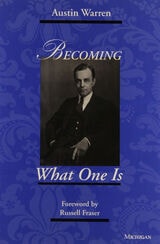
Becoming What One Is
Austin Warren
University of Michigan Press, 1995
The late Austin Warren was one of the most distinguished literary scholars of the twentieth century, well known as a biographer, literary critic, and teacher. He retired from the University of Michigan English Department in 1968 after twenty years on the faculty. Warren's memoir ends at age forty, because, as he explains in the preface, the most interesting part of anyone's life is the formative years.
He begins with his childhood in Massachusetts and education at Wesleyan, Harvard, and Princeton, and ends with reflections on the problems of integrating his profession, teaching, with his vocation, writing. The journey in between is extraordinary, a re-creation of the scholar's search for identity, religion, wisdom, and a new vision of the role of a teacher.
Warren "forged his soul when others weren't looking," writes Russell Fraser in his foreword to the book. He grew up on a lonely New England farm, went to a school where he learned to hate even Shakespeare, and entered college without enthusiasm. But the history of his education, as is often the case, was one first of rescue by inspiring mentors, then of outgrowing those mentors, and finally of forging a vision of his own. By the 1930s he had shaken up classrooms by abandoning formal lectures and become an inspiration in his own right.
A singular personality who never stopped searching for meaningful spirituality and a wider intellectual world, Austin Warren was among the most important scholars of the twentieth century. His memoirs of "becoming" are an elegant and absorbing chronicle.
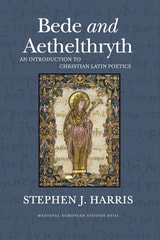
Bede and Aethelthryth
An Introduction to Christian Latin PoeticsStephen J. Harris
West Virginia University Press, 2016
Bede and Aethelthryth asks why Christians in Britain around the year 700 enjoyed Latin poetry. What did they see in it? What did they get from it? This book attempts to reconstruct the horizon of expectation of a highly learned, Latin-speaking nun as she encounters a fifty-line poem by the Venerable Bede, the Hymn to Aethelthryth.
The reconstruction is hypothetical and derived from grammatical manuals, learned commentaries from the early medieval period (especially Servius’s commentary on Virgil), and a wide variety of aesthetic observations by classical and medieval readers. The first four chapters describe basic expectations of a reader of Christian Latin poetry. The fifth chapter places the Hymn in its context within Bede’s Ecclesiastical History. A few pages after Bede records his hymn, Caedmon will recite his own hymn under the watchful eye of Whitby’s Abbess Hild, who was a friend of Aethelthryth.
Both hymns are attempts to reform the lyric traditions of pagan Rome and pagan Anglo-Saxon England in the light of Christian teaching. The last three chapters contain a line-by-line commentary on Bede’s alphabetic, epanaleptic elegy.

Before the Closet
Same-Sex Love from "Beowulf" to "Angels in America"Allen J. Frantzen
University of Chicago Press, 1998
With its ambitious scope and elegant style, Before the Closet sets same-sex relations in Anglo-Saxon sources in relation to the sexual themes of contemporary opera, dance, and theatre. Frantzen offers a comprehensive analysis of sources from the seventh to the twelfth century and traces Anglo-Saxon same-sex behavior through the age of Chaucer and into the Renaissance.
"Frantzen's marvelous book . . . opens up a world most readers will never have even known was there. It's a difficult topic, but Frantzen's comprehensive, readable and even wryly funny treatment makes this an unexpected pleasure."—Publishers Weekly, starred review
Behind the Stars, More Stars
The Tagus/Disquiet Collection of New Luso-American WritingEdited by Christopher Larkosh and Oona Patrick
Tagus Press, 2019
Presenting experimental and boundary-breaking prose from women, people of color, and LGBTQ writers, Behind the Stars, More Stars imagines a more diverse and inclusive Luso-American and Portuguese-American literary scene, which has traditionally been dominated by male voices. Since its first “Writing the Luso Experience” workshops were held in 2011, Dzanc Books's Disquiet International Literary Program in Lisbon has aimed to break silences within today's Luso-American communities. Disquiet faculty Katherine Vaz and Frank X. Gaspar appear alongside up-and-coming writers from the workshops, such as Traci Brimhall, Megan Fernandes, Hugo Dos Santos, and previously unpublished women writers.

Behold an Animal
Four Exorbitant ReadingsThangam Ravindranathan
Northwestern University Press, 2019
As animals recede from our world, what tale is being told by literature’s creatures? Behold an Animal: Four Exorbitant Readings examines incongruous animals in the works of four major contemporary French writers: an airborne horse in a novel by Jean-Philippe Toussaint, extinct orangutans in Éric Chevillard, stray dogs in Marie NDiaye, vanishing (bits of) hedgehogs in Marie Darrieussecq. Resisting naturalist assumptions that an animal in a story is simply—literally or metaphorically—an animal, Thangam Ravindranathan understands it rather as the location of something missing. The animal is a lure: an unfinished figure fleeing the frame, crossing bounds of period, genre, even medium and language. Its flight traces an exorbitant (self-)portrait in which thinking admits to its commerce with life and flesh. It is in its animals, at the same time unbearably real and exquisitely unreal, that literature may today be closest to philosophy.
This book’s primary focus is the contemporary French novel and continental philosophy. In addition to Toussaint, Chevillard, NDiaye, and Darrieussecq, it engages the work of Jean de La Fontaine, Eadweard Muybridge, Edgar Allan Poe, Lewis Carroll, Samuel Beckett, and Francis Ponge.
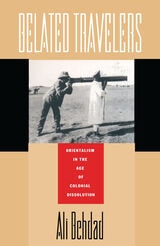
Belated Travelers
Orientalism in the Age of Colonial DissolutionAli Behdad
Duke University Press, 1994
Through readings of Flaubert, Nerval, Kipling, Blunt, and Eberhardt, and following the transition in travel literature from travelog to tourist guide, Belated Travelers addresses the specific historical conditions of late nineteenth-century orientalism implicated in the discourses of desire and power. Behdad also views a broad range of issues in addition to nostalgia and tourism, including transvestism and melancholia, to specifically demonstrate the ways in which the heterogeneity of orientalism and the plurality of its practice is an enabling force in the production and transformation of colonial power.
An exceptional work that provides an important critique of issues at the forefront of critical practice today, Belated Travelers will be eagerly awaited by specialists in nineteenth-century British and French literatures, and all concerned with colonial and postcolonial discourse.
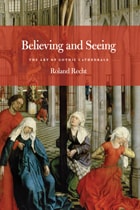
Believing and Seeing
The Art of Gothic CathedralsRoland Recht
University of Chicago Press, 2008
In addition to the great cathedrals of France, Recht explores key religious buildings throughout Europe to reveal how their grand designs supported this profusion of images that made visible the signs of scripture. Metalworkers, for example, fashioned intricate monstrances and reliquaries for the presentation of sacred articles, and technical advances in stained glass production allowed for more expressive renderings of holy objects. Sculptors, meanwhile, created increasingly naturalistic works and painters used multihued palettes to enhance their subjects’ lifelike qualities. Reimagining these works as a link between devotional practices in the late Middle Ages and contemporaneous theories that deemed vision the basis of empirical truth, Recht provides students and scholars with a new and powerful lens through which to view Gothic art and architecture.
Belonging
PoemsDick Davis
Ohio University Press, 2002
Benito Perez Galdos and the Creative Process
Walter T. Pattison
University of Minnesota Press, 1954
Benito Perez Galdos and the Creative Process was first published in 1954. Minnesota Archive Editions uses digital technology to make long-unavailable books once again accessible, and are published unaltered from the original University of Minnesota Press editions.
Most critics would rank Benito Perez Galdos second only to Cervantes among the great novelists of Spain. However, in spite of the esteem in which he is generally held, Galdos has been the subject of relatively few scholarly studies. Professor Pattison, by an analysis of two of Galdos' novels, attempts to reconstruct the creative processes that were involved in the writing of these novels. This is the first time that such a critical approach has been used in the field of Spanish fiction and the resulting study is significant not only to Spanish scholars but to all students of literature seeking further insights into the fascinating and still elusive creative process.
Professor Pattison analyzes the novels Gloria, published in 1877, and Marianela,which was published the following year. Both are stories of contemporary life, the former having as its theme the conflict between noble religion and the fanaticism of individual religious sects, and the latter presenting a story of tragic love interwoven with the social problem of the responsibilities of the rich toward the poor.
In tracking down the sources of ideas, characters, plots, and viewpoints that emerge in these novels, Professor Pattison worked first-hand in Galdos' personal library in Madrid. From the notes and markings in the books and from other intimate observations, the scholar-detective put his finger on many of the original sources that contributed to Galdos' artistic creations and identified the prototypes for fictional characters among persons Galdos knew.
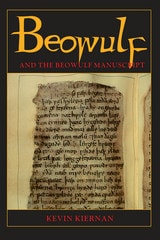
Beowulf and the Beowulf Manuscript
Kevin S. Kiernan
University of Michigan Press, 1997
Kevin S. Kiernan, one of the world's foremost Beowulf scholars, has studied the manuscript extensively with the most up-to-date methods, including fiber-optic backlighting and computer digitization. This volume reprints Kiernan's earlier study of the manuscript, in which he presented his novel conclusions about the date of Beowulf. It also offers a new Introduction in which the author describes the value of electronic study of Beowulf, and a new Appendix that lists all the letters and parts of letters revealed by backlighting.
This important volume will be a must-read not only for the scholar of early English history and literature, but for all those who are interested in practical applications of the new technologies.
Beowulf and the Grendel-Kin
Politics and Poetry in Eleventh-Century EnglandHelen Damico
West Virginia University Press, 2014
In Beowulf and the Grendel-kin: Politics and Poetry in Eleventh-Century England, Helen Damico presents the first concentrated discussion of the initiatory two-thirds of Beowulf’s 3,182 lines in the context of the sociopolitically turbulent years that composed the first half of the eleventh century in Anglo-Danish England.
Damico offers incisive arguments that major historical events and personages pertaining to the reign of Cnut and those of his sons recorded in the Anglo-Saxon Chronicle, the Encomium Emmae Reginae, and major continental and Scandinavian historical texts, hold striking parallels with events and personages found in at least eight vexing narrative units, as recorded by Scribe A in BL, Cotton Vitellius A.xv, that make up the poem’s quasi sixth-century narrative concerning the fall of the legendary Scyldings.
Given the poet’s compositional skill—widely relational and eclectic at its core—and his affinity with the practicing skalds, these strings of parallelisms could scarcely have been coincidental. Rather, Damico argues that examined within the context of other eleventh-century texts that either bemoaned or darkly satirized or obversely celebrated the rise of the Anglo-Danish realm, the Beowulfian units may bring forth a deeper understanding of the complexity of the poet’s compositional process.
Damico illustrates the poet’s use of the tools of his trade—compression, substitution, skillful encoding of character—to reinterpret and transform grave sociopolitical “facts” of history, to produce what may be characterized as a type of historical allegory, whereby two parallel narratives, one literal and another veiled are simultaneously operative.
Beowulf and the Grendel-Kin lays out the story of Beowulf, not as a monster narrative nor a folklorish nor solely a legendary tale, but rather as a poem of its time, a historical allegory coping with and reconfiguring sociopolitical events of the first half of eleventh-century Anglo-Saxon England.
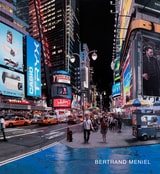
Bertrand Meniel
Paintings, 1996-2024Bertrand Meniel
The Artist Book Foundation, 2024
Using composite digital photography, self-taught artist Bertrand Meniel incorporates more detail into each of his cityscapes than any other Photorealist to date.
Photorealism is a genre of painting that developed in the United States and Europe using high-resolution photography as its primary source material. Embracing digital photography perhaps more than any other artist working in this genre, Bertrand Meniel is able to incorporate an astonishing amount of detail into his renderings of cityscapes in New York City, Miami, and Paris. Using a variety of photographs of his chosen subject, he manipulates an image to perfection, focusing simultaneously on the foreground and background by combining hundreds of shots on a computer screen.
His choice to depict iconic American scenes in his paintings, particularly those associated with the “American Way of Life,” reflects not just a technical mastery of Photorealism but a deep emotional connection to the culture that captivated him during his youth. His unique perspective, influenced by French artistic traditions and shaped by exposure to American pop culture, allows him to capture in his art the essence of what may be best described as the “New York State of Mind."
Beside the Bard
Scottish Lowland Poetry in the Age of BurnsGeorge S. Christian
Bucknell University Press, 2020
Published by Bucknell University Press. Distributed worldwide by Rutgers University Press.
Between History and Myth
Stories of Harald Fairhair and the Founding of the StateBruce Lincoln
University of Chicago Press, 2014
Taking the story of how Harald Fairhair unified Norway in the ninth century as its central example, Bruce Lincoln illuminates the way a state’s foundation story blurs the distinction between history and myth and how variant tellings of origin stories provide opportunities for dissidence and subversion as subtle—or not so subtle—modifications are introduced through details of character, incident, and plot structure. Lincoln reveals a pattern whereby texts written in Iceland were more critical and infinitely more subtle than those produced in Norway, reflecting the fact that the former had a dual audience: not just the Norwegian court, but also Icelanders of the twelfth and thirteenth centuries, whose ancestors had fled from Harald and founded the only non-monarchic, indeed anti-monarchic, state in medieval Europe.
Between History and Myth will appeal not only to specialists in Scandinavian literature and history but also to anyone interested in memory and narrative.
Between Market and Myth
The Spanish Artist Novel in the Post-Transition, 1992-2014Katie J. Vater
Bucknell University Press, 2020
Published by Bucknell University Press. Distributed worldwide by Rutgers University Press.
Between Sea and Sahara
An Algerian JournalEugene Fromentin
Ohio University Press, 1999
Between Sea and Sahara gives us Algeria in the third decade of colonization. Written in the 1850s by the gifted painter and extraordinary writer Eugene Fromentin, the many-faceted work is travelogue, fiction, stylized memoir, and essay on art. Fromentin paints a compelling word picture of Algeria and its people, questioning France’s—and his own—role there. He shows French dynamism tending to arrogance, tinged with malaise, as well as the complexity of the Algerians and their canny survival tactics. In his efforts to capture the non-Western world on paper as well as on canvas, Fromentin reveals much about the roots of a colonial relationship that continues to affect the Algeria of today. He also reveals his own development as painter, writer—and human being.
Now available for the first time in English, Between Sea and Sahara appeals to today’s reader on many levels—as a story of color, romance, and dramatic tension; as an eywitness account of the colonial experience in Algeria; as a study in trans-genre text, foreshadowing Fromentin’s psychological masterpiece, the novel Dominique. And, as Valérie Orlando points out in her introduction, Fromentin opens a window on the ethos informing the fashion of Orientalism that flourished with colonialism.
Between Self and Society
Inner Worlds and Outer Limits in the British Psychological NovelBy John Rodden
University of Texas Press, 2016
Between Self and Society explores the psychosocial dramas that galvanize six major British novels written between the eighteenth and twentieth centuries. The book challenges an influential misconception that has for too long hindered appreciation of the psychological novel. John Rodden argues that there should be no simplifying antithesis between psychological, “inner” conflicts (within the mind or “soul”) and institutional, “outer” conflicts (within family, class, community). Instead, it is the overarching, dramatic—yet often tortuous—relations between self and society that demand our attention. Rodden presents fresh interpretations of an eclectic group of prose fiction classics, including Tobias Smollett’s The Adventures of Roderick Random, William Godwin’s Caleb Williams, Thomas Hardy’s The Mayor of Casterbridge, Ford Madox Ford’s The Good Soldier, Wyndham Lewis’s Tarr, and D. H. Lawrence’s Women in Love.
Far from being merely admirable experiments, let alone daring though interesting failures, these fictions are shown to possess aesthetic unity, stylistic consistency, and psychic force. Between Self and Society thus impels our careful reconsideration of novels that represent major artistic achievements, yet have been either unjustly neglected or appreciated in limiting ways that do injustice to their psychological aspects. Rodden’s vibrant discussion invites an upward revaluation of these works and encourages the full recognition of their value and significance in British literary history.
Between the Iceberg and the Ship
Selected EssaysAnne Stevenson
University of Michigan Press, 1998
Feminist critics will find much to invigorate and infuriate them in these essays. Stevenson believes that the "takeover" of poetry by critical theorists has, in recent years, all but brought about its demise in England and America. But she also fears that the media's doctrine of mass marketability may have a detrimental effect on the future of poetry. Her essays on Plath, Bishop, Irish poetry, and other subjects are as witty as they are challenging, upsetting many of the easy assumptions of our putatively "postmodern" era.
Anne Stevenson is the author of numerous books, including Bitter Fame: A Life of Sylvia Plath, The Other House, Four and a Half Dancing Men, and most recently, Collected Poems 1955- 1995.
Beyond Decadence
Exposing the Narrative Irony in Jan Opolský's ProsePeter Butler
Karolinum Press, 2015
Beyond Human
Vital Materialisms in the Andean Avant-GardesDaly, Tara
Bucknell University Press, 2019
Published by Bucknell University Press. Distributed worldwide by Rutgers University Press.
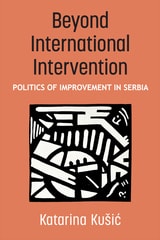
Beyond International Intervention
Politics of Improvement in SerbiaKatarina Kušic
University of Michigan Press, 2025
By engaging with subjects, the book not only enhances our understanding of intervention, but also uncovers the limitations of the concept. Katarina Kušić argues that the concept limits what we can observe and theorize, and it prevents researchers from engaging with the people living in spaces of intervention as coeval political subjects. As an alternative, she proposes to foreground improvement over “intervention.” This reorientation enables researchers to trace hierarchies beyond the local/international dichotomy, expands fields of visibility beyond those prescribed by interventions themselves, and seriously considers the contradictions at the heart of liberalism.

Beyond Left, Right, and Center
The Politics of Gender and Ethnicity in Contemporary GermanyChristina Xydias
Temple University Press, 2024
Christina Xydias shows that some right-leaning parties advocate for women’s rights and interests, while left- and right-leaning parties can be equally indifferent to lack of representation for women from marginalized groups. These findings follow from analyses of election results, transcripts from debates and speeches, and personal interviews, as well as from a close reading of intertwined military and citizenship policies that illustrate how women’s and ethnic minority groups’ rights are constructed.
Beyond Left, Right, and Center concludes with an analysis of women’s representation across OECD countries, showing that right-leaning parties are more likely to support women’s rights and interests in societies that are more egalitarian.
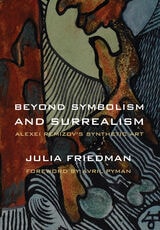
Beyond Symbolism and Surrealism
Alexei Remizov's Synthetic ArtJulia Friedman, Foreword by Avril Pyman
Northwestern University Press, 2011
The great modernist eccentric Alexei Remizov was a “writers’ writer” whose innovative poetic prose has long since entered the Russian literary canon. Gradually expanding his working methods to make drawing an integral part of the writing process, during the 1930s and 1940s, Remizov created hundreds of albums that combined texts with collages and india ink and watercolor illustrations. In Beyond Symbolism and Surrealism, Julia Friedman provides the first extensive examination of the dynamic interplay between text and image in Remizov’s albums, revealing their coequal roles in his oneiric and synaesthetic brand of storytelling. A participant in the Russian symbolist movement, an intellectual ally of many futurists, and during his émigré years, a collaborator of the surrealists, Remizov had unique insight into artistic cultures of the European avant-garde. His reinterpretation of the medieval illuminated manuscripts carries forward the traditions of symbolist mysticism and
This long-overdue examination of Remizov’s visual art addresses modernism’s key theoretical questions surrounding the relationships between image and text. Beyond Symbolism and Surrealism introduces a generous sampling of Remizov’s graphic work, much of which is currently held in private collections.
Beyond Tordesillas
New Approaches to Comparative Luso-Hispanic StudiesEdited by Robert Patrick Newcomb and Richard A. Gordon
The Ohio State University Press, 2017
The jumping-off point for Beyond Tordesillas is the critic Jorge Schwartz’s evocative call to arms, “Down with Tordesillas!” In this groundbreaking essay, Schwartz looks to the imaginary line created by the Treaty of Tordesillas (1494), which divided the known world into Spanish and Portuguese spheres of influence, to stand in for generations of literary and cultural noncommunication between the Spanish- and Portuguese-speaking spheres, and their attendant academic disciplines. This volume’s contributions range topically across continents, from the Iberian Peninsula to Latin American countries. They also range across genres, with studies that analyze fictional narrative, music, performance, and visual culture. Beyond Tordesillas forcefully challenges the disciplinary—and indeed, arbitrary—boundaries that for too long have separated Hispanic and Luso-Brazilian studies.
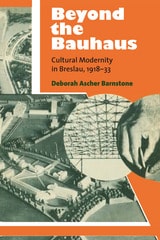
Beyond the Bauhaus
Cultural Modernity in Breslau, 1918-33Deborah Ascher Barnstone
University of Michigan Press, 2016
This richly illustrated volume is the first book in English to address this history, constituting an invaluable addition to the literature on the Weimar period. Its readership includes scholars of German history, art, architecture, urban design, planning, collecting, and exhibition history; of the avant-garde, and of the development of arts academies and arts pedagogy.

Beyond the Body
The Boundaries of Medicine and English Renaissance DramaWilliam Kerwin
University of Massachusetts Press, 2005
Drawing on research in the social history of medicine as well as a wide-ranging collection of primary narratives of medical encounters, Kerwin pursues the stories of several medical groups. Specifically, he examines women healers in terms of the changing place of women in the public sphere; the connections between drug sellers—apothecaries and alchemists—and an emerging modern economy; the role barbers and surgeons played in early modern concerns for protecting a new sense of privacy and interiority; the ways physicians defined their professional primacy through the language of theaters and actors; and the ways individual patients employed rhetorics of diagnosis as a way of participating in sectarian religious battles. The study moves from the dynamics of medical politics to the work drama does in exposing those dynamics. In addition to offering astute readings of works by Shakespeare and Ben Jonson, the book pays substantial attention to plays by Samuel Daniel, John Fletcher, John Ford, Thomas Heywood, John Lyly, Philip Massinger, and John Webster.
Beyond the Body complements the wealth of recent critical attention given to the body. Kerwin attends to a different sort of material politics; as the book's title suggests, he asks a reader interested in the politics of medicine to look not at the practitioner treating the body but at the social forces influencing the practitioner. Beyond the Body works to erode a widespread cultural bias toward giving medicine deference as a self-defining profession.
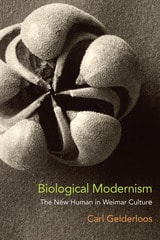
Biological Modernism
The New Human in Weimar CultureCarl Gelderloos
Northwestern University Press, 2020
Honorable Mention for the DAAD/GSA Book Prize for the Best Book in Germanistik or Cultural Studies
Biological Modernism identifies an intellectual current in the Weimar Republic that drew on biology, organicism, vitalism, and other discourses associated with living nature in order to redefine the human being for a modern, technological age. Contrary to the assumption that any turn toward the organic indicated a reactionary flight from modernity or a longing for wholeness, Carl Gelderloos shows that biology and other discourses of living nature offered a nuanced way of theorizing modernity rather than fleeing from it. Organic life, instead of representing a stabilizing sense of wholeness, by the 1920s had become a scientific, philosophical, and disciplinary problem. In their work, figures such as Alfred Döblin, Ernst Jünger, Helmuth Plessner, and August Sander interrogated the relationships between technology, nature, and the human and radically reconsidered the relationship between the disciplines as well as the epistemological and political consequences for defining the human being. Biological Modernism will be of interest to scholars of German literature and culture, literary modernism, photography, philosophical anthropology, twentieth-century intellectual history, the politics of culture, and the history of science.

Black Paris
THE AFRICAN WRITERS' LANDSCAPEBennetta Jules-Rosette
University of Illinois Press, 1998
Bennetta Jules-Rosette explores African writing and identity in France from the early négritude movement and the founding of the Présence Africaine publishing house in 1947 to the mid-1990s. Examining the relationship between African writing and French anthropology as well as the emergence of new styles and discourses, Jules-Rosette covers French Pan-Africanism and the revolutionary writing of the 1960s and 1970s. She also discusses the new generation of African writers who appeared in Paris during the 1980s and 1990s.
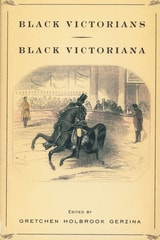
Black Victorians / Black Victoriana
Edited by Gretchen Holbrook Gerzina
Rutgers University Press, 2003
The essays taken as a whole also highlight prevailing Victorian attitudes toward race by focusing on the ways in which empire building spawned a "subculture of blackness" consisting of caricature, exhibition, representation, and scientific racism absorbed by society at large. This misrepresentation made it difficult to be both black and British while at the same time it helped to construct British identity as a whole. Covering many topics that detail the life of blacks during this period, Black Victorians/Black Victoriana will be a landmark contribution to the emergent field of black history in England.
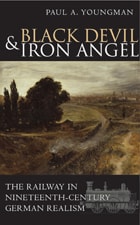
Black devil and iron angel
the railway in nineteenth-century German realismPaul A. Youngman
Catholic University of America Press, 2005
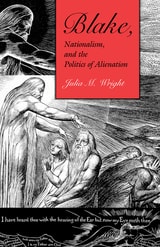
Blake, Nationalism, and the Politics of Alienation
Julia M. Wright
Ohio University Press, 2027
William Blake’s reputation as a staunch individualist is based in large measure on his repeated attacks on institutions and belief systems that constrain the individual’s imagination. Blake, however, rarely represents isolation positively, suggesting that the individual’s absolute freedom from communal pressures is not the ideal. Instead, as Julia Wright argues in her award-winning study Blake, Nationalism, and the Politics of Alienation, Blake’s concern lies with the kind of community that is being established. Moreover, writing at the moment of the emergence of modern nationalism, Blake reveals a concern with the national community in particular.
Beginning with a discussion of the priority of national narrative in late-eighteenth-century art theory and antiquarianism, Blake, Nationalism, and the Politics of Alienation traces its relevance in Blake’s printed works, from The Poetical Sketches and the Lambeth Prophecies to The Laocoön. Professor Wright then turns to Europe, America, and Visions of the Daughters of Albion, focusing on Blake’s portrayals of particular characters’ alienation from the groups and ideologies represented in the texts. The book closes by arguing that Blake’s major printed works, Milton and Jerusalem, are explicit and extensive engagements with the question of nation—and empire.
Although nationalism existed in various forms during the Romantic period, Blake’s contemporaries generally assumed that nations should progress continuously, producing a clear narrative line from an auspicious origin to the perfect fulfillment of that promise. Wright argues that these mutually determining constructs of national character and national narrative inform Blake’s handling of the problem of the individual-within-a-community.