Results by title
1787 books match the query 'Literary Collections' and 95 start with b
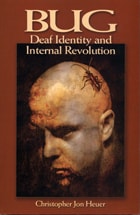
BUG
Deaf Identity and Internal RevolutionChristopher Jon Heuer
Gallaudet University Press, 2007
“What you have in your hands is a bomb. But it is the kind you need to hold on to for dear life, not run away from.”
—From the Foreword, John Lee Clark
Christopher Jon Heuer lost his hearing early, but not before “being able to hear a lot as a kid.” He also received a good education, both in a speech-oriented setting and a signing environment. These varied experiences provided him with the perfect background to write about biases he faced, not only those of a mostly oblivious hearing society, but also those of ideologically restrictive members of the Deaf community. BUG: Deaf Identity and Internal Revolution combines new work of Heuer’s with his best columns from The Tactile Mind Weekly and the National Association of the Deaf’s Mind Over Matter. He addresses all topics – exit interviews, baldness, faith healing, marriage, cats, Christmas trips, backyard campfires in boxer shorts – with a withering wit that spares no aspect of life and deafness.
Being “bugged” for Heuer began early: “When I was growing up, my mother’s response to every problem I had was: ‘Well, he just needs to adjust to his deafness.’ Bloody nose? ‘Chris, you need to adjust to your deafness.’ Homework not done? ‘I know it’s hard adjusting to your deafness, honey, but ....’ Acne scarring? ‘Lots of teenagers get zits, Chris. I know it’s hard for you, dealing with this while trying to adjust to your ....’” He rebelled then, and continues through his even-handed irreverence in BUG, a bomb that should go off in everyone’s consciousness about being deaf and Deaf.

Bachelor Bess
The Homesteading Letters of Elizabeth Corey, 1909-1919Philip L. Gerber
University of Iowa Press, 1990
In July 1909 twenty-one-year-old Elizabeth Corey left her Iowa farm to stake her claim to a South Dakota homestead. Over the next ten years, as she continued her schoolteaching career and carved out a home for herself in this inhospitable territory, she sent a steady stream of letters to her family back in Iowa. From the edge of modern America, Bess wrote long, gossipy accounts—"our own continuing adventure story," according to her brother Paul—of frontier life on the high plains west of the Missouri River. Irrepressible, independent-minded, and evidently fearless, the self-styled Bachelor Bess gives us a firsthand, almost daily account of her homesteading adventures. We can all stake a claim in her energetic letters.
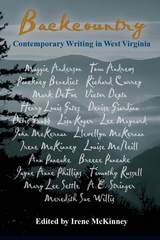
Backcountry
Contemporary Writing in West VirginiaIRENE MCKINNEY
West Virginia University Press, 2002
This is as closely-knit an anthology as you are ever likely to see. It is as though a large, extended family were drawing on the same store of family stories, jokes, symbols, landscapes, animals, trees, language, and vernacular. How many snakes are in this book? How many foxes, possums? Fossils? And how very many coal mines? But it is not merely local references that unites these writers. There is a larger vision that ties these works together.
"The connection is not so much in mutual influence, though there is some of that, but in each writer’s total immersion in place. Even those writers who no longer live in the state remember the feel, the physical texture, the overwhelming and enfolding vegetal surround of the place." Editor, Irene McKinney

Backtalk
Women Writers Speak OutDonna Perry
Rutgers University Press, 1993
Agents or victims, liberated or oppressed, "bad girls" or "good girls." What do these labels mean and do they further or hinder women's progress? How are today's visions of female sexuality and power like or unlike those of the past? How do younger women define feminism? Isn't the personal still political?
Dismayed by the media's tendency to reduce the feminist enterprise to labels and superstars, Donna Perry and Nan Bauer Maglin decided to find out what a diverse group of feminists think about women, sex, and power in the nineties. The result is a provocative and varied collection of twenty-four essays by second- and third-wave feminists; artists and activists; professors and graduate students; professional journalists and just-published writers; mothers and daughters. By focusing on society's construction, containment, and exploitation of female sexuality, in particular, these essays offer fresh perspectives on women's agency or lack of it.
The contributors focus on the oversimplifications and false dichotomies in current discussions of female sexuality, as well as the privileged perspective and individualism that currently dominate the popularized feminist message. Individual writers--including Emma Amos, bell hooks, Ann Jones, Lisa Jones, Paula Kamen, Matuschka, Marge Piercy, Katha Pollitt, Anna Quindlen, Elayne Rapping, Lillian S. Robinson, and Ellen Willis--reexamine women's empowerment in the light of issues like AIDS, battering, acquaintance rape, narratives of childhood sexual abuse, and pornography. Several draw political conclusions from their personal struggles, while others read stories and texts--from history, the art world, the media, popular culture, and social science research--in new and controversial ways.
Backwoods Tales
Paddy McGann, Sharp Snaffles, and Bill BauldyWilliam Gilmore Simms
University of Arkansas Press, 2010

Bad Objects
Essays Popular and UnpopularNaomi Schor
Duke University Press, 1995
Written in a distinctive personal and self-reflective mode, this collection offers new unpublished work and brings together for the first time some of Schor’s best-known and most influential essays. These engagements with Anglo-American feminist theory, Freud and psychoanalytic theory, French poststructuralists such as Barthes, Foucault, and Irigaray, and French fiction by or about women—especially of the nineteenth century—also address such issues as bilingual identity, professional controversies, female fetishism, and literature and gender. Schor then concludes with a provocative meditation on the future of feminism.
As they read Bad Objects, Anglo-American theoreticians who have been mainly preoccupied with French feminism will find themselves drawn into French literary and cultural history, while French literary critics and historians will be placed in contact with feminist debate.
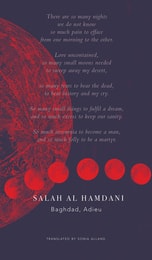
Baghdad, Adieu
Selected Poems of Memory and ExileSalah Al Hamdani
Seagull Books, 2018
This landmark collection gathers thirty-five years of his writings, from his first volume in Arabic, Memory of Embers, to his latest collection, written originally in French, For You I Dream. It offers English-language readers their first substantial overview of Al Hamdani’s work, fired by the fight against injustice and shot through with longing for the home to which he can never return.
Bait
David Albahari
Northwestern University Press, 2001

Balkan Blues
Writing Out of YugoslaviaJoanna Labon
Northwestern University Press, 1995
Contributors: Dubravka Ugrešić, Bogdan Bogdanović, Dragan Velikić, Danilo Kiš, Drago Jančar, Mirko Kovač, Goran Stefanovski, Dževad Karahasan, and Slobodan Blagojević.

Ballad of Descent
Martin Vopenka
Northwestern University Press, 1995
Basques of the American West
New and Collected Essays on History and EthnicityRichard W. Etulain
University of Nevada Press, 2026
This collection offers readers a thoughtful and engaging look at the enduring presence and influence of Basques across the cultural and historical landscape of the American West.

Battle Of Kosovo
John Matthias
Ohio University Press, 1987
The Battle of Kosovo cycle of heroic ballads is generally considered the finest work of Serbian folk poetry. Commemorating the Serbian Empire’s defeat at the hands of the Turks in the late fourteenth century, these poems and fragments have been known for centuries in Eastern Europe. With the appearance of the collections of Serbian folk poems by Vuk Stefanovic Karasdzic, the brilliance of the poetry in the Kosovo and related cycles of ballads was affirmed by poets and critics as deeply influential as Goethe, Jacob Brimm, Adam Mickiewicz, and Alexander Pushkin. Although translations into English have been attempted before, few of them, as Charles Simic notes in his preface, have been persuasive until now. Simic compares the movement of the verse in these translations to the “variable foot” effect of William Carlos Williams’s later poetry, and argues that John Matthias “grasps the poetic strategies of the anonymous Serbian poet as well as Pound did those of Chinese poetry.”
First published in 1987, the translation of the Battle of Kosovo is now reprinted both because of its intrinsic merits and because the recent crisis in Kosovo itself compels the entire world to understand the nature of the ancient conflicts and passions that fuel it. Although Matthias and Simic have elected to retain their original preface and introduction, Christopher Merrill, a scholar of the region and author of Only the Nails Remain, has contributed a brief afterword explaining the importance of this poetry in the context of NATO’s first military action ever against a sovereign nation.

Battles and Leaders of the Civil War, Volume 5
Edited by Peter Cozzens
University of Illinois Press, 2001
Indispensable must-reads for all Civil War buffs and historians, bringing together little-known and never before gathered first-hand accounts, articles, maps, and illustrations
The first four volumes of Battles and Leaders of the Civil War, published in the late nineteenth century, became the best-selling and most frequently cited works ever published on the Civil War. Volume 5, assembled by the acclaimed military historian Peter Cozzens, carries on the tradition of its namesake, offering a dazzling new collection of fresh material written by military and civilian leaders, North and South, on a broad array of war-related topics. Featured articles include General Grant on the second battle of Bull Run, General Beauregard on the Shiloh campaign, General Sherman on the conference at City Point, Joshua Chamberlain on the Fredericksburg campaign, and many more. Also presented are dozens of maps and more than one hundred illustrations.

Battles and Leaders of the Civil War, Volume 6
Edited by Peter Cozzens
University of Illinois Press, 2001
Be-Hooved
Mar Ka
University of Alaska Press, 2019
Entrancing, profound, and startling, this book is a testament to hope before change, persistence before confusion, and empathy before difference: all the world’s light and all the world’s dark / can fit into an eye into a heart.
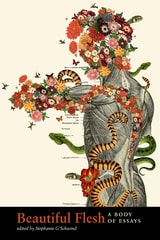
Beautiful Flesh
A Body of EssaysStephanie G'Schwind
University Press of Colorado, 2017
Selected from the country’s leading literary journals and publications—Colorado Review, Creative Nonfiction, Georgia Review, Prairie Schooner, Crazyhorse, The Normal School, and others—Beautiful Flesh gathers eighteen essays on the body, essentially building a multi-gender, multi-ethnic body out of essays, each concerning a different part of the body: belly, brain, bones, blood, ears, eyes, hair, hands, heart, lungs, nose, ovaries, pancreas, sinuses, skin, spine, teeth, and vas deferens. The title is drawn from Wendy Call’s essay “Beautiful Flesh,” a meditation on the pancreas: “gorgeously ugly, hideously beautiful: crimson globes embedded in a pinkish-tan oval, all nestled on a bed of cabbage-olive green, spun through with gossamer gold.”
Other essays include Dinty W. Moore’s “The Aquatic Ape,” in which the author explores the curious design and necessity of sinuses; Katherine E. Standefer’s “Shock to the Heart, Or: A Primer on the Practical Applications of Electricity,” a modular essay about the author’s internal cardiac defibrillator and the nature of electricity; Matt Roberts’s “Vasectomy Instruction 7,” in which the author considers the various reasons for and implications of surgically severing and sealing the vas deferens; and Peggy Shinner’s “Elective,” which examines the author’s own experience with rhinoplasty and cultural considerations of the “Jewish nose.” Echoing the myriad shapes, sizes, abilities, and types of the human body, these essays showcase the many forms of the genre: personal, memoir, lyric, braided, and so on.
Contributors: Amy Butcher, Wendy Call, Steven Church, Sarah Rose Etter, Matthew Ferrence, Hester Kaplan, Sarah K. Lenz, Lupe Linares, Jody Mace, Dinty W. Moore, Angela Pelster, Matt Roberts, Peggy Shinner, Samantha Simpson, Floyd Skloot, Danielle R. Spencer, Katherine E. Standefer, Kaitlyn Teer, Sarah Viren, Vicki Weiqi Yang

Beauty and the Beast
The Original StoryGabrielle-Suzanne Barbot de Villeneuve
Iter Press, 2020
The Other Voice in Early Modern Europe: The Toronto Series volume 74
Because the Light Will Not Forgive Me
Essays from a PoetShaun T, Griffin
University of Nevada Press, 2019
In this luminous and moving book of essays, award-winning author Shaun Griffin weaves together a poetic meditation on living meaningfully in this world. Anchored in the American West but reaching well beyond, he recounts his discoveries as a poet and devoted reader of poetry, a teacher of the disadvantaged, a friend of poets and artists, and a responsible member of the human family.
Always grounded in place, be it Nevada, South Africa, North Dakota, Spain, Zimbabwe, or Mexico, Griffin confronts the world with an openness that allows him to learn and grow from the people he meets. This is a meditation on how all of us can confront our own influences to achieve wholeness in our lives. Along with Griffin, readers will reflect on how they might respond to a homeless man walking through central Nevada, viewing the open desert as Thoreau might have viewed Walden, seeing the US-Mexico border as a region of lost identity, reconciling how poets who live west of the Hudson River find anonymity to be their laurel, and experiencing how writing poetry in prison becomes lifesaving.
Whether poets or places in the West or beyond, experiences with other cultures, or an acute awareness that poetry is the refuge of redress—all have influenced Griffin’s writing and thinking as a poet and activist in the Great Basin. The mindfulness of Because the Light Will Not Forgive Me demonstrates that even though the light does not forgive, it still reveals.

Before Mark Twain
A Sampler of Old, Old Times on the MississippiEdited by John Francis McDermott
Southern Illinois University Press, 1998
Beginner's Luck
Dispatches from the Klamath MountainsMalcolm Terence
Oregon State University Press, 2018
In the late 1960s, Malcolm Terence left his job as a reporter for the Los Angeles Times to look for adventure and may have found more than he bargained for. The era had triggered unprecedented social and political changes in America, tectonic shifts that challenged war and the social order that oppressed people along lines of class, gender, and race. One branch was a back-to-the-land movement, and Terence, who had just traveled for a year managing a rock band, strayed into Black Bear Ranch, a commune just starting in a remote corner of the Klamath Mountains near the California-Oregon border.
Black Bear Ranch still exists, but many of its early residents eventually returned to urban civilization. A few, Terence among them, stayed on in neighboring river towns. Some tried logging, others gold mining, and some tried growing marijuana, all with mixed success. The local mining and timber communities had a checkered opinion of their new hippie neighbors, as did the Native tribes, but it was the kind of place where people helped each other out, even if they didn’t always agree.
When wildfires grew large, Terence and other veterans of the commune joined the fire crews run by the US Forest Service. In between, the Black Bear expats built homesteads, planted gardens, delivered babies, and raised their children. They gradually overcame the skepticism of the locals and joined them in political battles against the use of herbicides in the forest and the Forest Service’s campaign to close all the mining claims. As in the best of organizing efforts, the organizers learned as much as they led.
Beginner’s Luck will appeal to anyone who experienced life on a commune in the 1960s–1970s or who wants to learn about this chapter in modern American history. Terence offers insight into environmental activism and the long history of conflict between resource exploitation and Native American rights without lecturing or pontificating. With wit, humor, and humility, his anecdotal essays chronicle a time and place where disparate people came together to form an unlikely community.
Behind the Red Mist
Short Fiction by Ho Anh ThaiHo Anh Thai
Northwestern University Press, 1998
Behind the Stars, More Stars
The Tagus/Disquiet Collection of New Luso-American WritingEdited by Christopher Larkosh and Oona Patrick
Tagus Press, 2019
Presenting experimental and boundary-breaking prose from women, people of color, and LGBTQ writers, Behind the Stars, More Stars imagines a more diverse and inclusive Luso-American and Portuguese-American literary scene, which has traditionally been dominated by male voices. Since its first “Writing the Luso Experience” workshops were held in 2011, Dzanc Books's Disquiet International Literary Program in Lisbon has aimed to break silences within today's Luso-American communities. Disquiet faculty Katherine Vaz and Frank X. Gaspar appear alongside up-and-coming writers from the workshops, such as Traci Brimhall, Megan Fernandes, Hugo Dos Santos, and previously unpublished women writers.
Below Grass Roots
A NovelFrank Waters
Ohio University Press, 2002
In Below Grass Roots, the second book in Frank Waters’s Pikes Peak saga, turn-of-the-century Colorado Springs is prospering with the mining boom and a growing tourist industry. Patriarch Joseph Rogier becomes ever more obsessed with the treasures of the towering mountain and tries to enlist his son-in-law Jonathan Cable in his mining schemes. Cable instead leaves for Navajo country with his young son. Rogier, convinced that new wealth lies deep within the mountain, below grass roots, sinks his mines and what remains of his fortune ever deeper into the mountain’s granite.
As in the other two novels in this semiautobiographical saga, Waters’s masterful narrative draws on his own keen perception of the human condition to bring us this compelling tale of struggle and hope in the American West.
Pike’s Peak is composed of three condensed novels: The Wild Earth’s Nobility, Below Grass Roots, and The Dust within the Rock.
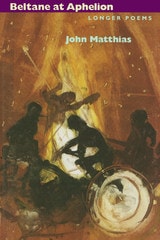
Beltane At Aphelion
Longer PoemsJohn Matthias
Ohio University Press, 1995
Beltane at Aphelion collects all of John Matthias’s longer poems and is published simultaneously with Swimming at Midnight, which collects his shorter poems. The volume includes his exuberant experiments from the 1960s, Poem in Three Parts and Bucyrus, followed by The Stefan Bathory & Mihail Lermontov Poems, his comedic diptych from the 1970s set on a Polish and a Russian ocean liner, and by Northern Summer, his meditation on history and language set in Scotland. It concludes with the three long poems first published in A Gathering of Ways which explore ancient paths and river routes in the East Anglian region of Britain and the American Midwest, and, in the most ambitious poem he has yet written, the famous pilgrim trails to Santiago de Compostela in Spain. About the books in which these poems originally appeared, critics and poets have written with enthusiasm.
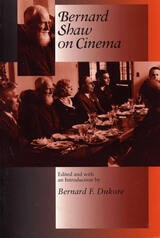
Bernard Shaw on Cinema
Edited by Bernard F. Dukore
Southern Illinois University Press, 1997
With his customary wit and quite often with remarkable prescience, Bernard Shaw maintained a dialogue on cinema that ran almost from the infancy of the industry in 1908 until his death in 1950. Bernard F. Dukore presents the first collection of Bernard Shaw’s writings and oral statements about cinema. Of the more than one hundred comments Dukore has selected, fifty-nine—more than half—are new to today’s readers. Twelve are previously unpublished, one is published in full for the first time, and forty-six appear in a collected edition of Shaw’s writings for the first time since their publication in newspapers and magazines.
Very early in the life of cinema, Shaw perceived that as an invention, movies would be more momentous than the printing press because they appealed to the illiterate as well as the literate, to the manual laborer at the end of an exhausting day as well as to the person with more leisure. He predicted that cinema would form people’s minds and shape their conduct. He recognized that cinema’s "colossal proportions make mediocrity compulsory" by leveling art and life down to the blandest morality and to the lowest common denominator of potential audiences throughout the world.
By 1908, Shaw was familiar with experiments synchronizing movies and sound. When talkies arrived, he discerned that they would precipitate major changes in acting, writing, and economics. He also saw how they would affect live theatre: "The theatre may survive as a place where people are taught to act," he said in 1930, "but apart from that there will be nothing but ‘talkies’ soon." At that time, few people in the theatrical profession were making such prophecies, at least not in public.
Better than Laughter
Mildred Boie
University of Minnesota Press, 1946
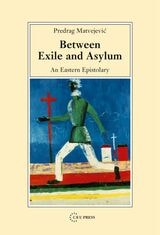
Between Exile and Asylum
An Eastern EpistolaryPredrag Matvejevic
Central European University Press, 2004
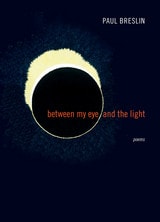
Between My Eye and the Light
PoemsPaul Breslin
Northwestern University Press, 2015
“Hole torn in the language, / How shall we speak?” The first lines of the first poem in Paul Breslin’s artful second collection of poetry demand an answer, of both poet and reader, to the seemingly unspeakable tragedies of modern life. Between My Eye and the Light forms a beautifully insistent exercise in the power of language to engage experiences both mundane and profound. Breslin queries far-flung corners of experience for answers, engaging childhood, his longtime home of Chicago, small moments of life, and encounters with artists such Rainer Maria Rilke and Derek Walcott. The poems even query the volume’s opening question, How shall we speak? While pat answers elude us, poetry acts as a bulwark against cliché and cynicism, strengthening those who have the courage to question and explore.
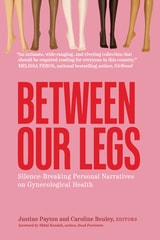
Between Our Legs
Silence-Breaking Personal Narratives on Gynecological HealthJustine Payton
University of Iowa Press, 2026
In a world where even saying the word “vagina” can feel taboo, Between Our Legs breaks the silence surrounding gynecological health. Featuring essays by award-winning authors Nina de Gramont, Nafissa Thompson-Spires, and Jessica Hendry Nelson, as well as by practicing medical experts, this collection explores topics ranging from childbirth, menopause, abortion, endometriosis, and PMOS to yeast and urinary tract infections, while contending with the shame, frustrations, and stigmas that women, nonbinary, and trans individuals navigate when searching for basic care.
Between Our Legs serves as a catalyst for difficult conversations. It illustrates the necessity of not just having access to basic gynecological care, but good, equitable, patient-centered care. Care that sees the patient as a whole person, not solely as someone capable of making a baby. As reproductive rights and maternal healthcare are stripped away in state after state, it’s urgent that our voices be heard, elevated, and addressed. The consequences for not doing so can be fatal.
Between Sea and Sahara
An Algerian JournalEugene Fromentin
Ohio University Press, 1999
Between Sea and Sahara gives us Algeria in the third decade of colonization. Written in the 1850s by the gifted painter and extraordinary writer Eugene Fromentin, the many-faceted work is travelogue, fiction, stylized memoir, and essay on art. Fromentin paints a compelling word picture of Algeria and its people, questioning France’s—and his own—role there. He shows French dynamism tending to arrogance, tinged with malaise, as well as the complexity of the Algerians and their canny survival tactics. In his efforts to capture the non-Western world on paper as well as on canvas, Fromentin reveals much about the roots of a colonial relationship that continues to affect the Algeria of today. He also reveals his own development as painter, writer—and human being.
Now available for the first time in English, Between Sea and Sahara appeals to today’s reader on many levels—as a story of color, romance, and dramatic tension; as an eywitness account of the colonial experience in Algeria; as a study in trans-genre text, foreshadowing Fromentin’s psychological masterpiece, the novel Dominique. And, as Valérie Orlando points out in her introduction, Fromentin opens a window on the ethos informing the fashion of Orientalism that flourished with colonialism.
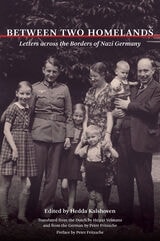
Between Two Homelands
Letters across the Borders of Nazi GermanyEdited by Hedda Kalshoven
University of Illinois Press, 2014
In 1920, at the age of thirteen, Irmgard Gebensleben first traveled from Germany to The Netherlands on a "war-children transport." She would later marry a Dutch man and live and raise her family there while keeping close to her German family and friends through the frequent exchange of letters. Yet during this period geography was not all that separated them. Increasing divergence in political opinions and eventual war between their countries meant letters contained not only family news but personal perspectives on the individual, local, and national choices that would result in the most destructive war in history.
This important collection, first assembled by Irmgard Gebensleben's daughter Hedda Kalshoven, gives voice to ordinary Germans in the Weimar Republic and the Third Reich and in the occupied Netherlands. The correspondence between Irmgard, her friends, and four generations of her family delve into their most intimate and candid thoughts and feelings about the rise of National Socialism. The responses to the German invasion and occupation of the Netherlands expose the deeply divided loyalties of the family and reveal their attempts to bridge them. Of particular value to historians, the letters evoke the writers' beliefs and their understanding of the events happening around them.
This first English translation of Ik denk zoveel aan jullie: Een briefwisseling tussen Nederland en Duitsland 1920-1949, has been edited, abridged, and annotated by Peter Fritzsche with the assent and collaboration of Hedda Kalshoven. After the book's original publication the diary of Irmgard's brother and loyal Wehrmacht soldier, Eberhard, was discovered and edited by Hedda Kalshoven. Fritzsche has drawn on this important additional source in his preface.
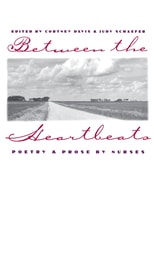
Between the Heartbeats
Poetry and Prose by NursesCortney Davis
University of Iowa Press, 1995

Beyond Borders
The Selected Essays of Mary AustinRueben J Ellis
Southern Illinois University Press, 1996
Seventeen essays by Mary Hunter Austin (1868–1934), author of the western classic The Land of Little Rain (1903), demonstrate her wide-ranging interests and equally varied writing styles.
Although she was born in Carlinville, Illinois, and graduated from Blackburn College, Mary Austin spent most of her writing career in California, New York, and finally Sante Fe, New Mexico. A well-known, popular, and prolific writer, Austin published thirty-three books and three plays and was closely associated with many important literary figures of her time, including H. G. Wells, George Bernard Shaw, Mabel Dodge Luhan, Jack London, and Willa Cather. Still best known today for her nature writing and southwestern cultural studies, Austin has been increasingly recognized for her work on feminist themes, including the play The Arrow Maker, the nonfiction The Young Woman Citizen, and the novels A Woman of Genius and No. 26 Jayne Street. What has been perhaps an overemphasis on Austin’s nature writing has, since her death, eclipsed the fact that Austin was known during her lifetime as a colorful, eccentric, and controversial person whose direct and outspoken opinions engaged a wide variety of topics.
Beyond Borders demonstrates that variety. In addition to her monographs, Austin also published her short fiction and essays in periodicals. In fact, like many a writer earning a living from her work, Austin wrote prolifically for the magazine market, producing during her career over two hundred individual pieces published in over sixty periodicals. Although a collection of her short fiction appeared in 1987, Austin’s nonfiction periodical work has remained uncollected until now.
In support of Austin’s essays, Reuben J. Ellis provides an introduction that establishes a biographical and historical context for Austin’s work. In addition, each Austin essay is prefaced by brief introductory remarks by the editor. A selected bibliography of Austin’s essays is also included.

Beyond Decadence
Exposing the Narrative Irony in Jan Opolský's ProsePeter Butler
Karolinum Press, 2015
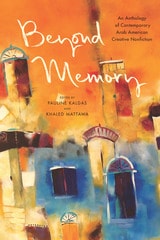
Beyond Memory
An Anthology of Contemporary Arab American Creative NonfictionPauline Kaldas
University of Arkansas Press, 2020
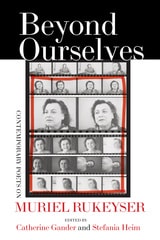
Beyond Ourselves
Contemporary Poets on Muriel RukeyserCatherine Gander
West Virginia University Press, 2026
Muriel Rukeyser has many faces: poet, biographer, theorist, playwright, novelist, story-writer, filmmaker, translator, ethnographer, and innovator of social, documentary poetics; feminist, queer, Jewish, single mother, and social justice activist. Yet above all, she was a poet. Threaded through her work, politics, and life was the conviction that poetry is an animating force that connects people and disciplines. Recent years have seen a surge of renewed interest in Rukeyser’s work, bringing her back into public consciousness as a crucial voice on the relations between poetry and social life in America and beyond.
Beyond Ourselves is the first volume of its kind to comprehensively consider the continued urgency and lasting legacy of Rukeyser’s work as a key source and inspiration for poets working today. Volume editors Catherine Gander and Stefania Heim—both scholars and poets—have gathered critical and creative contributions from some of the most innovative, exciting, and socially engaged poets writing today. In lyric and braided essays, scholarly critique, hybrid investigations, documentary collages, and collaborative poetry, these poets dive deeply into Muriel Rukeyser’s work and life to interrogate, explore, and challenge the models she provides for thinking and writing in our own social, political, and poetic moment. These essays address a range of themes, from the transhistorical politics of motherhood and contemporary relational and feminist poetics of war to communal history via documentary film and the possibilities of coalition-building beyond borders. As in Rukeyser’s own work, the forms of these texts animate their inquiries.
Beyond Ourselves is a volume at the intersections of creative and critical thought, reflecting on how Rukeyser’s expansive body of work offers a vision for, as she writes, “a kind of imagination with which to meet the world.”
Contributors: Daniel Borzutzky, Susan Briante, Catherine Gander, Stacy Hardy, Stefania Heim, Erika Meitner, Philip Metres, Jena Osman, Deborah Paredez, Khadijah Queen, Solmaz Sharif, and Nomi Stone.

Beyond the Archipelago
Selected PoemsMuhammad Haji Salleh
Ohio University Press, 1994
A collections of 70 poems from one of Malaya’s leading poets, that depict longing, loneliness, modernization, and insights in Malaysian culture.
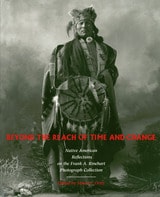
Beyond the Reach of Time and Change
Native American Reflections on the Frank A. Rinehart Photograph CollectionEdited by Simon J. Ortiz
University of Arizona Press, 2004
This book provides an unusual perspective on the Rinehart collection. It features one hundred outstanding images printed from the original negatives made by Rinehart and Muhr at the Congress and over the course of the next two years. It also includes 14 essays by modern Native American writers, artists, and educators—some of them descendants of the individuals photographed—reflecting on the place of these images in their heritage.
Beyond the Reach of Time and Change is not another coffee-table book of historical Indian photographs but rather a conversation between Indian people of a century ago and today. Just as the Rinehart collection offers today's Native Americans a unique connection to the past, this book offers all readers a positive understanding of continuity and endurance within the American Indian community.

Bill Clinton on Stump, State, and Stage
The Rhetorical Road to the White HouseStephen A. Smith
University of Arkansas Press, 1994
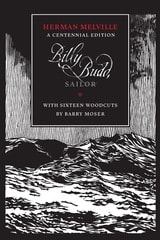
Billy Budd, Sailor (An Inside Narrative)
Herman Melville, Illustrated by Barry Moser
University of Chicago Press, 2025
An illustrated edition of Billy Budd featuring woodcuts by celebrated artist Barry Moser.
This edition of Billy Budd, Sailor presents Herman Melville’s iconic tale of the high seas alongside illustrations by renowned artist, publisher, and printmaker Barry Moser.
Throughout his fifty-year career, Moser has illustrated more than three hundred books ranging from novels to children’s stories to the Bible. Through his Pennyroyal Press, Moser designs and prints fine-press, illustrated, and occasionally oversized books in very limited editions, which are beloved by collectors and bibliophiles. To coincide with the centenary of the novella’s posthumous publication, Moser created sixteen original woodcuts illustrating the scenes and characters of Billy Budd, Sailor, and this trade edition now makes these exquisite illustrations accessible to a wide audience.
This illustrated edition adapts the text of the critical edition of the novella prepared for the Melville Electronic Library by John Bryant, Wyn Kelley, and Christopher Ohge.
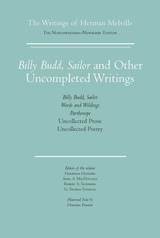
Billy Budd, Sailor and Other Uncompleted Writings
The Writings of Herman Melville, Volume 13Herman Melville; Historical Note by Hershel Parker
Northwestern University Press, 2017
These unfinished writings include, besides Billy Budd, two projected volumes containing poems and prose pieces, Weeds and Wildings and Parthenope; three prose pieces, “Rammon,” “Story of Daniel Orme,” and “Under the Rose”; and some three dozen poems of varying lengths. Some of these pieces were surely composed late in Melville’s career, during his retirement, but others may date to as early as the 1850s. Except for Billy Budd, many of these works have not been readily available in reliable texts, when available at all.
This volume, the result of the editors’ meticulous study of the manuscripts, offers new reading texts, with significant corrections of words, phrases, and titles, the inclusion of heretofore unpublished lines of verse, and the return to their original locations of the two poems, “The Enviable Isles” and “Pausilippo,” that Melville had extracted for use in John Marr (1888) and Timoleon (1891). Hershel Parker’s Historical Note traces how these writings fit into the trajectory of Melville’s career, and the rest of the Editorial Appendix presents the scholarly evidence and decisions made in creating the reading texts. As a whole, the Northwestern-Newberry Edition of The Writings of Herman Melville, now complete in fifteen volumes, offers for the first time the total body of Melville’s extant writings in a critical text, faithful to his intentions.
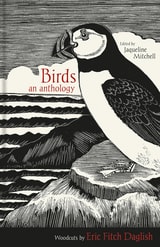
Birds
An AnthologyEdited by Jaqueline Mitchell
Bodleian Library Publishing, 2020
Birth
A Literary CompanionKristin & Lynne Kovacic & Barrett
University of Iowa Press, 2002
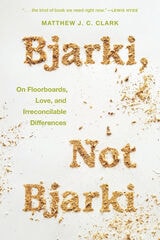
Bjarki, Not Bjarki
On Floorboards, Love, and Irreconcilable DifferencesMatthew J. C. Clark
University of Iowa Press, 2023
These are the words of Bjarki Thor Gunnarsson, the young man who manufactures the widest, purest, most metaphorical pine floorboards on the planet.
As Matthew Clark—a carpenter by trade—begins researching a magazine-style essay about Bjarki and his American Dream Boards, he comes to discover that nothing is quite as it seems. Santa Claus arrives by helicopter. A wedding diamond disappears. A dead coyote jumps to its feet. And then, at a Thai restaurant in central Maine, Bjarki is transformed into an eggplant.
In Bjarki, Not Bjarki, Clark wants nothing less than to understand everything, to make the world a better place, for you and him to love each other, and to be okay. He desires all of this sincerely, desperately even, and at the same time he proceeds with a light heart, playfully, with humor and awe. As Clark reports on the people and processes that transform the forest into your floor, he also ruminates on gift cards, crab rangoon, and Jean Claude Van Damme. He considers North American colonization, masculinity, the definition of disgusting, his own uncertain certainty. When the boards beneath our feet are so unstable, always expanding and cupping and contracting, how can we make sense of the world? What does it mean to know another person and to connect with them, especially in an increasingly polarized America?
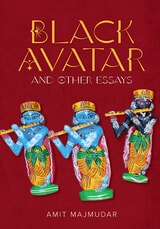
Black Avatar
and Other EssaysAmit Majmudar
Acre Books, 2023
The eight pieces in this deeply engaging volume reflect author Amit Majmudar’s comprehensive studies of American, European, and Indian traditions, as well as his experiences in both suburban Ohio and the western Indian state of Gujarat. The volume begins with the title piece, a fifteen-part examination of “How Colorism Came to India.” Tracing the evolution of India’s bias in favor of light skin, Majmudar reflects on the effects of colonialism, drawing upon sources ranging from early Sanskrit texts to contemporary film and television.
Other essays illuminate subjects both timely and timeless. “The Ramayana and the Birth of Poetry” discusses how suffering is portrayed in art and literature (“The spectrum of suffering: slapstick on one end, scripture on the other, with fiction and poetry . . . in the vastness between them”), while in “Five Famous Asian War Photographs”—a 2018 Best American Essays selection—Majmudar analyzes why these iconic images of atrocity have such emotional resonance. In “Nature/Worship,” another multi-part piece, the author turns his attention to climate change, linking notions of environmentalism to his ancestral tradition of finding divinity within the natural world, connections that form the basis of religious belief.
Perhaps the greatest achievement of these wide-ranging essays is the prose itself—learned yet lively, erudite yet accessible—nimbly revealing the workings of a wonderfully original mind.
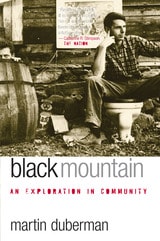
Black Mountain
An Exploration in CommunityMartin Duberman
Northwestern University Press, 2009
With faculty and alumni that included John Cage, Robert Creeley, Merce Cunningham, Buckminster Fuller, Charles Olson, Josef and Anni Albers, Paul Goodman, and Robert Rauschenberg, Black Mountain College ranked among the most important artistic and intellectual communities of the twentieth century. In his groundbreaking history, Martin Duberman uses interviews, anecdotes, and research to depict the relationships that made Black Mountain College what it was. Black Mountain documents the college’s twenty-three-year tenure, from its most brilliant moments of self-reinvention to its lowest moments of petty infighting. It records the financial difficulties that beleaguered the community throughout its existence and the determination it took to keep the college in operation. Duberman creates a nuanced portrait of this community so essential to the development of American arts and counterculture.
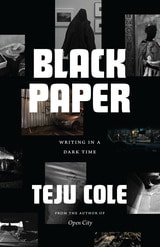
Black Paper
Writing in a Dark TimeTeju Cole
University of Chicago Press, 2021
“Darkness is not empty,” writes Teju Cole in Black Paper, a book that meditates on what it means to sustain our humanity—and witness the humanity of others—in a time of darkness. One of the most celebrated essayists of his generation, Cole here plays variations on the essay form, modeling ways to attend to experience—not just to take in but to think critically about what we sense and what we don’t.
Wide-ranging but thematically unified, the essays address ethical questions about what it means to be human and what it means to bear witness, recognizing how our individual present is informed by a collective past. Cole’s writings in Black Paper approach the fractured moment of our history through a constellation of interrelated concerns: confrontation with unsettling art, elegies both public and private, the defense of writing in a time of political upheaval, the role of the color black in the visual arts, the use of shadow in photography, and the links between literature and activism. Throughout, Cole gives us intriguing new ways of thinking about blackness and its numerous connotations. As he describes the carbon-copy process in his epilogue: “Writing on the top white sheet would transfer the carbon from the black paper onto the bottom white sheet. Black transported the meaning.”
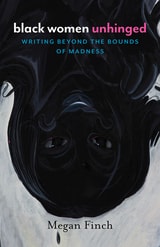
Black Women Unhinged
Writing Beyond the Bounds of MadnessMegan Finch
University of Minnesota Press, 2027
Rethinking the theoretical and political deployment of madness in the late twentieth century through the critical work of black women novelists
Black Women Unhinged revisits the “black women’s literary renaissance” to offer new terms at the intersection of gender, race, and madness before and beyond its crystallization into discourses of mental health and disability. Reconstructing the cultural zeitgeist of the 1960s–1980s, when madness emerged as a radical position in the work of Michel Foucault, Gilles Deleuze, Luce Irigaray, and David Cooper, and in the politics of feminists and Black Power activists, Black Women Unhinged reassesses black women’s overlooked contributions to this politics of madness. Megan Finch reads this renaissance’s catalogue of ostensibly mad literary characters—schizophrenic girls, infanticidal and drug-addicted mothers, castrating murderesses, and suicidal revolutionaries—beyond madness’s philosophical and political bounds.
Centering the relationship between Reason and the multiple forms of unReason central to modern politics, Finch traces the deployment of madness by the Black Power/Art’s movements and second-wave feminists to fortify black men’s and white women’s civic inclusion while dismissing black women’s politics as irremediable folly. Finch argues that black women’s novels of the period—including Toni Morrison’s The Bluest Eye and Beloved, Gayl Jones’s Corregidora and Eva’s Man, Toni Cade Bambara’s The Salt Eaters, and Nettie Jones’s Fish Tales—depict characters who exceed the category of madness and are unhinged from the curative politics of inclusion purchased through another’s abjection. Black Women Unhinged reckons with black women’s literary and theoretical contributions to the politics of madness and their attempts, past and present, to move beyond them to something akin to freedom.
Retail e-book files for this title are screen-reader friendly.
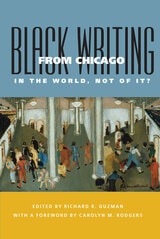
Black Writing from Chicago
In the World, Not of It?Edited by Richard R. Guzman. Foreword by Carolyn M. Rodgers
Southern Illinois University Press, 2006
Black Writing from Chicago: In the World, Not of It? takes readers on a cultural trip through Chicago’s literary history. Editor Richard R. Guzman compiles the first comprehensive collection of the works of Chicago’s black writers from 1861 to the present day. The anthology, which includes works from newspaper writing, poetry, fiction, drama, essays, and historical and social commentary, seeks not only to represent a broad range of writings but also to focus tightly on such themes as hope and despair, racism and equality, spirituality and religion. More than sixty writers, from the anonymous “J. W. M. (Colored)” to Ken Green, unfold a story that reflects the literary periods in black American history. Each author’s selection is preceded by a biographical and a bibliographical introduction. Readers interested in Chicago, race relations, and literature, as well as scholars of history, sociology, urban studies, and cultural studies, will find the collection invaluable.
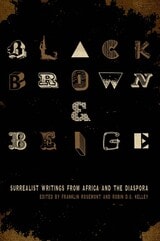
Black, Brown, & Beige
Surrealist Writings from Africa and the DiasporaEdited by Franklin Rosemont and Robin D.G. Kelley
University of Texas Press, 2009
Surrealism as a movement has always resisted the efforts of critics to confine it to any static definition—surrealists themselves have always preferred to speak of it in terms of dynamics, dialectics, goals, and struggles. Accordingly, surrealist groups have always encouraged and exemplified the widest diversity—from its start the movement was emphatically opposed to racism and colonialism, and it embraced thinkers from every race and nation.
Yet in the vast critical literature on surrealism, all but a few black poets have been invisible. Academic histories and anthologies typically, but very wrongly, persist in conveying surrealism as an all-white movement, like other "artistic schools" of European origin. In glaring contrast, the many publications of the international surrealist movement have regularly featured texts and reproductions of works by comrades from Martinique, Haiti, Cuba, Puerto Rico, South America, the United States, and other lands. Some of these publications are readily available to researchers; others are not, and a few fall outside academia's narrow definition of surrealism.
This collection is the first to document the extensive participation of people of African descent in the international surrealist movement over the past seventy-five years. Editors Franklin Rosemont and Robin D. G. Kelley aim to introduce readers to the black, brown, and beige surrealists of the world—to provide sketches of their overlooked lives and deeds as well as their important place in history, especially the history of surrealism.