Results by title
5448 books match the query 'History and criticism' and 252 start with b
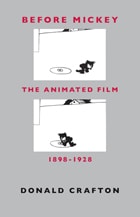
Before Mickey
The Animated Film 1898-1928Donald Crafton
University of Chicago Press, 1993
This witty and fascinating study reminds us that there was animation before Disney: about thirty years of creativity and experimentation flourishing in such extraordinary work as Gertiethe Dinosaur and Felix the Cat. Before Mickey, the first in-depth history of animation from the turn of the century until the debut of Disney, includes accounts of mechanical ingenuity, marketing, and art. Donald Crafton is equally adept at explaining techniques of sketching and camera work, evoking characteristic styles of such pioneering animators as Winsor McCay and Ladislas Starevitch, placing work in its social and economic context, and unraveling the aesthetic impact of specific cartoons.
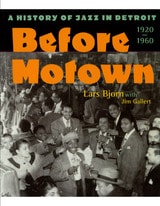
Before Motown
A History of Jazz in Detroit, 1920-60Lars Bjorn with Jim Gallert
University of Michigan Press, 2001
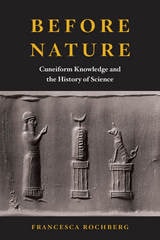
Before Nature
Cuneiform Knowledge and the History of ScienceFrancesca Rochberg
University of Chicago Press, 2016
Before the concept of nature formed over the long history of European philosophy and science, our ancestors in ancient Assyria and Babylonia developed an inquiry into the world in a way that is kindred to our modern science. With Before Nature, Francesca Rochberg explores that Assyro-Babylonian knowledge tradition and shows how it relates to the entire history of science. From a modern, Western perspective, a world not conceived somehow within the framework of physical nature is difficult—if not impossible—to imagine. Yet, as Rochberg lays out, ancient investigations of regularity and irregularity, norms and anomalies clearly established an axis of knowledge between the knower and an intelligible, ordered world. Rochberg is the first scholar to make a case for how exactly we can understand cuneiform knowledge, observation, prediction, and explanation in relation to science—without recourse to later ideas of nature. Systematically examining the whole of Mesopotamian science with a distinctive historical and methodological approach, Before Nature will open up surprising new pathways for studying the history of science.
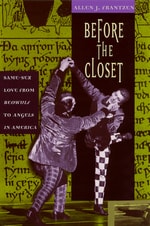
Before the Closet
Same-Sex Love from "Beowulf" to "Angels in America"Allen J. Frantzen
University of Chicago Press, 1998
With its ambitious scope and elegant style, Before the Closet sets same-sex relations in Anglo-Saxon sources in relation to the sexual themes of contemporary opera, dance, and theatre. Frantzen offers a comprehensive analysis of sources from the seventh to the twelfth century and traces Anglo-Saxon same-sex behavior through the age of Chaucer and into the Renaissance.
"Frantzen's marvelous book . . . opens up a world most readers will never have even known was there. It's a difficult topic, but Frantzen's comprehensive, readable and even wryly funny treatment makes this an unexpected pleasure."—Publishers Weekly, starred review
Before the Global South
Unthinking Medieval PoetryMarisa Galvez
University of Chicago Press, 2026
A bold approach to the work of contemporary, Indigenous, and other emergent artists as revisionist adaptations of medieval lyric poetry.
In this book, Marisa Galvez gathers an eclectic array of contemporary poets, artists, writers, and translators—from Brazilian poet Augusto de Campos and Irish painter Louis le Brocquy, to Occitanists Gérard Zuchetto and Jean-Louis Séverac, to Martinican writer Édouard Glissant, poet Rosanna Warren, and essayist Eliot Weinberg—to explore how they reimagine medieval European lyric forms. Galvez calls these adaptations unthought medievalism, and in Before the Global South, she argues that we should understand them as a mode of inquiry that is at once scholarly, critical, and creative. In these modern innovations, Galvez finds an expression of the medieval that challenges popular and scholarly dogmas alike, one she believes can inspire us to create a more shared, global world.

Behind the Burnt Cork Mask
Early Blackface Minstrelsy and Antebellum American Popular CultureWilliam J. Mahar
University of Illinois Press, 1999
The songs, dances, jokes, parodies, spoofs, and skits of blackface groups such as the Virginia Minstrels and Buckley's Serenaders became wildly popular in antebellum America. Drawing on an unprecedented archival study of playbills, newspapers, sketches, monologues, and music, William J. Mahar explores the racist practices of minstrel entertainers and considers their performances as troubled representations of ethnicity, class, gender, and culture in the nineteenth century.
Mahar investigates the relationships between blackface comedy and other Western genres and traditions; between the music of minstrel shows and its European sources; and between "popular" and "elite" constructions of culture. Locating minstrel performances within their complex sites of production, Mahar reassesses the historiography of the field.
Behind the Lines
War Resistance Poetry on the American Home Front since 1941Philip Metres
University of Iowa Press, 2007
Behind the Lines investigates American war resistance poetry from the Second World War through the Iraq wars. Rather than simply chronicling the genre, Philip Metres argues that this poetry gets to the heart of who is authorized to speak about war and how it can be represented. As such, he explores a largely neglected area of scholarship: the poet’s relationship to dissenting political movements and the nation.
In his elegant study, Metres examines the ways in which war resistance is registered not only in terms of its content but also at the level of the lyric. He proposes that protest poetry constitutes a subgenre that—by virtue of its preoccupation with politics, history, and trauma—probes the limits of American lyric poetry. Thus, war resistance poetry—and the role of what Shelley calls unacknowledged legislators—is a crucial, though largely unexamined, body of writing that stands at the center of dissident political movements.
Behold an Animal
Four Exorbitant ReadingsThangam Ravindranathan
Northwestern University Press, 2019
As animals recede from our world, what tale is being told by literature’s creatures? Behold an Animal: Four Exorbitant Readings examines incongruous animals in the works of four major contemporary French writers: an airborne horse in a novel by Jean-Philippe Toussaint, extinct orangutans in Éric Chevillard, stray dogs in Marie NDiaye, vanishing (bits of) hedgehogs in Marie Darrieussecq. Resisting naturalist assumptions that an animal in a story is simply—literally or metaphorically—an animal, Thangam Ravindranathan understands it rather as the location of something missing. The animal is a lure: an unfinished figure fleeing the frame, crossing bounds of period, genre, even medium and language. Its flight traces an exorbitant (self-)portrait in which thinking admits to its commerce with life and flesh. It is in its animals, at the same time unbearably real and exquisitely unreal, that literature may today be closest to philosophy.
This book’s primary focus is the contemporary French novel and continental philosophy. In addition to Toussaint, Chevillard, NDiaye, and Darrieussecq, it engages the work of Jean de La Fontaine, Eadweard Muybridge, Edgar Allan Poe, Lewis Carroll, Samuel Beckett, and Francis Ponge.
Beholding Disability in Renaissance England
Allison P. Hobgood
University of Michigan Press, 2021
Beholding Disability also uncovers crucial counterdiscourses circulating in the English Renaissance that opposed cultural fantasies of ability and had a keen sensibility toward non-normative embodiments. Hobgood reads impairments as varied as epilepsy, stuttering, disfigurement, deafness, chronic pain, blindness, and castration in order to understand not just powerful fictions of ability present during the Renaissance but also the somewhat paradoxical, surprising ways these ableist ideals provided creative fodder for many Renaissance writers and thinkers. Ultimately, Beholding Disability asks us to reconsider what we think we know about being human both in early modernity, and today.

Being a Minor Writer
Gail Gilliland
University of Iowa Press, 1994
There are countless theoretical arguments that attempt to define “major” and “minor” literatures, but this lively and deeply felt work is one of the first to speak from the authority of the experience of being minor—of being the “minor writer” who, according to the definition of “author” given by Michel Foucault, does not possess a “name.” This book, then, is an impassioned critical and ethical defense of the act of writing for purposes other than critical acclaim.
In the tradition of Horace's
Ars Poetica,Gilliland uses comments by a broad range of writers, as well as her own experience as a minor woman writer, to consider the basic Horatian questions of purpose, choice of subject matter and genre, diction, characterization, setting, and style. She points out that in the absence of major recognition, the minor writer is continually confronted by the existential question, why do I (still) write? This book offers not only a challenge to existing critical theories but an argument in favor of being—for
stillbeing, for continuing
anywaywith one's life and art
Belated Modernity and Aesthetic Culture
Inventing National LiteratureGregory Jusdanis
University of Minnesota Press, 1991
How does literature function in the formation of a nation-state? What are its pivotal contributions to national discourse and the production of ideological collective will? And, ultimately, how is literature institutionalized and aestheticized?
Belated Modernity and Aesthetic Culture: Inventing National Literature addresses these questions and considers the role literature plays in the construction of a national cultural. Gregory Jusdanis examines the emergence of art and literature in Western Europe in the eighteenth century and traces their introduction to Greece, a stratified, noncapitalist society that was hostile to Enlightenment and secularism. This groundbreaking work explores the importation of national literatures into a largely non-Western society and the inherent resistance they faced.Arguing for the literary status of national culture at its inception, Jusdanis brilliantly demonstrates that in literature, the specific meanings in narratives and fiction form the process of nation building. Culture, history, and literature, he says, merge in those narratives, which in turn provide the imaginary mirror in which a nation reflects itself.
Beleaguered Poets and Leftist Critics
Stevens, Cummings, Frost, and Williams in the 1930sMilton A. Cohen
University of Alabama Press, 2011
A critical examination of modernist poetry and the demands of leftist literary theory.
Different as they were as poets, Wallace Stevens, E. E. Cummings, Robert Frost, and William Carlos Williams grappled with the highly charged literary politics of the 1930s in comparable ways. As other writers moved sharply to the Left, and as leftist critics promulgated a proletarian aesthetics, these modernist poets keenly felt the pressure of the times and politicized literary scene. All four poets saw their reputations critically challenged in these years and felt compelled to respond to the new politics, literary and national, in distinct ways, ranging from rejection to involvement.
Beleaguered Poets and Leftist Critics closely examines the dynamics of these responses: what these four poets wrote—in letters, essays, lectures, fiction (for Williams), and most importantly, in their poems; what they believed politically and aesthetically; how critics, particularly leftist critics, reviewed their work; how these poets reacted to that criticism and to the broader milieu of leftism. Each poet’s response and its subsequent impact on his poetic output is a unique case study of the conflicting demands of art and politics in a time of great social change.
Believable Impossibilities
Race, Testimony, and the Horror FilmChristopher Bracken
University of Chicago Press, 2026
A gripping exploration of belief in the impossible through horror film, informed by philosophy, history, and anthropology.
What if aliens crash-landed at an old mine? What if you discovered your spouse is protecting you from witchcraft? What if you received messages from the dead? You wouldn’t believe it, of course—but you might investigate. As Christopher Bracken shows through this gripping exploration of the horror film, this is the first step toward believing the impossible.
In Believable Impossibilities, Bracken examines the genre in which we are most frequently called on to believe something seemingly impossible has unsettled our ordinary lives—the horror story. Whether on the page or on screen, horror draws us into narratives in which a community of nonbelievers are suddenly confronted with the challenge of believing in events and experiences that radically break with expectation. As Bracken argues, questions of belief often intersect with issues of race and Indigeneity because, historically, belief in the impossible has been racially coded as a trait of “primitive” thought. Drawing on philosophy, anthropology, and psychoanalysis, Bracken explores the fictional spaces in which the paranormal and supernatural challenge and defy our social bonds.

Beneath Missouri Skies
Pat Metheny in Kansas City, 1964-1972Carolyn Glenn Brewer
University of North Texas Press, 2021
Beowulf and the Grendel-Kin
Politics and Poetry in Eleventh-Century EnglandHelen Damico
West Virginia University Press, 2014
In Beowulf and the Grendel-kin: Politics and Poetry in Eleventh-Century England, Helen Damico presents the first concentrated discussion of the initiatory two-thirds of Beowulf’s 3,182 lines in the context of the sociopolitically turbulent years that composed the first half of the eleventh century in Anglo-Danish England.
Damico offers incisive arguments that major historical events and personages pertaining to the reign of Cnut and those of his sons recorded in the Anglo-Saxon Chronicle, the Encomium Emmae Reginae, and major continental and Scandinavian historical texts, hold striking parallels with events and personages found in at least eight vexing narrative units, as recorded by Scribe A in BL, Cotton Vitellius A.xv, that make up the poem’s quasi sixth-century narrative concerning the fall of the legendary Scyldings.
Given the poet’s compositional skill—widely relational and eclectic at its core—and his affinity with the practicing skalds, these strings of parallelisms could scarcely have been coincidental. Rather, Damico argues that examined within the context of other eleventh-century texts that either bemoaned or darkly satirized or obversely celebrated the rise of the Anglo-Danish realm, the Beowulfian units may bring forth a deeper understanding of the complexity of the poet’s compositional process.
Damico illustrates the poet’s use of the tools of his trade—compression, substitution, skillful encoding of character—to reinterpret and transform grave sociopolitical “facts” of history, to produce what may be characterized as a type of historical allegory, whereby two parallel narratives, one literal and another veiled are simultaneously operative.
Beowulf and the Grendel-Kin lays out the story of Beowulf, not as a monster narrative nor a folklorish nor solely a legendary tale, but rather as a poem of its time, a historical allegory coping with and reconfiguring sociopolitical events of the first half of eleventh-century Anglo-Saxon England.
Bergson and Russian Modernism
1900-1930Hilary L. Fink
Northwestern University Press, 2012
Beside You in Time
Sense Methods and Queer Sociabilities in the American Nineteenth CenturyElizabeth Freeman
Duke University Press, 2019
Beside the Bard
Scottish Lowland Poetry in the Age of BurnsGeorge S. Christian
Bucknell University Press, 2020
Published by Bucknell University Press. Distributed worldwide by Rutgers University Press.
Between Human and Divine
The Catholic Vision in Contemporary LiteratureMary Reichardt
Catholic University of America Press, 2010
Between Market and Myth
The Spanish Artist Novel in the Post-Transition, 1992-2014Katie J. Vater
Bucknell University Press, 2020
Published by Bucknell University Press. Distributed worldwide by Rutgers University Press.
Between Montmartre and the Mudd Club
Popular Music and the Avant-GardeBernard Gendron
University of Chicago Press, 2002
When and how did popular music earn so much cultural capital? To find out, Bernard Gendron investigates five key historical moments when popular music and avant-garde art transgressed the rigid boundaries separating high and low culture to form friendly alliances. He begins at the end of the nineteenth century in Paris's Montmartre district, where cabarets showcased popular music alongside poetry readings in spaces decorated with modernist art works. Two decades later, Parisian poets and musicians "slumming" in jazz clubs assimilated jazz's aesthetics in their performances and compositions. In the bebop revolution in mid-1940s America, jazz returned the compliment by absorbing modernist devices and postures, in effect transforming itself into an avant-garde art form. Mid-1960s rock music, under the leadership of the Beatles, went from being reviled as vulgar music to being acclaimed as a cutting-edge art form. Finally, Gendron takes us to the Mudd Club in the late 1970s, where New York punk and new wave rockers were setting the aesthetic agenda for a new generation of artists.
Between Montmartre and the Mudd Club should be on the shelves of anyone interested in the intersections between high and low culture, art and music, or history and aesthetics.
Between Pen and Pixel
Comics, Materiality, and the Book of the FutureAaron Jacob Kashtan
The Ohio State University Press, 2018
In Between Pen and Pixel: Comics, Materiality, and the Book of the Future, Aaron Kashtan argues that paying attention to comics helps us understand the future of the book. Debates over the future of the book tend to focus on text-based literature, particularly fiction. However, because comics make the effects of materiality visible, they offer a clearer demonstration than prose fiction of how the rise of digital reading platforms transforms the reading experience. Comics help us see the effects of alterations in features such as publication design and typography, whereas in print literature, such transformations often go unnoticed.
With case studies of the work of Alison Bechdel, Matt Kindt, Lynda Barry, Carla Speed McNeil, Chris Ware, and Randall Munroe, Kashtan examines print comics that critique digital technology, comics that are remediated from print to digital and vice versa, and comics that combine print and digital functionality. Kashtan argues that comics are adapting to the rise of digital reading technologies more effectively than print literature has yet done. Therefore, looking at comics gives us a preview of what the future of the book looks like. Ultimately, Between Pen and Pixel argues that as print literature becomes more sensitive to issues of materiality and mediacy, print books will increasingly start to resemble to comic books.
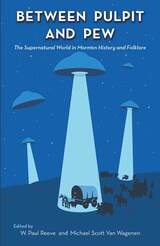
Between Pulpit and Pew
The Supernatural World in Mormon History and FolkloreW. Paul Reeve and Michael Scott Van Wagenen
Utah State University Press, 2011
Cain wanders the frontier as a Bigfoot-like hairy beast and confronts an early Mormon apostle. An evil band of murderers from Mormon scripture, known as the Gadianton robbers, provides an excuse for the failure of a desert town. Stories of children raised from the dead with decayed bodies and damaged minds help draw boundaries between the proper spheres of human and divine action. Mormons who observe UFOs in the nineteenth and twentieth centuries find ways to explain them in relation to the church’s cosmology. The millenarian dimension of that belief system induces church members to invest in the Dream Mine, a hidden treasure that a would-be heir to Joseph Smith wraps in prophecy of the end times. A Utah version of Nessie haunts a large mountain lake. Non-Mormons attempt to discredit Joseph Smith with tales that he had tried and failed to walk on water.
Mormons gave distinctive meanings to supernatural legends and events, but their narratives incorporated motifs found in many cultures. Many such historical legends and beliefs found adherents down to the present. This collection employs folklore to illuminate the cultural and religious history of a people.
Between Self and Society
Inner Worlds and Outer Limits in the British Psychological NovelBy John Rodden
University of Texas Press, 2016
Between Self and Society explores the psychosocial dramas that galvanize six major British novels written between the eighteenth and twentieth centuries. The book challenges an influential misconception that has for too long hindered appreciation of the psychological novel. John Rodden argues that there should be no simplifying antithesis between psychological, “inner” conflicts (within the mind or “soul”) and institutional, “outer” conflicts (within family, class, community). Instead, it is the overarching, dramatic—yet often tortuous—relations between self and society that demand our attention. Rodden presents fresh interpretations of an eclectic group of prose fiction classics, including Tobias Smollett’s The Adventures of Roderick Random, William Godwin’s Caleb Williams, Thomas Hardy’s The Mayor of Casterbridge, Ford Madox Ford’s The Good Soldier, Wyndham Lewis’s Tarr, and D. H. Lawrence’s Women in Love.
Far from being merely admirable experiments, let alone daring though interesting failures, these fictions are shown to possess aesthetic unity, stylistic consistency, and psychic force. Between Self and Society thus impels our careful reconsideration of novels that represent major artistic achievements, yet have been either unjustly neglected or appreciated in limiting ways that do injustice to their psychological aspects. Rodden’s vibrant discussion invites an upward revaluation of these works and encourages the full recognition of their value and significance in British literary history.
Between the Lines
South Asians and Postcolonialityedited by Deepika Bahri and Mary Vasudeva
Temple University Press, 1996
This ground-breaking collection of new interviews, critical essays, and commentary explores South Asian identity and culture. Sensitive to the false homogeneity implied by "South Asian," "diaspora," "postcolonial," and "Asian American," the contributors attempt to unpack these terms. By examining the social, economic, and historical particularities of people who live "between the lines"—on and between borders—they reinstate questions of power and privilege, agency and resistance. As South Asians living in the United States and Canada, each to some degree must reflect on the interaction of the personal "I," the collective "we," and the world beyond.
The South Asian scholars gathered together in this volume speak from a variety of theoretical perspectives; in the essays and interviews that cross the boundaries of conventional academic disciplines, they engage in intense, sometimes contentious, debate.
Contributors: Meena Alexander, Gauri Viswanathan, Gayatri Chakravorty Spivak, Amritjit Singh, M. G. Vassanji, Sohail Inayatullah, Ranita Chatterjee, Benita Mehta, Sanjoy Majumder, Mahasveta Barua, Sukeshi Kamra, Samir Dayal, Pushpa Naidu Parekh, Indrani Mitra, Huma Ibrahim, Amitava Kumar, Shantanu DuttaAhmed, Uma Parameswaran.
In the series Asian American History and Culture, edited by Sucheng Chan, David Palumbo-Liu, Michael Omi, K. Scott Wong, and Linda Trinh Võ.
Beyond Human
Vital Materialisms in the Andean Avant-GardesDaly, Tara
Bucknell University Press, 2019
Published by Bucknell University Press. Distributed worldwide by Rutgers University Press.
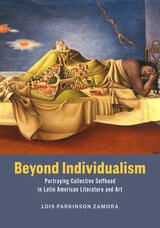
Beyond Individualism
Portraying Collective Selfhood in Latin American Literature and ArtLois Parkinson Zamora
University of Chicago Press, 2025
Beyond Individualism examines the portrayal of collective identities over two centuries in Latin American literature and visual art. Lois Parkinson Zamora shows that many authors and artists are less concerned with singular selves than with selves-in-relation: less with individual autonomy than with communal affiliation. Their works—sometimes situated under the labels Neobaroque, magical realism, Surrealism, Expressionism, and idealism—resist the kind of psychological realism typical of European and North American novels, moving instead toward a wholly new kind of fiction.
Zamora calls this new Latin American form “archetypal realism” because its characters represent entities larger than themselves. They may embody entire communities, cultures, families, religious orders, or ideal planets. Through deft readings of collective characters in fiction by Gabriel García Márquez, Isabel Allende, Jorge Luis Borges, and more alongside the art of Diego Rivera, Remedios Varo, and Xul Solar, Zamora reveals a modernity based not on Enlightenment conceptions of selfhood but on community, collectivity, and kinship.
Beyond Innocence, or the Altersroman in Modern Fiction
Linda A. Westervelt
University of Missouri Press, 1997
In this groundbreaking work, Linda A. Westervelt defines an important yet previously unidentified and therefore unnamed type of novel, the altersroman, or age novel. Fictions focusing on a protagonist's confrontation with mortality toward the end of middle age are likely to become ever more prominent in a Western world in which the average age of the population increases and more people reach late middle age and old age.
Working from a diverse sample of modern literature, Westervelt analyzes the variety of responses to the life evaluation. Some characters achieve a level of affirmation that allows renewal, redirection, or simply peace, while others confront feelings of disgust or despair that so little time is left them. Her altersromane are books about seeking wisdom, though not everyone of this age becomes wise. The use of the term altersroman highlights the fact that the altersroman is a classification comparable to but also clearly distinguishable from the bildungsroman, wherein characters make the transition from youth to adulthood. Westervelt contrasts her older protagonists' characteristics with the equivalent characteristics in the bildungsroman through an examination of Don Quixote, part 2, as well as six American novels: The Ambassadors, by Henry James; The Professor's House, by Willa Cather; The Mansion, by William Faulkner; The Angle of Repose, by Wallace Stegner; A Book of Common Prayer, by Joan Didion; and Jazz, by Toni Morrison. These seven works, though remarkably different, share the common features of the altersroman. Westervelt articulates the traits clearly, rests them on the psychological literature, and then shows in depth how the characteristics of the altersroman can enrich and more deeply inform our reading of a significant subset of modern literature that previously went unheralded. Readers can use Westervelt's analysis to identify altersromane in literature other than their own, and she begins this process by identifying exemplars written in other languages.
Beyond Innocence, or the Altersroman in Modern Fiction introduces readers to the altersroman as a tool for classification and analysis and demonstrates the power and utility of that tool. It offers a meaningful and enriching complement to the more established category of the bildungsroman.
Beyond Practical Virtue
A Defense of Liberal Democracy through LiteratureJoel A. Johnson
University of Missouri Press, 2007
Why hasn’t democracy been embraced worldwide as the best form of government?
Aesthetic critics of democracy such as Carlyle and Nietzsche have argued that modern democracy, by removing the hierarchical institutions that once elevated society’s character, turns citizens into bland, mediocre souls. Joel A. Johnson now offers a rebuttal to these critics, drawing surprising inspiration from American literary classics.
Addressing the question from a new perspective, Johnson takes a fresh look at the worth of liberal democracy in these uncertain times and tackles head-on the thorny question of cultural development. Examining the novels of James Fenimore Cooper, Mark Twain, and William Dean Howells, he shows that through their fiction we can gain a better appreciation of the rich detail of everyday life, making the debate relevant to contemporary discussions of liberal democracy.
Johnson focuses on an issue that liberals have inadequately addressed: whether people tend to develop fully as individuals under liberal democracy when such a regime does little formally to encourage their development. He argues that, though the liberal fear of state-guided culture is well founded, it should not prevent us from evaluating liberalism’s effect on individual flourishing. By extending the debate over the worthiness of liberal democracy to include democracy’s effect on individual development, he contends that the democratic experience is much fuller than the aristocratic one and thus expands the faculties of its citizens.
Critics of American democracy such as John Rawls have sought to transform it into a social or egalitarian democracy in the European style. Johnson shows that neither the debate between Rawls and his communitarian critics nor the ongoing discussion of the globalization of American values adequately addresses the fundamental critique of democratic culture advanced by the aesthetic critics. Johnson’s cogent analysis reaches out to those readers who are ready for a more comprehensive evaluation of liberal democracy, offering new insight into the relationship between the state and the individual while blazing new trails in the intersection of politics and literature.
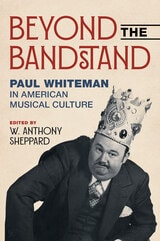
Beyond the Bandstand
Paul Whiteman in American Musical CultureEdited by W. Anthony Sheppard
University of Illinois Press, 2024
The most successful bandleader of the 1920s, Paul Whiteman was an entertainment icon who played a major role in the mainstreaming of jazz. Whiteman and his band premiered Gershwin’s Rhapsody in Blue. Duke Ellington acknowledged his achievements. His astonishing ear for talent vaulted a who’s who of artists toward prominence. But Whiteman’s oversized presence eclipsed Black jazz musicians while his middlebrow music prompted later generations to jettison him from jazz history.
W. Anthony Sheppard’s collection of essays confronts the racial implications of Whiteman’s career. The contributors explore Whiteman’s broad impact on popular culture, tracking his work and influence in American marketing, animated films, the Black press, Hollywood, and the music publication industry, and following him behind the scenes with arrangers, into grand concert halls, across the Atlantic, into the courtroom, and on television.
Multifaceted and cutting-edge, Beyond the Bandstand explores the racial politics and artistic questions surrounding a controversial figure in popular music.
Contributors: Ryan Raul Bañagale, Stephanie Doktor, John Howland, Katherine M. Leo, Sarah Caissie Provost, W. Anthony Sheppard, Catherine Tackley, Elijah Wald, and Christi Jay Wells
Beyond the Binary
Reconstructing Cultural Identity In a Multicultural ContextEdited by Timothy B. Powell
Rutgers University Press, 1999
"Beyond the Binary offers a coherently presented collection of uniformly strong essays that speak to what is perhaps the most widely discussed, contested and conflicted topic in the study of US culture. It joins the growing body of work that seeks to move beyond identity politics and racial essentialism to formulate racial identity as a more complex series of social, cultural and political gestures." -Priscilla Wald, author of Constituting Americans: Cultural Anxiety and Narrative Form and Constituting Americans
Cultural studies have reached a theoretical impasse. As scholars continue to topple the previously entrenched concept of Eurocentrism, this field has fragmented into works covering many separate cultural enclaves. In the first wave of this "post-Eurocentric" scholarship, a binary model ensued, using the designations of "Self" and "Other:" i.e., black/white, gay/straight. This model, however, also has found disfavor. As a result, recent scholarship has focused on a single group studied in isolation.
What is needed is a new critical phase of reconstruction that will bring discussion of these disparate cultural enclaves back into a more organized, critical sphere. Researchers must have the necessary conceptual tools so they can study the ways in which cultures overlap, intersect, or else violently conflict with one another.
Beyond the Binary: Reconstructing Cultural Identity in a Multicultural Context addresses this theoretical impasse by proposing new critical models that fully engage the dilemmas posed by multiculturalism. Rather than becoming entangled in the polarizing rhetoric of the culture wars, these essays are firmly grounded in the lived perplexities of specific historical moments. One piece, for example, considers the cultural identity of "freaks" exhibited in P. T. Barnum's circus, the contested place of hemophiliacs within Queer Nation, and "white" working-class musicians who proudly proclaim themselves to be "black lesbians."
Beyond the Binary is meant to be read in its entirety as a many-voiced narrative dedicated to bringing the divisions within cultural studies back into contact with one another. By doing so, Powell ushers in a new era of multicultural analysis that recognizes the historical existence of racism, yet also acknowledges the dynamic fluidity of cultural identity.
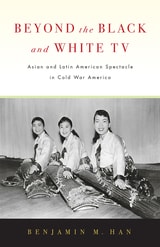
Beyond the Black and White TV
Asian and Latin American Spectacle in Cold War AmericaBenjamin M. Han
Rutgers University Press, 2020
Beyond the Classroom
Essays on American AuthorsMerton M. Sealts, Jr.
University of Missouri Press, 1996
Merton M. Sealts, Jr., a long-respected scholar and teacher of Emerson and Melville, has written, "I shall never tire of such writers, nor absorb all that they have to teach." This new collection of Sealts's essays reflects his many years of classroom experience and ongoing scholarship since his retirement in 1982. Most of these essays were originally delivered as public lectures before diverse audiences beyond the classroom; others first appeared in study pamphlets and as chapters of books.
These lucid essays, though varied in subject, have the commonality of an emphasis on teaching. The first essay, entitled "Emerson as Teacher," demonstrates how Emerson "provoked and inspired and educated his students--and his students' students."
In the most recently written essays Sealts deals with four of Emerson's contemporaries--Whitman, Thoreau, Hawthorne, and Melville--who responded variously to Emerson's teachings. A common thread among these four essays is each author's distinctive use of first-person narration.
Teachers of literature at every level will greatly benefit from these highly readable discussions, which illustrate practical strategies for reading and teaching literary works. Included in the appendixes are questions for the study of Melville's Bartleby, Benito Cereno, and Billy Budd, Sailor, which are also treated in individual essays.
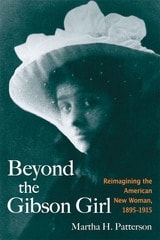
Beyond the Gibson Girl
Reimagining the American New Woman, 1895-1915Martha H. Patterson
University of Illinois Press, 2005
Challenging monolithic images of the New Woman as white, well-educated, and politically progressive, this study focuses on important regional, ethnic, and sociopolitical differences in the use of the New Woman trope at the turn of the twentieth century. Using Charles Dana Gibson's "Gibson Girls" as a point of departure, Martha H. Patterson explores how writers such as Pauline Hopkins, Margaret Murray Washington, Sui Sin Far, Mary Johnston, Edith Wharton, Ellen Glasgow, and Willa Cather challenged and redeployed the New Woman image in light of other “new” conceptions: the "New Negro Woman," the "New Ethics," the "New South," and the "New China."
As she appears in these writers' works, the New Woman both promises and threatens to effect sociopolitical change as a consumer, an instigator of evolutionary and economic development, and (for writers of color) an icon of successful assimilation into dominant Anglo-American culture. Examining a diverse array of cultural products, Patterson shows how the seemingly celebratory term of the New Woman becomes a trope not only of progressive reform, consumer power, transgressive femininity, modern energy, and modern cure, but also of racial and ethnic taxonomies, social Darwinist struggle, imperialist ambition, assimilationist pressures, and modern decay.
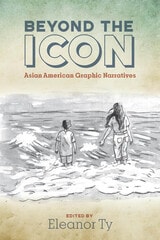
Beyond the Icon
Asian American Graphic NarrativesEdited by Eleanor Ty
The Ohio State University Press, 2022
While most US-based comics studies anthologies tend to neglect race, Beyond the Icon brings it to the foreground through an analysis of the vibrant and growing body of graphic narratives by Asian North American creators in the twenty-first century. By demonstrating how the forms and styles of the comics genre help depict Asian Americans as nuanced individuals in ways that words alone may not, Beyond the Icon makes the case for comics as a crucial artistic form in Asian American cultural production––one used to counter misrepresentations and myths, rewrite official history, and de-exoticize the Asian American experience.
An interdisciplinary team of contributors offers exciting new readings of key texts, including Ms. Marvel, George Takei’s They Called Us Enemy, Thi Bui’s The Best We Could Do, Gene Luen Yang and Sonny Liew’s The Shadow Hero, works by Adrian Tomine and Jillian Tamaki, and more, to uncover the ways in which Asian American comics authors employ graphic narratives to provide full and complex depictions of Asian diasporic subjects and intervene in the wider North American consciousness. Beyond the Icon initiates vital conversations between Asian American studies, ethnic studies, and comics.
Contributors:
Monica Chiu, Shilpa Davé, Melinda Luisa de Jesús, Lan Dong, Jin Lee, erin Khuê Ninh, Stella Oh, Jeanette Roan, Eleanor Ty
Beyond the Page
Poetry and Performance in Spanish AmericaJill S. Kuhnheim
University of Arizona Press, 2014
Jill S. Kuhnheim, looking at poetry and performance in Spanish America over time, has organized the book to begin with the early twentieth century and arrive at the present day. She includes noteworthy poets and artists such as José Martí, Luis Palés Matos, Eusebia Cosme, Nicomedes Santa Cruz, Pablo Neruda, César Vallejo, and Nicolás Guillén, as well as very recent artists whose performance work is not as well known. Offering fresh historical material and analysis, the author illuminates the relationship between popular and elite cultural activity in Spanish America and reshapes our awareness of the cultural work poetry has done in the past and may do in the future, particularly given the wide array of technological possibilities. The author takes a broad view of American cultural production and creates a dialogue with events and criticism from the United States as well as from Spanish American traditions.
Oral and written elements in poetry are complementary, says Kuhnheim, not in opposition, and they may reach different audiences. As poetry enjoys a revival with modern media, performance is part of the new platform it spans, widening the kind of audience and expanding potential meanings.
Beyond the Page will appeal to readers with an interest in poetry and performance, and in how poetry circulates beyond the page. With an international perspective and dynamic synthesis, the book offers an innovative methodology and theoretical model for humanists beyond the immediate field, reaching out to readers interested in the intersection between poetry and identity or the juncture of popular-elite and oral-written cultures.
Biblical Themes in Science Fiction
Nicole L. Tilford
SBL Press, 2023
What does a first-generation female robot have in common with the biblical figure of Eve? Or an intergenerational spaceship with Noah’s ark? If a computer compiles a deceased person’s photographs and digital activities into a virtual avatar, is that a form of resurrection? Such seemingly unlikely scenarios are common in science fiction—and science fiction writers often draw on people, places, and events from biblical texts, assuming that audiences will understand the parallels. Biblical Themes in Science Fiction is a journey from creation to apocalypse where contributors Frank Bosman, Rhonda Burnette-Bletsch, Krista N. Dalton, Tom de Bruin, James F. McGrath, Kelly J. Murphy, Steven J. Schweitzer, Jason A. Staples, Nicole L. Tilford, Christine Wenderoth, and Jackie Wyse-Rhodes trace biblical themes as they appear in contemporary science fiction, including Doctor Who, Lilith’s Brood, The Handmaid’s Tale, Battlestar Galactica, and Fallout 3. Essays are supplemented by images and key science fiction sources for diving deeper into how the Bible influenced writers and creators. An afterword considers the imaginative impulses common to both science fiction and biblical texts.
Big Ears
Listening for Gender in Jazz StudiesNichole T. Rustin and Sherrie Tucker, eds.
Duke University Press, 2008
Scholars of music, ethnomusicology, American studies, literature, anthropology, and cultural studies approach the question of gender in jazz from multiple perspectives. One contributor scrutinizes the tendency of jazz historiography to treat singing as subordinate to the predominantly male domain of instrumental music, while another reflects on her doubly inappropriate position as a female trumpet player and a white jazz musician and scholar. Other essays explore the composer George Russell’s Lydian Chromatic Concept as a critique of mid-twentieth-century discourses of embodiment, madness, and black masculinity; performances of “female hysteria” by Les Diaboliques, a feminist improvising trio; and the BBC radio broadcasts of Ivy Benson and Her Ladies’ Dance Orchestra during the Second World War. By incorporating gender analysis into jazz studies, Big Ears transforms ideas of who counts as a subject of study and even of what counts as jazz.
Contributors: Christina Baade, Jayna Brown, Farah Jasmine Griffin, Monica Hairston, Kristin McGee, Tracy McMullen, Ingrid Monson, Lara Pellegrinelli, Eric Porter, Nichole T. Rustin, Ursel Schlicht, Julie Dawn Smith, Jeffrey Taylor, Sherrie Tucker, João H. Costa Vargas
Big Feelings
Queer and Feminist Indie Rock After Riot GrrrlDan DiPiero
University of Michigan Press, 2025
By bringing listeners’ experiences into the analysis, DiPiero shows how indie rock feminisms have shifted since the 1990s, rejecting overt political messages in favor of sonic catharsis, and reflecting the complex, ambivalent feeling of being young while the world burns. In reprising the sounds of an alt-rock associated in public consciousness with white male pain, Big Feelings doubles down on the stereotypical association between femininity and emotionality to perform whole spectrums of feeling in varied states of overwhelm. In doing so, these artists draw attention to overlooked histories of women and queer musicians who have been forging indie rock all along, while also remaking how the music matters in the present.
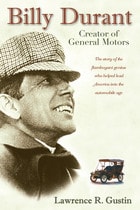
Billy Durant
Creator of General MotorsLawrence R. Gustin
University of Michigan Press, 2012
Praise for the first edition:
"A fascinating book [and] a sympathetic look at the man who glued General Motors together and in the process made Flint one of the great industrial centers of America."
---Detroit Free Press
"It is refreshing to report that Billy Durant is one of the best researched books dealing with an automotive giant."
---Antique Automobile
"Billy Durant fills in a masterly way the only important void remaining concerning the work of the motorcar pioneers."
---Richard Crabb, author of Birth of a Giant: The Men and Incidents That Gave America the Motorcar
What explains Billy Durant's powerful influence on the auto industry during its early days? And why, given Durant's impact, has he been nearly forgotten for decades?
In search of answers to these questions, Lawrence Gustin interviewed Durant's widow, who provided a wealth of previously unpublished autobiographical notes, letters, and personal papers. Gustin also interviewed two of Durant's personal secretaries and others who had known and worked with the man who created General Motors. The result is the amazing account of the mastermind behind what would become, as the twentieth century progressed, the world's largest company.
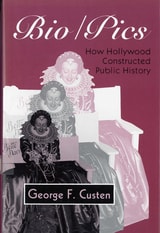
Bio/Pics
How Hollywood Constructed Public HistoryGeorge Custen
Rutgers University Press, 1992
Bio/Pics is the first comprehensive study of a once important film genre, the biographical film. Using previously unavailable archival materials from Twentieth Century-Fox, Warner Bros., MGM, and RKO studios, as well as censorship files from the Production Code Administration, George Custen argues that, through these films, Hollywood manufactured a nearly monochromatic view of history that was systematically distorted in regard to race, gender, nationality, and profession.Utilizing a carefully selected sample of over 100 films produced during the Studio Era (1927-1960), Custen maintains that the biopic constructed a Hollywood code of history out of a tightly controlled reference system, glamorizing the producers' own personal visions of what constituted a great life. Custen's examination of production practices reveals that the machinery of public history operating through these films was fueled by difference sources. His analysis of the roles played by star personae, legal considerations, censorship practices, and the producers' own ideologies brings the world of biopic alive, even into the age of the made-for-TV movie.
Biographical Passages
Essays on Victorian and Modernist BiographyEdited by Joe Law & Linda K. Hughes
University of Missouri Press, 2000
In the last two decades, biographies have grown in popularity, often eclipsing the novel in sales and accessibility to specialists and the general public alike. Widely regarded as a distinctly modern form, today's biographies are marked by their willingness to "tell all" or to pursue overt political aims. But how new, how unprecedented, are today's biographies? Biographical Passages addresses this important question by juxtaposing Victorian and Modernist biography from diverse perspectives.
Challenging the view that modern biographies are radically different from the straitlaced and ponderous Victorian tomes, Joe Law and Linda K. Hughes illustrate that continuities in biographical practice do exist, proving, for example, that the "tell-all" biography is not the exclusive preserve of the twentieth century. Enlisting the talents of such acclaimed biographers and scholars as P. N. Furbank and Michael Holroyd, Biographical Passages is a true exploration of the art and craft of biography. Essays on the usefulness of biography in approaching late Victorian artists provide a detailed scrutiny of modern biography across disciplines and from a rich array of vantage points. Additional essays on E. M. Forster and the relations between England and India analyze the role of cultural difference in biography.
Law and Hughes conclude Biographical Passages with an epilogue in tribute to a scholar whose work is closely connected to all the essays in this collection—Mary Lago. Widely known for her important contributions to studies of late Victorian and Edwardian literature, art, music, and Anglo-Indian relations, Lago is the author of biographies of Christina Herringham and E. M. Forster.
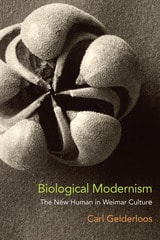
Biological Modernism
The New Human in Weimar CultureCarl Gelderloos
Northwestern University Press, 2020
Honorable Mention for the DAAD/GSA Book Prize for the Best Book in Germanistik or Cultural Studies
Biological Modernism identifies an intellectual current in the Weimar Republic that drew on biology, organicism, vitalism, and other discourses associated with living nature in order to redefine the human being for a modern, technological age. Contrary to the assumption that any turn toward the organic indicated a reactionary flight from modernity or a longing for wholeness, Carl Gelderloos shows that biology and other discourses of living nature offered a nuanced way of theorizing modernity rather than fleeing from it. Organic life, instead of representing a stabilizing sense of wholeness, by the 1920s had become a scientific, philosophical, and disciplinary problem. In their work, figures such as Alfred Döblin, Ernst Jünger, Helmuth Plessner, and August Sander interrogated the relationships between technology, nature, and the human and radically reconsidered the relationship between the disciplines as well as the epistemological and political consequences for defining the human being. Biological Modernism will be of interest to scholars of German literature and culture, literary modernism, photography, philosophical anthropology, twentieth-century intellectual history, the politics of culture, and the history of science.
Birds of Fire
Jazz, Rock, Funk, and the Creation of FusionKevin Fellezs
Duke University Press, 2011
Birth of an Industry
Blackface Minstrelsy and the Rise of American AnimationNicholas Sammond
Duke University Press, 2015
Bits and Pieces
Screening Animal Life and DeathSarah O'Brien
University of Michigan Press, 2023
Bitten by the Blues
The Alligator Records StoryBruce Iglauer and Patrick A. Roberts
University of Chicago Press, 2018
Bitten by the Blues is Iglauer’s memoir of a life immersed in the blues—and the business of the blues. No one person was present at the creation of more great contemporary blues music than Iglauer: he produced albums by Koko Taylor, Albert Collins, Professor Longhair, Johnny Winter, Lonnie Mack, Son Seals, Roy Buchanan, Shemekia Copeland, and many other major figures. In this book, Iglauer takes us behind the scenes, offering unforgettable stories of those charismatic musicians and classic sessions, delivering an intimate and unvarnished look at what it’s like to work with the greats of the blues. It’s a vivid portrait of some of the extraordinary musicians and larger-than-life personalities who brought America’s music to life in the clubs of Chicago’s South and West Sides. Bitten by the Blues is also an expansive history of half a century of blues in Chicago and around the world, tracing the blues recording business through massive transitions, as a genre of music originally created by and for black southerners adapted to an influx of white fans and musicians and found a worldwide audience.
Most of the smoky bars and packed clubs that fostered the Chicago blues scene have long since disappeared. But their soul lives on, and so does their sound. As real and audacious as the music that shaped it, Bitten by the Blues is a raucous journey through the world of Genuine Houserockin’ Music.
Bitter Music
Collected Journals, Essays, Introductions, and LibrettosHarry Partch
University of Illinois Press, 1991
Bitter Music collects writings by one of the twentieth century's great musical iconoclasts. Rejecting the equal temperament and concert traditions that have dominated western music, Harry Partch adopted the pure intervals of just intonation and devised a 43-tone-to-the-octave scale, which in turn forced him into inventing numerous musical instruments. His compositions realize his ideal of a corporeal music that unites music, dance, and theater.
Winner of the ASCAP-Deems Taylor Award, Bitter Music includes two journals kept by Partch, one while wandering the West Coast during the Depression and the other as he hiked the rugged northern California coastline. It also includes Partch's essays on and discussions of his own compositions, as well as librettos and scenarios for six major narrative/dramatic works.
Bittersweet Sounds of Passage
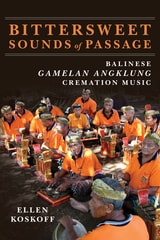
Balinese Gamelan Angklung Cremation MusicEllen Koskoff
University of Illinois Press, 2025
Koskoff examines the history, cultural significance, and musical structures of contemporary gamelan angklung cremation music through the lens of three intertwined stories: existing scholarship on this music, written mostly by Western composers and scholars; the views of those performing and experiencing the music who regard it as dharma--ritual obligation, a basic concept in Balinese Hinduism; and the music itself, with a musical analysis focusing on changes in rasa--feeling, flavor and musical flow.
A journey inside a tradition, Bittersweet Sounds of Passage reveals the overlooked music of an important ritual in Balinese village life.
Black Atlas
Geography and Flow in Nineteenth-Century African American LiteratureJudith Madera
Duke University Press, 2015