Results by title
546 books match the query 'Semiotics & Theory' and 31 start with c
Cacaphonies
The Excremental Canon of French LiteratureAnnabel L. Kim
University of Minnesota Press, 2022
Exploring why there is so much fecal matter in literary works that matter
Cacaphonies takes fecal matter and its place in literature seriously. Readers and critics have too long overlooked excrement’s vital role in the twentieth- and twenty-first-century French canon. In a stark challenge to the tendency to view this literature through sanitizing abstractions, Annabel L. Kim undertakes close readings of key authors to argue for feces as a figure of radical equality, both a literary object and a reflection on literature itself, without which literary studies is impoverished and sterile.
Following the fecal through line in works by Céline, Beckett, Genet, Sartre, Duras, and Gary and the contemporary authors Anne Garréta and Daniel Pennac, Kim shows that shit, far from vanishing from the canon after the early modern period, remains present in the modern and contemporary French literature that follows. She argues that all the shit in the canon expresses a call to democratize literature, making literature for all, just as shit is for (or of) all. She attends to its presence in this prized element of French identity, treating it as a continually uttered desire to manifest the universality France aspires to—as encapsulated by the slogan Liberté, égalité, fraternité—but fails to realize. In shit there is a concrete universalism that traverses bodies with disregard for embodied differences.
Cacaphonies reminds us that literature, and the ideas to be found therein, cannot be separated from the corporeal envelopes that create and receive them. In so doing, it reveals the aesthetic, political, and ethical potential of shit and its capacity to transform literature and life.
Calibrations
Reading For The SocialAto Quayson
University of Minnesota Press, 2003
Proposes an entirely new socially and politically conscious way of reading
Ato Quayson explores a practice of reading that oscillates rapidly between domains—the literary-aesthetic, the social, the cultural, and the political—in order to uncover the mutually illuminating nature of these domains. He does this not to assert the often repeated postmodernist view that there is nothing outside the text, but to outline a method of reading he calls calibrations: a form of close reading of literature with what lies beyond it as a way of understanding structures of transformation, process, and contradiction that inform both literature and society.
Quayson surveys a wide array of texts—ranging from Bob Marley lyrics, Toni Morrison’s work, Walter Benjamin’s Theses on the Philosophy of History, and Althusser’s reflections on political economy—and treats a broad range of themes: the comparative structures of alienation in literature and anthropology, cultural heroism as a trope in African society and politics, literary tragedy as a template for reading the life and activism of Ken Saro-Wiwa, trauma and the status of citizenship in post-apartheid South Africa, representations of physical disability, and the clash between enchanted and disenchanted time in postcolonial texts.
Cannibal Translation
Literary Reciprocity in Contemporary Latin AmericaIsabel C. Gómez
Northwestern University Press, 2023
Winner of the 2024 ACLA Harry Levin Prize • Honorable Mention MLA Katherine Singer Kovacs Prize
A bold comparative study illustrating the creative potential of translations that embrace mutuality and resist assimilation
Cannibal translators digest, recombine, transform, and trouble their source materials. Isabel C. Gómez makes the case for this model of literary production by excavating a network of translation projects in Latin America that includes canonical writers of the twentieth century, such as Haroldo and Augusto de Campos, Rosario Castellanos, Clarice Lispector, José Emilio Pacheco, Octavio Paz, and Ángel Rama. Building on the avant-garde reclaiming of cannibalism as an Indigenous practice meant to honorably incorporate the other into the self, these authors took up Brazilian theories of translation in Spanish to fashion a distinctly Latin American literary exchange, one that rejected normative and Anglocentric approaches to translation and developed collaborative techniques to bring about a new understanding of world literature.
By shedding new light on the political and aesthetic pathways of translation movements beyond the Global North, Gómez offers an alternative conception of the theoretical and ethical challenges posed by this artistic practice. Cannibal Translation: Literary Reciprocity in Contemporary Latin America mobilizes a capacious archive of personal letters, publishers’ records, newspapers, and new media to illuminate inventive strategies of collectivity and process, such as untranslation, transcreation, intersectional autobiographical translation, and transpeaking. The book invites readers to find fresh meaning in other translational histories and question the practices that mediate literary circulation.
Canons
Edited by Robert von Hallberg
University of Chicago Press, 1984

Capitalism's Other Times
Fiction, Speculation, and FuturityGreg Forter
Northwestern University Press, 2027
Reorienting critical theory and literary criticism to consider how the present contains seeds of a future beyond capitalism
Critical theorists have long held to the axiom that it is easier to imagine the end of the world than the end of capitalism. Greg Forter starts this wide-ranging study of contemporary literature by suggesting that this position is increasingly hard to maintain. In the wake of the 2008 financial crisis, the global rise of the New Right, and the mass disruptions and despair wrought by COVID-19, the story that capital had built about itself has begun to reveal cracks in its foundations. Capitalism has not succeeded in fully flattening or homogenizing time. Developing in combined and uneven fashion, it has retained the residues of pasts that suggest other futures are possible. Forter assembles a corpus of novels that theorize this insight. He names these fictions speculative realism to highlight how they map the closures of our present while opening that present onto other, more speculative orders of time. In the face of ongoing, overlapping crises, Forter posits, these fictions locate flickering intimations of a utopian somewhen; they illuminate a present charged with precipitates of a transfigured but now imaginable future.
Capturing Mariposas
Reading Cultural Schema in Gay Chicano LiteratureDoug P. Bush
The Ohio State University Press, 2019
In Capturing Mariposas: Reading Cultural Schema in Gay Chicano Literature, Doug P. Bush looks at the book as only the beginning, considering how this literature has the power to bring understanding to disparate groups, speak truth about repressed sexuality and repressive communities, and recast traditional spaces as ones of inclusion, all through the idea of the cultural schema. Integrating elements of narratology and cognitive studies of literature, the cultural schema speaks to how these authors challenge, reaffirm, and transform commonly held experiences of gay Chicanos—or potentially any audience who reads their works. Focusing on twenty-first-century writers such as Manuel Muñoz, Rigoberto González, and Alex Espinoza, Bush examines the cultural schema of their works and then moves toward a more holistic discussion of the publishing and political implications of this genre. In addition to Bush’s important scholarship, the book includes extensive interviews with the authors themselves.
Catherine
A StoryWilliam Makepeace Thackeray
University of Michigan Press, 1999
The Thackeray Edition proudly announces two additions to its collection: Catherine and The Luck of Barry Lyndon. The Thackeray Edition is the first full-scale scholarly edition of William Makepeace Thackeray's works to appear in over seventy years, and the only one ever to be based on an examination of manuscripts and relevant printed texts. It is also a concrete attempt to put into practice a theory of scholarly editing that gives new insight into Thackeray's own compositional process.
Written in 1839-40 for Fraser's Magazine, Catherine was Thackeray's first novel. Although originally intended as a spoof of the 1830s Newgate school of criminal romance, it has intrinsic merit of its own for its cynical narrator and roguish heroine, both of whom harbinger similar creations in Vanity Fair eight years later.
Chicana Sexuality and Gender
Cultural Refiguring in Literature, Oral History, and ArtDebra J. Blake
Duke University Press, 2008
Blake looks at how the Chicana professional intellectuals and the U.S. Mexicana women refigure confining and demeaning constructions of female gender roles and racial, ethnic, and sexual identities. She organizes her analysis around re-imaginings of La Virgen de Guadalupe, La Llorona, indigenous Mexica goddesses, and La Malinche, the indigenous interpreter for Hernán Cortés during the Spanish conquest. In doing so, Blake reveals how the professional intellectuals and the working-class and semiprofessional women rework or invoke the female icons to confront the repression of female sexuality, limiting gender roles, inequality in male and female relationships, and violence against women. While the representational strategies of the two groups of women are significantly different and the U.S. Mexicanas would not necessarily call themselves feminists, Blake nonetheless illuminates a continuum of Chicana feminist thinking, showing how both groups of women expand lifestyle choices and promote the health and well-being of women of Mexican origin or descent.
Cigarettes Are Sublime
Richard Klein
Duke University Press, 1993
Cinders
Jacques Derrida
University of Minnesota Press, 2014
“More than fifteen years ago,” Jacques Derrida writes in the prologue to this remarkable and uniquely revealing book, “a phrase came to me, as though in spite of me. . . . It imposed itself upon me with the authority, so discreet and simple it was, of a judgment: ‘cinders there are’ (il y a là cendre). . . . I had to explain myself to it, respond to it—or for it.”
In Cinders Derrida ranges across his work from the previous twenty years and discerns a recurrent cluster of arguments and images, all involving in one way or another ashes and cinders. For Derrida, cinders or ashes—at once fragile and resilient—are “the better paradigm for what I call the trace—something that erases itself totally, radically, while presenting itself.”
In a style that is both highly condensed and elliptical, Cinders offers probing reflections on the relation of language to truth, writing, the voice, and the complex connections between the living and the dead. It also contains some of his most essential elaborations of his thinking on the feminine and on the legacy of the Holocaust (both a word—from the Greek hólos, “whole,” and kaustós, “burnt”—and a historical event that invokes ashes) in contemporary poetry and philosophy. In turning from the texts of other philosophers to his own, Cinders enables readers to follow the trajectory from Derrida’s early work on the trace, the gramma, and the voice to his later writings on life, death, time, and the spectral.
Among the most accessible of this renowned philosopher’s many writings, Cinders is an evocative and haunting work of poetic self-analysis that deepens our understanding of Derrida’s critical and philosophical vision.
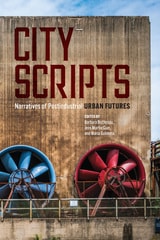
City Scripts
Narratives of Postindustrial Urban FuturesEdited by Barbara Buchenau, Jens Martin Gurr, and Maria Sulimma
The Ohio State University Press, 2023
Storytelling shapes how we view our cities, legitimizing histories, future plans, and understandings of the urban. City Scripts responds to calls by literary theorists to engage a new kind of narrative analysis that recalibrates close reading and interpretation to the multiple ways in which narratives “do things”—how they intervene in the world and take action in everyday life. A multidisciplinary cast of contributors approaches this new way of looking at cities through the stories people tell about them, looking especially at political activism and urban planning, which depend on the invention of plausible stories of connectedness and of a redemptive future.
The stakes are especially high in cities where economic, ecological, and social futures are delimited by histories of large-scale extraction and racialized industrial labor. Contributors thus focus on cities in postindustrial areas of Germany and the United States, examining how narratives about cities become scripts and how these scripts produce real-life results. This approach highlights how uses of narrative and scripting appeal to stakeholders in urban change. These actors continually deploy narrative, media, and performance, with consequences for urban futures worldwide.
Contributors:
Lieven Ameel, Juliane Borosch, Barbara Buchenau, Florian Deckers, Barbara Eckstein, Kornelia Freitag, Walter Grünzweig, Randi Gunzenhäuser, Jens Martin Gurr, Elisabeth Haefs, Chris Katzenberg, Johannes Maria Krickl, Renee M. Moreno, Hanna Rodewald, Julia Sattler, Maria Sulimma, James A. Throgmorton, Michael Wala, Katharina Wood
Classics Beyond the Pleasure Principle
Edited by Paul Allen Miller and Mario Telò
The Ohio State University Press, 2026
Contributors:
Karen Bassi, Martin Devecka, Micaela Janan, Hagi Kenaan, Vered Lev Kenaan, Sara Lindheim, Paul Allen Miller, Helen Morales, Jay Oliver, Victoria Rimell, Mario Telò

Closed Encounters
Literary Politics and Public CultureJeffrey Wallen
University of Minnesota Press, 1998
Closed Encounters was first published in 1998. Minnesota Archive Editions uses digital technology to make long-unavailable books once again accessible, and are published unaltered from the original University of Minnesota Press editions.
It's committed. It's political. It's socially engaged. It's academic criticism in the nineties. But what does it achieve? In a provocative and fair-minded look at current critical practices and the future of the academy, Jeffrey Wallen draws a disturbing picture of public intellectuals in search of a public and cultural critics unable to enter a dialogue with others.
Wallen argues that literary politics is no substitute for debate on genuine political issues. Taking up several of the most influential critics of recent years-Edward Said, Eve Kosofsky Sedgwick, Michael Bérubé, Gerald Graff, Richard Rorty, Stanley Fish, and many others-Wallen asks: Can their desire to persuade an audience beyond the classroom be fulfilled? And can cultural critics realize their ambitious social and institutional goals for change? In a work that is neither of the Left nor of the Right, but likely to unsettle both, Wallen argues that literary criticism actually undermines the prospects for the dialogue it calls out for.
In addition, Wallen argues that the institutionalization of critiques of truth and difference-critiques that appear to liberate us by revealing that knowledge and values are constructed, and can therefore be transformed-often leads to a further constraining of thought and narrowing of outlooks. In his analysis of the administration of conflict, Wallen describes the troubled state of academic freedom and points to a shift from the institutional protection of dissenting views to the institutional protection from views one finds unpleasant.
Yet the prospects are not bleak: Wallen emphasizes that academic critics continue to play a crucial role in crafting what we expect from discussion. In this spirit, Closed Encounters lays the groundwork for fashioning a truly public, socially engaged criticism.
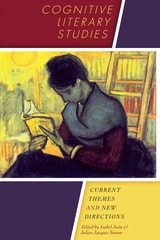
Cognitive Literary Studies
Current Themes and New DirectionsEdited by Isabel Jaén and Julien Jacques Simon
University of Texas Press, 2012
In the first decade of the twenty-first century, our understanding of the cognition of literature was transformed by scientific discoveries, such as the mirror neuron system and its role in empathy. Addressing questions such as why we care so deeply about fictional characters, what brain activities are sparked when we read literature, and how literary works and scholarship can inform the cognitive sciences, this book surveys the exciting recent developments in the field of cognitive literary studies and includes contributions from leading scholars in both the humanities and the sciences.
Beginning with an overview of the evolution of literary studies, the editors trace the recent shift from poststructuralism and its relativism to a growing interdisciplinary interest in the empirical realm of neuroscience. In illuminating essays that examine the cognitive processes at work when we experience fictional worlds, with findings on the brain’s creativity sites, this collection also explores the impact of literature on self and society, ending with a discussion on the present and future of the psychology of fiction. Contributors include Literature and the Brain author Norman N. Holland, on the neuroscience of metafiction reflected in Don Quixote; clinical psychologist Aaron Mishara on the neurology of self in the hypnagogic (between waking and sleeping) state and its manifestations in Kafka’s stories; and literary scholar Brad Sullivan’s exploration of Romantic poetry as a didactic tool, applying David Hartley’s eighteenth-century theories of sensory experience.
Collaborative Meaning in Medieval Scribal Culture
The Otho La3amonElizabeth J. Bryan
University of Michigan Press, 1999
In Collaborative Meaning in Medieval Scribal Culture, Bryan compares examples from the British Library Cotton Otho C.xiii manuscript of La3amon's Brut, the early thirteenth-century verse history that translated King Arthur into English for the first time. She discovers cultural attitudes that valued communal aspects of manuscript texts--for example, a view of the physical book as connecting all who read or even held it to each other.
The study is divided into two parts. Part one presents Early Middle English concepts of "enjoining" texts and explores the theoretical and methodological challenges they pose to present-day readers of scribally-produced texts. Part two conducts a detailed study of the multiple interpretations built into the manuscript text. Illustrations of manuscript pages accompany analysis, and the reader is invited to engage in interpreting the manuscript text.
Collaborative Meaning in Medieval Scribal Culture will be of interest to students and specialists in medieval chronicle histories, Middle English, Arthurian literature, and literary and textual theory.
Elizabeth J. Bryan is Associate Professor of English, Brown University.
Conditions of the Present
Selected EssaysLindon Barrett
Duke University Press, 2018
Contributors. Elizabeth Alexander, Jennifer DeVere Brody, Daphne A. Brooks, Linh U. Hua, Janet Neary, Marlon B. Ross, Robyn Wiegman
Contagious
Cultures, Carriers, and the Outbreak NarrativePriscilla Wald
Duke University Press, 2008
Wald traces how changing ideas about disease emergence and social interaction coalesced in the outbreak narrative. She returns to the early years of microbiology—to the identification of microbes and “Typhoid Mary,” the first known healthy human carrier of typhoid in the United States—to highlight the intertwined production of sociological theories of group formation (“social contagion”) and medical theories of bacteriological infection at the turn of the twentieth century. Following the evolution of these ideas, Wald shows how they were affected by—or reflected in—the advent of virology, Cold War ideas about “alien” infiltration, science-fiction stories of brainwashing and body snatchers, and the HIV/AIDS pandemic. Contagious is a cautionary tale about how the stories we tell circumscribe our thinking about global health and human interactions as the world imagines—or refuses to imagine—the next Great Plague.
Contemporary Advances in Theoretical and Applied Spanish Linguistic Variation
Juan J. Colomina-Almiñana
The Ohio State University Press, 2017
This volume makes three major contributions to Hispanic sociolinguistics. First, it covers variation in less commonly studied varieties, which are new areas of interest in a broader world where certain minorities and their languages are crucial. Second, it offers recent and innovative approaches to variation coming from formal theories in order to spark a debate about methodology that is more comprehensive of the diverse approaches to variation currently practiced in the field. Finally, it includes chapters that combine quantitative and qualitative analysis of different linguistic variables.
Contemporary Feminist Fiction and a Case for Expanding Rhetorical Narratology
Katherine J. Weese
The Ohio State University Press, 2025
Examining Ali Smith’s The Accidental and Hotel World, Barbara Kingsolver’s The Poisonwood Bible, Toni Morrison’s Beloved, Kate Atkinson’s A God in Ruins and Life After Life, and Ruth Ozeki’s A Tale for the Time Being, Weese demonstrates how various narratological theories inform rather than compete with one another. Through an expanded rhetorical poetics, including a refined version of James Phelan’s MTS (mimetic, thematic, synthetic) model, she reframes post-postmodern theorists’ concerns with communicative function through a narratological lens to make the case that exploring the rhetorical function of unnatural devices challenges and extends the claims of narrow metamodern readings.
Contemporary French and Francophone Narratology
Edited by John Pier
The Ohio State University Press, 2020
The essays included in this collection seek to take the pulse of recent developments in narratological research in the French-speaking countries. Theorists in these countries heavily participated in and shaped narratology, an outgrowth of the structuralist movement during the 1960s and 1970s. While US, German, and Scandinavian theorists took the forefront in the 1990s, narratology in France faded into the background. It was not until the turn of the century that a new interest in narratological issues among French researchers emerged. Activity in the field has since intensified, spurred on, in part, by the realization that narratology cannot be summed up by its formalist and structuralist origins.
Well-versed in French narrative theory, both classical and more recent, the authors in this collection also draw on scholarship coming from other research traditions. The result is that these contributions offer a number of syntheses and perspectives representative of recent French-language scholarship in the field that readers may not be familiar with or that provide them with further insight into subjects they may have encountered in other contexts. This volume will leave readers with a greater awareness of the directions taken by present-day French-language narratology as well as new and developing themes in narrative theory generally.
Contributors
Raphaël Baroni, Denis Bertrand, Olivier Caïra, Claude Calame, Benoît Hennaut, Françoise Lavocat, Sylvie Patron, John Pier, Françoise Revaz, and Richard Saint-Gelais
Contemporary German Editorial Theory
Hans Walter Gabler, George Bornstein, and Gillian Borland Pierce, Editors
University of Michigan Press, 1995
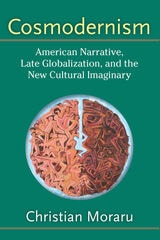
Cosmodernism
American Narrative, Late Globalization, and the New Cultural ImaginaryChristian Moraru
University of Michigan Press, 2010
"Christian Moraru is an especially dynamic and brilliant scholar who works at a high level of critical and theoretical sophistication. I've never seen anything quite so exhaustive, so magisterial. Readers of Cosmodernism will think of the Keats line about an astronomer's exhilaration when a new planet swims into his ken."
---David Cowart, University of South Carolina
"Cosmodernism has the potential to become foundational for the study of a whole period. Christian Moraru undertakes here to establish a new basis for thinking about the era of cultural history in which we have found ourselves, in the United States but also around the world, since the end of the Cold War. The strength of Moraru's work lies in its intellectual ambition and scope; its polymathic range and breadth of learning; its confident mastery of a variety of disciplinary discourses; its fresh and thoughtful selection of texts for discussion; the sharpness and insight of its textual analyses; and, animating everything, its fervent commitment to a new and better way of understanding our relationship to others and the world at large."
---Brian McHale, The Ohio State University
A sweeping inquiry into post–Cold War American literature and theory, Cosmodernism argues, cautiously but persuasively, for the rise of a new cultural paradigm against the backdrop of accelerating globalization. Moraru calls this paradigm "cosmodern." He uses the term to account for what seems to be gradually challenging the postmodern over the last twenty-odd years. Not so much a well-structured movement yet, cosmodernism is chiefly a critical construct enabling Moraru to articulate representative literary-theoretical interventions of the past two decades into a reasonably coherent model. The coherence inheres, he shows, in a certain "relational" imaginary, which the critic canvasses by placing a wide range of authors and works in, across, and against the material-conceptual networks of globalization, cosmopolitanism, modernism, postmodernism, postcolonialism, multiculturalism, and other areas of contemporary U.S. intellectual history.
Christian Moraru is Professor of English at the University of North Carolina, Greensboro. His latest books include Rewriting: Postmodern Narrative and Cultural Critique in the Age of Cloning (2001), Memorious Discourse: Reprise and Representation in Postmodernism (2005), and the edited collection Postcommunism, Postmodernism, and the Global Imagination (2009).
Cover art: Earth, oil and acrylic on canvas, 48" × 36", 2008. Painting courtesy of Rebecca Darlington.

Cosmopolitan Desires
Global Modernity and World Literature in Latin AmericaMariano Siskind
Northwestern University Press, 2014
Mariano Siskind’s groundbreaking debut book redefines the scope of world literature, particularly regarding the place of Latin America in its imaginaries and mappings. In Siskind’s formulation, world literature is a modernizing discursive strategy, a way in which cultures negotiate their aspirations to participate in global networks of cultural exchange, and an original tool to reorganize literary history. Working with novels, poems, essays, travel narratives, and historical documents, Siskind reads the way Latin American literary modernity was produced as a global relation, from the rise of planetary novels in the 1870s and the cosmopolitan imaginaries of modernism at the turn of the twentieth century, to the global spread of magical realism. With its unusual breadth of reference and firm but unobtrusive grounding in philosophy, literary theory, and psychoanalysis, Cosmopolitan Desires will have a major impact in the fields of Latin American studies and comparative literature.
Crash
Cinema and the Politics of Speed and StasisKaren Beckman
Duke University Press, 2010
Critical Writings, 1953-1978
Paul De Man
University of Minnesota Press, 1989
Twenty-five essays and reviews not previously collected, most of which were written before 1970, and eight of which are appearing in English for the first time. Valuable for the insights they afford into his development as a critic the essays are also significant in addressing de Man’s consistent views of romanticism, modernism and the dilemmas central to literature in recent centuries.
Criticism and Truth
On Method in Literary StudiesJonathan Kramnick
University of Chicago Press, 2023
Does literary criticism offer truths about the world? In Criticism and Truth, Jonathan Kramnick offers a new and surprising account of criticism’s power by zeroing in on its singular method: close reading. Long recognized as the distinctive technique of literary studies, close reading is the critic’s way of pursuing arguments and advancing knowledge, as well as the primary skill taught in the English major. But it is also more than that—a creative, immersive, and transformative writing practice that fosters a unique kind of engagement with the world. Drawing on the rich and varied landscape of contemporary criticism, Kramnick changes how we think about the basic tools of literary analysis, including the art of in-text quotation, summary, and other reading methods, helping us to see them as an invaluable form of humanistic expertise. Criticism and Truth is a call to arms, making a powerful case for the necessity of both literature and criticism within a multidisciplinary university.
As the humanities fight for survival in contemporary higher education, the study of literature doesn’t need more plans for reform. Rather, it needs a defense of the work already being done and an account of why it should flourish. This is what Criticism and Truth offers, in vivid and portable form.
Critique and Postcritique
Elizabeth S. Anker and Rita Felski, editors
Duke University Press, 2017
Contributors: Elizabeth S. Anker, Christopher Castiglia, Russ Castronovo, Simon During, Rita Felski, Jennifer L. Fleissner, Eric Hayot, Heather Love, John Michael, Toril Moi, Ellen Rooney, C. Namwali Serpell
Cruel Optimism
Lauren Berlant
Duke University Press, 2011
Arguing that the historical present is perceived affectively before it is understood in any other way, Berlant traces affective and aesthetic responses to the dramas of adjustment that unfold amid talk of precarity, contingency, and crisis. She suggests that our stretched-out present is characterized by new modes of temporality, and she explains why trauma theory—with its focus on reactions to the exceptional event that shatters the ordinary—is not useful for understanding the ways that people adjust over time, once crisis itself has become ordinary. Cruel Optimism is a remarkable affective history of the present.
Cultural Agency in the Americas
Doris Sommer, ed.
Duke University Press, 2006
Based in North and South America, scholars from fields including anthropology, performance studies, history, literature, and communications studies explore specific variations of cultural agency across Latin America. Contributors reflect, for example, on the paradoxical programming and reception of a state-controlled Cuban radio station that connects listeners at home and abroad; on the intricacies of indigenous protests in Brazil; and the formulation of cultural policies in cosmopolitan Mexico City. One contributor notes that trauma theory targets individual victims when it should address collective memory as it is worked through in performance and ritual; another examines how Mapuche leaders in Argentina perceived the pitfalls of ethnic essentialism and developed new ways to intervene in local government. Whether suggesting modes of cultural agency, tracking exemplary instances of it, or cautioning against potential missteps, the essays in this book encourage attentiveness to, and the multiplication of, the many extraordinary instantiations of cultural resourcefulness and creativity throughout Latin America and beyond.
Contributors. Arturo Arias, Claudia Briones, Néstor García Canclini, Denise Corte, Juan Carlos Godenzzi, Charles R. Hale, Ariana Hernández-Reguant, Claudio Lomnitz, Jesús Martín Barbero, J. Lorand Matory, Rosamel Millamán, Diane M. Nelson, Mary Louise Pratt, Alcida Rita Ramos, Doris Sommer, Diana Taylor, Santiago Villaveces
Cultural Capital
The Problem of Literary Canon FormationJohn Guillory
University of Chicago Press, 2023
Since its publication in 1993, John Guillory’s Cultural Capital has been a signal text for understanding the codification and uses of the literary canon. Cultural Capital reconsiders the social basis for aesthetic judgment and exposes the unequal distribution of symbolic and linguistic knowledge on which culture has long been based. Drawing from Pierre Bourdieu’s sociology, Guillory argues that canon formation must be understood less as a question of the representation of social groups and more as a question of the distribution of cultural capital in schools, which regulate access to literacy, to the practices of reading and writing.
Now, as the crisis of the canon has evolved into the so-called crisis of the humanities, Guillory’s groundbreaking, incisive work has never been more urgent. As scholar and critic Merve Emre writes in her introduction to this enlarged edition: “Exclusion, selection, reflection, representation—these are the terms on which the canon wars of the last century were fought, and the terms that continue to inform debates about, for instance, decolonizing the curriculum and the rhetoric of antiracist pedagogy.”
Cultural Studies in the Future Tense
Lawrence Grossberg
Duke University Press, 2010