Results by title
18284 books match the query 'United States' and 1260 start with c
Capitalism, Politics, and Railroads in Jacksonian New England
Michael J. Connolly
University of Missouri Press, 2003
Capitalism, Slavery, and Republican Values
American Political Economists, 1819-1848By Allen Kaufman
University of Texas Press, 1982
In the troubled days before the American Civil War, both Northern protectionists and Southern free trade economists saw political economy as the key to understanding the natural laws on which every republican political order should be based. They believed that individual freedom was one such law of nature and that this freedom required a market economy in which citizens could freely pursue their particular economic interests and goals.
But Northern and Southern thinkers alike feared that the pursuit of wealth in a market economy might lead to the replacement of the independent producer by the wage laborer. A worker without property is a potential rebel, and so the freedom and commerce that give birth to such a worker would seem to be incompatible with preserving the content citizenry necessary for a stable, republican political order.
Around the resolution of this dilemma revolved the great debate on the desirability of slavery in this country. Northern protectionists argued that independent labor must be protected at the same time that capitalist development is encouraged. Southern free trade economists answered that the formation of a propertyless class is inevitable; to keep the nation from anarchy and rebellion, slavery—justified by racism—must be preserved at any cost.
Battles of the economists such as these left little room for political compromise between North and South as the antebellum United States confronted the corrosive effects of capitalist development. And slavery's retardant effect on the Southern economy ultimately created a rift within the South between those who sought to make slavery more like capitalism and those who sought to make capitalism more like slavery.

Capitalism’s Tomorrows
Imagining the Future of BusinessGavin Benke
University of Chicago Press, 0
The institutional evolution of “corporate futurism” and its influence on our view of the role of private enterprise in society.
While the bright capitalist future that the power elite of postwar America dreamed of hasn’t come to pass, its influence and repercussions continue to resonate. Gavin Benke shows that the cultural, intellectual, and political rise of neoliberalism was not inevitable. Instead, beginning in the early 1960s, a group that he dubs “corporate futurists” imagined a differently shaped and community-minded version of capitalism. Most interestingly, Benke goes beyond the once-big names in the field (such as Alvin Toffler and Daniel Bell) to show how deep-seated and granular the engagement with futurism was.
Using an incredible array of futurists’ reports, conference proceedings, and internal deliberations at places like the infamous RAND Corporation, Capitalism’s Tomorrows uncovers a moment of genuine introspection about capitalism’s development and shows how it is subject to our imaginative capacity and ability to shape how these systems work.
Capitalist Pigs
Pigs, Pork, and Power in AmericaJ. L. Anderson
West Virginia University Press, 2019
Pigs are everywhere in United States history. They cleared frontiers and built cities (notably Cincinnati, once known as Porkopolis), served as an early form of welfare, and were at the center of two nineteenth-century “pig wars.” American pork fed the hemisphere; lard literally greased the wheels of capitalism.
J. L. Anderson has written an ambitious history of pigs and pig products from the Columbian exchange to the present, emphasizing critical stories of production, consumption, and waste in American history. He examines different cultural assumptions about pigs to provide a window into the nation’s regional, racial, and class fault lines, and maps where pigs are (and are not) to reveal a deep history of the American landscape. A contribution to American history, food studies, agricultural history, and animal studies, Capitalist Pigs is an accessible, deeply researched, and often surprising portrait of one of the planet’s most consequential interspecies relationships.
Capitol Investments
The Marketability of Political SkillsGlenn R. Parker
University of Michigan Press, 2011
What would you do if, the very day you were hired, you knew you could be unemployed in as little as two years? You'd seek opportunities in your current job to develop a portfolio of skills and contacts in order to make yourself more attractive to future employers. Representatives and senators think about their jobs in Congress in this way, according to Glenn R. Parker.
While in office, members of Congress plan not merely for the next election but for the next stage of their careers. By networking, serving on committees, and championing particular legislation, they deliberately accumulate human capital---expertise, networks, and reputation---which later will give them bargaining power in the job market. Parker's study of the postelective careers of more than 200 former members of Congress, both U.S. representatives and senators, who have left office during the last half century shows that such strategic planning generally succeeds. In most cases, the human capital these politicians amassed while in office increased their occupational mobility and earning power.
Capitol Investments offers a sophisticated yet accessible analysis of the acquisition and marketability of political skills. It suggests that an awareness of the trade in human capital shapes an officeholder's actions as much as the desire to win another election.
Glenn R. Parker is Distinguished Professor in the Department of Political Science at Purdue University.
Captain Paul Cuffe, Yeoman
A BiographyJeffrey A. Fortin
University of Massachusetts Press, 2024
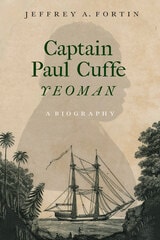
Paul Cuffe is best understood as a member of the Black founding fathers—a group of pre-eminent African Americans who built institutions and movements during the first decades of the United States. While he is known amongst scholars, his astounding life story deserves a much wider audience. Jeffrey A. Fortin has crafted a beautiful, moving portrait of this important maritime figure that will appeal to anyone interested in early American history and who loves great story telling.
Born on Cuttyhunk Island, Massachusetts in 1759 to a formerly enslaved African father and a Wampanoag Indian mother, Cuffe emerged from anonymity to become the most celebrated African-American sea captain during the Age of Sail. An abolitionist, veteran, and community activist, celebrity followed Cuffe as he built a shipping empire that traded both in American coastal waters and across the wider Atlantic Ocean. Cuffe and his Black crews shook the foundations of systemic racism, challenging norms by sailing into Charleston and other ports where slavery was legal, and thus demonstrating that business and profits were more powerful than social limitations. He founded America’s first racially integrated school in Westport, Massachusetts, and is considered the leader of the nation’s first back-to-Africa movement. Newspapers in England, the United States, and the Caribbean reported his whereabouts and adventures, and abolitionists hailed him for his Quaker beliefs, sobriety, and commitment to advancing opportunities for persons of African descent.
Drawing on pamphlets, letters, and other documents, and painstakingly reconstructing his genealogy, Fortin vividly describes Cuffe’s experiences and places them within the broader history of the Early Republic to help reveal the central role of African Americans in the founding of the United States. Unlike previous biographies, Fortin situates Cuffe within an Atlantic world where race and identity were fluid, and Africans and African Americans sought to build and govern a free Black nation in West Africa.

Captains of Charity
The Writing and Wages of Postrevolutionary Atlantic BenevolenceMary Kathleen Eyring
University of New Hampshire Press, 2017
According to Eyring, the men and women who most successfully wrote about and engaged in benevolent work strategically connected their work with the affluence generated by maritime commerce. The water trades supported the growth of the American publishing industry, but they also generated both vast inequities in wealth and physically and economically hazardous conditions that, in the absence of a welfare state, required the intervention of benevolent societies. Laborers in Atlantic port cities barred from lucrative professions by gender, race, physical ability, or social status found a way to make a living wage by conjoining the literary with the charitable—and attaching both to a profit structure. In so doing, they transformed the nature of American benevolence and gave rise to the nonprofit sector, which has since its inception provided discontented laborers with a forum in which to express their critique of for-profit American enterprise, by imitating it.
In Captains of Charity, Eyring looks at writers who overcame their marginalized status by bringing together the strands of maritime industry, publishing, and benevolence. These include Richard Allen and Absalom Jones, two black clergymen who managed a massive relief effort when refugees fleeing revolution in Haiti transported the yellow fever virus to Philadelphia in 1793; Nancy Prince, a free woman of color who sought her livelihood in the Protestant missions of Jamaica in the years immediately following Britain's emancipation of laborers in its Caribbean colonies; Sarah Josepha Hale, who parlayed the social influence she had gained as the founder of a seaman's aid society in Boston into a role as editor of the hugely popular periodical Godey's Lady's Book; and Sarah Pogson Smith, who donated the proceeds of her writing to such prominent charitable causes as the New York Institution for the Instruction of the Deaf and Dumb and then capitalized on the goodwill this charity work generated among her wealthy friends in New York City, Philadelphia, and Charleston.
Hardcover is un-jacketed.

Captivating Technology
Race, Carceral Technoscience, and Liberatory Imagination in Everyday LifeRuha Benjamin, editor
Duke University Press, 2019
Captive Histories
English, French, and Native Narratives of the 1704 Deerfield RaidEvan Haefeli
University of Massachusetts Press, 2006
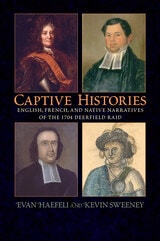
This volume draws together an unusually rich body of original sources that tell the story of the 1704 French and Indian attack on Deerfield, Massachusetts, from different vantage points. Texts range from one of the most famous early American captivity narratives, John Williams's The Redeemed Captive, to the records of French soldiers and clerics, to little-known Abenaki and Mohawk stories of the raid that emerged out of their communities' oral traditions. Evan Haefeli and Kevin Sweeney provide a general introduction, extensive annotations, and headnotes to each text.
Although the oft-reprinted Redeemed Captive stands at the core of this collection, it is juxtaposed to less familiar accounts of captivity composed by other Deerfield residents: Quentin Stockwell, Daniel Belding, Joseph Petty, Joseph Kellogg, and the teenaged Stephen Williams. Presented in their original form, before clerical editors revised and embellished their content to highlight religious themes, these stories challenge long-standing assumptions about classic Puritan captivity narratives.
The inclusion of three Abenaki and Mohawk narratives of the Deerfield raid is equally noteworthy, offering a rare opportunity not only to compare captors' and captives' accounts of the same experiences, but to do so with reference to different Native oral traditions. Similarly, the memoirs of French military officers and an excerpt from the Jesuit Relations illuminate the motivations behind the attack and offer fresh insights into the complexities of French-Indian alliances.
Taken together, the stories collected in this volume, framed by the editors' introduction and the assessments of two Native scholars, Taiaiake Alfred and Marge Bruchac, allow readers to reconstruct the history of the Deerfield raid from multiple points of view and, in so doing, to explore the interplay of culture and memory that shapes our understanding of the past.
Captive of the Labyrinth
Sarah L. Winchester, Heiress to the Rifle FortuneMary Jo Ignoffo
University of Missouri Press, 2010
Captive of the Labyrinth
Sarah L. Winchester, Heiress to the Rifle Fortune, Revised and Updated EditionMary Jo Ignoffo
University of Missouri Press, 2022
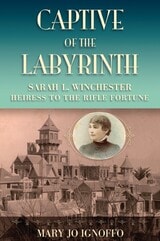
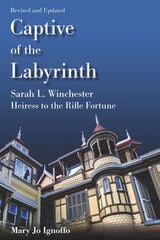
Author and historian Mary Jo Ignoffo’s definitive biography unearths the truth about this reclusive eccentric, revealing that she was not a maddened spiritualist driven by remorse but an intelligent, articulate woman who sought to protect her private life amidst the chaos of her public existence and the social mores of the time. The author takes readers through Winchester’s several homes, explores her private life, and, by excerpting from personal correspondence, one learns the widow’s true priority was not dissipating her fortune on the mansion in San José but endowing a hospital to eradicate a dread disease.
Sarah Winchester has been exploited for profit for over a century, but Captive of the Labyrinth finally puts to rest the myths about this American heiress, and, in the process, uncovers her true legacies.
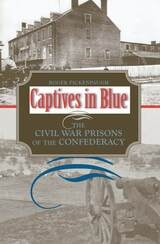
Captives in Blue
The Civil War Prisons of the ConfederacyRoger Pickenpaugh
University of Alabama Press, 2013
A gripping account of Union soldiers behind Confederate bars—where survival, sacrifice, and the unforgiving realities of Civil War imprisonment collide.
In Captives in Blue, Roger Pickenpaugh examines the ways the Confederate army contended with the growing prison population, the variations in the policies and practices of different Confederate prison camps, the effects these policies and practices had on Union prisoners, and the logistics of prisoner exchanges. He explores conditions that arose from conscious government policy decisions and conditions that were the product of local officials or unique local situations. He also considers how Confederate prisons and policies dealt with African American Union soldiers. Black soldiers held captive in Confederate prisons faced uncertain fates; many former slaves were returned to their former owners, while others faced harsh treatment in the camps. Drawing on prisoner diaries, Pickenpaugh provides compelling first-person accounts of life in prison camps often overlooked by scholars in the field.
This study of Union captives in Confederate prisons is a companion to Roger Pickenpaugh’s earlier groundbreaking book Captives in Gray: The Civil War Prisons of the Union and extends his examination of Civil War prisoner-of-war facilities into the Confederacy.
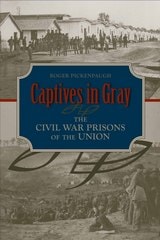
Captives in Gray
The Civil War Prisons of the UnionRoger Pickenpaugh
University of Alabama Press, 2009
“This is a vivid description of conditions and events rarely described: the imprisonment of captured Confederate soldiers during the Civil War. Its many parallels to circumstances in Andersonville are especially intriguing.” —Jimmy Carter, 39th President of the United States
Contains contemporary reports from prisoners and witnesses humanize the grim realities of the POW camps.
Captives in Gray is Civil War prison camp authority Roger Pickenpaugh’s acclaimed and definitive account of the Union’s POW camps. Combining his own extensive research into official records and a rich variety of letters and diaries with the best contemporary scholarship, Pickenpaugh covers every major northern camp.
Because the Union won few victories in 1861 and took few prisoners, the North had time to plan and build prison camps, an opportunity it largely squandered. Pickenpaugh gives illuminating accounts of the role and leadership of thrifty Lieutenant Colonel William Hoffman, the commissary general of prisoners for most of the conflict, and President Abraham Lincoln's secretaries of war, the incompetent Simon Cameron and the malignant Edwin M. Stanton.
Death came in many ways. Soldiers from the Deep South had no experience with extreme cold, and they died by the hundreds each winter. In one memorable freeze, Rock Island, Illinois, saw temperatures between twenty-eight and thirty-one degrees below zero. With insufficient fuel and inadequate shelter, clothing, and blankets, prisoners there and in other camps froze to death. Food rations varied widely. A few Confederates enjoyed better rations than they had in the CSA armies, but the majority supplemented their meager rations by eating rats, dogs, cats, and seagulls.
Poor medical care added to the death toll. Treatment was bad even by the standards of Civil War medicine, often due to Hoffman's reluctance to spend. Prisoners suffered from lice and scurvy, as well as pneumonia, measles, and a variety of fevers. As in both armies, diarrhea and dysentery were chronic. Smallpox epidemics killed many. Poor sanitation and drainage caused 385 deaths at Elmira, New York, in September 1864 alone.
During the war, over 12 percent of rebel prisoners, or 25,976 of the 214,865, died in captivity. Together with his Captives in Blue, Captives in Gray gives the fullest account of the experiences of prisoners of war in the American Civil War.
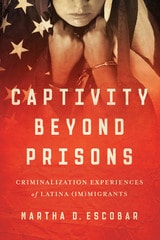
Captivity Beyond Prisons
Criminalization Experiences of Latina (Im)migrantsBy Martha D. Escobar
University of Texas Press, 2016
Today the United States leads the world in incarceration rates. The country increasingly relies on the prison system as a “fix” for the regulation of societal issues. Captivity Beyond Prisons is the first full-length book to explicitly link prisons and incarceration to the criminalization of Latina (im)migrants.
Starting in the 1990s, the United States saw tremendous expansion in the number of imprisoned (im)migrants, specifically Latinas/os. Consequently, there was also an increase in the number of deportations. In addition to regulating society, prisons also serve as a reproductive control strategy, both in preventing female inmates from having children and by separating them from their families. With an eye to racialized and gendered technologies of power, Escobar argues that incarcerated Latinas are especially depicted as socially irrecuperable because they are not considered useful within the neoliberal labor market. This perception impacts how they are criminalized, which is not limited to incarceration but also extends to and affects Latina (im)migrants’ everyday lives. Escobar also explores the relationship between the immigrant rights movement and the prison abolition movement, scrutinizing a variety of social institutions working on solutions to social problems that lead to imprisonment.
Accessible to both academics and those in the justice and social service sectors, Escobar’s book pushes readers to consider how, even in radical spaces, unequal power relations can be reproduced by the very entities that attempt to undo them.
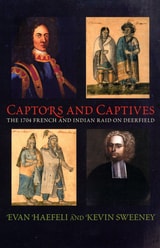
Captors and Captives
The 1704 French and Indian Raid on DeerfieldEvan Haefeli
University of Massachusetts Press, 2003
Haefeli and Sweeney reconstruct events from multiple points of view, through the stories of a variety of individuals involved. These stories begin in the Native, French, and English communities of the colonial Northeast, then converge in the February 29 raid, as a force of more than two hundred Frenchmen, Abenakis, Hurons, Kahnawake Mohawks, Pennacooks, and Iroquois of the Mountain overran the northwesternmost village of the New England frontier. Although the inhabitants put up more of a fight than earlier accounts of the so-called Deerfield Massacre have suggested, the attackers took 112 men, women, and children captive. The book follows the raiders and their prisoners on the harsh three-hundred-mile trek back to Canada and into French and Native communities. Along the way the authors examine how captives and captors negotiated cultural boundaries and responded to the claims of competing faiths and empires—all against a backdrop of continuing warfare.
By giving equal weight to all participants, Haefeli and Sweeney range across the fields of social, political, literary, religious, and military history, and reveal connections between cultures and histories usually seen as separate.
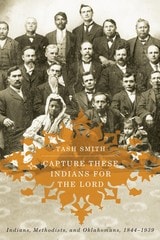
Capture These Indians for the Lord
Indians, Methodists, and Oklahomans, 1844-1939Tash Smith
University of Arizona Press, 2014
In Capture These Indians for the Lord, Tash Smith traces the trajectory of the Southern Methodist Church in Oklahoma when it was at the frontlines of the relentless push toward western expansion. Although many Native people accepted the missionaries’ religious practices, Smith shows how individuals found ways to reconcile the Methodist force with their traditional cultural practices. When the white population of Indian Territory increased and Native sovereignty came under siege during the allotment era of the 1890s, white communities marginalized Indians within the Church and exploited elements of mission work for their own benefit.
Later, with white indifference toward Indian missions peaking in the early twentieth century, Smith explains that as the remnants of the Methodist power weakened, Indian membership regained control and used the Church to regenerate their culture. Throughout, Smith explores the complex relationships between white and Indian community members and how these phenomena shaped Methodist churches in the twentieth century.
Capturing Campaign Effects
Henry E. Brady and Richard Johnston, eds.
University of Michigan Press, 2006
"Capturing Campaign Effects is an accessible and penetrating account of modern scholarship on electoral politics. It draws critical insights from a range of innovative analyses."
--Arthur Lupia, University of Michigan
"What a wonderful way to usher in the new era of election studies! This book spotlights fascinating paradoxes in the literature of voting behavior, highlights many promising approaches to resolving those paradoxes, and shows how these strategies can yield important findings with terrific payoffs for our understanding of contemporary democracy. Fasten your seatbelts, folks: scholarship on elections is about to speed up thanks to this collection of great essays."
--Jon Krosnick, Stanford University
"The past decade has seen a renewed interest in understanding campaign effects. How and when do voters learn? Does the election campaign even matter at all? Capturing Campaign Effects draws on leading political scientists to address these matters. The result is a collection that will become the major reference for the study of campaigns. The lesson that emerges is that campaigns do affect voter decision making, usually for the better."
--Robert S. Erikson, Columbia University
Henry E. Brady is Class of 1941 Monroe Deutsch Professor of Political Science and Public Policy, and Director of the Survey Research Center at the University of California, Berkeley.
Richard Johnston is Professor and Head of Political Science and Distinguished University Scholar at the University of British Columbia.
Capturing Labor
A History of Unfree Work in the SouthwestEdited by Jessica R. Pliley and John Mckiernan-González
University of Texas Press, 2026
A collection of essays grappling with the many, often overlooked, forms of unfree labor in the West.
When Americans think of unfree labor—coerced, extracted from workers unable to freely enter and exit contracts—what comes to mind is Black slavery and peonage in the South. But other forms of unfree labor also built the United States. Collecting a diverse range of sharply argued historical essays, Capturing Labor shares the story of unfree labor in the Southwest, affecting mainly Indigenous people, Mexican Americans, and people of color.
In Texas and elsewhere, state agents developed various methods for directing the movement of workers, seizing their time, and controlling the products of their efforts. Case studies highlight the detention during World War I of Indigenous children and unaccompanied women, who were placed in boarding schools, fined, and obligated to work off the resulting debt. Other essays expose authorities forcing workers to break strikes and jailing Americans who supported labor uprisings in rural Mexico and the United States. Prisons and asylums supplied coerced agricultural workers and musicians who were never compensated for their labor or by the labels that took their recordings.
Editors Jessica Pliley and John Mckiernan-González contend that unfree labor continues to shape American life, and is all around us today. Understanding its history aids us in recognizing and bringing attention to the grim realities of the present.
Capturing Water
Puebloan Resilience and Agricultural Sustainability in Chaco CanyonR. Gwinn Vivian and Samantha G. Fladd
University of Utah Press, 2025
The ability of the inhabitants of Chaco Canyon to sustain themselves through farming in an arid environment has long been a topic of debate among scholars. Building upon the work of his father, Gordon, R. Gwinn Vivian dedicated his lifetime of archaeological work to investigating water management and practices at Chaco. These efforts provide compelling evidence of the extensive use of canal irrigation systems and other water management techniques employed by the Ancestral Puebloan people by the ninth century and continuing through recent periods by Navajo farmers.
Rich with archaeological data, ethnographic evidence, maps, and photographs, this volume challenges long-standing assumptions about Chaco Canyon's agricultural potential. By highlighting the adaptability and ingenuity of the canyon's early inhabitants, the book offers a fresh perspective on the role of water management in the development of Chaco Canyon as a sociopolitical center in the northern Southwest.
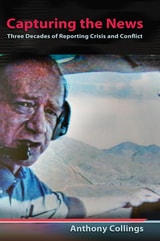
Capturing the News
Three Decades of Reporting Crisis and ConflictAnthony Collings
University of Missouri Press, 2010
Anthony Collings found himself in his share of difficult situations in his thirty-four years as a newsman. Like being captured by AK-47–toting Syrians in Lebanon in 1981 while looking for missiles that threatened a new outbreak of hostilities with Israel, or being “detained” by the KGB in Moscow in 1967 during his first foreign posting for the Associated Press filing stories about Soviet dissidents.
Brimming with entertaining stories about journalism, especially the chaotic early years at CNN when he and his colleagues established the first major cable news network, Collings’s book reveals the dangers and pressures of covering the news and the difficulties of overcoming obstacles to the truth. He recalls smuggling tapes out of Poland after the Communists had imposed martial law; flying dangerously near Libya’s “Line of Death”; interviewing world figures from Brezhnev to Kaddafi and Arafat; and winning awards for covering Iran-Contra and the Oklahoma City bombing. Collings brings fresh insights to the Oliver North affair and examines how the press was suckered in its coverage of the Jessica Lynch prisoner-of-war story in 2003. He voices his concerns regarding oversimplified reporting of complex issues and poses provocative questions about covering terrorism.
In this book, Collings presents an insider’s appraisal of the American news media’s failings and accomplishments. Easy to read, informative, and thoughtful, Capturing the News will enlighten general readers interested in how journalists cover current affairs, while offering newsmen food for thought about the craft and ethics of journalism.

Carbon County, USA
Miners for Democracy in Utah and the WestChristian Wright
University of Utah Press, 2019
Drawing on a variety of primary sources, Wright provides evidence for organized labor’s continuing significance and value while effectively illuminating its mounting frustrations during a relatively recent chapter in the history of Utah and the United States.
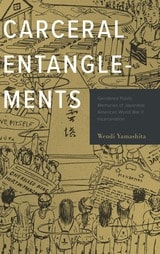
Carceral Entanglements
Gendered Public Memories of Japanese American World War II IncarcerationWendi Yamashita
Temple University Press, 2024
Carceral Entanglements features interviews, archival research, and texts to explore racial violence and patriotic masculinity and explain how Japanese American history and identity are publicly memorialized. Yamashita examines museums, digital archives, pilgrimages, and student-run and performed plays to understand how Japanese Americans occupy a “contradictory location” produced by the state. She also addresses historical erasure, race relations and the struggle for redress and reparations.
Carceral Entanglements is about the interlocking relationship Japanese American incarceration memories have to the prison industrial complex and the settler colonial logics that at times unknowingly sustain it.

Carceral Liberalism
Feminist Voices against State ViolenceEdited by Shreerekha Pillai. Foreword by Demita Frazier
University of Illinois Press, 2023
One of Ms. Magazine's Most Anticipated Books of 2023
Carceral liberalism emerges from the confluence of neoliberalism, carcerality, and patriarchy to construct a powerful ruse disguised as freedom. It waves the feminist flag while keeping most women still at the margins. It speaks of a post-race society while one in three Black men remain incarcerated. It sings the praises of capital while the dispossessed remain mired in debt.
Shreerekha Pillai edits essays on carceral liberalism that continue the trajectory of the Combahee River Collective and the many people inspired by its vision of feminist solidarity and radical liberation. Academics, activists, writers, and a formerly incarcerated social worker look at feminist resurgence and resistance within, at the threshold of, and outside state violence; observe and record direct and indirect forms of carcerality sponsored by the state and shaped by state structures, traditions, and actors; and critique carcerality. Acclaimed poets like Honorée Fanonne Jeffers and Solmaz Sharif amplify the volume’s themes in works that bookend each section.
Cutting-edge yet historically grounded, Carceral Liberalism examines an American ideological creation that advances imperialism, anti-blackness, capitalism, and patriarchy.
Contributors: Maria F. Curtis, Joanna Eleftheriou, Autumn Elizabeth and Zarinah Agnew and D Coulombe, Jeremy Eugene, Demita Frazier, Honorée Fanonne Jeffers, Alka Kurian, Cassandra D. Little, Beth Matusoff Merfish, Francisco Argüelles Paz y Puente, Shreerekha Pillai, Marta Romero-Delgado, Ravi Shankar, Solmaz Sharif, Shailza Sharma, Tria Blu Wakpa and Jennifer Musial, Javier Zamora
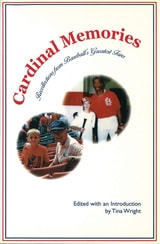
Cardinal Memories
Recollections from Baseball's Greatest FansEdited & Intro by Tina Wright
University of Missouri Press, 2000
Heralded by local and national media as perhaps baseball's most devoted followers, the lovers of St. Louis's legendary Redbirds have a special bond with their team. Cardinal Memories: Recollections from Baseball's Greatest Fans celebrates this relationship by focusing on the people in the stands. A collection of essays gathered from around the world, from St. Louis to Hong Kong, Cardinal Memories forms a history of the team the way it is best remembered—through the eyes and hearts of its fans.
By turns funny and poignant, these stories chronicle Cardinal teams and players from the Gashouse Gang to the Swifties, from El Birdos to Whiteyball and Big Mac. The bond between parent and child, the generosity of numerous players, and the power of a single game to unite thousands of people are only a few of the themes that run throughout this remarkable collection. Whether it's the tale of young fans clamoring at a bus stop for a glimpse of Stan the Man, a surprise gift from the "Mad Hungarian," or Mark McGwire's "71st" home run, these vignettes capture the joy, heartbreak, and passion of being a Cardinal fan.
Focusing on the game's emotional appeal, Cardinal Memories is about more than baseball—its evocative tales capture the game's deeper meanings and offer readers an affectionate slice of Americana. Transcending Cardinal country, these touching stories will appeal to baseball fans and sports enthusiasts everywhere.
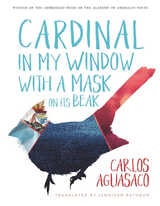
Cardinal in My Window with a Mask on Its Beak
Carlos Aguasaco, Translated by Jennifer Rathbun
University of Arizona Press, 2022
A first-generation immigrant to the United States, Aguasaco embraces his transborder/transnational/intercultural identity by building a bridge across time and distance to unite the great voices of the Renaissance with his lyrical poems. The collection offers bold and fascinating dialogue with Spanish authors such as Juan Boscán, Francisco de Quevedo, Garcilaso de la Vega, and Sor Juana Inés de la Cruz. The poems examine the fundamental liberties inherent to humanity through stunning verse. In a quest for freedom, the poems openly criticize the treatment of immigrants in the United States, drawing poignant parallels with human rights abuses throughout history.
Cardinal in My Window with a Mask on Its Beak brings potent voices of the past to life in poems that critically examine the present and future of the human experience.

Cardozo
A Study in ReputationRichard A. Posner
University of Chicago Press, 1993
"The present compact and unflaggingly interesting volume . . . is a full-bodied scholarly biography. . . .It is illuminating in itself, and will serve as a significant contribution."—Paul A. Freund, New York Times Book Review
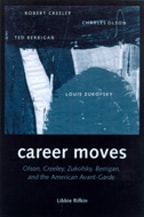
Career Moves
Olson, Creeley, Zukofsky, Berrigan, AndLibbie Rifkin
University of Wisconsin Press, 2000
How much did "making it new" have to do with "making it"? For the four "outsider poets" considered in this book—Charles Olson, Robert Creeley, Louis Zukofsky, and Ted Berrigan—the connection was everything. At once a social history of literary ambition in America in the fifties and sixties and a uniquely collective form of literary biography, Career Moves offers an intimate account of the postwar poetry underground.
Making the controversial claim that anti-Establishment poets were at least as "careerist" as their mainstream peers, Libbie Rifkin shows how the nature of these poets’ ambition actually defined postwar avant-garde identity. In doing so, she clarifies the complicated link between the crafting of a literary career and the defining of a literary canon.
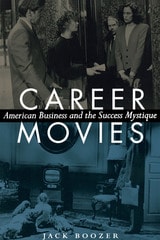
Career Movies
American Business and the Success MystiqueBy Jack Boozer
University of Texas Press, 2002
Achieving the American Dream became inextricably linked with career/business success after World War II, as an increasingly consumerist America learned to define the dream through possessions and status. Not surprisingly, Hollywood films in the postwar years reflected the country's preoccupation with work and career success, offering both dramatic and comedic visions of the career quest and its effects on personal fulfillment, family relations, women's roles, and the creation (or destruction) of just and caring communities.
In this book, Jack Boozer argues that the career/business film achieved such variety and prominence in the years between 1945 and 2001 that it should be considered a legitimate film genre. Analyzing numerous well-known films from the entire period, he defines the genre as one in which a protagonist strives for career success that often proves to be either elusive despite hard work, or unfulfilling despite material rewards and status. Boozer also explores several distinct subgenres of the career movie—the corporate executive films of the 1950s; the career struggles of (single, married, and/or parenting) women; the entrepreneurial film as it is also embodied in texts about immigrants and racial and ethnic minorities and business-oriented femmes fatales; the explosion of promotionalism and the corporatization of employment; and, finally, the blurring of work and private life in the brave new world of the televirtuality film.
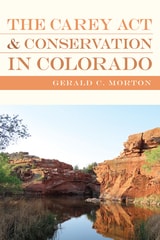
Carey Act and Conservation in Colorado
Gerald C. Morton
University Press of Colorado, 2024
Morton contextualizes the Carey Act’s significance in Colorado through a study of the Two Buttes and Muddy Creek projects in the state’s southeastern corner—tragic examples of the disconnect among developers seeking windfall profits in the face of financial rollercoasters, the challenge of reclaiming remote sagebrush country, and settlers seeking viable livelihoods that eventually led conservationists to reimagine the failures as public wildlife refuges. A collision of values between developers and settlers lay at the center of those wildlife habitat conservation efforts, forcing people to rethink their relationship with the land and ephemeral streams—an awareness that correlated with the advent of modern ecology.
The Carey Act and Conservation in Colorado is the untold story of the manipulation of nature and the reconceived use of land for public wildlife areas on the southern plains of the American West. Offering original research on arid lands policy, federal and state agency oversight, irrigation bond financing, heartbroken settlers’ grievances, individual developers’ motives, and the rise of wildlife conservation, this compelling tale of misfortune will appeal to scholars and general readers interested in conservationist and environmental history in the American West.
Caribbean Migration to Western Europe and the United States
Essays on Incorporation, Identity, and Citizenshipedited by Margarita Cervantes-Rodriguez, Ramon Grosfoguel and Eric Mielants
Temple University Press, 2009
Caribbean Migration to Western Europe and the United States features a diverse group of scholars from across academic disciplines studying the transnational paths of Caribbean migration. How has the colonial path of the Caribbean influenced migration with regard to power relations, ethnic identities and transnational processes?
Through a series of case studies, the contributors to this volume examine the experiences of Caribbean immigrants to Spain, France, the United Kingdom and the Netherlands as well as the United States. They show the demographic, socioeconomic, political and cultural impact migrants have, as well as their role in the development of transnational social fields. Caribbean Migration to Western Europe and the United States also examines how contrasting discourses of democracy and racism, xenophobia and globalization shape issues pertaining to citizenship and identity.
Contributors: Elizabeth Aranda, Mary Chamberlain, Michel Giraud, Lisa Maya Knauer, John R. Logan, Monique Milia-Marie-Luce, Laura Oso Casas, Livio Sansone, Nina Glick Schiller,Charles (Wenquan) Zhang and the editors.
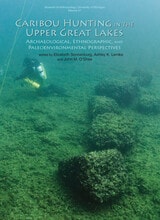
Caribou Hunting in the Upper Great Lakes
Edited by Elizabeth Sonnenburg, Ashley K. Lemke and John M. O'Shea
University of Michigan Press, 2015

Caring for Red
A Daughter's MemoirMindy Fried
Vanderbilt University Press, 2016
Caring for Red is Mindy Fried's moving and colorful account of caring for her ninety-seven-year-old father, Manny--an actor, writer, and labor organizer--in the final year of his life. This memoir chronicles the actions of two sisters as they discover concentric circles of support for their father and attempt to provide him with an experience of "engaged aging" in an assisted living facility.
The story is also that of a daughter of a powerful and outspoken man who took risks throughout his life and whose political beliefs had an enduring impact on his family. (After Manny was called before the House Un-American Activities Committee, he was blacklisted and his family was shunned.)
As an actor, Manny was affiliated with Elia Kazan's Group Theatre and the Federal Theatre Project. He did Shakespeare, Chekhov, and Ibsen, and played everything from the tormented father in Arthur Miller's All My Sons to an infant in a baby carriage in Thornton Wilder's Infancy, from the Rabbi in Fiddler on the Roof to--poignantly for this book--the role of Morrie in Tuesdays with Morrie.
As she devotes herself to caring for her dying father, Mindy grapples anew with the complexity of their relationship. She questions whether she can be there for him and how to assert her own voice as her father's caregiver in his last days.
Caring, Curing, Coping
Nurse, Physician, and Patient RelationshipsEdited by Anne H. Bishop and John R. Scudder
University of Alabama Press, 1985
The fundamental mission of medicine is caring, and curing may be only one component of that broad mission

Carl Sandburg - American Writers 97
University of Minnesota Pamphlets on American WritersGay Wilson Allen
University of Minnesota Press, 1972
Carl Sandburg - American Writers 97 was first published in 1972. Minnesota Archive Editions uses digital technology to make long-unavailable books once again accessible, and are published unaltered from the original University of Minnesota Press editions.

Carla Bley
Amy C. Beal
University of Illinois Press, 2011
This is the first comprehensive treatment of the remarkable music and influence of Carla Bley, a highly innovative American jazz composer, pianist, organist, band leader, and activist. With fastidious attention to Bley's diverse compositions over the last fifty years spanning critical moments in jazz and experimental music history, Amy C. Beal tenders a long-overdue representation of a major figure in American music.
Best known for her jazz opera "Escalator over the Hill," her role in the Free Jazz movement of the 1960s, and her collaborations with artists such as Jack Bruce, Don Cherry, Robert Wyatt, and Pink Floyd drummer Nick Mason, Bley has successfully maneuvered the field of jazz from highly accessible, tradition-based contexts to commercially unviable, avant-garde works. Beal details the staggering variety in Bley's work as well as her use of parody, quotations, and contradictions, examining the vocabulary Bley has developed throughout her career and highlighting the compositional and cultural significance of her experimentalism.
Beal also points to Bley's professional and managerial work as a pioneer in the development of artist-owned record labels, the cofounder and manager of WATT Records, and the cofounder of New Music Distribution Service. Showing her to be not just an artist but an activist who has maintained musical independence and professional control amid the profit-driven, corporation-dominated world of commercial jazz, Beal's straightforward discussion of Bley's life and career will stimulate deeper examinations of her work.
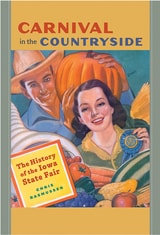
Carnival in the Countryside
The History of the Iowa State FairChris Rasmussen
University of Iowa Press, 2015
This tension between entertainment and agriculture goes back all the way to the fair’s founding in the mid-1800s, as historian Chris Rasmussen shows in this thought-provoking history. The fair’s founders had lofty aims: they sought to improve agriculture and foster a distinctively democratic American civilization. But from the start these noble intentions jostled up against people’s desire to have fun and make money, honestly or otherwise—not least because the fair had to pay for itself. In their effort to uplift rural life without going broke, the organizers of the Iowa State Fair debated the respectability of horse racing and gambling and struggled to find qualified livestock judges. Worried about the economic forces undermining rural families, they ran competitions to select the best babies and the “ideal” rural girl and boy while luring spectators with massive panoramas of earthquakes and fires, not to mention staged trainwrecks. In short, the Iowa State Fair has as much to tell us about human nature and American history as it does about growing corn.

Caroline Quarlls and the Underground Railroad
Julia Pferdehirt
Wisconsin Historical Society Press, 2008
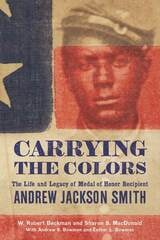
Carrying the Colors
The Life and Legacy of Medal of Honor Recipient Andrew Jackson SmithW. Robert Beckman
Westholme Publishing, 2025
An Escaped Slave who Fought for the Union and Whose Wartime Heroism was Finally Recognized with the Nation's Highest Honor for Military Valor
In 1862, Andrew “Andy” Jackson Smith, son of a white landowner and enslaved woman, escaped to Union troops operating in Kentucky, made his way to the North, and volunteered for the 55th Massachusetts, one of the newly formed African American regiments. The regiment was deployed to South Carolina, and during a desperate assault on a Confederate battery, the color bearer was killed. Before the flag was lost, Smith quickly retrieved it and under heavy fire held the colors steady while the decimated regiment withdrew. The regiment’s commanding officer promoted Smith to color sergeant and wrote him a commendation for both saving the regimental flag and bravery under fire. Honorably discharged, Smith returned to Kentucky, where over the course of the next forty years he invested in land. In the early twentieth century, Burt G. Wilder, medical officer of the 55th, contacted Smith about his experiences for a book he was writing. During their correspondence, Wilder realized Smith was eligible for the nation’s highest award. In 1916, Wilder applied to the army, but his request for Smith’s medal was denied due to the “absence of records.” At Smith’s death in 1932, his daughter Caruth received a box of his papers revealing the extent of her father’s heroism. Her nephew took up the cause and through long and painstaking research located the lost records. With the help of historians, local politicians, and others, Andrew Jackson Smith received his long overdue Medal of Honor in 2001.
In Carrying the Colors: The Life and Legacy of Medal of Honor Recipient Andrew Jackson Smith, the riveting journey from slavery to a White House ceremony is revealed, with the indomitable spirit of Smith—slave, soldier, landowner, father—mirrored by the dogged pursuit of his grandson and his allies in the quest to discover the truth about an American who dedicated his life to the service of his community and country.

Carryout
Hasan Dudar
University of Iowa Press, 2026
A Poets & Writers First Fiction 2026 Debut Selection
In the late 1970s, Ziad Idilbi, a Palestinian refugee from Lebanon, marries Salma, a Lebanese refugee escaping the war in Beirut. Resolving to start over for the very last time, the couple opens a corner store in Toledo, Ohio, across from the General Motors factory, where Toledo’s Arab community intermingles with the working class. Over the decades, whether it’s bigotry (pre- and post-9/11), financial ruin, or terminal illness, the Idilbis find themselves on life’s outskirts, attempting to build something new.
Achingly poignant and slyly funny, the linked stories in Carryout follow the Idilbis and their children as they teeter on the brink of catastrophe. Walid, the youngest child of Ziad and Salma, navigates the heartbreaks of youth as well as the colorful characters who haunt his parents’ corner store. As he grows up into a writer, Walid’s gaze fixes on his father and the long shadow of displacement and occupation. Mustafa, the eldest son, is forever trying to outrun the disasters that seem to seek him out, while Nawal, the only daughter, is dumped by a friend and hatches a scheme to win her back. Unsure whether to run toward each other or away from each other, the characters in Dudar’s exquisite debut suffer the absurdities and indignities of life in America with wry obstinance and striking wisdom.
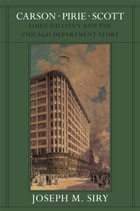
Carson Pirie Scott
Louis Sullivan and the Chicago Department StoreJoseph M. Siry
University of Chicago Press, 1988

Cart's Top 200 Adult Books for Young Adults
Two Decades in ReviewMichael Cart
American Library Association, 2013
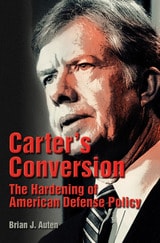
Carter's Conversion
The Hardening of American Defense PolicyBrian J. Auten
University of Missouri Press, 2008
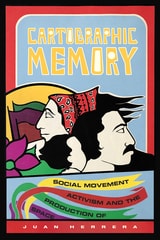
Cartographic Memory
Social Movement Activism and the Production of SpaceJuan Herrera
Duke University Press, 2022
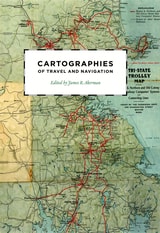
Cartographies of Travel and Navigation
Edited by James R. Akerman
University of Chicago Press, 2006
Finding one’s way with a map is a relatively recent phenomenon. In premodern times, maps were used, if at all, mainly for planning journeys in advance, not for guiding travelers on the road. With the exception of navigational sea charts, the use of maps by travelers only became common in the modern era; indeed, in the last two hundred years, maps have become the most ubiquitous and familiar genre of modern cartography.
Examining the historical relationship between travelers, navigation, and maps, Cartographies of Travel and Navigation considers the cartographic response to the new modalities of modern travel brought about by technological and institutional developments in the twentieth century. Highlighting the ways in which the travelers, operators, and planners of modern transportation systems value maps as both navigation tools and as representatives of a radical new mobility, this collection brings the cartography of travel—by road, sea, rail, and air—to the forefront, placing maps at the center of the history of travel and movement.
Richly and colorfully illustrated, Cartographies of Travel and Navigation ably fills the void in historical literature on transportation mapping.

Case Closed
Holocaust Survivors in Postwar AmericaCohen, Beth B
Rutgers University Press, 2006
Case Closed challenges the prevailing optimistic perception of the lives of Holocaust survivors in postwar America by scrutinizing their first years through the eyes of those who lived it. The facts brought forth in this book are supported by case files recorded by Jewish social service workers, letters and minutes from agency meetings, oral testimonies, and much more.
Cohen explores how the Truman Directive allowed the American Jewish community to handle the financial and legal responsibility for survivors, and shows what assistance the community offered the refugees and what help was not available. She investigates the particularly difficult issues that orphan children and Orthodox Jews faced, and examines the subtleties of the resettlement process in New York and other locales. Cohen uncovers the truth of survivors' early years in America and reveals the complexity of their lives as "New Americans."
Case Selection in the United States Supreme Court
Doris Marie Provine
University of Chicago Press, 1980
This concise and accessible study provides an intimate view of the Court's case-selection process through an analysis of the docket books and other papers of Justice Harold H. Burton, who kept scrupulous records of the Court's work from 1945 to 1957. In her analysis of these invaluable records—the only records of case-selection votes made public since the advent of discretionary review in 1925—Provine provides two perspectives on the problematic issue of judicial motivation in case selection. The first perspective is an institutional one in which the Court is treated as the unit of analysis: the second is personal, in which differences among decision makers are the focus of analysis. Provine suggests that judicial role perceptions go far to explain both agreement and disagreement in case selection. She also considers the impact of the process upon litigants, since the system seems to favor petitioners with litigation expertise, especially the U.S. government. Yet, she claims, the secrecy of case selection fosters the popular misperception that any worthwhile case can be appealed "all the way to the Supreme Court." The Court thus maintains its image as a forum equally available to all litigants.
Case for Critical Literacy
A History of Reading in Writing StudiesAlice S. Horning
Utah State University Press, 2024
This book examines how college-level instruction reached this point and provides pedagogical strategies that writing instructors and teachers can use to address the problem. Alice Horning makes the case for the importance of critical reading in the teaching of writing with intentionality and imagination, while sharing glimpses of her own personal history with reading and writing. Horning provides the context for understanding what college faculty face in their classrooms and offers a history of critical literacy that explains why, to date, it has mostly neglected or ignored the diverse statuses of students’ reading challenges.
The Case for Critical Literacy explores actionable options to better meet students’ literacy needs. College and university faculty, especially writing instructors, will benefit from an understanding of what has happened in the field and what needs to change.
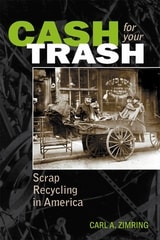
Cash For Your Trash
Scrap Recycling in AmericaCarl A. Zimring
Rutgers University Press, 2005
Over the past two decades, concern about the environment has brought with it a tremendous increase in recycling in the United States and around the world. For many, it has become not only a civic, but also a moral obligation. Long before our growing levels of waste became an environmental concern, however, recycling was a part of everyday life for many Americans, and for a variety of reasons. From rural peddlers who traded kitchen goods for scrap metal to urban children who gathered rags in exchange for coal, individuals have been finding ways to reuse discarded materials for hundreds of years.
In Cash for Your Trash, Carl A. Zimring provides a fascinating history of scrap recycling, from colonial times to the present. Moving beyond the environmental developments that have shaped modern recycling enterprises, Zimring offers a unique cultural and economic portrait of the private businesses that made large-scale recycling possible. Because it was particularly common for immigrants to own or operate a scrap business in the nineteenth century, the history of the industry reveals much about ethnic relationships and inequalities in American cities. Readers are introduced to the scrapworkers, brokers, and entrepreneurs who, like the materials they handled, were often marginalized.
Integrating findings from archival, industrial, and demographic records, Cash for Your Trash demonstrates that over the years recycling has served purposes far beyond environmental protection. Its history and evolution reveals notions of Americanism, the immigrant experience, and the development of small business in this country.
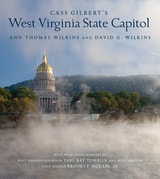
Cass Gilbert's West Virginia State Capitol
Ann Wilkins
West Virginia University Press, 2014
At the turn of the twentieth century, West Virginia was in the throes of its formative years as a state. After more than two decades of alternating its government seat between Wheeling and Charleston and the destruction of the Gothic Revival Capitol in Charleston by fire in 1921, a building commission was formed to create a permanent Capitol that would display the young state’s pride, wealth, and sophistication to the entire nation. To achieve these goals, the legislature approved a budget of more than $6.5 million for the design and construction of this statehouse and the Commission appointed by the Governor hired internationally renowned Cass Gilbert as its architect. After much debate, an impressive site along the shore of the Kanawha River in Charleston was selected as its location.
As one of the most influential architects of the early twentieth century, Cass Gilbert is known for structures such as the Woolworth Building, the United States Supreme Court building, and the Minnesota State Capitol. He believed architecture should reflect historic tradition and established social order, and this conservative philosophy is evinced within the classic form and proportions of the West Virginia State Capitol. As one of his final commissions, the West Virginia Capitol, with its golden “dome of majestic proportion,” marble interiors, ornamental reliefs, and rich woodwork, remains a distinguished example of noble simplicity in American architecture.
Cass Gilbert’s West Virginia State Capitol narrates the intricate story behind this architectural feat. Its close examination of the design, construction, and execution of this commission not only reveals the social, political, and financial climate of West Virginia during this period but also provides insight into the cultural importance of this public building. As Cass Gilbert’s design process is traced through unpublished documentation, drawings, and letters from several archives, the over one hundred accompanying photographs—many historical and others newly commissioned for this book—divulge the subtle beauty of the Capitol complex. At the same time, an extensive analysis of historical and contemporary illustrations and primary sources further elucidates the architectural value of this structure.
With welcomes by West Virginia Governor Earl Ray Tomblin and State Senator Brooks F. McCabe, Jr., a prologue by art historians Bernard Schultz and Mary L. Soldo Schultz, and an epilogue by Chad Proudfoot, this revealing and comprehensive study examines the importance of this often overlooked architectural accomplishment, solidifying its significance as a socio-political symbol as well as its place within the history of American public architecture.
Cass Hite
The Life of an Old ProspectorJames H. Knipmeyer
University of Utah Press, 2016
Despite this notoriety, no one has written a full-length, scholarly account of Hite’s life. This biography fills that void, detailing Hite’s story from his birth in central Illinois in 1845 to his death in Glen Canyon in 1914. It corrects some of the long-accepted stories about Hite and puts others in their proper perspective, while revealing new information. Scores of photographs and excerpts from Hite’s own writing further illuminate this colorful prospector’s life.