Results by title
3071 books match the query 'Business & Economics' and 254 start with c

Comparative National Balance Sheets
A Study of Twenty Countries, 1688-1979Raymond W. Goldsmith
University of Chicago Press, 1985
The majority of the balance sheets were created especially for this project, their components gleaned from fragmentary and heterogeneous data. There are approximately 3,500 entries, each measuring the value of one type of tangible or financial asset or liability at a given date. Goldsmith's estimates are keyed to fifteen benchmark dates in the economic progress of the cited nations, and for twelve nations he was able to construct balance sheets dating back to the nineteenth century or earlier. Combined, worldwide balance sheet are included for 1950 and 1978.
Comparative National Balance Sheets will provide an essential basis for the quantitative analysis of the long-term financial development of these nations. In addition to national balance sheets for all large countries except Brazil and China, sectoral balance sheets for France, Germany, Great Britain, India, Japan, and the United States in the postwar period are also included.
Competition and Cooperation
Conversations with Nobelists about Economics and Political ScienceJames Alt
Russell Sage Foundation, 1999

Competition and Entrepreneurship
Israel M. Kirzner
University of Chicago Press, 1978
Kirzner's book establishes a theory of the market and the price system which differs from orthodox price theory. He sees orthodox price theory as explaining the configuration of prices and quantities that satisfied the conditions for equilibrium. Mr. Kirzner argues that "it is more useful to look to price theory to help understand how the decisions of individual participants in the market interact to generate the market forces which compel changes in prices, outputs, and methods of production and in the allocation of resources."
Although Competition and Entrepreneurship is primarily concerned with the operation of the market economy, Kirzner's insights can be applied to crucial aspects of centrally planned economic systems as well. In the analysis of these processes, Kirzner clearly shows that the rediscovery of the entrepreneur must emerge as a step of major importance.

Competition in the Health Care Sector
Ten Years LaterWarren Greenberg, ed.
Duke University Press, 1988
“Competition in health care has developed to a greater degree than most economists predicted ten years ago. That is the conclusion of Warren Greenberg in his introduction to Competition in the Health Care Sector: Ten Years Later, a retrospective of a 1977 Federal Trade Commission conference, which produced the landmark treatise Competition in the Health Care Sector: Past, Present, and Future. Seven of the ten original papers are reexamined; a chapter on the nursing home industry has been added.
“As with the original volume, Greenberg predicts that the retrospective will become a critical element in the health care economic literature.”—Hospitals
Competitiveness Matters
Industry and Economic Performance in the U.S.Candace Howes and Ajit Singh, Editors
University of Michigan Press, 2000

Computational Analysis of Global Trading Arrangements
Alan V. Deardorff and Robert M. Stern
University of Michigan Press, 1990
Concentrated Corporate Ownership
Edited by Randall K. Morck
University of Chicago Press, 2000
What corporate governance problems arise in tightly held firms? How do these differ from corporate governance problems in widely held firms? How do control blocks arise and how are they maintained? How does concentrated ownership affect economic growth? How should we regulate tightly held firms?
Drawing together leading scholars from law, economics, and finance, this volume examines the economic and legal issues of concentrated ownership and their impact on a shifting global economy.
Conceptualizing Capitalism
Institutions, Evolution, FutureGeoffrey M. Hodgson
University of Chicago Press, 2015
With Conceptualizing Capitalism, Geoffrey M. Hodgson offers readers a more precise conceptual framework. Drawing on a new theoretical approach called legal institutionalism, Hodgson establishes that the most important factor in the emergence of capitalism—but also among the most often overlooked—is the constitutive role of law and the state. While private property and markets are central to capitalism, they depend upon the development of an effective legal framework. Applying this legally grounded approach to the emergence of capitalism in eighteenth-century Europe, Hodgson identifies the key institutional developments that coincided with its rise. That analysis enables him to counter the widespread view that capitalism is a natural and inevitable outcome of human societies, showing instead that it is a relatively recent phenomenon, contingent upon a special form of state that protects private property and enforces contracts. After establishing the nature of capitalism, the book considers what this more precise conceptual framework can tell us about the possible future of capitalism in the twenty-first century, where some of the most important concerns are the effects of globalization, the continuing growth of inequality, and the challenges to America’s hegemony by China and others.

Confessions of an Entrepreneur
Simple Wisdom for Starting, Building, and Running a BusinessMark C. Zweig
Epic Books, 2022
Finalist, 2022 Goody Business Book Awards, Entrepreneur, Start Ups / New Business Category
With more than fifty years of professional experience, Mark C. Zweig has seen it all—from the fear and excitement of starting a new business to the joys and challenges of life as an entrepreneur. In Confessions of an Entrepreneur: Simple Wisdom for Starting, Building, and Running a Business, Zweig draws upon this wealth of experience to offer practical, easy-to-understand guidance for bringing a business to life and cultivating success at every stage of its development. The candid stories he shares from his career provide insight into the realities of business ownership and illustrate proven principles for both personal and professional success. Written by an entrepreneur for entrepreneurs, this book is an indispensable guide filled with wisdom for new and seasoned business leaders alike.

Confidence Games
Money and Markets in a World without RedemptionMark C. Taylor
University of Chicago Press, 2004
In Confidence Games, Mark C. Taylor considers the implications of these developments for our digital and increasingly virtual economy. According to Taylor, money and markets do not exist in a vacuum but grow in a profoundly cultural medium, reflecting and in turn shaping their world. To understand the recent changes in our economy, it is not enough to analyze the impact of politics and technology—one must consider the influence of art, philosophy, and religion as well.
Bringing John Calvin, G. W. F. Hegel, and Adam Smith to Wall Street by way of Las Vegas, Taylor first explores the historical and psychological origins of money, the importance of religious beliefs and practices for the emergence of markets, and the unexpected role of religion and art in the classical understanding of economics. He then moves to an account of economic developments during the past four decades, exploring the dawn of our new information age, the growing virtuality of money and markets, and the complexity of the networks by which monetary value is now negotiated.
Returning full circle to a version of the market first proposed by Adam Smith when he used theology and aesthetics to rethink economics, Confidence Games closes with a plea for a conception of life that embraces uncertainty and insecurity as signs of the openness of the future. Like religion and economics, life is a confidence game in which the challenge is not to find redemption but to learn to live without it.
"Before the global credit system began its collapse in 2007, Mark Taylor had connected the dots between increasingly complex financial instruments and larger cultural forces. Anyone who wants to understand the disappearing foundation of our financial markets needs to read this book immediately."—Michael Lewitt, editor, The HCM Market Letter
Confidence Regained
Economics, Mrs. Thatcher, and the British VoterHelmut Norpoth
University of Michigan Press, 1992

Conflict Resolution Training for the Classroom
What Every ESL Teacher Needs to KnowBarrie J. Roberts
University of Michigan Press, 2020

Conflict in Organizational Groups
New Directions in Theory and PracticeLeigh Thompson
Northwestern University Press, 2007
The chapters in this book were presented at a conference held at the Kellogg School of Management in June 2005 entitled Conflict in Organizational Groups: New Directions in Theory and Practice. The Kellogg Team and Group Research Center (KTAG) and the Kellogg School of Management cosponsored the conference. The goal of the conference was to bring together both junior and senior scholars from a variety of disciplines to discuss their newest ideas and current trends in group conflict research. The chapters in this book represent perspectives from the fields of business, political science, sociology, and psychology.
The idea to organize a conference about conflict in organizational groups arose from three interrelated and exciting opportunities for theory and practice--both the academic and business press have focused growing attention on the management challenges of organizational groups; the academic community has begun to integrate various disciplinary perspectives, as evidenced by a growing number of cross-disciplinary coauthorships and thematic conferences; and several statistical and methodological advances have allowed scholars to better model variables across levels of analysis.
Taken together, these three reasons inspired the assembling of the interdisciplinary mix of seasoned and newly minted authors who in this volume tackle important and complex questions about group conflict. Their chapters represent cutting-edge advances in theory, methodology, and challenges to dominant perspectives.
Conflicting Counsels to Confuse the Age
A Documentary Study of Political Economy in Qing China, 1644–1840Helen Dunstan
University of Michigan Press, 1996
Confronting American Labor
The New Left DilemmaJeffrey W. Coker
University of Missouri Press, 2002

Confronting Mass Democracy and Industrial Technology
Political and Social Theory from Nietzsche to HabermasJohn P. McCormick, ed.
Duke University Press, 2002
Scholars representing the fields of political science, philosophy, history, law, literature, and cultural studies devote essays to the work of Nietzsche, Weber, Heidegger, Lukács, Schmitt, Marcuse, Adorno, and Habermas. They also discuss the writings of such figures as Brecht and Freud, who are not primarily thought of as political theorists, and explore the thought of Helmut Plessner and reformist theorists from East Germany who have been little studied in the English language. In the process of debating the nature and responsibilities of the modern state in an era of mass politics, unparalleled military technology, capacity for surveillance, and global media presence, the contributors question whether technology is best understood as an instrument of human design and collective control or as an autonomous entity that not only has a will and life of its own but one that forms the very fabric of modern humanity.
Contributors. Seyla Benhabib, Richard J. Bernstein, Peter C. Caldwell, Richard Dienst, David Dyzenhaus, Andrew Feenberg, Nancy S. Love, John P. McCormick, Jan-Werner Müller, Gia Pascarelli, William E. Scheuerman, Steven B. Smith, Tracy B. Strong, Richard Wolin
Congress, the President, and the Federal Reserve
The Politics of American Monetary Policy-MakingIrwin L. Morris
University of Michigan Press, 2002
Current formal theories of the general policy-making process are utilized to construct an explanatory framework that identifies the mechanisms through which congressional and executive influence is exercised. The theoretical framework presented in the text also helps to explain the political dynamics of several of the most significant policy decisions of the Federal Reserve during the last half-century. In addition, this book provides a unique perspective on the manner in which Fed policymakers attempt to shield themselves from unwelcome political influence.
While the main focus of Congress, the President, and the Federal Reserve is monetary policy-making, it also speaks to the political nature of policy-making in a more general sense and provides a guide for the future study of the political dynamics in a wide variety of substantive policy areas. Thus it will interest not only political scientists and economists interested in monetary policy-making specifically but also those interested in the nature of public policy-making more generally.
Irwin L. Morris is Assistant Professor of Political Science, University of Maryland.

Consensual Policy-making in the Nordic World
Peter Munk Christiansen
University of Wisconsin Press, 2023
The preconditions for these policies are strong civil societies, that is, strong capacities for collective mobilization and collective action among groups, relatively strong unitary states, and high levels of generalized trust. The institutional apparatus of these consensual policies has been labeled corporatism. Scandinavian corporatism has implied consent to a norm of affected interests. Groups that are supposedly affected by state policies have access to the processes leading up to political decision-making and are involved in the implementation of policies. This access often has public commissions or committees charged with preparing political decisions and delivering advice, as well as policy implementation committees.
Corporatist and consensual policymaking come at a price. The exchange between interest groups (in pursuit of policy influence) and state actors (in pursuit of information and political support from groups) tends to be time-consuming and confined to solutions that are accepted by all actors. Corporatist policies are consequently not very conducive to more radical reforms. After the heyday of corporatist policymaking in the 1970s, all the Scandinavian countries have loosened their corporatist structures to pave the way for reforms.

Conservation Is Our Government Now
The Politics of Ecology in Papua New GuineaPaige West
Duke University Press, 2006
West reveals how every aspect of the Crater Mountain Wildlife Management Area—including ideas of space, place, environment, and society—was socially produced, created by changing configurations of ideas, actions, and material relations not only in Papua New Guinea but also in other locations around the world. Complicating many of the assumptions about nature, culture, and development underlying contemporary conservation efforts, Conservation Is Our Government Now demonstrates the unique capacity of ethnography to illuminate the relationship between the global and the local, between transnational processes and individual lives.

Conservative Counterrevolution
Challenging Liberalism in 1950s MilwaukeeTula A. Connell
University of Illinois Press, 2016
Conspicuous Corporation
Business, Public Policy, and Representative DemocracyNeil J. Mitchell
University of Michigan Press, 1997
Constituent Interests and U.S. Trade Policies
Alan V. Deardorff and Robert M. Stern
University of Michigan Press, 1998

Constructing Cooperation
The Evolution of Institutions of ComanagementSara Singleton
University of Michigan Press, 1999
This book will appeal to policy makers concerned with the management of natural resources as well as to economists, political scientists, and sociologists concerned with collective action problems.
Sara Singleton is Assistant Professor of Political Science, Tulane University.

Consumed
Food for a Finite PlanetSarah Elton
University of Chicago Press, 2013

Consumers’ Cooperatives in the North Central States
Leonard Kercher
University of Minnesota Press, 1941
Consuming Environments
Television and Commercial CultureMichael Budd
Rutgers University Press, 1999
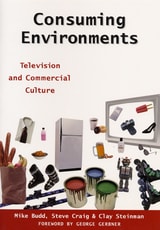
Whether we love it, hate it, or use it just to pass the time, most adults in the United States are watching more television than ever, up to four hours a day by some estimates. Our devotion to commercial television gives it unprecedented power in our lives.
Advertisers and television executives want us to spend as much time as we can in front of our sets, for it is access to our brains that they buy and sell. Yet the most important effect of television may be one that no one intends-accelerated destruction of the natural environment.
Consuming Environments explores how, with its portrayals of a world of simulated abundance, television has nurtured a culture of consumerism and overconsumption. The average person in the U.S. consumes more than twice the grain and ten times the oil of a citizen of Brazil or Indonesia. And people in less industrialized countries suffer while their resources are commandeered to support comfortable lifestyles in richer nations.
Using detailed examples illustrated with images from actual commercials, news broadcasts, and television shows, the authors demonstrate how ads and programs are put together in complex ways to manipulate viewers, and they offer specific ways to counteract the effects of TV and overconsumption's assault on the environment.
Consuming Environments
Television and Commercial CultureCraig, Steve
Rutgers University Press, 1999
Advertisers and television executives want us to spend as much time as we can in front of our sets, for it is access to our brains that they buy and sell. Yet the most important effect of television may be one that no one intends--accelerated destruction of the natural environment.
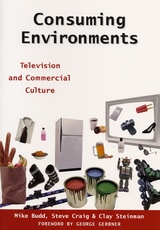
Consuming Environments explores how, with its portrayals of a world of simulated abundance, television has nurtured a culture of consumerism and overconsumption. The average person in the U.S. consumes more than twice the grain and ten times the oil of a citizen in Brazil or Indonesia. And people in less industrialized countries suffer while their resources are commandeered to support comfortable lifestyles in richer nations. Using detailed examples illustrated with images from actual commercials, news broadcasts, and television shows, the authors demonstrate how ads and programs are put together in complex ways to manipulate viewers, and they offer specific ways to counteract the effects of TV and overconsumption's assault on the environment.

Consuming Youth
Vampires, Cyborgs, and the Culture of ConsumptionRobert Latham
University of Chicago Press, 2002
Inspired by Marx's use of the cyborg vampire as a metaphor for the objectification of physical labor in the factory, Latham shows how contemporary images of vampires and cyborgs illuminate the contradictory processes of empowerment and exploitation that characterize the youth-consumer system. While the vampire is a voracious consumer driven by a hunger for perpetual youth, the cyborg has incorporated the machineries of consumption into its own flesh. Powerful fusions of technology and desire, these paired images symbolize the forms of labor and leisure that American society has staked out for contemporary youth.
A startling look at youth in our time, Consuming Youth will interest anyone concerned with film, television, and popular culture.

Containing Health Care Costs in Japan
Naoki Ikegami and John Creighton Campbell, Editors
University of Michigan Press, 1996
The Japanese health care system provides universal coverage to a healthy but aging population. Its costs are among the lowest in the world and have remained nearly constant as a share of the economy for more than a decade. Americans concerned about runaway medical spending need to know about the successes that Japan has experienced and the problems the country has encountered in its effort to control costs while maintaining quality of care.
Offered here is an analysis of the key issues of cost-containment by specialists followed by reactions from some of America's best-known experts on health care delivery and finance. Topics include the macro-and microeconomics of health care, technology and costs, institutions and costs, attitudinal and behavioral aspects, and the politics of health care.
This collection provides an authoritative study of successful cost-containment in the Japanese health care system---a chronicle of success that is neither a statistical illusion nor a result of sociocultural factors. Detailed here is information on the key mechanism of cost constraint: a fee schedule that covers virtually all medical services and rewards inexpensive services while making expensive services unprofitable. This system has resulted in the provision of quality health care to the entire population at roughly half the cost of American health care. Is it a single-payer system? Would the United States have to introduce a dramatically altered health care structure to benefit from the Japanese experience? No. Japan relies mainly on fee-for-service medicine financed by multiple insurers---a system familiar to Americans and one from which many lessons may be learned.
Based on conferences held in Washington, D.C., and Izu, Japan, this volume collects original chapters on the overall cost structure, how the negotiated mandatory fee schedule works, specific mechanisms for cost control, the politics of health care financing, and the impact of cost cutting on quality, among other topics. These pathbreaking studies will be a significant resource for policymakers and scholars interested in comparative health care systems as well as those interested in health care reform in the United States.
Continuous Improvement
Quality Control Circles in Japanese IndustryPaul Lillrank; Noriaki Kano
University of Michigan Press, 1989

Contours of the Illiberal State
Governing Circulation in the Smart EconomyEdited by Boris Vormann and Christian Lammert
Campus Verlag, 2019

Contra Keynes and Cambridge
Essays, CorrespondenceF. A. Hayek
University of Chicago Press, 1995
When the journal Economica published a review of Keynes's Treatise on Money by Hayek in 1931, Keynes's response consisted principlally of an attack on Hayek's own work on monetary theory, Prices and Production. Conducted almost entirely in economics journals, the battle that followed revealed two very different responses to a world in economic crisis. Keynes sought a revision of the liberal political order—arguing for greater government intervention in the hope of protecting against the painful fluctuations of the business cycle. Hayek instead warned that state involvement would cause irreparable damage to the economy.
This volume begins with Hayek's 1963 reminiscence "The Economics of the 1930s as Seen from London," which has never been published before. The articles, letters, and reviews from journals published in the 1930s are followed by Hayek's later reflections on Keynes's work and influence. The Introduction by Bruce Caldwell puts the debate in context, providing detailed information about the economists in Keynes's circle at Cambridge, their role in the acceptance of his ideas, and the ways in which theory affected policy during the interwar period.
Caldwell calls the debate between Hayek and Keynes "a battle for the minds of the rising generation of British-trained economists." There is no doubt that Keynes won the battle during his lifetime. Now, when many of Hayek's ideas have been vindicated by the collapse of collectivist economies and the revival of the free market around the world, this book clarifies Hayek's work on monetary theory—formed in heated opposition to Keynes—and illuminates his efforts to fight protectionism in an age of economic crisis.
F. A. Hayek (1899-1992), recipient of the Medal of Freedom in 1991 and co-winner of the Nobel Memorial Prize in Economics in 1974, was a pioneer in monetary theory and the principal proponent of classical liberal thought in the twentieth century. He taught at the University of London, the University of Chicago, and the University of Freiburg.
Contrasting Styles of Industrial Reform
China and India in the 1980sGeorge Rosen
University of Chicago Press, 1992
For economists, the two countries offer an interesting test case for examining similar reform programs launched from disparate political and economic systems. For policymakers concerned with the region's stability, a clear view of the economic futures of these two major powers is paramount.
Examining and comparing the reform experiences of China and India up to the present, George Rosen shows that although China enacted more sweeping reform measures and produced more impressive local growth, it also experienced more significant inflationary spurts. Two-thirds of each nation's population was involved in agriculture at the start of the reform period and nearly that many at the conclusion. Ultimately, the effects of the past industrial reforms in both countries in terms of significantly greater industrial employment or well-being of their populations were limited. An important lesson in these findings, argues Rosen, is that they actually reveal more about the political factors that limit and shape economic policy reforms in a dictatorship or democracy than they confirm the virtues of either capitalism or communism.

Controlling Crime
Strategies and TradeoffsEdited by Philip J. Cook, Jens Ludwig, and Justin McCrary
University of Chicago Press, 2011
Criminal justice expenditures have more than doubled since the 1980s, dramatically increasing costs to the public. With state and local revenue shortfalls resulting from the recent recession, the question of whether crime control can be accomplished either with fewer resources or by investing those resources in areas other than the criminal justice system is all the more relevant.

Controlling East-West Trade and Technology Transfer
Power, Politics, and PoliciesGary K. Bertsch, ed.
Duke University Press, 1988

Cooperatives across Clusters
Lessons from the Cranberry IndustryAnil Hira
Oregon State University Press, 2024
Most agricultural production is of commodity or undifferentiated products. Producers suffer from a roller-coaster ride of price swings, over- or under-production, weather and pest threats, and the inability of family famers to capture anything beyond a small percentage of the final price.
Cooperatives Across Clusters provides lessons from the cranberry industry, a commodity product organized mostly into family farms in seven different clusters around North America. The industry is remarkable in that it's substantially organized around one large cooperative, Ocean Spray. The authors examine how the cooperative came to be, the challenges of coordination and industry leadership across the diverging clusters, and the lessons for cooperation for other agricultural industries.
The book provides a multi-layered contribution to agricultural economics. First, it examines location decisions and what factors supersede growing conditions to allow industries to arise around production. Second, it explores pathways available for farmers to try to overcome, through cooperative organization, the natural boom-bust cycles of commodity price swings. Third, it looks at how cooperative decisions are made, and the challenges of providing industry leadership, including research and development and collective marketing, through a cooperative that faces continual defections and new problems. Finally, through in-depth historical, statistical, and field research, it provides a comprehensive study of the cranberry industry and suggests ways farmers can grow the industry. Agricultural policymakers, farmers, industry specialists, and researchers of agriculture and clusters more generally will find this to be an important and informative new resource.
Coordination and Information
Historical Perspectives on the Organization of EnterpriseEdited by Naomi R. Lamoreaux and Daniel M. G. Raff
University of Chicago Press, 1995
In an ideal world, the market would be the optimal provider of coordination, but in the real world of incomplete information, some activities are better coordinated in other ways. Divided into three parts, this book addresses coordination within firms, at the borders of firms, and outside firms, providing a picture of the overall incidence and logic of economic coordination. The case studies—drawn from the late nineteenth and early twentieth century, when the modern business enterprise was evolving, address such issues as the relationship between coordination mechanisms and production techniques, the logic of coordination in industrial districts, and the consequences of regulation for coordination.
Continuing the work on information and organization presented in the influential Inside the Business Enterprise, this book provides material for business historians and economists who want to study the development of the dissemination of information and the coordination of economic activity within and between firms.

Coping With Poverty
The Social Contexts of Neighborhood, Work, and Family in the African-American CommunitySheldon Danziger and Ann Chih Lin, Editors
University of Michigan Press, 2000

Cores, Peripheries, and Globalization
Peter Hanns Reill
Central European University Press, 2011

Corporate Aviation Management
Raoul Castro. Foreword by Torch Lewis
Southern Illinois University Press, 1995
In this comprehensive aviation manual, Raoul Castro provides a source of invaluable corporate aviation management information. He begins by giving an overview of corporate aviation from its inception, then focuses on the management principles and functions that specifically target corporate aviation. Through the utilization of these sound management principles, Castro facilitates the acceptance of corporate aircraft as indispensable tools of industry.
As Castro notes, few companies know how to use corporate aircraft to maximum advantage. Drawing on his expertise and experience, Castro designs a plan by which a company can achieve maximum utilization of an airplane or helicopter fleet. He gives specific instructions on how to facilitate the efficient use of the aviation department of a company, select appropriate aircraft, plan for disasters and establish security measures, fulfill legal requirements of the governmental agencies that regulate the use of aircraft, and manage the maintenance and repair of aircraft. Castro also discusses the scores of details involved in the management of a professional corporate aviation branch and how these details can be handled in a positive, productive manner.
After thoroughly examining the overall managerial functions involved in planning, organizing, controlling, and implementing an aviation arm, Castro concludes by discussing the future of corporate aviation.
This book is a practical and valuable guide for the executive in charge of an aviation department, an aviation department manager or chief pilot, aspirants to aviation management positions, and both students and teachers of aviation management.
Corporate Bodies and Guilty Minds
The Failure of Corporate Criminal LiabilityWilliam S. Laufer
University of Chicago Press, 2006
In this timely work, William S. Laufer argues that even with recent legal reforms, corporate criminal law continues to be ineffective. As evidence, Laufer considers the failure of courts and legislatures to fashion liability rules that fairly attribute blame for organizations. He analyzes the games that corporations play to deflect criminal responsibility. And he also demonstrates how the exchange of cooperation for prosecutorial leniency and amnesty belies true law enforcement. But none of these factors, according to Laufer, trumps the fact that there is no single constituency or interest group that strongly and consistently advocates the importance and priority of corporate criminal liability. In the absence of a new standard of corporate liability, the power of regulators to keep corporate abuses in check will remain insufficient.
Corporate Capital Structures in the United States
Edited by Benjamin M. Friedman
University of Chicago Press, 1985

Corporate Crops
Biotechnology, Agriculture, and the Struggle for ControlBy Gabriela Pechlaner
University of Texas Press, 2012
Biotechnology crop production area increased from 1.7 million hectares to 148 million hectares worldwide between 1996 to 2010. While genetically modified food is a contentious issue, the debates are usually limited to health and environmental concerns, ignoring the broader questions of social control that arise when food production methods become corporate-owned intellectual property. Drawing on legal documents and dozens of interviews with farmers and other stakeholders, Corporate Crops covers four case studies based around litigation between biotechnology corporations and farmers. Pechlaner investigates the extent to which the proprietary aspects of biotechnologies—from patents on seeds to a plethora of new rules and contractual obligations associated with the technologies—are reorganizing crop production.
The lawsuits include patent infringement litigation launched by Monsanto against a Saskatchewan canola farmer who, in turn, claimed his crops had been involuntarily contaminated by the company’s GM technology; a class action application by two Saskatchewan organic canola farmers launched against Monsanto and Aventis (later Bayer) for the loss of their organic market due to contamination with GMOs; and two cases in Mississippi in which Monsanto sued farmers for saving seeds containing its patented GM technology. Pechlaner argues that well-funded corporate lawyers have a decided advantage over independent farmers in the courts and in creating new forms of power and control in agricultural production. Corporate Crops demonstrates the effects of this intersection between the courts and the fields where profits, not just a food supply, are reaped.

Corporate Dreams
Big Business in American Democracy from the Great Depression to the Great RecessionHoopes, James
Rutgers University Press, 2011
Public trust in corporations plummeted in the wake of the 2008 financial crisis, when “Lehman Brothers” and “General Motors” became dirty words for many Americans. In Corporate Dreams, James Hoopes argues that Americans still place too much faith in corporations and, especially, in the idea of “values-based leadership” favored by most CEOs. The danger of corporations, he suggests, lies not just in their economic power, but also in how their confused and undemocratic values are infecting Americans’ visions of good governance.
Corporate Dreams proposes that Americans need to radically rethink their relationships with big business and the government. Rather than buying into the corporate notion of “values-based leadership,” we should view corporate leaders with the same healthy suspicion that our democratic political tradition teaches us to view our political leaders. Unfortunately, the trend is moving the other way. Corporate notions of leadership are invading our democratic political culture when it should be the reverse.
To diagnose the cause and find a cure for our toxic attachment to corporate models of leadership, Hoopes goes back to the root of the problem, offering a comprehensive history of corporate culture inAmerica, from the Great Depression to today’s Great Recession. Combining a historian’s careful eye with an insider’s perspective on the business world, this provocative volume tracks changes in government economic policy, changes in public attitudes toward big business, and changes in how corporate executives view themselves.
Whether examining the rise of Leadership Development programs or recounting JFK’s Pyrrhic victory over U.S. Steel, Hoopes tells a compelling story of how America lost its way, ceding authority to the policies and values of corporate culture. But he also shows us how it’s not too late to return to our democratic ideals—and that it’s not too late to restore the American dream.
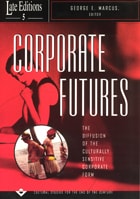
Corporate Futures
The Diffusion of the Culturally Sensitive Corporate FormEdited by George E. Marcus
University of Chicago Press, 1998
Late Editions 5, Corporate Futures, questions this idea of a "cultural landscape" by focusing on the the marked investment of corporations in the concept of culture, long the purview of anthropologists and, more recently, those involved in the humanistic disciplines. Emerging in the discourse of the workplace—and traveling beyond it to traditionally alternative associations—is the idea of a "corporate culture" with its own organization, management policies and practices, and ethos. How can we understand this culture of corporations, and to what extent does it reflect self-contained communities or fragmented human existence in groups under conditions of postmodernity? Corporate Futures tackles these issues and questions through conversations with managers, financial and risk analysts, and other participants in national and international organizations.
The results—engaging, intriguing, speculative, current—continue the work begun in earlier volumes to map the terrain of the present and navigate the uncertain future.
Praise for Late Editions: "If the succeeding volumes are as compassionate and informed as the first, this series could become an essential postmodern guidebook to the world's changing cultural terrain. I plan on letting it ease me into the next century."—Catherine Gysin, Utne Reader

Corporate Governance in Central Europe and Russia
Banks, Funds, and Foreign InvestorsRoman Frydman
Central European University Press, 1996
Corporate Governance in Central Europe and Russia
Insiders and the StateAndrzej Rapaczynski
Central European University Press, 1996
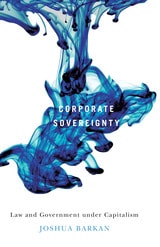
Corporate Sovereignty
Law and Government under CapitalismJoshua Barkan
University of Minnesota Press, 2013
Refinery explosions. Accounting scandals. Bank meltdowns. All of these catastrophes—and many more—might rightfully be blamed on corporations. In response, advocates have suggested reforms ranging from increased government regulation to corporate codes of conduct to stop corporate abuses. Joshua Barkan writes that these reactions, which view law as a limit on corporations, misunderstand the role of law in fostering corporate power.
In Corporate Sovereignty, Barkan argues that corporate power should be rethought as a mode of political sovereignty. Rather than treating the economic power of corporations as a threat to the political sovereignty of states, Barkan shows that the two are ontologically linked. Situating analysis of U.S., British, and international corporate law alongside careful readings in political and social theory, he demonstrates that the Anglo-American corporation and modern political sovereignty are founded in and bound together through a principle of legally sanctioned immunity from law. The problems that corporate-led globalization present for governments result not from regulatory failures as much as from corporate immunity that is being exported across the globe.
For Barkan, there is a paradox in that corporations, which are legal creations, are given such power that they undermine the sovereignty of states. He notes that while the relationship between states and corporations may appear adversarial, it is in fact a kind of doubling in which state sovereignty and corporate power are both conjoined and in conflict. Our refusal to grapple with the peculiar nature of this doubling means that some of our best efforts to control corporations unwittingly reinvest the sovereign powers they oppose.
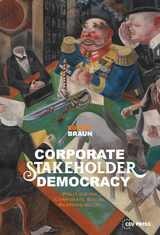
Corporate Stakeholder Democracy
Politicizing Corporate Social ResponsibilityRobert Braun
Central European University Press, 2019

Corporate Takeovers
Causes and ConsequencesEdited by Alan J. Auerbach
University of Chicago Press, 1988